Children learn much – probably most – of their vocabulary indirectly, without explicit instruction. One robust experimental demonstration of indirect word learning is the ‘disambiguation effect’. When shown a shoe (an object with a known label) and a whisk (an as-yet unnamed object), for example, and asked to select the whisk, children usually respond correctly: they infer that the whisk is called a whisk, even though no one explicitly labeled the item for them (e.g. Carey & Bartlett, Reference Carey and Bartlett1978; Diesendruck & Markson, Reference Diesendruck and Markson2001; Golinkoff, Hirsh-Pasek, Bailey & Wengner, Reference Golinkoff, Hirsh-Pasek, Bailey and Wenger1992; Markman & Wachtel, Reference Markman and Wachtel1988; Merriman & Bowman, Reference Merriman and Bowman1989). In the two studies reported here, we address whether this inference reflects an expectation young children have that words are mutually exclusive (e.g. Markman, Reference Markman1989) or an expectation they have about how speakers convey their communicative intentions (e.g. Bloom, Reference Bloom2000; Clark, Reference Clark1997).
According to one account of early word learning, children come to word learning situations with a few default expectations, which help to constrain the possible meanings of new words (for a review, see Woodward & Markman, Reference Woodward, Markman, Kuhn and Siegler1998). The proposed constraints most relevant to the disambiguation effect are mutual exclusivity and the whole object assumption. According to mutual exclusivity, children assume by default that each object belongs to just one category and therefore has just one category label (Markman, Reference Markman1989, Reference Markman and Wachtel1992; Markman & Wachtel, Reference Markman and Wachtel1988). For example, because an object cannot be a member of both the shoe category and the whisk category, children who know that a shoe is called a shoe will infer that whisk refers to something other than the shoe category. According to the whole object assumption, children also assume by default that a new word refers to a whole object rather than to an object's parts or properties, for example (Markman & Wachtel, Reference Markman and Wachtel1988). Thus, according to the mutual exclusivity/whole object (hereafter, ‘mutual exclusivity’) account of the disambiguation effect, when faced with an exemplar from a named category and one from an as-yet unnamed category, children infer that a new word refers to the whole object from the category for which they do not yet have a label.
A very different explanation of the disambiguation effect comes from the social–pragmatic account of word learning. Here, the emphasis is on how children make sense of new words in light of their expectations about the people who use those words (Bloom, Reference Bloom2000; Clark, Reference Clark1988, Reference Clark1990, Reference Clark1997; Diesendruck & Markson, Reference Diesendruck and Markson2001; Gathercole, Reference Gathercole1987, Reference Gathercole1989). According to Clark (Reference Clark1988), for example, children (and adults) expect speakers to use conventional forms to convey conventional meanings (the principle of conventionality). When a speaker uses a new form, it signals that he or she intends to convey a new meaning (the principle of contrast). Thus, when children in a disambiguation task infer that the new word refers to the unfamiliar object rather than the familiar one, it is thought to reflect something like the following (implicit) reasoning process: ‘I know that a shoe is called a shoe. If the speaker meant to refer to the shoe, she would have asked me for the shoe. But she didn't; she asked for a whisk. A plausible candidate is this other object. Therefore, whisk must refer to it.’
In an attempt to distinguish between the mutual exclusivity and social–pragmatic accounts of the disambiguation effect, Jaswal & Hansen (Reference Jaswal and Hansen2006) modified the classic disambiguation procedure. In previous disambiguation studies, the speaker carefully avoided looking at either the novel or familiar object (e.g. Diesendruck & Markson, Reference Diesendruck and Markson2001; Merriman & Bowman, Reference Merriman and Bowman1989; Markman & Wachtel, Reference Markman and Wachtel1988). Researchers presumably assumed that children would have been influenced by the speaker's gaze direction (e.g. Baldwin, Reference Baldwin1991, Reference Baldwin1993). Indeed, from a very young age, children seem to recognize that a person who gestures in a particular direction may intend for that gesture to serve as a cue for how they should respond. In Behne, Carpenter & Tomasello (Reference Behne, Carpenter and Tomasello2005, Study 1), for example, infants played a hiding game in which the experimenter hid a toy in one of two locations, and then looked at or pointed toward that location. Children as young as 1 ; 2 tended to search in the location indicated by the experimenter's gesture. Interestingly, in a second study, when the experimenter's gestures were performed in an absent-minded (rather than intentional) manner, infants were equally likely to search in either location.
In Jaswal & Hansen's (Reference Jaswal and Hansen2006) work, the speaker presented children with a novel object and a familiar one and made a request using a novel word, as in previous disambiguation studies. Unlike earlier studies, however, when making the request, the speaker pointed toward (Study 1) or looked at (Study 2) the familiar object. Remarkably, three- and four-year-olds tended to select the novel object, even though the speaker was gesturing toward the familiar one. Jaswal & Hansen argued that these results suggest that children select the novel object in disambiguation studies because of an expectation that each object has one label (mutual exclusivity), not because they are reasoning about the speaker's communicative intent. If they had been reasoning about the speaker's intent, children should have inferred that the referent of the new word was the object at which the speaker was pointing or looking. Crucially, in control conditions in which the speaker made a neutral request (rather than one involving a new word), children did select the object that the speaker was pointing or looking at, indicating that these gestures were interpretable cues to his or her intent.
The present studies were designed with four goals in mind. First, given Jaswal & Hansen's (Reference Jaswal and Hansen2006) surprising finding that children who heard a new label inferred that it referred to a novel object even when the speaker was pointing toward or looking at a familiar one, we sought to replicate their results. Second, Jaswal & Hansen used children who were, on average, aged 4 ; 1 in the pointing study and 3 ; 8 in the gaze study. In the studies reported here, we used children over a year younger. We chose to focus on children aged 2 ; 6 because this is the youngest age at which children have robustly demonstrated the disambiguation effect in an object choice task (e.g. Evey and Merriman, Reference Evey and Merriman1998; Markman, Wasow & Hansen, Reference Markman, Wasow and Hansen2003; Merriman, Reference Merriman1991; Merriman & Bowman, Reference Merriman and Bowman1989; Merriman, Marazita & Jarvis, Reference Merriman, Marazita, Jarvis, Tomasello and Merriman1995; Merriman & Shuster, Reference Merriman1991; but see Graham, Poulin-Dubois & Baker, Reference Graham, Poulin-Dubois and Baker1998). Merriman & Bowman (Reference Merriman and Bowman1989) suggested that the mutual exclusivity bias may be weaker in toddlers than preschoolers, raising the possibility that the children aged 2 ; 6 in the present work may be more influenced by the speaker's point or gaze than the older children in Jaswal & Hansen's study.
A third goal of the present work was to compare directly whether the likelihood of discounting a pointing gesture that conflicts with mutual exclusivity is the same as the likelihood of discounting a gaze cue that does so. Jaswal & Hansen (Reference Jaswal and Hansen2006) did not compare the two, but it is conceivable that they differ in the pragmatic force they carry. Although the speaker's shift in gaze is unambiguous and involves the movement of her head and eyes toward the familiar object, the pointing gesture could be seen as involving more intentional movement: people's hands rarely assume the form of a pointing gesture unless that gesture is meant to convey referential information. In contrast, their eyes often wander to locations absent-mindedly or without any intention to communicate (Johnson, Ok & Luo, Reference Johnson, Ok and Luo2007). Given this difference, it is possible that children will be more likely to override mutual exclusivity and map a new word onto a familiar object if the speaker points toward the familiar object than if the speaker gazes toward it.
A final goal was to investigate one pragmatic circumstance that even constraint theorists would agree would lead children to override mutual exclusivity. Given that children do learn multiple labels for the same object (e.g. poodle–dog–animal), there are likely to be some behavioral pragmatic cues, or some combinations of cues, that will lead them to map new words onto familiar objects. For example, if a speaker actually picked up a familiar object and held it in his or her hand (rather than just looking or pointing at it) while offering a novel label, children might be more inclined to interpret that label as a second label for the familiar object. Jaswal & Hansen (Reference Jaswal and Hansen2006) made this argument theoretically, but they did not investigate it empirically. Study 2 was designed to investigate whether children would override mutual exclusivity if the speaker both looked at and pointed toward the familiar object when requesting the referent of a new word.
STUDY 1
METHOD
Participants
Participants were sixty-four children aged 2 ; 6 (average age=2 ; 5.15, range=2 ; 4–2 ; 8, 32 boys). Eighteen additional children participated, but their data are not included because of a failure to complete the session (10), a side bias involving always selecting the object on the left or right (6), video failure (1) or a failure to follow the speaker's gaze on any trial (1; see below). Children were primarily white, and from middle-class or upper-middle-class backgrounds.
Materials
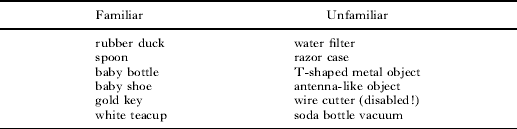
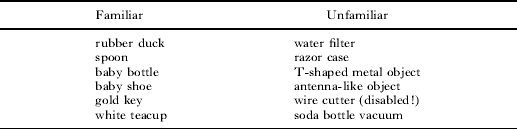
Six pairs of objects were used in the study. Each pair consisted of one novel object and one familiar object. The pairs are listed in Table 1. Additionally, an infant's sock and a small plastic horse, tree and bed were used in the warm-up procedure.
Novel–familiar pairs used in Studies 1 and 2
Design
We crossed the pragmatic cue that the researcher provided when making a request (gaze or point) with the type of request she made (novel word or it), yielding four between-subjects conditions: gaze-word (n=15), gaze-baseline (n=16), point-word (n=17), point-baseline (n=16). Approximately equal numbers of boys and girls participated in each condition.
Procedure
Children were tested individually in the laboratory in a single session, lasting about five minutes. Children sat at a small table, with a researcher across from them. Each session began with two warm-up trials, whose purpose was to introduce children to the game and to provide them with practice in handing a single object to the researcher in response to a request.
During each of the two warm-up trials, the researcher held up a pair of familiar objects (either the horse and tree, or the bed and sock), drew a child's attention to the pair (‘Oooh, look at these!’), and then drew attention to each object in the pair (‘Look at this one! It's pretty interesting … And did you see this one? That's pretty neat too!’). She then pushed both objects toward the child and encouraged him or her to explore them. If the child explored a single object exclusively, the researcher drew attention to the other object. When the child's interest waned, or after about ten seconds, the researcher retrieved the two toys and placed them on the table about shoulder-length apart and within reach of the child. During the warm-up trials, the researcher kept her gaze fixed directly at the child as she made a request for one of the objects: ‘Can you hand me the [horse]?’ During the warm-up trials only, children's correct responses were praised effusively. The second warm-up trial was identical to the first, except the opposite pair of objects was used. On one warm-up trial for each child the requested object was on the left, and on the other trial it was on the right. Which pair was presented first and which object was requested from a pair was randomly determined. All children responded correctly on both warm-up trials.
The six test trials involved novel–familiar pairs of objects and were similar in format to the warm-up trials. On each test trial, the researcher began by drawing a child's attention to the two objects in a pair and then allowing him or her to explore them. When the child's attention had waned, or after about ten seconds, the researcher retrieved the two objects, placed them about shoulder-width apart and within reach of the child, called the child's name and requested that the child select an object.
In the gaze-word and gaze-baseline conditions, as the researcher made a request, she turned her head and eyes in a clear and unambiguous manner to look directly at the familiar object of the pair. She continued looking at the familiar object until the child had selected one of the objects. If a child did not make a response, or selected both objects, the researcher repositioned the objects about shoulder-length apart and repeated her request and look toward the familiar object. Regardless of which object the child chose, the researcher responded neutrally using a positive tone (‘Okay!’) and moved on to the next trial and pair of objects.
In the point-word and point-baseline conditions, as the researcher made a request she extended the index finger of her right hand toward the familiar object (which was about 20 cm away) and tapped that finger twice on the table, after which she kept her index finger pointed toward the familiar object until the child made a selection. The two taps were intended to draw the child's attention to the pointing gesture; the taps made no noise. She looked directly at the child until the child made a response. If a child did not make a response, or selected both objects, the researcher repositioned the objects slightly and repeated her request and pointed toward the familiar object.
Children in the gaze-word and point-word conditions heard the researcher use a novel name when making her request (e.g. ‘Can you hand me the blicket?’). The six novel names were blicket, toma, dax, jeter, dawnoo and nez. Children in the gaze-baseline and point-baseline conditions heard the researcher simply ask, ‘Can you hand it to me?’ Our interest was in whether children in the word conditions would select the familiar object less often (and thus, the novel object more often) than those in the baseline conditions – even though the researcher was looking or pointing to the familiar object in all cases. If so, this would suggest that toddlers adhere to mutual exclusivity even in the face of some types of conflicting pragmatic information. (Note that results will be reported in terms of the number of selections of the familiar object because that was the one to which the speaker was pointing or looking. Our interest was in whether children in the word conditions would discount those referential gestures, which conflicted with mutual exclusivity.)
We created four orders of the six test trials. The order of the six pairs of objects within each order was random. The particular novel word assigned to a given pair of objects in the word conditions was also randomly determined and differed for each of the four orders. The left–right positions of the novel and familiar objects were counterbalanced, such that for each child the familiar object appeared on the right on three trials and on the left on three trials, and it appeared on a particular side no more than twice in a row. The location of the familiar object on the first trial was counterbalanced across children, so that half of the children saw the familiar object on the right on the first trial and half saw the familiar object on the left on the first trial.
Coding
Sessions were videotaped and scored off-line by a coder who was blind to the hypotheses of the study. The coder indicated which object a child selected on each trial. In addition, the coder noted on each trial whether the child followed the researcher's gaze or point to the familiar object at any point during or after she had made her request and before the child had made a selection. A second coder, also blind to the hypotheses of the study, coded a random selection of 25% of sessions from each condition. Reliability was excellent, with 100% agreement on which object children selected, and 89% agreement on gaze- or point-following.
RESULTS AND DISCUSSION
Consistent with the results from Jaswal & Hansen's (Reference Jaswal and Hansen2006) study with older children, toddlers were more likely to select the familiar object following a request for it than a request involving a novel word. In the gaze-baseline and point-baseline conditions, they selected the familiar object on 3·38 (SD=1·59) and 3·00 (SD=1·64) of 6 trials, respectively, and in the gaze-word and point-word conditions, they selected the familiar object on just 1·33 (SD=1·54) and 2·12 (SD=2·34) of 6 trials, respectively. A 2×2 (pragmatic cue×request type) analysis of variance (ANOVA) on these data showed a significant effect of request type (F(1, 60)=10·27, p=0·002, ηp2=0·15). It did not matter whether the pragmatic cue involved gaze or pointing (F(1, 60)<1), nor was there an interaction between cue and request type (F(1, 60)<1·62).
We next analyzed how often the hypothesis-blind coder indicated that children followed the speaker's gaze or point to the familiar object. This was of interest because we wanted to ensure that children in the word conditions had attended to the speaker's pragmatic cue as much as those in the baseline conditions. Children followed the researcher's gaze on an average of 3·60 (SD=1·64) and 3·50 (SD=1·21) of 6 trials in the gaze-word and gaze-baseline conditions, respectively. They followed the researcher's point on an average of 4·35 (SD=1·50) and 3·56 (SD=1·21) of 6 trials in the point-word and point-baseline conditions, respectively. A 2×2 (pragmatic cue×request type) ANOVA on these data showed no significant effects and no interaction (Fs<1·60). This is important because it indicates that, although children did not always attend to and follow the researcher's pragmatic cue, they were equally likely to do so in all four conditions.
In the next set of analyses, we compared how likely children were to select the familiar object when they followed the researcher's gaze or point with how likely they were to do so when they did not, as a function of the type of request they heard. Figure 1 shows results for the gaze and pointing conditions separately. A 2×2×2 (pragmatic cue×request type×cue-follow) ANOVA on these data showed that there was no effect, nor any interactions, involving the type of pragmatic cue involved (Fs<1): children responded similarly in the pointing and gaze conditions. The other two main effects, however, were significant: children were more likely to select the familiar object when they followed the researcher's gaze or point than when they did not (F(1, 54)=55·76, p<0·0001, ηp2=0·51), and they were more likely to select the familiar object when they heard a request for it than a request involving a novel word (F(1, 54)=18·30, p<0·0001, ηp2=0·25). In addition, there was a significant interaction between these two main effects (F(1, 54)=11·26, p=0·002, ηp2=0·17).
Average percentage of selections of the familiar object in Study 1, as a function of whether children followed the researcher's gaze (top) or point (bottom), and whether they heard a baseline request or a novel word request. Error bars show SEM.

We investigated this interaction using simple main effects analyses. When children followed the researcher's cue to the familiar object, they were more likely to select that object than when they did not follow, regardless of request type (Word: F(1, 54)=7·77, p=0·007, ηp2=0·12; Baseline: F(1, 54)=65·92, p<0·0001, ηp2=0·54). Thus, children in the word conditions were not immune to the effects of the speaker's gaze or point; it had a measurable influence on their responses. Importantly, however, when children in the baseline conditions followed the experimenter's cue to the familiar object, they were significantly more likely to select that object than when children in the word conditions followed the experimenter's cue (F(1, 54)=23·44, p<0·0001, ηp2=0·30). When children in the word and baseline conditions did not follow the experimenter's gaze or point to the familiar object, they were equally likely to select the familiar object (F(1, 54)<1·64).
The discounting of the speaker's pragmatic cue in the word conditions was also evident at the individual level, as evaluated by chi-squared tests. Whereas 12 of the 16 children (75%) in the gaze-baseline condition selected the familiar object on 75% or more of the trials where they followed the researcher's gaze to that object, only 2 of 15 (13%) in the gaze-word condition did so (χ2 (1, N=31)=11·89, p<0·0001). Similarly, whereas 11 of the 16 children (69%) in the point-baseline condition selected the familiar object on 75% or more of the trials where they followed the researcher's point to that object, only 4 of the 17 children in the point-word condition did so (χ2 (1, N=33)=6·80, p=0·009).
The disambiguation task was a two-alternative forced-choice, so the proportion of selections of the familiar and unfamiliar objects always summed to 1. Because of this problem of dependence, it is not possible to compare directly the proportion of selections of familiar objects to the proportion of selections of unfamiliar ones. However, one can investigate whether one response is more frequent than the other by comparing the proportion of selections of the familiar object to chance of 50%. If children select the familiar object more frequently than expected by chance, this indicates that they selected the familiar object more often than the unfamiliar one. If they select the familiar object less frequently than expected by chance, this indicates that they selected the unfamiliar object more often than the familiar one. Given that none of the analyses thus far have identified any differences between the two types of pragmatic cues (gaze and point), we collapsed across cue type in order to increase power for these chance analyses.
On those trials where they did not follow the researcher's cue, children had a preference for the unfamiliar object regardless of the type of request they heard: they selected the familiar object just 11% (SD=28%) of the time when they heard a request for a new word and 24% (SD=33%) of the time when they heard a request for it, both less often than expected by chance (ts>4·5, ps<0·0001, ds>0·80). When children did follow the researcher's cue, however, as the earlier analyses have shown, the type of request they heard had an important influence. When they heard a request for it and followed the speaker's cue, they selected the familiar object 78% (SD=28%) of the time, more than would be expected by chance (t(31)=5·76, p<0·0001, d=1·02). In contrast, when they heard a request for a novel word and followed the experimenter's cue, they selected the familiar object 36% (SD=38%) of the time, less often than expected by chance (t(31)=2·14, p=0·04, d=0·38) (meaning that they selected the novel object more often than expected by chance).
In summary, children in both the word and baseline conditions were influenced by the speaker's behavioral pragmatic cue indicating the familiar object: in both cases, they were more likely to select the familiar object when they followed the cue than when they did not. However, when children in the baseline conditions followed the speaker's pragmatic cue to the familiar object, they were much more likely to be influenced by that cue than when children in the word conditions followed the cue. Indeed, chance analyses showed that when children in the baseline conditions followed the experimenter's cue, they selected the familiar object more frequently than expected by chance; when children in the word conditions followed the experimenter's cue, they nevertheless selected the novel object more frequently than expected by chance. Thus, as in Jaswal & Hansen's (Reference Jaswal and Hansen2006) study with older children, many toddlers seem to discount some interpretable, behavioral pragmatic cues that conflict with mutual exclusivity.
Given that children can and do learn that a single object can be referred to by multiple labels (e.g. poodle–dog–animal), one question concerns what behavioral pragmatic cues might be more effective in leading them to violate mutual exclusivity. Jaswal & Hansen (Reference Jaswal and Hansen2006) suggested that there were likely to be pragmatic cues that would lead children to violate mutual exclusivity, but they did not investigate this question empirically. In Study 2, we combined the two cues the speaker provided separately in Study 1: the speaker both looked at and pointed toward the familiar object when making a request for the referent of a new label. We reasoned that although neither of those cues alone was sufficient to lead children in the word conditions to infer at above-chance levels that the label referred to the familiar object, the two together might be. Although pragmatic cues are sometimes considered to have all-or-none rather than graded effects, there is some reason to think that a combination of cues could be more powerful than a single cue on its own.
For example, in Hollich et al. (Reference Hollich, Hirsh-Pasek, Golinkoff, Brand, Brown and Chung2000, Study 8), one-year-old infants saw an experimenter look at one of two novel objects and label it repeatedly. During this training phase, infants spent more time looking at the object being labeled than at the other one, showing that they were sensitive to the referential intent of the speaker. However, on a subsequent comprehension test, they did not show evidence of having mapped the new label to the target. In another study (Study 7), however, infants saw the experimenter look at one of two novel objects and handle it while labeling it repeatedly. On the subsequent comprehension test, infants did show evidence of having mapped the label to the target. Hollich et al. argued that infants were better able to learn a new word given multiple, overlapping social cues. Although the children in the present studies are a year and one-half older than those in Hollich et al., it is possible that they, too, will find multiple social cues more persuasive than a single one.
We did not include a baseline condition in Study 2 because, as will be described below, children in a word condition nearly always selected the familiar object as the referent for a new name when they saw the speaker both look and point at that object.
STUDY 2
METHOD
Participants
Participants were sixteen children aged 2 ; 6 (average age=2 ; 6.20, range=2 ; 4–2 ; 8, 8 boys). Two additional children participated, but their data are not included because of experimenter error. Children were primarily white, and from middle-class or upper-middle-class backgrounds. None had participated in Study 1.
Materials, design and procedure
The same six novel–familiar pairs of objects were used as in Study 1. All sixteen children participated in the same warm-up trials described in Study 1, and then in a very similar test procedure. On each of six trials, the researcher presented a novel–familiar pair of objects, and made a request using a novel label. When making the request, the researcher both looked at and pointed toward the familiar object, using the same manner of pointing and the same unambiguous head and eye turn that had been presented in the separate conditions of Study 1.
A coder blind to the hypotheses of the study coded for whether children followed the researcher's gaze and point to the familiar object, as well as which object children selected on each trial. A second coder coded a random 25% of the sessions. Reliability for object selection and cue-following was 100%.
RESULTS AND DISCUSSION
Toddlers overwhelmingly selected the familiar object rather than the unfamiliar one as the referent for the new name. They selected the familiar object on an average of 5·19 (SD=1·60) of 6 trials (87% of the time), more often than expected by chance of 3 (t(15)=5·47, p<0·0001, d=1·36). In fact, 11 of the 16 children (69%) selected the familiar object on each of the 6 trials. It is possible that had we included a condition in which children observed an experimenter both point and look at the familiar object when making a neutral request (i.e. a baseline condition), children would have selected the familiar object more often than 87% of the time. However, it seems unlikely that such a manipulation with children aged 2 ; 6 would produce responses much closer to 100%.
Recall that in the word conditions of Study 1, children followed the researcher's gaze or point to the familiar object 60% (3·60 out of 6 trials) and 73% (4·35 out of 6 trials) of the time, respectively. In contrast, in Study 2, children followed the researcher's gaze and point to the familiar object 97% (5·82 out of 6 trials) of the time. Indeed, 13 of the 16 participants in Study 2 followed the researcher's gaze and point on all six trials; the other three children followed on five of the six trials. This suggests that the combination of the two cues was more salient than either of the cues on its own.
Although Studies 1 and 2 were conducted separately, the objects, counterbalancing, novel words, and point and gaze gestures were the same. Thus, we next compared how often children in the two word conditions of Study 1 selected the familiar object with how often they did so in Study 2. In the gaze-word and point-word conditions of Study 1, when they followed the researcher's cue to the familiar object, they selected that object, on average, just 31% (SD=36%) and 39% (SD=39%) of the time, respectively. In the gaze+point condition of Study 2, they selected the familiar object, on average, 87% (SD=27%) of the time. A one-way ANOVA on these data confirmed that children in Study 2 were more likely to select the familiar object as the referent for the new name than children in either condition of Study 1 (F(2, 45)=11·71, p<0·0001, ηp2=0·34). Thus, seeing the researcher both point and look at the familiar object when requesting a new word was more likely to lead children to select that object than just seeing the researcher point or look toward it.
General discussion
Toddlers in Study 1 weighted a speaker's overt pragmatic cues differently, depending on whether those cues accompanied a neutral request or a request involving a new word. Children who saw the speaker look at or point toward a familiar object in a novel–familiar pair were more likely to select the familiar object when the speaker requested it than when she requested e.g. the blicket. Hearing a new word seemed to lead children to discount an otherwise interpretable behavioral cue suggesting that the speaker intended to refer to the familiar object. Study 2 demonstrated one circumstance in which toddlers did consistently violate mutual exclusivity on the basis of behavioral pragmatic cues: when the speaker both looked at and pointed toward the familiar object, children overwhelmingly selected that object as the referent for a new word.
These findings are noteworthy for several reasons. First, Study 1 replicates Jaswal & Hansen's (Reference Jaswal and Hansen2006) results and extends them to an age group an average of 1.5 years younger. Like the preschoolers in Jaswal & Hansen, the toddlers in Study 1 were less likely to select the familiar object (and therefore more likely to select the novel one) in response to a request involving a new label than to a neutral request – even though overt behavioral cues in both conditions were available to suggest that the speaker intended to refer to the familiar object.
Second, we directly compared the likelihood that toddlers would discount gaze and pointing gestures that conflicted with mutual exclusivity. Some researchers have pointed out that one's eyes often wander to locations absent-mindedly or without any intention to communicate (Johnson et al., Reference Johnson, Ok and Luo2007). In contrast, it is unlikely that a hand would take the configuration of a point unless it was intended to convey referential information. As a result, gaze cues may be less readily interpreted as intentional than pointing gestures. However, analyses in Study 1 failed to reveal any differences between the gaze and pointing conditions: in all cases, children were less likely to select the familiar object of a novel–familiar pair when they heard the speaker make a request involving a new word than when they heard her make a neutral request.
The pattern of results obtained in Study 1 is consistent with the explanation of the disambiguation effect derived from mutual exclusivity, the proposed default assumption children have that category labels are mutually exclusive (e.g. Behrend, Reference Behrend1990; Markman, Reference Markman1989). The pattern of results is less consistent with the social–pragmatic account: if children had been reasoning about the speaker's communicative intent, those in the word conditions should have been as likely as those in the baseline conditions to select the familiar object, which the speaker was looking at or pointing toward.
Before continuing, it is important to address the possibility that children discounted the gaze and pointing gestures used in Study 1 because they were somehow unnatural. Our baseline conditions show that, in fact, the gestures were not unnatural; they were readily interpretable cues to the speaker's communicative intent. Children in the baseline conditions who followed the speaker's gaze or point to the familiar object overwhelmingly selected that object. Children in the word conditions were as likely to follow the speaker's gaze or point to the familiar object as those in the baseline conditions. When they followed her gaze or point, they were more likely to select the familiar object than when they did not. However, they were significantly less likely than those in the baseline conditions to subsequently select that object, and they were less likely than chance to select that object (meaning they were more likely than chance to select the novel object). When children in Study 1 did not follow the speaker's gaze or point to the familiar object, the two conditions did not differ: in this case, children in all conditions preferred the novel object.
One could argue that the children in Study 1 were faced with a conflict between two social–pragmatic expectations – an expectation about the speaker's intent based on contrast and conventionality and one based on where she was pointing or looking. Perhaps contrast and conventionality were simply weighted more heavily than ostensive communicative gestures. We cannot rule out this possibility, but it seems unlikely because it would mean that children favored a non-obvious inference about a speaker's intent (i.e. if she had meant the shoe, she would have said shoe) over an obvious cue to her intent (i.e. her gaze or point toward the shoe). Perhaps the pragmatic account could be modified to weight non-obvious inferences about intent more heavily than obvious cues, but we are unaware of any theoretical justification for doing so.
One could also argue that children in the word conditions of Study 1 construed the situation as a game in which the speaker's gaze or point was an attempt to deceive them. This is possible, but unlikely in light of research that shows that children older than those used here have difficulty understanding that communicative gestures can be used deceptively. For example, Couillard & Woodward (Reference Couillard and Woodward1999) found that three-year-olds who were told that an experimenter was going to try to trick them about where an object was hidden nonetheless often searched in the location where that experimenter pointed instead of in the other available location.
Although the expectation that each object has just one category label is so strong that children will discount some pragmatic cues that conflict with it, there are clearly situations in which it will be overridden. Jaswal & Hansen (Reference Jaswal and Hansen2006) had made the argument that in a disambiguation setting, some pragmatic cues (or a combination of cues) could lead children to override mutual exclusivity, but they did not investigate this empirically. Study 2 showed that the combination of a speaker's gaze and point toward the familiar object was sufficient to lead children to override mutual exclusivity. We expect that many other pragmatic and/or linguistic cues would undoubtedly also be sufficient. For example, when children hear a new label introduced in the context of an inclusion relationship (e.g. ‘a poodle is a kind of dog’), they seem to readily accept that the same referent can have two labels (e.g. Callanan & Sabbagh, Reference Callanan and Sabbagh2004; Clark & Grossman, Reference Clark and Grossman1998). Clearly, then, given sufficient pragmatic and/or linguistic evidence, children can learn multiple labels for a familiar object. But, to return to the results from Study 1, a single pragmatic cue (i.e. pointing alone or gaze alone) indicating that the speaker intended to refer to a familiar object did relatively little to influence their expectation that the referent of a new word was a novel object.
These results add to a growing body of work suggesting that the mutual exclusivity assumption explains aspects of early word learning that other theories do not. For example, Golinkoff, Mervis & Hirsh-Pasek (Reference Golinkoff, Mervis and Hirsh-Pasek1994) suggested that children's performance on disambiguation tasks may reflect an expectation children have that new words map onto objects from categories for which they do not yet already have a name (the novel name–nameless category principle) rather than an expectation that each object has just one label. On this account, when children see a new object, they are motivated to fill a gap in their lexicon (see also Merriman & Bowman, Reference Merriman and Bowman1989). Children do seem to be motivated to learn the names of new objects (e.g. Clark, Reference Clark, Gelman and Byrnes1991; but see Kemler Nelson, Egan & Holt, Reference Kemler Nelson, Egan and Holt2004), but a recent study by Markman et al. (Reference Markman, Wasow and Hansen2003, Study 3) casts doubt on lexical gap-filling as an explanation for the disambiguation effect. In Markman et al., infants as young as 1 ; 3 were presented with a single, familiar object (e.g. a spoon). When the experimenter requested a crimp, children often engaged in search behaviors, looking around the room and under the table. Even though there was no new object available as a referent for crimp (and thus, no lexical gap to fill), they were apparently reluctant to assume that the new word referred to a familiar object (see also Liittschwager & Markman, Reference Liittschwager and Markman1994).
Diesendruck & Markson (Reference Diesendruck and Markson2001) argued that one strength of the social–pragmatic account is that it predicts the disambiguation effect whenever a speaker expresses contrasting referential intentions, not just when new words are involved. They found that when two novel objects were introduced, and a speaker provided a fact about one of them (e.g. ‘This is the one my uncle gave me’), three-year-olds tended to assume that the other object was the referent for a different fact (e.g. ‘Can you give me the one my dog likes to play with?’). However, Scofield & Behrend (Reference Scofield and Behrend2007) recently reported that children are more likely to show the disambiguation effect with some types of information than others. In their study, the speaker provided a word or fact about one of two novel objects, and then made a request for the referent of a different word or fact. Children at all ages tested, from 2 ; 6 to 4 ; 0, disambiguated when a word was provided for one object and the referent of another word was requested. But the children aged 2 ; 6 did not do so in any of the other possible combinations of words and facts (e.g. word–fact, fact–word, fact–fact), and three- and four-year-olds showed inconsistent patterns in these other combinations as well. Scofield & Behrend (Reference Scofield and Behrend2007: 884) argued that that these results challenge the social–pragmatic explanation for the disambiguation effect because ‘disambiguation as a pragmatic process should presumably be applied broadly to a variety of referential acts’.
The present work has focused on how mutual exclusivity can take precedence over some behavioral cues to a speaker's intent; other research has shown that mutual exclusivity can also take precedence over contextual pragmatic cues. In a study by Haryu (Reference Haryu1991; described by Haryu & Imai, Reference Haryu and Imai1999), children heard a researcher explain, ‘Mary [a puppet] is hungry now. I would like to give Mary the heku.’ They were then presented with an apple (a familiar object) and a lipstick holder (a novel object), and asked to select the heku. Haryu argued that, given that Mary was just said to be hungry, the most pragmatically felicitous response would be to assume that heku referred to the apple. However, children aged 3 ; 6 did not do so; they tended to select the lipstick holder as the referent for heku. Importantly, a control condition showed that children did understand the pragmatics of this situation; they knew that when Mary was hungry she would want the apple rather than the lipstick holder.
Finally, the central tenet of the social–pragmatic account of the disambiguation effect is that children select the novel object rather than the familiar one because of inferences they make about the speaker's intent (e.g. Bloom, Reference Bloom2000; Diesendruck & Markson, Reference Diesendruck and Markson2001). However, children with autism, who have well-known difficulties reading other people's intentions (e.g. Baron-Cohen, Reference Baron-Cohen1995), are as likely to select the unnamed object in a disambiguation task as typically developing children (Preissler & Carey, Reference Preissler and Carey2005). Additionally, some non-human animals, who presumably do not have an understanding of contrast and conventionality, respond to disambiguation situations in a similar way to humans. For example, Kaminski, Call & Fischer (Reference Kaminski, Call and Fischer2004) found that a border collie tended to select an object it did not yet know the name for rather than any of several familiar objects when asked to retrieve the referent of a new word. One could argue that there are two (or more) routes to the disambiguation effect: one that requires the reading of the speaker's communicative intent, and one that does not. However, given the results of Study 1, in which children discounted an overt behavioral cue to the speaker's intent, it is not clear what additional benefit the social–pragmatic route to the disambiguation effect provides.
The controversy we have highlighted is not just a debate about which of two explanations best explains children's performance on a particular task. It represents a fundamental disagreement about the nature of early word learning. Constraint theorists recognize the importance of social–pragmatic cues to a speaker's intent (e.g. Hollich et al., Reference Hollich, Hirsh-Pasek, Golinkoff, Brand, Brown and Chung2000; Woodward & Markman, Reference Woodward, Markman, Kuhn and Siegler1998), but they argue that without additional constraints on the hypotheses children consider, the inductive problem posed by word learning would be insurmountable. Social–pragmatic theorists counter that constraints actually reflect pragmatic reasoning processes (e.g. Bloom, Reference Bloom2000; Clark, Reference Clark1997; Nelson, Reference Nelson1988; Tomasello, Reference Tomasello, Bowerman and Levinson2001). The studies described here suggest that, in fact, mutual exclusivity does not reduce to a pragmatic reasoning process.