1. INTRODUCTION
This paper presents analogues between great circle sailing and 2D linear equations, hoping to provide new insights.
A great circle (GC) is the intersection of a sphere and a plane passing through the centre of the same sphere. The smaller portion of a great circle is the shortest path between two points on the sphere; this path is known as the geodesic on a sphere, while travelling on this path is called great circle sailing, or great circle navigation. Great circle equations can be found in many textbooks such as Advanced Engineering Mathematics (Wylie and Barrett, Reference Wylie and Barrett1982), Geodesy (Bomford,Reference Bomford1980), and Calculus of Vector Functions (Williamson, Crowell and Trotter, Reference Williamson, Crowell and Trotter1972). They can also be found online at Wolfram MathWorld (2013). Some works, such as those by Chen, Hsu and Chang (Reference Chen, Hsu and Chang2004) and Earle (Reference Earle2005, Reference Earle2006) approach the great circle with interesting methods. Linear equations arise in many natural phenomena and are used daily, such as the velocity equation of a moving object and the distance equation on a flat plane. Linear equations are simple and easy to remember compared to non-linear equations, making them the perfect mnemonic for the equations used for great circle sailing.
This paper is set out as follows: Section 2 contains a brief explanation of linear equations and the different parameters used here. Section 3 introduces the great circle sailing and parametric equations used, including the parametric equations of the great circle with distance and the parametric latitude equation of longitude used for great circle sailing. Section 4 analyses how to get the azimuth for great circle sailing and the problems used in computerizations. Section 5 organises and explains the similarities between linear equations and the equations used for great circle sailing, and the work is concluded in Section 6.
2. LINEAR EQUATIONS
Linear equations consist of formulae in which each term is either a constant or the first power of a single variable, they are often known as “Hyperplanes”, or on a 2D plane, ‘straight line equations’. With laws of elementary algebra, linear equations can be rewritten in many different forms. In what follows for 2D linear equations, and generally, x, y and t are variables; other letters represent constants.
2.1. The Two-Point Form for 2D Linear Equations
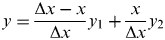
The linear equation through two points is given by the two-point form:
 $$y = \displaystyle{{\Delta x - x} \over {\Delta x}}y_1 + \displaystyle{x \over {\Delta x}}y_2 $$
where Δx is the displacement between two points on the x axis.
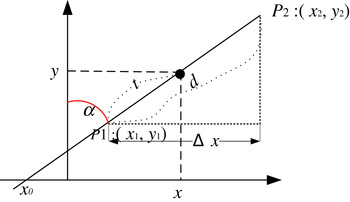
Note that Equation (1) is only correct if the x value of P1 coincides with the origin for x (see Figure 1). Because this paper compares the similarities between linear equations and great circle equations, when one calculates a great circle determined by two points on the sphere, to simplify the calculations, one often assumes that the departure point (P1) is the meridian origin. The compactness of this relative latitude concept for great circle equations, which replaces the Greenwich meridian with the departure point meridian, can be seen in the paper “The Vector Function for Distance Travelled in Great Circle Navigation” (Tseng et al., Reference Tseng and Lee2007). With this in mind, this two-point linear equation here also assumes that the departure point (P1) coincides with the x value origin, making the formula shorter and more compact.
A parametric vector for 2D linear equations.

The two-point form expresses that the difference in the y-axis between two points on a line is proportional to the difference in the x-axis. The proportionality is the slope of the line which can be expressed as a constant m; this m is dependent on the angle (α) which is the angle between the line linked by two points and the y axes, and is called the azimuth here (Figure 1).
2.2. A Parametric Vector for 2D Linear Equations
A parametric vector is given by:
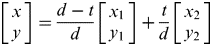 $$\left[ {\matrix{ x \cr y \cr}} \right] = \displaystyle{{d - t} \over d}\left[ {\matrix{ {x_1} \cr {y_1} \cr}} \right] + \displaystyle{t \over d}\left[ {\matrix{ {x_2} \cr {y_2} \cr}} \right]$$
where d is the distance between two points P 1 and P 2, t is the distance along the line which is joined by P 1 and P 2 and originates from P 1,α is the azimuth, and same as before, shown in Figure 1. As Equation (2) originates from Equation (1), the same conditions should be met here for Equation (2).
3. PARAMETRIC EQUATIONS USED FOR GREAT CIRCLE SAILING
When sea and air navigation assume the earth is a perfect sphere, then navigating on the smaller portion of the great circle's arc has the shortest travel distance, and is called great circle sailing. If the departure and destination points were antipodal then there would be infinite arcs that would suffice as the shortest distance for the great circle sailing. The algebraic formulas of great circle sailing can be found in Bowditch (Reference Bowditch1977) and Chou (Reference Chou1999). Bowditch introduces spherical trigonometry and implies the spherical coordinate system in practical navigation. Many creative ways to get the great circle equation can be found in the works of Miller et al. (Reference Miller, Moskowitz and Simmen1991) and Earle (Reference Earle2005, Reference Earle2006). The Wolfram MathWorld website (2013) also provides great circle (GC) equations. The great circle is more than enough for practical uses and has the advantage of being much less complicated than the great ellipse and geodesic on a spheroid (Clynch, Reference Clynch2013; Earle, Reference Earle2005, Reference Earle2006).
In mathematics, parametric equations are methods of defining a relation using parameters. They allow anyone to fill in variables called parameters or independent variables of the equations with any value they desire, this causes the equation to acquire a corresponding value known as the dependent variable. A simple example in kinematics is filling in a time parameter in the parametric equations to get the position, velocity, and other information of a moving object.
3.1. The Parametric Equations of a Great Circle with Distance
Assuming the earth is a unitary sphere, any point on the earth's surface can be vectorised from spherical coordinates (latitude (ϕ) and longitude (λ)) to rectangular coordinates as Equation (3).
 $$\vec P = \left[ {\matrix{ {\cos \phi \cos \lambda} & {\cos \phi \sin \lambda} & {\sin \phi} \cr}} \right]$$
Vectorial methods expressed with Cartesian coordinates give simple and compact functions for spherical trigonometry that can be applied for navigational uses and are shown in this paper.
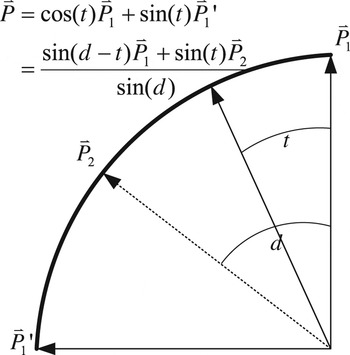
A great circle can be determined by two points on the sphere, if the two are given and non-antipodal, the dot product of the two vectors gives the angle in between them (Equation (4)). This angle between the vectors  $\vec P_1 $ (departure point) and
 $\vec P_2 $ (destination point) is the great circle distance (d) as in Figure 2, also shown in Earle (Reference Earle2005). Therefore:
 $$\vec P_1 \cdot \vec P_2 = \left| {\vec P_1} \right| \cdot \left| {\vec P_2} \right|\cos d,$$
 $$\cos d = \cos \phi _1 \cos \phi _2 \cos (\Delta \lambda ) + \sin \phi _1 \sin \phi _2 $$
where Δλ=λ 2−λ 1.
The linear combination of two vectors along a great circle.

Equation (5) is also known as the spherical law of cosines in spherical trigonometry. With simple inverse trigonometric functions we can obtain the great circle distance (d).
Equation (6) is known as the haversine formula and is better conditioned for smaller distances in computerization. This is due to the issue of computer arithmetic methods, not mathematics; when using computers that can provide enough decimal digit precision, then either formula would suffice in modern navigation (Movable Type Scripts, 2013).
 $$\sin (d/2) = \sqrt {\sin ^2 (\Delta \phi /2) + \cos \phi _1 \cos \phi _2 \sin ^2 (\Delta \lambda /2)} $$
where Δϕ=ϕ 2−ϕ 1.
The two vectors $\vec P_1 $ and $\vec P_2 $ are linearly independent, so the two vectors form a basis for the set of all vectors (R 2) on the plane spanned by them. Every vector originating from the centre of the sphere to the great circle  $\vec P \in R^2 $ is a linear combination of $\vec P_1 $ and $\vec P_2 $ with real coefficients.
On a unitary sphere, the vector $\vec P _1 $ʹ along a great circle is perpendicular to$\vec P _1 $ and located on the great circle spanned by the two vectors (Figure 2). Because the vectors $\vec P _1 $ and $\vec P _1 $ʹ are perpendicular to each other, they form the orthonormal basis of the plane containing the great circle. Then any unit vector  $\vec P $ on the great circle is the orthogonal combination of the vectors $\vec P _1 $ and $\vec P _1 $ʹ as follows:
 $$\vec P (t) = \cos (t)\vec P_1 + \sin (t)\vec P _1 '$$
where t is the distance travelled along the great circle from $\vec P _1 $ (departure point).
The vector $\vec P _2 $ can also be expressed by Equation (8):
 $$\vec P _2 = \cos (d)\vec P_1 + \sin (d)\vec P _1 '$$
Manipulating Equation (8) gives
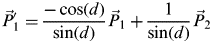 $$\vec P '_1 = \displaystyle{{ - \cos (d)} \over {\sin (d)}}\vec P_1 + \displaystyle{1 \over {\sin (d)}}\vec P _2 $$
Substituting Equation (9) into (7) and applying trigonometry identities yield the parametric function, Equation (10):
 $$\vec P (t) = \displaystyle{{\sin (d - t)} \over {\sin (d)}}\vec P_1 + \displaystyle{{\sin (t)} \over {\sin (d)}}\vec P _2 $$
Setting the distance t=d/2 gives the mid-way Equation (11):
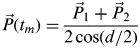 $$\vec P (t_m ) = \displaystyle{{\vec P_1 + \vec P _2} \over {2\cos (d/2)}}$$
Expanding Equation (10) yields the coordinates relative to the departure point as shown in Equation (12).
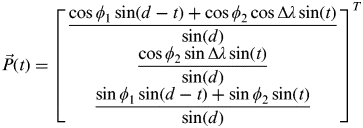 $$\vec P(t) = \left[ {\matrix{ {\displaystyle{{\cos \phi _1 \sin (d - t) + \cos \phi _2 \cos \Delta \lambda \sin (t)} \over {\sin (d)}}} \cr {\displaystyle{{\cos \phi _2 \sin \Delta \lambda \sin (t)} \over {\sin (d)}}} \cr {\displaystyle{{\sin \phi _1 \sin (d - t) + \sin \phi _2 \sin (t)} \over {\sin (d)}}} \cr}} \right]^T $$
If the dot product gives the distance of the great circle, then what does the cross product give? The cross product of $\vec P_1 $ and $\vec P_2 $ is vector  $\vec K$ (Equation (13)), $\vec K$ is perpendicular to the great circle plane and parallel to the normal of the tangent plane, the vertex vector(s) is on the great circle plane and perpendicular with $\vec K$, and since both vectors are on the east-west meridian plane, this means that the vertex latitude and ϕ of $\vec K$ are supplementary angles, and the meridian of the vertex (vertices) crosses the great circle with right angles. Thus the tangent of ϕ k is the cotangent of the vertex latitude. This can give us the latitude of the great circle vertex ϕ V with simple trigonometry, as in Equation (14), and as shown by the results of Earle (Reference Earle2005).
 $$\vec K = \vec P_1 \times \vec P_2 = [x_K, y_K, z_K ]$$
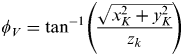 $$\phi _V = \tan ^{{\rm -} 1} \left( {\displaystyle{{\sqrt {x_K^2 + y_K^2}} \over {z_k}}} \right)$$
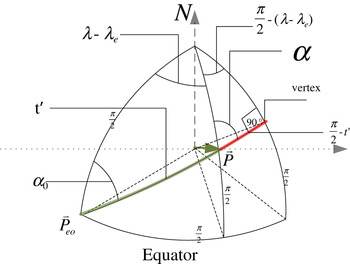
With the vertex known, the azimuth at the equator (α 0) can be obtained. The definition of azimuth is the angle between the meridian and a direction measured clockwise from the north. The vertex latitude of a great circle happens to be the supplementary angle of the great circle azimuth at the equator. Thus the identity α 0=π/2−φ V exists on the great circle. With Napier's pentagon and the law of spherical cosines, two linear equation analogues (16) and (18) for curvilinear equations of a great circle can be obtained. By implying Napier's rule on the spherical triangle  $\hat \Delta $ ($\vec P $, N, vertex) (Figure 3), we can obtain the relations of (t’)-(distance from equator) with regard to α 0 and longitude difference (λ−λ e) between $\vec P $ and the intersection point(s) between the great circle and equator as shown in Equation (15).
 $$\sin (90\deg {\rm -} \phi _v ) = \tan (90\deg {\rm -} t')\tan (90\deg {\rm -} (90\deg {\rm -} (\lambda {\rm -} \lambda _e )) = \cos (90\deg - x)\cos (90\deg - (90\deg - \phi _t ))$$
Rearranging Equation (15) and applying trigonometric identities gives the linear equation analogue Equation (16).
 $$\tan (t') = \tan (\lambda - \lambda _e )/\sin \alpha _0 $$
Applying the vertex angle with π/2 into the law of spherical cosines (Equation (5)) in spherical triangle $\hat \Delta $ ($\vec P$eo, N, vertex) (Figure 3) gives:
 $$\cos (90\deg - \phi _t ) = \cos (90\deg )\cos (t') + \sin (90\deg )\sin (t')\cos \alpha _0 $$
Rearranging Equation (17) gives the analogue Equation (18):
 $$\sin (t') = \sin (\phi )/\cos \alpha _0 $$
Spherical triangle $\hat \Delta $ ($\vec P $, N, vertex) & $\hat \Delta $($\vec P$eo, N, vertex).

3.2. Parametric Latitude Equation of Longitude
To get the Parametric Latitude Equation of Longitude, the normal of the meridian plane which passes $\vec P$ must be acquired, and that is Equation (19) expressed as vector  $\vec P_{\lambda - \pi /2} $.
 $$\vec P _{\lambda - \pi /2} = \left[ {\matrix{ {\sin (\lambda )} & { - \cos (\lambda )} & 0 \cr}} \right]$$
This is because  $\vec P_{\lambda {\rm -} \pi /2} \; \bot \; \vec P$, and
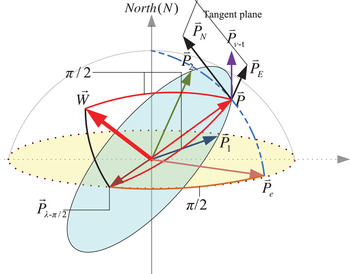
 $\vec W \; \bot \; \vec P$, thus $\vec P$ is the normal to the plane spanned by
 $\vec P_{\lambda {\rm -} \pi /2} $ and
 $\vec W$, as shown in Figure 4. With vector directions and the right hand rule, this gives Equation (20):
 $$\vec P = \left( {\vec P _1 \times \vec P _2} \right) \times \vec P _{\lambda - \pi /2} \; {\rm or} \; \vec P = \vec W \times \vec P _\lambda \,_{\pi /2} $$
where  $\vec P_1 \times \vec P_2 = \vec W$, $\vec W$ is the normal of the great circle plane, and because:
 $$\tan \phi = z/\sqrt {x^2 + y^2} $$
Taking corresponding Cartesian coordinates of Equation (20) into Equation (21) and expanding it obtains the Latitude Equation of Longitude for great circles, as shown in Equation (22).
 $$\tan \phi = \displaystyle{{\sin (\Delta \lambda - d\lambda )\tan \phi _1 + \sin (d\lambda )\tan \phi _2} \over {\sin (\Delta \lambda )}}$$
where dλ=λ−λ 1.
Parametric Latitude Equation of Longitude.

This Latitude Equation of Longitude is consistent with the equations of Chen et al. (Reference Chen, Hsu and Chang2004), and Earle (Reference Earle2005). Other methods by “The equation of the plane determined by the two points and the centre of the sphere” and by “The equation of the straight line along the Polar Gnomonic” can also be used to obtain Equation (22), and when taking dλ=Δλ/2 into Equation (22) gives the mid-longitude function. These methods are fully explained by Tseng et al. (Reference Tseng and Lee2007).
4. AZIMUTH FOR GREAT CIRCLE SAILING
At any point on a great circle, there is a corresponding tangent plane that uses $\vec P $ as its normal. On this tangent plane the great circle azimuth is the angle measured clockwise from the vector pointing towards north ($\vec P _N $) at $\vec P $ to the velocity vector of $\vec P $, which are both on the tangent plane, and can be considered as the angle of the great circle plane with the meridian plane passing through point $\vec P $, as shown in Figure 4.
The velocity vector ( $\vec P _{v{\rm - t}} $) of any point ($\vec P $) on the great circle can be obtained by the derivative of $\vec P $ with respect to (t) – (the travel distance on the great circle from departure point). The vector $\vec P _{v{\rm - t}} $ represents the change of $\vec P $ in accordance to (t). This also represents the perpendicular change of vector $\vec P $ on the great circle plane, and is shown in Equation (23):
 $$\vec P _{v{\rm -} t} = \displaystyle{{d\vec P} \over {dt}} = \displaystyle{{\cos (d{\rm -} t)} \over {\sin (d)}}\vec P_1 + \displaystyle{{\cos (t)} \over {\sin (d)}}\vec P _2 $$
Next, the vector pointing towards north can be obtained by the derivative of $\vec P $ with respect to latitude as shown in Equation (24):
 $$\vec P _N = \displaystyle{{d\vec P} \over {d\phi}} = \left[ {{\rm -} \sin (\phi )\cos (\lambda ),\,\sin (\phi )\sin (\lambda ),\cos (\phi )} \right]$$
The azimuth can be obtained by the dot product of $\vec P _{v{\rm - t}} $ and $\vec P_N $, Equation (25):
 $$\alpha = \cos ^{{\rm - 1}} (\vec P _{v{\rm -} t} \cdot \vec P_N )$$
Equation (25) will have azimuth-distinguishing problems of whether the course is going east or west from the north, leaving the navigator to determine by him/herself. If used in computerization, then more than one restriction must be imposed for the computer to determine the course direction. To solve this problem, the atan2 is used in computerisation, as atan2 has a value range of [−π∼π], and thus will directly tell the correct azimuth origination from an originating direction, where arccosine has a value range of [0∼π], and needs to determine whether the angle is measured clockwise or counter-clockwise from an originating direction. However, to use the atan2 function, one will have to first get the orthogonal basis of the tangent plane, because atan2 requires the input of the orthogonal components of the velocity vector. Since the azimuth is measured clockwise from north, then $\vec P _N $ should be the measuring point origin and also one of the orthogonal basis for the tangent plan in atan2, thus causing the other orthogonal basis to be the component vector of $\vec P $ pointing towards east ( $\vec P _E $) at corresponding $\vec P $ point due to the clockwise measurement direction.
$\vec P _E $ is the cross product of $\vec P _N $ and $\vec P $ (26), and can also be obtained by deviating $\vec P $ with longitude.
 $$\vec P _E = \vec P_N \times \vec P = \left[ {{\rm -} \sin (\lambda ),\cos (\lambda ),0} \right]$$
Thus the azimuth for the great circle used in atan2 is Equation (27):
 $$\alpha = {\rm atan} 2(\vec P _{v{\rm -} t} \cdot \vec P _E, \vec P _{v - t} \cdot \vec P _N )$$
The initial azimuth, also known as the initial course will be obtained when t=0 (travel distance is 0). Using trigonometry identities gives the following Equation (28):
 $$\alpha = {\rm atan} 2(\cos (\phi _2 )\sin (\Delta \lambda ),\cos (\phi _1 )\sin (\phi _2 ) - \sin (\phi _1 )\cos (\phi _2 )\cos (\Delta \lambda ))$$
Thus atan2 needs no other requirements to determine the correct course in computerisation compared to the arccosine method. Note that the input value sequences for atan2 may be reversed in different computer languages such as EXCEL and JavaScript input sequences (Movable Type Scripts, 2013).
5. THE ANALOGUES OF LINEAR EQUATION FOR THE GREAT CIRCLE SAILING
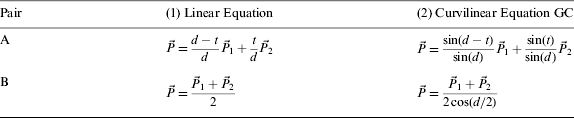
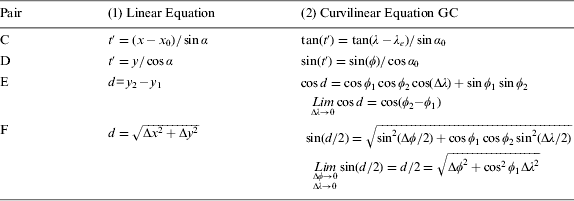
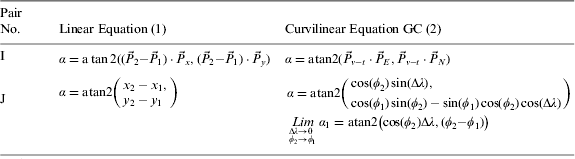
We list here the analogues of linear equations for great circle sailing. Table 1 shows the analogues for parametric equations of the great circle with travel distance. Table 2 shows the analogues for the distance equations. Table 3 shows the analogues for parametric latitude equation of longitude. Table 4 shows the analogues for azimuth.
The Analogues of Linear Equation for the Great Circle Sailing with Distance.
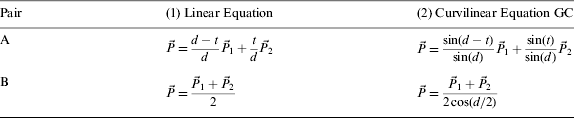
In the above table, $\vec P_1 $, $\vec P_2 $(vectors of departure and destination), and d (distance from departure to destination point) are already known.
$\vec P$ is the vector along the great circle spanned by$\vec P_1 $, $\vec P_2 $, is also the dependent variable of the equations.
t is the distance travelled from departure point, the independent variable of the equations.
The Analogues for the Distance Equation.
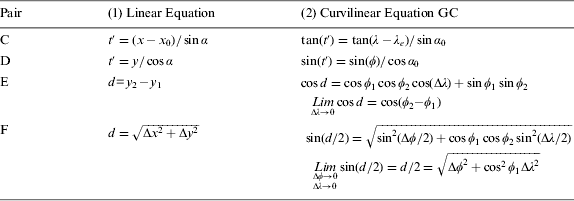
Dependent variables:
- Pair C&D:
t′: for GC equations, distance travelled from intersection of the equator and the great circle, for linear equations, the distance travelled from intersection of the x axis.
- Pair E&F:
d : distance from departure to destination point.
Independent variables:
- ϕ 1,λ 1:
latitude and longitude of departure point; ϕ 2,λ 1: Latitude and longitude of destination point.
- λ e:
The longitude of intersection between a great circle and equator.
- Δϕ:
ϕ 2−ϕ 1; Δλ:λ 2−λ 1; Δx:x 2−x 1; Δy:y 2−y 1.
- x,y:
orthonormal units of a 2D plane; x 0 is the intersection if the linear equation and x axis.
- α:
azimuth, for 2D linear lines: from y axis to the course.
- α 0:
azimuth at the equator.
The Analogues for Parametric Latitude Equation of Longitude.

Dependent variables: y for linear equations, ϕ for GC equations.
Independent variables: dλ for linear equations, x for GC equations.
The Analogues for Azimuth.
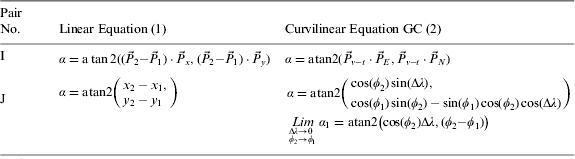
 $\vec P _x $: Component of the vector $\vec P $ in the direction of x-axis.
 $\vec P _y $: Component of the vector $\vec P $ in the direction of y-axis.
The similarities between equations used for great circle sailing and linear equations are described below:
In Pair A: In a linear equation such as row A column 1 (A1), if d and  $\vec P_1 \& \vec P_2 $ are known, the only difference between its corresponding great circle equation (A2) is the sine functions inputted into the denominator and nominator of the linear equation.
In Pair B: The equations are derived from Pair A, by taking t=d/2 as the independent variable of the equations and rearranging it with trigonometry identities. This forms the mid-point equation between two ends.
In Pairs C through E, one can take each component (independent variable) with trigonometry functions, then substitute x for longitude, y for latitude to transform them to GC equations, and one can assume that the x axis of linear equations is the equator for GC equations, showing the similarities of the pair equations.
In Pairs C and D: The linear distance equations (C1) and (D1) can be seen as the distance equations of the great circle starting from the equator with a known azimuth. With Napier's rule or the spherical law of cosines implied on the vertex, the spherical triangle resembles basic trigonometry functions used for finding the travel distance in linear equations. In linear equations (C1) and (D1) by substituting x for longitude, y for latitude, and by taking tangent function into distance and longitude components this resembles the distance equation (C2), while taking sine functions into distance and longitude components resembles the distance equation (D2).
In Pair E: The distance of parallel longitude equations (E1) and the limit equation of (E2) are nearly identical. By substituting y for latitude and inputting the cosine function in (E1), it becomes the limit equation. There are no restrictions for the distance of parallel longitude in linear equations (E1), yet it must be noted that the distance of parallel longitude for the great circle must be divided into two parts when passing the equator.
In Pair F: (F2) and the limited equation of (F2) are derived from the haversine formula. While (F1) comes from the Pythagorean Theorem where the travelled distance is the side of the right triangle formed by Δx and Δy. These equations do not resemble each other like the others do and only when λ 1≅λ 2, ϕ 1≅ϕ 2 does the equation (F1) resemble (F2) in the limit equation.
In Pair G: By substituting x for longitude, y for latitude in the linear equation Two-point form (G1), the only difference between this and the Latitude Equation of Longitude (G2) are the trigonometry functions used on the independent variables, where latitude components differ with a tangent function and longitude components differ with a sine function making it resemble the great circle Parametric Latitude Equation of Longitude (G2).
In Pair H: (H1) and (H2) are the mid-longitude function derived from similarity pair G by taking x=Δx/2 into (G1) and dλ=Δλ/2 into (G2).
In Pair I: The azimuth changes at different positions in the great circle, thus the velocity vector that represents the different directions one must make when travelling on the great circle can give the azimuth. The velocity vector in a linear equation does not change direction since it is a straight line, thus one can assume that the linked vector from departure to destination points can represent the velocity vector. When applying the atan2 function to obtain the azimuth, it requires the orthonormal basis components of the velocity; the orthonormal basis for 2D Liner equations would be the x and y axis, while the orthonormal basis for the great circle tangent plane would be the vectors pointing north and east at point $\vec P $. Thus the analogue is derived and presented in (I1) and (I2).
In Pair J: (J2) is the initial azimuth equation (t=0) for the great circle with known departure and destination points. The resemblance with linear equations (J1) is a little farfetched but they are still quite similar in a way when replacing x with longitude and y with latitude. (J1) most resembles (J2) when λ 1≅λ 2, ϕ 1≅ϕ 2 as in the limit equation below (J2).
The tables above show just how similar 2D linear equations are to great circle curvilinear equations and present these analogue equations for new insights.
6. CONCLUSION
This paper presents the analogues of linear equations for great circle sailing. This paper hopes to provide insight on just how similar the 2D linear equations are to great circle sailing equations using basic vector analysis with simple mathematical methods to give vector functions of a great circle. This paper gives a simple introduction of commonly used great circle equations. The equations presented here are ready to use by any particular discipline, especially in computer programming of great circle navigation.
With great circle sailing analogues provided in the paper, this paper wishes to inspire more people to research the relationships between different navigational methods and other areas of science.
ACKNOWLEDGMENT
This work was supported in part by the National Science Council of Taiwan, Republic of China, under grant NSC 98-2410-H-019-019, NSC 99-2410-H-019-023, NSC 100-2410-H-019-018, and NSC 101-2410-H-019-025.