Introduction
Depression accounts for a substantial proportion of the global burden of disease and has a devastating impact on occupational functioning, quality of life and well-being (Beddington et al. Reference Beddington, Cooper, Field, Goswami, Huppert, Jenkins, Jones, Kirkwood, Sahakian and Thomas2008). While the core symptoms of depression are depressed mood and loss of interest or pleasure, a ‘diminished ability to think or to concentrate or indecisiveness’ is a diagnostic criterion for major depressive disorder (MDD) (APA, 1994). An understanding of these emotional and cognitive deficits, and how they interact, thus has important theoretical and practical implications for the study and treatment of this debilitating disorder.
Investigations of the neuropsychological profile of depression typically report wide-ranging deficits. These vary from impairments of more basic psychomotor ability and processing speed to memory, attention, working memory and higher-order abilities such as planning or decision-making (Austin et al. Reference Austin, Ross, Murray, O'Carroll, Ebmeier and Goodwin1992; Elliott et al. Reference Elliott, Sahakian, McKay, Herrod, Robbins and Paykel1996; Purcell et al. Reference Purcell, Maruff, Kyrios and Pantelis1997; Rose & Ebmeier, Reference Rose and Ebmeier2006; Hammar & Årdal, Reference Hammar and Årdal2009; McDermott & Ebmeier, Reference McDermott and Ebmeier2009). While a characteristic profile remains elusive, depression may best be characterized by specific and pronounced deficits of executive function (Elliott, Reference Elliott1998; Zakzanis et al. Reference Zakzanis, Leach and Kaplan1998). This analysis is consistent with the residual executive impairment observed in remitted depressed patients (Beats et al. Reference Beats, Sahakian and Levy1996; Clark et al. Reference Clark, Scarna and Goodwin2005) and the results of meta-analyses reporting the most consistent deficits in depressed patients on tasks assessing cognitive control and flexibility (Veiel, Reference Veiel1997) and a significant correlation between depression severity and compromised executive function (McDermott & Ebmeier, Reference McDermott and Ebmeier2009).
The terms executive function, executive control and cognitive control are often used interchangeably. They refer to the ability to flexibly organize thought and action toward a goal (Funahashi, Reference Funahashi2001; Miller & Cohen, Reference Miller and Cohen2001; Fuster, Reference Fuster2008), and to coordinate and monitor schemas to achieve novel and complex tasks (Norman & Shallice, Reference Norman, Shallice, Davidson, Schwartz and Shapiro1986). Representative executive tasks thus assess goal-directed planning, problem solving and flexible responding to changing contingencies. It is important to note, however, that many contemporary theorists do not consider executive function to be a unitary function. For example, Miyake et al. (Reference Miyake, Friedman, Emerson, Witzki, Howerter and Wager2000) have presented empirical support for three distinct executive processes – updating working memory, inhibiting pre-potent responses and shifting between alternate tasks or mental sets.
The classic test of flexible cognition is the Wisconsin Card Sorting Test (WCST; Grant & Berg, Reference Grant and Berg1948). This test requires individuals to shift attentional set from a previously reinforced dimension to a new stimulus dimension, and depressed patients frequently demonstrate impairments (Franke et al. Reference Franke, Maier, Hardt, Frieboes, Lichterann and Hain1993; Channon, Reference Channon1996; Degl'Innocenti et al. Reference Degl'Innocenti, Agren and Backman1998; Merriam et al. Reference Merriam, Thase, Haas, Keshavan and Sweeney1999). On the Cambridge Neuropsychological Test Automated Battery (CANTAB) of visual discrimination learning and attentional set-shifting (Downes et al. Reference Downes, Roberts, Sahakian, Evenden, Morris and Robbins1989), which allows independent assessment of the formation, maintenance and shifting of cognitive set, depressed patients have shown a specific set-shifting impairment that is akin to a category shift in the WCST (Purcell et al. Reference Purcell, Maruff, Kyrios and Pantelis1997).
These impairments can be interpreted as evidence for an inflexible processing style that is consistent with clinical observations of depressed patients. Sustained negative emotion with negative and automatic thoughts about the self, the world and the future is a characteristic feature of depression (Beck, Reference Beck1967, Reference Beck1976). Furthermore, cognitive theories of depression argue that this biased processing of emotional information plays a key role in the aetiology and maintenance of depression (Beck, Reference Beck1979; Teasdale & Barnard, Reference Teasdale and Barnard1993). More recently, a growing corpus of evidence indicates that impaired cognitive control processes may play a key causal role in the regulation of emotion in depressed patients and that deficits in the cognitive control over emotional information, in particular, may be at least partly responsible for the persistence of negative emotion (Joormann et al. Reference Joormann, Yoon and Zetsche2007, Reference Joormann, Evan Nee, Berman, Jonides and Gotlib2010; Clark et al. Reference Clark, Chamberlain and Sahakian2009).
Tests of flexible cognition like those described above typically incorporate neutral, or non-emotional, stimulus materials. However, robust cognitive deficits may be more evident on tasks that require depressed patients to process emotional information (Roiser et al. Reference Roiser, Rubinsztein and Sahakian2003; Joormann et al. Reference Joormann, Yoon and Zetsche2007). Whereas there is plenty of evidence indicating that emotional stimulus materials can have marked effects on a range of cognitive abilities, including attention and memory, particularly in depressed individuals (Lloyd & Lishman, Reference Lloyd and Lishman1975; Clark & Teasdale, Reference Clark and Teasdale1982; Mogg et al. Reference Mogg, Bradley and Williams1995; Cuthbert et al. Reference Cuthbert, Bradley and Lang1996; Murphy et al. Reference Murphy, Sahakian, Rubinsztein, Michael, Rogers, Robbins and Paykel1999; Gotlib & Joormann, Reference Gotlib and Joormann2009), similarly-focused investigations of executive control and flexible cognition are few in number. A notable exception is a study by Deveney & Deldin (Reference Deveney and Deldin2006) in which an emotional variant of the WCST was administered to depressed patients and healthy controls. Their patients did not demonstrate impaired cognitive flexibility overall; instead, performance varied according to the valence of the stimulus materials, with controls and patients demonstrating reduced flexibility for positive and negative stimuli, respectively. An important feature of that task was that the emotional stimuli were irrelevant to successful task performance so that the task could be as similar as possible to the WCST. The authors concluded that the predicted results with emotional stimuli that were relevant and necessary for task performance remained unclear. Furthermore, the involvement of multiple cognitive processes in the WCST means that it was not possible to specify specific functional deficits.
We have previously investigated executive control over relevant emotional stimulus materials in depressed patients and healthy controls by administering an emotional variant of a dynamic go/no-go task that incorporated happy and sad word stimuli (Murphy et al. Reference Murphy, Sahakian, Rubinsztein, Michael, Rogers, Robbins and Paykel1999). In this task, the emotional content was necessary for successful performance, as it was on this basis that participants attended and responded to some stimuli (i.e. targets) while inhibiting responses to others (i.e. distractors). The task also required dynamic shifts of attention and response from one emotional category to the other. Relative to healthy controls, depressed patients responded more quickly to sad than to happy stimuli – a finding consistent with Beck's cognitive theory (Beck, Reference Beck1967, Reference Beck1976) and reports of biased memory and attention in depression. Depressed patients were also impaired in their ability to shift attention and response from one emotional category to the other.
A question that was not addressed in the Murphy et al. study was whether the shifting impairment was greater than would be expected on a parallel task that incorporated relevant non-emotional stimuli. Here, we report additional findings for depressed patients and healthy controls on an emotionally neutral go/no-go task for which the task parameters were otherwise identical. The prediction was that the cognitive flexibility deficit observed for emotional stimulus materials in depressed patients would be absent or less marked on the matched neutral version of this task.
Method
Patients
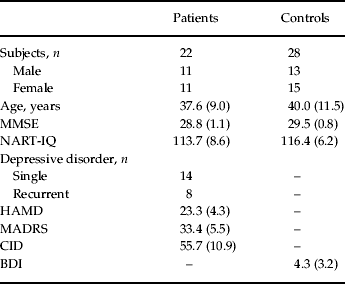
A total of 22 patients with MDD participated in this study; the demographic and clinical characteristics are presented in Table 1. These patients were selected from those described previously (Murphy et al. Reference Murphy, Sahakian, Rubinsztein, Michael, Rogers, Robbins and Paykel1999) as they had completed both the emotional and parallel non-emotional (i.e. neutral) variants. In-patients and out-patients with a diagnosis of depression were initially assessed by a psychiatrist (A.M.) to determine whether they met Diagnostic and Statistical Manual of Mental Disorders, 4th edition (DSM-IV) criteria (APA, 1994) for MDD. Those who met DSM-IV criteria for MDD were reassessed by another psychiatrist to confirm the diagnosis and that they additionally met Research Diagnostic Criteria (Spitzer et al. Reference Endicott and Spitzer1978) for MDD using the Schedule for Affective Disorders and Schizophrenia-Lifetime Version (Endicott & Spitzer, Reference Endicott and Spitzer1978).
Demographic and clinical characteristics of depressed patients and matched healthy controls

MMSE, Mini Mental State Examination; NART-IQ, pre-morbid verbal IQ as estimated by the National Adult Reading Test; HAMD, Hamilton Depression Scale; MADRS, Montgomery–Åsberg Depression Rating Scale; CID, Clinical Interview for Depression; BDI, Beck Depression Inventory.
Data are given as mean (standard deviation) or as number of subjects.
The exclusion criteria included: history of neurological illness or head injury; untreated thyroid disease or other major medical disorders likely to affect cognition (e.g. diabetes mellitus); use of steroids; electroconvulsive therapy in the previous 3 months; and psychoactive substance abuse. Though attention deficit hyperactivity disorder (ADHD) was not ruled out specifically, ADHD is managed by a specialist service and so was unlikely to have been present in our sample.
Severity of depression was assessed using the Hamilton Depression Scale (HAMD; Hamilton, Reference Hamilton1960), the Montgomery–Åsberg Depression Rating Scale (MADRS; Montgomery & Åsberg, Reference Montgomery and Åsberg1979) and the Clinical Interview for Depression (CID; Paykel, Reference Paykel1985). The Mini Mental State Examination (MMSE; Folstein et al. Reference Folstein, Folstein and McHugh1975) was administered to all participants in order to screen for clinically significant cognitive impairment; no participant was suspected of having dementia, with all scoring above 24 out of 30 possible points on the MMSE.
All patients continued to take their regular medication for the duration of the study. One patient was not taking any medication; the remaining 21 patients were receiving antidepressants as follows: eight selective serotonin reuptake inhibitors (SSRI), nine tricyclic, two SSRI plus tricyclic, one SSRI plus monoamine oxidase inhibitors (MAOI), and one MAOI. Of these, two patients were additionally receiving lithium (one for prophylaxis of recurrent depressive disorder; the other to augment antidepressant medication) and two were receiving low doses of benzodiazepine or antipsychotic medication.
Healthy control participants
A total of 28 healthy control participants were selected to match the patient group as closely as possible with respect to gender, age and pre-morbid verbal IQ as estimated by the National Adult Reading Test (NART; Nelson, Reference Nelson1982). No participant reported psychiatric or neurological disorders, psychoactive substance abuse or use of medication that might potentially influence cognition. They were screened for depressive symptoms using the Beck Depression Inventory (BDI; Beck et al. Reference Beck, Ward, Mendelson, Mock and Erbaugh1961). None had a BDI score greater than nine, the lower limit of mild to moderate depression (Beck et al. Reference Beck, Steer and Garbin1988). The patients and controls were comparable with respect to female to male ratio (χ2<1, n.s.), age [t(48)<1, n.s.] and NART-estimated IQ [t(48)=1.25, p>0.2].
Go/no-go tasks
Assessment took place as soon as possible after clinical evaluation. The order of administration of computerized neutral and emotional go/no-go tasks was counterbalanced across participants.
In the neutral go/no-go task, letters and numbers appeared one by one in the centre of the monitor. Participants pressed the space bar as quickly as possible to each target stimulus (e.g. letter) while withholding responses to each distractor stimulus (e.g. number). Half of the stimuli were letters and half were numbers, presented in a randomly determined order, and each was presented for 300 ms with an inter-stimulus interval of 900 ms. At the beginning of each block, instructions were provided on screen, informing participants about what stimuli were targets for that particular block of trials (e.g. LETTERS). This was the only indication of the requirement to shift responding from the previous target (e.g. letters) to the new one (e.g. numbers). There were 10 blocks (18 trials each), arranged into five pairs. Half of the participants completed the blocks as follows: pair one (practice) number targets, pair two letter targets, pair three number targets, pair four letter targets, pair five number targets. The remaining half completed the pairs of blocks in the opposite order (letters, numbers, letters, numbers, letters). Of the eight experimental blocks in total, four were shift blocks, where participants began responding to previous distractors and ceased responding to previous targets, and four were non-shift blocks, where participants continued responding to the same targets and withholding responses to the same distractors. The stimuli were nine letters drawn from the alphabet and the numbers 1 to 9, and the order of target presentation (e.g. whether letters or numbers served as targets initially) was determined by random assignment.
The emotional go/no-go task has been described in detail elsewhere (Murphy et al. Reference Murphy, Sahakian, Rubinsztein, Michael, Rogers, Robbins and Paykel1999). The structure and timing of the blocks and trials were identical to the neutral go/no-go described above, except that the stimuli comprised ‘happy’ and ‘sad’ words instead of letters and numbers. Examples of the happy and sad words are cheery, laugh, comfort, and alone, misery and suffer, respectively.
Results
Response time (RT) and accuracy data (proportion correct and d') were analysed in a three-way mixed-model analysis of variance (ANOVA), with group (patients, controls) as the between-participants factor and condition (shift, non-shift) and task (emotional go/no-go, neutral go/no-go) as the within-participants factors. RTs were calculated on the basis of correct trials only, and RTs less than 100 ms (probable anticipations) or those greater than 1500 ms (probable distractions) were excluded from analysis. The use of a d' accuracy, or ‘sensitivity’, measure derives from signal detection theory (Macmillan & Creelman, Reference Macmillan and Creelman1991; Stanislaw & Todorov, Reference Stanislaw and Todorov1999). This measure is considered to be independent of response bias, with lower values representing lower sensitivity. It is calculated using the formula, d'=z(H) – z(FA), where z(H) and z(FA) represent the transformation of the hit (i.e. correct go trials) and false alarm (i.e. commission error) rates to z scores. As the results of the statistical analyses for proportion correct mirrored those for d', we present the results of only RT and d' analyses for brevity.
Fig. 1 presents mean RTs for depressed patients and healthy controls on shift and non-shift blocks of trials in the neutral and emotional go/no-go tasks. The analysis of RTs revealed a significant main effect of task [F(1, 48]=222.51, p<0.001, neutral=452 ms, emotional=560 ms], with participants responding more slowly on the emotional task. There was also a significant main effect of condition [F(1,48)=6.79, p=0.012], though this main effect must be considered within the context of its significant interaction with task [F(1, 48)=19.54, p<0.001]; this was due to significant RT costs associated with shifting on the emotional [t(49)=3.87, p<0.001, shift=568 ms, non-shift=551 ms] but not non-emotional task [t(49) <1, n.s., shift=451 ms, non-shift=453 ms]. The main effect of group also approached significance [F(1, 48)=3.74, p=0.06, patients=517 ms, controls=494 ms], but the interaction between group and task did not [F<1].
Response times for depressed patients and healthy controls as a function of condition (shift versus non-shift) in the neutral and emotional go/no-go tasks. Values are means, with standard errors represented by vertical bars.

Most importantly, there was a significant three-way interaction between group, condition and task [F(1, 48)=5.73, p<0.05]. On the emotional go/no-go task, reduced flexibility has been observed in depressed patients previously, as shown by a significant interaction between group and condition due to larger RT costs associated with shifting attention and response, relative to control participants (Murphy et al. Reference Murphy, Sahakian, Rubinsztein, Michael, Rogers, Robbins and Paykel1999). This interaction between group and condition was confirmed in the present, smaller subset of depressed patients [F(1, 48)=4.54, p<0.05], and was due, as expected, to a larger RT cost associated with shifting attention and response in patients than in controls [t(48)=2.13, p<0.05, patient RT cost=24 ms, control RT cost=8 ms]. The aim of the current study was to determine whether the time cost associated with shifting was reduced or absent in depressed patients on a parallel non-emotional (i.e. neutral) version of the go/no-go task; in line with this prediction, the condition×group interaction was not significant for the neutral go/no-go task [F<1, patient RT cost=−4 ms, control RT cost=0 ms]. Thus, the significant three-way interaction was due to depressed patients having a larger RT cost associated with shifting attention and response on the emotional but not non-emotional task. Put another way, the increased RT cost associated with shifting on the emotional (relative to neutral) task (see significant interaction between task and condition, above) was particularly marked in depressed patients.
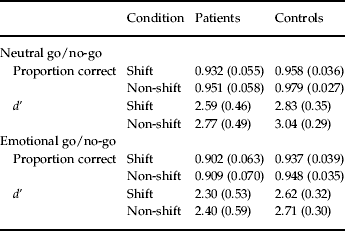
Table 2 presents accuracy data for patients and controls on the emotional and neutral tasks. In the analysis of d', there was a significant main effect of group [F(1, 48)=8.08, p<0.01, patient d'=2.52, control d'=2.80], with impaired performance in depressed patients relative to control participants. The main effects of task [F(1, 48)=26.31, p<0.001, emotional=2.51, neutral=2.81] and condition [F(1, 48)=12.85, p=0.001, shift=2.59, non-shift=2.73] were also significant. Thus, averaged across depressed patients and controls, performance was worse on the emotional task and on blocks that required participants to shift attention and response. No other effects approached significance [all p's >0.13].
Accuracy data for depressed patients and healthy controls in the neutral and emotional go/no-go tasks

Data are given as mean (standard error).
Emotional go/no-go
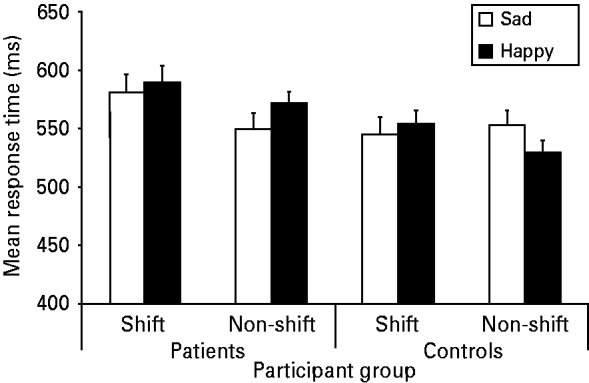
To facilitate comparison of performance across the two tasks, target valence was not incorporated into the analysis reported above. However, a key finding from the Murphy et al. (Reference Murphy, Sahakian, Rubinsztein, Michael, Rogers, Robbins and Paykel1999) study was one of mood-congruent processing; depressed patients were quicker to respond to sad than to happy targets. A three-way mixed model ANOVA (group×condition×target valence) confirmed this bias in the current subset of depressed patients [F(1, 48)=9.97, p<0.01]. Depressed patients responded more slowly to happy than to sad targets [t(21)=2.71, p=0.013, sad=565 ms, happy=581 ms], whereas healthy controls did not show this pattern [t(27)=1.68, p=0.1, sad=549 ms, happy=542 ms]. There was also a significant three-way interaction between group, condition and valence [F(1, 48)=9.38, p<0.01]. As shown in Fig. 2, depressed patients' slower responses on shift relative to non-shift blocks were particularly pronounced when shifting attention and response from sad to happy targets [t(21)=2.63, p<0.05, sad to happy=39 ms, happy to sad=9 ms]. This pattern, which contrasts with the pattern observed in healthy controls [t(27)=1.68, p=0.1, sad to happy=1 ms, happy to sad=15 ms], is not surprising, given the bias in responding described above. In the analysis of d, the three-way interaction between group, condition and valence was not significant (p>0.2).
Response times for depressed patients and healthy controls on shift and non-shift blocks with sad versus happy targets in the emotional go/no-go task. Values are means, with standard errors represented by vertical bars.

Relating task performance to severity of depression and medications
To determine whether the severity of depression was associated with performance on our tasks, we computed Pearson correlations between scores on the clinical ratings scales (HAMD, MADRS and CID) and the RT costs associated with shifting on both tasks. No effects achieved significance (all p's>0.4). To account for the possible influence of medication on our main performance indices (speed and accuracy for shift and non-shift blocks in the emotional and neutral tasks), we conducted independent t tests to contrast the performance of those receiving or not receiving SSRIs and tricyclic medications. No effect achieved significance (all p's>0.15). The numbers of patients taking other medications were very small.
Discussion
Previous research has shown that depressed patients demonstrate impaired cognitive flexibility on a dynamic go/no-task that requires participants to shift attention and response from one emotion category to the other (Murphy et al. Reference Murphy, Sahakian, Rubinsztein, Michael, Rogers, Robbins and Paykel1999). In the present study, depressed patients and matched healthy controls completed a parallel neutral go/no-go task that required cognitive flexibility over non-emotional stimulus materials. In contrast to the emotional task, where depressed patients demonstrated increased time costs when shifting the focus of their attention and response (Murphy et al. Reference Murphy, Sahakian, Rubinsztein, Michael, Rogers, Robbins and Paykel1999), flexibly shifting attention and response from one class of neutral stimuli to the other was unimpaired. The emotional and neutral go/no-go tasks, while incorporating different stimulus materials, were otherwise identical. In the emotional task, participants were required to shift responding from sad to happy targets in successive paired blocks of trials, and vice versa. In the neutral task, they were required to shift attention and response from one emotionally neutral target category to another, in this case letters and numbers. The present data thus indicate that depression-related executive control difficulties may be particularly evident on tasks that require processing of relevant emotional, rather than simply neutral, stimuli when the tasks are well-matched for design and timing parameters.
In a community sample of depressed patients, Deveney & Deldin (Reference Deveney and Deldin2006) demonstrated cognitive inflexibility only on trials that incorporated negative stimuli; importantly, however, their emotional materials were irrelevant for successful performance. Impaired inhibitory control over emotional information has also been demonstrated in dysphoric participants using a more spatially focused anti-saccade task (Derakshan et al. Reference Derakshan, Salt and Koster2009). As noted in the Introduction, contemporary models posit the presence of specific executive processes, such as inhibition and shifting set (e.g. Miyake et al. Reference Miyake, Friedman, Emerson, Witzki, Howerter and Wager2000). A recent study conducted in dysphoric undergraduates found that depression symptoms in general were not related to inhibition and that a set-shifting impairment for emotional versus non-emotional material was observed only in those individuals scoring above the clinical cut-off for self-reported depression (BDI-II ⩾20) (de Lissnyder et al. Reference de Lissnyder, Koster, Derakshan and de Raedt2010).
Depressed patients did not previously demonstrate difficulties inhibiting pre-potent responses on the emotional go/no-go task used here (Murphy et al. Reference Murphy, Sahakian, Rubinsztein, Michael, Rogers, Robbins and Paykel1999). As such, commission error rates were not a current focus, though supplementary analyses confirmed a null group effect for both tasks (p's>0.2). By contrast, across the emotional and neutral tasks and relative to control participants, depressed patients demonstrated a significant reduction in accuracy and an increase in RTs that approached significance (p=0.06). Even considering the inevitable trade-off between speed and accuracy, this pattern is consistent with an explanation emphasizing impaired control at the level of cognitive set. Importantly, the slowed responses of depressed patients did not interact with shift condition unless the particular task (emotional versus neutral) was taken into account, indicating that shifting mental set may prove difficult for depressed patients when this shift involves emotional materials, particularly when shifting from a sad to happy set.
Across all participants, shifting attention and response from one category to the other was associated with performance costs in both tasks. Whereas these costs were observed for both accuracy and RT measures in the emotional task, they were observed for only accuracy in the neutral task. Speed and accuracy are inextricably linked in tasks like these, with inevitable trade-offs between the two measures. It is thus possible that the absence of RT shift costs for the neutral task could reflect differing speed–accuracy trade-offs, or differential involvement of dissociable control processes, for the two tasks. However, the absence of a significant interaction between group and task for either dependent measure suggests that this class of explanation is unlikely to account for the very specific pattern of findings for depressed patients in the form of a three-way interaction between group, task and condition, as described above.
The present pattern of performance maps onto the division between hot and cold cognition drawn by Roiser et al. (Reference Roiser, Cannon, Gandhi, Taylor Tavares, Erickson, Wood, Klaver, Clark, Zarate, Sahakian and Drevets2009) and theoretical models of depression that emphasize a distinction between genuine emotional reactions and cold appraisals which relate to effects on the self (Teasdale & Barnard, Reference Teasdale and Barnard1993). It has also been suggested that the persistent ruminations associated with depression (Ingram, Reference Ingram1990; Nolen-Hoeksema, Reference Nolen-Hoeksema1991; APA, 1994) may be characterized, and perhaps even prolonged, by an inflexible cognitive style or an inability to inhibit prior mental sets (Davis & Nolen-Hoeksema, Reference Davis and Nolen-Hoeksema2000; Whitmer & Banich, Reference Whitmer and Banich2007; de Lissnyder et al. Reference de Lissnyder, Koster, Derakshan and de Raedt2010; Koster et al. Reference Koster, De Lissnyder, Derakshan and De Raedt2011). Reduced flexibility is indexed in the present study by an inability to perform affective shifts. Though a tendency to ruminate was not quantified in the current study, impaired cognitive control over affectively-toned information could conceivably hinder the ability to switch out of this set as necessary (during a cognitive task) or as willed (during ruminations). Teasdale (Reference Teasdale, Clark and Fairburn1997) has argued that one of the goals of psychotherapy is to give depressed individuals greater control over switching in and out of different ‘minds-in-place’ or mental sets. This view is compatible with a recent review highlighting the significance of psychological flexibility for mental health (Kashdan & Rottenberg, Reference Kashdan and Rottenberg2010) and with empirical evidence linking rumination to deficient cognitive control (Whitmer & Banich, Reference Whitmer and Banich2007; de Lissnyder et al. Reference de Lissnyder, Koster, Derakshan and de Raedt2010).
The earlier mood-congruent findings on the emotional go/no-go task (Murphy et al. Reference Murphy, Sahakian, Rubinsztein, Michael, Rogers, Robbins and Paykel1999) were confirmed in the present subgroup, with depressed patients responding more slowly to happy than to sad stimuli overall. This contrasts with the pattern reported for manic patients (Murphy et al. Reference Murphy, Sahakian, Rubinsztein, Michael, Rogers, Robbins and Paykel1999) and healthy controls (Erickson et al. Reference Erickson, Drevets, Clark, Cannon, Bain, Zarate, Charney and Sahakian2005). In the current study, depressed patients demonstrated increased shift costs particularly when shifting the focus of attention from sad to happy targets. This bias is consistent with the clinical picture of depression and Beck's cognitive theory (Beck, Reference Beck1979, Reference Beck2008), and also with demonstrations of mood-congruent biases of memory and attention in depression (Lloyd & Lishman, Reference Lloyd and Lishman1975; Clark & Teasdale, Reference Clark and Teasdale1982; Mogg et al. Reference Mogg, Bradley and Williams1995; Cuthbert et al. Reference Cuthbert, Bradley and Lang1996; Murphy et al. Reference Murphy, Sahakian, Rubinsztein, Michael, Rogers, Robbins and Paykel1999; Gotlib & Joormann, Reference Gotlib and Joormann2009). Holtzheimer & Mayberg (Reference Holtzheimer and Mayberg2011) have argued that depression may be best characterized by an inability to disengage from a negative emotional state and a tendency to re-enter this state inappropriately. Though the design of our tasks did not allow us to address engagement versus disengagement explicitly, our data are not incompatible with an impairment of attentional disengagement that could account for the prolonged processing of self-referent negative material characteristic of depression (Siegle et al. Reference Siegle, Steinhauer and Thase2004; Gotlib & Joormann, Reference Gotlib and Joormann2009; Koster et al. Reference Koster, De Lissnyder, Derakshan and De Raedt2011).
With respect to the neural underpinnings of these findings, damage to the prefrontal cortex (PFC) is known to impair inhibitory or cognitive control processes (Norman & Shallice, Reference Norman, Shallice, Davidson, Schwartz and Shapiro1986; Roberts & Wallis, Reference Roberts and Wallis2000). The shifting component of the current tasks has similarities with dynamic task-switching paradigms, which are compromised in humans following frontal lobe damage (Rogers et al. Reference Rogers, Sahakian, Hodges, Polkey, Kennard and Robbins1998; Monsell, Reference Monsell2003). Reports of abnormal functioning in regions of the PFC are common in depression (Drevets et al. Reference Drevets, Price, Simpson, Todd, Reich, Vannier and Raichle1997; Clark et al. Reference Clark, Chamberlain and Sahakian2009; Price & Drevets, Reference Price and Drevets2009), and a failure to recruit the PFC during behavioural reversal has been demonstrated in depressed patients (Taylor Tavares et al. Reference Taylor Tavares, Clark, Furey, Williams, Sahakian and Drevets2008). Readers are referred to a comprehensive review of cognitive-affective processing in major depression and its associated neural circuitry (Elliott et al. Reference Elliott, Zahn, Deakin and Anderson2011).
With respect to cognitive control performance, a recent investigation of the neural response to emotional oddballs found that depressed patients showed increased deactivation, relative to controls, in executive brain regions while processing emotional distractors (Wang et al. Reference Wang, LaBar, Smoski, Zachary Rosenthal, Dolcos, Lynch, Krishnan and McCarthy2008). Fales et al. (Reference Fales, Barch, Rundle, Mintun, Snyder, Cohen, Mathews and Sheline2008) have shown that relative to controls, depressed patients demonstrate increased amygdala activity but decreased dorsolateral PFC activity while attempting to ignore emotional stimuli. Particularly relevant is fMRI evidence of increased and sustained amygdala activity to self-referential negative words in depressed patients relative to controls (Siegle et al. Reference Siegle, Steinhauer, Thase, Stenger and Carter2002, Reference Siegle, Carter and Thase2006). A more recent study of unmedicated depressed patients demonstrated sustained amygdala activity when processing emotional words, combined with reduced dorsolateral PFC activity during an executive control task and reduced functional coupling of these regions (Siegle et al. Reference Siegle, Thompson, Carter, Steinhauer and Thase2007). Phillips et al. (Reference Phillips, Drevets, Rauch and Lane2003) have argued that increased limbic activity during the initial evaluation of emotional stimuli, combined with reduced prefrontal cortical control, underlie the negative biases observed in depression. Neuroimaging data converge on the idea that emotion dysregulation in depression can reflect increased bottom-up responses to affective stimuli, impaired top-down cognitive control over emotional responses, or both (Elliott et al. Reference Elliott, Zahn, Deakin and Anderson2011; Koster et al. Reference Koster, De Lissnyder, Derakshan and De Raedt2011) – a model that fits well with the neuropsychological data reported for depressed patients in the current study.
In summary, the current findings indicate that in tasks that require participants to flexibly shift attention and response from one category to another, the depression-related impairments of cognitive control demonstrated for emotional stimulus materials are less apparent when patients are required to shift attention and response between distinct emotionally neutral stimulus categories. A potential limitation of the present study is that while measures of depression and dysphoric symptoms were taken in patients and controls, respectively, there were no measures of current mood state. This leaves open the possibility that differences in current mood state, rather than depression, might have influenced patterns of performance. This limitation aside, this study adds to a small but growing literature that links depression to deficits in executive control. The majority of these studies have employed tasks that incorporate only neutral materials and combined multiple executive processes, making it difficult to specify the precise mechanisms that are impaired in depression. By contrast, the go/no-go tasks used here indicate that depression-related impairments in cognitive control over emotional content may be more related to difficulties shifting mental set than to inhibiting prepotent responses. Considered in the context of neuroimaging evidence for enhanced amygdala activity to emotional stimuli and impaired prefrontal executive activity in depressed patients, the present data highlight the need for future research to consider not only depression-related biases in emotional processing but also the cognitive mechanisms that interact with and possibly even function to maintain them.
Acknowledgements
F.C.M. is currently supported by the United Kingdom Medical Research Council and was supported by the Natural Sciences and Engineering Research Council of Canada and the Cambridge Commonwealth Trust at the time of data collection. This research received further funding from a Programme Grant from the Wellcome Trust to Professor T. W. Robbins, Professor B. J. Everitt, B.J.S. and Dr A. C. Roberts. It was completed within the MRC Co-operative Group in Brain, Behaviour and Neuropsychiatry. We thank participating patients and volunteers, and staff at the West Suffolk, Addenbrooke's and Fulbourn Hospitals.
Declaration of Interest
None.