Recent high profile African adoptions by American celebrities Madonna and Angelina Jolie have raised interest in a little-explored area of comparative political inquiry—the politics of intercountry adoptions.Footnote 1 Although there were some questions whether Angelina Jolie “fast-tracked” her Ethiopian adoption, her agency maintained that she had followed the same steps required of all adoptive parents and there was no identifiable reason to suspect otherwise. The criticism of Madonna's adoption did not die down quite as easily, because Malawi requires that prospective adoptive parents foster the child they hope to adopt for 24 months while residing within the country and Madonna had clearly not spent that amount of time in Malawi.Footnote 2 These two celebrity adoptions highlight differences in the adoption laws of Ethiopia and Malawi, and prompt the question: what factors explain the variation in the adoption policies of Sub-Saharan African countries, such as the length of Malawi's residency requirement and the absence of Ethiopia's?
A residency requirement is generally perceived as an impediment to intercountry adoption. Few prospective adoptive parents have the resources that would enable them to leave their job, home, and family behind for an extended period of time. Although the 24 months required by Malawi are on the high end of such requirements, even a residency period of six months is in practice often prohibitive. Therefore, residency requirements are one measure of a more restrictive adoption policy.
Short-term stays and the possibility of having a child escorted are more permissive of intercountry adoption. A few countries, such as Liberia or Ethiopia permit (or have in the past permitted) adoptive parents to forego travel altogether and have their child escorted from the birth country.Footnote 3 Most adoptive parents do travel to the birth country to bring their child home, but they usually do not stay for an extended period of time. Travel for periods from one to three weeks is common. Such time periods are easier to navigate for most families, often by using vacation days or unpaid leave under the federal Family and Medical Leave Act (FMLA). Some of the duration of the stay in the child's birth country is determined by the legal requirements of the sending country.
There is much variation in these requirements and little research on the factors that might explain that variation. What determines whether a country has more or less restrictive policies regarding intercountry adoption? Despite the growing importance of intercountry adoption as a political issue and as an explicitly human face of globalization, there is virtually no systematic empirical work on the topic.Footnote 4 In addition, there is very little research on African adoption, although there is an increasing interest in African children among prospective adoptive parents.Footnote 5 Moreover, there is no existing comparative scholarship that examines why countries in Sub-Saharan Africa are more or less restrictive in their adoption rules.
Using a measure of the level of restrictiveness of adoption laws in Sub-Saharan African countries as our dependent variable, we develop an explanatory model to shed light on the variations in legal restrictions on intercountry adoption among these countries. We test both domestic and international variables as potential explanations for the variation in adoption laws across the countries of Sub-Saharan Africa.
Intercountry Adoption
The study of intercountry adoption has primarily proceeded from the perspectives of social work and sociology, law and the emerging international regime embodied in the Hague Convention, as well as normative perspectives and political theory.Footnote 6 There have been a limited number of single-country case studies that have examined the domestic politics behind intercountry adoption policies.Footnote 7 Unfortunately, there is little comparative work beyond Altstein and Simon's edited volume, which is comprised of case studies that detail the adoption policies of a number of countries children are adopted into—the so-called “receiving countries.”Footnote 8 Furthermore, Bartholet indicates that there is a lot of variation in how countries design their adoption laws, that such laws are generally not designed specifically to facilitate intercountry adoption, and that the resulting laws can create significant impediments to intercountry adoption.Footnote 9 She does not, however, actually compare the adoption policies of countries, nor offer an explanation for why countries are more or less restrictive in their adoption policies.
Intercountry adoptions have grown significantly over the past decade, making such adoptions an important subject of investigation. Despite this growth, Menozzi and Mirkin report that intercountry adoption remains a relatively small proportion of all adoptions. Their global data indicate that “almost 85 per cent of all adoptions are currently undertaken by parents who are residents and citizens of the same country as their adopted children.”Footnote 10 These authors include in their study adoptions of children by step-parents and note that such adoptions account for approximately one-third of domestic adoptions.Footnote 11 Whether or not step-parent adoptions are taken into account, the conclusion remains the same: intercountry adoptions account for a relatively small proportion of all adoptions. Nonetheless, such adoptions—and particularly those from African countries—remain a controversial issue.Footnote 12
Both the growth in intercountry adoptions and the controversy that surrounds this phenomenon make it important to better understand the politics of adoption of children across borders. Below, we outline the areas of controversy and explain how each is expected to influence the restrictiveness or permissiveness of the adoption laws of the countries of Sub-Saharan Africa. Before turning to this task, however, we sketch the emerging patterns in intercountry adoptions.
Emerging Patterns
Menozzi and Mirkin indicate that the U.S. accounts for about half of all adoptions worldwide.Footnote 13 The changing pattern of adoption in the U.S. is therefore likely to have a global impact. In the past decade and a half, domestic adoptions declined in the U.S. and in the same period intercountry adoptions tripled.Footnote 14 Data from the U.S. Department of State furthermore indicate that the top countries of origin of children adopted into U.S. families in the past decade have been China, Guatemala, Russia, and South Korea.Footnote 15 In fact, over the past ten years these four countries have accounted for over 70 percent of all intercountry adoptions into American families.Footnote 16
In that same period, there has been an increasing interest in adoptions from African countries.Footnote 17 Adoptions of children from Ethiopia in particular have soared in the past few years. Until the start of the twenty-first century American adoptions of Ethiopian-born children did not exceed 100 annually—in the early 1990s, they numbered between 50 and 60 per year. In 2001, American adoptions from Ethiopia exceeded 100 for the first time and rose especially steeply between 2004 and 2006, the most recent year for which data are available. In 2006, 732 Ethiopian-born children joined American families. American adoptions of Liberian children grew steeply in the past three years as well, from 86 in 2004 to 353 in 2006. Additionally, in the past three years Nigeria emerged among the top twenty countries from which Americans adopted children. Adoptions from other African countries are much less prevalent and in some cases extremely rare.
Even though intercountry adoption from African countries is still quite modest compared to adoptions from the top four countries of origin, there is reason to believe that interest in adoption from African countries will continue to rise. One, the AIDS pandemic has created an orphan crisis which “in sub-Saharan Africa has reached desperate proportions.”Footnote 18 Two, in the U.S. there is now greater acceptance of transracial adoption.Footnote 19 To be sure, not all intercountry adoptions are transracial—although they are by definition intercultural. Yet, intercountry adoption is frequently and typically described as transracial or involving parents and children “who look physically different” from one another.Footnote 20 The reasons given for the greater acceptance of transracial and intercountry adoption is variously attributed a host of largely speculative reasons relating to (changes in) the institutional and legal frameworks surrounding adoption, as well as social changes in the U.S.Footnote 21 It is beyond the scope of this research to investigate these claims.Footnote 22 What matters here is that an increasing interest in adopting from African countries coincides with a sharp rise in the number of children who lose their birth parents due to AIDS and related illnesses on that continent.
African societies traditionally cared for orphaned children within family networks. Monash and Boerma's research indicates that this continues to be the case.Footnote 23 In contrast, Roby and Shaw argue that the AIDS crisis is depleting the “once seemingly limitless network of extended family.”Footnote 24 These authors all do agree, however, that orphaned children—especially those who have lost both parents—are especially vulnerable. There is evidence that orphaned African children are much less likely to remain in school and more likely to be poor.Footnote 25 According to Bartholet, the pressures created by the AIDS crisis “have begun to increase the flow” of children sent abroad through intercountry adoption.Footnote 26
Yet it would be a mistake to think that intercountry adoption increases simply because the AIDS pandemic renders more children orphans while simultaneously reducing the availability of traditional avenues for providing care for such children. Roby and Shaw note that many African countries currently “have lengthy processes that make it difficult to adopt, and some do not allow adoption at all.”Footnote 27 In addition, Varnis describes the current emphasis on community-based care (CBC) approaches, highlights their shortcomings, and argues in favor of adoption and other approaches that provide “what orphans have lost: parents.”Footnote 28 Interestingly, Roby and Shaw found that across a number of African countries “many government and private-sector leaders expressed an interest in exploring the option of international adoptions.”Footnote 29 In other words, there is at least the possibility that the AIDS pandemic will encourage African governments to reduce the restrictiveness of intercountry adoption rules. We hypothesize that the stronger such pressures impinge on a society, the more likely it is that a country removes barriers to intercountry adoption.
African governments are unlikely to ease restrictions with regard to intercountry adoption, however, unless they are able to communicate to their populations that such adoptions serve the needs of children and form one aspect of a comprehensive response to the orphan crisis which also includes sustainable, domestic solutions.Footnote 30 The controversies to which we alluded above suggest additional factors that mitigate the restrictiveness of policies regarding intercountry adoption.
Controversies and Adoption Law
The controversial nature of intercountry adoption influences policy making regarding it. Several broad areas of controversy can be identified: international legal issues, the impact of globalization and neoimperialism, cultural factors, and democracy and governance issues.
International law
Until the Hague Convention of 29 May 1993 on Protection of Children and Co-Operation in Respect of Intercountry Adoption (hereafter Hague Convention; Hague Conference on Private International Law, hereafter HccH, 1993) international law was “largely silent on the topic of adoption.”Footnote 31 This created an international environment that lacked transparency and made it easy for detractors of intercountry adoption to equate such adoptions with trafficking in children or also “baby-buying.” Indeed, Kapstein highlights the negative impact of corruption and trafficking in children on the popular image of intercountry adoption.Footnote 32 The U.S. Government Accountability Office acknowledges that such abuses have occurred in intercountry adoptions into the U.S.Footnote 33 On the other hand, Roby and Shaw assert—but do not provide evidence—that there have been “no documented cases of adoption trafficking into the United States from Africa.”Footnote 34 While it is unclear how pervasive abuses are, it is evident that reports of malfeasance in intercountry adoption, and of child trafficking more generally, provide convenient excuses for governments to restrict—or prohibit altogether—the adoption of children by citizens of other countries.
In this context, the Hague Convention could provide an important framework for improving transparency and accountability in intercountry adoptions. Globally, 71 states have either signed or ratified the convention and have (or are in the process of) implementing it.Footnote 35 The U.S. has signed and is in the process of implementing the convention.Footnote 36 The Hague Convention further develops the provisions of the United Nations' Convention on the Rights of the Child.Footnote 37 Although there has been criticism of the Hague Convention, specifically regarding the cost and the feasibility of its implementation for some countries and its potential impact on smaller adoption agencies, the intercountry adoption regime created by the convention has largely been evaluated as a positive step.Footnote 38 Bartholet argues that the convention can be employed by sending governments to demonstrate to their domestic publics that “internationally adopted children will be protected against sale and exploitation, and that the world community approves of such adoptions as a good option for children.”Footnote 39 Hence, we hypothesize that countries that have become party to the Hague Convention are likely to be more permissive (or less restrictive) in their intercountry adoption law.
Globalization and neo-imperialism
In addition to the international legal environment, a country's interconnectedness with the international environment is suspected to affect the restrictiveness of its intercountry adoption policy as well. A number of authors cite arguments that intercountry adoption constitutes a form of neo-imperialism, although not all agree with this line of reasoning.Footnote 40 Bartholet, for instance, acknowledges that intercountry adoption “serves a symbolic function for those in power. Sending countries can talk of their homeless children as “precious resources,” but it is entirely clear that the last thing they need is more children to care for. Clamping down on international adoption does constitute an easy, relatively cost-free way of standing up to the United States and other industrialized nations.”Footnote 41 In other words, decisionmakers in sending countries may score points with certain segments of their domestic audiences when they restrict the possibilities for intercountry adoption of their orphaned children. At the same time, doing so is unlikely to damage their diplomatic relations with receiving countries, because decisionmakers in the receiving countries tend not to perceive intercountry adoption “as serving any significant national interest.”Footnote 42 The decisionmakers who represent receiving countries do have an interest in ensuring that intercountry adoption proceeds in a manner that is transparent and according to the laws of both the sending and the receiving country, but they do not have much reason to force any potential sending country to open up to intercountry adoption. More likely, the diplomacy of intercountry adoption results in receiving countries refusing to grant entry visas to orphans when evidence mounts that the adoption processes within sending countries are not conducted in a legally defensible manner.
The restrictive policies of (potential) sending countries are therefore more likely to have their roots in domestic dynamics—which may include decisionmaker references to neo-imperialism—than in demonstrable neo-imperial relationships with potential receiving countries. Whether or not such restrictive policies are rational in the context of the orphan crisis currently faced by many Sub-Saharan governments is less relevant for our purposes than the policy choices made by those governments. Frustrated with the meager benefits that globalization nets them, it may be tempting to frame intercountry adoption in terms of exploitation and to restrict or prohibit it.
Conversely, the governments of countries that are more connected to the global economy may be more willing to see the potential benefits of having some of its orphans join families abroad; although international adoption usually affects only a small proportion of a society's population of orphaned children, anecdotal evidence suggests that such adoptions may serve to increase the commitment of adoptive parents to advocate—and provide resources—for improved social services in their children's birth countries.Footnote 43 In other words, permitting some orphaned children to be adopted abroad may yield the sending country additional resources for the care of the orphans who remain behind.
Democracy and good governance
The extant literature on intercountry adoption does not explicitly discuss a connection between democracy and the restrictiveness of its adoption laws. However, Bartholet suggests that sending country governments may use the Hague Convention to lessen domestic fears and apprehensions about intercountry adoption, and to garner support for it.Footnote 44 Of course, this presumes that the government perceives itself as accountable to the society's people. According to this logic, democracy and good governance will lead to less restrictive intercountry adoption laws, especially in light of the orphan crisis. This also presumes that the number of orphans exceeds the number that Sub-Saharan African governments can feasibly care for, and that such governments do wish to find ways to serve those “excess” orphans in some way. It is reasonable to suspect that democracy enhances the incentives for governments to take positive action on behalf of orphaned children, including easing restrictions on intercountry adoption.
Culture and the role of Islam.Footnote 45
The notion that democracy enhances the likelihood that a country's laws are less restrictive regarding intercountry adoption assumes there are no cultural factors mitigating against it. Although culture is a rather amorphous concept and notoriously difficult to measure, a number of authors have noted that countries in which Islam is prevalent and where family matters are governed by Shari'a law do not permit intercountry adoption.Footnote 46 Although this is often stated as a fixed rule that emanates from religious doctrine, Bargach provides a more nuanced account.Footnote 47 Nevertheless, her discussion of adoption-related practices in one Islamic society, Morocco, makes clear that the American (or, more accurately, Western) concept of legal adoption is alien to Islam.
There are many countries in Sub-Saharan Africa in which a significant proportion of the population professes Islam. Few of these countries observe Shari'a law, but we expect that its codes do affect attitudes towards adoption. Hence, we hypothesize that the higher the proportion of Muslims within a society, the more restrictive will be the laws pertaining to intercountry adoption.
To sum up, the restrictiveness of adoption law among the countries of Sub-Saharan Africa is hypothesized to be a function of several variables, which we derived from the existing literature on intercountry adoption:
1. We expect that the greater the severity of the orphan crisis in a country, the lower will be the restrictions on intercountry adoption;
2. If a country has signed on to the Hague Convention, it will have lower restrictions on intercountry adoption;
3. The more globalized the country, the less will be the restrictions on intercountry adoption;
4. The more a country has moved towards democracy, the lower will be restrictions on intercountry adoption;
5. The larger the proportion of the population which professes Islam, the more restrictive will be the law regarding intercountry adoption.
Design and Methodology
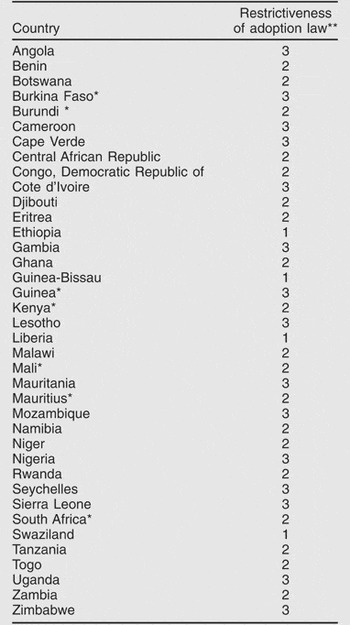
To systematically investigate what political factors influence the relative restrictiveness of the intercountry adoption rules of the countries of Sub-Saharan Africa, we created a dataset including 38 of 48 Sub-Saharan African countries. The ten missing cases were excluded because of lack of data on the dependent variable. The 38 countries and their scores on the restrictiveness scale for the dependent variable, which is explained in the next paragraph, are listed in table 1.
Cases and restrictiveness of intercountry adoption rules

* Countries which are party to the Hague Convention.
** Scale as explained in text: 0 = least restrictive, 3 = most restrictive.
Restrictiveness of intercountry adoption rules
In order to measure the level of restrictiveness in intercountry adoption, we coded the intercountry adoption rules of 38 Sub-Saharan African countries. Restrictiveness is conceptualized as being comprised of three key dimensions: whether or not the country has an official residency requirement for prospective adoptive parents, whether or not a government agency could be identified that was specifically charged with handling intercountry adoptions, and whether or not international adoption agencies or organizations were allowed to operate within the country. Countries that do not have a residency requirement provide fewer restrictions (and hence fewer disincentives) for intercountry adoption. Thus, a 1 was used to code countries that required a residency period (since this was relatively more restrictive) when compared to countries that had no residency requirement (which were coded as 0). Further, countries that helped facilitate adoptions by having a dedicated government agency (coded as 0) or allowing international agencies to operate in the country (coded as 0), were two other dimensions that comprised this index (if agencies did not exist, or international organizations nor lawyers were permitted) this was coded as a 1 since these would act as impediments to intercountry adoption.
To check whether these three dimensions could be usefully combined into an additive composite score, we used a Cronbach's Alpha test to measure the extent to which there was intercorrelation between the four items. The Alpha score of .88 indicated that the three items could be combined into a single index, ranging from a low of 0 or least restrictive in terms of intercountry adoption, to a high score of 3. We use this ordinal measure of restrictiveness as our dependent variable for this study.
What influences the relative restrictiveness of a country's adoption rules, as measured by our ordinal scale? The literature we reviewed in the previous section suggests several explanatory factors. Next, we explain how we have measured each of these independent variables for the countries of Sub-Saharan Africa:
Severity of the AIDS pandemic and orphan crisis
Not all orphaned African children have lost their parent(s) due to AIDS, but the AIDS pandemic has certainly increased the likelihood that a child will lose one or both parents at a young age. The proportion of orphans that is estimated to have lost their parent(s) due to AIDS varies per country. It is estimated to be extremely low in Madagascar (1 percent) and much higher in Botswana and Zimbabwe (76 percent and 77 percent, respectively), with an average of 12 percent across Sub-Saharan Africa.Footnote 48 Here, we measure the severity of the crisis by two variables:
1. The reduction in life expectancy between 2000 and 2005, as reported by UNAIDS.Footnote 49
2. Proportion of all children who are orphans, also reported by UNAIDS.Footnote 50
Hague Convention
If Bartholet is correct, countries that have become party to the Hague Convention should be more open to intercountry adoption.Footnote 51 Therefore, we include whether or not countries are party to the Hague Convention treaty. This is coded as 1 for those countries which have acceded to the treaty and where the treaty has entered into force, and 0 for those who have not at this time become party to the convention. The data are derived from the status table provided by the HccH.Footnote 52
Globalization
There are several recent measures of the extent to which a country is connected to global economy, such as the AT Kearney/Foreign Policy index and the KOF index, developed by a group of researchers at the Swiss Federal Institute of Technology in Zurich (Switzerland). These indices measure different aspects of globalization, especially the three main dimensions of globalization: economic, social, and political. However, the KOF index has a longer time series, dating from the 1970s to the present whereas the AT Kearney/Foreign Policy Index only includes data from the latter half of the 1990s. Unfortunately relatively few African countries are included in each index (the AT Kearney/Foreign Policy index has only 6 Sub-Saharan African countries and the KOF Index has 29 Sub Saharan African countries).
As a second-best proxy measure we employ a very simple measure of the extent to which a country receives Foreign Direct Investment (FDI), as a proportion of Gross Domestic Product (GDP), on average from 2000–2005. This data is taken from the World Bank's World Development Indicators.Footnote 53 Although we pointed out above that an argument can be made that greater integration into the global economy (as indicated by the level of FDI) could make a country less open to intercountry adoption, we noted that the argument that greater integration into the global economy would make a country more open to intercountry adoption could also be made. We expect that the argument in favor of the latter is stronger. Therefore, we hypothesize that greater integration into the global economy, as measured by FDI, leads to less restrictiveness.
Democracy/democratization
To measure the level of democracy we employ the often used Polity IV data base. The Polity IV measure was developed at the University of Maryland College Park in order to demonstrate the degree to which a political system is autocratic or democratic. It uses different measures of constraints on the chief executive, the openness and competitiveness of executive recruitment and the competitiveness of political participation. These scores are then combined onto a scale ranging from −10 to +10, with −10 being the most autocratic and +10 being the most democratic. In order to measure the past regime type, the average Polity IV score will be used for the period 2000–2005.
Proportion of the population that professes Islam
As suggested above, we suspect that Islam has a cultural as well as a legal impact on societies. Therefore, we hypothesize that the larger the proportion of the population which professes Islam, the more restrictive will be that country's adoption laws. We measure the proportion of the population that is Muslim as an indicator of cultural values that are likely to restrict intercountry adoption. Data for this indicator were derived from the CIA World Factbook.Footnote 54
Findings
This article sought to investigate the determinants of the restrictiveness of sending countries' policies regarding intercountry adoption. In order to do so, we first created a measure of the level of restrictiveness of adoption laws in Sub-Saharan African countries. As table 1 shows, the 38 Sub-Saharan countries in our dataset vary in terms of the restrictiveness of their adoption laws. The scale we created to measure restrictiveness was conceptualized to consist of three key dimensions: whether or not the country has an official residency requirement for prospective adoptive parents, whether or not a dedicated government agency could be identified that was specifically charged with handling intercountry adoptions, and whether or not international adoption agencies or organizations were allowed to operate within the country. The resulting scale places the top African countries of origin of children adopted into U.S. families, Ethiopia and Liberia among the least restrictive countries. Two other countries scored similarly on the restrictiveness scale: Guinea-Bissau and Swaziland. Both have relatively small populations and less well-established connections with the U.S., the largest receiving country of internationally adopted children. These could be reasons why these countries, despite their low level of restrictiveness toward intercountry adoption, are not active participants in intercountry adoption into the U.S. It must be noted that a low level of restrictiveness merely makes it possible for such a country to become a sending country in intercountry adoption, but does not mean that such a country must become a major sending country.
The two top African sending countries, Ethiopia and Liberia, have long cultivated their ties with the U.S. Both also stand out among African countries because they were never colonized. Liberia was settled by freed American slaves in 1822, whereas Ethiopia was ruled by indigenous Emperors until a coup in 1974 ended imperial rule. Although there is no reason why a country's past as a colony of a European imperial power would necessarily have a negative impact on intercountry adoption, the U.S.'s status as the largest recipient of internationally adopted children means that traditionally close ties with the U.S. may make a difference—they may constitute the diplomatic context within which intercountry adoption can be negotiated.
The third African country that has emerged among the top twenty countries of origin of children adopted into U.S. families is Nigeria, which ranks among the most restrictive countries in our scale. This is due in part to the federal structure of government of Nigeria: adoption is ostensibly regulated by the states rather than the federal government. This may make sense domestically (and with respect to the different social and religious traditions in different states within Nigeria), but it also results in a highly complex (and therefore restrictive) environment for intercountry adoption. In addition, the relationship between state and federal authority regarding intercountry adoption is not entirely transparent; federal authorities can overrule the states in this matter.Footnote 55
Although Nigeria has been among the top three African countries of origin of children adopted into U.S. families for the past three years, the numbers are not large and Nigeria is among the bottom three of the top twenty sending countries. It is conceivable that these adoptions were completed by families with connections in Nigeria, either through family ties or missionary work. Given the size of the Nigerian diaspora in the U.S. and the prevalence Christian missionary activity in parts of Nigeria, such an explanation is plausible. This explanation is admittedly speculative, but anecdotal evidence suggests that the Nigerian diaspora in the U.S. is primarily responsible for the adoption into this country of Nigerian-born children.Footnote 56 Given the size of Nigeria's population, the likelihood for a Nigerian child to be adopted into an American (or perhaps more appropriately Nigerian-American) family remains quite small.
On the whole, the scale measuring the sending countries' restrictiveness regarding intercountry adoption appears valid. Although it is not possible to measure in such a scale every nuance of a country's legal framework with regard to intercountry adoption, it ranks countries in a manner that mirrors the generally accepted wisdom with regard to the restrictiveness of different African countries regarding intercountry adoption.
What factors explain whether an African country is more or less restrictive with regard to intercountry adoption? The available literature suggests explanations such as: the severity of the orphan crisis, whether a country is a signatory of the Hague Convention, the extent to which a country is interconnected with the global economy, the degree of a country's democratization, and the proportion of the population that professes Islam. We developed measures to systematically evaluate each potential explanation, as explained above.
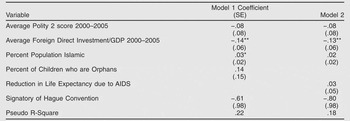
Table 2 reports the results of the ordinal logistic regression analysis, with the dependent variable being the adoption law restrictiveness index. We ran two separate models, largely because we had two separate indicators of the severity of the orphan crisis. The orphan crisis intersects with the AIDS pandemic, but available data do not tell us how AIDS has affected the likelihood that a child will be orphaned. Hence, we employed two independent variables: the percent of children orphaned and the reduction in life expectancy due to AIDS. As might be expected, these two variables were highly collinear. For this reason, we included the percent of children who are orphans in model 1 and the reduction of life expectancy due to AIDS in model 2. Interestingly, neither variable provides a statistically significant explanation for the restrictiveness of a country's adoption laws. If anything, the relationship is contrary to the one we hypothesized on the basis of the available literature: the positive (but non-significant) coefficient indicates that the tendency is in the direction of greater restrictiveness by countries that are more strongly affected by the AIDS crisis.
Coefficient estimates, restrictiveness of adoption laws, ordinal logistic regression results.

* p ≤ .10,
** p ≤ .05
The Hague Convention is negatively related to sending country restrictiveness, i.e., Hague signatories are more likely to have less restrictive adoption laws. This is as we hypothesized; however, the relationship is again not statistically significant. Perhaps the Hague Convention will have a stronger impact in the future, as more countries adjust their laws in accordance with its provisions, but at this time it does not have a statistically significant impact on lessening the restrictiveness of sending country adoption laws. This means that, contrary to Bartholet's cautionary note that the Hague Convention has thus far had the effect of restricting intercountry adoption, we do not find such an effect for sub-Saharan African countries.Footnote 57
The level of democracy was also statistically unrelated to the level of restrictiveness, although here, too, the relationship is at least in the hypothesized direction: the negative relationship means that a higher score on the Polity measure is associated with a less restrictive adoption laws.
The remaining two variables appear to be related to the restrictiveness of the sending country's adoption laws: the level of FDI as a proportion of GDP is significant in both models 1 and 2, and the proportion of the population that is Muslim is significant in model 1 (but not model 2). The FDI variable indicates that the more the country is connected with the world economy, the less restrictive are a country's adoption laws. This is as we hypothesized.
The percentage of the population that professes Islam tends to be positively related to the level of restrictiveness, meaning that the larger the proportion of Muslims, the more restrictive the sending country's adoption laws. This relationship is marginally statistically significant in model 1 (p ≤ .10) and not statistically significant in model 2. In other words, the relationship is in the hypothesized direction, but it is not strong and not robust.
In sum, sending countries do not simply lessen the restrictions on intercountry adoption because the AIDS pandemic renders more children orphans, nor has the Hague Convention made the laws of sending countries less restrictive (yet), and neither is democratic governance related to the restrictiveness of sending country adoption laws. Additionally, the proportion of the population that professes Islam is only weakly related to the restrictiveness of the adoption law. Interconnectedness with other countries, as measured through FDI, is the only variable in our two models that appears to be related to less restrictive adoption laws in Sub-Saharan Africa.
Discussion
The explanatory variables used in this study were derived from the literature on intercountry adoption. The available studies generally did not use systematic empirical analysis. Instead, many of the studies were descriptive (single) case studies. The explanations offered in that literature provided a good starting point for formulating our hypotheses, but our analysis demonstrates that the insights offered in that literature do not, for the most part, offer generalizable explanations for the restrictiveness of sending country laws regarding intercountry adoption. Here, we revisit the hypotheses, speculate on the reasons why commonly offered explanations did not provide statistically significant explanations, and offer some avenues for further research.
We suspected that the larger the proportion of the population that professes Islam, the more restrictive will be the law regarding intercountry adoption. We used this as the measure of cultural values that are often cited as associated with greater restrictiveness regarding intercountry adoption.Footnote 58 Although the lack of statistical significance of this measure should not be interpreted to mean that cultural values do not matter, their impact is probably more complex than a simple measure is able to capture. In fact, as Bargach suggests,Footnote 59 Islam and adoption may not be as incompatible as they have often been portrayed. More research along the lines of the field work she completed in Morocco could shed greater light on the practices (as opposed to the legal doctrine) in Islamic societies and possibly point to a deeper understanding of the (variety of) actual experience of Islamic societies with adoption.
We hypothesized that the severity of the combined AIDS and orphan crises would lead countries to lessen restrictions on intercountry adoption. Our analysis shows that this is simply not the case. Neither the reduction in life expectancy due to AIDS, nor the proportion of children who are orphaned are related to lesser restrictiveness of a country's adoption law. Countries do not lessen restrictions on intercountry adoption simply because there are many orphaned children within their borders.
A possible explanation for this lack of responsiveness to the needs of orphaned children could be the lack of democratic governance.Footnote 60 Indeed, one of the ostensible advantages of democracy is that it makes governments more responsive to the needs of their citizens.Footnote 61 Unfortunately, we found no evidence that African governments that are more democratic are also more responsive to the needs of their society's orphaned children—or at least to intercountry adoption as one of the possible solutions to the orphan crisis—than less (or non-) democratic African governments. This suggests that a society's responsiveness regarding the needs of children depends on something besides a democratic government. Indeed, responsiveness to the domestic audience could possibly lead to a more restrictive intercountry adoption policy, as suggested by the neo-imperialist arguments cited earlier.
If domestic governance is not related to the restrictiveness of adoption laws, neither is participation in the Hague Convention. We hypothesized that countries that have signed on to the Hague Convention would have lesser restrictions on intercountry adoption. This expectation was founded in the regime's purpose, which was designed to bring greater transparency to international adoption. Only eight African countries have become party to the treaty, seven of which are in our dataset (the countries with an asterisk in table 1). These countries scored 2 or 3 on our restrictiveness scale. On the other hand, the countries or origin of most African children adopted into U.S. families—Ethiopia and Liberia—have stayed out of the regime, as has Nigeria (which in recent years appears in the top twenty sending countries for children adopted into U.S. families). It may be worth investigating why relatively few African countries have chosen to become part of the Hague Convention. Critics of the treaty have charged that implementation would be a costly burden for many of the sending countries. This is one plausible explanation, but only further investigation can determine whether the decisionmakers do indeed perceive accession to this regime as too costly and burdensome, or whether these governments had other reasons for not signing on to the Hague Convention.
Ironically, greater interconnectedness with the global economy was related to less restrictive adoption laws. We hypothesized that this would be the case, largely favoring the argument made by Bartholet that intercountry adoption may serve to increase the commitment of adoptive parents to advocate—and provide resources—for improved social services in the birth countries of their children.Footnote 62 According to this logic, a country that permits some orphaned children to be adopted abroad may receive back additional resources for the care of the orphans who remain behind: children who are adopted abroad serve as informal (and unsuspecting) “ambassadors of goodwill” for their birth country, much like international exchange programs are expected to foster goodwill between countries. Clearly, we did not test this proposition directly. We did, however, consider that the governments of countries that are more closely connected to the global economy may be more willing to see the potential benefits of intercountry adoption, rather than perceiving it as a form of neo-imperialism, as was suggested by several authors.Footnote 63
Our findings suggest that there is something to the proposition that economic interconnectedness, which we measured in terms of FDI, creates the foundation for other ties. Currently, economic interconnectedness appears to provide a better explanation as to why some African countries have lesser restrictions on intercountry adoption than does the Hague Convention.
This finding can be interpreted to suggest that the international legal framework represented by the Hague Convention has not provided an effective incentive for African countries to lower restrictions on intercountry adoption, whereas economic interconnectedness as measured by FDI has. If so, this may mean that economic interconnectedness builds sufficient trust to give sending governments the confidence that the children they send abroad to be raised by families in other countries will indeed find loving, stable families at their destination, as suggested by Bartholet.Footnote 64 In other words, such governments trust that intercountry adoption is what it purports to be rather than a smokescreen for child trafficking, as is sometimes feared.
A second explanation suggests that the association between economic interconnectedness and lesser restrictions on intercountry adoption represents the commodification of children. This interpretation leads to the conclusion that the governments of more globalized countries are willing to participate in the global market in a variety of ways, including “exporting” their children. This second explanation suggests that the needs of children are not well served by the only available international regime concerned with adoption; those African countries which are the most active participants in intercountry adoption are not party to the Hague Convention. The solution to this dilemma is not to suggest that those countries should accede to the treaty, but to ask why their governments do not judge this treaty to be a useful instrument to them.
Conclusion
As interest in intercountry adoption from Africa increases, such adoptions are likely to become more controversial as well; prospective adoptive parents are often drawn to Africa because of the perceived needs of its many orphaned children. Although AIDS orphans remain a relatively small proportion of the total number of orphaned children,Footnote 65 it is the AIDS crisis that has drawn attention to Africa's orphans, facilitated by celebrity travel to—as well as adoption from—the continent. The positive result of this attention is that more orphaned children will have the opportunity to join a family. The other side of the coin is that the children afforded this opportunity do not necessarily hail from the countries where the orphan crisis is most acute; our analysis shows that sending country adoption laws are not explained by the size of its orphan population. Rather, the country's economic interconnectedness best explains its adoption laws.
Orphaned children residing in African countries that are economically more interconnected with the rest of the world are more likely to be the beneficiary of intercountry adoption. Although the proportion of orphaned children who benefit from such adoptions remains small and all African countries face the question as to how best to care for their orphaned children, the willingness of a country to participate in intercountry adoption opens up that society to scrutiny by outsiders. International agencies generally employ nationals of the sending country, but also provide guidelines for the treatment of children in the care of the agency and make visits not only to their own in-country facilities but also to other orphanages. Hence, intercountry adoption from Africa is not without scrutiny, but that scrutiny occurs largely outside of the Hague Convention's framework.
Instead, intercountry adoption from Africa is largely dependent on the laws of the sending and receiving country, the diplomacy between the two, and the degree to which each state monitors the actions of the private and public agencies involved in intercountry adoption. Although adoption across borders—and continents—has the potential to successfully serve the needs of orphans by providing them with permanent and loving families,Footnote 66 it also has the potential to turn children into an “export product.”
Our findings suggest that the more globalized an African country is, the more likely is it to have a less restrictive intercountry adoption policy. This can alternatively be explained positively as stemming from increased trust by such a country's leaders in their ability to navigate the international relationships involved in adoption or, more negatively, as a willingness to “commodify” orphaned children. Such commodification could be motivated either by a desire to lessen the burden of taking care of large numbers of orphans or a desire to profit from such children. The degree to which either explains the greater openness to intercountry adoption by more globalized sub-Saharan African countries is a matter requiring further investigation.
Much work remains to be done to better understand the politics of international adoption. The global movement of orphaned children from (usually poor) sending countries to eager families in (most often wealthy) receiving countries has largely been studied from the perspectives of social work, sociology, and law. Yet, at the root of this movement of children across borders is the political decisionmaking and diplomacy that makes it possible. This initial, systematic investigation into the politics of intercountry adoption from Africa suggests that greater attention is warranted if the objectives of transparent and ethical intercountry adoption are to be met.