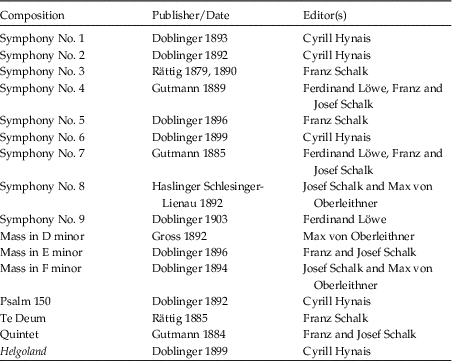
An extensive exhibition in the Austrian National Library on the occasion of the sesquicentenary of Bruckner’s birth (1974), and the establishment of the Anton Bruckner Institut Linz shortly thereafter, served as catalysts for a notable increase in international interest in Bruckner source criticism during the last two decades of the twentieth century.Footnote 1 One consequence was a reassessment of the editorial policies that had shaped the Bruckner Collected Works Edition since its inception.Footnote 2 New perspectives, together with the discovery of some long-lost primary sources, prompted substantial revisions and additions to the existing volumes.Footnote 3 By 2013 it had become obvious that patchwork repair was not a long-term solution, and The New Anton Bruckner Complete Edition [NBG] was launched, like the older one, under the auspices of the Austrian National Library.Footnote 4 The present study has been prepared on the occasion of the publication of the NBG’s first volume, Thomas Röder’s edition of the Linz version of the First Symphony.Footnote 5 This article focuses on a fundamental precept of the old Gesamtausgabe – the supremacy of the readings in Bruckner’s autograph manuscripts over those in his early editions. After a brief history of the controversies this position has provoked over the years, the article provides an overview of the composer’s relationship with the brothers Franz and Josef Schalk, who were responsible for the production of many of his early editions. The discussion leads inevitably to a re-examination of a clause in Bruckner’s will that exercised a controlling influence over the old Gesamtausgabe and remains a seminal factor in any editorial considerations regarding Bruckner. A summary of the principal differences between the editorial policies of the NBG and those of the old Gesamtausgabe concludes the article.
***
On 2 April 1932 Siegmund von Hausegger conducted the Munich Philharmonic Orchestra in a concert that would alter the world’s understanding of Anton Bruckner’s music. The orchestra performed the composer’s Ninth Symphony twice – once from the first edition edited by Ferdinand Löwe and published posthumously in 1904, and then from the version in the autograph manuscript that the composer had bequeathed to the Imperial Library in Vienna.Footnote 6 In the face of prevailing opinion, the International Bruckner Society, which had organized the concert, hoped to demonstrate that the previously unperformed manuscript version was not only playable, but also musically superior. The Directors of the Society were so gratified by the overwhelming success of the manuscript version that they determined that same day to use all the manuscripts Bruckner had left to the library as the basis for its new Collected Works Edition.Footnote 7 Robert Haas who, along with Alfred Orel, was co-editor of the Collected Works at the time, formulated the argument as follows in an essay prior to another Hausegger Munich concert – this one featuring the manuscript version of the Fifth Symphony on 28 October 1935:
Another special celebration will begin with the premiere of Bruckner’s mighty “Fifth” almost sixty years after the work was completed. This performance uses the [new] score from the Collected Works Edition – i.e. the reading in Bruckner’s autograph manuscript that the master identified in his will as the definitive version – not the first edition of 1896 that we have known until now. The 1896 publication contains an arrangement with extensive cuts and massive orchestration changes . . . that have no verifiable connection with the master.Footnote 8
Haas and his supporters argued, at times on slender evidence, that, prior to the publication of the Collected Works Edition, Bruckner’s editors – Franz and Josef Schalk, Ferdinand Löwe, Max von Oberleithner and Cyrill Hynais, all former students of the composer – had altered the master’s printed scores without his knowledge or permission. Or worse, they and their colleagues had coerced a composer, victim of years of conflict and rejection in Vienna and notorious for revising his pieces, into making ill-advised changes. Haas, for example, wrote in his preface to the Eighth Symphony:
Baffled by the score, Hermann Levi in Munich, seconded by Josef Schalk in Vienna, applied intense pressure for extensive revisions … . Especially the Finale betrays a soulless superficiality and cursory, casual style that one must expect of an arrangement in which cuts have been wrung out of the work.Footnote 9
For Haas, a critical piece of evidence was Bruckner’s will which contains the following passage:
I bequeath to the Imperial Library in Vienna and request that its administration assume responsibility for the autograph manuscripts of the following compositions: the symphonies, as of now eight in number, the ninth God willing soon to be finished; the three large Masses; the quintet; the Te Deum; Psalm 150; and the choral piece Helgoland.
In addition, I stipulate that the firm of Josef Eberle should borrow the manuscripts of the works it publishes for a reasonable time from the library, which should be prepared to loan them to Eberle and Cie. for an adequate period.Footnote 10
Whatever had happened during Bruckner’s lifetime, so the argument went, the manuscripts in the library preserved the readings that he had identified ‘for later times’. Bruckner himself had used the phrase ‘for later times’ in his famous letter of 27 January 1891 to Felix Weingartner, who was preparing to conduct the Eighth Symphony. The composer told Weingartner to take two extensive cuts that were marked in the finale score because ‘it would be much too long and is valid only for later times, to be sure, for a circle of friends and aficionados’.Footnote 11
Needless to say, the Gesamtausgabe policy did not go unchallenged. The new scores provoked the so-called Bruckner-Streit, one of the most vitriolic and extended controversies in the history of modern musical literature.Footnote 12 Alfred Orel resigned from his editorial position under duress over the issue.Footnote 13 Speculation was rife on both sides, because many of the engravers’ copies that might otherwise have shed some light on the genesis of the readings in the early editions were lost.Footnote 14 Haas’s opponents pointed out that the editors had been Bruckner’s students and friends who had worked tirelessly on the composer’s behalf for years in the hostile Viennese environment. Bruckner had been grateful for their support and applauded performances of the readings in their editions. Those readings were superior from a performance standpoint to those of the autograph manuscripts. Eyewitness testimony was summoned to the effect that nothing had happened in the preparation of the early editions without Bruckner’s approval. Friederich Eckstein, for example, described the composer’s conversations with his students as follows:
I know that every note … was set in stone during endless conversations among Bruckner, Franz and Josef Schalk, and [Ferdinand] Löwe. … It is certain that these conductors advised Bruckner regarding changes at least in the instrumentation, but also in tempo and dynamics.Footnote 15
For the most part, supporters of the early editions ignored the will.Footnote 16 The most cogent response to Haas’s insistence upon its supremacy came from Alfred Orel, who saw the will as Bruckner’s method of providing multiple sources for future reference.Footnote 17 The opposition notwithstanding, by the 1950s, the manuscript versions had prevailed. Haas’s successor as editor of the Complete Works, Leopold Nowak, continued the policy of ignoring the early printed scores and for most of the twentieth century, with few exceptions, they remained on the library shelf.Footnote 18
Even as Nowak did his work, evidence began to accumulate that supporters of the early editions were in large part correct about the Third and Fourth Symphonies. In 1959 Nowak published the third version of the Third Symphony – the 1889 reading that had served as the basis for the score published by Theodor Rättig the following year.Footnote 19 Nowak demonstrated that, although the contents of the 1890 edition itself had been tampered with, the composer had been involved in the preparation of the engraver’s copy.Footnote 20 Bruckner and Franz Schalk had in fact interacted as co-composers in the preparation of the 1889 Finale.Footnote 21 Benjamin Korstvedt later showed that, in 1888, Ferdinand Löwe and the Schalk brothers had prepared the engraver’s copy for the first edition of the Fourth Symphony (1889/90) with the composer’s cooperation.Footnote 22 Bruckner was thrilled with the public acclaim that performances of the new editions of the Third and Fourth Symphonies received and publicly endorsed the readings they contain. On 14 January 1893, for example, the same year he made his will, the composer wrote about the Third to Hermann Levi:
I ask you please to perform from the new edition that the emperor paid for three years ago. It is incomparably better. (I don’t want to hear any more about the earlier version.)Footnote 23
Why, then, did he include in his bequest to the library autograph manuscripts with substantially different readings of the two symphonies?Footnote 24
Bruckner’s Editors

***
The most important evidence about the relationship between Bruckner and his editors is an extensive correspondence, largely unpublished, between the brothers Franz (1863–1931) and Josef Schalk (1857–1900) that survives in the Fonds Schalk in the Music Collection of the Austrian National Library.Footnote 25 The correspondence came about because, during the 1880s and 90s, Franz pursued a successful performing career with a series of appointments around Germany and Austria while Josef remained in Vienna. The brothers, both of whom studied with Bruckner at the Conservatory, were by far the most active of his editors. Ferdinand Löwe (1863–1925), himself a successful conductor and friend of the Schalks, played a somewhat lesser role. Max von Oberleithner (1868–1935) was involved with the editions of the Eighth Symphony and Masses in D and F Minor, and Cyrill Hynais (1862–1913) with the First, Second and Sixth Symphonies, Psalm 150 and Helgoland. The Schalks began to have a professional interest in Bruckner’s music in 1881, when Josef completed a piano four-hand arrangement of the String Quintet and hosted rehearsals in his home for the work’s first performance.Footnote 26 That same year, Franz, who was playing violin in the orchestra in Karlsruhe, convinced his conductor, Felix Mottl, to perform the Fourth Symphony. Franz’s effort led to one of the many public debacles in Bruckner’s career. On 10 December, after a disastrous first rehearsal, Franz wrote to his brother:
The symphony will be performed. How is another matter! … I am convinced it will be a failure here, and I don’t know how to break the news to Bruckner. The orchestra is not up to it [and] unfortunately doesn’t want to play the piece. … So I will have to dress up in my tuxedo to witness the demise of a great work of art. Mottl beats without inspiration and is really only doing the piece because he doesn’t want to send it back unperformed. He told me the symphony has great weaknesses. I replied briefly: ‘but many greater strengths’. God be with Bruckner. His time has not yet come.Footnote 27
Franz’s predictions proved correct. Three days later he wrote again:Footnote 28
The Bruckner symphony was a total failure. … Mottl never grew to appreciate Bruckner’s genius … . His tempi reduced the delicate motives to banal fiddling. The interpretation hid the densely intertwined melodic threads from the listener. I am disgusted to write any further about it and deeply regret convincing Mottl to do a performance that did more harm than good … . You will do your best to conceal the extent of the failure from Bruckner; he would be discouraged to learn that the verdict about one of his most easily understood works was unanimous. In the entire hall hardly a single pair of hands stirred.
From that point on, the brothers became Bruckner’s counsellors, supporters, friends, editors, arrangers, performers and, as mentioned, even co-composers.Footnote 29 To their credit, they and their fellow editors invested long hours with no personal gain helping Bruckner. He came to rely heavily on the brothers, and on Ferdinand Löwe in particular, during the years immediately following Hermann Levi’s rejection of the Eighth Symphony in October 1887.Footnote 30 Bruckner was distraught upon learning of the rejection, so much so that his colleagues repeatedly expressed concern over his wellbeing. Before he communicated his decision to the composer, on 30 September 1887, for example, Levi wrote to Josef Schalk for advice:
Please write to me immediately about how I should approach Bruckner. If the outcome were merely that he would think I am an ass, or worse a traitor, I could live with that. But I fear even worse – that this disappointment will destroy him.Footnote 31
Josef replied on 18 October that Bruckner was badly shaken by the rejection, though he had begun to revise the first movement.Footnote 32 Although there is no evidence to support Robert Haas’s assertion that the brothers and Löwe took advantage of Bruckner’s fragile state in the late 1880s to coerce the composer into accepting their suggestions, there can be little question that it caused him to rely on them more than he might have otherwise.Footnote 33 Theirs cannot have been an easy role to fill, as Bruckner was often acrimonious and difficult to work with. Because Franz was usually away from Vienna, his brother and Ferdinand Löwe bore the brunt of the composer’s ill humour.Footnote 34
The principal objective of the young editors was to help Bruckner avoid debacles like the Karlsruhe performance – to make it easier for conductors, performers and audiences to understand his music. In 1930, decades after the composer’s death, Franz Schalk, by this time one of Austria’s leading conductors, wrote:
Many of the changes would not be necessary today. … The master himself had minimal understanding of the little comforts of music making. He seldom if ever considered it necessary in his notation and method of writing to distinguish thematically or harmonically significant notes from their neighbours. As a result, the first attempts at performance often featured masses of sound and confused intonation. This is where his students – with the deepest belief in the eternal greatness of his music – intervened and tried to create remedies. Their extremely careful work was limited … almost without exception to technical simplifications which would make the inner meaning of this symphonic colossus easier for the listener to comprehend.Footnote 35
The remedies were often more far reaching than Schalk leads us to believe and were infused with Wagnerian ideology and practice. The Schalks brought Bruckner personally closer to the young Wagnerian faction in Vienna, and their musical interventions were based on their understanding of Wagnerian orchestral sound.Footnote 36 At the end of the Scherzo of the Fifth Symphony (Nowak edition bars 369–382), for example, among other modifications Franz replaced Bruckner’s static tutti repeating chords with a passage marked crescendo and accelerando built in orchestral blocks full of trills reminiscent of Act 1, Scene 4, of Tristan und Isolde (bars 24 ff.) or of the Prelude to Act 1 of Die Meistersinger (bars 207–210). Throughout their scores, the editors:
1. Added innumerable performance directions (often in German in the Wagnerian fashion) such as breit or hervortretend to provide the orchestra with some direction where Bruckner wrote none
2. Re-orchestrated to ameliorate Bruckner’s instrumentation in choirs, adjust balance (usually to reduce the brass), reinforce contrapuntal lines, or emphasize structural high points
3. Tried to clarify the phrase structure by adding or changing markings, inserting rests after the final notes of cadences, or adding innumerable ritard – a tempo directions
4. Despite Franz’s protestations to the contrary, made or suggested numerous cuts to make the works more palatable for the audience.Footnote 37
Of course, it was commonplace for conductors to make such alterations to the scores of many composers at the end of the nineteenth century. By 1930, orchestras and conductors were used to the technical and musical demands of Wagnerian style, and many of the editorial changes to Bruckner’s scores, whether or not they had been justified in the 1880s and 90s, were no longer necessary as even Franz Schalk conceded at the beginning of the above-cited passage.
Throughout most of the 1880s, the Schalks and Löwe worked in close collaboration with Bruckner. Leaving aside the usual incursions and mistakes that crept into many nineteenth-century editorial projects, the early editions of the Third (1890), Fourth and Seventh Symphonies, the String Quintet and the Te Deum are blessed de facto with his imprimatur. Bruckner held Franz’s musical abilities in particularly high regard and sought out his opinions, as Josef noted, for example, in a letter of 26 November 1888 to Franz: ‘He [Bruckner] wants to show you each of the many alterations he is now making assiduously to the Third and Eighth symphonies’.Footnote 38 Towards the end of the decade, the students began to lose patience with what they perceived as Bruckner’s pedantry. As early as 9 May 1887 Josef wrote to Franz:
Our friend Löwe has very favourably re-orchestrated many sections of the Romantic [Fourth Symphony] with Bruckner’s approval. [Bruckner’s] unbelievable preoccupation with detail, not to say pedantry, forced him [Löwe] to prolong the task so that [Albert] Gutmann, who is publishing the piece, only received the first movement a few days ago.Footnote 39
Alfred Orel observed that the more the composer came to depend upon his young colleagues, the more acerbic and domineering he became in trying to assert his control.Footnote 40
On 10 June 1888, Josef wrote again to Franz:
[Bruckner] is still sitting over the finale of the Third [Symphony]. He has recomposed a few places. By the way, he has kept your cuts and alterations. Now he is severely plagued by the delusion of removing parallel octaves from the movement. In the process, he wastes a lot of time and struggles horribly, but is unmoved by any objections from Löwe or me. It is really sad to see how, at the expense of natural voice leading, he erases everything and makes changes for the sake of this fixation.Footnote 41
As the brothers grew less and less tolerant of Bruckner’s overbearing interference, they began not only to make alterations without consulting him, but also to conceal them from him. Although the Schalks were both very much involved with the preparation of the manuscript of the second or 1890 version of the Eighth Symphony, for example, Josef and Max von Oberleithner prepared the first edition (1892) entirely behind the composer’s back. In the midst of corrections for the edition, on 5 August 1891, Josef wrote to Oberleithner: ‘Please communicate only with the publisher about the corrections’.Footnote 42 Josef and Oberleithner also conspired to conceal alterations to the first edition of the Mass in F minor (1894) from the composer.Footnote 43 Thomas Leibnitz has demonstrated that Franz Schalk made the entire arrangement of the Fifth Symphony (1896) that Haas later criticized without consulting Bruckner. Schalk deliberately deceived the composer by having the parts for the premiere (Graz, 8 April 1894) copied from the score of his arrangement while allowing Bruckner to believe he was using the autograph manuscript.Footnote 44 Bruckner is not known either to have endorsed or criticized any of these three editions in public, though his anger with Oberleithner with regard to the Mass was common knowledge in the inner circle. Max Auer believed that Bruckner indicated his dissatisfaction with the Schalks’ and Oberleithner’s efforts by turning to Cyrill Hynais for editorial help with the editions published late in his life.Footnote 45
As Thomas Leibnitz observed, the editors hoped public acclaim would overcome Bruckner’s chagrin when he discovered he had been omitted from the publication process. They expected he would come to prefer the readings in the editions of the Fifth and Eighth Symphonies and Mass in F Minor as he did those of the Third and Fourth Symphonies. Leibnitz wrote:
at times the students and friends preferred the easier path of making changes on their own … to the laborious road of discussion and persuasion . ... [Their] alterations to Bruckner’s music spanned the gamut of sought-after advice to covert manipulation.Footnote 46
Distinguishing Bruckner from his editor/co-composers in pieces where he worked closely with them is often difficult, if not impossible. From an editorial perspective, it is pointless, because the composer accepted their suggestions and made them his own. At times, editorial advice in one passage became part of the original conception in the next. The cymbal crash at the climax of the Adagio of the Seventh Symphony, for example, found its way into the autograph score at the analogous place in the first version of the Eighth (measure 269) with no external prompting. However much the Schalks and Löwe may have contributed, the composer was responsible for the 1888 version of the Fourth Symphony and the 1889 version of the Third. As Nowak, Röder and Korstvedt have demonstrated, the authenticity of these versions cannot be questioned. Publications prepared with Bruckner partially or entirely removed from the editorial process, inadvertently or deliberately, are a different matter. At this point the will comes into play, though not precisely in the manner Haas had envisioned.
***
In November 1893, as the students’ changing attitude was becoming obvious, Bruckner signed his will. The clause in question (see above) contains two instructions: one to the library and another to the firm of Josef Eberle (engraver for Doblinger). The former includes all the major works (except the Nullte Symphony) that Bruckner had composed since the conclusion of his studies with Otto Kitzler – that is, since 1863. The latter can refer only to those works covered under the contract that Bruckner had signed with Eberle’s firm on 14 July 1892.Footnote 47 The Third (Rättig, 1879, 1890), Fourth (Gutmann, 1889, 1890), Seventh (Gutmann, 1885) and Eighth (Haslinger Schlesinger – Lienau, 1892) Symphonies; the String Quintet (Gutmann, 1884); the Mass in D minor (Gross, 1892); and the Te Deum (Rättig, 1885) had been or were in the process of being published elsewhere. The instruction to Eberle could not have applied to these works. All other pieces listed in the instruction to the library had been committed to Eberle in the 1892 contract or had already been published by Doblinger. The second instruction was designed to facilitate access for Eberle to Bruckner’s as yet unpublished works, at the time the Fifth, Sixth and Ninth Symphonies, Helgoland and the Mass in E minor; and to provide the publisher a point of reference for subsequent printings of the scores in his catalogue – the First and Second Symphonies, Psalm 150 and the Mass in F minor. In accordance with the first instruction in the will, on 19 October 1896, Bruckner’s attorney, Theodor Reisch, delivered the scores identified today as Wn Mus. Hs. 19.473 through 19.486 to what was then the Imperial Library, among them, as mentioned above, manuscripts containing readings of the Third and Fourth Symphonies that differed substantially from printed scores that he had endorsed.Footnote 48 Robert Haas interpreted the will as the composer’s most emphatic stipulation that future editions should be based on the manuscripts Reisch deposited regardless of Bruckner’s previous assertions.
In fact, the composer probably never intended his will to have a bearing on post-mortem editorial issues or to dictate the hierarchy of versions of his pieces.Footnote 49 There is no evidence that, for 30 years after his death, anyone – not even his attorney or Eberle – believed that it did. Josef Lasner, cellist in Ferdinand Löwe’s orchestra the Wiener Konzertverein, reported, for example, that in publishing the 1904 edition of the Ninth Symphony, Löwe first prepared parts from the autograph score in the library and then made his editorial alterations throughout rehearsals for the first performance (11 February 1903).Footnote 50 If Eberle was even aware that Löwe had made alterations, when the engraver produced his score, he must have believed he was following Bruckner’s verbal direction to Josef Stritzko, a former student who served in an administrative capacity for his firm. According to Stritzko, in 1892, possibly in connection with the Eberle contract, the composer said:
If something is to be published after my death, it should go through the hands of Löwe and [Franz] Schalk; or they should at least have nothing against it.Footnote 51
With respect to the first print of the Ninth Symphony, editor and publisher followed the directions of Bruckner’s will to the letter: they borrowed the manuscript from the library, edited and printed the work. As far as editing is concerned, they followed a practice that dated back to the 1880s with the composer’s blessing. The will says nothing about how the contents of the manuscripts were to be edited beyond that Eberle should consult them. Bruckner must have known that, so long as Schalk and Löwe served as his chosen arbiters, similar policies would be applied to new publications, and the readings in his extant editions, authorized or not, would prevail.
In the 1982–83 issue of the Bruckner Jahrbuch, attorney Rolf Keller published a detailed study of Bruckner’s will. He pointed out that the impetus for making the will at the end of 1893 came from Bruckner’s recent illness and from his brother Ignaz’s urging to put personal affairs in order, not from any concern with his professional life.Footnote 52 In a line-by-line analysis of the entire document, Keller outlined Bruckner’s top legal priorities as follows:
1. Arranging for his remains to be interred in St Florian
2. Arranging for Masses to be said on behalf of his immortal soul
3. Bequests for his brother, sister and long-time house-keeper Katharina Kachelmayer
4. Memorializing his name for posterity.
Keller sees the gift of manuscripts to the library as a cornerstone in Bruckner’s effort to memorialize his name. As Alfred Orel put it, by paying for his crypt in St Florian and giving his manuscripts to the library, Bruckner was making a statement for posterity: ‘I am somebody!’Footnote 53
In Keller’s view, by publishing a Collected Works Edition, the Austrian National Library fulfilled the musical half of their donor’s wish, as expressed in the will, to establish a long-term legacy. The other half was the internment in the crypt in St Florian. Beyond the instruction to Eberle, Bruckner did not take advantage of the opportunity the will offered to dictate what the musical legacy might look like, as he did with the crypt.Footnote 54 A little less than a year after the will had been signed, by which time Bruckner was well aware of his students’ unapproved editorial liberties, at least with the Eighth Symphony and Mass in F minor, he added a codicil to the will.Footnote 55 It contains further detailed instructions about his final resting place in St Florian and an alternative plan for Steyr, should the monastery not work out. He could easily have added more stipulations for Eberle and the library or instructions to future editors on reconciling the contents of the manuscripts with those of his editions. Does the absence of any such direction indicate that he expected editors of post-Schalk generations to prefer the manuscript readings, including those of the Third and Fourth Symphonies, whose editions he was endorsing heartily at the very time he made the will? Even Haas compromised on this point towards the end of his life and came to accept the 1888 reading of the Fourth and 1889 reading of the Third.Footnote 56 Or does it rather indicate that, for better or worse, Bruckner had reconciled himself with the editorial status quo, including the unsanctioned scores, and saw the manuscripts in the library only as an important palaeographic ornament in his legacy? A third possibility, as Alfred Orel suggested, is that he was content with a plethora of versions as long as his music was performed. At the very least, the will ensured that the versions in the autograph manuscripts survived in the public forum. None of these scenarios is very satisfying for anyone looking for help from the composer’s will in ranking competing readings. They all imply a level of ambivalence, even indifference, on Bruckner’s part toward some aspect of the editorial problem he was well aware that he was leaving behind.
What about the notion, made popular during the days of the Bruckner Streit, that the composer preserved the manuscript versions in the library ‘for later times?’. Whatever the composer may have intended, the question has been de facto asked and answered. Thanks to Haas and Nowak, the manuscript versions – and there are many of them – are here to stay.Footnote 57 Contemporary editorial and performance practices will ensure their continued supremacy for the foreseeable future; performers and scholars today are far less tolerant than their counterparts in Bruckner’s time of conductors and editors altering any composer’s scores. In the interim, Leopold Nowak, Thomas Röder and Benjamin Korstvedt, have ensured that the final versions of the Third (1889) and Fourth (1888) Symphonies have found their rightful place as contenders for our admiration.
How will the NBG proceed? From the outset, the new edition will have a broad perspective with an international editorial board and individual scholars to prepare each volume.Footnote 58 The editors are beginning from two perhaps obvious premises:
1. As much as possible, the final reading the composer left, whether it be in a print or a manuscript, must be respected.
2. Revision was an important part of Bruckner’s compositional process and must be allowed to play a major role as the present generation takes its turn at shaping his legacy.
Bruckner’s music survives in the manuscripts Reisch delivered to the library, in many more manuscripts not listed in the will, and in early editions. For each work, the editors of the NBG will consult all the sources and rank them in relative order of importance. Early editions will be evaluated according to reliability and the extent of the composer’s involvement, in the same way as printed scores for a modern Collected Works Edition of any other composer.Footnote 59 Spurious editorial additions will be set aside in favour of the manuscript readings chronologically closest to them, and editorial imperfections in the prints Bruckner approved will be corrected by consulting the manuscripts. Variants for specific readings will be listed in Editorial Reports contained in each volume. Each of the new scores will also include an extensive Introduction describing the genesis of the work and significant editorial questions it poses.
Perhaps the most difficult question in the face of Bruckner’s numerous revisions is: ‘What constitutes a version?’ The NBG will identify versions of individual works on the basis of a definitive historical fact – for example, date of composition, a performance, date of a major revision or first publication. As a result, some of the new readings will differ significantly from those of Haas and Nowak whose scores of the first versions of the Mass in F minor and First Symphony, for example, reflect an accumulation of years of revision. The readings in their so-called Linz versions of the First Symphony (each a little different) both date from the 1880s, almost 20 years after the composer had left Linz. Thomas Röder’s new score in the NBG contains the work as Bruckner first declared it finished and performed it in 1868.Footnote 60 Such decisions will be made work by work, rather than dictated by a blanket policy.Footnote 61
As far as Bruckner’s will is concerned, it has achieved its purpose: the readings in the manuscripts he left to the library have become a most valued part of his legacy and will continue to play a significant role in the new edition.