Introduction
Falls are a major problem.1 ‘Fear of falling’ (FoF) is an area of increasing interest to health services, perhaps because of its high prevalence within the older population. Estimates of prevalence vary considerably,Reference Scheffer, Schuurmans, van Dijk, Van Der Hooft and de Rooij2–Reference Vellas, Wayne, Romero, Baumgartner and Garry10 but assessments using single questions suggest that it may affect over 20% of the community-dwelling older population, or up to an estimated 66% based upon use of the Falls Efficacy Scale (FES).
FoF was originally observed in older patients who had suffered falls.Reference Tinetti, Richman and Powell6, Reference Murphy and Isaacs11–Reference Maki, Holliday and Topper13 Tinetti defined FoF as ‘the psychological trauma that may result in a self-imposed decline in activity and function not necessitated by physical disabilities or injury’.Reference Tinetti, Richman and Powell6 Later, it was observed that FoF can occur without any previous fall and in association with multiple conditions, including neurological and rheumatological diseases.Reference Smulders, Schreven, Weerdesteyn, Van Den Hoogen, Laan and Van Lankveld14–Reference Stolze, Klebe, Zechlin, Baecker, Friege and Deuschl23 Subsequently, many studies have been conducted to investigate the aetiology, risk factors, prevalence, diagnosis and treatment of the problem. However, research has been hampered by the lack of a clear consensus about the definition of FoF and how to measure it.
The aims of this paper are to describe how FoF and the activity restriction consequent to this have been measured in original research, to analyse how activity in general is measured and to look for consensus or agreement between authors in approaches used.
Why ‘fear of falling’ is important
FoF has a negative impact. First this is because loss of confidence is associated with other psychological factors such as anxiety or depression.Reference Scheffer, Schuurmans, van Dijk, Van Der Hooft and de Rooij2, Reference Burker, Wong, Sloane, Mattingly, Preisser and Mitchell24 Second, it may lead to a restriction in activity, a more sedentary lifestyle and finally to a loss of independence.Reference Cumming, Salkeld, Thomas and Szonyi8, Reference Vellas, Wayne, Romero, Baumgartner and Garry10 Health professionals working with older people should be particularly concerned, not only because of the resultant deterioration in quality of life, but also because of its social implications. FoF may force an older person to reduce or stop undertaking some activities and become more dependent. When an older person is not able to go shopping, help may come from informal carers such as family members. However, it may have to be provided through social services with consequent implications for societal expense. All improvements in this state have to be seen as potentially benefiting tax-payers as well as improving the quality of life of not only the person affected by FoF, but also his or her carers.
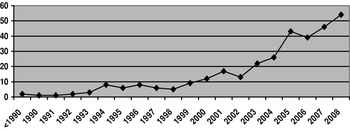
The increasing recognition by health professionals of the importance of FoF is demonstrated by the year-on-year increase in the numbers of articles published about this problem over the past two decades, in areas including geriatrics and gerontology, rheumatology, neurology, physiotherapy and occupational therapy (Figure 1).
Number of articles published since 1990 with fear of falling as the main outcome.

Various aspects of FoF have been investigated including risk factors, prevalence, how to measure it and therapeutic approaches. Some authors have considered the restriction that can occur when FoF renders the person too afraid to continue with their customary activities and have measured which activities can or cannot be accomplished.
Search methods
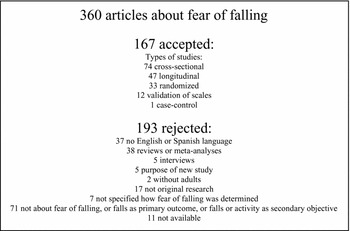
We searched for all articles included in the Medline Database up to June 2009 with the term ‘fear of falling’. From the 360 original articles, we considered all those in which ‘fear of falling’ was the main outcome, was a key for the population admitted, or those where FoF was a secondary objective and ‘falls’ or ‘activity’ was the main outcome.
The exclusion criteria were articles not written in English or Spanish, a review or meta-analysis, studies including children but not adults, interviews, commentaries or qualitative studies, or where FoF was considered not as a state but as a momentary feeling. Those articles in which the criteria used to define FoF were not clearly indicated or not referenced were also rejected.
From the initial 360 articles, 193 were rejected for reasons as set out in Figure 2.
Articles included and excluded according to search criteria.

Measuring fear of falling – criteria
All questions or scales used to determine the existence of FoF addressed to the person or, in some cases to the caregiver or health professional, were recorded. The importance of the question or scale was derived from the number of individual articles in which it was included, not from the number of the participants included in each research project. Some investigators had used more than one system to measure FoF.
Measuring restriction in activity due to fear of falling
All direct questions or scales used to enquire of patients or caregivers or health professionals whether any activity had been abandoned due to FoF were included. Those questions or scales which did not clearly identify that any restriction of the activity was due to FoF were rejected.
Measuring activity in general
We included questions about activity levels in general, such as any basic or instrumental ADL indices, or enquiries about leisure or social activities. Examples include the Barthel IndexReference Mahoney and Barthel25 or Lawton and Brody Scale,Reference Lawton and Brody26 and any scale or questionnaire that included any questions about any ADL, including scales of activities that are disease specific (such as the Health Assessment Questionnaire in Rheumatoid Arthritis), or questionnaires of quality of life.
Results
Measuring fear of falling
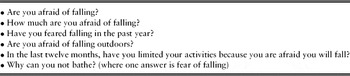
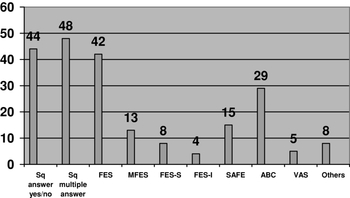
Many studies use single questions with a yes/no answer, or multiple answers. A single question was used to measure FoF in 92 of the studies, with a single answer (yes/no) in 44. A scale of measures was used in 48 of the studies, with answers of ‘not at all’, ‘a little’, ‘slightly’, ‘somewhat’, ‘very much’, or ‘other’. The wording of these questions varied greatly between studies. Examples are shown in Table 1. Some research attempted to measure change by grading the severity of FoF using a modified clinical global impression of change.Reference Balash, Hadar-Frumer, Herman, Peretz, Giladi and Hausdorff22
Examples of questions used to explore fear of falling

Many other studies used the Falls Efficacy Scale (FES),Reference Tinetti, Richman and Powell6 Activities-Specific Balance Confidence Scale (ABC),Reference Powell and Myers27 or Survey of Activities and Fear of Falling in the Elderly (SAFE).Reference Lachman, Howland, Tennstedt, Jette, Assmann and Peterson28 Some research used both single questions and scales.Reference Tinetti, Richman and Powell6, Reference Lawton and Brody26, Reference Kempen, Todd, Van Haastregt, Zijlstra, Beyer, Freiberger, Hauer, Piot-Ziegler and Yardley30–Reference Legters, Verbus, Kitchen, Tomecsko and Urban42 It is not possible from the literature to define a gold standard.
Tinetti's Falls Efficacy Scale (FES)Reference Tinetti, Richman and Powell6 is the scale most frequently used, in 42 studies. The Swedish versionReference Hellström and Lindmark43 was used in eight and the Modified FESReference Hill, Schwarz, Kalogeropoulos and Gibson44 in 13 studies. The Falls Efficacy Scale – International,Reference Kempen, Todd, Van Haastregt, Zijlstra, Beyer, Freiberger, Hauer, Piot-Ziegler and Yardley30, Reference Yardley, Beyer, Hauer, Kempen, Piot-Ziegler and Todd45 derived from FES but with a different system, had been used in four studies and, in its short version, in two.Reference Kempen, Yardley, van Haastregt, Zijlstra, Beyer, Hauer and Todd31, Reference Denkinger, Igl, Coll-Planas, Nikolaus, Bailer, Bader and Jamour34 The other frequently used scale is the ABC (Activity Balance Confidence Scale)Reference Powell and Myers27 that is also derived from the original FES and was used in 29 publications, one of them using the Dutch version. From this scale, shorter versions have been derived and used.Reference Schepensa, Goldberga and Wallace46
A different system of measurement is achieved by the SAFE scale,Reference Lachman, Howland, Tennstedt, Jette, Assmann and Peterson28 which poses questions about whether the person is able to carry out certain activities and specifically asks about activity restrictions. The SAFE scale was used in 15 articles, and in two of these the Dutch version was employed.
The Visual Analogue Scale (VAS)Reference Wolf, Feys, De, Van Der Meer, Noom, Aufdemkampe and Noom47–Reference Resnick, Orwig, D'Adamo, Yu-Yahiro, Hawkes, Shardell, Golden, Zimmerman and Magaziner51 requires the answer to each question to be marked on a line. This scale was used in five articles. The frequency of use of each scale/question is shown in Figure 3.
Use of questionnaire or scale methods of measuring fear of falling in analysed articles. Sq: single question; FES: Falls Efficacy Scale; MFES: Modified Falls Efficacy Scale; FES-S: Falls Efficacy Scale Swedish version; FES-I: Falls Efficacy Scale International; SAFE: Survey of Activities and Fear of Falling in the Elderly; ABC: Activities-Specific Balance Confidence Scale; VAS: Visual Analogue Scale.

Other scales used (in under five studies each) are the Post-Traumatic Stress Disorder scale,Reference Chun, McKee and Austin52 Activity-Specific Fall Caution Scale, Geriatric Fear of Falling Measure,Reference Huang53 and four questions in the fear scale in the Quality of Life Questionnaire for Osteoporosis.Reference Devereux, Robertson and Briffa54
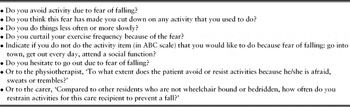
In some research, the carers rather than the individuals were questioned and scales were used that measure professional carers’ attitudes regarding falling. Examples of questions are shown in Table 2.
Questions used to explore restriction of activity consequent to fear of falling

Measuring activity restriction in patients with fear of falling
FoF has the potential to worsen the quality of life of not only the person who experiences it, but also others affected only indirectly. When FoF becomes more severe and provokes restriction of usual activity, the problem is no longer just a feeling, but becomes a practical problem for the person, their family and potentially for social support agencies. It is because of this that FoF may have catastrophic consequences for the life of the older person.
Data on restriction of activity due to FoF was collected in only 55 (32%) of the analysed articles, much less frequently than about FoF itself. Questions exploring this area are shown in Table 2.
Systems including SAFE, the Geriatric Fear of Falling Measure, the Activity Restriction Measure, and the Fear Induced Activity Restriction Measure question clearly whether or not the person participates in specific activities and specifically about activity restriction. We may suppose that people with very high apprehension of FoF are going to have activity restriction. Some other scales such as FES do enquire about the degree of activity restriction, but do not ask outright if it is the result of FoF. The modified FES poses the question ‘How confident are you to do the activity. . .’, but advises to score 0 if FoF has stopped the activity. Some studies suggest that FES has a very high concordance with activity restriction,Reference Cumming, Salkeld G, Thomas and Szony32, Reference Mendes de Leon, Seeman, Baker, Richardson and Tinetti55 even more than SAFE.Reference Hotchkiss, Fisher, Robertson, Ruttencutter, Schuffert and Barker56 The SAFE scale has been used in 15 studies, the rest in less than two each. Items have sometimes been obtained from other scales such as ‘Geriatric Fear of Falling Measure’Reference Huang53 or ‘Quality of Life Questionnaire measuring Fear of Falling’.Reference Warnke, Meyer, Bott and Mühlhauser57
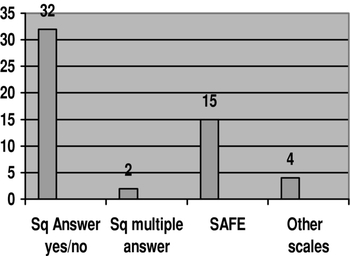
A single question was posed in 34 studies with a single yes/no answer in 32, and two with multiple answers. Some used both single questions and a scale. A summary is shown in Figure 4. In other articles, the questions relating to restriction in activity were asked of the carers: i.e. ‘Compared to other residents who are not wheelchair bound, or bed-ridden, how often do you place activity restrictions on this care recipient?’,Reference Fitzgerald, Hadjistavropoulos and MacNab58 or to a physiotherapist: ‘To what extent does the patient avoid or resist activities because he/she is afraid, sweats or trembles?’
Use of methods of approach measuring activity restriction in patients with fear of falling. Sq: single question; SAFE: Survey of Activities and Fear of Falling in the Elderly.

Measuring activity
In spite of its practical relevance, few studies about FoF include questions or scales to determine the restriction in activity that it produces. Where attempts are made to quantify this, measures of activity vary depending on the focus of the study, who organized it, and the nature of the participants.
From the reviewed articles concerning this area, 118 (71%) included a question or scale about ADL, ranging from the basic to the complex, for example sports participation. The measures used varied greatly between articles. The most frequently used is to ask the participants about basic ADL, namely bathing, dressing, getting in and out of bed or chair, transfers, toileting, eating, and urinary and bowel continence. Instrumental activities of daily living are frequently enquired about, for example preparing meals, household chores, financial management and medication, using the telephone, shopping, and transportation. Other activities may be enquired about including outdoor pastimes (e.g. going outdoors, distances walked, cycling, travelling, dancing, gardening) and more complex activities such as social interaction, volunteer work, leisure, sports, hobbies, visiting friends or church, or even taking care of other family members.
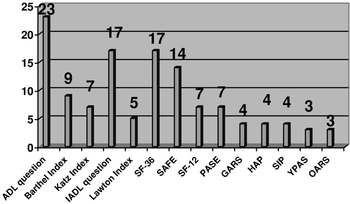
An alternative approach is to use an ADL index as a measure. The most frequently used were the BarthelReference Cameron, Stafford, Cumming, Birks, Kurrle, Lockwood, Quine, Finnegan and Salkeld35, Reference Franzoni, Rozzini, Boffelli, Frisoni and Trabucchi59 and Katz Index for basic ADLReference Cumming, Salkeld G, Thomas and Szony32, Reference Baloh, Spain, Socotch, Jacobson and Bell60 and Lawton and BrodyReference Andresen, Wolinsky, Miller, Wilson, Malmstrom and Miller40, Reference Baloh, Spain, Socotch, Jacobson and Bell60, Reference Wolf, Barnhart, Kutner, McNeely, Coogler and Xu61 for instrumental ADL.
Many articles include scales that contain questions about the functional situation and the activities in which the participant is involved. Examples of these scales or questionnaires are:
1 SF-36, which asks questions about activities such as lifting groceries, climbing stairs, walking outdoors, bathing or dressing, or moderate activities like moving a table or bowling, or more vigorous activities such as running or lifting heavy objects. It asks how limited the participant is in carrying out the activity. The SF-12 and SF-20 are similar (only one article used SF-20).Reference Cumming, Salkeld G, Thomas and Szony32, Reference Talley, Wyman and Gross62–Reference Suzuki, Ohyama, Yamada and Kanamori64
2 Physical Activity Scale for the Elderly, which includes many questions about current activities, such as those done sitting like reading a book or watching television; taking a walk outside, climbing up stairs, sports or recreational activities, housework or caring for another person. The results vary according to the frequency of doing that activity.Reference Nilsson, Fransson, Jarnlo, Magnusson and Rehncrona65–Reference Logghe, Zeeuwe, Verhagen, Wijnen-Sponselee, Willemsen, Bierma-Zeinstra, van Rossum, Faber and Koes67
3 Groningen Activity Restriction Scale, which asks about the majority of the basic and instrumental activities of daily living. Eighteen questions enquire about activities including washing, taking care of feet, and doing laundry. The results are dependent upon the degree of difficulty being experienced.Reference Logghe, Zeeuwe, Verhagen, Wijnen-Sponselee, Willemsen, Bierma-Zeinstra, van Rossum, Faber and Koes67, Reference Reelick, van Iersel, Kessels and Rikkert68
4 Yale Physical Activity Survey, which enquires about more difficult tasks such as carrying a load while climbing stairs, or walking outside and then enquires how often and for how long the activity is done.Reference Resnick, Orwig, Hawkes, Shardell, Golden, Werner, Zimmerman and Magaziner69–Reference Tinetti, Mendes de Leon, Doucette and Baker71
5 Survey of activity and fear of falling scale (SAFE), which is particularly targeted at measuring the fear of falling and the restriction that it produces, but also asks directly if the participant is able or not to perform the activity. The 11 activities enquired about vary in degrees of difficulty, some more basic such as bending down or getting out of bed, some instrumental such as preparing meals and some more complex or social such as visiting friends or walking for exercise.Reference Lachman, Howland, Tennstedt, Jette, Assmann and Peterson28, Reference Delbaere, Bourgois, Van Den Noortgate, Vanderstaraeten, Willems and Cambier33, Reference Delbaere, Van Den Noortgate, Bourgois, Vanderstraeten, Tine and Cambier39, Reference Talley, Wyman and Gross62, Reference Brouwer, Walker, Rydahl and Culham72
6 Human Activity Profile, which includes 95 activities that require progressively more effort. Many relate to basic activities such as getting in and out of chairs or bed without assistance or dressing or undressing without assistance. Instrumental questions include the use of public transport or driving a car, and social or leisure questions concern running, ball sports or dancing. The scale of responses is ‘still doing’, ‘have stopped doing’, or ‘never did the activity’.Reference Brouwer, Walker, Rydahl and Culham72, Reference Hill and Stinson73
7 Sickness Impact Profile, which indicates the changes in a person's behaviour due to sickness. It asks for responses to 136 statements about activities in ambulation, mobility, body care and movement, communication, alertness and emotional behaviour, social interaction, sleep and rest, eating, work, home management, and recreation and pastimes. Many questions are asked about basic and instrumental activities of daily living, such as ‘I do not bathe myself at all, but am bathed by someone else’ or ‘I do not walk at all’. The response to other social activities may be ‘I am going out for entertainment less’. Respondents check only the items that describe them on a given day and are related to their health.Reference Lawrence, Tennstedt, Kasten, Shih, Howland and Jette74, Reference Tennstedt, Howland, Lachman, Peterson, Kasten and Jette75
8 Health Assessment Questionnaire, which is a scale specifically for patients with rheumatoid arthritis, but it has been used more generally in people with FoF. It asks about dressing, grooming or eating, but also about shopping or housework. Responses are ‘without any difficulty’, ‘some difficulty’, ‘much difficulty’ or ‘unable to do’.Reference Martin, Hart, Spector, Doyle and Harari66, Reference Fessel and Nevitt76
9 Older American Resources and Services (OARS) Multidimensional Functional Assessment Questionnaire, which was designed to assess the overall personal functional status and service use of adults, in particular of the elderly. In part A, the Multidimensional Functional Assessment Questionnaire includes one section about ADL. Questions are asked about dressing and undressing, taking care of own appearance, getting in and out of bed or bathing, and about instrumental activities such as using the telephone, or going shopping. The response records the amount of help the person needs and whether they are totally dependent.Reference Fitzgerald, Hadjistavropoulos and MacNab58, Reference Fagerström, Persson, Holst and Hallberg77
The number of times each of these approaches was used in measuring activity restriction due to FoF in the articles surveyed is shown in Figure 5.
Use of methods of measuring activity in articles analysed. ADL: activities of daily living; IADL: instrumental activities of daily living; SAFE: Survey of Activities and Fear of Falling in the Elderly; PASE: Physical Activity Scale for the Elderly; GARS: Groningen Activity Restriction Scale; HAP: Human Activity Profile; SIP; Sickness Impact Profile; YPAS: Yale Physical Activity Survey; OARS: Older American Resources and Services Multidimensional Functional Assessment Questionnaire.

Scales or questions about degree of activity used in two or fewer articles each were: the Functional Ability Test,Reference Li, Fisher, Harmer, McAuley and Wilson78 Prosthetic Evaluation Questionnaire,Reference Miller, Deathe, Speechley and Koval79 Houghton Scale,Reference Miller, Deathe, Speechley and Koval79 Frenchay Activity Index,Reference Miller, Deathe, Speechley and Koval79 Intended Activity Scale,Reference Tennstedt, Howland, Lachman, Peterson, Kasten and Jette75 Hierarchical Physical Activity Scale,Reference Tinetti, Mendes de Leon, Doucette and Baker71 Late Life Function and Disability Instrument,Reference Denkinger, Igl, Coll-Planas, Nikolaus, Bailer, Bader and Jamour34 Iowa Self Assessment Inventory,Reference Vellas, Wayne, Romero, Baumgartner and Garry10 the motor component of the Unified Parkinson's Disease Rating Scale (UPDRS)Reference Dennison, Noorigian, Robinson, Fisman, Cianci, Moberg, Bunting-Perry, Martine, Duda and Stern80, Reference Franchignoni, Martignoni, Ferriero and Pasetti81 and the Parkinson's Disease Questionnaire,Reference Franchignoni, Martignoni, Ferriero and Pasetti81 World Health Organization Quality of Life Scale,Reference Lin, Wolf, Hwang, Gong and Chen50, Reference Huang and Wang82 EuroQol/EQ-5D Quality of Life Scale,Reference Brownsell and Hawley83 Physical Activity Scale for Individuals with Physical Disabilities,Reference Pang and Eng84 and the Functional Independent Measure.Reference Petrella, Payne, Myers, Overend and Chesworth85, Reference Manckoundia, Gerbault, Mourey, d'Athis, Nourdin, Monin, Camus and Pfitzenmeyer86
Discussion
FoF is difficult to measure objectively, as evidenced by the varying approaches used. A single question with single or multiple answers is the system that is most used. Several scales have been devised to measure FoF, including the FES and other derivative scales such as the most frequently used ABC. It is common practice for researchers to use both scales and single questions. Having a consensus approach to the meaning of FoF and its measurement in various situations is required.
The optimal approach to determining whether the patient has FoF will depend on the clinical or research circumstances and the purpose behind the assessment. A long scale will not be very suitable for use in a busy geriatric clinic, unless staff time is available. A quick measure will usually be more appropriate. However, using more time-consuming scales may be essential for monitoring the evolution of FoF and response to intervention.
The characteristics of the patients surveyed also influence the optimal approach. For illiterate, nearly illiterate or cognitively impaired older patients (a substantial proportion of the target population), single questions or simple answer scales are preferred. Cultural influences are important and agreements on methods used in different geographical situations are required. Few scales have been translated and validated in languages other than English. Validated scales in Dutch and German are exceptions.
Similar issues need to be considered when considering how best to measure the restriction of activity due to FoF. The percentage of articles collecting information about this restriction is low and the aim of the studies has tended to be academic rather than clinical service based. For the clinical situation, agreement on simple questions with yes and no answers addressing important ADL would be helpful. As restriction of activities by older people is a higher-level consequence of FoF, increasing dependency, and restricting quality of life, there would be potential benefit from incorporating measurement of this and the effect of interventions into routine clinical practice.
As FoF is a subjective feeling, it is difficult to measure in an objective way. However, the consequent restriction in activity can be objectively measured, with an ability to check from independent sources whether the responses accurately reflect activities undertaken. Future scales could benefit from refinements, such as measuring degree of risk avoided. For example, a ‘riskometer’ to grade the activities avoided, such as walking outside on snow or less risky personal care, could add sophistication to assessment of benefit from interventions.
Conclusion
Measuring level of activity can clarify not only the consequence of FoF but can also be used to determine whether therapeutic approaches are effective. Approaches to measurement vary: basic or instrumental ADL indices are most frequently used to describe activity level, with well-known measures of Barthel, Katz or Lawton and Brody being commonly used. Other scales or questionnaires about quality of life (e.g. SF-36 or OARS) or activity (such as SAFE or Groningen Activity Restriction Scale) have also been used. The different aims and objectives of the research articles explain some of these variations. There is a need for general consensus about how to measure the activity level in older people or other patients and the impact of FoF in order to improve interpretation and application of research results into clinical practice.
Conflicts of interest
No conflict of interest is declared by the authors.
This study is supported by grant BAE 90020 of the Instituto de Salud Carlos III, Madrid, Spain.