Background
At least 26.1 percent of Uganda's rural households derive their livelihoods from indigenous cattle (MAAIF et al., 2010) which constitutes 93.3 percent of the national herd. However, 1.2 million rural households from cattle keeping areas in Uganda have been reported to experience food insecurity (IRIN, 2013). Globally, a rapid human population growth rate, increased urbanization and escalating consumer preferences occurring in most parts of the developing world is a serious threat to food security (Thornton, Reference Thornton2010). Food insecurity is more evident among the rural poor households who are mainly engaged in smallholder crop-livestock farming systems (Delgado et al., Reference Delgado, Rosegrant, Steinfeld, Ehui and Courbois1999; Delgado, Reference Delgado2003). Smallholder farming systems have been perceived as less likely to satisfy the demand for foods of animal origin set to dramatically increase (MAAIF, 2013). In order to arrest this situation, a High Level Panel of Experts on Food Security and Nutrition (HLPE, Reference Gitz2013) has argued that increased capitalization of smallholder livestock enterprise systems could provide a dependable conduit out of poverty and food insecurity for nearly one billion people in sub-Saharan Africa. Since about 26.1 percent of the Uganda's households derive most of their livelihood from indigenous cattle (MAAIF et al., 2010), government and local non-government organizations (NGOs) perceive increased capitalization of smallholder livestock farming systems as a springboard for poverty reduction (Baltenweck et al., Reference Baltenweck, Mubiru, Nanyeenya, Njoroge, Halberg, Romney and Staal2007). As a result current national livestock policies encourage smallholder livestock farmers to cross-breed their indigenous cattle towards the more specialized high yielding exotic breeds in a bid to increase productivity (Taberlet et al., Reference Taberlet, Valentini, Rezaei, Naderi, Pompanon, Negrini and Ajmone-Marsan2008). This is being done without conservation plans of the indigenous genetic resources which manifests as variation of the indigenous cattle adapted to the different landscapes (Taberlet et al., Reference Taberlet, Valentini, Rezaei, Naderi, Pompanon, Negrini and Ajmone-Marsan2008). Indigenous cattle are well endowed with adaptive traits to endemic diseases, fragile climatic conditions and poor feed resources (Hanotte, Dessie and Kemp, Reference Hanotte, Dessie and Kemp2010; Hoffmann, Reference Hoffmann2010) and the current cross-breeding practices may result into an irreversible loss of genetic variation (Taberlet et al., Reference Taberlet, Valentini, Rezaei, Naderi, Pompanon, Negrini and Ajmone-Marsan2008). Indeed, scientists have already warned that this loss spells disaster for Africa's food security and livestock genetic pool for the next generation (Seré et al., Reference Seré, van der Zijpp, Persley and Rege2008; Hanotte, Dessie and Kemp, Reference Hanotte, Dessie and Kemp2010). Before more losses are realized, there is a need to study in a landscape approach the current genetic variation among the indigenous breeds and how geographic and socio-cultural factors have influenced these patterns of variations (Joost et al., Reference Joost, Bonin, Bruford, Després, Conord, Erhardt and Taberlet2007; Pariset et al., Reference Pariset, Joost, Ajmone Marsan and Valentini2009; Schwartz et al., Reference Schwartz, Copeland, Anderson, Squires, Inman, Mckelvey, Pilgrim, Waits and Cushman2009). In this study we review literature concerning indigenous cattle in Uganda with the aim of establishing how management factors, socio-cultural values and landscapes influence variations among local indigenous cattle genotypes. Finally we have highlighted the consequences of intensive management systems, selection for increased productivity traits and the threats to indigenous cattle diversity in Uganda.
Review methodology
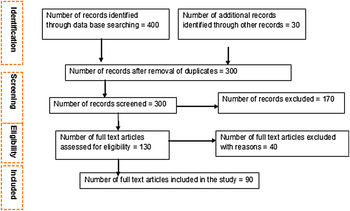
A search of peer-reviewed studies on indigenous cattle breed diversity was conducted from comprehensive databases including Google Scholar, PubMed, Science Direct, Swetswise and CAB direct. The search was extended to available theses, conference proceedings, project reports etc. The search was restricted to English language articles. Keywords were standardized across the databases to produce comparable searches and these were: Ankole; genetic variation; indigenous cattle keepers; agro-pastoral and pastoral; East African shorthorn zebu; Uganda. References of all relevant articles were also searched to identify articles that could have been missed in the search. A total of 430 records were retrieved. All records were imported in to Microsoft Excel, and articles presenting duplicate titles/findings were removed to obtain 300 records. Further screening was done by title and abstract focusing on studies reporting on indigenous cattle breeds and factors enhancing their variation, potential challenges of intensification and threats to genetic diversity in Uganda and countries with similar situations yielding 130 text articles published as of May 2015. Additional screening of the articles then identified the most relevant ones for Uganda yielding 90 articles which were used in this review. Figure 1 shows a flow chart of the methodology used to identify and review literature used in this report (Moher et al., Reference Moher, Liberati, Tetzlaff and Altman2009).
A flow chart of the methodology used to identify and review literature on Indigenous cattle breeds and factors enhancing their variation, potential challenges of intensification and threats to genetic diversity in Uganda (Adopted from PRISMA flow diagram (Moher et al. 2009).

Indigenous cattle breeds in Uganda
Uganda has a total of 10.64 million indigenous cattle, representing 93.3 percent of the national herd of 11.4 million (MAAIF/UBOS, 2010). The Ankole and East African shorthorn Zebu (EASZ) constitute the main traditional cattle breeds in Uganda. Other breeds are variants and intermediates of the two including Nganda, Nkedi, Kyoga, Nyoro and Kigezi (Rege and Tawah, Reference Rege and Tawah1999). Although indigenous cattle have been faulted for low productivity and reproductive performances, they still remain popular in Uganda because of their adaptive traits to the local underprivileged conditions (Balikowa, Reference Balikowa2011). Below is a brief description of the indigenous cattle breeds.
The Ankole cattle
The Ankole cattle have been naturalized in Uganda having been imported from North-eastern Africa about 600 years ago (Rege, Reference Rege1999) by the Hamitic (Bantu) pastoralists. In addition to Uganda, Ankole cattle are found in Burundi, Democratic Republic of Congo (DRC), northern Tanzania and Rwanda. In Uganda, the Ankole cattle are mainly present in the western and south-western rangelands but also some parts of central Uganda (Okello and Sabiti, Reference Okello and Sabiti2006; Ndumu et al., Reference Ndumu, Baumung, Wurzinger, Drucker, Okeyo, Semambo and Sölkner2008).They are part of the Sanga linage of cattle which probably evolved in Ethiopia as a product of interbreeding between the original longhorn non-humped cattle with the cervico-thoracic humped zebu cattle (Rege and Tawah, Reference Rege and Tawah1999; Rege, Reference Rege1999; Kugonza et al., Reference Kugonza, Nabasirye, Hanotte, Mpairwe and Okeyo2012). Having evolved within Africa, the Ankole cattle constitute an indispensible Animal Genetic Resource (AnGR). They are reared by the pastoral and agro-pastoral farming communities in a typical subsistence traditional farming system, thus constituting an indispensable and unique AnGR well adapted to the local tropical conditions. They are characterized by a medium to large body frame with a small cervico-thoracic hump, large, long and curved white horns. The coat colour is mainly red, fawn, brown and often spotted with white. Several ecotypes have emerged as a result of different indigenous cattle keeping communities who benefit a supply of food and income for recurrent needs, risk aversion, accumulation of cultural wealth and prestige (Wurzinger et al., Reference Wurzinger, Ndumu, Baumung, Drucker, Okeyo, Semambo, Byamungu and Sölkner2006).
The EASZ cattle
The EASZ cattle (Bos indicus) were introduced into the East African region by the Arab traders through the East African coast from Western Asia (Payne, Reference Payne1990; Rege, Reference Rege1999). Several variations of Shorthorn Zebu cattle are reared in the eastern and southern Africa, all commonly referred to as the “East African Zebu”. However, based on their sizes and conformation, two main populations of Shorthorn Zebu are recognized and these are “the large” and “small” groups (Rege, Reference Rege1999). The large Zebu types traditionally inhabit the marginal lands of northern Kenya, north-eastern Uganda, southern Sudan, southern Ethiopia and western Somalia. The small East African Zebu cattle have a smaller and more compact body as compared with the large Zebu. They are more common in the much wetter habitats and manifest greater variations in size and conformation. However, both the small and large Zebu types are believed to be of common lineage. Mwacharo et al. (Reference Mwacharo, Okeyo, Kamande and Rege2006) have attributed the variations in size to have resulted from adaptive response to the prevailing natural environment.
Variation among cattle populations, its origins and importance
Only two cattle domestication centres, the Fertile Crescent at the border of Iran, Iraq and Turkey, and the Indus valley of today's Pakistan (Bradley et al., Reference Bradley, MacHugh, Cunningham and Loftus1996; Freeman et al., Reference Freeman, Hoggart, Hanotte and Bradley2006) have been fully documented. The progenitor of modern cattle is the extinct wild auroch (Bos primigenius) (Ajmone-Marsan, Garcia and Lenstra, Reference Ajmone-Marsan, Garcia and Lenstra2010) which lived as two subspecies in the Fertile Crescent and the Indus Valley which have given rise to a vast variation present in cattle populations today. Enormous variations arose after subsequent dispersal of cattle over different continents and adaptation to various environments (Ajmone-Marsan, Garcia and Lenstra, Reference Ajmone-Marsan, Garcia and Lenstra2010).
This wide variety of characteristics evolved more or less naturally over a few thousands of years, but has recently been rapid leading to the development of well defined, specialized and genetically isolated breeds (Ajmone-Marsan, Garcia and Lenstra, Reference Ajmone-Marsan, Garcia and Lenstra2010). Cattle variations based on geographical, ecological or cultural isolations with heritable characteristics such as colour markings, unique morphologies and differences in yields have resulted into the modern distinct breeds (FAO, 2003, 2007). Felius et al. (Reference Felius, Beerling, Buchanan, Theunissen, Koolmees and Lenstra2014) have noted that the natural distribution of B. taurus and indicus is successfully restricted to regions with similar climatic conditions to those of the earlier domestication centres in the Fertile Crescent and the Indus Valley, respectively.
Wilson (Reference Wilson2009) has described fitness traits of tropical indigenous livestock that may equally apply to cattle which give them comparative advantage to survive in the tropics better than the temperate breeds. They are: – a lower metabolic rate that produces less heat; reduced panting but more ready sweating that preserves energy; a feed intake which is less affected by high ambient temperatures; a higher ability to survive on lower quality feed; higher digestibility and efficiency of feed conversion; lower water requirement; a greater ability to retain feed and water in the large intestine and better resistance to ticks, insects and some diseases. Indeed these qualities are present among indigenous cattle populations of Uganda with different variations.
Today, several breeds have emerged as a result of interbreeding related indicine and taurine cattle. This tends to occur in localities without distinct boundaries as is the case of Ankole-Zebu crosses giving rise to unique variations of the two such as the Nganda and Nyoro cattle in central Uganda. Variation has not emerged to be studied at a later time as a basis for classification of cattle, genetic diversity and adaptation. Studying the factors which enhance indigenous cattle variation in contrasting landscapes could provide a baseline for landscape genomic research and conservation approaches thus establishing the gene pool for next generation livestock farming.
Traditional management systems and their influence on indigenous cattle variation
Traditional management systems by either opening grazing and/or tethering on communal pastures are the mainstay of traditional cattle management practices in East Africa (Muhereza and Ossiya, Reference Muhereza and Ossiya2004). These systems form a continuum between agro-pastoralism and pastoralism in Uganda (Nalule, Reference Nalule2010; Balikowa, Reference Balikowa2011). Livestock farming communities select breeding sires and dams with specific traits to enhance resilience to the challenges of pastoralism and agro-pastoralism in their localities. This selective breeding enhances cattle population adaptive traits to extremes of either system with tendencies to develop variations (Franktin and Mearns, Reference Franktin and Mearns2003). For example, in the semi-arid region of north eastern Uganda, the climatic conditions vary from arid to semi-arid with seasonal availability of pasture and water (Loquang and Köehler-Rollefson, Reference Loquang and Köehler-Rollefson2005; Nalule, Reference Nalule2010), to which traditional Karamojong shorthorn zebu cattle are well adapted. Similar although less severe conditions apply to the Bahima pastoral communities in the South-western pastoral rangelands of Uganda (Kugonza et al., Reference Kugonza, Nabasirye, Hanotte, Mpairwe and Okeyo2012). Indigenous cattle provide the most suitable means of exploiting marginal lands with scarce resources and sustainable pastoral livelihoods (Hoffmann, Reference Hoffmann2011). The farmers’ selection criteria of breeding cattle under this system would opt for resilience traits observed in parent stock associated with strong well-developed musculature to enable long distance movement in search for pastures and water (FAO, 2007). While in the agro-pastoral areas of the Lake Victoria Crescent agro-ecological zone (AEZ) where cattle are mainly tethered, selection will target docile cattle to enable frequent handling. Such selection is likely to result into locally adapted variations of indigenous cattle. Presently, local farmers’ choices greatly influence patterns of genetic variation which has not yet been fully studied, similar to the morphometric variation lately documented (Kabi et al., Reference Kabi, Masembe, Negrini and Muwanika2015).
The role of socio-cultural practices in indigenous cattle variations
Cattle keeping communities in Uganda have deliberately bred cattle as a socio-cultural prestige in addition to being a primary source of livelihood to households (Kugonza et al., Reference Kugonza, Nabasirye, Mpairwe, Hanotte and Okeyo2011). Several indigenous breeds are connected to a specific ethnic group or community, which is often reflected in the breed names such as the Nganda and Ankole cattle (Kohler-Rollefson, Reference Kohler-Rollefson2003; Krätli, Reference Krätli2008). Different cattle keeping communities deliberately breed cattle to develop favoured unique variations (FAO, 2007, 2009). This practice has been observed among the Ankole cattle communities where unique morphological features such as the shape of horns and colour markings (Ndumu et al., Reference Ndumu, Baumung, Wurzinger, Drucker, Okeyo, Semambo and Sölkner2008; Kugonza et al., Reference Kugonza, Nabasirye, Hanotte, Mpairwe and Okeyo2012) create a sense of ownership while meeting the traditional desires of the communities. Some of these practices were initiated by the pre-colonial monarchies for gifts and presents to beloved ones or ceremonies and festivities (Ndumu et al., Reference Ndumu, Baumung, Wurzinger, Drucker, Okeyo, Semambo and Sölkner2008). As a result cattle populations in Uganda have been named according to tribal communities such as the Teso zebu for the Itesot speaking community and Nyoro cattle for the Banyoro speaking communities. This accounts for great variation among indigenous cattle populations within the country.
The traditional cattle keepers from the West Nile region, North-eastern and South-eastern Uganda keep the EASZ cattle. The specific features of the EASZ cattle such as size and shape of horns, multiple colourations, body size are carefully selected for by kraal leader through utilization of specific sires and dams (Loquang and Köehler-Rollefson, Reference Loquang and Köehler-Rollefson2005; Nalule, Reference Nalule2010). These too account for significant variations among cattle populations. The Karamojong Zebu cattle, Nkedi Zebu, Lango Zebu and the Nganda Zebu are the common varieties belonging to the various cattle keeping communities in Uganda.
The role of landscape features to variations among indigenous cattle populations
Uganda is endowed with unique physical features such lakes, rivers, highlands and rift valleys. These features provide exclusion barriers within geographical and ecological locations dividing indigenous cattle inhabitants into several subpopulations. Breeding of cattle within the same localities have definitely concentrated specific features (productivity, resilience and adaptive) which vary from one locality to another as could be influenced by the landscape as previously described by Grimaud et al. (Reference Grimaud, Mpairwe, Chalimbaud, Messad and Faye2007). Pastoral communities select breeding cattle with attributes to withstand challenges created by landscapes, this is common in semi-arid region of Karamoja where cattle have to trek long distances in search of pastures and water (FAO, 2007; Nalule, Reference Nalule2010). In the South-western rangeland cattle will utilize pastures on the higher altitudes during the wet seasons and are moved to the lower altitude valleys in the dry seasons. This requires adaptation to seasonal movements between the different altitudes. This local adaptation could potentially create significant variations between the cattle in the rangelands, plateaus and highlands.
The role of adaptation to endemic diseases
Cattle keeping communities in rural areas may not have access to adequate modern disease control and veterinary services. For example, Gradé, Tabuti and Van Damme (Reference Gradé, Tabuti and Van Damme2009) note that cattle present in the semi-arid regions do not access adequate veterinary services. In such situations cattle get adapted to seasonal movement away from areas with high disease risks created by insect vectors emergence during the rainy seasons and will return when the dry season sets in. However, minimal continuous exposure to specific diseases such as East coast fever will result into exhibition of non-clinical disease conditions loosely related to endemic stability within a population as lately described (Kabi et al., Reference Kabi, Masembe, Muwanika, Kirunda and Negrini2014). Such practices will result into indigenous cattle genotypes yet to be described that vary with different disease challenges and control practices (Carval and Ferrier, Reference Carval and Ferrier2010). Several studies have indicated that indigenous cattle can endure and be sustainably productive in the presence of disease challenges, a phenomenon referred to as tolerance or resilience to disease (Baker and Gray, Reference Baker and Gray2004; Bishop, Reference Bishop2012) and endemic stability (Jonsson et al., Reference Jonsson, Bock, Jorgensen, Morton and Stear2012) to infection. In pastoral areas of Uganda, the humid climatic conditions favour proliferation of vectors creating an endemic disease presence (Otim et al., Reference Otim, Ocaido, Okuna, Erume, Ssekitto, Wafula, Kakaire, Walubengo, Okello, Mugisha and Monrad2004; Ocaido et al., Reference Ocaido, Otim, Okuna, Erume, Ssekitto, Wafula, Kakaire, Walubengo and Monrad2005; Moloo, Kutuza and Borehan, Reference Moloo, Kutuza and Borehan2006). The continuous exposure of endemic diseases such as tick borne diseases among indigenous cattle populations has led to the development of tick borne disease tolerant traits (Jonsson et al., Reference Jonsson, Bock, Jorgensen, Morton and Stear2012). However, these unique traits (such as endemic stability among indigenous cattle) may be lost due to stringent tick control measures being imposed on indigenous cattle in order to protect exotic naïve breeds imported in Uganda since the former are regarded as source of infection (Okello-Onen et al., Reference Okello-Onen, Mukhebi, Tukahirwa, Musisi, Bode, Heinonen, Perry and Opuda-Asibo1998). Disease outbreaks among populations with low genetic variation have been reported to result into high morbidity and mortality rates as is the case with exotic genotypes compared with genetically diverse livestock populations (Mirkena et al., Reference Mirkena, Duguma, Haile, Tibbo, Okeyo, Wurzinger and Sölkner2010; Danchin-Burge et al., Reference Danchin-Burge, Leroy, Moureaux and Verrier2012).
Based on the above factors of variation, an appropriate cattle population would require most of these traits, such as adaptation to local physical landscape, nutritional and management environments; acceptability to local communities’ socio-cultural needs; resistance to the endemic diseases of the area; good reproductive and growth performance; and adequate yields of meat, milk, draught power related to the prevailing management system. Similar qualities have also been alluded to by Wilson (Reference Wilson2009). However, it is worth noting that adaptive traits may not be positively correlated to increased productivity as shown by unfavourable genetic correlation between milk yield and the incidence of ketosis, ovarian cyst, mastitis and lameness. This means that continued selection for higher milk yield will increase incidence rates for these production diseases and reduce the well-being of dairy cows (Ingvartsen, Dewhurst and Friggens, Reference Ingvartsen, Dewhurst and Friggens2003). Generally, the critical factor for increased productivity in farm animals is the availability of insufficient resources for adequately coping with environmental stresses and disease pathogen challenges (Rauw, Reference Rauw2009). This indirectly assigns limits to further increase in productivity of livestock in the tropics where endemic disease challenges are quite high.
The potential challenges of intensification of smallholder livestock farming systems
Increasing quality of farm inputs and services
Improvement of rural household incomes is part of Uganda's obligations to the Millennium Development Goals initiatives (MAAIF et al., 2010). In view of the circumstances that most of the rural households derive much of their livelihoods from smallholder livestock farming systems. Policy makers and other stakeholders envisage the commercialization of livestock production as one of the favourable option, both to meet the increasing demand for livestock products in addition to contributing to poverty reduction among households (Otte and Upton, Reference Otte and Upton2005; MAAIF et al., 2010; Udo et al., Reference Udo, Aklilu, Phong, Bosma, Budisatria, Patil, Samdup and Bebe2011). This policy and practice will most likely lead to intensive cattle management systems. However, intensification demands increased use of purchased high quality inputs and services, such as feed supplements, replacement stock, breeding and veterinary health services (Bebe et al., Reference Bebe, Udo, Rowlands and Thorpe2003; Otte and Upton, Reference Otte and Upton2005; Udo et al., Reference Udo, Aklilu, Phong, Bosma, Budisatria, Patil, Samdup and Bebe2011). This means that in practical terms more investment will be needed and it is the affluent livestock farmers who may have the capacity to benefit from the increased demands for livestock products. This paints a dark cloud over the benefits of intensification of smallholder livestock farming systems especially among the majority of the rural poor. Cooperatives for bulk milk marketing and purchase of inputs, and modern management skills will be needed urgently. This calls for revitalization of farmers’ credit and cooperative saving schemes which were abolished during privatization of public enterprises in Uganda to assist small scale farmers with procurement of farm inputs, value addition and marketing of milk and its products.
Intensified selection of cattle
After livestock were domesticated, selection criteria mostly targeted phenotypic behavioural traits such as calmness in cattle for non-problematic handling and beautiful colour patterns (Oltenacu and Broom, Reference Oltenacu and Broom2010; Taberlet et al., Reference Taberlet, Coissac, Pansu and Pompanon2011) in addition to productivity traits to provide better livelihoods among households. However, in the last 40 to 60 years, interest has mainly shifted to genetic improvement of productivity traits, including milk yield and beef in cattle (Oltenacu and Broom, Reference Oltenacu and Broom2010). Consequently milk productivity has tremendously increased in various farming systems within the tropics over the recent decades as observed by Galukande et al. (Reference Galukande, Mulindwa, Wurzinger, Roschinsky, Mwai and Sölkner2013). However, this has to be accompanied with intensive management practices, without which the maintenance of increased productivity remains quite challenging to rural smallholder livestock farmers. In other regions, high productivity has been accompanied by challenges such as reduced capacity to reproduce, increased incidence of metabolic disorders and declining longevity in modern dairy cows (Van Raden, Reference Van Raden2004; Oltenacu and Algers, Reference Oltenacu and Algers2005). Lameness is a common welfare challenge for dairy cows in the UK (Webster, Reference Webster2000; Amory et al., Reference Amory, Barker, Wright, Mason, Blowey and Green2008) which is usually complicated by loss of weight, poor feed intake, lowered milk production and higher risks of reduced fertility, mastitis and eventually culling (Weaver, Reference Weaver and Andrews2000). The incidence of metabolic disorders and production ailments tends to occur whenever high yielding cows are unable to satisfy the high metabolic requirements of maintenance, pregnancy and lactation (Rauw et al., Reference Rauw, Kanis, Noordhuizen-Stassen and Grommers1998). For example severe forms of hypocalcaemia or hypomagnesaemia occur when the cows run short of calcium and magnesium in circulation, respectively (Rauw et al., Reference Rauw, Kanis, Noordhuizen-Stassen and Grommers1998). Other diseases such as ketosis and fat liver syndrome occur due to above normal energy demands (Webster, Reference Webster2000). Without specialized veterinary attention and manufactured nutritional farm inputs, huge losses will usually result. Intense selection for high milk yield has also been linked to high infertility levels (Webster, Reference Webster2000). Increased milk yield is genetically correlated to longer calving intervals, more days to first service and lowered chances of conception at first service. The resultant infertility is the main reason for culling in dairy cows (Whitaker, Kelly and Smith, Reference Whitaker, Kelly and Smith2000). Nørgaard, Lind and Agger (Reference Nørgaard, Lind and Agger1999) conclude that a higher level of physiological stress due to higher milk yield and concentrate consumption has led to increased mortality in dairy cows. Intensified selection for increased productivity without fitness is now being discouraged in developed countries due to welfare reasons (Oltenacu and Broom, Reference Oltenacu and Broom2010).
Selective breeding for increased productivity in tropical countries like Uganda must be accompanied with agro-ecological fitness to counter metabolic, unsustainable feed resources and endemic diseases challenges as suggested by Eisler et al. (Reference Eisler, Lee, Tarlton, Martin, Beddington, Dungait, Greathead, Liu, Mathew, Miller, Misselbrook, Murray, Vinod, Van Saun and Winter2014). Intensive selective breeding for increased productivity in Uganda can be successful if well planned to counter the negative effects which usually occur at extremely high levels of productivity of cross-bred cattle. In India for example the Sunandini synthetic cattle breed has been developed through a well-organized cross-breeding programme between the Jersey, Brown Swiss and Friesian and the local cows of Kerala state, with the involvement of local farmers’ interests resulting into high milk production (Chacko, Reference Chacko, Ojango, Malmfors and Okeyo2005). The Australian Friesian Sahiwal is another popular synthetic breed with 50:50 Sahiwal:Friesian developed and maintained by the Queensland government in Australia for more than 30 years before being privatized. Among other traits, this breed is known to have good tick resistance, milk yield traits and well adapted to tropical grazing pastures (Stephens, Reference Stephens2006).
Threats to indigenous cattle diversity in Uganda
In general, several authors have accepted the fact that AnGR is on the decline due to several factors acting as threats to the latter (Eisler et al., Reference Eisler, Lee, Tarlton, Martin, Beddington, Dungait, Greathead, Liu, Mathew, Miller, Misselbrook, Murray, Vinod, Van Saun and Winter2014). For example Bett et al. (Reference Bett, Okeyo, Malmfors, Johansson, Agaba, Kugonza, Bhuiyan, Filho, Mariante, Mujibi and Philipsson2013) have noted that the Ankole and Nganda cattle genotypes have become gradually threatened due to cross-breeding with exotic dairy breeds. Likewise the Nkedi and Lugbara zebu linage could be disappearing due to breed substitution with Ankole and Karamajong, respectively. The Kigezi breed could be threatened due to the high human population pressure in its homeland of south western highlands, increased cross-breeding with the more productive exotic genotypes and suitable environmental conditions (Bett et al., Reference Bett, Okeyo, Malmfors, Johansson, Agaba, Kugonza, Bhuiyan, Filho, Mariante, Mujibi and Philipsson2013).
The use of exotic germplasm, changes in production systems, because of socio-economic factors, natural disasters (drought, famine, disease epidemics, civil strife/war) and exploitation of rangeland resources have been cited as the major causes of genetic erosion (Rege and Gibson, Reference Rege and Gibson2003; Gibson et al., Reference Gibson, Gamage, Hanotte, Iñiguez, Maillard, Rischkowsky, Semambo and Toll2006; Taberlet et al., Reference Taberlet, Valentini, Rezaei, Naderi, Pompanon, Negrini and Ajmone-Marsan2008) however, these are common in the rest of the world but also occur in Uganda.
Changes in producer preference due to socio-economic and policy factors
The increasing demand for foods of animal origin and improvement in income levels have tempted livestock farmers and policy makers towards the utilization of specialized high yielding breeds (Delgado, Reference Delgado2003). In Uganda, smallholder cattle farmers have been encouraged to replace their indigenous cattle with high yielding exotic breeds (Grimaud et al., Reference Grimaud, Mpairwe, Chalimbaud, Messad and Faye2007; Balikowa, Reference Balikowa2011). This is a widespread consequence of the need to increase productivity, although it is latently accompanied with narrowing of within-breed genetic variation (Kantanen et al., Reference Kantanen, Løvendahl, Strandberg, Eythordottir, Li, Kettunen-Præbel, Berg and Meuwissen2015). This is a big threat to indigenous cattle genetic diversity among agro-pastoral and pastoral farmers. Regions where this practice was previously promoted have reported loss of genetic variation (Kantanen et al., Reference Kantanen, Løvendahl, Strandberg, Eythordottir, Li, Kettunen-Præbel, Berg and Meuwissen2015). In Europe for example, 200 breeds of indigenous cattle have been replaced only by 20. This is undesirable in the current uncertain times of climate change.
Introduction of exotic germplasm
Use of exotic germplasm has been the approach in the desire to increase productivity in the tropics. Several initiative such as cattle zero-grazing and semi-intensive cattle farming with increased upgrading towards the more productive exotic cattle have been popularized in tropics including Uganda (Galukande et al., Reference Galukande, Mulindwa, Wurzinger, Roschinsky, Mwai and Sölkner2013). The use of artificial insemination, embryo transfer and exotic village bull schemes have been used at various stages as tools to support the introduction of exotic germplasm especially in cattle since 1960 (Galukande et al., Reference Galukande, Mulindwa, Wurzinger, Roschinsky, Mwai and Sölkner2013). In Uganda, these practices have been mainly amplified by local NGOs and other developmental community based organizations targeting smallholder cattle farmers with the objective of increasing milk productivity (Balikowa, Reference Balikowa2011). Unfair competition from vigorously promoted commercial European breeds (Rege and Gibson, Reference Rege and Gibson2003) even where such genotypes are inappropriate (King et al., Reference King, Parsons, Turnpenny, Nyangaga, Bakari and Wathes2006; Hanotte, Dessie and Kemp, Reference Hanotte, Dessie and Kemp2010) have been observed. No comprehensive national breeding program has been established to produce cattle that would easily get adapted to the local disease conditions, usually resulting into high mortality rates among improved dairy cattle (Bebe et al., Reference Bebe, Udo, Rowlands and Thorpe2003; Bayemi et al., Reference Bayemi, Bryant, Perera, Mbanya, Cavestany and Webb2005; Galukande et al., Reference Galukande, Mulindwa, Wurzinger, Roschinsky, Mwai and Sölkner2013). Despite the successes associated with cross-breeding, the practice has faced challenges such as limitations of skilled techniques (inadequate heat detection), mismatches between genotypes and production system where environmental conditions cause stress affecting heat detection, intermittent funding of programmes, lack of appropriate supportive policies and limited involvement of farmers in the design of the interventions. Unplanned use of exotic germplasm will most likely lead to loss of the much cherished indigenous cattle traits including endemic disease tolerance, adaptation to poor quality pasture and high environmental temperatures (Taberlet et al., Reference Taberlet, Valentini, Rezaei, Naderi, Pompanon, Negrini and Ajmone-Marsan2008). Improved dairy cattle are more vulnerable to local diseases and parasites particularly tick-borne diseases, internal helminths and trypanosomosis (Magona, Walubengo and Kabi, Reference Magona, Walubengo and Kabi2011), whose effective control requires substantial investments.
Changes in production systems
Indigenous cattle are managed by open grazing on communal rangelands, involving mobility in search of pastures and water in resource-scarce and highly variable marginal areas to enable human habitation and subsistence (Krätli et al., Reference Krätli, Huelsbusch, Brooks and Kaufmann2013). This is implemented in the form of sophisticated herd movements and grazing strategies to save forage for critical periods for sustainable utilization. However, successive colonial and post-independence government policies have always advocated for the settlement of pastoralists to enhance governance and political control (Inselman, Reference Inselman2003; AU-IBAR, 2012) faulting pastoralism as backwards and wasteful. In certain circumstances, increased population growth has in addition limited the availability of land available for pastoral nomadic movement, forcing pastoralists to revert to settled agriculture (Grimaud et al., Reference Grimaud, Mpairwe, Chalimbaud, Messad and Faye2007). The above have resulted into reduced mobility of pastoralists and their livestock, but may hasten loss of indigenous AnGR since local farmers are further enticed to indiscriminately cross-breed their cattle.
Breakdown of traditional and cultural leadership as a consequence of disaster
Livestock keeping communities have for long established traditional and cultural leadership institutions in order to ensure long-standing sustainable pasture management, water supply and AnGR (Rathore and Kohler-Rollefson, Reference Rathore, Kohler-Rollefson, Maier, Armonia and Gura2002; Homann, Dalle and Rischkowsky, Reference Homann, Dalle and Rischkowsky2004; Nalule, Reference Nalule2010). Due to continued conflicts and civil wars, community leaders are not able to enforce these leadership roles which would enable them to sustainably utilize scarce natural resources in the region (Nalule, Reference Nalule2010; Stites, Fries and Akabwai, Reference Stites, Fries and Akabwai2011; AU-IBAR, 2012). The council of Jie and Dodoth ethnic elders of Karamoja region have previously planned for the sustainable use of grazing pastures and water for livestock. Lack of comprehensive livestock management system due to the breakdown of traditional leadership as a continuous civil strife has resulted into degradation of rangeland resources which supplies livestock feeds thus threatening AnGR (Nalule, Reference Nalule2010).
Exploitation of natural resources within pastoral areas
Exploitation of oil and minerals in the Albertine region of Western savannah grassland zone and the Northeastern Drylands zone, respectively, will definitely interfere with the natural ecosystem of wildlife and plants (Kityo, Reference Kityo2011). Indigenous cattle which benefit from this ecosystem will lose access to feed and water resources. This is a threat to AnGR in the region.
Discussion and conclusion
Variations of indigenous cattle populations have augmented their agro-ecological fitness in Uganda while supporting several cattle keeping communities through provision of household livelihoods. This paper reviewed literature to establish how traditional management factors, contrasting landscapes and socio-cultural practices have influenced indigenous cattle variations. Additionally, challenges associated with intensive management initiatives, increased selection for higher productivity and associated threats to indigenous cattle diversity were elucidated.
From the review of available literature, indigenous cattle breeds including the Ankole and EASZ in Uganda have been regionally structured until recently when cattle trade and restocking plans have led to widespread dispersal of the two main breeds. Several indigenous cattle intermediate populations of the Ankole and EASZ occur patronized by other cattle keeping communities (Balikowa, Reference Balikowa2011; Kabi et al., Reference Kabi, Masembe, Negrini and Muwanika2015). The Ankole have been naturalized in the southwestern and western regions, while the EASZ have been mainly reared in the eastern, northern and west Nile regions. This breed distribution structure could be attributed to points of entry and settlements of immigrant cattle keepers and promotion by the pre-colonial traditional leadership in Uganda (Hanotte et al., Reference Hanotte, Tawah, Bradley, Okomo, Verjee, Ochieng and Rege2000). Ankole cattle that are present in Uganda, DRC, Rwanda, Burundi and western Tanzania could have arisen from livestock movements that followed Bantu immigration from the Niger-Cameroon region, along the Atlantic coast, or through the rainforest basin into the African Great Lakes region (Hanotte et al., Reference Hanotte, Tawah, Bradley, Okomo, Verjee, Ochieng and Rege2000). While the EASZ cattle that are believed to have moved inland following their introduction at the east African coast by Arab traders. The Zebu cattle spread was further enhanced by local pastoral communities and their natural resistance to the Rinderpest epidemic of the late nineteenth century (Epstein, Reference Epstein1971). Traditional management practices (selective breeding and grazing patterns), different landscapes, socio-cultural needs and endemic disease challenges have overtime enhanced indigenous cattle breed adaptation to their localities. The adaptations to diverse AEZs take the form of variations in body sizes and levels of productivity (Kugonza et al., Reference Kugonza, Nabasirye, Mpairwe, Hanotte and Okeyo2011), morphometric traits variations (Kabi et al., Reference Kabi, Masembe, Negrini and Muwanika2015) and resilience to endemic diseases (Magona, Walubengo and Kabi, Reference Magona, Walubengo and Kabi2011; Kabi et al., Reference Kabi, Masembe, Muwanika, Kirunda and Negrini2014). Currently, intensive cattle management policies are being popularized for increased productivity and prospective poverty alleviation (MAAIF, 2013). Developing countries mostly rely on cross-breeding towards the industrial livestock genotypes as a standard approach to the improvement of livestock production more especially for dairy cattle productivity. Several authors allude to the fact that at a higher level of cross-bred cattle, local animal genetic resources are lost (Thomas et al., Reference Thomas, Zerbini, Rao and Vaidyanathan2002; Udo et al., Reference Udo, Aklilu, Phong, Bosma, Budisatria, Patil, Samdup and Bebe2011; Galukande et al., Reference Galukande, Mulindwa, Wurzinger, Roschinsky, Mwai and Sölkner2013). Thus the call for national conservation plans of indigenous livestock resources to act as a source for future generation livestock farming. Additionally, several case-studies by Bebe et al. (Reference Bebe, Udo, Rowlands and Thorpe2003) and Udo et al. (Reference Udo, Aklilu, Phong, Bosma, Budisatria, Patil, Samdup and Bebe2011), reported that intensification demands increased use of purchased inputs and services, including feeds, replacement stock, breeding and veterinary health services, credit facilities, producer organizations and market access for both inputs and outputs, and an increase in livestock management skills.
Udo et al. (Reference Udo, Aklilu, Phong, Bosma, Budisatria, Patil, Samdup and Bebe2011), further noted that the less financially privileged farm households may exhibit less interest in investing their scarce resources and efforts in more intensive livestock systems. The socio-cultural and capital asset roles will remain important for these households. Furthermore, without robust development policies that deliberately consider the opportunities and threats likely to be met by mixed crop-livestock farming systems, these households are likely to miss out from the increased market opportunities for livestock intensification initiatives. Commercial industrial breeds of interest must only be promoted with adequate guidance in suitable ecologies and under appropriate management, while retaining the adaptive traits among indigenous cattle breeds. It is also worthy understanding that the modern breeding techniques such as artificial insemination, embryo transfer, cryopreservation and cloning from which industrial breeds are benefitted for wide popularization may also contribute immensely to the conservation and promotion of local breeds.
Awareness of the value of indigenous cattle genetic variations has now attracted lots of attention and can no longer be overlooked with respect to the different landscapes of Uganda. Indigenous cattle breeds adapted to contrasting landscapes and ecosystems need to be conserved since they constitute an important genetic source for next generation farming. Conservation efforts should be well planned to enable maintenance of within breed and between breed variations with consideration of their agro-ecological habitats. Within-breed variation is critical for the genetic adaptation of a population to changes in the production and economic environment and for averting inbreeding problems. With regard to the increasing demand of foods of animal origin, stakeholder must create policies that will enable the poor to obtain a share in the expanding market for livestock products. The policies include introduction of savings and credit schemes, removal of market barriers to trade in traditional livestock products and improvement of social services to rural farming communities.
Acknowledgements
We thank the Next generation methods to preserve farm animal biodiversity (NEXTGEN) project and the Eastern Africa Agricultural Productivity Project (EAAPP) for providing the logistics for this study.
Statement of interest
The authors have no conflict of interest to declare.