Tobacco causes significant risks of cancer, cardiovascular disease, and diabetes mellitus. Reference Warren, Alberg and Kraft1 When people increase their tobacco consumption, the harm to their health may increase. Some previous studies have suggested that, compared with those who maintained a consistent cigarettes per day (CPD) level, higher death risks were observed in smokers who increased their CPD.
The Great East Japan Earthquake (GEJE) struck Japan in March 2011. It was a complex disaster, which comprised an earthquake, tsunami, and radiation. The GEJE killed thousands of people and destroyed a substantial number of homes and buildings, which in turn affected stress levels and health behavior among the residents. Reference Matsumoto, Sakuma and Ueda2-Reference Nakano, Ohira and Maeda4 Smoking behaviors, such as smoking rate, may have changed after the disaster. However, few studies have examined the determinants of increased CPD, including personal, social, and cultural factors when a disaster occurred. Reference Lanctot, Stockton and Mzayek5-Reference Flory, Hankin and Kloos9 Therefore, the objective of this study was to explore the determinants of increased tobacco consumption after the GEJE.
METHODS
Data
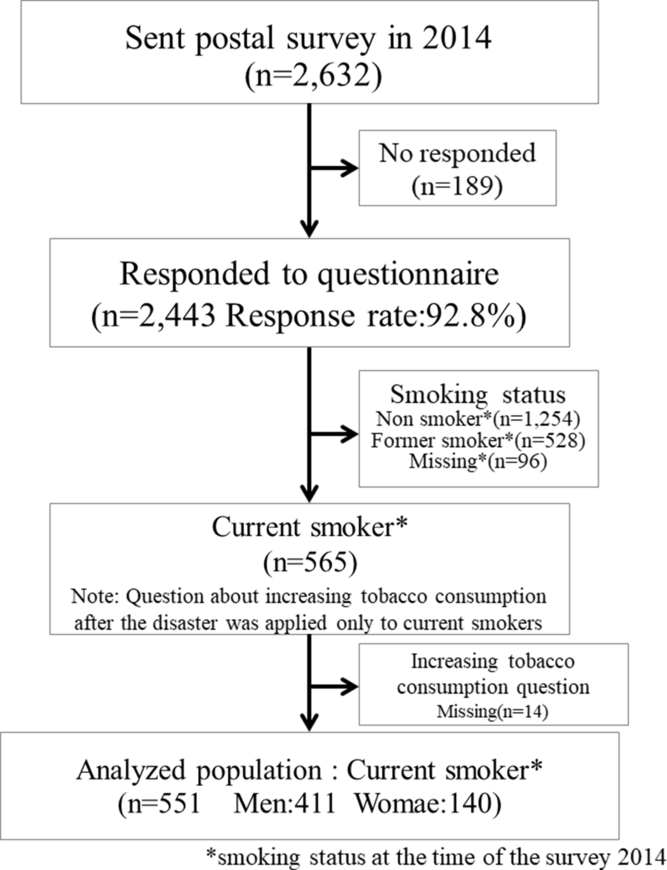
A cross-sectional study with secondary analyses was conducted using data from the Miyagi Prefectural Health Survey 2014. Reference Matsuyama, Aida and Tsuboya10 Miyagi Prefecture is in the central part of Tohoku, facing the Pacific Ocean. As a result of the GEJE, Miyagi prefecture experienced the most devastating damage in Japan; over 10,000 people died, over 1000 people were reported missing and over 80,000 houses were completely destroyed. 11 Furthermore, approximately 10,000 people lost their jobs after the GEJE compared with the same period in the previous year. In October and November 2014, a total of 2632 people were randomly selected from residents aged ≥20 years in Miyagi Prefecture and were sent self-report questionnaires. The full questionnaire is available on the prefecture website. 12 Of the 2632 residents who received the questionnaires, 2443 (92.8%) responded. The distribution of responses to the single question: “Have you ever smoked?” among the 2443 respondents was as follows: 565 current smokers (23.1%), 528 former smokers (21.6%), 1254 never smokers (51.3%), and 96 with missing information on their smoking status (3.9%). The question about increased tobacco consumption after the GEJE was only applied to current smokers at the time of survey, thus only data of 551 current smokers were used in the present study (Figure 1). Ethical approval for this secondary analysis was obtained from the Ethics Committee of Tohoku University.
Data for 551 Smokers Were Included in the Analysis.

Outcome Variable: Increasing Tobacco Consumption After the GEJE
To assess any increase in tobacco consumption after GEJE participants were asked: “Did you change the number of cigarettes you smoked compared to before the earthquake?”. The possible responses were “increased/about the same (unchanged)/decreased.” We divided these responses into 2 values: increased/about the same (unchanged) or decreased.
Explanatory Variables
We used key variables: age, sex, disaster-related job status change, educational attainment, self-rated health, and age at smoking initiation. Age was categorized as follows: 20–39 years old, 40–59 years old, and 60–89 years old. Disaster-related job status change was assessed using the question: “Did the GEJE have any impact on your employment?” with possible answers: “lost job/changed job/leave of absence/retired/no change”. Educational attainment was categorized as: ≤9 years (low), 10–12 years (middle), and ≥13 years (high) of education. Self-rated health status was categorized as: very good, good, average, not good, and poor. To understand the changes caused by the earthquake more clearly, we included a question about smoking history to determine age at smoking initiation. This was categorized as ≥20 years old/<19 years old.
Statistical Analysis
Descriptive statistics were used to characterize the respondents. First, to determine the associations between an increase in tobacco consumption after the GEJE and the key variables of tobacco consumption change, cross-tabulation and a chi-square test were performed. Second, we verified the associations between an increase in tobacco consumption after the GEJE and the key variable of change in tobacco consumption using univariate and multivariable logistic regressions. We calculated the odds ratios (ORs) and 95% confidence intervals (95% CI) for tobacco consumption based on the key variables of change in tobacco consumption. Missing answers for predictor variables were added into the models as dummy variables.
All analyses were performed using Stata software (version 14.0; Stata Corp LP, College Station, TX) at a significance level of 0.05.
RESULTS
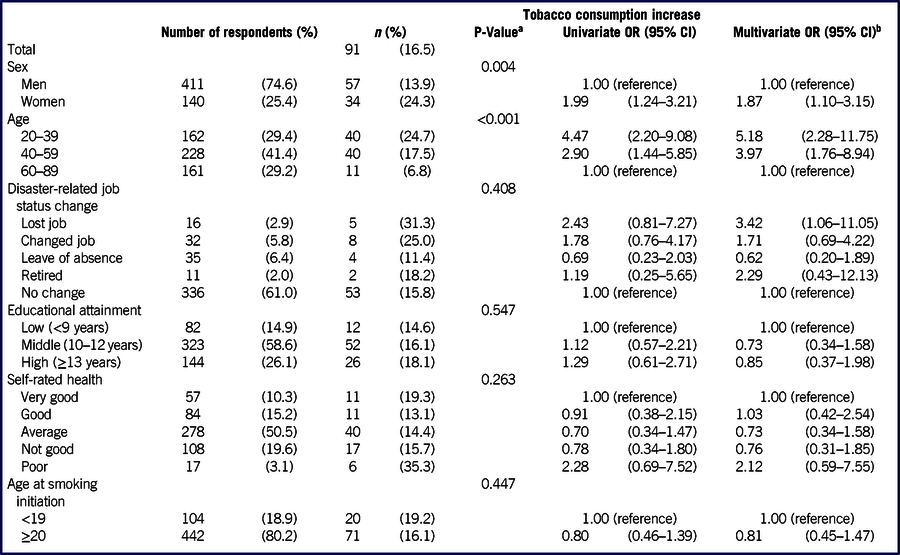
Percentages and ORs for increased tobacco consumption according to key variables of the study participants are shown in Table 1. Of 551 respondents (411 men and 140 women), whose mean (standard deviation) age was 49.1 years (15.11), 91 respondents (57 men and 34 women, 16.5%) had increased their tobacco consumption after the GEJE, with significant differences between men and women (13.9% and 24.3%; P = 0.004), and across age groups (20–39 years old: 24.7%; 40–59 years old 17.5%; and 60–89 years old: 6.8%; P < 0.001).
Percentage and Univariate- and Multivariable-Odds Ratios for Increasing Tobacco Consumption According to Characteristics of Study Participants

The number of unknown cases was 121 for disaster-related job status change, 2 for education status, 7 for self-rated health, and 5 for age at smoking initiation.
a Chi-square test.
b Adjusted for age, sex, disaster-related job status change, education status, self-rated health, and age at smoking initiation.
After adjustment for all variables, significantly higher multivariable ORs for increased tobacco consumption after the GEJE were observed in women (OR = 1.87; 95% CI = 1.10–3.15), 20–39 years old (OR = 5.18; 95% CI = 2.28–11.75), 40–59 years old (OR = 3.97; 95% CI = 1.76–8.94) and respondents who had lost their jobs (OR = 3.42; 95% CI = 1.06–11.05) compared with their counterpart categories.
DISCUSSION
We found 3 determinants of increased tobacco consumption after the disaster: being a woman, being of working age (20–59 years old), and experiencing disaster-related job loss. Disasters generally increase posttraumatic stress and depression. Reference Fergusson, Horwood and Boden13 Current smokers who are exposed to a disaster are more dependent on nicotine, and smoke more cigarettes a day compared with unexposed smokers. Reference Alexander, Ward and Forde14 In a previous study of Hurricane Katrina, posttraumatic stress was a major pathway from disaster exposure to smoking relapse, Reference Alexander, Ward and Forde15 indicating that stress might be one of the mechanisms by which disasters lead to increased tobacco consumption. The level of stress may depend on the 3 determinants. First, women were more likely to experience emotional responses such as fear, helplessness, or horror, than men. Reference Breslau and Kessler16 Of 49 articles on disaster studies, 46 (96%) found that women experienced more stress after a disaster than men. Reference Norris, Friedman and Watson17 Similar gender differences in posttraumatic stress disorder (PTSD) were observed in a previous study of the GEJE, Reference Onose, Sakata and Nochioka18 suggesting a possible mechanism in this study.
Second, younger people generally reported more stress than older people, especially in a work situation. A previous study that examined adult patients with unintentional burn injuries who were admitted to Sina Burn Center in Tabrizof, Iran, found that younger people were more likely to have PTSD than older people. Reference Sadeghi-Bazargani, Maghsoudi and Soudmand-Niri19 In a previous study of the GEJE, people aged 55 years or younger showed a 27 times higher risk of mental distress than those aged 72 years or older. Reference Koyama, Aida and Kawachi20 Furthermore, people aged 55 years or younger were more likely to report strong anxiety about their future than those aged 72 years or older: 59% versus 27%. Reference Koyama, Aida and Kawachi20
Third, job loss and unemployment were major stressors for personal life. Reference Reichert and Tauchmann21 In a postdisaster period, employees whose employment situation changed as a result of the disaster were substantially damaged in terms of their finances, confidence, employment, and living situation. Reference Brooks, Dunn and Amlot22 Furthermore, this damage might impact on their psychological well-being. Reference Brooks, Dunn and Amlot22
The unbalanced distribution of stress after the disaster might occur because women, people of working age (20–59 years old), or those who have experienced disaster-related job loss smoke more cigarettes per day. This, in turn is because most smokers reported smoking to relieve stress, or smoking more when they are experiencing stress. This notion of stress relief from smoking was mainly derived from a stress researcher who received extensive funding from the tobacco industry Reference Petticrew and Lee23 ; it should be noted that smoking cessation will reduce stress.
A previous study indicated that the Hurricane Katrina disaster increased tobacco consumption, but that the reason for the increase might include pathways other than stress. Reference Alexander, Ward and Forde14 After the GEJE, the number of medical institutions and the availability of medicine decreased. Therefore, people who were receiving help with smoking cessation might have been unable to continue treatment; there were also shortages of smoking cessation patches. Reference Fujiwara24 Furthermore, some celebrities offered free tobacco as relief supplies. Reference Kamematsu25,Reference Noguchi26 These situations might have increased smoking.
Limitations
There are several limitations to address. First, this was a cross-sectional study, so causal interpretation of the association between tobacco consumption after the GEJE and risk factors was limited. Second, the study only targeted 1 of the 47 prefectures in Japan; therefore, generalizability is limited. However, the prevalence of active smoking (23.1%) in the study did not largely differ from that of a national survey (21.6%). 27 Third, we used data collected in 2014, 3 years after the disaster. Some participants might have recall bias. Additionally, the smoking variables were self-reported without biomarker validation; however, the quality of self-reported smoking data has been noted to be high. Reference Caraballo, Giovino and Pechacek28
Fourth, the participants in this study were current smokers in 2014 not smokers at the time of the disaster. Because data on the number of cigarettes smoked after the disaster was only available among current smokers at the time of the survey, we could not include individuals who were smokers at the time of the disaster but had quit by the time of the survey (and were thus included in “former smokers”). This would result in a selection bias, but the impact of the bias may be small. Comparison between the present survey and a previous cross-sectional survey in the same place in 2010 (before the disaster) 29 indicated that approximately 90% of former smokers had quit smoking before the disaster.
CONCLUSIONS
In recent years, the number of natural disasters has been increasing worldwide. Reference Stormberg30 Disaster victims suffer harm to both their physical and psychological health. Reference Harada, Shigemura and Tanichi3 Furthermore, disasters like the GEJE may increase tobacco consumption, resulting in more severe health outcomes, such as cancer and cardiac infarction. We found 3 determinants of increased tobacco consumption after a major disaster: being a woman, being of working age (20–59 years old), and experiencing disaster-related job loss. To avoid the harmful effects of tobacco and cope with disaster-related stress, some kind of social support may be necessary to manage stressors.
Acknowledgments
This study was conducted using data from the Miyagi Prefectural Health Survey 2014. We appreciate their work and the contribution of the participants. We also thank Dr. J. Mortimer for her English language editing.
Funding
This study was supported by JSPS (Japan Society for the Promotion of Science) KAKENHI Grant Number (JP18K17107, JP18H03062), Health Labour Sciences Research Grants (H30-Gantaisaku-Ippan-009) from the Ministry of Health, Labour, and Welfare, Japan. The study sponsor had no role in study design; collection, analysis, and interpretation of the data; writing the report; or the decision to submit the report for publication.
Financial disclosure
No financial disclosures were reported by the authors of this study.
Conflicts of interest
The authors report no conflicts of interest.