INTRODUCTION
Non-breeding, migratory shorebird populations that spend significant portions of their annual cycle in tropical environments can be affected by anthropogenic factors such as habitat loss and human disturbance, including hunting (Iwamura et al. Reference IWAMURA, POSSINGHAM, CHADES, MINTON, MURRAY, ROGERS, TREML and FULLER2013, Ottema & Spaans Reference OTTEMA and SPAANS2008, Schlacher et al. Reference SCHLACHER, NIELSEN and WESTON2013, Yang et al. Reference YANG, CHEN, BARTER, PIERSMA, ZHOU, LI and ZHANG2011). Competition for food resources, increased rates of predation (Burger & Gochfeld Reference BURGER and GOCHFELD1991, Fernandez & Lank Reference FERNANDEZ and LANK2008, Nebel & Ydenberg Reference NEBEL and YDENBERG2005), and high adult and juvenile mortality (Piersma & Baker Reference PIERSMA, BAKER, Gosling and Sutherland2000, Van Den Hout et al. Reference VAN DEN HOUT, SPAANS and PIERSMA2008), can also impact non-breeding shorebirds in the tropics. To obtain sufficient energy, some shorebird species forage almost continuously, both day and night, while others engage in periodic intense bursts of foraging (Dodd & Colwell Reference DODD and COLWELL1998, Robert & McNeil Reference ROBERT and MCNEIL1989). When competition for food resources is high, shorebirds may have to spend more time foraging, despite high predation risk, and expend more energy in aggressive interactions with conspecifics and other species (Fernandez & Lank Reference FERNANDEZ and LANK2008, Myers Reference MYERS, Burger and Olla1984).
Despite substantial literature on the ecology (Catry et al. Reference CATRY, ALVES, GILL, GUNNARSSON and GRANADEIRO2012, Navedo et al. Reference NAVEDO, SAUMA-CASTILLO and FERNANDEZ2012, Robert & McNeil Reference ROBERT and MCNEIL1989) and time budgets of foraging shorebirds during the non-breeding season (Barbosa & Moreno Reference BARBOSA and MORENO1999, Fasola & Biddau Reference FASOLA and BIDDAU1997, Rose & Nol Reference ROSE and NOL2010), less is known about how shorebirds apportion their time between foraging and non-foraging activities. Shorebirds may be more vulnerable while not foraging if, for example, they occupy high-density roosts more susceptible to human activities (Rogers et al. Reference ROGERS, PIERSMA and HASSELL2006). Spacing in both foraging and non-foraging birds reflects a trade-off between benefits gained from proximity to conspecifics and heterospecifics, such as decreased risk of predation and foraging enhancement, and the costs of increased competition for preferred habitat and prey (Beauchamp Reference BEAUCHAMP2007, Stinson Reference STINSON1980). Resting birds can form single- or mixed-species flocks as a predator avoidance or detection tactic (Myers Reference MYERS, Burger and Olla1984, Stinson Reference STINSON1980). In terms of competition for food resources, shorebirds employing tactile foraging techniques may benefit from close proximity to conspecifics and other species, as they may be able to collect prey disturbed by other individuals (Stinson Reference STINSON1980). In contrast, visual foragers are less likely to benefit from proximity to other individuals and may expose themselves to serious injury through competition over valuable prey items (Boettcher et al. Reference BOETTCHER, HAIG and BRIDGES1994, Puttick Reference PUTTICK, Burger and Olla1984).
We use data on time budgets, foraging techniques and rates, as well as intraspecific and interspecific spacing patterns for foraging and non-foraging shorebirds on the non-breeding grounds in Cayo Guillermo Cuba, to test several predictions. In general, given the high energetic costs of non-breeding shorebirds (Robert & McNeil Reference ROBERT and MCNEIL1989), we expected that all shorebird species studied would spend greater than 50% of their time foraging. We expected that species with similar morphology (e.g. plovers, yellowlegs, Calidris sandpipers) would exhibit similar foraging techniques and time budgets (Barbosa & Moreno Reference BARBOSA and MORENO1999). As larger species generally have lower mass-specific metabolic rates (Krijgsveld et al. Reference KRIJGSVELD, RICKLEFS and VISSER2012) and may forage more efficiently on a wider range of prey sizes (Radloff & Du Toit Reference RADLOFF and DU TOIT2004), we also predicted that both the proportion of time spent foraging and foraging rates would be negatively related to body mass (Fasola & Biddau Reference FASOLA and BIDDAU1997). We predicted that foraging birds of all species would have larger intraspecific and interspecific distances than non-foraging birds, as a tactic to reduce competition for food resources. Within foraging birds, shorebirds employing mainly tactile foraging strategies were predicted to have lower intraspecific and interspecific distances than shorebirds employing mainly visual techniques. Finally, we predicted that levels of vigilant behaviour and competition would be greater among foraging birds than non-foraging birds and that vigilance rates would decline as a function of group size while rates of competition would increase.
METHODS
Study sites
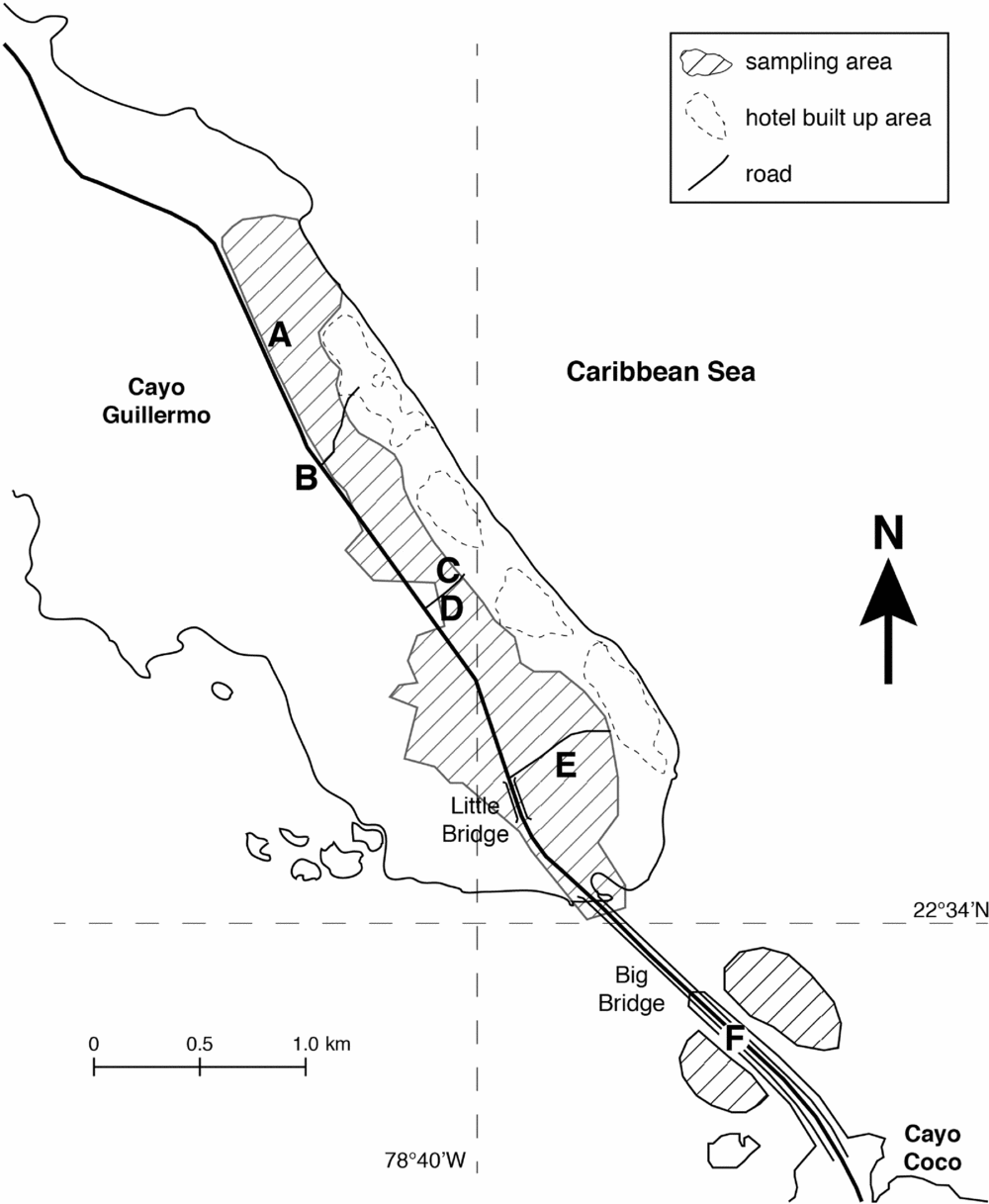
Non-breeding shorebirds were studied on the island of Cayo Guillermo, Cuba (22°25’N 78°30’W) from 5 February to 12 March 2005. Cayo Guillermo is a narrow island approximately 13 km long and is connected via a bridge to the main island of Cayo Coco, in the Jardines del Rey Archipelago (Figure 1). There were four resorts and a number of marinas and other tourist attractions located on the island. Six sites (A–F) were chosen for detailed study based on sightings of foraging and roosting shorebirds (Figure 1). All but one site was non-tidal and consisted of shallow, highly saline lagoons or channels, mud, sand and varying amounts of rocks and mangrove. Water depths in non-tidal sites ranged from 5–50 cm. The Big Bridge site (F) was tidal with a large sand flat covered with seagrass (Zostera capricorni Ascherson) and was exposed for roughly 4 h during each 12-h tidal cycle. Water depths ranged from 0–40 cm over the tidal cycle. All sites were located on or near roads with moderate traffic and within approximately 1 km of tourist resorts (Figure 1).
Location of all observation points (A–F) on Cayo Guillermo Island, Cuba. Areas where sites were located were muddy lagoons or shallow ponds, or in tidal regions near Big Bridge.

Time-budget observations
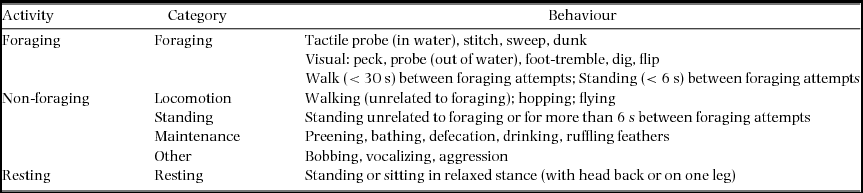
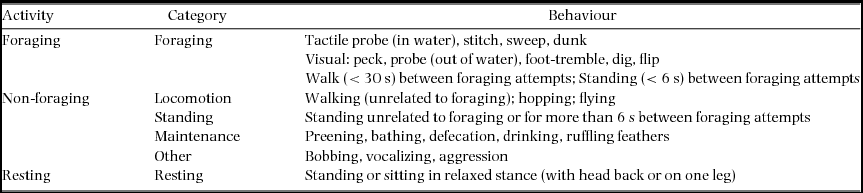
Activity censuses of shorebirds were completed daily at all sites in a random order with observations completed between 7 h 00 and 17 h 00. Data were not collected on rainy days, although only 2 days were rainy; most days were sunny or had partial cloud cover, with temperatures ranging from 22–28°C. Shorebirds were observed using a ×20–60 spotting scope from a distance of 10–50 m. The number of each species and their activity was noted during a rapid scan. Birds were classified as foraging (actively seeking prey) or non-foraging (not actively seeking prey). Upon completion of the rapid scan, focal birds were then randomly selected and observed for 5 min, or until the observer lost sight of the individual (Altmann Reference ALTMANN1974, Rose & Nol Reference ROSE and NOL2010). Observations of less than 2 min were not included in analyses. To minimize the probability of observing the same bird twice, no more than 50% of the flock was observed, unless individual identity could be assured. Hand-held tape recorders were used to document the behaviour of each focal individual and these audio recordings were later transcribed into activity budgets for each bird. Individuals were then grouped into three broad activity categories: foraging, non-foraging and resting (Table 1). The per cent of time spent performing each activity was calculated for all observations. Birds were classified as foraging if they spent 50% or more of the observation time engaged in foraging activities, resting if they spent 50% or more of the observation time engaged in resting activities, or non-foraging if they did not fall into the foraging or resting categories. The mean per cent of time spent performing each behaviour was calculated for each individual. A time budget for all birds was then calculated for each activity and for all activities combined.
Behaviour categories for observations of shorebirds in Cayo Guillermo, Cuba.
Foraging techniques and rates
The foraging techniques used included pecking, probing, sweeping, dunking and stitching. Pecking, considered a visual technique, involved striking a substrate or the surface of water without inserting the bill. Probing, both a visual and tactile technique, involved inserting the bill into the substrate or water. Probing in water was considered tactile for this study, as waters were murky and prey did not appear visible to the human observer. Sweeping, also considered a tactile method, involved a slow walk through water with the head tilted down so a slightly open bill could be swept from side to side underwater to catch prey. Dunking is a tactile technique involving complete submersion of the head and neck underwater while the bird slowly moves forward. Stitching, also largely tactile, was a technique in which birds insert the entire bill in the substrate, walking forward while bobbing their heads up and down without removing the bill from the substrate. Bobbing behaviour is commonly seen in vigilant birds, where the neck and head are quickly extended and lowered in rapid succession. We also recorded whether birds suddenly stopped a foraging activity, raised their heads and looked around, as an instance of alert behaviour. We were unable to determine whether any species successfully captured prey items while foraging because prey was either too small to identify or prey capture occurred under the water and was therefore not visible.
We calculated the foraging rate for each feeding technique (Table 1) for each observation by dividing the total number of foraging attempts per technique by the total time of observation. We also calculated the total foraging rate (i.e. the total number of foraging attempts regardless of technique, per minute of observation) by adding up all individual foraging rates. We calculated the frequencies of apparent aggression (the sum of chased or being chased), vigilance (the sum of bobbing and alert behaviour) and vocalizing as the proportion of 5-min observations that included these behaviours. Because sweeping, dunking, stitching, drinking and defecations occurred very infrequently, we did not analyse these behavioural actions statistically, although we report the proportions of individuals for each species who drank and defecated.
To test for a relationship between body mass and time spent foraging and foraging rates, we gathered adult body mass data from the literature: least sandpiper (Calidris minutilla, Vieillot, 1819) (Cooper Reference COOPER and Poole1994); greater yellowlegs (Tringa melanoleuca, Gmelin, 1789) (Elphick & Tibbitts Reference ELPHICK, TIBBITTS and Poole1998); red knot (Calidris canutus, Linnaeus, 1758) (Harrington Reference HARRINGTON and Poole2001); killdeer (Charadrius vociferus, Linnaeus, 1758) (Jackson & Jackson Reference JACKSON, JACKSON and Poole2000); short-billed dowitcher (Limnodromus griseus, Gmelin, 1789) (Jehl et al. Reference JEHL, KLIMA, HARRIS and Poole2001); ruddy turnstone (Arenaria interpres, Linnaeus, 1758) (Nettleship Reference NETTLESHIP and Poole2000); semipalmated plover (Charadrius semipalmatus, Bonaparte, 1825) (Nol & Blanken Reference NOL, BLANKEN and Poole1999); black-bellied plover (Pluvialis squatarola, Linnaeus, 1758) (Paulson Reference PAULSON and Poole1995); black-necked stilt (Himantopus mexicanus, Müller, 1776) (Robinson et al. Reference ROBINSON, REED, SKORUPA, ORING and Poole1999); lesser yellowlegs (Tringa flavipes, Gmelin, 1789) (Tibbitts & Moskoff Reference TIBBITTS, MOSKOFF and Poole1999). We used average body mass of males and females when data from both sexes were presented.
Nearest-neighbour distances (NND)
During each scan census, intraspecific and interspecific nearest-neighbour distances were estimated for randomly selected individuals. If there were no birds visible around the focal individual, a maximum value of 100 m was set.
Data analysis
Mean time budgets are presented graphically to ease comparison with previously published accounts. Differences in spacing behaviour were compared between species and between behavioural categories using either Kruskal–Wallis or Mann–Whitney U-tests because behavioural data were not normal. Non-parametric multiple comparison tests were used when the Kruskal–Wallis tests indicated significance. We compared proportion of individuals expressing aggression, vigilance and vocalizations as a function of maximum counts of individuals (used as an index of density), using linear regression. We also used linear regression to test for a relationship between body mass and mean time spent foraging and foraging rates across species. As the black-necked stilt was the only species for which sex could easily be determined in the field (Robinson et al. Reference ROBINSON, REED, SKORUPA, ORING and Poole1999), we compared time budgets of male and females, within each category but among activities (i.e. forage, stand, rest, maintenance) using MANOVA first, prior to using this species’ time budgets in other analyses. We used 0.05 as the level of significance.
RESULTS
A total of 10 shorebird species were observed throughout the study period, including, in order of decreasing maximum count: short-billed dowitcher (max count = 533), red knot (315), black-necked stilt (70), semipalmated plover (68), least sandpiper (34), killdeer (13), black-bellied plover (11), ruddy turnstone (5), greater yellowlegs (4) and lesser yellowlegs (3).
Time budgets
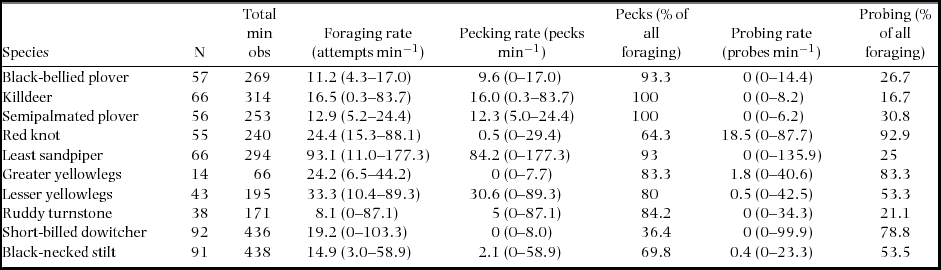
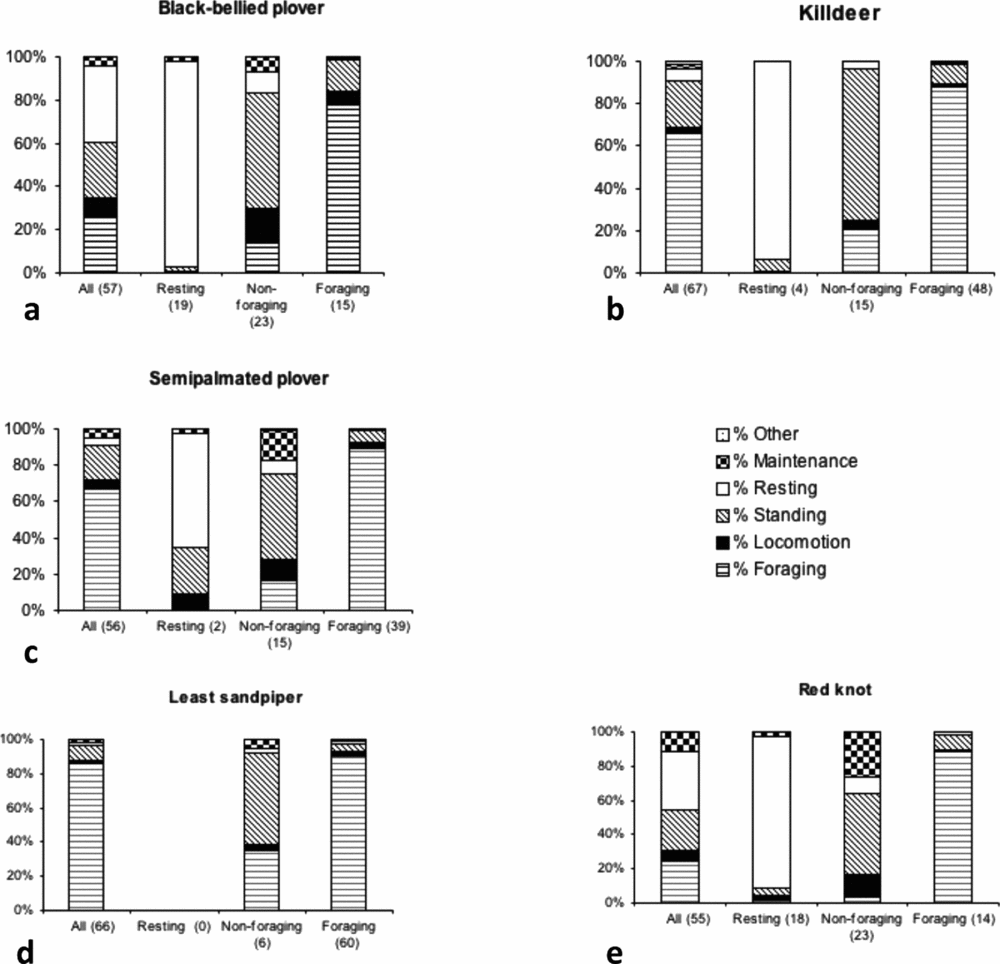
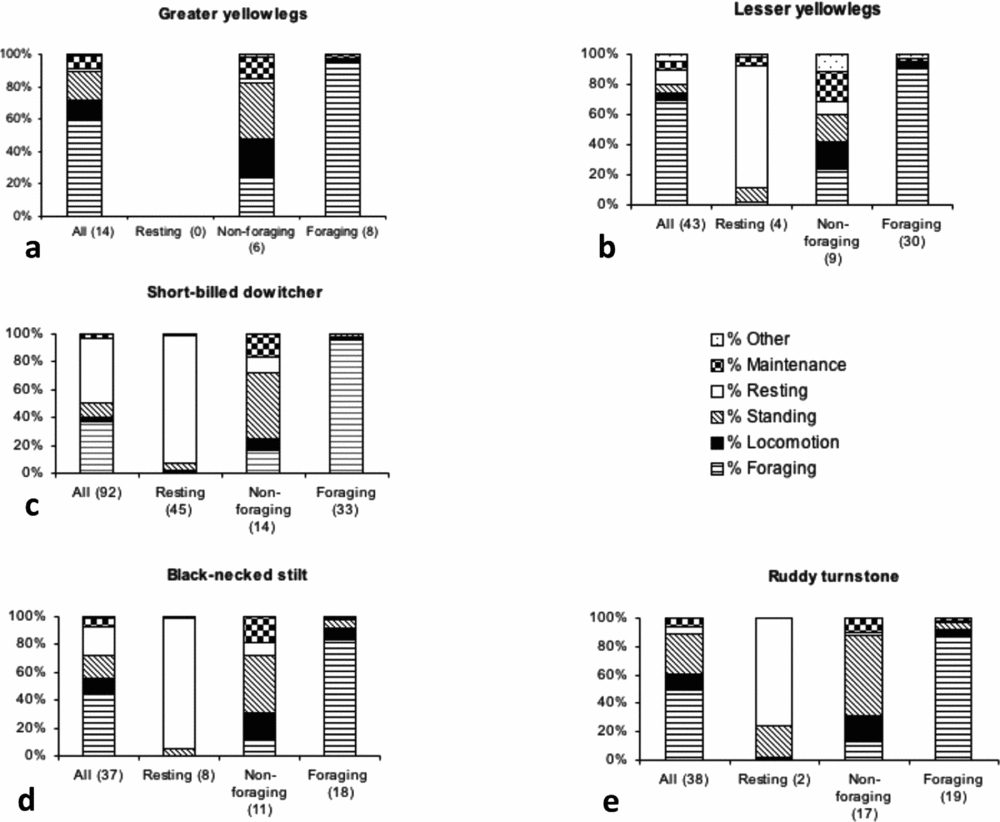
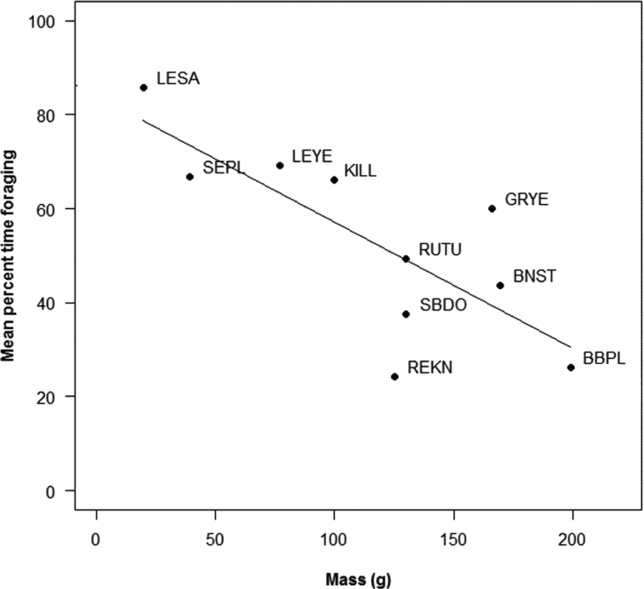
Five-minute focal observations were conducted on 594 birds, for a total of 2676 observation minutes distributed among the 10 species (Table 2). We identified to sex, 37 male and 20 female black-necked stilts. We did not detect significant differences in time budgets between male and female foraging (Wilks λ = 0.68, F10,42 = 0.88, P = 0.56), non-foraging (Wilks λ = 0.75, F5,12 = 0.80, P = 0.57) or resting black-necked stilts (Wilks λ = 0.47, F4,7 = 2.01, P = 0.20) so these results were combined. Combining observations of foraging, non-foraging and resting birds, six species (killdeer, semipalmated plover, least sandpiper, greater yellowlegs, lesser yellowlegs and ruddy turnstone) spent more than 50% of the observation time foraging, whereas four species (black-bellied plover, red knot, short-billed dowitcher, black-necked stilt) spent (sometimes considerably) less than 50% of the observation time foraging (Figures 2, 3). A significant negative relationship between time spent foraging and body mass of all shorebird species was detected. As body mass increased, birds spent less time foraging (% time foraging = 83.9 – 0.27 × Mass, F1,8 = 11.4, R2 = 0.54, P < 0.01; Figure 4).
Medians and ranges of total foraging rates, and rates and percentages of individual shorebirds in Cayo Guillermo, Cuba, observed pecking and probing.
Mean per cent of time spent on each activity for all observations, resting, non-foraging, and foraging observations for black-bellied plover (a), killdeer (b), semipalmated plover (c), least sandpiper (d) and red knot (e) during February to March 2005 in Cayo Guillermo, Cuba.
Mean per cent of time spent on each activity for all observations, resting, non-foraging and foraging observations for greater yellowlegs (a), lesser yellowlegs (b), short-billed dowitcher (c), black-necked stilt (d) and ruddy turnstone (e) during February to March 2005 in Cayo Guillermo, Cuba.
Relationship between mean per cent time foraging and body mass for 10 species of shorebird in Cayo Guillermo, Cuba (Mean time foraging = 83.9 – 0.27 × Mass, F1,8 = 11.4, R2 = 0.54, P = 0.01). The species codes are as follows: BBPL = black-bellied plover; KILL = killdeer; SEPL = semipalmated plover; REKN = red knot; GRYE = greater yellowlegs; LEYE = lesser yellowlegs; RUTU = ruddy turnstone; SBDO = short-billed dowitcher; BNST = black-necked stilt.
Foraging bird time budgets and foraging rates
Within this category, all species spent the majority of time foraging (by definition), while all species interrupted their foraging to either change position or for maintenance (Figure 2, 3). During foraging black-bellied plovers interrupted their foraging bouts most for these other activities, while interruptions of actively foraging short-billed dowitchers were rare.
The least sandpiper had by far, the highest rate of foraging, while the ruddy turnstone pecked fewer than 10 times min−1 (Table 2). The rate of foraging (combined pecking and probing) was negatively related to average body mass, although not significantly (log foraging rate = 3.8 – 0.007 × mean body mass, R2 = 0.31, P < 0.09).
Non-foraging and resting
Plovers, sandpipers, the ruddy turnstone, the short-billed dowitcher and the black-necked stilt spent the majority of their non-foraging time standing, with locomotion, maintenance and foraging also common behavioural states (Figures 2, 3). Not surprisingly, given the large amount of time spent foraging overall, the least sandpiper, even while engaged primarily in non-foraging activities, spent nearly 30% of this time foraging. The time budgets of all other species during non-foraging were largely similar. All species spent the majority of time in this defined category in resting (also known as roosting), with standing also important (Figures 2, 3).
Vigilance, competition and vocalizing
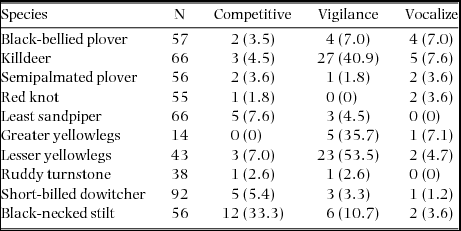
Fewer than 10% of all observations for all species except the black-necked stilt included any acts signalling competition like chasing or being chased (Table 3). For the black-necked stilt there were no significant differences in the rates of competition among foraging, non-foraging and resting birds (H2 = 5.25, P = 0.07), although most conspecific chasing activity was observed during foraging (mean per 5-min observation period: foraging: 0.75 (median, 0) non-foraging: 0.28 (median, 0), resting: 0 (median, 0). The proportion of individuals among species that expressed any competitive chasing was not related to maximum counts (R2 = 0.003, F1,8 = 0.03, P = 0.87). Fewer than 10% of observations in all species included vocalizing individuals (Table 3) and the rate of occurrence of vocalizing was also not related to maximum counts (R2 = 0.12, F1,8 = 1.09, P = 0.32). Vigilance varied more in frequency of occurrence among species (Table 3) than did aggression or vocalizing, but the degree of vigilance exhibited among species also did not relate significantly to maximum counts (R2 = 0.18, F1,8 = 1.73, P = 0.22).
Number and per cent of focal individuals observed in competitive and vigilant behaviours and vocalizing in eight shorebird species in Cayo Guillermo, Cuba. N is the total number of 5-min observation periods.
Foraging techniques and nearest-neighbour distances
The plovers, the least sandpiper and the two yellowlegs species employed primarily visual foraging techniques and the short-billed dowitcher primarily tactile methods, while the red knot, the ruddy turnstone and the black-necked stilt all used a combination of visual and tactile foraging methods (Table 2). Only the yellowlegs and the black-necked stilt used sweeping or dunking, and only for small amounts of time (only one individual greater yellowlegs and five black-necked stilts). Stitching was only used by the short-billed dowitcher and only killdeer and semipalmated plover were observed using foot-trembling (three killdeer, 16 semipalmated plover).
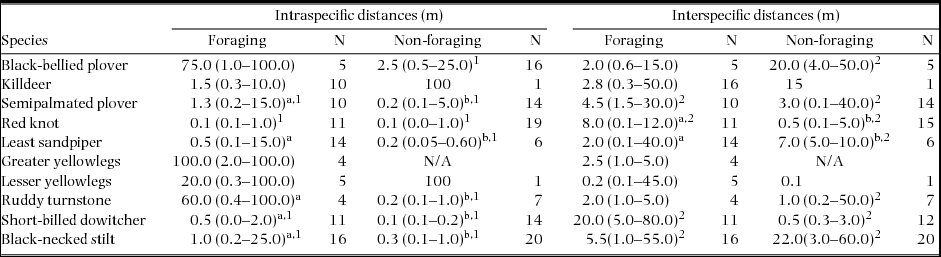
Killdeer, semipalmated plover, red knot, least sandpiper, short-billed dowitcher and black-necked stilt all foraged in close proximity to conspecifics (median < 0.1–1.5 m; Table 3), whereas foraging black-bellied plover, greater and lesser yellowlegs and ruddy turnstone maintained much larger distances from conspecifics (median: 20–100 m). The primarily tactile foragers, red knot, least sandpiper, short-billed dowitcher and black-necked stilt were closer together than primarily visual foragers (plovers, yellowlegs and ruddy turnstone; Table 4). Non-foraging birds of all species for which we had multiple observations remained in close proximity to conspecifics (< 3 m) (Table 4). All species except killdeer, red knot and lesser yellowlegs (no information available for greater yellowlegs) were farther from conspecifics when they were foraging than not foraging, although significant differences were found for only semipalmated plover, least sandpiper, ruddy turnstone, short-billed dowitcher and black-necked stilt (Table 4).
Intraspecific and interspecific distances (medians and ranges) for foraging and non-foraging birds of all focal species in Cayo Guillermo, Cuba. Significant differences (Mann–Whitney U test, P < 0.05) indicated with different letters (between activities, within species) or numbers (between intra- and interspecific distances, within activities).
Interspecific distances for foraging birds of all species were low to moderate with the exception of short-billed dowitcher, which remained relatively far from other species while foraging (Table 4). In non-foraging birds interspecific distances were always larger than intraspecific distances, although some species like red knot, ruddy turnstone and short-billed dowitcher spent the non-foraging period at relatively close distances of 1 m or less from other shorebird species (Table 4). The direction of difference between heterospecific foraging and non-foraging birds varied depending on the species and was significant only for red knot (foraging > non-foraging) and least sandpiper (non-foraging > foraging; Table 4).
DISCUSSION
Time-budgets
Shorebirds demonstrate seasonal variation in activity in response to variation in energy requirements (Puttick Reference PUTTICK, Burger and Olla1984). During the breeding season, shorebirds spend the majority of their time performing courtship, nest building, mating, incubation and chick-rearing activities. During migration, individuals focus more on foraging to rebuild fat reserves required for long-distance migration (Harrington et al. Reference HARRINGTON, BROWN, CORVEN and BART2002) and less time resting and on maintenance. During the non-breeding season, energy demands, though lower than during migration, are still high and as a result, shorebirds spend a large amount of time foraging. However, the general hypothesis that shorebirds spend the majority of their time foraging in order to meet their energetic demands was not strongly supported by shorebird time budgets documented in this study, as only six of 10 species spent more time foraging than on any other activity.
Although the study species varied considerably in their overall time budgets, all species had similar time budgets within each activity category (foraging, non-foraging and resting). Foraging birds spent the majority of their time on feeding, and a small amount of time on locomotion, which was unrelated to foraging and standing. The time budgets for non-foraging birds were more variable, with shorebirds spending a large portion of their time standing, along with foraging, resting and performing maintenance activities. Resting birds spent almost all of their time resting with a small amount of time spent standing and in locomotion. Previous research on non-breeding semipalmated plovers in Venezuela (Morrier & McNeil Reference MORRIER and MCNEIL1991) and greater yellowlegs in managed wetlands in California (Elphick & Tibbitts Reference ELPHICK, TIBBITTS and Poole1998) found similar time-budget allocations to those we document in this study. For the only species in which we observed enough apparently competitive behaviour (black-necked stilt) there were no differences in rates of vigilant behaviour or aggression between foraging and non-foraging birds. Given low rates of apparent competitive behaviour overall (for all species except black-necked stilt < 10% were involved in conspecific chases) we suggest that species-specific energy requirements rather than competitive interactions are the main determinants of foraging behaviour in these tropical non-breeding grounds.
The amount of time shorebirds spent foraging was directly related to their body size; smaller species foraged almost constantly, while larger species foraged less frequently and rested more. This is not entirely surprising, as body size is often considered an important factor in differentiating niches among species (Burger & Trout Reference BURGER and TROUT1979) and the same relationship has been found in non-breeding foraging shorebirds in East Africa (Fasola & Biddau Reference FASOLA and BIDDAU1997). The shorter amount of time larger-bodied species spent foraging may be a reflection of variation in the quality of prey consumed. Larger predators can consume food (e.g. large worms) that is unavailable to smaller predators, as well as smaller food items that are available to birds of all sizes. This asymmetry in resource availability, along with the ability of larger species to physically outcompete smaller species for preferred prey and habitat, leave smaller species at a competitive disadvantage (Wilson Reference WILSON1975). If larger species eat fewer large prey of high caloric content, they will not have to forage as long to meet their energy requirements. Two of the largest species (black-necked stilt and black-bellied plover) in Cuba were observed consuming much larger-sized prey (small fish and worms up to 40 cm in length) than any other species. While we expected that the foraging rate would also be negatively proportional to body mass, this prediction was not supported, although there was a tendency for large species to forage at lower rates, and the highest rate of foraging attempts occurred in least sandpiper. Thus, as with the pattern seen for time budgets, larger species may be able to fulfil their energetic requirements in less time through selection of larger prey items requiring less foraging effort.
There is little published information on the foraging rates of many shorebird species on their non-breeding grounds. The foraging rate of black-bellied plover in Cuba fell within the range of values found at other locations (Paulson Reference PAULSON and Poole1995). Smith & Nol (Reference SMITH and NOL2000) found slightly higher foraging rates for semipalmated plover in Venezuela (16.8 ± 1.31 events min−1 for males, 15.9 ± 2.22 events min−1 for females compared with median = 12.9, range = 5.20–24.4 events min−1 in this study) and this could be due to differences in prey availability (Rose & Nol Reference ROSE and NOL2010).
Foraging rates in this study did not represent success rates, as these were difficult to determine, although in semipalmated plover foraging in southern Georgia, USA, peck rates were strongly correlated with rates of defecation, which suggested that higher rates of foraging did correspond to higher intake rates (Rose & Nol Reference ROSE and NOL2010). Visual foragers are thought to have higher success rates than tactile foragers, but because they often have much slower rates of foraging, the effort (time spent foraging) is often similar. The benefits of visual and tactile methods are dependent on the quality of prey consumed. Shorebirds may choose to consume a few large prey or many smaller prey items depending on availability and individual morphology (Durell Reference DURELL2000). Many questions on the profitability of specific prey and foraging techniques remain. Future studies should address these questions and also examine potential risks associated with each foraging method (e.g. parasite load, predation, competition; Durell Reference DURELL2000).
Spacing
For many of the study species (e.g. sandpipers, yellowlegs, ruddy turnstone and short-billed dowitcher), information on spacing behaviour during the non-breeding season is lacking and the relationship between the spatial distribution of shorebirds and their activities has not been examined. This study was able to quantitatively support the hypothesis that shorebirds are farther apart when foraging than when they are not. Closer proximity while resting or simply not foraging supports the common assumption that being in close proximity to other birds decreases the risk of predation (Stinson Reference STINSON1980, Fernandez & Lank Reference FERNANDEZ and LANK2008). Shorebirds may also benefit from flocking during non-foraging to act as guides to good foraging habitat (Myers Reference MYERS, Burger and Olla1984), although this idea remains to be tested.
Distributions of foraging individuals reflect the costs and benefits of remaining near other conspecifics and heterospecifics. We predicted that tactile foragers, who are more likely to benefit from foraging enhancement from prey stirred up by other foragers, would forage closer to conspecifics than visually foraging species (Stinson Reference STINSON1980). This hypothesis was generally supported with primarily tactile foragers (short-billed dowitcher and red knot) feeding within 0.5 m of conspecifics, while primarily visual foragers (plovers) foraged more than 1.3 m away from conspecifics. Presumably, those birds for which foraging enhancement is not substantial must space out to forage so as to decrease competition for preferred habitat and prey. Visual foragers are more sensitive to foraging interference. Spacing can be mutual avoidance or can involve aggressive interactions (Stinson Reference STINSON1980). Even visual foragers will often stay within a certain maximum distance of other species and conspecifics. In this way they can be far enough apart to minimize costs of aggressive interactions and interference, but close enough that they can benefit from knowledge of profitable foraging sites, decreased predation risk, and in some cases the opportunity to steal prey from less dominant or smaller individuals (Puttick Reference PUTTICK, Burger and Olla1984). Greater interspecific than intraspecific distances may reflect slightly different habitat use patterns within our suite of species, exhibited sometimes during foraging (e.g. short-billed dowitcher in deeper water than other species) and sometimes while not foraging (e.g. black-bellied plover would roost singly far from other species). That we found fewer differences between interspecific distances while foraging than while non-foraging suggests that there may be important niche differentiation during the non-foraging period possibly due to differences in predator detection based on habitat features or morphology.
General conclusion
The apparent high availability of prey, low predation (no predation seen during study), and relatively low disturbance from humans make the sites at Cayo Guillermo ideal for non-breeding shorebird populations. We found broad consistency of activity budgets across all species within each category. Similar seasonal constraints such as energy acquisition, predator avoidance and plumage maintenance likely shape the allocation of time within each activity category. By contrast, body size appears to shape the overall time budget, and to a lesser degree, may shape foraging and intake rates, although this relationship awaits behavioural observations such as those collected here on a larger sample, in particular of smaller shorebird species (e.g. Calidris mauri, C. pusilla).
Future studies should examine length of stay at small tropical feeding areas such as Cayo Guillermo, to determine whether prey availability remains high enough to sustain the numbers. Alternatively competition levels may rise due to decreasing prey availability as the season progresses and foraging intensifies closer to the northward departure times. Also determining whether the strong relationship between foraging time and body size is constant through all seasons, or if it varies depending on the specific seasonal time constraints is of importance. Additionally, a comparison of non-breeding time budgets of the same species in different climatic zones (e.g. north temperate and tropical), would elucidate whether time spent foraging in areas that experience higher temperatures may be lower, where less energy is required for maintenance (Hulscher et al. Reference HULSCHER, EXO, CLARK and Goss-Custard1996).
ACKNOWLEDGEMENTS
Our study was made possible due to funding by Natural Sciences and Engineering Research Council of Canada (PGS-A to KM and Discovery Grant to EN), and a Trent University research grant. Vicente Rodrigues, through El Centro de Investigaciones de Ecosistemas Costeros in Cayo Coco, Cuba, kindly facilitated permit acquisition to conduct work on the ecology of birds in Cuba. Special thanks are due to Jean-Francois Lammare for field assistance and to G. Burness, M. Fox, M. Berrill, G. Fraser, M. Hainstock and B. Walpole for helpful insight and comments on early versions of the manuscript.