I. INTRODUCTION
Micro fuel cells have many advantages including high reaction surface area, high process efficiency, and more efficient use of materials. Reference Gao, Munroe, Kong and Jones1 They can be scaled up by stacking components according to the power requirement and provide power in the milliwatt to kilowatt range. Additionally, current fuel cell manufacturing is error prone and labor intensive due to the large number of individual components required for assembly. Reference Jiang, Maeder, Santis-Alvarez, Poulikakos and Muralt2 Hence, a critical growth step for the fuel cell industry is to develop a fuel cells technology that uses standard micro-fab processes to provide a monolithic device that replaces the “layer cake” styled structure.
Low temperature co-fired ceramics (LTCC) is a low cost material that offers thermal, mechanical, and chemical stability. Additionally, LTCC allows the flexibility of integrating sensors, micro-channels, capacitors, heating elements, and interconnects among other components into a layered monolithic structure. Reference Shin, Kim, Hong, Oh, Kim, Haam and Chung3 Hence, it is desirable to develop a multi-layered microfluidic and monolithic device utilizing LTCC and ceramic metal composites that has the potential to provide a step change in cost and performance.
Materials comprising carbon nanotubes (CNTs) decorated with Au NPs have been explored by many researchers Reference Zhang and Olin4,Reference Premkumar, Geckeler, Geckeler and Nishide5 and applied to many applications including, but not limited to, electrochemical sensors, biosensors, and fuel cells. The CNT-Au NP composites have very unique mechanical, chemical, thermal, and electrical properties owing to the high tensile strength of the CNTs and small size (1–5 nm) of the Au NPs.
There are many established procedures in the literature for preparing the CNT-Au NP composites for various applications. Reference Zhang and Olin4,Reference Premkumar, Geckeler, Geckeler and Nishide5 The Au NPs can be attached to the CNTs covalently via a variety of different chemistries or they can be simply adsorbed onto the surface of the CNTs due to supramolecular forces which include electrostatic and hydrophobic interactions.
To achieve the goal of developing a LTCC monolithic energy storage device, the preparation of nanoscale materials, such as insulators and conductors, with the desired thermal, chemical, and electrical properties is a critical first step. This report focuses on the preparation of conductive materials utilizing multi-walled carbon nanotubes (MWCNTs) and gold nanoparticles (Au NPs) from commercially available starting materials. More specifically, COOH–MWNTs and plain MWCNTs are decorated with Au NPs by adsorption of the Au NPs onto the surface of the MWNT using simple procedures. The plain Au NPs are obtained from a commercial source; however, the thiolated Au NPs are prepared using known literature procedure. Reference Andrieux-Ledier, Tremblay and Courty6 The electrical conductivity property of the final materials is surveyed via CV and oxygen reduction reaction (ORR) studies.
II. EXPERIMENTAL
The carboxylated multi-walled carbon nanotubes (COOH–MWCNTs, >8% carboxylated, OD × L 9 nm × 1.5 µm), un-functionalized multi-walled carbon nanotubes (MWCNTs, OD × L 6–13 nm × 2.5–20 µm) and plain Au NPs (5 nm, 0.1 mg/mL citrate buffer solution), and 11-mercapto-1-undecanol (99%) are purchased from Sigma–Aldrich. The chloro(triphenylphosphine)gold(I) (99.99%), tert-butylamine borane complex (97%), toluene (anhydrous, 99.5%), and ethanol (denatured, 94–96%) are purchased from Alfa Aesar.
X-ray photoelectron spectroscopy (XPS) is conducted on a Thermo VG Scientific Theta Probe system with an aluminum Kα x-ray source (1486.6 eV). Scanning electron microscopy (SEM) is performed on a Hitachi s-4800 field emission SEM (Hitachi Corp., Tokyo, Japan). The CV and ORR studies are performed using a Pine Research Instrumentation CBP Bipotentiostat rotating disc electrode apparatus and a glassy carbon electrode (GCE) is used as the working electrode.
Preparation of thiolated Au NPs: A stirred solution of (Ph3)PAuCl (0.25 g, 0.5 mmol) in toluene (50 mL) is heated to 100 °C followed by the addition of mercapto undecanol (0.85 g, 4.2 mmol). After 5 min, a solution of tert-butylamine borane complex (0.87 g, 10 mmol) in toluene (10 mL) is rapidly added to the reaction mixture and continuously stirred at 100 °C for 12 h. The reaction mixture is cooled, placed in a centrifuge (1600 rpm for 30 min) and the reaction solvent is removed. Approximately 20 mL of toluene is added to the residue and it is sonicated for 10 min and then placed in a centrifuge (1600 rpm for 30 min). The colorless solvent is removed and the dilution (toluene, 20 mL), sonication, and centrifugation step is repeated two additional times and the residue is dried in an oven at 50 °C. The deep purple solid is characterized by XPS and SEM.
A. Method 1
(a) Preparation of CNT-Au NP composites using plain Au NPs: To a suspension of MWCNTs or COOH–MWCNTs (10 mg) in ethanol (10 mL) at room temperature is added a solution of Au NPs (0.1 mg/mL in citrate buffer, 6 mL). The mixture is sonicated for 20 min, allowed to incubate for 6 h, sonicated for 20 min and allowed to incubate for 12 h. It is observed that the deep red color of the Au NPs had dissipated significantly but not completely. Hence, the reaction mixture is placed in a centrifuge (1600 rpm for 30 min) and the reaction solvent is removed. Approximately 10 mL water is added to the residue and it is sonicated for 10 min and then placed in a centrifuge (1600 rpm for 30 min). The colorless solvent is removed and the residue is dried over a stream of nitrogen gas at room temperature or in an oven at 50 °C and then characterized by XPS, CV, and ORR.
(b) Preparation of CNT-Au NP composites using thiolated Au NPs: To a suspension of COOH–MWNTs (10 mg) in ethanol (10 mL) at room temperature, thiolated Au NPs (40 mg) is added. The mixture is sonicated for 20 min, allowed to incubate for 6 h, sonicated for 20 min and allowed to incubate for 12 h. It is observed that the deep red color of the Au NPs had dissipated significantly but not completely. Hence, the reaction mixture is placed in a centrifuge (1600 rpm for 30 min) and the solvent is removed. Approximately 20 mL (1:1) ethanol and toluene is added to the residue and it is sonicated for 10 min and placed in a centrifuge (1600 rpm for 30 min). The sonication and centrifugation step is repeated one more time and the colorless solvent is removed and the residue is dried over a stream of nitrogen gas at room temperature or in an oven at 50 °C and then characterized by XPS, CV, and ORR.
B. Method 2
Preparation of CNT-Au NP composites using plain Au NPs or thiolated Au NPs: To a suspension of COOH–MWCNTs (10 mg) in ethanol (10 mL) at room temperature is added a solution of Au NPs (0.1 mg/mL in citrate buffer, 10 mL) or thiolated Au NPs (60 mg). The mixture is sonicated for 20 min and placed under a steady stream of nitrogen until the solvent completely evaporated. The dry residue is suspended in ethanol (15 mL), sonicated for 10 min, placed in the centrifuge (1600 rpm for 30 min), and the red colored solvent is removed. This process of dilution, sonication, centrifugation, and decanting is repeated until the ethanol solution appeared colorless. The resulting residue is dried over a stream of nitrogen gas at room temperature or in an oven at 50 °C and then characterized by XPS, CV, and ORR.
III. RESULTS AND DISCUSSION
The ORR study is initially conducted with the undecorated MWCNTs and COOH–MWCNTs to establish baseline data, prior to examining the CNT-metal composite materials. It is decided to primarily examine the more polar COOH–MWCNTs as the base material. It is believed that favorable electrostatic interactions between the metallic gold and the electronegative carboxylate group can help facilitate the adsorption of the Au NPs onto the surface of the CNTs.
The MWCNTs are treated with plain Au NPs using “method 1” and the COOH–MWCNTs are treated with plain and thiolated Au NPs using the two procedures, “method 1” and “method 2”, which are described in the experimental section. The procedure called “method 1” is based on literature precedent Reference Shi, Yang and Yuet7,Reference Hou, Wang, Wang and Li8 while “method 2” is developed in-house to maximize the absorption of the Au NPs onto the COOH–MWCNTs. In “method 2” the suspension of Au NPs and COOH–MWCNTs is dried at ambient temperature under a stream of nitrogen gas. The key idea behind this process is to increase the concentration of the Au NPs in solution during the adsorption reaction and ultimately force their adsorption onto the surface of the COOH–MWCNTs once the reaction mixture reached complete dryness.
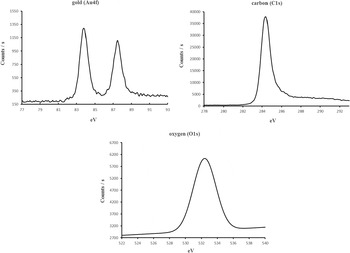
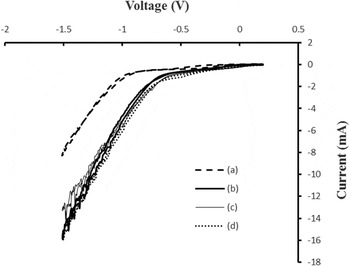
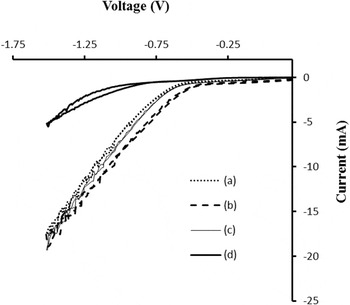
The plain Au NP (5 nm diameter) is obtained commercially as a citrate buffer solution containing a 0.1 mg/mL concentration of the Au NPs. In the case of COOH–MWCNT-plain Au NP composite the XPS data indicated the presence of comparable amounts of gold (∼0.2 at.%) when employing “method 1” and “method 2” (Fig. 1). The ORR study of the materials prepared using these two methods is compared with un-functionalized COOH–MWCNTs and the result is described (Fig. 2). The undecorated COOH–MWCNTs demonstrate a reduction reaction under the ORR conditions using oxygen gas saturated 0.1 M perchloric acid with the GCE electrode rotating at 900 rpm. However, the Au NP decorated MWCNTs demonstrate a much greater ORR activity than the undecorated MWCNTs. The COOH–MWCNT-plain Au NP composites prepared via “method 1” and “method 2” display comparable activity to each other. Finally, the MWCNT-plain Au NP composite also displays comparable ORR activity to the COOH–MWCNT-plain Au NP composites. This data indicates that the presence of the carboxylate group on the surface of the MWCNTs does not provide any advantage in ORR activity, over the simple MWCNTs.
XPS data for COOH–MWCNTs-plain Au NP composite.

Effect of adsorption method and NP on ORR activity. ORR activity in O2 saturated 0.1 M perchloric acid at 900 rpm (a) COOH–MWCNTs (b) COOH–MWCNT-plain Au NP composite prepared by “method 2” (c) COOH–MWCNT-plain Au NP composite prepared by “method 1” and (d) MWNT-plain Au NP composite prepared by “method 1”.

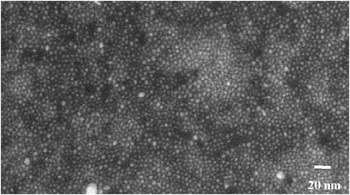
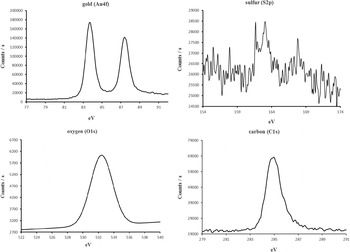
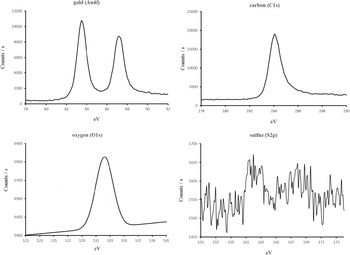
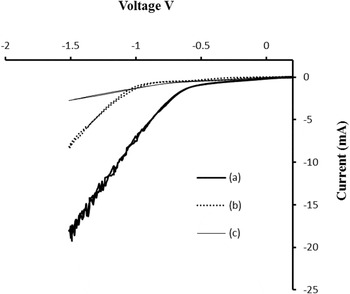
The thiolated Au NPs with a particle size ranging between 4 and 9 nm is prepared using a literature procedure Reference Andrieux-Ledier, Tremblay and Courty6 and the resulting Au NPs are imaged using a high resolution SEM (Fig. 3). XPS analysis of the 11-mercapto-1-undecanol thiolated Au NPs indicates the presence of carbon, oxygen, and sulfur along with gold (Fig. 4). The signal for sulfur (∼163 eV) is weak due to the fact that sulfur is sensitive to x-rays. 9 The COOH–MWCNTs are decorated with the thiolated Au NPs using “method 1” and “method 2”. The ORR activity of the COOH–MWCNT-thiolated Au NP composites prepared using either “method 1 or 2” is comparable to each other even though the amount of gold in the two samples is dramatically different (∼0.2 at.% gold in the material prepared via “method 1” and ∼13 at.% gold in the material prepared via “method 2”) and their ORR data is found to overlap (Fig. 5). The XPS data suggests that in the case of thiolated Au NPs the adsorption due to “method 2” does result in an increase in NP adsorption, as hypothesized earlier. This is likely due to favorable hydrophobic interactions between the 11-carbon chain of the mercaptoundecanol and the CNT surface. Additionally, the ORR activity of both these COOH–MWCNT-thiolated Au NP composites is similar to the activity of the COOH–MWCNT-plain Au NP composite prepared using “method 2” (Fig. 5).
SEM micrograph of 11-mercapto-1-undecanol thiolated Au NPs.

XPS data for 11-mercapto-1-undecanol thiolated Au NPs.

Effect of adsorption method and NP on ORR activity. ORR activity in O2 saturated 0.1 M perchloric acid at 900 rpm (a) COOH–MWCNT-thiolated Au NP composite prepared by “method 1” (b) COOH–MWCNT-thiolated Au NP composite prepared by “method 2” and (c) COOH–MWCNT-plain Au NP composite prepared by “method 2”.

The XPS data for the COOH–MWCNT-thiolated Au NP composite does show a very weak peak for sulfur (162.5 eV) but as suggested previously, the sensitivity of sulfur to x-rays is the only reasonable explanation for this result (Fig. 6).
XPS data for COOH–MWCNTs-thiolated Au NP composite.

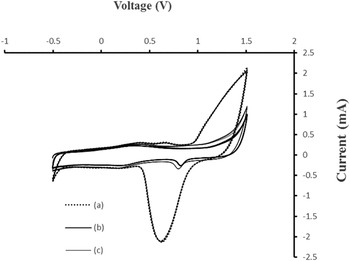
The CV data for the MWCNT-Au NP composite materials is obtained in argon saturated 0.1 M perchloric acid using a carbon electrode. Interestingly the CV data for the COOH–MWCNT-thiolated Au NP composite exhibits a measurable reduction potential whereas the COOH–MWCNT-plain Au NP composite provided a capacitive curve (Fig. 7). The thiol group encapsulating the Au NPs is most likely responsible for the Au NPs ability to support a redox reaction. This additional property of the thiolated Au NPs makes it a preferable candidate as a conductive material for the application at hand. Lastly, the CV data for the COOH–MWCNT-plain Au NP composite and the MWCNT-plain Au NP composite is almost identical, further emphasizing the enhanced activity due to the presence of the thiolated Au NPs.
Comparison of CV data for MWCNTs. CV activity in Ar saturated 0.1 M perchloric acid (a) COOH–MWCNT-thiolated Au NP composite prepared by “method 1” (b) COOH–MWCNT-plain Au NP composite prepared by “method 2” and (c) MWCNT-plain Au NP composite prepared by “method 1”.

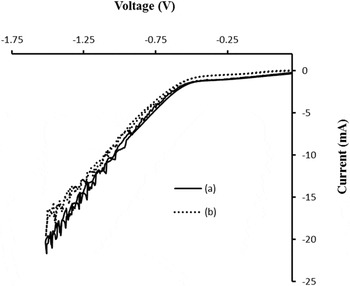
The COOH–MWCNT-Au NP composite is annealed in a tube furnace at 400 and 600 °C under a forming gas atmosphere and the ORR activity of the resulting materials is examined. It is observed that after the 400 °C anneal, the activity of the COOH–MWCNTs is decorated with plain and thiolated Au NPs remained consistent with the preanneal samples (Fig. 8). However, after the 600 °C anneal the physical appearance of both materials changed significantly, from a black color to a light brown color, and it is very difficult to prepare inks from the resulting post-anneal solids. However, the ORR data for the COOH–MWCNTs decorate with plain Au NPs exhibited a significant reduction in ORR activity after the 600 °C anneal. On the other hand the material containing the COOH–MWCNT decorated with thiolated Au NPs retains its ORR activity after the 600 °C anneal indicating that the Au NPs has increased stability at the higher temperature due to the presence of the thiol groups encapsulating the Au NPs.
Effect of high temperature anneal on ORR activity. ORR activity in O2 saturated 0.1 M perchloric acid at 900 rpm (a) COOH–MWCNT-thiolated Au NP composite after 600 °C anneal (b) COOH–MWCNT-thiolated Au NP composite after 400 °C anneal (c) COOH–MWCNT-plain Au NP composite after 400 °C anneal and (d) COOH–MWCNT-plain Au NP composite after 600 °C anneal.

The effect of changing hydrogen ion concentration versus the ORR activity is briefly studied for the COOH–MWCNTs decorated with plain 5 nm Au NPs. Therefore, 0.1, 0.05, and 0.01 M perchloric acid solution is used for the ORR study. It is observed that the ORR activity increases by approximately double as the hydrogen ion concentration is doubled (Fig. 9). The plain COOH–MWCNTs is also subjected to the ORR study with different perchloric acid concentrations and the same trend of increasing current with increasing hydrogen ion concentration is observed.
Effect of hydrogen ion concentration on ORR activity. ORR activity in O2 saturated perchloric acid at 900 rpm (a) COOH–MWCNT-plain Au NP composite in 0.1 M perchloric acid (b) COOH–MWCNT-plain Au NP composite in 0.05 M perchloric acid and (c) COOH–MWCNT-plain Au NP in 0.01 M perchloric acid.

IV. CONCLUSION
Two methods for decorating COOH–MWCNTs are utilized and it is noted that “method 2” is the preferred method for maximizing the adsorption of Au NPs onto the surface of the MWCNTs. Both the plain and thiolated Au NPs provide comparable ORR activity in the oxygen saturated 0.1 M perchloric acid reaction system. Additionally, there is no significant difference in the ORR activity between the COOH–MWCNT-plain Au NP composite material and the MWCNT-plain Au NP composite. Furthermore, after a 400 °C anneal, the ORR activity of the materials containing the plain and thiolated Au NPs remained consistent with the pre-anneal data. However, after the 600 °C anneal the COOH–MWCNT-thiolated Au NP composite retains its ORR activity while the COOH–MWCNT-plain Au NP composite experienced a significant reduction in activity. The metalized CNT composites described in this article exhibit properties that make them worthy of investigation as conductive material for fuel cell application.
ACKNOWLEDGMENT
The research was supported via a grant provided by NYSERDA (New York State Energy Research & Development Authority).