1. Introduction
Persistent scourge of child malnutrition in all its form represents one of the missed opportunities of human development, particularly in the low-and-middle income countries during last two decades. The multiple burden of child malnutrition, i.e. - undernutrition, hidden hunger and overweight- continue to perpetuate the vicious cycle of infections, malnutrition, poor child survival, suboptimal human capital formation through restricted cognitive and emotional development, and resulting into a fragile national economic system in the long run(UNICEF. 2019). The existing global double burden of malnutrition crisis, that mainly includes hunger and malnutrition (stunting, wasting, underweight and micro-nutrient deficiencies), and diet-related non-communicable diseases (overweight, obesity, diabetes, cardiovascular disease and cancer etc.) leads to enormous health, economic, and environmental consequences, particularly among low-and-middle income countries suffering with widespread inequalities in food and health systems(Development Initiatives 2020).
Investing in the young infants, children and adolescent’s health and nutrition has been recognized as an indispensable development priority under the United Nation’s ratified Sustainable Development Goals Framework 2015-2030. The SDG-2 is committed to end hunger, achieve food security, improve nutrition and promote sustainable agriculture. The nutrition related SDG target aims to reduce the prevalence of stunted children up to 40 percent by 2025. However, the burden of anthropometric failures among infant and young children is disproportionately clustered among low- and middle-income countries, particularly in the parts of Sub-Saharan Africa and South Asia- including India during past three decades(Kinyoki et al. Reference Kinyoki, Osgood-Zimmerman, Pickering and Hay2020; Li et al. Reference Li, Kim, Vollmer and Subramanian2020). Recent evidence confirmed disproportionately higher burden of poor nutritional outcomes among children were concentrated within socioeconomically weaker/disadvantaged population groups spread across relatively laggard regions in India(Subramanyam et al. Reference Subramanyam, Kawachi, Berkman and Subramanian2011; Swaminathan et al. Reference Swaminathan, Hemalatha, Pandey and Dandona2019).
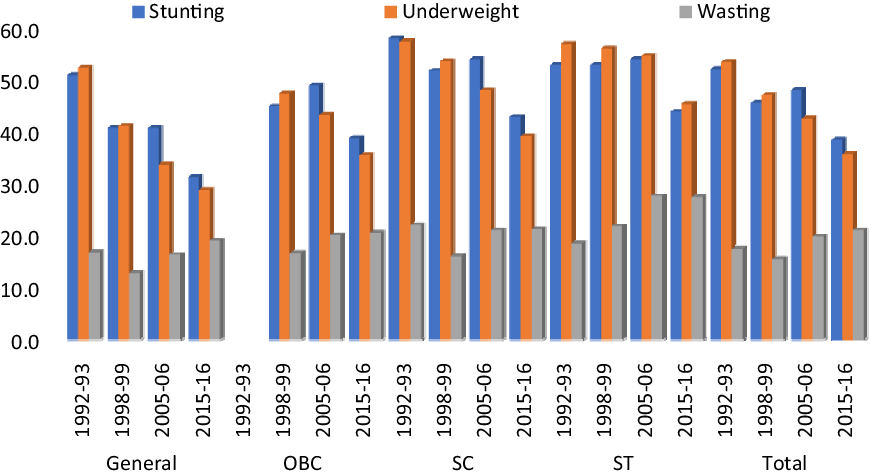
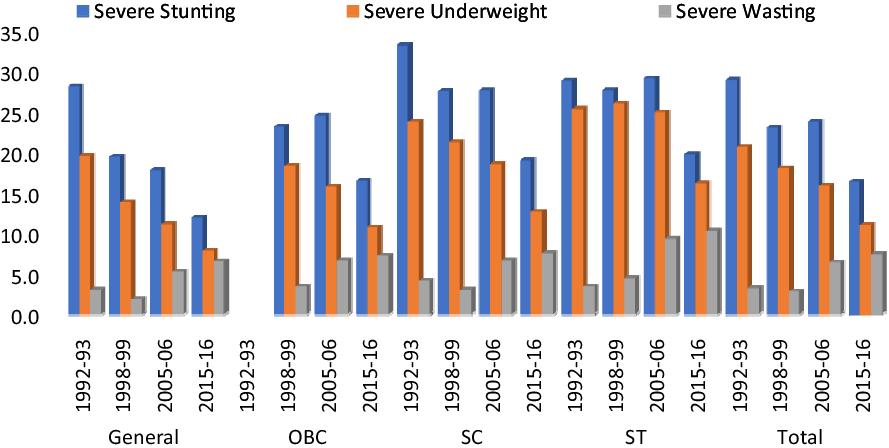
During the past two and half decade (1992-2016), India’s progress on improving the nutritional status among children has been mixed, as more than half of children under age five (approximately 63 million) suffered from diverse form of anthropometric failure (stunting, wasting or underweight)(Menon et al. Reference Menon, Headey, Avula and Nguyen2018). For instance, children from the General/Forward caste groups experienced 20 (from 51% in 1992 to 31% in 2016) and 24 percentage points (52% in 1992 to 28% in 2016) decline in the prevalence of stunting and underweight respectively, whereas, wasting increased by two percentage points (17% in 1992 to 19% in 2016) in India during 1992-2016. On the contrary, children from the socially disadvantageous caste groups (Scheduled Tribes) experienced 9 (from 53% 1992 to 44 % in 2016) and 12 percentage points (57% in 1992 to 45% in 2016) decline in the prevalence of stunting and underweight respectively, whereas, the prevalence of wasting increased by nine percentage points (18% in 1992 to 27% in 2016) in India during the same period (Figure 1a & Figure 1b) (International Institute for Population Sciences 1995, 2017). Despite numerous policies and programmes implemented by the federal and provincial governments over recent decades, including the Balwadi Nutrition Programme (1970), Integrated Child Development Services (ICDS) in the latter half of 1970s, the Mid-day Meal scheme (MDM) since 1995, National Nutritional Strategy (2017) and the POSHAN Abhiyan (2018), progress has remained far from satisfactory owing to the multi-factorial dimension of the child nutrition phenomenon and widespread socioeconomic and spatial inequalities(Jain & Agnihotri Reference Jain and Agnihotri2020; Rajpal et al. Reference Rajpal, Kim, Sankar, Kumar, Joe and Subramanian2020).
Trends in anthropometric failure by caste groups among children in India, 1992-2016.

Trends in severe anthropometric failure by caste groups among children in India, 1992-2016.

Previous studies related to analysing the magnitude of inequalities in the childhood undernutrition in India have largely focused on the individual measures of socioeconomic status such as wealth status, educational status, gender, caste groups, residence, and geographical region. However, most of these studies have failed to address the overlapping and intersectional nature of inequalities to examine the burden of anthropometric failures among Indian children(Cavatorta et al. Reference Cavatorta, Shankar and Flores-Martinez2015; Jain & Agnihotri Reference Jain and Agnihotri2020; Krishna et al. Reference Krishna, Oh, Perkins and Subramanian2019; Kumar et al. Reference Kumar, Kumari and Singh2015; Menon et al. Reference Menon, Headey, Avula and Nguyen2018; Mukhopadhyay & Chakraborty Reference Mukhopadhyay and Chakraborty2020; Pathak & Singh Reference Pathak and Singh2011; Singh et al. Reference Singh, Srivastava and Upadhyay2019; Subramanyam et al. Reference Subramanyam, Kawachi, Berkman and Subramanian2010). Only a few studies have employed intersectional framework to assess selected measure of child health and nutritional outcomes in India(Adhikari et al. Reference Adhikari, Yadav, Tripathi, Tolani, Kaur and Rao2020; Joe Reference Joe2015; Mukhopadhyay Reference Mukhopadhyay2015). Therefore, the present study provides a comprehensive assessment of multidimensional social inequalities in the burden of anthropometric failures using intersectional framework among children under five years of age using the most recent nationally representative data of NFHS-4 (2015-2016) in India. It will highlight the heterogeneous dynamics of overlapping power structures of different caste groups (Scheduled Caste, Scheduled Tribe, Other Backward Class, and General Caste) along a set of socioeconomic (wealth status and maternal education) and contextual factors (place of residence and geographical region)(Adhikari et al. Reference Adhikari, Yadav, Tripathi, Tolani, Kaur and Rao2020; Eeckhaut Reference Eeckhaut2020; Schulz, Amy J., Mullings Reference Schulz and Mullings2006).
2. Methods
2.1 Data
Using data on 2,15,554 children under five years from the 2015-16 National Family Health Survey (NFHS-4), the present study provides a comprehensive assessment of multidimensional social inequalities in the burden of anthropometric failures (using anthropometric indices of stunting, underweight, wasting, severe stunting, severe underweight and severe wasting) using intersectional framework among children under five years of age from 29 states and seven Union Territories using the most recent nationally representative data of NFHS-4 (2015-2016) in India. The NFHS-4 is a nationally representative household survey that provides comprehensive information related to fertility, mortality, maternal health care utilization, child nutritional and health status etc. across the districts and states/union territories (UTs) in India. Details of sampling procedure is provided in the national report of the survey(International Institute for Population Sciences 2017).
2.2 Outcome Variables
The present study employed six anthropometric indicators of nutritional status of children namely stunting (height-for-age), underweight (weight-for-age), wasting (weight-for-height), severely stunted, severely underweight and severely wasted as the outcome variables. These six measures are the standardized measures of nutritional status of children used in literature(Vollmer et al. Reference Vollmer, Harttgen, Kupka and Subramanian2017; World Health Organisation 2006). Stunting represents chronic nutritional deprivation, being underweight shows an acute and chronic form of undernourishment, while wasting indicates acute nutritional deficiency. Z-scores are assessed relative to the WHO reference population and z-scores less than -2 standard deviation define undernutrition for the respective indicator. On the other hand, z-score less than -3 standard deviation define severe undernutrition for the respective indicator. Observations of the biologically implausible values of anthropometric indices were dropped from the analysis. The rationale of choosing moderate and severe magnitude of anthropometric failure in the study is based on complex interplay of plausible risk factors that may potentially determine nutritional deprivation and health burden among young children differently (Bhutta et al. Reference Bhutta, Berkley, Bandsma, Kerac, Trehan and Briend2017; Ghimire et al. Reference Ghimire, Aryal, Gupta and Sapkota2020).
2.2 Exposure Variables
We used a set of theoretically pertinent socioeconomic, demographic and contextual correlates of anthropometric failure among children were selected, in tune with the UNICEF framework on childhood undernutrition(Fund Reference Fund1991), and existing research studies on childhood nutrition, and availability of data(Amugsi et al. Reference Amugsi, Mittelmark and Lartey2013; Bhutta et al. Reference Bhutta, Ahmed, Black and Shekar2008; Boah et al. Reference Boah, Azupogo, Amporfro and Abada2019; Chowdhury et al. Reference Chowdhury, Rahman, Khan, Mondal, Rahman and Billah2016; Khan et al. Reference Khan, Zaheer and Safdar2019; Khanam et al. Reference Khanam, Shimul and Sarker2019; Kim et al. Reference Kim, Rajpal, Joe and Subramanian2019; Krishna et al. Reference Krishna, Oh, Perkins and Subramanian2019; Mohseni et al. Reference Mohseni, Aryankhesal and Kalantari2019). This included child level factors such as age, sex, birth order, birth interval, birth size, multiple birth status, any diarrhea, any acute respiratory infection (ARI), had fever, place of delivery; maternal characteristics including maternal age at time of birth, maternal height, maternal body mass index (BMI), maternal education, exposure to mass media; household level characteristics including water facility, sanitation facility, wealth status, caste group, religious group, place of residence and geographical region. Caste groups is categorized into following categories- Scheduled Caste, Scheduled Tribe, Other Backward Class and General/Forward caste.
2.3 Analytical Methods
Descriptive statistics (cross-tabulations, bar graphs, and chi-square statistics) were used to examine the patterning of anthropometric failure among children under five years. Furthermore, three set of multinomial logistic regression models were fitted to examine the determinants of moderate stunting, severe stunting with no stunting; moderate underweight, severe underweight with no underweight; and moderate wasting, severe wasting with no wasting respectively among children under five years of age, after duly adjusting for the selected demographic, socioeconomic and contextual factors(Long & Freese Reference Long and Freese2014; Okubo et al. Reference Okubo, Janmohamed, Topothai and Blankenship2020).
In addition, a test of interaction effects between caste groups (Scheduled Caste- SC, Scheduled Tribe- ST, Other Backward Class- OBC, and General Caste-GC) with the selected measures of socioeconomic status (i.e. wealth status, maternal education, place of residence and geographic region) on the anthropometric failure (moderate stunting, severe stunting, moderate underweight, severe underweight, moderate wasting, and severe wasting) has been examined. Testing of the interaction effect of caste groups of the children with selected measures of socioeconomic status (SES) provides an opportunity to investigate the intersectional nature of social inequalities in the nutritional status of children, and highlights the heterogeneous dynamics of overlapping privilege, power, and resource structures of historically disadvantageous social group and the SES subgroup of the population(Adhikari et al. Reference Adhikari, Yadav, Tripathi, Tolani, Kaur and Rao2020; Eeckhaut Reference Eeckhaut2020). Therefore, this provides a deeper insight than a direct ‘additive approach’ where one merely examined the independent effect of relatively ‘weaker versus advanced caste group’ children on their nutritional outcomes. Similar interactions between SC, ST, OBC and GC caste group of children with wealth status, maternal education, place of residence and geographical regions have been implemented to capture the complexities in the multidimensional social inequalities within anthropometric failure among Indian children. The interaction effects between the socioeconomic position and nutritional status of children have been implemented through margins and marginsplot command in STATA 13.1 version (Buis Reference Buis2010; Williams Reference Williams2012). The margins command allows the estimation of the predictive probabilities of anthropometric failure among children across the interaction term between the socioeconomic position (for instance, different categories of wealth index such as poorest, poorer middle, richer, richest) and caste group categories (SC, ST, OBC and GC) of children, after duly adjusting for all the pertinent demographic, socioeconomic, and contextual covariates in the multinomial logistic regression model. Furthermore, the marginsplot graphically depicts the predictive probabilities with 95 percent confidence interval, and summarises the association between dependent variable and interaction term. All the analyses have been performed using statistical weights to adjust for the complex survey design in STATA 13.1 version.
3. Results
3.1 Descriptive Analysis of Anthropometric Failures
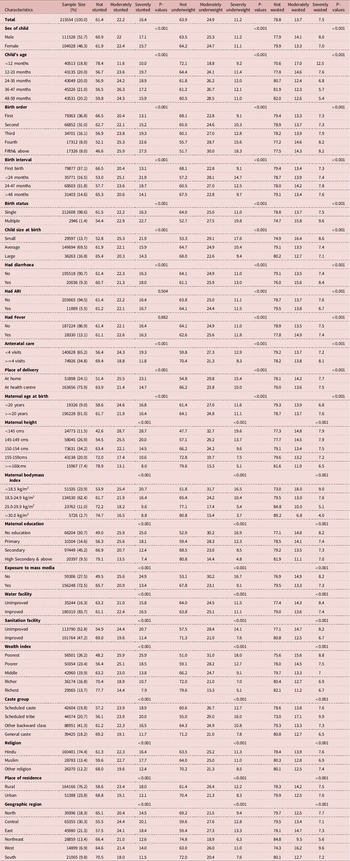
Table 1 presents the socioeconomic and demographic characteristics of the under-5 children and the prevalence of anthropometric failures. A total of 2,15,554 under-5 children were selected to determine the risk factors associated with anthropometric failures. Out of total surveyed children 52 percent were males whereas, 48 percent were females. More than one-third of the children were of first birth order and birth interval as well (36.8 and 37.1 percent respectively). Mother’s height of around one-third (34.2 percent) of children was between 150-154cms. Almost a quarter of mothers had a BMI of ≤18.5. Almost 45.2 percent of mothers were educated up to secondary school and 72.5 percent had mass media exposure. Among the household surveyed 16.3 percent of them did not have improved source of drinking water, whereas, 52.8 percent were using unimproved toilet facility. More than one-fourth (26.2 percent) of the households belonged to poorest wealth quintile.
Sample characteristics and pattern of anthropometric failure among children under-5 years of age, India, NFHS-4 (2015-2016)

Overall, 22.2 percent of children were moderately stunted and 16.4 percent were severely stunted. Severe stunting was higher among males (17.1 percent) as compared to females (15.7 percent). The rate of moderately underweight children was 24.9 percent and severely underweight was 11.2 percent. Children with higher birth order had higher percentages of moderate and severe underweight. Children who belonged to poor families had significantly higher likelihood of being moderately and severely underweight. Scheduled caste and scheduled tribe children were at higher risk of being moderately and severely underweight as compared to their counterparts. The prevalence of moderate and severe underweight was higher among children residing in rural areas (26.4 and 12.2 percent) as compared to those who stay in urban areas (21.3 and 8.3 percent).
Around 13.7 percent of children were moderately wasted and 7.5 percent were found to be severely wasted. Moderate wasting was significantly higher in rural areas (14.2 percent) compared with urban areas (12.5 percent), but severe wasting was slightly lower in rural than in urban children. It also shows that 13.7 percent of Indian children were moderately wasted, and 7.5 percent were severely wasted. Children whose mothers had a low BMI (≤18.50) had the highest percentages of moderate and severe wasting (18 and 9 percent respectively) compared with those whose mothers had a greater BMI. Children in poor families had a higher percentage of moderate and severe wasting than those in rich or middle-income families. The prevalence of moderate wasting decreased with an increase in maternal education.
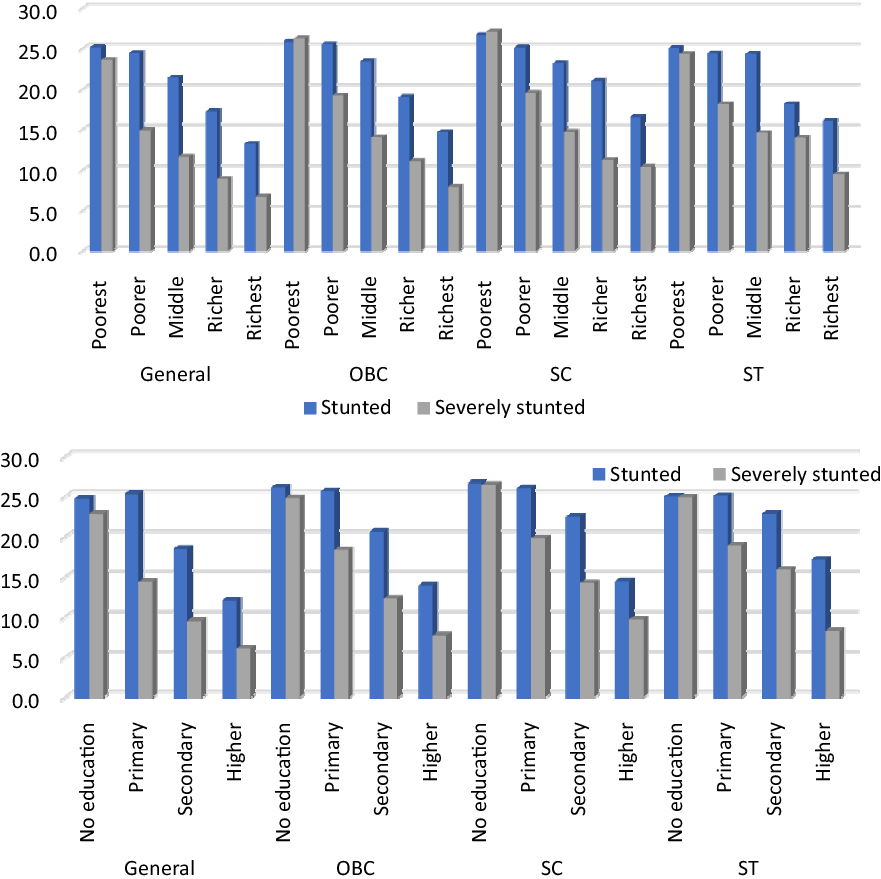
Figure 2 represent the differentials in the burden of anthropometric failures among under-5 children by caste groups (SC, ST, OBC and GC) and selected socioeconomic factors as measured by household’s wealth status, maternal education, place of residence and geographical region in India. The caste groups and household wealth status differentials indicated disproportionate burden of moderate stunting and severe stunting among children from historically disadvantageous caste groups such as SC, ST and OBC relative to children from GC caste groups, particularly those coming from the economically poorest and poorer households.
Prevalence of stunting and severe stunting (%) among children aged 0–59 months by caste group and a) wealth status of household, b) education of mother, c) geographical region and d) place of residence.

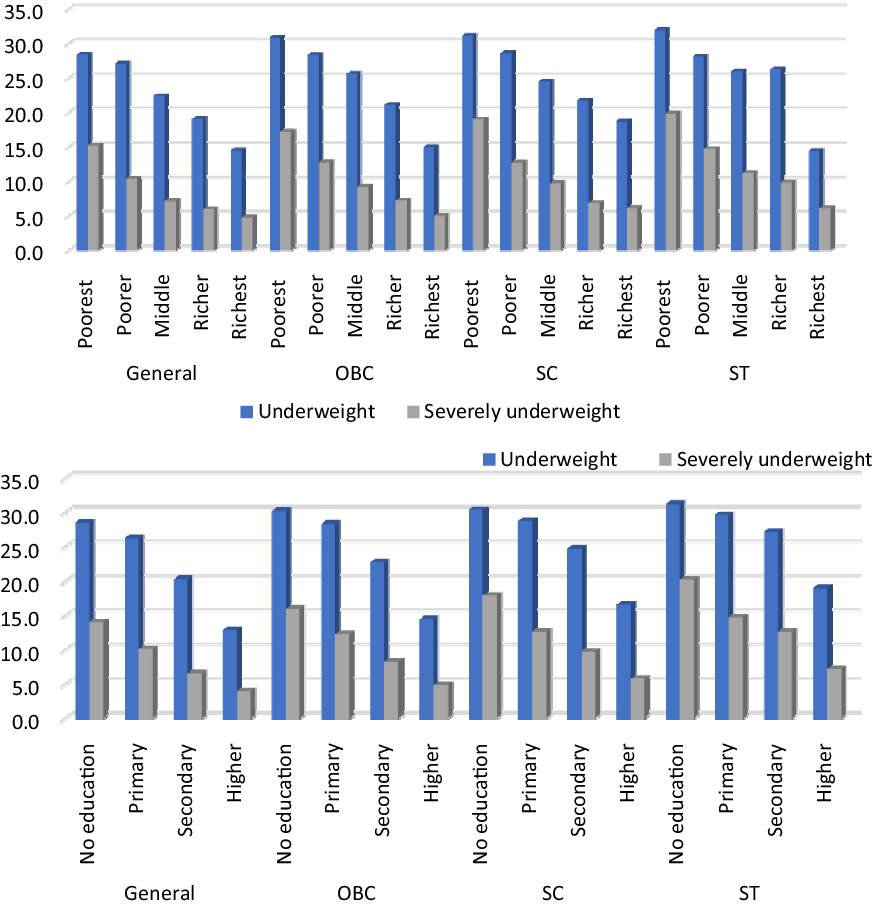
Prevalence of underweight and severe underweight (%) among children aged 0–59 months by caste group and a) wealth status of household, b) education of mother, c) geographical region and d) place of residence.

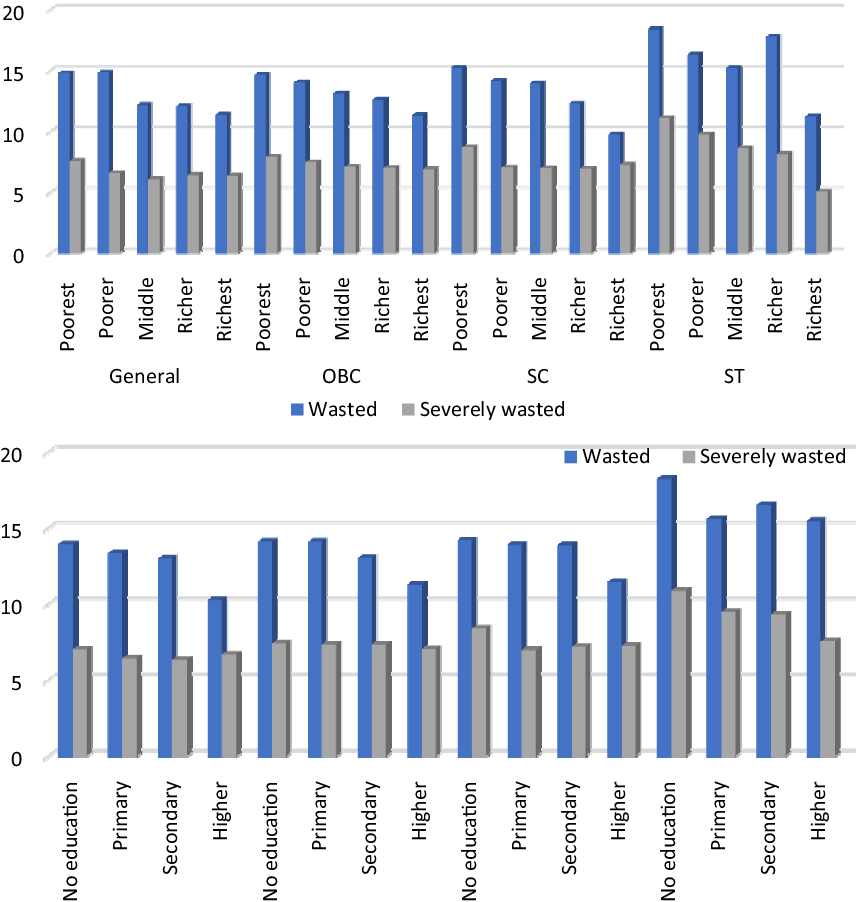
Prevalence of wasting and severe wasting (%) among children aged 0–59 months by caste group and a) wealth status of household, b) education of mother, c) geographical region and d) place of residence.

3.2 Multivariate Analysis of Anthropometric Failures
3.2.1 Risk factors of Moderate Stunting and Severe Stunting
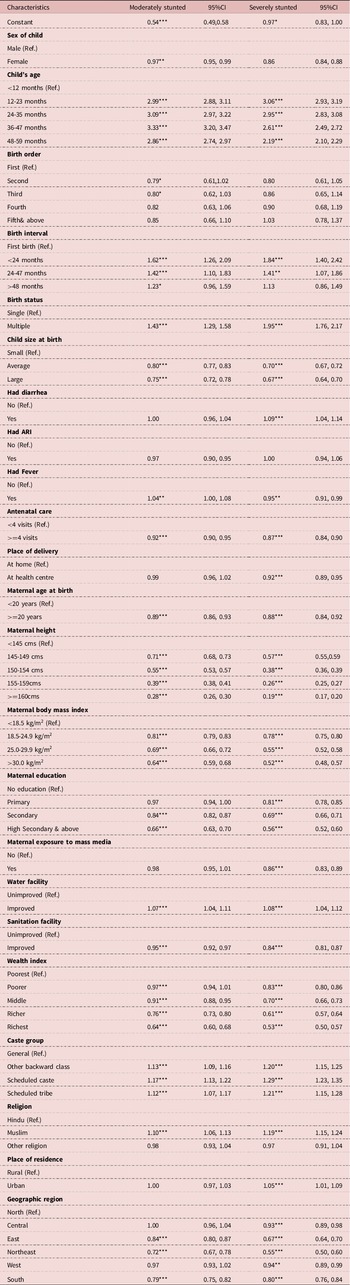
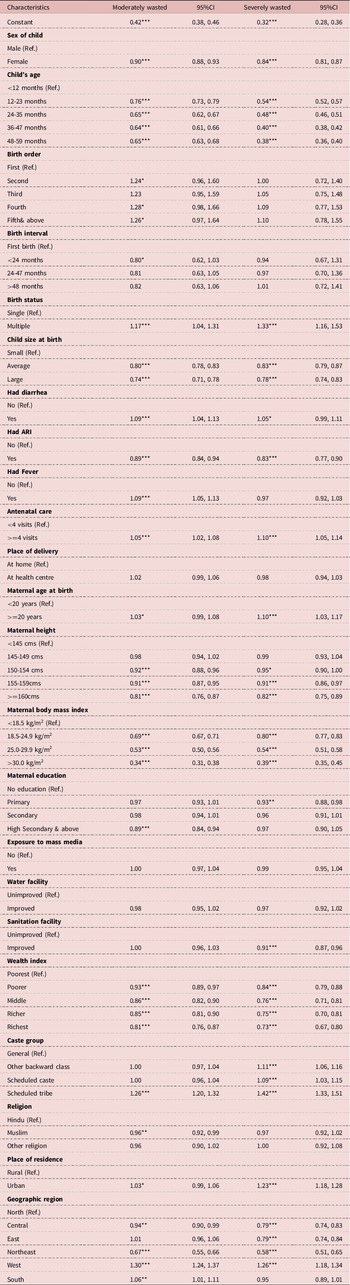
Children from the Scheduled Caste (risk ratio of moderate stunting- 1.17; 95% CI- 1.13, 1.22; risk ratio of severe stunting- 1.29; 95% CI- 1.23, 1.35) and Scheduled Tribe (risk ratio of moderate stunting-1.12; 95% CI- 1.07, 1.17; risk ratio of severe stunting- 1.21; 95% CI- 1.15, 1.28) backgrounds had statistically significant and heightened risk of being moderately stunted and severely stunted as compared to their counterparts from General Caste groups, after adjusting for other demographic and socioeconomic factors (Table 2a).
Multinomial logistic regression model showing relative risk ratio of moderate stunting and severe stunting relative to no stunting among children under-5 age, India, NFHS-4 (2015-2016)

Note: Dependent variable ‘stunting’ has following three categories: no stunting=0; moderate stunting=1; severe stunting=2. Being ‘No stunting’ is the base category in the regression model.
Model has been adjusted for complex survey design and sampling weights is applied.
*p < .05, **p < .01, ***p < .001.
3.2.2 Risk factors of Moderate Underweight and Severe Underweight
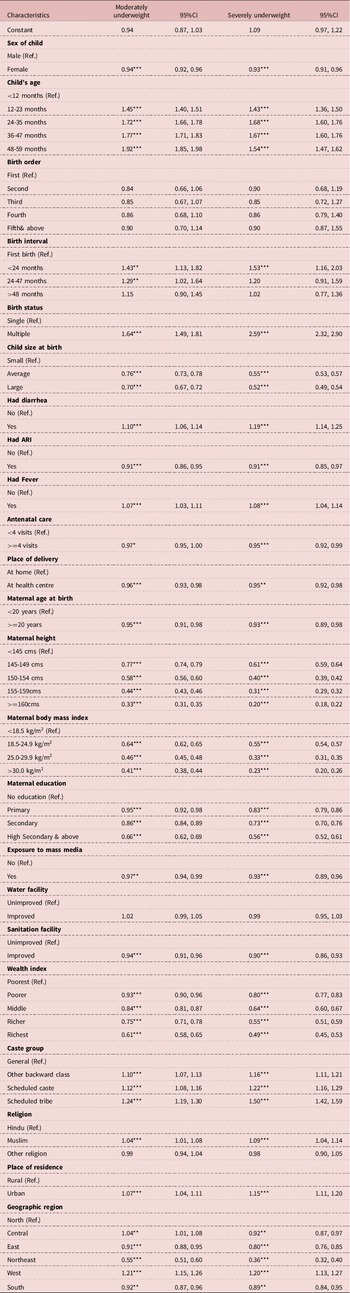
Children from the Scheduled Caste (risk ratio of moderate underweight- 1.12; 95% CI- 1.08, 1.16; risk ratio of severe underweight- 1.22; 95% CI- 1.16, 1.29) and Scheduled Tribe (risk ratio of moderate underweight-1.24; 95% CI- 1.19, 1.30; risk ratio of severe underweight- 1.50; 95% CI- 1.42, 1.59) backgrounds had statistically significant and elevated risk of being moderately underweight and severely underweight as compared to their counterparts from General Caste groups, after adjusting for other demographic and socioeconomic factors (Table 2b).
Multinomial logistic regression model showing relative risk ratio of moderate underweight and severe underweight relative to no underweight among children under-5 age, India, NFHS-4 (2015-2016)

Note: Dependent variable ‘underweight’ has following three categories: no underweight=0; moderate underweight=1; severe underweight=2.
Being ‘No underweight’ is the base category in the regression model.
Model has been adjusted for complex survey design and sampling weights is applied.
*p < .05, **p < .01, ***p < .001.
3.2.3 Risk factors of Moderate Wasting and Severe Wasting
Children from the Scheduled Caste (risk ratio of moderate wasting- 1.00; 95% CI- 0.96, 1.04; risk ratio of severe wasting- 1.09; 95% CI- 1.03, 1.13) and Scheduled Tribe (risk ratio of moderate wasting-1.26; 95% CI- 1.20, 1.32; risk ratio of severe wasting- 1.42; 95% CI- 1.33, 1.51) backgrounds had statistically significant and elevated risk of being moderately wasted and severely wasted as compared to their counterparts from General Caste groups, after adjusting for other demographic and socioeconomic factors (Table 2c).
Multinomial logistic regression model showing relative risk ratio of moderate wasting and severe wasting relative to no wasting among children under-5 age, India, NFHS-4 (2015-2016)

Note: Dependent variable ‘wasting’ has following three categories: no wasting=0; moderate wasting=1; severe wasting=2.
Being ‘No wasting’ is the base category in the regression model.
Model has been adjusted for complex survey design and sampling weights is applied.
*p < .05, **p < .01, ***p < .001.
3.2.4 Interaction effects of caste groups and socioeconomic status
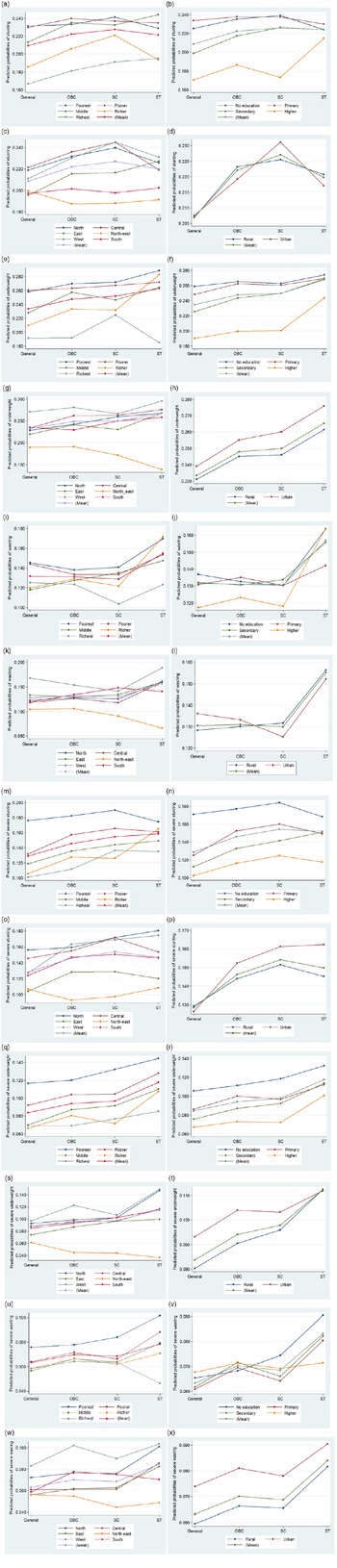
Adjusted multinomial logistic regression model with interaction terms of caste groups with household wealth status, maternal education, place of residence and geographic region suggested statistically significant association with anthropometric failures among children under-5 years of age in India. Result suggests that children from the SC, ST, and OBC caste groups from economically poorer households, with no/limited maternal education, living in the rural areas and residing in the Central/Eastern/Western geographical regions had statistically significant and elevated risk of being stunted, underweight, wasted, severely stunted, severely underweight and severely wasted than their counterparts from the General caste groups, from wealthier households, born to educated mothers, residing in the urban areas and living across the North-eastern/Southern geographical regions in India (Figure 3).
Margins plot showing the interaction effect of socioeconomic status variables and caste groups with anthropometric failures among children aged 0–59 months, adjusting for selected demographic and other socioeconomic characteristics in India. Interaction effect of caste groups and a) wealth index on stunting, b) education on stunting, c) region on stunting, d) place of residence on stunting, e) wealth on underweight, f) education on underweight, g) region on underweight, h) place of residence on underweight, i) wealth on wasting, j) education on wasting, k) region on wasting and l) place of residence on wasting, m) wealth index on severe stunting, n) education on severe stunting, o) region on severe stunting, p) place of residence on severe stunting, q) wealth on severe underweight, r) education on severe underweight, s) region on severe underweight, t) place of residence on severe underweight, u) wealth on severe wasting, v) education on severe wasting, w) region on severe wasting and x) place of residence on severe wasting.

4. Discussion
This paper, employed an intersectionality framework, to investigate the multidimensional inequalities related to the burden of anthropometric failures among children under-5 years of age in India. Net of the underlying demographic and other factors, the present study addressed the social, economic and contextual disparities within different caste groups that drives underlying heterogeneities related to anthropometric failure among young children in the Indian context. For instance, to what extent children from historically weaker social groups (SC/ST/OBC) disproportionately suffered anthropometric failure as compared to their counterparts from relatively forward/advantageous social group (such as general castes). Furthermore, interaction between social groups and selected socioeconomic status (SES) (i.e. household wealth status, mother’s education, geographical region and residence- rural vs. urban) were employed to assess the spectrum of social group and SES linked heterogeneities related to anthropometric failure among young children. This approach has multiple health policy benefits. First, these insights help to address different pathways linked to perpetuating population health and nutritional inequalities, particularly among the most deprived population groups. Second, these findings are helpful for targeted programme implementation for the neediest population groups. Therefore, it helps to improve the public health/nutritional programme efficiency and response.
Our finding shows that one out of every five children under-5 years suffered from moderate stunting, one out of every four children under age five suffered from moderate underweight, while, one out of every seven children under age five suffered from moderate wasting in India. On the other hand, the burden of severe stunting was 16 percent, severe underweight was 11 percent and severe wasting was eight percent among children under-5 age in India. However, these average statistics masked substantial heterogeneities across demographic, socioeconomic and contextual characteristics. These findings are consistent with previous studies that also noted disproportionate burden of anthropometric failures among children from socially and economically marginalized groups in India(Adhikari et al. Reference Adhikari, Yadav, Tripathi, Tolani, Kaur and Rao2020; Subramanian et al. Reference Subramanian, Ackerson, Subramanyam and Sivaramakrishnan2008; Van De Poel & Speybroeck Reference Van De Poel and Speybroeck2009).
The multivariate results from multinomial logistic regression analysis established disproportionate burden of anthropometric failures among under-5 children occur among those from the SC, ST and OBC caste groups (historically marginalized social communities) relative to their counterparts from the General caste categories, after duly adjusting for the selected demographic, socioeconomic and contextual factors. In addition, severe anthropometric failures were conspicuously higher among children with poor maternal nutritional status, frequent disease experiences, non-singleton birth and small birth size, and socioeconomically weaker population groups in India. Our findings are consistent with previous studies that underscored the important role of economic, educational, intergenerational transmission of nutritional deprivations through maternal heights, and contextual characteristics that drives anthropometric failures among young infant and children in developing countries(Addo et al. Reference Addo, Stein, Fall and Martorell2013; Balarajan et al. Reference Balarajan, Selvaraj and Subramanian2011; Bawdekar & Ladusingh Reference Bawdekar and Ladusingh2008; Singh et al. Reference Singh, Srivastava and Upadhyay2019; Subramanian et al. Reference Subramanian, Ackerson, Smith and John2009).
We also demonstrated statistically significant effect of interaction between caste groups and socioeconomic status (measured by household wealth, maternal education, place of residence and geographical regions) with the anthropometric failures among children under-5 years of age in India. Net of the other socio-demographic characteristics, the risk of anthropometric failures measured by six indicators, were disproportionately higher among children from SC, ST and OBC caste categories, particularly coming from economically poorest households, with no/limited maternal education, living across rural areas, and residing in the Central/Eastern/Western geographical regions of India. The National Food Security Act 2013 enacted by the Parliament of India, is committed to protect the household food and nutritional security, particularly of the socially marginalized communities with special entitlements including the provision of subsidized food grains, access to targeted Public Distribution System (TPDS), Integrated Child Development Schemes (ICDS) centres, The Anganwadi Centre Schemes, and Mid-day Meal programmes(Government of India 2013). In addition, the ongoing National Nutritional Mission Programme, popularly refereed as POSHAN Abhiyaan- an overarching scheme of holistic nutrition, a flagship programme implemented by the Government of India 2017 is a multi-sectoral programme to address the maternal and child nutritional issues across India, with particular focus on equity and justice. It envisages to bring maternal and child nutritional issues as a people driven movement and galvanize behavioral social and behavioral change communication (SBCC) strategies to involve different section of society, with particular focus on the socially and economically weaker sections(Kapur & Suri Reference Kapur and Suri2020; Kumar et al. Reference Kumar, Kaur, Singh and Menon2020). Investing in nutritional status of children with reducing inequity shall help to foster sustainable and inclusive future for the Indian people.