1. Introduction
Argan oil is now the most expensive edible oil in the world. It is even more expensive as a cosmetic product and is the subject of several US and European cosmetic patents. The oil, which has been a mainstay for the Amazigh (Berber) tribes of southwestern Morocco for centuries, was propelled out of obscurity in the 1990s by favorable findings about its culinary, cosmetic, and even medicinal virtues. Growing high-value argan markets have sparked a bonanza of argan activity. NGOs, international and domestic development agencies, and argan oil cooperatives have played a central role in this bonanza with the win–win aim of benefiting locals and thereby benefiting the argan forest. These win–win claims appear on virtually every argan product label and have been showcased widely by media outlets worldwide, including the New York Times, Elle magazine, TV5, National Geographic, among countless others. The win–win argan story is indeed compelling, but is it true?
The conservation through commercialization hypothesis (Evans, Reference Evans, Hladik, Hladik, Linares, Pagezy, Semple and Hadley1993) has come under increasing scrutiny by researchers and policymakers in the past decade (see Neumann and Hirsch, Reference Neumann and Hirsch2000; Arnold and Perez, Reference Arnold and Perez2001 for a review). The impact of resource extraction on conservation depends on its impacts on regeneration – especially in the case of fruit or seed harvesting (Peters, Reference Peters1994; Witkowski et al., Reference Witkowski, Lamont and Obbens1994), property rights regimes within indigenous communities (Ostrom et al., Reference Ostrom, Gardner and Walker1994; Arnold and Perez, Reference Arnold and Perez2001; Lopez-Feldman and Wilen, Reference Lopez-Feldman and Wilen2008), and sovereignty over the resource (Dove, Reference Dove1993). The majority of this work focuses on the tropics with little attention paid to semi-arid forests. We broaden the geographic scope of the literature and use panel data to study the development and conservation outcomes of increased resource commercialization in southwestern Morocco.
The impact of forest product extraction on poverty and inequality has been mixed. Lopez-Feldman et al. (Reference Lopez-Feldman, Mora and Taylor2007) show that extraction of the xate palm in southern Mexico contributes greatly to economic equality. Reddy and Chakravarty (Reference Reddy and Chakravarty1999) show that without forest income, poverty would increase 28 per cent in India. Jodha (Reference Jodha1986) and Fisher (Reference Fisher2004) demonstrate that without forest income, inequality would increase 36 per cent in India and 12 per cent in southern Malawi, respectively. In a related vein, Pattanayak and Sills (Reference Pattanayak and Sills2001) show that access to nontimber forest products acts as a natural insurance in the Brazilian Amazon, increasing welfare by mitigating agricultural risk. In many other cases, however, the impact of forest resource commercialization on poverty and inequality has been ambiguous or negative. Neumann and Hirch (Reference Neumann and Hirsch2000) present evidence to show that nontimber forest product extraction is an activity of the poor and Wunder (Reference Wunder2001) and Angelsen and Wunder (Reference Angelsen and Wunder2003) argue that nontimber forest product extraction may even result in a poverty trap. In the case of argan products, Lybbert et al. (Reference Lybbert, Barrett and Narjisse2002) offer a cautionary assessment of the potential for argan commercialization to stimulate development or decrease poverty. A primary limitation of these existing studies is the cross-sectional data on which these tests are based, which make it difficult to infer how changes in market conditions actually affect household welfare.
We test the credibility of the popular win–win argan story by assessing the impact of the argan boom on rural households in the argan forest region. We do this by surveying households before and after the argan markets started booming. This panel dataset allows for a unique assessment of the causal impacts of increasing argan oil prices. While earlier analysis of these households included some nascent changes in markets (Lybbert et al., Reference Lybbert, Barrett and Narjisse2002, Reference Lybbert, Barrett and Narjisse2003), the subsequent evolution of argan markets and commercialization represents a dramatic departure from 1999 trends. In a dosage response model, we use this shock to argan markets as a treatment and households’ ex ante access to argan trees as the ‘dosage’ of this treatment. We find that households that stood to benefit from the boom in 1999 increased both their weekly consumption spending at the souk (market) and goat herd size more than households that did not stand to benefit. These households were also significantly more likely to send their girls to secondary school in subsequent years. Results for the argan forest are more mixed. While locals are keeping their goats out of argan trees during the fruit harvest, which is good for the trees, they may also be resorting to more aggressive harvesting techniques. With the argan boom, households have become vigilant guardians of fruit on the tree (especially on their own trees), but seem much less eager to invest in longer-term tree and forest health.
2. The argan oil bonanza
The argan tree (Argania spinosa (L) Skeels) is endemic to Morocco, where it is second in coverage only to the cork oak tree and is ecologically indispensable. Its deep roots are the most important stabilizing element in the arid ecosystem, providing the final barrier against the encroaching deserts (see Morton and Voss, Reference Morton and Voss1987). The tree resists domestication and is difficult to transplant or establish on any meaningful scale outside Morocco.
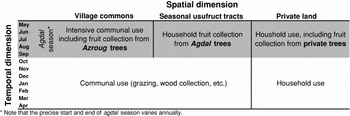
Argan forests are invaluable to the indigenous Amazigh tribes who rely on the tree for firewood and charcoal for heating and cooking; fodder for livestock; and oil for culinary, cosmetic, and medicinal purposes. Indeed, nearly 90 per cent of the rural economy in the region depends on argan-based agroforestry (Benchekroun, Reference Benchekroun1990), which is governed by clear and well-established, albeit complex, tenure arrangements (see figure 1). While some have argan trees on private land, most households access argan fruit via seasonal usufruct rights in defined forest tracts called agdal. After fruit harvest, these usufruct tracts return to collective exploitation. Other portions of the collective forest, called azroug, are collectively exploited year round by members of the assigned village (see Lybbert et al., Reference Lybbert, Barrett and Narjisse2002). In recognition of its ecological value and local economic importance, the argan forest region was declared a UNESCO Biosphere Reserve in 1998.
The spatial and temporal structure of the right to collect argan fruit

Despite its uniqueness and importance, nearly half of the argan forest disappeared during the twentieth century – and average density in the remaining half dropped from 100 to less than 30 trees per hectare. Historical pressure from high-quality charcoal production (especially important during the world wars) and, more recently, conversion to export crops such as tomatoes, has been replaced by predominantly local threats, including intensification of livestock browsing and grazing and encroaching suburban and rural settlements.Footnote 1
Growing appreciation among chemists, tourists, entrepreneurs, and cosmetic firms during the 1990s for the culinary and cosmetic properties of the oil extracted from the kernels inside argan fruit set the stage for dramatic changes in argan oil markets. During our 1999 survey, some of these changes and their implications for the extraction and commercialization of argan products were evident. Entrepreneurs had already started tapping into higher value tourist markets in 1999 and were laying plans for expansion into Europe and North America. A few European cosmetic firms, including Yves-Roche and Colgate-Palmolive, were experimenting with argan-based moisturizers. An even more potent early influence came from conservation and development interests that sought to leverage high-value argan markets to benefit locals, empower women (who are primarily responsible for argan activities), and thereby promote local conservation of the threatened forests (Lybbert et al., Reference Lybbert, Barrett and Narjisse2002).Footnote 2 Through investments in oil quality, testing to ensure purity, mechanical extraction, packaging and labeling, and in the distribution networks required to tap export markets, these initiatives pioneered the path to high-value argan oil commercialization – a drastic departure from traditional roadside stalls offering oil of questionable purity in re-used plastic bottles.
Following these early efforts, argan oil has frequently attracted the media's gaze. It has been featured in its own French documentary, is showcased by just about any tourist publication or production on Morocco, and now has dozens of websites dedicated to it. Across this broad array of media attention, one strand is nearly always woven into the argan story: the wonderful win-win it offers consumers to protect trees and help local women all while enjoying the many virtues of this “liquid gold” (Larocca, Reference Larocca2007). Not surprisingly, this compelling story has fueled a veritable frenzy of argan activity in the past decade with new argan oil producers, distributors, and cooperatives springing up at every turn to leverage the win-win story with quaint references to the threatened tree and the women involved in extracting the oil on their labels. Others more proactively link up with cooperatives, which have exploded from a handful involving a few hundred women in 1999 to over 100 cooperatives involving nearly 4,000 women in 2007.Footnote 3
How has this argan bonanza affected argan markets? Total fruit production in the argan forest can vary wildly from year to year due to rainfall fluctuations, but is perfectly price inelastic in the short and medium term. An argan sapling – very few of which typically survive beyond a few years – can take 20 years or more before producing fruit (see Lybbert et al., Reference Lybbert, Barrett and Narjisse2003). Fruit collection is likely less inelastic than production, but aggregate production and collection estimates do not exist, making it difficult to assess whether fruit collection could expand in the near term. Anecdotally, locals seem to have become much more careful about how and how completely they collect fruit in the last several years. For example, locals historically collected dried fruit by hand off the ground and also collected argan stones from the dung of their goats after they ate fruit directly from the thorny tree canopy. As the fruit has become more valuable, locals are collecting much more fruit by hand, which has likely made fruit collection more complete and expanded slightly the amount of fruit available for oil extraction. This very modest fruit supply response, however, is swamped by the recent explosion in argan oil demand, and argan prices have skyrocketed as a result. Real argan fruit prices in rural markets nearly doubled between our 1999 and 2007 survey rounds, while oil prices in these markets increased 40 per cent.Footnote 4
Changes in argan oil demand have driven significant differentiation in argan markets. Presently, there are two broad argan oil markets, one culinary and the other cosmetic. Culinary argan oil, historically available only in or near the argan forest region, is now marketed across Morocco, Europe, the Middle East, and North America. Since this market spans dusty village souks and upscale restaurants in New York and Paris, retail prices range widely from $15/liter to twenty times this much, making it the most expensive edible oil in the world. The market for cosmetic argan oil has likewise exploded over the past decade. The Amazighs have used argan oil cosmetically for centuries (see M'Hirit et al., Reference M'Hirit, Benzyane, Benchekroun, El and Bendaanoun1998), but introducing argan oil into high-value cosmetic markets has required more than this traditional knowledge, including validation of its chemical properties and mechanical extraction and processing technologies. On international markets, pure argan oil is marketed as a natural moisturizer or added directly to a moisturizer or other cosmetic product. A second segment of the cosmetic argan market is more research-intensive, focuses of extracts from argan oil, leaves, fruit, and seeds that are marketed as active ingredients in cosmetic treatments, and has generated a variety of patents in Europe and the United States (see Lybbert, Reference Lybbert2007). As with the culinary oil, cosmetic firms are quick to leverage the win-win story of rural development and conservation.Footnote 5
Improvements in packaging and labeling were the first step to tapping high-value markets in the late 1990s. Labeling is again emerging as a potentially important aspect of differentiation in argan markets, this time in conjunction with certification. First, there are currently several argan oil products – both culinary and cosmetic – that are fair trade certified by organizations such as AlterEco and Max Havelaar. Many more products include label claims that locals benefit from the sale of the product without any fair trade certification. Next, many have pushed to protect argan oil as a geographic indicator in Europe. Last, there is currently no clear certification to distinguish argan cooperatives from private firms, which are indistinguishable to many locals.Footnote 6 As a result, the argan forest region is rife with cooperatives that function more like a profit shop and small shops that pose as cooperatives, yet do not offer cooperative-type benefits to their members.Footnote 7
3. Data
The data used in this study was collected in two rounds of a household survey. The first round was conducted in summer 1999 at the cusp of the dramatic changes in argan markets described in the previous section. The second round was conducted in summer 2007, after argan markets had changed substantially. The original sampling frame was constructed as a stratified cluster sample in the Smimou Caidat, a county-like administrative unit located in the Essaouira Province in southwest Morocco. We stratified villages in the Smimou Caidat by forest density: low, medium, and high.Footnote 8 We then randomly selected two villages in each density class. We supplemented this list with four additional villages located near two of the original argan cooperatives. With the help of village officials, we sorted households within these selected villages into two categories, those with few or many agdal rights, and then randomly selected households from each category. The survey was fielded separately with the male head of household and his wife.
We surveyed approximately 15 households in each of these villages in 1999, for a total sample size of 149 households in 1999. Of these 149 households, 46 were not resurveyed in 2007. About half of attrition can be attributed to age-related factors; in 21 of these households the household head died between 1999 and 2007 and in four of these households the household head was too sick to participate or hospitalized at the time of the 2007 survey. Of the other missing household heads, nine permanently migrated, five were traveling (for vacation or work), five were absent for the day (working nearby or running errands), and two refused to participate. Of the 103 remaining households, nine only consisted of the wife of the household head and seven only consisted of the male household head. This leaves 87 households for which there is panel data for both the male- and female-oriented questions. For some households in which both the male and female head of household participated in both the 1999 and 2007 surveys, there is missing data due to respondents’ inability or unwillingness to answer certain questions. Consequently, the sample size for analyses done at the household level varies from 77 to 96 depending on what variables are involved. Because some households have no school-aged children and others have multiple school-aged children, sample size for individual-level education analyses is 118 (57 girls and 61 boys).
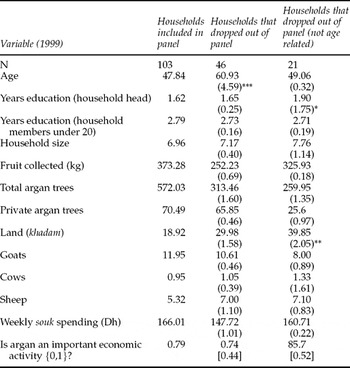
Attrition can lead to biased results if households missing from the 2007 sample are systematically different from panel households. We checked for differences in key variables from the 1999 survey between panel households (those surveyed in 1999 and 2007) and attrition households (those only surveyed in 1999) and found no significant differences other than age. We also compared panel households with households that could not be surveyed in 2007 for nonage related reasons. Household heads that could not be surveyed in 1999 for nonage related reasons were slightly more educated (although levels of education were still under three years total on average) and had more land. There were no significant differences in key argan variables: access to total trees, private trees, fruit collected, and importance of argan production among other household economic activities (table 1).
Descriptive statistics (1999 values) for households that dropped out of the panel (i.e., were not surveyed in 2007) and those that were included in the panel

Absolute value of t-statistics in parentheses; p-values from Pearson's chi-square test in brackets; significant at *10%; **significant at 5%; ***significant at 1%.
Our empirical approach in this paper relies on changes that occurred in our surveyed households between 1999 and 2007 to shed light on the local welfare impacts of booming argan markets. Before turning to this analysis we look at broad trends in the argan forest region in order to understand what else – in addition to the argan price boom – may have changed between these years. Ideally, we would begin by comparing total argan fruit production in the forest, but annual fruit production estimates for the argan forest simply do not exist. Qualitative and anecdotal evidence, however, uniformly suggests that 2007 fruit production was higher than in most recent years including 1999, which was a mediocre year. Livestock play a central role in household welfare and put pressure on the argan forest, making changes in the aggregate goat herd important. The goat herd trended upward after 1995, albeit with substantial yearly variability. Although argan prices, especially for argan fruit, have boomed since 1998, this has apparently not translated into an aggregate reduction in livestock pressure on the forest – something we investigate more closely in the next section. Finally, the cost of living in the argan forest region increased between our survey rounds. Cost of living indices for urban areas in the region (Agadir and Marrakesh) increased nearly 25 per cent between 1999 and 2007. Although this is well below the increase in argan prices, rural households broadly note that things are getting more expensive and the value of their production is not keeping up. This cost of living squeeze could easily force some rural households to modify their expenditure decisions.
4. Analysis and results
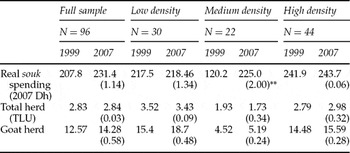
In this section, we empirically test the win–win claim of the argan story by evaluating whether locals have benefited from the argan boom and whether this has led to improvements in locals’ management of the argan forest. If the boom has broadly benefited rural households in the region, we would expect to see some encouraging improvements in household spending and wealth. Based on the average changes in table 2, the only significant change was for real souk spending among our medium density households. Although these households have easy access to argan markets, simple averages obviously cannot attribute this general change to the argan boom. Average goat herds have increased over these years, but these are not statistically significant changes. To understand whether these unconditional changes have any relation to the argan boom, we must model household-level changes in detail. We begin by assessing changes in household argan production and reliance on argan products. We then analyze the impact of booming argan markets on household welfare and on the forest.
Average weekly household souk spending and herd size in 1999 and 2007

Absolute value of t-statistics in parentheses; significant at *10%; **significant at 5%; ***significant at 1%.
4.1. Aggregate trends in household argan activities
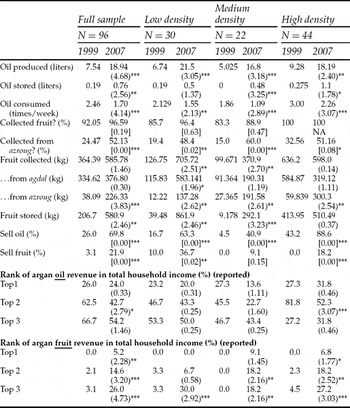
The argan boom has strongly shaped the evolution of argan production, storage, sales, and consumption among households. Table 3 shows how these have changed on average and suggests a few notable fruit and oil trends. Based on our full sample, household argan oil production was nearly three times higher in 2007 than in 1999, and was very consistent across density classes in both survey years. Table 3 also suggests that households are storing significantly more oil – likely the result of higher oil production between periodic sales – and consume argan oil almost half as frequently as before.
Changes in household argan activities across density zones

Absolute value of t-statistics in parentheses; p-values from Pearson's chi-square test in brackets; significant at *10%; **significant at 5%; ***significant at 1%.
Fruit collection was nearly ubiquitous in the argan forest in both 1999 and 2007, but the amount of fruit collected per household increased significantly in the low- and medium-density areas of the forest. Mean household fruit collection did not change significantly in the high density areas of the forest – likely due to a combination of their distance to fruit markets and their 1999 fruit collection already being relatively complete. As discussed above, 2007 saw excellent argan fruit production – so it is not surprising that fruit collection is higher in 2007 than in 1999. Rather, the most striking change in fruit collection involves where households collected fruit.
The number of households collecting fruit from the village commons (azroug) more than doubled from 1999 to 2007. This increase occurred as households already using the azroug in 1999 increased collection and those not previously collecting fruit in the azroug expanded where they collect. This expanded azroug fruit collection is due largely to reduced aerial goat grazing during the fruit harvest. In contrast, the manual collection of agdal fruit was already nearly complete in 1999, which limited any price-induced fruit collection response in these tracts. Increased azroug participation was most prevalent in medium density villages, where participation was lowest in 1999 and highest in 2007. The common property structure of usage rights in the azroug shapes exactly how these changes occur – a theme to which we will return.
Since fruit collection can fluctuate wildly by year according to rainfall, households have always relied on fruit storage to smooth oil production across years.Footnote 9 One of the most dramatic recent changes in household argan activity is the enormous surge in fruit storage, which has nearly tripled from 207 kg per household in 1999 to 581 kg in 2007. Where previously it enabled households to smooth their own oil production over time, fruit storage now functions as a store of wealth or speculative investment. The increase in storage came almost entirely from the low-density (39–862 kg) and medium-density (9–292 kg) areas of the forest, which are much closer to market. In the high-density area, average household fruit storage was already substantial and did not increase significantly.
While some increase in both argan oil and fruit sales would be expected given how productive the argan forest was in 2007, the proportion of households in our sample that sells any argan oil more than doubled between 1999 and 2007. Meanwhile, the proportion selling fruit increased more than six-fold. In both 1999 and 2007 we asked households to rank their most important sources of household income. Argan fruit has become a substantial component of household income, whereas argan oil did not become more or less important. These findings are consistent across density classes. While more households continue to rank argan oil as their most important income-generating activity, the booming argan fruit market has turned argan fruit from a triviality into an important income generator. The divergence between argan oil prices on local markets and on high-value markets is clearly inciting households to sell their fruit to cooperatives and firms that can tap these higher prices.
4.2. Impacts of the argan boom on household welfare
To evaluate how these dramatic changes in households’ argan activities have translated into welfare effects, we must harness more rigorously the panel structure of our data. Specifically, we consider how a household's access to argan fruit in 1999 – an indicator of its ex ante potential to benefit from the argan boom – affected three types of household welfare outcomes: consumption, assets, and children's education. In this subsection, we discuss our chosen welfare outcomes and describe our estimation approach. We then present and discuss results.
Welfare outcomes
In the argan forest, most household purchases (and sales) are made at a souk. Since souk spending is readily known by households, we use the change in real household souk spending from 1999 to 2007 as a measure of consumption changes. Households in this region hold livestock as a primary productive asset and as a store of wealth since they do not have easy access to financial markets. We therefore use the change in herd size from 1999 to 2007 as a measure of asset changes. Although some households have cattle and even camels in their herds, small livestock – especially goats – are most prominent. Moreover, goats are the primary grazing threat to the forest. Since goats are both a key productive asset that captures an important dimension of household wealth and a primary threat to the forest, we use the change in household goat herd as an additional and particularly relevant measure of asset change.
Formal education in rural Morocco lags far behind urban areas. According to the Moroccan Direction de la Statistique (1999), 57 per cent of 7–12 year old rural children (47 per cent of girls and 67 per cent of boys) – compared to 86 per cent of urban children – were in primary school in 1999. Rural rates of secondary school attendance are even lower – 8 per cent for girls and 17 per cent for boys. Most rural villages, including those in our sample, have easy access to a local primary school, but secondary schools are farther away so the transition from primary to secondary school requires a substantial investment. Given the difficulty and importance of this transition, we use the advancement of children in the household from primary to secondary school during the period 1999–2007 as the education outcome of interest. In contrast to our consumption and asset outcomes, which are measured at the household level, we measure secondary school advancement at the individual level and include all children who could have advanced to secondary school between 1999 and 2007.Footnote 10
Differences in gender roles in Morocco imply that the decision to send a daughter to secondary school is quite different than the decision to send a son, so we analyze impacts on secondary advancement by gender. An educated son may be expected to yield greater benefits than an educated daughter in the future. Furthermore, the opportunity cost of a son's labor and daughter's labor will also differ, particularly in regards to argan work which is primarily done by women. It is unknown, however, if the presumably higher opportunity cost of sending a daughter to school will offset the potential future benefits of sending a daughter to secondary school. Our analysis will attempt to shed some light on this question.
Model: Difference-in-difference with instrumental variables
The panel structure of our data, which includes an observation for each household before and after booming argan prices, enables us to structure our empirical approach as a ‘dosage response’ difference-in-difference analysis. Since households were not sorted neatly into treatment and control categories before the boom, we use instrumental variables to purge the dosage variable – households’ ex ante fruit collection – of bias induced by endogeneity.
We define a household's ex ante ability to benefit from a boom in argan prices as their potential to collect argan fruit at the onset of the boom. This potential differs across households based on a number of factors. Households have different endowments of rights to trees, both agdal and private, and these trees vary in productivity. While our data suggest that in 1999 the majority of households were harvesting fruit from their own private and agdal trees at capacity, they also have access to communal trees in azroug areas of the forest. Most of the increase in fruit collection from 1999 to 2007 came from households collecting more intently and more extensively from these communal trees. Thus, fruit collection has both an exogenous component (access to private and agdal trees) and an endogenous component (effort put into harvest intensity and use of the azroug). To deal with this endogeneity problem, we use a limited information maximum likelihood instrumental variables (IV) approach, where our structural equation is the change in the welfare variable for household i in village j from 1999 to 2007 as a function of total fruit collection in 1999 and a vector of exogenous control variables that can affect welfare outcomes through other means:

where eij is a heteroskedastic error term clustered at the village level. The coefficient β 1 in this specification allows us to test whether the argan boom indeed benefited locals. Because 18 per cent of all fruit collection in 1999 came from azroug trees and because this fruit collection is largely determined by effort, we also tested a variation of equation (1) that uses fruit collected exclusively from private and agdal trees in 1999 rather than all fruit collected as the instrumented treatment variable as a robustness check. Key results were nearly equally significant, and slightly stronger.Footnote 11
To instrument for fruit collection in equation (1), we use exogenous measures of rights to collect argan fruit. These rights come in the form of access to agdal trees and private trees and are correlated with fruit collection (23 per cent and 9 per cent, respectively). In theory, agdal rights and land can be acquired through purchase, but in practice they are acquired only though inheritance so we are confident that these variables are exogenous. The number of private and agdal trees a household can access should only impact welfare outcomes via the household's ability to gather fruit from these trees. Since we control for land in the IV estimation, we are confident that private trees do not proxy for land ownership. Argan trees provide goat fodder and firewood in addition to fruit, but households generally rely most heavily on communal azroug trees or others’ agdal trees outside the fruit harvest season (see figure 1) for these purposes. We discuss empirical tests of the validity of our instruments with our results.
The control variables in equation (1) are exogenous factors that can impact welfare outcomes directly and can help predict fruit collection. We use household size, which is exogenous in the short term, to control for the amount of labor a family is endowed with to engage in argan production or other activities. Controlling for household size is also important because bigger households will generally spend more at the souk and may also have larger herds since they have more mouths to feed, and more available labor to tend to the herd.Footnote 12 We use age and education of household head to control for hisFootnote 13 economic capacity. The age of the household head also serves as a proxy for the age structure of the rest of the household. We control for private landholdings because it is an indicator of family wealth, and can also be used as a productive asset in some cases (private grazing, crops), however private land is not highly correlated with private trees (correlation coefficient of 0.15), and therefore should be treated as a separate variable from private trees. Finally, we control for the presence of an argan cooperative in the village since a cooperative may encourage more argan production, or help households capitalize on existing collection. Since this variable is essentially a fixed effect for the four cooperative villages, we also estimate the models without this variable as a robustness check. For the education regressions we control for distance from a secondary school in transportation time, which is a major barrier to successful transition from primary to secondary school.
First stage results
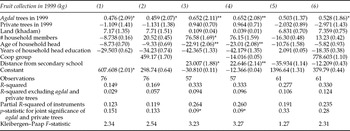
Table 4 contains the complete estimation results of the first stage equation, as well as some diagnostics for the strength of the instruments. These results indicate that fruit collection was positively impacted by the household's agdal tree holdings but was not significantly impacted by households’ private treeholdings. This is not too surprising as private trees only compose 12 per cent of the total amount of private and agdal trees households have rights to. Rights to agdal trees and private trees were only jointly significant in two of six first stage regressions,Footnote 14 an early warning sign of weak instruments. Household size only significantly increases fruit collection in one first stage regression. Amount of land owned was not a significant determinant of ex ante access to argan fruit.
First stage regression results for 1999 argan fruit collection equation

Cluster (village) robust t-statistics in parentheses (z-statistics for (3)–(6)).
*Significant at 10%; **significant at 5%; ***significant at 1%.
(1) Household level data for souk spending and livestock holdings.
(2) Household level data for souk spending and livestock holdings (with control for coop village {0,1}).
(3) Individual level data for educational advancement (girls).
(4) Individual level data for educational advancement (girls) (with control for coop village {0,1}).
(5) Individual level data for educational advancement (boys).
(6) Individual level data for educational advancement (boys) (with control for coop village {0,1}).
For (3)–(6) R-squared, partial R-squared, Klebergen–Paap F-statistic, and P-statistic for joint significance of tree variables are taken from IV linear probability model regressions, whereas “second stage” IV probit results come from the maximum likelihood estimation IV probit.
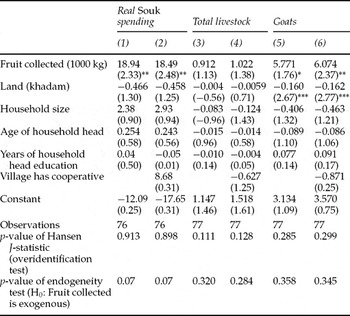
The R-squared values for the first stage regressions range from 0.149 to 0.33 depending on the model. While these R-squared values may seem low, the partial R-squared valuesFootnote 15 for these first stage regressions – a diagnostic tool for weak instruments – approach those of the total R-squared, indicating that the selected exogenous instruments (agdal trees and private trees) explain most of the endogenous explanatory variable used in the second stage (fruit collection). Since there is no consensus on how high a first stage R-squared or partial R-squared must be to obviate weak instrument problems (Cameron and Trivedi, Reference Cameron and Trivedi2009), we conduct a series of tests. Stock and Yogo (Reference Stock, Yogo, Andrews, Stock and Rothenberg2005) propose a formal weak instruments test that can be used to determine the maximum degree of inflation of the test-statisticFootnote 16 on the parameter estimate for the endogenous explanatory variable(s) in IV models using finite samples.Footnote 17 Using this test, we cannot reject the null hypothesis that the estimated impact of fruit collection on welfare outcomes is inflated by as much as 12 per cent. On the basis of this concern, we employ limited information maximum likelihood (LIML IV), which is asymptotically equivalent to 2SLS but has better finite sample properties, especially in the case of weak instruments (Cameron and Trivedi, Reference Cameron and Trivedi2009). While they may be weak, the instruments nevertheless appear to be valid: p-values for Hansen's J-statistic range from 0.12 to 0.91 (tables 5a and 6a), indicating that we cannot reject the null that the instruments are exogenous. Since the measurement error introduced by weak (albeit statistically valid) instruments may be more problematic than the potential endogeneity bias introduced by using 1999 fruit collection as an explanatory variable, we report ordinary least squares (OLS) results for each of our models below.
IV (LIML) estimation results for change in weekly spending, total livestock, and goats

Cluster (village) robust z-statistics in parentheses.
*Significant at 10%; **significant at 5%; ***significant at 1%.
Second Stage Results
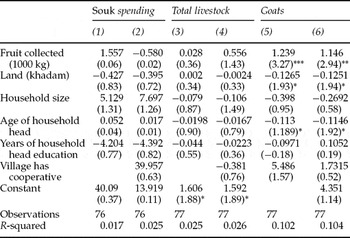
Consumption & Savings: Table 5a displays second stage results for changes in spending and assets. Models 1 and 2 in this table indicate that households that were well positioned to benefit from the argan boom – as captured by fruit collected in 1999 – experienced a higher increase in household consumption relative to households with access to less fruit. While statistically significant, this difference is small in economic terms: ceteris paribus an increase in 1999 fruit collection of 300 kg (0.25 standard deviations) leads to roughly 300 Dh ($35) of additional annual souk spending in 2007. This is a small change considering that mean weekly souk spending for households in our sample was 170 Dh in 1999 and mean annual fruit collection was 364 kg. This effect vanishes with OLS (table 5b), which suggests that weak instruments may distort the IV results, but since we reject the null that fruit collection is exogenous in this spending specification, these OLS estimates may themselves be biased.
OLS estimation results for change in weekly spending, total livestock, and goats

Cluster (village) robust t-statistics in parentheses, p-stat given for Kleibergen–Paap F-statistic
*Significant at 10%; **significant at 5%; ***significant at 1%.
Models 3 and 4 suggest that the change in total herd size from 1999 to 2007 was not affected by the argan boom. In contrast, however, models 5 and 6 indicate that households that stood to benefit most from the argan boom have increased their goat herds more than others. This impact is both statistically and economically significant: the same 300 kg increase in 1999 fruit collection as above is associated with adding two goats to the household herd – a 17% increase for the average 1999 herd. This result emerges as statistically significant in the OLS estimates reported in table 5b, but with a smaller magnitude.
The qualitative finding that goat herds appear to increase most among households that benefit from the argan boom is robust to both endogeneity bias and weak instruments. On the surface, this is indeed evidence of local benefits from the boom – but this benefit has a dark side. As households improve their earnings through argan exploitation they reinvest in goats, the primary contemporary threat to the forest. It is estimated that the argan tree accounts for 50%–80% of goat diets in the region, roughly half of which comes from leaves grazed in the tree canopy (El Aich et al., Reference El Aich, El Assouli, Fathi, Morand-Fehr and Bourbouze2007). Although purchased feed sources may be replacing canopy grazing during the fruit harvest, the tree seems to be grazed as intensively as ever during the rest of the year. This ‘killing the golden goose’ story is of course not unique to the argan case.Footnote 18
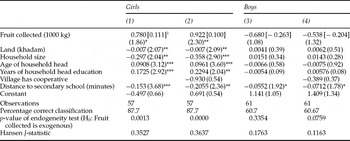
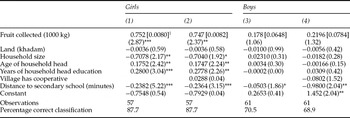
Education: Table 6a reports the IV probit results for our education specification. We estimate the transition to secondary school among individual children in our sample for girls and boys separately because education decisions are quite different by gender. In particular, while 27 per cent of children in our sample transition to secondary school, this percentage is nearly half for girls what it is for boys. Our results indicate that the impact of the argan boom on the education decision may similarly be conditioned on gender. Girls from households that stood to benefit from booming argan prices were significantly more likely to make the transition from primary to secondary school than girls from other households, but no such result appears for boys.Footnote 19
IV probit estimation results for children's advancement to secondary school

†Marginal effects reported in brackets.
Hansen J-statistic is from IV regression of LPM model.
Absolute value of cluster (village) robust z-statistics in parentheses.
*Significant at 10%; **significant at 5%; ***significant at 1%.
Given the important role that women's empowerment has played in motivating the development and deployment of argan oil cooperatives, it is encouraging to note that instead of girls being pulled out of school to work in argan markets, the argan boom seems to have been positive for girls’ education outcomes. This result was robust to an OLS specification, reported in Table 6b. A potential reason for this is that women who produce more argan goods have gained bargaining power in their households as their income generating potential has increased with appreciating argan markets and have lobbied more effectively for girls’ education. More plausibly, there may simply be more room for improvement with girls than with boys. Many girls may have previously been withheld from secondary school for no particular reason and additional household income may therefore have a bigger effect on the decision on the margin for girls than for boys (fewer of whom were held back without reason). Whatever the reason, this may be the most meaningful of the local benefits flowing from the argan boom.
Probit estimation results for children's advancement to secondary school

†Marginal effects reported in brackets.
Absolute value of cluster (village) robust -statistics in parentheses.
*Significant at 10%; **significant at 5%; ***significant at 1%.
4.3. Impacts of the argan boom on the forest
Given the unique ecological role played by the argan tree and the fact that locals seem to pose the greatest threat to argan forests through local exploitation, argan forest conservation has always played a central role in the argan cooperative movement and in the development of high-value argan oil markets as described above. We now turn to this important aspect and assess likely impacts of the argan boom on the way locals use and perceive the forest and, consequently, on the forest itself.
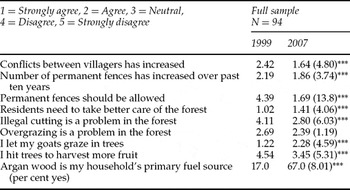
As the value of argan has increased, so has resident defensiveness over the trees and fruit they consider theirs. Table 7 shows that residents of the argan forest have noted significantly more conflicts over argan resources as well as the increased use of permanent barriers around agdals to clearly define their limits and discourage use by others year-round. Although such permanent barriers around agdals are technically illegal, residents were largely in favor of allowing them in 2007, whereas in 1999 they were soundly against them. These observations and opinions were consistent among those that were engaged in argan production in 1999, those that started producing argan goods between 1999 and 2007, and those that have never participated in argan activities.Footnote 20 Despite residents’ efforts to protect their private fruit, their attitudes and behavior toward the forest do not show a general trend of conservationism.
Conservation-related attitudes, perceptions and activities

Absolute value of t-statistics in parentheses; ***significant at 1%.
In 1999 the residents surveyed were adamant that they collectively needed to take better care of the forest. In 2007 they still agreed that they needed to practice greater stewardship, but the stance softened significantly. This view was consistent across residents that produced argan goods since 1999, those that started producing argan goods between 1999 and 2007, and those that have not produced argan goods since before 1999. Residents’ actions reflect their weakened stance on conservation; the data show that forest residents perceive collective abuses to be increasing and that they personally engage in activities detrimental to the forest more frequently than in the past.
In 1999 forest residents did not collectively think that illegal tree cutting was problematic at all, but in 2007 they thought it was a slight problem. Residents’ views toward overgrazing of the forest were mixed; overall, residents thought it was only a slight problem in both 1999 and 2007. Even more revealing than residents’ views on how they collectively treat the forest was how they individually treat the forest. On the one hand, grazing goats in argan trees decreased from 1999 to 2007. This harmful practice was very widely practiced in 1999. Although still practiced by most residents in 2007, the intensity decreased significantly. This indicates that the value of argan fruit for sale or oil extraction has surpassed the value of argan fruit as goat fodder.Footnote 21 On the other hand, residents have become more aggressive in argan fruit and wood harvesting. Hitting tree branches with sticks to knock out fruit was extremely rare in 1999, but occurred with some frequency in 2007. Harvesting with sticks is a pre-emptive tactic to avoid fruit theft, but can also damage trees (it is technically illegal for this reason) and dislodge the subsequent year's budding fruit, which are setting when this year's fruit are ripening.
We have already established that for most households argan fruit has become lucrative enough that keeping goats out of trees makes sense, but there has been a drastic and surprising trend away from butagaz (butane) and toward argan wood as a source of energy. Specifically, whereas 17 per cent of our surveyed households relied primarily on dead argan branchesFootnote 22 for cooking in 1999, this had risen to 67 per cent by 2007. Although locals are allowed to harvest dead argan wood and much of this increase may be due to more complete collection of dead wood in the forest, there may also be more dead branches in the forest. Illegal harvesting of branches that are not quite dead may also play a role (see perceptions in table 6). What explains this dramatic shift to argan wood for cooking that occurred at the same time argan markets were booming? In Morocco, butane is subsidized and its price has not changed since 1999, so increasing relative prices could not be the culprit. When we asked locals about this trend, they were not at all surprised by the finding – and the explanation was always the same: households in the forest region are having a tougher time making ends meet and are cutting out-of-pocket costs where they can. With steadily increasing costs of living and stagnant income outside the argan sector, households are increasingly choosing to substitute ‘free’ argan wood for purchased butane. This finding and explanation suggest – yet again – the apparent conflict of timeline: High and rapidly appreciating fruit prices have clearly changed locals’ short-run behavior and created compelling incentives to collect as much fruit as possible, but it is much less clear that these changes will translate into appreciable changes in local conservation.
5. Concluding remarks
In the past decade, the market for argan products has boomed. This argan bonanza was sparked by credible evidence of the cosmetic and culinary virtues of argan oil. The oil has been successfully promoted using quaint stories of rural poverty reduction, empowerment of women, and forest conservation. Consumer demand for high quality and often ‘fair-trade’ argan oil products has grown quickly and outpaced the supply of argan fruit – and argan prices have appreciated rapidly as a result. The win–win story of conservation and development sells well, but is it true? In this paper, we use the argan case to provide a novel before–after empirical test of this popular (and marketable) logic.
At the market level, most of the action in local argan markets has been in the market for whole argan fruit as expected (Lybbert et al., Reference Lybbert, Barrett and Narjisse2002). Fruit prices nearly doubled between 1999 and 2007. With this substantial increase in both the absolute value of argan fruit and its value in local markets relative to argan oil, households have started managing their fruit stocks like a quasi-liquid bank account. Many households now actively trade and speculate on the price of argan fruit. Skyrocketing fruit prices have also motivated locals to keep their goats out of argan trees during the fruit harvest since collecting by hand ensures a larger, more complete harvest.
At the household level, the boom has had several impacts – and has drawn nearly all rural households into argan markets. Households are collecting more fruit – with most of this increase due to harvesting changes in the communal forest. While most households did not bother to manually collect fruit from these common parcels in 1999 and chose to let goats eat the fruit instead, they have systematically shifted to manual collection and increased their total fruit harvest accordingly. Employing a difference-in-difference approach, we use households’ exogenous rights to collect argan fruit in 1999 to compare key welfare outcomes before and after booming argan prices. Although we find evidence that households pre-positioned to benefit enjoyed a greater increase in market spending from 1999 to 2007, the most robust and meaningful local benefit appears to come in the form of larger goat herds. Encouragingly, we also find evidence that the boom has improved the transition from primary to secondary education for girls (but not boys).
At the forest level, the impact of booming argan markets appears mixed. Adding goats to a household's herd benefits the household, but harms the forest. Even though locals are now less likely to let their goats browse in the tree canopy, goats still regularly climb and browse trees outside the fruit harvest season and so continue to tax the forest. Observed changes in local practices and attitudes are clearly motivated more by immediate concerns about the fruit harvest than by longer-term concerns for tree productivity or forest sustainability. Locals have changed the way they use the forest to increase their personal fruit harvest, but rising argan prices have not turned them into champions of the forest's future. The polished win–win stories told on labels universally overlook this understandable focus on short-term gain.
Local benefits and forest impacts can also be sensitive to stochastic production shocks. While the 2007 harvest was one of the best in recent memory, the 2007–2008 season – one year after the second round of our survey – was a severe drought and the 2008 harvest was one of the worst on record. Many households harvested nothing, but most did whatever they could to collect that season's scarce and small fruit. Argan fruit, kernel, and oil prices nearly doubled in the first half of 2008. This led some cooperatives to close their doors, as they could no longer cover their input costs. Cooperatives with large fruit stocks fared better, but many of these reduced the piece rate paid to women extracting kernels from stones – work that had become even more tedious with the smaller fruit – and cut literacy training or other benefits to their members in order to cut costs. Many producers allegedly chose to dilute argan oil with cooking oil in order to keep prices – after all, even rich consumers have a reservation price. As for the forest, in drought years like 2008, a focus on short-term fruit harvest without a counter-balancing longer term conservation ethic could prove especially destructive.
We end by looking forward at how local benefits and forest impacts might be improved. First, the argan oil cooperative movement, which has played a central role in the development of argan markets, needs more effective certification, monitoring, and enforcement. Diluted oil continues to be a concern, although the extent of the problem is difficult to assess. Similarly, there remains significant confusion about the differences between firms and cooperatives. Essentially every retailer makes cooperative-like claims about benefiting locals (and especially women). A credible and enforced certification for cooperatives might help them to more effectively differentiate themselves in high-value markets. Any such certification program should hold cooperatives accountable for delivering the benefits they claim to deliver to their members, such as literacy programs, which they might be more eager to do if they were no longer in direct competition with private firms with pure profit motives.
Second, UNESCO recognized the argan forest as a Biosphere site in 1998, but there is currently no governing institutional structure in place. Based on the experiences of other Biosphere sites, much more could be done. Presently, there is no common Biosphere label or certification for argan oil. This is unfortunate since a strong, clear Argan Forest Biosphere label could help producers to send a coordinated signal to consumers. Such a label could include a certification process to ensure purity. This would provide both firms and cooperatives more recognition and leverage with quality conscious consumers.
Finally, in order to convert local benefits into conservation gains, households in the argan forest region will ultimately have to broaden their focus beyond short-run fruit collection to include longer-term considerations about forest productivity and preservation. While the tenure system that governs access to and use of the argan forest seems to have evolved in a way that strengthens private control over part of the forest, privatization pressure has increased and will continue to increase as long as fruit prices are high. Although privatizing sections of the forest may create a degree of certainty and control that will help locals see beyond fruit on the tree, such a shift toward stronger private rights raises unique equity concerns given the collective reliance on the forest outside of the fruit harvest season. Conservation education and training might also play an important role in lengthening locals’ perspective. Many cooperatives have offered such programs to their members, but the efficacy of these programs is debatable. These programs should be extended to primary and secondary students in the argan forest region – perhaps with a proactive, hands-on component in which students can learn to adopt a long-term sustainability perspective as ‘Junior Argan Forest Rangers’.