INTRODUCTION
Cancer is one of the ailments in our society with the greatest potential to cause psychological morbidity. Prevalence rates of emotional distress among individuals diagnosed with cancer in North America vary from 35% to 45% (Carlson et al., Reference Carlson, Angen, Cullum, Goodey, Koopmans, Lamont and Bultz2004; Carlson & Bultz, Reference Carlson and Bultz2003; Zabora et al., Reference Zabora, Brintzenhofeszoc, Curbow, Hooker and Piantadosi2001). Cancer related distress has been linked to existential concerns (Bolmsjo, Reference Bolmsjo2000; Vehling et al., Reference Vehling, Lehmann, Oechsle, Bokemeyer, Krull, Koch and Mehnert2012) largely because cancer diagnoses are accompanied by considerable uncertainty that can potentially challenge people's most fundamental beliefs and sense of purpose in life. Consequently, individuals diagnosed with cancer often engage in efforts to make meaning of their experience in order to cope with greatly altered circumstances.
The restoration of meaning in the context of highly stressful events (i.e. meaning-making) has been considered essential for adjustment (Breitbart et al., Reference Breitbart, Rosenfeld, Gibson, Pessin, Poppito, Nelson and Olden2010; Reference Breitbart, Poppito, Rosenfeld, Vickers, Li, Abbey and Cassileth2012; Fife, Reference Fife2005; Gillies & Neimeyer, Reference Gillies and Neimeyer2006). In a recent review, Park (Reference Park2010) proposes an integrative model of meaning-making composed of principles showing a high degree of consensus among influential theorists in the area. According to Park's meaning-making model, individuals possess orienting systems (i.e. global-meaning) that consist of beliefs, goals, and subjective feelings through which the world is understood. Also, individuals appraise and assign meaning to situations (i.e. situational-meaning) with the potential to challenge their global-meaning. Discrepancies between the situational-meaning ascribed to an event, such as a cancer diagnosis, and one's global-meaning are hypothesized to generate distress. As a result individuals engage in meaning-making, in efforts to reduce discrepancies and restore a sense of the world as meaningful. Better adjustment is believed to be experienced when the process of meaning-making results in a product, known as meaning-made (Park, Reference Park2010; Park & Folkman, Reference Park and Folkman1997; Segerstrom et al., Reference Segerstrom, Stanton, Alden and Shortridge2003).
The ability to make meaning out of a cancer diagnosis has been associated with good quality of life and psychosocial adjustment (Eton et al., Reference Eton, Lepore and Helgeson2005; Fife, Reference Fife2005; Park, Reference Park2005). Much attention in this area has been devoted to the finding of positive meaning. Perceptions of growth and benefit finding are examples of positive meaning- made that have been frequently assessed among individuals diagnosed with cancer (Park, Reference Park2010; Park & Helgeson, Reference Park and Helgeson2006). However, the notion that efforts to make meaning of a cancer diagnosis may also result in negative meaning-made has received less attention. Evidence that this is plausible comes from anecdotal accounts of cancer survivors reporting shifts to an increased sense of vulnerability (Bower et al., Reference Bower, Meyerowitz, Desmond, Bernaards, Rowland and Ganz2005). Also, some studies have shown that high levels of negative affect and poor functional status following cancer diagnosis have been associated with perceived negative changes (Pinquart et al., Reference Pinquart, Frohlich and Silbereisen2007; Schroevers et al., Reference Schroevers, Kraaij and Garnefski2011).
THE PRESENT STUDY
The objective of this study was to examine the relationship between negative meaning- made and quality of life and psychosocial adjustment after controlling for positive meaning-made. There is evidence that positive and negative meanings may simultaneously surface in the context of cancer and have opposite effects on psychosocial adjustment and quality of life (Bower et al., Reference Bower, Meyerowitz, Desmond, Bernaards, Rowland and Ganz2005; Pinquart et al., Reference Pinquart, Frohlich and Silbereisen2007; Schroevers et al., Reference Schroevers, Kraaij and Garnefski2011). Still, most studies have focused only on positive meaning-made, without accounting for the potential counteracting effects of negative meaning-made. Consistent with research attesting to the independence of positive and negative affect systems (Costa & McCrae, Reference Costa and McCrae1980; Watson & Tellegen, Reference Watson and Tellegen1985), examining negative meaning-made in addition to positive may increase the understanding and predictability of quality of life and psychosocial adjustment following cancer diagnosis. This study sought to explore this issue in a sample of individuals diagnosed with colorectal cancer because in Canada colorectal cancer ranks third and second in terms of incidence rates and cancer related deaths respectively (Canadian Cancer Society, 2012).
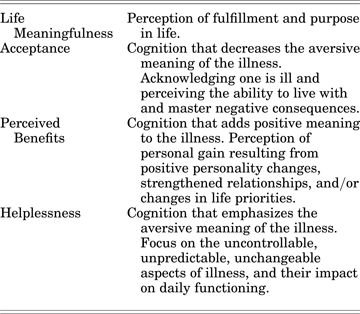
First, in accord with research in the area, we hypothesized that the presence of positive meaning-made (i.e. life meaningfulness, acceptance, and perceived benefits) (see Table 1) would significantly predict improvements in quality of life and reductions in levels of depression and anxiety. We also hypothesized that the presence of negative meaning-made (i.e. helplessness) would significantly attenuate improvements in quality of life and predict increased levels of depression and anxiety, independently of the presence of positive meaning-made. In addition, this study sought to explore the relationship between different components of quality of life and different types of meaning-made with no specific hypothesis.
Brief description of meanings made referred to in this study

METHODS
Participants
This study was conducted in accordance with the human ethics standards and received approval from the Conjoint Ethics Committee at the University of Calgary. Inclusion criteria comprised patients aged 18 years or older histologically diagnosed with colorectal cancer, in treatment or medical follow up. Exclusion criteria included physical problems or mental disorders preventing patients from providing informed consent as assessed by the medical staff or by a clinical psychologist (G.P.). Patients were also excluded from the study if, at the time of recruitment, they were facing important medical events such as impending surgery or other cancer treatments, if they were diagnosed with a recurrence, if they had other acute or chronic health problems that could significantly affect their quality of life, and if they had an insufficient knowledge of English.
Procedure
The study was introduced to patients by the attending physicians and researchers between October 2010 and March 2011. After providing informed consent, patients were required to complete a questionnaire on demographic information, as well as the study questionnaires described below. Information about the participants' diagnoses and treatment was obtained from medical charts with the participants' consent. Semi-structured interviews were conducted with six participants from the initial sample.
Measures
Meaning-made
The Personal Meaning Profile (PMP) (Wong, Reference Wong, Wong and Fry1998) is a comprehensive measure of global meaning in life. The PMP is comprised of 57 items grouped in 7 subscales: achievement, relationship, religion, self-transcendence, self-acceptance, fair-treatment, and intimacy. Answers are rated on a 7-point Likert scale ranging from 1 (‘not at all’) to 7 (‘a great deal’). The total score is an index of magnitude; the higher the score the greater the experience of a meaningful life. The PMP has an internal consistency (coefficient α) of .93, as well as established content, construct, and concurrent validity.
The Illness Cognition Questionnaire (ICQ) (Evers et al., Reference Evers, Kraaimaat, van Lankveld, Jongen, Jacobs and Bijlsma2001) is a measure of situational meaning based on the notion that evaluative processes, in terms of the meaning ascribed to events, are essential to adjusting to chronic illnesses. The ICQ is comprised of 18 items grouped in three subscales: acceptance, perceived- benefits, and helplessness. Items are rated using a 4 point Likert scale ranging from 1 (‘not at all’) to 4 (‘completely’). The ICQ has established content, concurrent, and predictive validity, and its internal consistency (coefficient α) for the three subscales ranges from .84 to .91.
Psychosocial Adjustment and Quality of Life
The Functional Assessment of Cancer Therapy-Colorectal (FACT-C) (Ward et al., Reference Ward, Hahn, Mo, Hernandez, Tulsky and Cella1999; Yoo et al., Reference Yoo, Kim, Eremenco and Han2005) is a 38-item questionnaire designed to assess health-related quality of life (QoL) in individuals affected by colorectal cancer. The FACT-C is divided into five subscales: physical well-being, social/family well-being, emotional well-being, functional well-being and disease-specific concerns. The FACT-C yields a total QoL score derived by summing up the scores of the five subscales. Responses in the FACT-C are rated on a 5-point Likert scale ranging from 0 (‘not at all’) to 4 (‘very much’). The FACT-C has good convergent, divergent, construct, and criterion validity. Across four samples, the FACT-C was found to have an internal consistency (coefficient α) above .85, while the coefficients α for each subscale varied from .56 to .89.
The Psychosocial Screen for Cancer (PSSCAN) (Linden et al., Reference Linden, Andrea Vodermaier, McKenzie, Barroetavena, Yi and Doll2009; Linden et al., Reference Linden, Yi, Barroetavena, MacKenzie and Doll2005) is a 21-item questionnaire designed to assess a range of psychosocial concerns among individuals diagnosed with cancer. The PSSCAN has established content, construct, and concurrent validity, and high internal consistency (coefficient α ranging from .79 to .89). For the purposes of this study, only the depression and anxiety subscales were used. Items on those scales were rated on 5-point Likert scales ranging from “not at all” to “very much”.
DATA ANALYSIS
Descriptive statistics were used to characterize the sample. Three hierarchical multiple regression analyses were conducted (method: enter) (p < .05) to test the two hypotheses of this study. Correlation analyses were conducted to explore the relationship between meaning-made (i.e. life meaningfulness, acceptance, perceived benefits, and helplessness) and the different components of quality of life assessed by the FACT-C (i.e. physical well-being, social/family well-being, emotional well-being, functional well-being and disease-specific concerns). The quantitative results were reviewed and a semi-structured interview guide was constructed based on these to gain additional insight on significant findings. Interviews were conducted with a subset of six individuals from the initial sample and transcribed verbatim. Selected excerpts from the interviews are presented in the results section.
RESULTS
Sample Characteristics
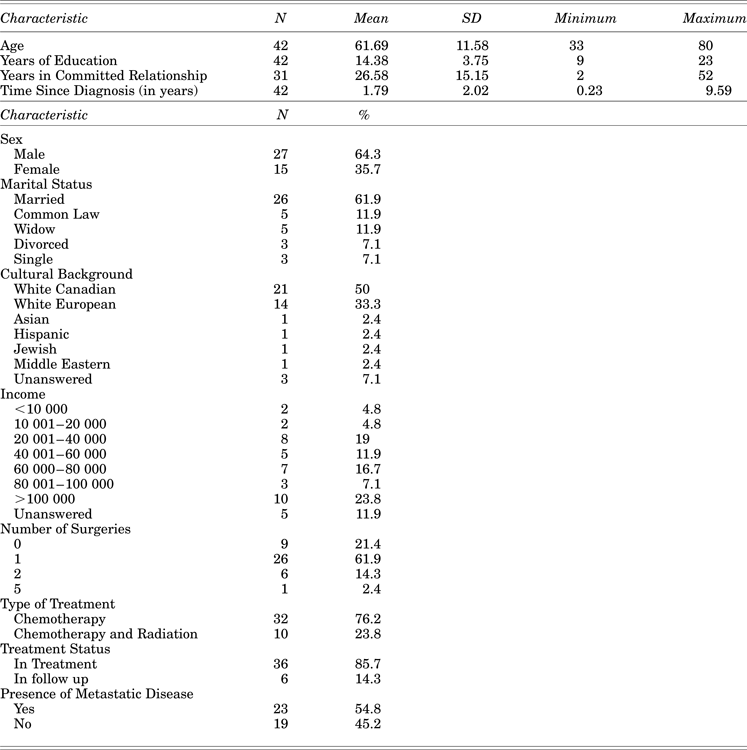
A total of 49 participants were approached for this study. Forty-two agreed to participate and returned their questionnaires, two declined participation, four did not return the questionnaires, and one was excluded for not meeting the inclusion criteria. The sample showed an average age of 61.69 years (range 33 to 80) and was mostly male (64%). The mean time since diagnosis was 1.79 years. More than a half of participants in the sample (55%) presented with metastatic disease, and 86% were still undergoing active treatment. Detailed demographic and medical information can be found in Table 2.
Demographic and Medical Characteristics
Meaning Made, Quality of Life, and Psychosocial Adjustment
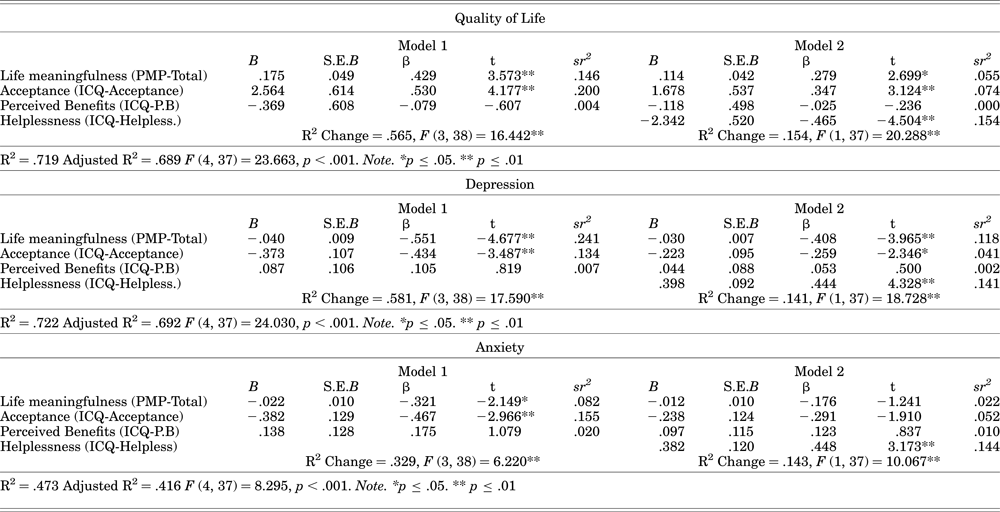
The first hierarchical multiple regression analysis showed that life meaningfulness, acceptance, perceived benefits, and helplessness accounted altogether for approximately 72% of the variance in the total quality of life score, F (4, 37) = 23.663, p < .001. Life meaningfulness, acceptance, and perceived benefits were entered in STEP 1, initially accounting for approximately 57% of this variance, F (3, 38) = 16.442. Helplessness was entered in STEP 2, contributing approximately another 15% to the variance in quality of life, F (1, 37) = 20.288, beyond that accounted for by the variables entered in STEP 1. Post hoc power calculations using G*Power (Faul et al., Reference Faul, Erdfelder, Buchner and Lang2009) showed the sample size to be adequate to find a significant effect, as a power of .97 was obtained based on the primary variable, quality of life.
The second hierarchical multiple regression analysis showed that life meaningfulness, acceptance, perceived benefits, and helplessness accounted for approximately 72% of the variance in depression, F (4, 37) = 24.030, p < .001. Life meaningfulness, acceptance, and perceived benefits were entered in STEP 1 and accounted for approximately 58% of this variance, F (3, 38) = 17.590. The addition of helplessness in STEP 2 accounted for approximately an extra 14% of the variance in depression, F (1, 37) = 18.728, beyond that accounted for by life meaningfulness, acceptance, and perceived benefits.
The third hierarchical multiple regression analysis showed that life meaningfulness, acceptance, perceived benefits, and helplessness accounted altogether for approximately 47% of the variance in anxiety, F (4, 37) = 8.295, p < .001. Life meaningfulness, acceptance, and perceived benefits were entered in STEP 1, initially accounting for approximately 33% of this variance, F (3, 38) = 6.220. Helplessness was entered in STEP 2, and its addition accounted for approximately and extra 14% of the variance in anxiety, F (1, 37) = 10.067, beyond that accounted for by the variables entered in STEP 1.
Helplessness accounted for the largest amount of unique variance in quality of life (sr 2 = .154), depression (sr 2 = .141), and anxiety (sr 2 = .144). Detailed information about the hierarchical regression analyses can be found in Table 3.
Hierarchical Multiple Regressions
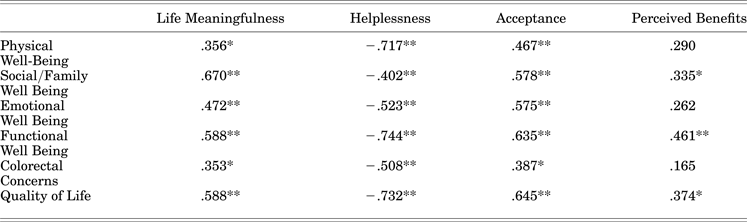
Table 4 shows detailed information about the correlation analysis between meaning-made (i.e. life meaningfulness, acceptance, perceived benefits, and helplessness) and the components of quality of life assessed by the FACT-C (i.e. physical well-being, social/family well-being, emotional well-being, and functional well-being, and disease-specific concerns). As a form of meaning-made, helplessness most strongly correlated with physical well-being r (40) = −.72, p < .01, functional well-being r (40) = −.74, p < .01, and disease-specific concerns r (40) = −.51, p < .01. Social/family well-being r (40) = .67, p < .01 was most strongly correlated with life meaningfulness, and emotional well-being most strongly correlated with acceptance r (40) = .58, p < .01.
Correlation analysis
Note. *p ≤ .05. **p ≤ .01
The qualitative data obtained from interviews revealed themes congruent with the results of the statistical analyses. In terms of the positive relationship between life meaningfulness and psychosocial adjustment one participant said:
“Having that seamless and continued sense of purpose has allowed my focus to stay the same, so when I am trying to cope it's clear why I am trying to cope” (male, stage IV, 33 years old).
Relationships with loved ones were often referred to as a meaningful aspect of life, which concurred with the strong correlation between life meaningfulness and social/family well-being. In this regard one participant said:
“We learn the most of those relationships under times of stress for good and bad. And I would like to think that with the stress that comes with having cancer, those relationships and sense of purpose have strengthened” (male, stage IV, 33 years old).
The positive association between acceptance and functional well-being also emerged in interviews. In this regard one participant said:
“I have been able to accept it (…) I don't do anything different, it hasn't impaired me physically or psychologically” (male, stage II/III, 67 years old).
And a second participant stated:
“This is something that happened like any other thing that happens in your life, you have to accept it to be able to conquer it” (female, stage I, 48 years old).
In terms of the positive association between acceptance and emotional well-being one participant said:
“It is a matter of having the time to [accept] it. Because not to have [cancer] fit makes life very difficult to live” (female, stage IV, 66 years old).
Finding acceptance was viewed by one participant as a potentially recurrent process:
“I guess being able to live with the illness, I think…I think that's a hurdle that you just don't jump it once and it's behind you, I think it's something that you deal with on a daily weekly monthly basis. [And even if] I get over it, maybe there is something tomorrow in my daughter's life and she asks me a question, or my wife, or my mother, or my brother, so it's a hurdle that constantly re-appears in my life and I constantly have to keep addressing this issue of acceptance”. (male, stage IV, 33 years old).
Participants associated helplessness with decreased quality of life and psychosocial adjustment. This was captured by one participant:
“I have surgery coming up two days from now and that's going to control, you know, the weekend. (…). There are also times when I am on chemotherapy where I have days in my two week cycle where it's the same thing, I am useless, and life is not normal, and my illness, the treatment of my illness controls my life for those days” (male, stage IV, 33 years old).
In this regard a second participant said:
“[cancer] certainly has controlled me (…) [and] put me into a state of depression (…) I don't think that me or anybody has control of that, only the emotional and the mental part, because the physical part is what it is” (male, stage III, 62 years old).
Contrary, one participant spoke about the association between decreased levels of helplessness and psychosocial adjustment/quality of life :
“I think that being in control, having a few things you can exercise control over certainly contributes to a sense of peace, and acceptance, (…) and you feel you are being proactive and it's not painful if you have control” (male, stage IV, 33 years old).
DISCUSSION
Taken together, the results of the multiple regression analyses offer partial support for the first hypothesis. Considered individually, the positive meanings life meaningfulness and acceptance significantly predicted improvements in quality of life and reductions in depression, but contrary to the first hypothesis they did not predict a reduction in anxiety. Also contrary to the first hypothesis, the positive meaning perceived benefits did not significantly predict improvements in quality of life and reductions in depression and anxiety. The second hypothesis was supported: helplessness as a negative meaning-made predicted an attenuation of improvements in quality of life and increases in depression and anxiety beyond life meaningfulness, acceptance, and perceived benefits.
Most participants stated when interviewed that their sense of meaning in life became stronger following their diagnosis. In particular, relationships were commonly reported as a meaningful aspect of life that gained additional importance after diagnosis. Even though participants often talked about their relationships with loved ones, they also mentioned their relationships with neighbours, co-workers, and health practitioners. A common theme that emerged in this regard was a strengthened desire to relate to and help others. This appears to have provided participants with a focus on what made their lives valuable and increased determination to fight cancer. A sense of increased meaning in life has been considered an important outcome of meaning-making among individuals impacted by cancer (Jim et al., Reference Jim, Richardson, GoldenKreutz and Andersen2006), positively relating to quality of life and psychosocial adjustment (Park, Reference Park, Park, Lechner Antoni and Stanton2008).
Achieving a sense of acceptance was most strongly associated with improved functional well-being. This association surfaced in most interviews as a reported ability to learn to live with cancer and minimize its aversive effects on daily functioning. Subjectively, a sense of acceptance fostered the capacity to normalize the experience of cancer, which seemed to enable participants to function naturally. In addition, developing a sense of acceptance of cancer as part of life was viewed by participants as essential to reduce their distress levels and focus on improving their quality of life. Significant positive relationships between acceptance (using the ICQ) and quality of life were also found in two samples of individuals diagnosed with colorectal cancer (Bossema et al., Reference Bossema, Seuntiens, Marijnen, BaasThijssen, van de Velde and Stiggelbout2011; Simmons, Smith et al., Reference Simmons, Smith, Bobb and Liles2007).
Perceived benefits did not account for a significant amount of changes in quality of life, depression, or anxiety. This failed to support the first hypothesis of this study and contradicts the large body of research showing a positive relationship between quality of life and benefit finding in individuals diagnosed with cancer (e.g. Calhoun & Tedeschi, Reference Calhoun and Tedeschi2006; Park, Reference Park, Park, Lechner Antoni and Stanton2008; Park & Helgeson, Reference Park and Helgeson2006). This discrepancy may be due to the scale used to measure benefit finding in this study, as no significant relationship between perceived benefits (using the ICQ) and quality of life was also found in a sample of rectal cancer survivors (Bossema et al., Reference Bossema, Seuntiens, Marijnen, BaasThijssen, van de Velde and Stiggelbout2011). Inconsistencies in findings resulting from variability in conceptualization and operational definitions have in fact constituted a problem within this area of research (Park, Reference Park2010). Nevertheless, it is possible that participants in this study may have not yet drawn their focus to finding benefits in their experience with cancer, as 85% of them were still dealing with treatment and its side effects at the time of participation (EppingJordan et al., Reference EppingJordan, Compas, Osowiecki, Oppedisano, Gerhardt, Primo and Krag1999; Filipp, Reference Filipp, Montada, Filipp and Lerner1992; Stanton, Reference Stanton2006).
In accordance with the second hypothesis of this study, negative meaning-made (i.e. helplessness) significantly predicted attenuation in improvements in quality of life and increased levels of depression and anxiety, above and beyond positive meaning-made (i.e. life meaningfulness, acceptance, and perceived benefits). Helplessness was strongly correlated with physical and functional disability, and this clearly emerged in interviews. Most participants reported feelings of lack of control to a varying extent, which especially derived from disease severity, side effects of treatment, and the effects of both on daily functioning. Participants related their feelings of lack of control to high levels of distress. Contrary, they reported a sense of peace at times when they felt they were in control of cancer and its treatment, which made it easier to cope with the effects of cancer on their lives.
As suggested by the findings of this study, negative meaning-made may be at least as important in predicting psychosocial adjustment to a colorectal cancer diagnosis as positive meaning-made. Cancer had uneven consequences across different components of participants' lives (e.g. psychological and physical), and meanings of varying valence were simultaneously ascribed to cancer as it impacted each of these components. Even though positive meaning-made appeared to help participants come to terms with their illness, it did not seem in itself enough to prevent deterioration in quality of life and the development of depression and anxiety. Retaining a sense of control of the physical and functional aspects of their lives seemed also important for maintaining a good quality of life and low distress levels. For instance, reducing perceptions of lack of control by reframing treatment (e.g. going for chemotherapy) as a matter of choice was a common strategy.
Viewed from the theoretical framework of Park's meaning-making model this study attests to the complexity of finding meaning following a diagnosis of colorectal cancer. These findings constitute evidence that positive and negative meaning-made affect quality of life and psychosocial adjustment quite independently. In this sense, positive meaning-made may not necessarily result in overall high levels of quality of life and psychosocial adjustment when negative meanings also emerge. In addition, because of continuous reminders of their condition and the cyclical characteristics of treatment (e.g. chemotherapy) and potential for recurrence of illness, colorectal cancer patients may experience the emergence of negative meanings and the need to re-find positive meaning on a periodic basis. This can further negatively influence their levels of quality of life and psychosocial adjustment.
Several limitations should be taken into account when interpreting the results of this study. This study used a relatively small, homogenous sample of mostly white, English-speaking individuals diagnosed with colorectal cancer, which limits its generalizability. Also, this study used a cross-sectional design; therefore it cannot be known with certainty whether distress resulted from the meanings ascribed to cancer or whether meanings emerged as the result of distress.
Despite these limitations, the present study provided evidence that negative meaning- made (helplessness) is an important predictor of quality of life and psychosocial adjustment following colorectal cancer diagnosis, above and beyond positive meaning-made. Helplessness predicted low levels of quality of life and elevated levels of depression and anxiety. High levels of distress among cancer patients have been linked not only to poor quality of life, but also to poor immune function and compliance with medical treatment (Reiche, Morimoto, & Nunes, Reference Reiche, Morimoto and Nunes2005; Sephton, Reference Sephton, Dhabhar, Keuroghlian, Giese-Davis, McEwen, Ionan and Spiegel2009; Witek-Janusek, Gabram, & Mathews, Reference Witek-Janusek, Gabram and Mathews2007). Therefore, negative meaning-made is a subject of great relevance for research in psychosocial oncology and one that warrants future exploration.
Future research in psychosocial oncology should incorporate more comprehensive approaches when assessing the meaning ascribed to the experience of cancer. As shown by these findings, meanings of positive and negative valence may emerge simultaneously following diagnosis; the presence of one does not entail the absence of the other. That individuals may ascribe different meanings to their cancer experience reflects cancer's complex and broad impact on people's lives. Therefore, the effect of positive AND negative meaning should be examined in relation to each of the areas of life affected, in order to have a more precise understanding of how it influences quality of life and how to best promote psychosocial adjustment.