Introduction
Dementia of Alzheimer's type (AD) is a neurodegenerative disorder occurring mainly in the elders. It incrementally causes deficits in many cognitive domains, such as episodic memory, working memory and language, with some of these deficits observable at the earliest stages of the disease (Brandt & Rich, Reference Brandt, Rich, Baddeley, Wilson and Watts1998) and accompanied by functional disabilities (Morris, Reference Morris1996). There are seven stages of progression for Alzheimer's disease (Reisberg, Ferris, de Leon, & Crook, Reference Reisberg, Ferris, de Leon and Crook1982). Stages 1–3 are characterised as an early ‘forgetfulness’ phase, followed by the middle (confusional) and late (dementia) stages of the disease (stages 4–7). We are interested in the mild Alzheimer's disease (mAD).
According to Reisberg's Global Deterioration Scale (Reisberg et al., Reference Reisberg, Ferris, de Leon and Crook1982), individuals with mAD experience a range of deficits including loss of ability to perform complex tasks, decreased knowledge of current and recent events, impaired memory of personal history, concentration impairments as well as decreased ability to travel to non-familiar places and to manage their finances. Personality changes, such as the flattening of effect and withdrawal from challenging situations can also frequently occur, with denial of such deficits featuring as the dominant defence mechanism. However, deficits in orientation to time and place and failure to recognise familiar persons and faces are relatively rare during this stage.
Pharmacological and/or non-pharmacological interventions are proposed by the national associations for the management of the AD (e.g., the American Association for Geriatric Psychiatry; Lyketsos et al., Reference Lyketsos, Colenda, Beck, Blank, Doraiswamy, Kalunian and Yaffe2006). Non-pharmacological interventions include specific psychotherapies and psychosocial treatments (e.g., see www.psych.org), and span behaviour, emotion, cognition and stimulation-oriented approaches for helping the patients and/or their care givers. In this research we will focus on cognition-oriented approaches for the patients, as they can take place successfully in the first stage of the disease and have long lasting effects. They include cognitive stimulation (CS), cognitive training (CT) and cognitive rehabilitation (Clare, Woods, Moniz Cook, Orrell, & Spector, Reference Clare, Woods, Moniz Cook, Orrell and Spector2003; Teixeira et al., Reference Teixeira, Cobbi, Corazza, Stella, Costa and Gobbi2011). Our research interests are focused on the possible benefits of the first two, namely CS and CT.
CS has been suggested as a means for increasing non-specific cognitive and social functioning (Clare et al., Reference Clare, Woods, Moniz Cook, Orrell and Spector2003; Woods, Aguirre, Spector, & Orrell, Reference Woods, Aguirre, Spector and Orrell2012; Woods & Clare, Reference Woods, Clare, Tuokko and Hultsch2006) as well as contributing to quality of life (self-reported) and wellbeing (Woods et al., 2006). Its effects appear to be similar to those reported with the currently available anti-dementia drugs (Aguirre, Woods, Spector, & Orrell, Reference Aguirre, Woods, Spector and Orrell2013) (www.cstdementia.com), and can be administered by psychologists and other health professionals in many settings including residential homes, hospitals or day centres.
CT, in contrast, has been suggested as an effective treatment in mAD to improve cognitive functions through teaching theoretical techniques and abilities (Gates, Sachdev, Fiatarone-Singh, & Valenzuela, Reference Gates, Sachdev, Fiatarone-Singh and Valenzuela2011). CT typically involves guided practice on a set of standardised tasks with the aim to ameliorate specific cognitive deficits, in cognitive domains, such as memory, attention and problem solving. Tasks may be presented in paper-and-pencil or computerised form or may involve analogues of activities of daily living. The difficulty of the tasks is tailored to the individual performance level.
A range of benefits of CT with medium to small effect sizes have been reported. These include improvements in general cognitive function as well as in specific domains, such as learning (especially visual learning), memory, executive functioning, motor speed and activities of daily living. Small improvements have also been noted in functions that are not directly targeted by such training, including functionality (e.g., activities of daily living), social and behavioural abilities (Sitzer, Twamley, & Jeste, Reference Sitzer, Twamley and Jeste2006). However, achieving such results seems to be predicated upon a range of factors. First, it is crucial to understand the intensity of treatment (in terms of number of training sessions and length of training sessions [e.g., not less than 40–60 minutes duration]) required to ensure the effectiveness of the interventions. According to a recent literature review, cognitive interventions that lasted less than three months in duration seemed to produce either no positive effect or at best improvements that were of marginal statistical significance (Bahar-Fuchs, Clare, & Woods, Reference Bahar-Fuchs, Clare and Woods2013). Other factors associated with better results are: (1) the designation of the cognitive intervention for each specific type of memory problem, (2) the lack of memory load to the patients and (3) the appropriate cues for both encoding and recall processes (Woods, Reference Woods and Morris1996).
The aim of our study was to investigate the relative impact of CT and CS interventions on general cognitive state in mAD patients, as well as in the more specific domains of memory, naming and retrieval ability and to evaluate the magnitude of change (improvement/decline) in trained and untrained cognitive abilities 12 months after baseline measurement. Our hypothesis is that CT will have a greater effect on trained abilities and general cognitive state as compared to CS and no intervention conditions, as the purpose of CT is to ameliorate specific cognitive deficits.
Methods
Design
The hypothesis was tested using a randomised controlled trial with participants randomly allocated to the three conditions (CT, CS and control dementia (CD)) on a 1:1:1 ratio. The trial is reported in accordance with the CONSORT statement. The flow diagram for the trial is displayed in Figure 1.
The general cognitive performance (MMSE) for the three groups during the three phases.

Sample
The original sample of 63 mAD outpatients came from two memory clinics provided by the Geriatric Unit of the B Internal Medicine of the Hippokration Hospital of the Aristotle University of Thessaloniki in Greece and the Neurologic Clinic of the General Hospital ‘Saint Pavlos’, Thessaloniki, Greece). All participants were recruited as a consecutive series (a list of Alzheimer's outpatients), with the following criteria applied across the two sites in relation to age (67–82 years), education level (6–16 years), the stage of Alzheimer's disease (mild, CDR=1), cognitive performance according to a battery of neuropsychological tests, the type and the duration of medication for Alzheimer's disease (i.e., inhibitors of cholinesterase used at least for 2 years), and the non-active lifestyle. Non-active lifestyle was defined as restricted to a routine way of living (everyday doing the same things), without mental or physical activities, such as hobbies, other creative tasks or participation in social events. Other inclusion criteria included the willingness and the consensus of the patients and their families to participate in the trials. Exclusion criteria included self-reported history of drug or alcohol abuse, use of cognition-affecting medication (with the exception of medication for AD), and moderate to severe sensory deficits. Prospective participants were also excluded if they had a history of head trauma, stroke, loss of consciousness, congestive heart failure, abnormal thyroid function, delirium, depression, psychosis or mental retardation (IQ < 75).
All the participants were native non-institutionalised Greek speakers, spoke Greek as first language, neither received money nor have any other benefits for their participation. The patients and their primary care givers had been informed during earlier visits in the clinics about both the pharmacological and non-pharmacological management of dementia. Τhey were also informed from the campaigns of the Associations of Alzheimer's Disease and Related Disorders in Greece about their programmes. They attended lectures regarding memory disorders and quality of life in aging organised by the two clinics and the afore-mentioned associations.
Assessment of AD
The diagnosis of AD was based on clinical criteria, history (included neurologic and psychiatric), biological, physical, neuropsychological and neuroimaging assessment. The clinical assessment met both the NINCDS-ADRDA (McKhann et al., 1984) and DSM-IV-TR (American Psychiatric Association, 1984) criteria. The severity of AD was assessed by the Clinical Dementia Rating (CDR) scale (Hughes, Berg, Danziger, & Cohen, Reference Hughes, Berg, Danziger and Cohen1982). The diagnosis was based on the consensus of a disciplinary scientific team, consisting of expert clinicians (e.g., neurologists, radiologists, gerontologist and neuropsychologists), who were blinded to the purpose of the research.
Measures
General cognitive state, memory, attention and language disorders were assessed through an extended neuropsychological battery. General cognitive state was determined by administration of the Greek edition of the Mini Mental State Examination (MMSE) (Tsantali, Economidis, Rigopoulou, & Porpodas, Reference Tsantali, Economidis, Rigopoulou and Porpodas2012) and the CAMCOG (Roth, Huppert, Tym & Mountjoy, Reference Roth, Huppert, Tym and Mountjoy1988); to assess semantic memory and general memory deficits, the Pyramids & Palm Trees (PPT) (Howard & Patterson, Reference Howard and Patterson1992) and Rivermead Behavioural Memory Test (RBMT)(Wilson et al., Reference Wilson, Clare, Baddeley, Cockburn, Watson and Tate1999) were used, respectively; and naming ability was assessed using the Greek edition of the Boston Naming Test (BNT) (Τsantali, Lekka, Τsolaki, Kazi, & Kazis, Reference Τsantali, Lekka, Τsolaki, Kazi and Kazis2003).
Procedures
The stages for the selection of the sample were (1) recruitment of the participants from the Alzheimer's outpatients list according to the stage of the disease (mild), their history, age and education level and their MMSE score and (2) applying the other inclusion criteria (neuropsychological profile, type of medication, lifestyle). The patients who met the inclusion criteria were drawn in approximately equal numbers equally from the two participating clinics.
The intervention protocol had been approved by the local Ethics Committee of the two hospitals and conformed to the provisions of the Declaration of Helsinki. The 63 participants and their primary care givers were informed about the aims and the usefulness of the programmes, with the participants providing informed consent. Participants were then randomly allocated by lot into the three conditions (CT, CS and CD) with 21 participants in each. The CD group received no intervention and no other memory assistance during the study period. For ethical reasons, participants in the CD group were assured that they would have the chance to participate in their choice of programme after the end of the trial.
The final sample consisted of 55 participants, as there was an attrition of eight participants who could not manage to complete or attend the programmes for health reasons (e.g., orthopaedic accidents, seasonal flu). After completing treatment, the remaining participants completed an end-of-programme retest of their general cognitive state (i.e., MMSE, CAMCOG), with a second follow up (12 months after the baseline) re-testing of all cognitive functions that were assessed at baseline. The clinicians who conducted the post and follow-up assessments were blinded to the treatment aim.
Treatment Programme
The aims of the programme were to improve semantic memory, naming and retrieval deficits as measured by the study test battery using the techniques of (a) deep processing of information, (b) the rehearsal and (c) the errorless learning. The duration of the programme was four months (16 weeks) and consisted of three individual sessions of 90 minutes each per week. The enhancement of semantic memory and naming ability included language tasks contained: (1) filling the blanks in sentences and progressively in paragraphs related to everyday's objects and activities (written speech), (2) semantic categorisation of everyday objects (written speech), (3) find synonyms and opposites (written speech), (4) verbal fluency tasks of specific categories (animals, foods, everyday objects) and word associations (written and oral speech), (5) find the similarities and differences of subordinate items belonged to the same superordinate objects (e.g., kitchen tools such as pans, pots, kettles, fryers) (oral speech).
Tasks that aimed to enhance retrieval ability consisted of (1) teaching strategies in order to delayed recall items belonged to the same superordinate category, (2) reading comprehension of small paragraphs and texts, (3) direct and delayed recall of the gist of the reading texts, (4) listening comprehension and recall (direct-delated) of small texts, (5) writing a story with given words. These types of tasks were thought to facilitate the reorganisation of the semantic categories in memory and the relearning of meaning, function and lexical label of the fading items.
The CS programme contained non-complicated cognitive tasks that were not targeted a specific cognitive impaired ability, for example, drawing and painting, puzzles, copying a figure, looking and naming images (without any cues), listening to music and signing and free discussion with the clinician.
Four licensed psychologists, who had sufficient clinical experience in providing cognitive remediation programmes to an aging population administered the programmes. The four psychologists interacted with all participants from both treatment conditions according to their specialisation. For example, one psychologist had the job to administer tasks for listening and reading comprehension and writing a story within given words for participants in the CT condition, and listening to music and singing tasks for participants in the CS condition.
Data Analysis
For the analysis of the results we used the Statistical Package for the Social Sciences (SPSS 20.0.0) and the Microsoft Windows 8.1. A per-protocol analysis was conducted, with the eight participants who dropped out from the statistical analysis. A one-way ANOVA was conducted to test the equivalence of the groups on the baseline measures. ANOVA with repeated measures was then conducted to test for differences in general cognitive state and Bonferroni corrections among groups (CT, CS, CD) for the three phases (baseline, end of the programme, 12 months from the baseline). We also applied repeated measures analysis with Bonferroni correction within subjects during the three phases. For the other neuropsychological tests we applied MANOVA at the baseline and at the 12 month follow up.
Results
Data were collected between January 2012 and December 2014. The demographic characteristics of the participants are shown in Table 1.
Demographic Characteristics of the Sample

CT = Cognitive Training Programme; CS = Cognitive Stimulation; CD = Controls with Dementia.
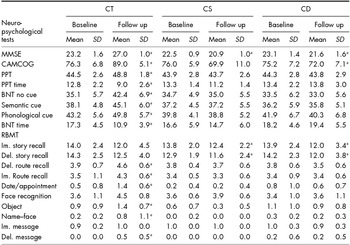
Participants were matched across the three conditions in terms of age [F (2, 52) = .144, p > .05, range 67–82 years] and years of schooling [F(2, 52) =.058, p > .05], general cognitive performance [MMSE, F (2, 52) = 1.550; CAMCOG scores, F (2, 52) = .150, p > .05], as well as on the other neuropsychological tests (BNT, PPT, RBMT p > .05, see Table 2).
Means and SD for the General Cognitive State and the Rest Neuropsychological Performance at the Baseline and 12 Months Later

*Statistical significant difference.
MMSE = Mini Mental State Examination; CAMCOG = Cambridge Cognition Examination; PPT = Pyramids and Palm Trees; BNT = Boston Naming Test; RBMT = Rivermead Behavioral Memory Test; Im. = Immediate; Del. = Delayed.
Applying the ANOVA with repeated measures and Bonferroni corrections among groups (CT, CS, CD) for the three phases (baseline, end of the programme, 12 months from the baseline), we observed statistically significant differences in their general cognitive state [MMSE F(2, 52) = 82.33, p < .001, CAMCOG F(2, 52) = 65.45, p < .001] (see Figure 1) with a large effect size for MMSE (partial η2 .810) and a moderate effect size for CAMCOG scores (partial η2 .532). There was also interaction between the three phases and the three exercises conditions (CT, CS, CD) [MMSE F(4, 104) = 54.74 p < .001; CAMCOG F(4, 104) = 25.6, p < .001]. Tukey analysis with Bonferroni corrections indicated that the CT participants had better performance compared with the other two groups in general cognitive functioning (MMSE, CAMCOG; see Table 2 and Figure 1). However, there were no statistically significant differences between the other two groups (CS, CD) (p > .05).
Repeated measures analysis with Bonferroni correction within subjects for the three phases showed statistically significant improvement for the general cognitive state of the CT condition [MMSE: F(2,15) = 192.4, p < .001, CAMCOG F(2,15) = 94.34, p < .001] with large effect sizes (MMSE partial η2 .962, CAMCOG partial η2 .926). Participants in the CS condition showed statistically significant differences with declining MMSE across the three phases [F(2, 15) = 52.4 p < .001] (see Table 2 and Figure 1), also with a large effect size (partial η2 .875). However, there was no significant differences across the three phases according on their CAMCOG performance [F (2, 15) = 3.12, p > .05]. Finally, participants in the CD group demonstrated significant declines across the three phases in both MMSE and CAMCOG scores [MMSE: F (2, 19) = 20.11, F(2,19) = 20.85, p < .001, respectively] with a medium effect size (MMSE partial η2 .679, CAMCOG partial η2 .687).
Examining the other neuropsychological tests using MANOVA, significant differences were found between groups at 12 months compared to the baseline on the BNT [F = (2, 54) = 12.1 without cue, F = (2, 54) = 15.7 semantic cue and F = (2, 54) = 16.9, p < .001 phonological cue] and the PPT [F=(2, 54)=23.3 p < .001] with a moderate effect size (partial η2 from .319 to .473).
Significant differences were also found for the following subtasks on the RBMT: direct and indirect Route [F = (2, 54) = .940, p = .002, F = (2, 54) = .789, p = .009, partial η2 = .412, partial η2 = .384, respectively], Appointment [F = (2, 54) = 15.9, p < .001, partial η2 = .379], Faces’ recognition [F = (2, 54) = 5.09, p = .010, partial η2 = .164], name of a person [F = (2, 54) = 6.4, p = .003, partial η2 = .199], Indirect Message [F = (2, 54) = 6.73, p = .003, partial η2 = .200] and Objects [F = (2, 54) = 10.88, p < .001, partial η2 = .295]. In addition, significant differences were found to time response of the PPT and the BNT [F = (2, 54) = 17.48, F = (2, 54) = 12.19, p < .001, respectively].
Tukey analysis with Bonferroni correction across groups indicated that participants in the CT condition scored significantly better than participants in the CS group on the BNT (three conditions and its time response p < .001), the PPT (p < .001) and its time response (p = .032), the Direct and Indirect Route (RBMT) (p < .001), Appointment (RBMT) (p < .001), Object (RBMT) (p < .001), Name of the person (RBMT) (p = .003) and Indirect Message (RBMT) (p = .002). Similarly, the participants in the CT condition performed significantly better (p = .000–0.48) than the controls (CD) on the same tests, as well as on Faces’ recognition (RBMT p = .008). The CS participants only showed statistically significant better performance than the controls (CD) on the BNT time response (p = .024), the PPT time response (p = .008) and the Object test (p = .027) on the RBMT.
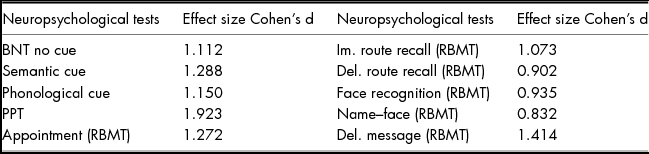
Participants in the CT showed significant improvement to the following tests/subtests: the BNT in three conditions (p < .001), the PPT (p < .001), Faces’ recognition (RBMT) (p < .001), Direct (p = .006) and Indirect Route (RBMT) (p = .020), Appointment (RBMT) (p = .005) and Indirect Message (RBMT) (p = .001). The time performance of the BNT and the PPT was significantly better on both tests (p < .001). On the other hand the participants in the CS condition showed significant decline in their performance on the Immediate Story Recall (RBMT) (p = .006) and Delayed Story Recall (RBMT) (p = .042), but achieved significantly better performance to the response time of the BNT (p = .004) and the PPT (p < .001). This was similar to the performance of the control group (CD) Direct and Delayed Story Recall (RBMT) (p = .004 and .002, respectively) (see Table 2). The effect size improvement of the participants in the CT condition for the neuropsychological tests is presented in Table 3.
Effect Size Improvement for the CT Group from the Baseline to the 12th Month

BNT = Boston Naming Test; PPT = Pyramids and Palm Trees; RBMT = Rivermead Behavioural Memory Test; Im. = Immediate; Del. = Delayed.
Discussion
Recent literature for cognitive treatments in the first stage of AD indicates medium to small effect size improvement in cognitive abilities and behavioural functioning (Sitzer et al., Reference Sitzer, Twamley and Jeste2006) lasting from 6 months to 2 years (Clare et al., Reference Clare, Wilson, Carter, Hodges and Adams2001) and retrogression reaching up to 5 years (Tsantali & Economidis, Reference Tsantali and Economidis2014) for individualised tailored interventions. Our results are consistent with these previous findings in which our participants in the CT condition demonstrated long term improvements. Moderate effect size was found for trained abilities, with associated modest improvements for untrained related abilities (small effect sizes), when clinicians use tailored CT programmes of adequate intensity (over two times per week for at least for 4 months) for at least 12-months post-baseline.
The literature refers to a general cognitive decline in AD of three points in the MMSE per year (Salmon, Thal, Butters, & Heindel, Reference Salmon, Thal, Butters and Heindel1990); however, our participants in the CT condition showed significant improvements with large effect sizes on the MMSE. Additionally, they showed significant improvements with moderate effect sizes on trained abilities (naming, semantic memory, retrieval ability), as was hypothesised. Furthermore, small effect size improvements on untrained abilities [face recognition, the immediate and delayed recall of a route and a message and prospective memory (memory of an appointment)] compared with the performance of the other two groups (CS, CD) at 12 months after baseline.
We suggest that naming ability improved through the training of semantic memory using the techniques of deep processing of information, rehearsal and errorless learning. As a result there was an enhancement of re-learning ability and better access to fading information. There was also an improvement in related abilities not targeted by the CT programme (e.g., prospective memory, person's naming). This finding shows that good performance in delayed memory tasks means good prospective memory performance, as prospective memory is a type of delayed memory into the future.
We hypothesised that training in how to code and retrieve information would improve performance in the CT condition and our results were consistent with this hypothesis. We suggest that the improvement may be the result of the CT participants applying the techniques to untrained abilities using implicit memory which is known to be well preserved in mAD. Although retrieval performance improved over the 12-months, it was still impaired (i.e., did not reach the benchmark of recalling 5 items, as the Immediate and the Delayed Story and Route recall task showed; 4.6 items) compared to aged-matched controls. Although the literature suggests that the gradual weakening of interventions effects in the two years after receiving an intervention is due to the progress of the disease as well as the routine lifestyle, a previous study by our group suggested that cognitive decline could be limited for up to five years in a tailored individualised CT programme (Tsantali & Economidis, Reference Tsantali and Economidis2014).
Participants in the CS group showed a significant decline (with a large effect size) at 12 months after baseline, both in general cognitive state and retrieval ability (Immediate and Delayed Story Recall task). This is in contrast to the finding of Aguirre et al. (Reference Aguirre, Woods, Spector and Orrell2013), who found a significant benefit to cognitive function after a CS treatment, over and above any medication effects. However, the results of this study are consistent with that reported by other researches (Galante, Venturini, & Fiaccadori, Reference Galante, Venturini and Fiaccadori2007). It is therefore possible to speculate that the main reasons for cognitive decline was the lack of a structured intervention and training in specific techniques for coding and retrieve of information, which were the two main differences between the CT and CS conditions. However, CS is perhaps preferable than the no intervention condition, as there was no requirement for specifically trained clinicians and the CS condition may have positive emotional impacts.
It is also important to consider the potential benefits of participating in either CT or CS treatments on quality of life and well-being, as well as communication and social interaction. Unfortunately, this was not directly assessed in the current study, but other researchers (e.g., Aguirre et al., Reference Aguirre, Woods, Spector and Orrell2013) have been able to show such benefits from CS treatments. Furthermore, it could be suggested that the CT group improved specifically due to increased interaction with a psychologist and possibly as a result of the psychologist's energetic presentation. However, previous literature does not support this hypothesis (Tarraga et al., Reference Tarraga, Boada, Modinos, Espinosa, Diego, Morera and Becker2006). Our study also does not support this view, as we were able to control this possibility by using the same psychologists across both CT and CS conditions. Additionally, as these patients had a routine way of living without mental or other activities, we wonder if the routine lifestyle is a stronger cause of deterioration among the patients rather than the disease per se, as there was significant cognitive improvement for at least 12 months for the CT participants compared to the deterioration observed in the CD and CS conditions.
One limitation of the study was that the transfer of the improvement from the intervention to everyday life was not investigated, due to lack of funding. However, we did observe increased social activities (e.g., participation in events for people with memory problems organised by the Alzheimer's disease associations) after the end of the follow up. However, it cannot be claimed that this was an effect of the intervention itself, because it could be also explained by the patients’ increased familiarity with the clinicians, the volunteers and the place. It would therefore be worthwhile to undertake further research investigating other variables which may influence the course of the disease. Such variables could include the pattern of the care-givers’ lifestyle and their beliefs for the management of the disease and the clinicians’ guidelines to the care givers, in order to investigate the potential correlations among these variables with the rates of cognitive decline of the patients.
In summary, participants in a CT condition showed significantly better performance than participants in the CS condition in areas of trained (general cognitive state, semantic memory, naming ability, delayed memory and reaction time) and untrained but related cognitive abilities (prospective memory, name a person, face recognition). As a result of our findings, we suggest that primary caregivers are routinely trained on individualised CT programmes tailored to their patients in order to slow the progression of AD and minimise the cost of a CT programme. This may also help caregivers to better understand the specific deficits of their relative suffered from AD, as well as the progress of the disease, thereby helping to adjust their behaviour to the requirements and the needs of their relatives.
Conflict of Interest
None.
Financial Support
This research received no specific grant from any funding agency, commercial or profit sectors.
Ethical Standards
The authors assert that all procedures contributing to this work comply with the ethical standards of the relevant national and institutional committees on human experimentation and with the Helsinki Declaration of 1975, as revised in 2008.
Supplementary Material
To view supplementary material for this article, please visit https://doi.org/10.1017/BrImp.2017.6.