For some young people, some forms of externalizing behaviors or conduct problems increase significantly during preadolescence and adolescence (see Moffitt, Reference Moffitt1993). Conduct problems encompass a variety of antisocial behaviors, including aggression, destruction of property, deceit, and theft. Sustained or increased conduct problems forecast later aggressive and antisocial behaviors, adult criminality, early mortality, poor physical health, comorbid disorders, academic underachievement, and underemployment during young adulthood (Teichner & Golden, Reference Teichner and Golden2000; Wicks-Nelson & Israel, Reference Wicks-Nelson and Israel2003). The processes that contribute to the development and maintenance of conduct problems during this developmental period should be identified, not only to advance knowledge of their etiology and the trajectories they foster but also to inform the design of preventive interventions (Howe, Beach, & Brody, Reference Howe, Beach and Brody2010). Using a three-wave prospective research design that spanned 3.5 years, we advanced and evaluated predictions about a salient vulnerability factor for the development of conduct problems among African American youths, perceived racial discrimination. Racial discrimination is a prevalent stressor for African American youths; children and adolescents who perceive high levels of racial discrimination display, over time, increasing rates of conduct problems, and the direction of causality in this association has been demonstrated to flow from discrimination to conduct problems rather than the reverse (Brody, Chen, et al., Reference Brody, Chen, Murry, Ge, Simons and Gibbons2006). It is therefore important to understand better the factors that increase the impact of this contextual stressor.
The primary purpose of this study was to test predictions regarding the genetic moderation of the association between perceived discrimination and development of conduct problems. We did not expect genetic variation to have a direct linear association to the development of conduct problems; instead, we expected genetic status to predict variation in youths' responses to perceived racial discrimination. This perspective is consistent with resilience and differential susceptibility theories, in which genetic variations are hypothesized to render individuals more or less susceptible to environmental risks (Belsky, Bakermans-Kranenburg, & van IJzendoorn, Reference Belsky, Bakermans-Kranenburg and van IJzendoorn2007; Caspi, Hariri, Holmes, Uher, & Moffitt, Reference Caspi, Hariri, Holmes, Uher and Moffitt2010; Cicchetti & Blender, Reference Cicchetti and Blender2006; Kim-Cohen & Gold, Reference Kim-Cohen and Gold2009). One such genetic factor is variability at the serotonin transporter gene (5-HTT). We tested a hypothesis involving a putative genetic vulnerability factor, the presence of a short allele of a variable nucleotide repeat polymorphism in the promoter region of 5-HTT known as the 5-HTT linked promoter region (5-HTTLPR). We proposed that youths who carry one or two copies of this allele, compared with those carrying two copies of the long allele, would display higher rates of conduct problems over time when they perceive high levels of racial discrimination. We also expected rates of conduct problems among youths carrying two copies of the long allele to evince little variation across levels of perceived discrimination. In the following sections, we discuss the hypothesized roles of racial discrimination, the 5-HTTLPR genotype, and their interaction in the development of conduct problems.
Racial discrimination presents daily challenges in the lives of African American youths and their families. Landrine and Klonoff (Reference Landrine and Klonoff1996) found that 98% of the African American adults in their sample had experienced a racist event during the past year. All participants reported that, at some point in their lives, they had been treated badly or their intentions were misinterpreted because of their race. Likewise, Sellers, Copeland-Linder, Martin, and Lewis (Reference Sellers, Copeland-Linder, Martin and Lewis2006) found that 70% or more of African American adolescents reported racialized insults in which others perceived them as threatening or incompetent. These experiences are demeaning and degrading, inducing stress, frustration, depression, and anxiety. Thoits (Reference Thoits1991) maintained that those stressors that threaten the central parts of an individual's identity are particularly pernicious and likely to undermine mental health. Accordingly, African American youths' experiences with discrimination have the potential to provoke problem behaviors arising from anger, a sense of injustice, and other negative emotions.
Survey research with adolescents corroborates the hypothesized association between perceived discrimination and the development of conduct problems; links between these variables have been demonstrated and replicated using both contemporaneous and longitudinal research designs (Brody, Chen, et al., Reference Brody, Chen, Murry, Ge, Simons and Gibbons2006; DuBois, Burk-Braxton, Swenson, Tevendale, & Hardesty, Reference DuBois, Burk-Braxton, Swenson, Tevendale and Hardesty2002; Simons, Chen, Stewart, & Brody, Reference Simons, Chen, Stewart and Brody2003; Simons et al., Reference Simons, Murry, McLoyd, Lin, Cutrona and Conger2002, Reference Simons, Simons, Burt, Drummund, Stewart and Brody2006; Szalacha et al., Reference Szalacha, Erkut, García Coll, Fields, Alarcón, Ceder and Luthar2003). Even worrying about the prospect of future racial discrimination creates a heightened state of vigilance, placing adolescents' psychological well-being at risk (Fordham & Ogbu, Reference Fordham and Ogbu1986; Taylor, Wright, & Porter, Reference Taylor, Wright, Porter, Zanna and Olson1993). These findings resonate with the hypothesis (Franklin, Reference Franklin1993) that ethnic minority individuals' inner vigilance for racial slights can create a state of constant watchfulness that leads to tension and stress.
The first purpose of this study was to replicate findings published in earlier reports (Brody, Chen, et al., Reference Brody, Chen, Murry, Ge, Simons and Gibbons2006; Simons et al., Reference Simons, Chen, Stewart and Brody2003, Reference Simons, Simons, Burt, Drummund, Stewart and Brody2006) in which we found that perceptions of racial discrimination forecast increases in conduct problem behaviors across 5 years for male, but not female, youths. In those studies, we proposed that male youths are more likely than are female youths to become emotionally dysregulated and lose inhibitory controls when experiencing life stresses (Rutter, Reference Rutter, Rolf, Masten, Cicchetti, Nuechterlein and Weintraub1990), leading to an increase in conduct problems in response to perceived discrimination. In the present study, the longitudinal links between perceived racial discrimination and increases in conduct problems were reexamined using a different sample of African American youths who were 15 years of age at the first wave of data collection and 17 years of age at the last wave. We hypothesized that perceptions of high levels of discrimination would forecast higher rates of conduct problems for male youths.
Ecological (Bronfenbrenner & Ceci, Reference Bronfenbrenner and Ceci1994), systems (Lerner, Reference Lerner1991), and developmental psychopathology (Cicchetti & Tucker, Reference Cicchetti and Tucker1994) approaches to life-span development share the tenet that biological predispositions transact with contextual processes to create variations in phenotypes over time. Such transactions are termed Gene × Environment (G × E) interactions and are evident when genetic variation alters an organism's sensitivity to specific environmental events or when environmental features exert differential control over genetic effects (Kendler & Eaves, Reference Kendler and Eaves1986). In this study, we focused on the role of genetic status as a moderator of environmental influence. We hypothesized that a functional polymorphism in the promoter region of 5-HTT would moderate the association of perceived discrimination with longitudinal increases in youths' conduct problems. The 5-HTT gene is a key regulator of serotonergic neurotransmission, localized to 17p13 and consisting of 14 exons and a single promoter. The common polymorphism in the promoter region results in two variants, a short and a long allele, with the short allele resulting in lower serotonin transporter availability. The short (s) variant contains 14 copies of the repeat element and the long (l) variant 16. Youths with one or two copies of the short allele are hypothesized to display greater increases in conduct problems when they perceive racial discrimination than are youths who carry two copies of the long allele.
Two bodies of research support the proposition that 5-HTTLPR status will moderate the link between perceived discrimination and rates of conduct problems across time. The first was generated by neuroscientists who sought to determine whether 5-HTTLPR status affected the processing of social cues. The second was sponsored by researchers testing G × E hypotheses involving 5-HTTLPR status and exposure to stressful life events. Research on the neuroscience of information processing indicates that the 5-HTTLPR genotype affects the processing of socially important cues, particularly those related to threats and punishment. Specifically, the s allele is associated with relatively greater activity in the amygdala (Heinz et al., Reference Heinz, Braus, Smolka, Wrase, Puls and Hermann2005), a brain region involved in the processing of verbal and nonverbal threats (Isenberg et al., Reference Isenberg, Silbersweig, Engelien, Emmerich, Malavade and Beattie1999), and with enhanced amygdala reactivity to punishment cues in the environment (Battaglia et al., Reference Battaglia, Ogliari, Zanoni, Citterio, Pozzoli and Giorda2005; Hariri et al., Reference Hariri, Mattay, Tessitore, Kolachana, Fera and Goldman2002, Reference Hariri, Drabant, Munoz, Kolachana, Mattay and Egan2005; Hariri, Drabant, & Weinberger, Reference Hariri, Drabant and Weinberger2006; Hariri, Mattay, Tessitore, Fera, & Weinberger, Reference Hariri, Mattay, Tessitore, Fera and Weinberger2003). Recent research has extended these findings by demonstrating that ss and sl allele carriers also display amygdala hyperactivity to nonemotional and neutral cues (Heinz et al., Reference Heinz, Smolka, Braus, Wrase, Beck and Flor2007; Munafò, Brown, & Hariri, Reference Munafò, Brown and Hariri2008), direct preferential attention toward threat-related stimuli, and have difficulty disengaging from such stimuli (Beevers, Wells, Ellis, & McGeary, Reference Beevers, Wells, Ellis and McGeary2009; Osinsky et al., Reference Osinsky, Reuter, Küpper, Schmitz, Kozyra and Alexander2008). This suggests that the s allele may engender a predisposition toward hypervigilance and high reactivity to environmental events. Presumably, this would have implications for reactions to perceived discrimination.
Recent G × E research involving the 5-HTT genotype provides evidence that this genotype sponsors differential reactivity to environmental influence (Caspi et al., Reference Caspi, Hariri, Holmes, Uher and Moffitt2010). Many of these studies focused on determining whether 5-HTTLPR status conditions the associations between stressful life events and depressive symptomatology. These studies described how genetic variability at 5-HTT alters individuals' reactivity to environmental stressors, resulting in higher levels of depressive symptoms depending on both participants' 5-HTTLPR status and the level of environmental stress they encountered. For example, adolescents (Eley et al., Reference Eley, Sugden, Corsico, Gregory, Sham and McGuffin2004), young adults (Wilhelm et al., Reference Wilhelm, Mitchell, Niven, Finch, Wedgwood and Scimone2006), and adults (Brummett et al., Reference Brummett, Boyle, Siegler, Kuhn, Ashley-Koch and Jonassaint2008; Caspi et al., Reference Caspi, Sugden, Moffitt, Taylor, Craig and Harrington2003; Lazary et al., Reference Lazary, Lazary, Gonda, Benko, Molnar and Juhasz2008; Taylor et al., Reference Taylor, Way, Welch, Hilmert, Lehman and Eisenberger2006; Zalsman et al., Reference Zalsman, Huang, Oquendo, Burke, Hu and Brent2006) carrying the ss or sl genotype reported more depressive symptoms when exposed to high levels of stressful life events compared with individuals carrying the ll genotype. A study by Surtees et al. (Reference Surtees, Wainwright, Willis-Owen, Luben, Day and Flint2006), however, did not replicate this pattern (see also Risch et al., Reference Risch, Herrell, Lehner, Liang, Eaves and Hoh2009).
Other investigators have focused on anxiety and attention-deficit/hyperactivity disorder (ADHD) outcomes to discover whether 5-HTTLPR status contributed to variation in emotional responses to negative environmental events. Gunthert et al. (Reference Gunthert, Conner, Armeli, Tennen, Covault and Kranzler2007) used a 1-year longitudinal design with a college sample to study moderation effects of daily negative events sampled across 30 days on symptoms of anxiety. They found that, compared with individuals with the ll genotype, individuals homozygous for the s allele experienced the greatest anxiety in the presence of negative events. Stein, Schork, and Gelernter (Reference Stein, Schork and Gelernter2008) examined, with a college sample, the link between retrospectively reported emotional abuse during childhood and anxiety sensitivity. A G × E interaction again emerged, showing differential outcomes according to the number of short alleles participants carried; those with the ss genotype scored highest in anxiety sensitivity when reporting high levels of emotional abuse relative to participants with ll alleles. Finally, research by Retz et al. (Reference Retz, Freitag, Retz-Junginger, Wenzler, Schneider and Kissling2008) tested longitudinal moderation effects in a sample of male adults with a history of delinquency. Retrospective assessments of adverse environments and ADHD during childhood and a clinical interview assessment of adult ADHD were obtained to examine the persistence of ADHD symptoms from childhood to adulthood. Results revealed an interaction between 5-HTTLPR genotypes and adverse childhood environments such that, compared with ll participants, the association between environmental adversity and symptom persistence was greatest for participants with ss or sl alleles who experienced childhood adversity. Taken together, the overall findings from this research are consistent with the view that individuals differ in their reactivity, with some more affected than others by stressful experiences.
Thus far, we have reviewed support for the propositions that perceived discrimination forecasts conduct problems, particularly among male youths; that carrying one copy of the short allele is associated with heightened reactivity to threatening environmental cues and events; and that studies focusing on 5-HTTLPR within the G × E literature suggest that certain individuals may be more sensitive and reactive than others to negative environmental experiences. The supporting literatures all speak to the primary purpose of this study, which is to determine whether some youths will be affected more than others by perceived discrimination, resulting in different rates of change in conduct problems across adolescence.
Summary of the Present Research
This study was conducted with rural African American youths using procedures that have been shown in developmental psychopathology research to yield reliable data. These procedures include computer-based interviewing, ethnic matching of interviewers and participants, and extensive reassurances concerning confidentiality of the data (Brody et al., Reference Brody, Murry, Gerrard, Gibbons, Molgaard and McNair2004; Patrick et al., Reference Patrick, Cheadle, Thompson, Diehr, Koepsell and Kinne1994). Genetic data were obtained from youths using procedures developed in partnership with rural African American community members (Brody, Beach, & Philibert, in press). We predicted that high levels of perceived discrimination would be associated with longitudinal increases in conduct problems among African American male, but not female, youths, and that this association would be amplified for youths carrying at least one copy of the s variant of 5-HTTLPR and ameliorated for those carrying two l alleles. We tested the study hypotheses using latent growth curve modeling (Singer & Willett, Reference Singer and Willett2003) with relevant demographic characteristics controlled.
Method
Data were collected as part of a family-based preventive intervention study (see Brody et al., Reference Brody, Murry, Gerrard, Gibbons, Molgaard and McNair2004). Random assignment to the prevention or control group did not interact with any of the variables that were addressed in this study. Nevertheless, participation in the prevention or control group was controlled in all of the data analyses reported. Three waves of data on conduct problems were obtained yearly when the youths were 15 through 17 years old. Perceived discrimination was assessed during the first data collection and the genetic data were obtained when the youths were 16.
Participants
The sample for this study included 454 African American youths residing in rural Georgia. Of a sample of families who provided data at Wave 1 (n = 573), 91% (n = 524) provided it at Wave 3. Youths in 87% (n = 454) of these families agreed to provide DNA. Two equivalence analyses were executed to determine whether any differences existed on demographic characteristics (monthly per capita income, maternal education, youth gender, maternal marital status, and program participation) or the study variables (perceived discrimination and conduct problems) between (a) the families with Wave 1 data (n = 573) and those with Wave 3 data (n = 524) and (b) the target youths who did (n = 454) and did not (n = 70) agree to provide DNA. To conserve space, the means and standard deviations for these tests are not presented. For these equivalence comparisons, t tests with alpha set at p < .05 were used for all comparisons except gender, maternal marital status, and program participation, for which chi-square tests with alpha set at p < .05 were used. No differences emerged on the demographic or study variables between the youths and families with Wave 1 or Wave 3 data. Some differences emerged between youths who did or did not agree to provide DNA. At Waves 1 and 2, levels of conduct problems were higher for youths who provided DNA than for those who did not provide it; no differences emerged for comparisons at Wave 3.
At the first data collection session, youths' mean age was 15.5 years (SD = 0.50). In terms of family structure, 38.7% of the youths were living in single-mother households, 35.3% were living in married-parent households, 18.8% were living with extended family members, 5.1% were living in households with unmarried cohabiting adults, and 2.1% were living in households in which married parents were separated. Mean household gross monthly income was $2,577 (SD = $2,608) and mean monthly per capita gross income was $670 (SD = $745). Although 72.6% of the mothers were employed outside the home and worked an average of 39.7 hr per week, 46.4% of the families lived below federal poverty standards and another 20.5% lived within 150% of the poverty threshold; they could be described as working poor (Boatright, Reference Boatright2005).
Schools in four rural Georgia counties provided lists of 11-year-old students, from which youth participants were selected randomly (see Brody et al., Reference Brody, Murry, Gerrard, Gibbons, Molgaard and McNair2004). Families were contacted and enrolled in the study by community liaisons who resided in the counties where the participants lived. The community liaisons were African American community members, selected on the basis of their social contacts and standing in the community, who worked with the researchers on participant recruitment and retention. The liaisons sent letters to the families and followed up on the letters with phone calls to the mothers. During the phone conversations, the community liaisons answered any questions that the mothers asked. Families who were willing to participate in the pretest were told that a research staff member would contact them to schedule the administration of the assessment in the families' homes. Parents gave written consent to their own and the youths' participation, and youths gave written assent to their own participation. Each family was paid $100 after each of the six assessments.
Preparation for the collection of genetic data
Several steps were taken to prepare for DNA data collection. The researchers met regularly over a 2-year period to review the genetic and family process literature. These researchers included a psychiatrist who specialized in human genetics, a biostatistician who specialized in the analysis of genetic data, a developmental psychologist, and a clinical psychologist. The meetings they held resulted in the formulation of the hypotheses tested in this report. In addition, two focus groups of rural African Americans were formed: one for parents and one for adolescents. Each group included 10 persons who met for 2 hr. These groups were formed to help the investigators understand any concerns that might arise about the collection of DNA and to develop procedures for dealing with these concerns. Several concerns arose that involved procedural clarity, detection, and potential benefits. Many focus group members wanted a clear explanation of the procedures for obtaining the DNA and they wanted to know how DNA collection would advance knowledge about the development of African American youths. This feedback was incorporated into the development of a brochure, available from the first author, that included answers to frequently asked questions. The information addressed in a straightforward manner the issues the focus groups raised. A copy of the brochure was given to each participating family to provide them with written information that they could consult in addition to the verbal description of the protocol given during DNA collection.
A pilot study was conducted to assess the viability of DNA collection from saliva versus whole blood (Philibert, Zadorozhnyaya, Beach, & Brody, Reference Philibert, Zadorozhnyaya, Beach and Brody2008). As predicted, concentrations of DNA were higher in blood than in saliva; the saliva samples, however, contained adequate amounts of DNA to permit genotyping. We concluded that the ease and economy of DNA collection from saliva made it appropriate for the research questions we planned to address.
Procedure
Trained African American field researchers conducted computer-based interviews in participants' homes. Youths were interviewed individually and privately; they were told that their answers were strictly confidential and would not be disclosed to anyone within or outside the family. Mothers provided informed consent for the youths' provision of interview data and the collection of DNA from the youths; youths assented to their own participation.
Measures
The measures were selected for their relevance to the lives of rural African American youths. They were derived from previous research, which included focus group meetings and pilot testing followed by construct validation of the instruments (Brody, Murry, et al., Reference Brody, Murry, Kogan, Gerrard, Gibbons and Molgaard2006).
Demographics
Youth age and gender, maternal age, employment status, and monthly income were recorded. Each mother also reported the number of children and adults living in her home, her marital status, and her relationship status.
Perceived discrimination
At the first wave of data collection, the target youths completed 13 items from a revised version of the Schedule of Racist Events (SRE; Landrine & Klonoff, Reference Landrine and Klonoff1996). The SRE was designed for adult respondents; we revised it for youths in late childhood through adolescence. We have used the revised scale successfully in our previous research (Brody, Chen, et al., Reference Brody, Chen, Murry, Ge, Simons and Gibbons2006; Gibbons, Gerrard, Cleveland, Wills, & Brody, Reference Gibbons, Gerrard, Cleveland, Wills and Brody2004; Simons et al., Reference Simons, Chen, Stewart and Brody2003, Reference Simons, Simons, Burt, Drummund, Stewart and Brody2006). The revisions included simplifying the language and replacing items dealing with discrimination in the workplace with items about discriminatory behaviors in the community. The revision process involved presentation of the revised scale to focus groups of African American primary caregivers and youths of the same age as those in the study population; the second step included psychometric and validity analyses. The validity of the revised scale was demonstrated through its association with variables that the literature suggests would be associated with perceived discriminatory experiences, such as anger, a hostile world view, depression, and conduct problems (Clark, Anderson, Clark, & Williams, Reference Clark, Anderson, Clark and Williams1999; Landrine & Klonoff, Reference Landrine and Klonoff1996), in contemporaneous (Simons et al., Reference Simons, Chen, Stewart and Brody2003), 2-year longitudinal (Gibbons et al., Reference Gibbons, Gerrard, Cleveland, Wills and Brody2004), and 5-year longitudinal (Brody, Chen, et al., Reference Brody, Chen, Murry, Ge, Simons and Gibbons2006; Simons et al., Reference Simons, Simons, Burt, Drummund, Stewart and Brody2006) assessments. These associations remained robust when family income, financial stress, negative life events, and parental education were controlled.
The items in the revised SRE assessed the frequency during the past year, ranging from 1 (never) to 4 (several times), with which the respondent perceived specific discriminatory behaviors. These events include racially based slurs and insults, disrespectful treatment from community members, physical threats, and false accusations from business employees or law enforcement officials. Sample items include, “someone said something insulting to you because you are African American,” “a store owner or sales person working at a business treated you in a disrespectful way because you are African American,” “someone yelled a racial insult at you because you are African American,” and “you encountered Whites who didn't expect you to do well because you are African American.” The coefficient α value for the scale was 0.85.
Conduct problems
Using 14 questions from the National Youth Survey (Elliott, Ageton, & Huizinga, Reference Elliott, Ageton and Huizinga1985), youths indicated how often, during the past year, they engaged in problem behaviors involving theft, truancy, suspension from school, and fighting. Elliott et al. (Reference Elliott, Ageton and Huizinga1985) illustrated the scoring of this instrument; the number of behaviors that a youth endorses were summed and this sum constituted the conduct problems score. Because this instrument assesses count data, internal consistency analyses were not executed.
Genotyping
Youths' DNA was obtained using Oragene™ DNA kits (Genetek, Calgary, AB, Canada). Youths rinsed their mouths with tap water and then deposited 4 ml of saliva in the Oragene sample vial. The vial was sealed, inverted, and shipped via courier to a central laboratory in Iowa City, Iowa, where samples were prepared according to the manufacturer's specifications. Genotype at 5-HTTLPR was determined for each youth as described by Bradley, Dodelzon, Sandhu, and Philibert (Reference Bradley, Dodelzon, Sandhu and Philibert2005), using the primers F-GGCGTTGCCGCTCTGAATGC and R-GAGGGACTGAGCTGGACAACCAC, standard Taq polymerase and buffer, standard dNTPs with the addition of 100 µM 7-deaza GTP, and 10% DMSO. The resulting polymerase chain reaction products were electrophoresed on a 6% nondenaturing polyacrylamide gel, and products were visualized using silver staining. Genotype was then called by two individuals blind to the study hypotheses and other information about the participants. Of the sample, 6.4% were homozygous for the short allele (ss), 35.2% were heterozygous (sl), and 58.4% were homozygous for the long allele (ll). None of the alleles deviated from Hardy–Weinberg equilibrium (p = .77, ns). Consistent with prior research (Hariri et al., Reference Hariri, Drabant, Munoz, Kolachana, Mattay and Egan2005), genotyping results were used to form two groups of participants: those homozygous for the long allele and those with either one or two copies of the short allele.
Results
Descriptive statistics
Prevalence of conduct problems increased across time, particularly among male youths. When male youths were 15 years of age, their mean conduct problem score was 4.44 (SD = 13.58); at age 17, it was 4.62 (SD = 11.25). The corresponding means for female youths were 2.07 (SD = 7.57) and 1.93 (SD = 7.26), respectively. Means for depressive symptoms at Wave 3 were 10.42 (SD = 7.77) for male youths and 11.42 (SD = 8.34) for female youths. The gender differences that emerged in this sample are consistent with those found in other longitudinal studies with African American youths residing in urban contexts (Brody, Chen, et al., Reference Brody, Chen, Murry, Ge, Simons and Gibbons2006; Simons et al., Reference Simons, Simons, Burt, Drummund, Stewart and Brody2006).
Plan of analysis for the study hypotheses
Growth curve modeling (GCM) using hierarchical linear modeling (Bryk & Raudenbush, Reference Bryk and Raudenbush1992) was used to test the study hypotheses. GCM estimates the mean and variance for the slope and intercept of conduct problems, treating the conduct problem intercept and slope as a random effect. The slope corresponding to change in conduct problems varies depending on the mathematical form being tested (e.g., linear, quadratic, and so forth). In this study, we used a linear model. Testing the hypotheses involved several steps. In the first step an unconditional growth curve analysis was executed to test the measurement model for conduct problems. Two GCM models were then evaluated with the whole sample. The first model was designed to examine associations among increases in youths' conduct problems, perceived discrimination, and genetic status to determine whether they were statistically significant and to ensure that the hypothesized model would be consistent with the data. The second model was executed to estimate the main effects and interaction of perceived discrimination and genetic status in predicting conduct problem slopes. To test the interaction effect, the interaction term was inserted into the GCM model and its strength was assessed. For the hypothesized interaction between perceived discrimination and genetic status, a significant interaction term indicates that the perceived discrimination–conduct problem relationship differs across genetic status, yielding a G × E interaction. These analyses were repeated separately for male and female youths to test the proposed gendered hypothesis. For all of the models described here, the predictor variables were mean centered and the demographic variables of maternal education, monthly per capita income, youth gender (in analyses of the entire sample), marital status, and program participation were systematically controlled in every equation when predicting the slopes for conduct problems.
Discrimination and youth conduct problems
The theoretical rationale for this study is based on the premise that perceptions of racial discrimination lead to conduct problems rather than the reverse. Structural equation modeling was conducted in which the cross-lags (i.e., Wave 1 perceived discrimination to Wave 2 conduct problems and Wave 1 conduct problems to Wave 2 perceived discrimination) were first constrained to be equal; the constrained model was then compared with one in which the two paths were free to vary. The nonconstrained model fit the data well, χ2 (0) = 0. A significant reduction in the chi-square value from the constrained to the nonconstrained model indicates that one cross-lag is stronger than the other. In this analysis, only one cross-lag was significant, the path from perceived discrimination to conduct problems (β = 0.12, p < .01). The path from conduct problems to perceived discrimination was not significant (β = 0.05, ns). Chi-square was reduced significantly from 7.35 (df = 1) to 0 (df = 0), a change of 7.35 (df = 1; p < .01).
Testing the study hypotheses using latent growth curve modeling
We began by testing the measurement, or unconditional, model for the conduct problem latent growth construct by fitting a univariate growth curve for the construct. The model was based on reported levels of conduct problems at ages 15, 16, and 17. The slope for the three time points of conduct problems reflected the number of years after the first assessment when each subsequent assessment was obtained. The slope variance for the unconditional model was 26.18 (p < .01). The significant variance for the slope indicates significant variability around the mean slope for conduct problems.
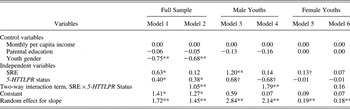
In the models that tested the study hypotheses, 5-HTTLPR status was dummy coded. Participants with ss or sl alleles were combined into one genetic status group and assigned a code of 1, participants with ll alleles were assigned a code of 0, and the genetic status predictor was regressed on the conduct problems slope. The first model involving the whole sample is presented in Model 1 in Table 1. The results were consistent with the first hypothesis: perceived discrimination was associated with a significantly higher rate of change in conduct problems across adolescence (perceived discrimination, β = 0.61, p < .01).
Unstandardized regression coefficients, slopes for conduct problems

Note: SRE, Schedule of Racist Events; 5-HTTLPR, serotonin transporter linked promoter region.
†p < .10. *p < .05. **p < .01. All tests two tailed.
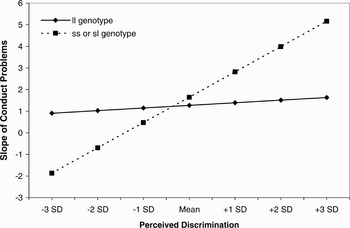
The second model executed on the whole sample (Model 2 in Table 1) was designed to test the proposed G × E hypothesis. When the interaction term was added to the model, the association between perceived discrimination and the slope of youth conduct problems approached significance (p < .10). The interaction between perceived discrimination and 5-HTTLPR status yielded significant predictions beyond the previous variables in the model (β = 0.76, p < .01). To interpret this interaction, we plotted the slopes of conduct problems in Figure 1 for levels of perceived discrimination that range from −3 to +3 SD from the sample mean, separately for youths with ss or sl genotypes and youths with ll genotypes. A perusal of Figure 1 reveals several notable findings. Consistent with the study hypothesis, compared with youths who had ll genotypes, youths with ss or sl genotypes evinced the highest rates of change in conduct problems when they perceived high levels of racial discrimination. Of particular note were the two findings, illustrated in Figure 2, that the ll genotype apparently protected youths exposed to high levels of discrimination from increases in conduct problems and that, under low levels of perceived racial discrimination, s carriers evinced lower levels of conduct problems than did ll carriers. The latter finding is consistent with Belsky and colleagues' (2007) differential susceptibility hypothesis. We also examined the possibility that a gene–environment correlation could exist between 5-HTTLPR and perceived discrimination. Consistent with our expectations that the short allele would be associated with greater vigilance for environmental threat, a significant correlation emerged between genetic status and perceived discrimination (r = .22, p = .05). To examine the possibility that this gene–environment correlation accounted for the association between perceived discrimination and conduct problems, we estimated a mediational model in which we assessed the significance of the indirect effect from genetic status on the conduct problems slope via perceived discrimination. The estimated indirect effect was β = 0.08 and p = .30; therefore, the gene–environment correlation association did not account for the impact of perceived discrimination on outcome.
The results of the analysis for the total sample. The slopes of conduct problems for levels of perceived discrimination, ranging from −3 to +3 SD from the sample mean, are plotted separately for youths with the ll genotype and youths with the ss or sl genotype (s, short; l, long).

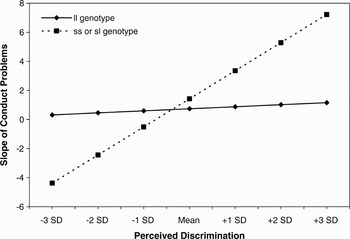
The results of the analysis for male youths only. The slopes of conduct problems for levels of perceived discrimination, ranging from −3 to +3 SD from the sample mean, are plotted separately for male youths with the ll genotype and male youths with the ss or sl genotype (s, short; l, long).

Gendered models
The model presented in Table 1 was rerun separately for male and female youths to test for hypothesized gender differences. The separate models are presented in Table 1. For male youths, the main effect model presented in Model 3 of Table 1 indicated that perceived discrimination was associated with increases in conduct problems (β = 1.24, p < .05). The second model for male youths, presented in Model 4 in Table 1, tested the G × E hypothesis that perceived discrimination would interact with genetic status to forecast the slope of conduct problems. The interaction between perceived discrimination and genetic status was significant (β = 1.22, p < .01). Again, to understand how the interaction affected the trajectories of conduct problems for male youths, we plotted the slopes of conduct problems in Figure 2. The forms of the slopes were nearly identical to those depicted in Figure 1. Male youths with the ss or sl genotype, compared with those who had the ll genotype, evinced the highest rates of change in conduct problems when they perceived high levels of discrimination. The slope of conduct problems for male youths with the ll genotype appeared relatively unaffected by perceived racial discrimination, whereas carriers of a short allele evinced lower levels of conduct problems than did ll carriers.
The analyses for female youths (see Models 5 and 6 in Table 1) reveal a different pattern. A main effect for perceived discrimination approached significance (β = 0.19, p < .10), but no G × E interaction emerged.
Discussion
Sponsored by both differential susceptibility and resilience theories (Belsky et al., Reference Belsky, Bakermans-Kranenburg and van IJzendoorn2007; Caspi et al., Reference Caspi, Hariri, Holmes, Uher and Moffitt2010; Cicchetti & Blender, Reference Cicchetti and Blender2006; Kim-Cohen & Gold, Reference Kim-Cohen and Gold2009), we predicted that perceived discrimination would be linked to increases in conduct problems when male African American youths carried one or two copies of the s allele of the 5-HTTLPR. Consistent with this hypothesis, a clear and pronounced link emerged between perceived discrimination and growth in conduct problems across 3 years among youths with these genotypes. This finding is consistent with the proposition, informed by neuroimaging and prior G × E research involving the 5-HTTLPR, that male youths who carry the short allele, because of their genetic makeup, are more likely to be affected by perceived discrimination than are those with the ll genotype. The finding that carrying two copies of the long allele buffered male youths from developing conduct problems when they perceived high levels of discrimination is pertinent to research on youth resilience. This literature has addressed the reasons why some youths who experience many discrete and chronic stressors do not succumb to their negative effects (Luthar, Reference Luthar, Cicchetti and Cohen2006). Typically the locus of these resilience effects is identified through contextual processes at different levels of analysis (family, peer, school, or neighborhood) that alter several types of pathways, including reduction of the effects of risk factors. The present results reinforce recent suggestions that genetic status can also contribute to resilience (Kim-Cohen & Gold, Reference Kim-Cohen and Gold2009; Moffitt, Caspi, & Rutter, Reference Moffitt, Caspi and Rutter2006; Rutter & Silberg, Reference Rutter and Silberg2002). The observed buffering effects of carrying two l alleles suggest an emotional self-regulatory mechanism in which genotype contributes to youths' downregulation of emotions such as anger, victimization, and feelings of injustice that discrimination occasions (Simons et al., Reference Simons, Chen, Stewart and Brody2003, Reference Simons, Simons, Burt, Drummund, Stewart and Brody2006). Further research is needed to test this hypothesis.
Caution should be used, however, in interpretation and generalization of the protective effects the ll genotype to all African American youths. Some who seem unfazed by high levels of perceived discrimination may not be as adaptable as they appear; still others may be resilient in some areas but experience distress in others, such as health or aspects of social relationships that do not involve conduct problems. Research with children who have been maltreated (Farber & Egeland, Reference Farber, Egeland, Anthony and Cohler1987), whose mothers have depression (Hammen, Reference Hammen and Luthar2003), and whose parents have alcoholism (Zucker, Wong, Puttler, & Fitzgerald, Reference Zucker, Wong, Puttler, Fitzgerald and Luthar2003) support this caveat. Even youths who are well adjusted behaviorally can have their resilient trajectories disrupted by the introduction of other risk factors that diminish the protective capacities that the ll genotype may confer.
The results also supported Belsky and colleagues' (2007) differential susceptibility hypothesis, in which specific gene variants, including the 5-HTTLPR, are proposed to render individuals more susceptible to the surrounding environment whether it is characterized by high positivity or high risk. The finding that, under conditions of low perceived discrimination, s carriers evinced lower levels of conduct problems than did ll carriers does support differential susceptibility predictions.
We also investigated gender differences in the G × E hypothesis that we examined. Although gender has been identified as an important source of individual variability in stress and coping among members of ethnic minority groups (Clark et al., Reference Clark, Anderson, Clark and Williams1999; Slavin, Rainer, McCreary, & Gowda, Reference Slavin, Rainer, McCreary and Gowda1991), few studies other than our own have examined gender differences in youths' responses to discrimination. As expected, the hypothesized G × E effects were apparent for male youths but not for female youths. This finding may reflect two realities. First, the rates of conduct problems for male youths were three times those of female youths across the time frame of the present study. This finding is not specific to the sample in this investigation; other studies report male/female ratios of 3:1 or 4:1 for conduct problems (Davison, Neale, Blankstein, & Flett, Reference Davison, Neale, Blankstein and Flett2005). The greater prevalence of conduct problems among male youths and the resulting increased variability in change trajectories would render interactions easier to detect. It is possible that a much larger sample than the one included in the present study would allow the identification of a subsample of female youths who display high rates of conduct problems; this would permit an adequately powered test of the G × E hypotheses addressed in this study. Second, gender differences in conduct problem rates may reflect beliefs that aggression and other antisocial behaviors are more acceptable and effective coping tactics for male than female youths. It is also consistent with other studies in which male youths were found to be more likely than female youths to respond to life stress by losing inhibitory controls and expressing anger and frustration through their behaviors (Brody, Chen, et al., Reference Brody, Chen, Murry, Ge, Simons and Gibbons2006; Hetherington, Reference Hetherington1989; Rutter, Reference Rutter, Rolf, Masten, Cicchetti, Nuechterlein and Weintraub1990). The results of the present study extend these findings by demonstrating that 5-HTTLPR status may promote a stronger manifestation of conduct problems in adolescence among male than female youths when they experience negative emotions occasioned by high levels of discrimination.
The findings raise questions about the mechanisms through which G × E interactions connect perceived discrimination with the development of conduct problems. The neuroimaging research mentioned in the introduction offers one answer. This research has demonstrated that carriers of one s allele evince more amygdala-mediated arousal and increased cortical reactivity in response to threatening stimuli (Battaglia et al., Reference Battaglia, Ogliari, Zanoni, Citterio, Pozzoli and Giorda2005; Hensch et al., Reference Hensch, Wargelius, Herold, Lesch, Oreland and Brocke2006). The s allele also has been linked with preferential attention toward and difficulty disengaging from threat-related stimuli (Beevers et al., Reference Beevers, Wells, Ellis and McGeary2009; Osinsky et al., Reference Osinsky, Reuter, Küpper, Schmitz, Kozyra and Alexander2008). Together, this literature suggests that male youths who perceive high levels of discrimination and carry one or two copies of the short allele develop heightened anticipation of and reactivity to both subtle and overt discrimination. This heightened reactivity in response to perceived discrimination may engender for some youths high levels of negative affectivity that contribute to engagement in and justification of antisocial behavior. This process is consistent with Franklin's (1993) observation that African Americans' inner vigilance toward racial slights can create a state of constant watchfulness that leads to chronic stress and its accompanying emotional costs. The research in this report suggests that this process is most likely to occur among male African Americans who carry a short allele. These conjectures await empirical analysis.
Some limitations of the research design should be noted. Only one genetic polymorphism was examined, which does not represent all the variation that could place youths at risk for conduct problems. Many genetic variants may alter risk, the expression of which may only emerge under particular contextual conditions. A corollary of this limitation is the perception that genetic variation confers only risk. Genetic effects may also be protective, and that which is conceptualized as a risk-promoting genetic effect may actually be the absence of protective genes. In this study, the ll genotype for 5-HTTLPR protected youths who perceived high levels of discrimination from developing conduct problems. This is an important finding and one that should be explored in future research. Research also is needed to examine the processes that interact with genetic status that have been found to protect youths from the psychological costs of discrimination, such as parenting practices, affiliations with prosocial peers, school efficacy, and racial identity (Brody, Chen, et al., Reference Brody, Chen, Murry, Ge, Simons and Gibbons2006; Simons et al., Reference Simons, Simons, Burt, Drummund, Stewart and Brody2006), to refine understanding of the processes and conditions through which discrimination compromises children's and adolescents' development. Future research with larger samples will be able to address this issue. These limitations notwithstanding, the present study demonstrates the ways in which perceived exposure to racial discrimination and 5-HTTLPR status combine to create different trajectories of conduct problems among male African American youths during adolescence.