The public literature and perception about education in very remote Aboriginal and Torres Strait Islander communities is replete with the word ‘failure’. ‘Very remote’ is used here according to the Australian Bureau of Statistics Remoteness Structure (ABS, 2011c). The comparative statistics, whether presented in terms of academic performance, attendance, retention to Year 12, transition to higher education, transition to employment, teacher retention or any of a number of other indicators, invariably show that Aboriginal and Torres Strait Islanders living in very remote parts of Australia consistently fare worse than those who are non-Indigenous, and anyone living in urban, regional or even remote parts of the nation (see, e.g., Australian Curriculum Assessment and Reporting Authority [ACARA], 2012b; Steering Committee for the Review of Government Service Provision, 2011).
The very remote education system faces huge challenges — a significant part of that system is not presenting results commensurate with the stated goals of the system, particularly in relation to participation in education, literacy and numeracy outcomes and international competitiveness (Ministerial Council on Education, Employment, Training and Youth Affairs, 2008; Standing Council on Federal Financial Relations, 2012). When we refer to the ‘system’ here we are speaking generically about an ‘interconnected set of elements that is coherently organised in a way that achieves something’ (Meadows, Reference Meadows2008, p. 11). The apparent failure is not for want of effort or professional expertise. It is fair to say that considerable resources have been put into making the system work better in order to improve outcomes for Aboriginal and Torres Strait Islander students. However, to date, even the best reported results fall well short of the Australian system's own benchmarks. The research challenge then is to find practical ways that make a meaningful difference for remote communities: Is there a way to improve outcomes? Is the system perhaps measuring the wrong things? Or is there perhaps a need to change the very system? The consideration of these questions is the intention of the Cooperative Research Centre for Remote Economic Participation (CRC-REP) and its Remote Education Systems (RES) research project.
The purpose of this article is not to provide answers, but simply to raise questions about the purpose and value of education. For the pragmatically minded, these questions may be somewhat frustrating as they are somewhat philosophical in nature. However, if the underpinning assumptions that provide both the foundations and imperatives of the education system are inappropriate for very remote Australia — or just do not work — then serious consideration needs to be given to these questions. Otherwise, the kind of innovation in and for remote education will be little more than moving the desks around. The need for this discussion arises in part from the increasingly nationalised approach to education, which is seen in the development of a national curriculum (ACARA, 2012c), teacher quality and professional standards (Australian Institute for Teaching and School Leadership, 2011) and standardised testing regimes (ACARA, 2012a).
Background and Context
Global Change
Change is happening. What is more, the rate of change is increasing particularly in the way people access information, the way we all communicate with each other, the way we do work or business and the way we get around. To a large extent technology is driving the change. Breakthroughs in medicine and the sciences regularly feature in the news. But what about breakthroughs in education? Robinson (Reference Robinson2011) comments:
The rate and scale of change engulfing the world is creating a tidal shift in how people live and earn their living. We now need to be equally radical in how we think of education. Raising standards alone will not solve the problems we face: it may compound them. (p. 81)
Education In and For Remote Australian Communities
This global shift is also making its impact in the remote communities of Australia. Remote classrooms are similar to classrooms in any Australian school. There may be some different languages represented, but they still look and feel the same. Despite the geographical, sociocultural, linguistic and epistemological diversity that exists within remote Australia and between remote and urban Australia, the education system in remote Australia is largely built on urban or regional models, with all the assumptions that go with education in those locations.
The one exception is the ‘School of the Air’ model, which is designed primarily for children who live on isolated cattle stations, national parks or roadhouses. While Aboriginal or Torres Strait Islander children are not excluded, they are generally not well represented in this student population. For example, the My School website (ACARA, 2013) shows that the Katherine School of the Air records Aboriginal and Torres Strait Islander participation as 27%. The Northern Territory government (Department of Education and Training, 2012) reports that 40% of all students in the Territory are Aboriginal or Torres Strait Islanders. In very remote schools, our analysis suggests that the figure is about 85%.
The other models used for education of students in remote Australian communities tend to be either community-based schools or boarding schools. Some boarding schools are set up specifically for Aboriginal or Torres Strait Islander students (e.g., Tiwi College on Melville Island, Yirara College in Alice Springs, Djarragun College near Cairns). Most boarding options for remote students are based in urban settings where, to varying degrees, Aboriginal and Torres Strait Islander students are integrated into a mainstream program (e.g., Immanuel College and the Wiltja Program at Woodville High School in Adelaide; and St Johns College, Marrara Christian College, and Kormilda College in Darwin).
In terms of education for students who stay in very remote communities, there is little choice but to participate (or not) in what is offered at the ‘local’ school — not all very remote communities have a school campus. Based on an analysis of the My School website, there are 268 schools located in very remote Australia in six jurisdictions (Guenther, Reference Guenther2012). About 100 of these have enrolments of less than 40 students. More than half (160) of the very remote schools have an Aboriginal and Torres Strait Islander student population above 80%. About one-third are located in the Northern Territory. About 40% (117) of the schools are primary only schools below Year 7. Another nine are secondary only and the balance are combined primary/secondary schools with varying secondary endpoints. The large majority (85%) are government schools that operate under the direction of state and territory departments of education.
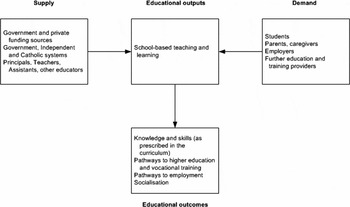
Yet, the expectation in the mainstream is that the universal model of educational supply and demand follows a schema like that shown below in Figure 1. Government and private providers are funded to deliver education through schools to students. Demand for education in this schema is driven by students and their parents/carers, employers and industry, as well as higher education and training providers. In this (over)simplified model, the shared expectation of those on the demand and supply side is that students will complete their compulsory education with all the knowledge and skills required by the curriculum, ready for work or further education and training, having been socialised in the system to conform to the norms and values of the broader society (OECD, 2006). But, as Leadbeater (Reference Leadbeater2012) points out in his global discussion about innovation, education and what motivates children to attend school:
There is a widespread assumption that the biggest challenges are on the supply-side of education: if we can just get more children into school for longer then everything should sort itself out. We assume that most parents want their children to be at school and that most children want to go. Yet many of the most significant challenges we face may be on the demand side: parents and children do not invest in education because they see little point in doing so. It could be that it's their low aspirations that lead to low attendance and poor outcomes. (p. 98)
Simplified supply/demand/outcome schema for mainstream education (CRC-REP, 2011).

In the Australian context, the discussion about demand and supply push- and pull-factors is at times contentious. Pearson (Reference Pearson2007, p. 2) who is often criticised for his call for an end to what he describes as ‘passive welfare’ also recognises that: ‘On the demand-side, as well as renewed real commitment to government accountability, we need strategies aimed at building the local demand for learning and demand for quality teaching’. What Pearson appears to be alluding to here is that more effort needs to be put into building the demand for education at the community level, rather than focusing on building supply.
The simplified model shown in Figure 1 — which it could be argued works quite well in metropolitan, regional and rural communities — is problematic when applied to remote communities. On the supply side, the system as it is, is confronted with issues of teacher turnover, teacher quality, pre-service teacher education, recruitment, housing, leadership, workload, and feelings of isolation for staff who relocate. These issues are all well documented in the research literature (see, e.g., Department of Education, 2011; Hudson & Millwater, Reference Hudson and Millwater2009; Lock, Reference Lock2008; Sharplin, Reference Sharplin2009). The problem on the demand side is often articulated through expressed frustration that parents are not sending their children to school. ‘We know children need to go to school every day in order to get the best possible education’ (see, e.g., Burns & Henderson, Reference Burns and Henderson2010), represents the determination of the supply side in its efforts to manage the demand side of education in order to increase outputs and thereby, outcomes. The solution for the ‘problem’ then translates into finding ways of helping young people fit within or adapt better to the education system, with parents being penalised for apparently not taking their responsibility seriously (Wright, Arnold, & Dandie, Reference Wright, Arnold and Dandie2012).
The high attrition rates for Aboriginal and Torres Strait Islander people participating in secondary remote schools suggests that for the majority of students there is little in the current education system to attract them or keep them there. Data from the Australian Bureau of Statistics (ABS, 2011a) show that in 2008, 10% of non-Indigenous young people aged 15 to 19 were neither studying nor had completed Year 12 or a higher qualification, while for Aboriginal and Torres Strait Islanders in remote areas of Australia, almost 40% per cent were neither studying nor had completed Year 12 or a higher qualification. The data presented by the ABS in this case only shows remote Australia. It is likely that the difference would be much greater for very remote Australia.
Much of the research and literature assumes the education system as a given, as if the system as it is, has always been there — it is largely immutable. The reality is that the education system with mass schooling is a relatively recent phenomenon, but education is not new. The starting point for any discussion about education models is generally schools. The assumption then is that Aboriginal and Torres Strait Islanders must fit within the system. Beresford and Gray's (Reference Beresford, Gray, Beresford, Partington and Gower2012) discussion of seven models of education makes no mention of a model that is demand driven. The seven models are either policy-driven, ideologically based, or delivery focused, and at best attempt to accommodate culture. At a local level it may be possible to model a system that does work to make it not only attractive but effective for remote communities to engage in formal learning for longer than they currently do, which is perhaps the intent of Pearson's (Reference Pearson2007) statement, quoted earlier. The point is too seldom made that the traditional systems for learning among Aboriginal and Torres Strait Islander peoples contrast with western systems of learning (Price, Reference Price and Price2012) — instead, the increasingly national, uniform approaches to education give privilege to systemic approaches that derive from the structural and philosophical foundations of western education.
System Assumptions
The Inherited Structure
Picture for a moment the ‘typical school classroom’ — what immediately springs to mind to most, if not all, is a room with desks, chairs, books, shelves and cupboards with resources, and some form of instructional tool at the front of the room, say a blackboard, whiteboard, or perhaps smartboard. The classroom is run by a teacher, who may have an assistant or two helping with the children who have special needs. Lessons are structured to a timetable. Classes all run to the same timetable. The staff of the classes is managed by a structure that includes a senior teacher, assistant principal(s) and a principal. Only in the smallest of schools would the roles of principal, assistant principal, senior teacher and sometimes even teacher be held by the one person. However, the roles can all be clearly delineated. Almost anyone in Australia would describe a school classroom in this way — but why? Where did this structure come from?
While ‘education’ itself has shifted, with the relationships between teacher and student changing, and with the purposes, philosophies of education and curriculum adapting, the classroom of today is still instantly recognisable as the direct descendant of the classroom generated out of the German comprehensive schools established in the 19th century — an ‘industrial model of schooling’ (Gerver, Reference Gerver2010, p. 59). The following description of the methods of teaching employed in schools in the late 19th and early 20th century is perhaps not all that different from what many would espouse as the ideal classroom today.
Methods of teaching in primary and secondary schools assumed that schools would be divided into classroom groups of pupils of approximately the same age, and that pupils would be taught together in each of these groups.. . . By 1900, teaching typically proceeded on the view that the teacher's principal task was to manage a classroom efficiently, that, in doing this, he should be able to instruct his pupils clearly, methodically, and thoroughly in a group, that the pupils should be directed by the teacher in what they learnt and how they learnt it, that the principal sources of their information should be the teacher and the textbook selected by the teacher, and that they should accept and reproduce the ideas and knowledge prescribed for them in a quiet and well-disciplined manner. (Connell, 1980, p. 4)
The focus on teachers and classrooms, which persists today, means that education quality tends to be defined in the same terms. Consequently, the indicators associated with improving education, in Australia described as ‘Education Reform’ or ‘Better Schools’, are largely focused on a narrow range of academic performance measures along with attendance (Standing Council on Federal Financial Relations, 2013). But is this fundamentally the basis of a good education?
Benefits of a ‘Good’ Education
The arguments for a ‘good’ education are compelling. We offer a set of eight assumptions that we see as inherently assumed within Australia. The assumptions are derived from our reading of the relevant literature. The focus is on the philosophy, rather than the theory of education. We would stress that these assumptions are not ‘bad’ — indeed, for the majority of Australians they work quite well. However, the literature is scant in support of these assumptions. Biesta (Reference Biesta2009a) suggests that the absence of a discussion in the literature about what constitutes good education is because of an ‘implicit reliance on a particular “common sense” view of what education is for’ (p. 37). He also asserts that comparative data ‘give the impression that the data can speak for themselves’ (Biesta, Reference Biesta2009b, p. 1). Biesta himself does not attempt to define what ‘good education’ actually is, perhaps because of the subjective moral connotations of the word ‘good’. There are philosophical bases for arguing that a ‘good’ education can be defined in terms of moral, social, civic and personal aims (see, e.g., Brighouse, Reference Brighouse and Siegel2009; Marples, Reference Marples and Bailey2010). Further, the underpinning values base of education systems are built on a history of western rational thought, and ancient Greek traditions (see an overview in Noddings, Reference Noddings2012) and have evolved over time with significant contributions from philosophers through the 19th and 20th centuries (see Oakes, Lipton, Anderson, & Stillman, Reference Oakes, Lipton, Anderson and Stillman2013). However, the process used to develop the following list of assumptions does not flow deductively from theory and philosophy. Our approach is based on a reading of the literature that focuses on artefacts, practices and outcomes — in this way we are using inductive reasoning to build a case, based on empirical evidence in the literature, for a set of propositions about what makes education ‘good’ (see Johnson & Christenson, Reference Johnson and Christensen2012, p. 14). The process used is built on a pragmatic interpretive framework (see Creswell, Reference Creswell2013, p. 37). The list is open to criticism and indeed we are open to being challenged.
Assumption 1: A good education is built on the core foundations of quality leaders, teachers, teaching, attendance, classrooms, curriculum, accountability, choice and associated administrative structures and infrastructure.
Assumption 2: A good education (in Australia) promotes high standards of English language and literacy, as well as numeracy — it has a global knowledge economy imperative.
Assumption 3: A good education supports the values and norms of the mainstream society — it has a socialisation imperative.
Assumption 4: A good education is a pathway to further and higher education — and is underpinned by an academic imperative.
Assumption 5: A good education supports learners’ career aspirations — it has a work imperative.
Assumption 6: A good education supports learners’ emerging independence — and is underpinned by an economic imperative.
Assumption 7: A good education is focused on individual performance — it has a competitive imperative.
Assumption 8: A good education supports learners to engage with the broader society — it has a civic participation imperative.
The benefits that accrue from this ‘good education’ result either directly or indirectly from the imperatives of Assumptions 2 to 8, and are tied to a large extent to the outcomes of education outlined in Figure 1 earlier. We have deliberately not included any reference to equity imperatives in our list of assumptions. The ‘school choice’ agenda coupled with the trend toward privatisation of schools in Australia (see Caldwell, Reference Caldwell, Lee and Caldwell2011) can have a negative impact on equity, particularly in terms of socio-economic segregation (OECD, 2012b). School choice is now sufficiently embedded in the culture of schooling in Australia to ensure that equity concerns are likely not at the core of education. Indeed, recent evidence suggests that choice makes little difference to school outcomes, where it is available (Jensen, Reference Jensen2013). There may be some disagreement about these assumptions, and part of the purpose of this article is to allow for a critique and discussion, both in the context of remote and non-remote education.
In Australia the question of resourcing for schools has to some extent overtaken the discussion about the benefits and delivery of education, in the lead-up to the so-called Gonski report (Gonski et al., Reference Gonski, Boston, Greiner, Lawrence, Scales and Tannock2012) and the reform agenda (Standing Council on Federal Financial Relations, 2013) that has followed. The logic applied is that better resourcing of schools will improve school outcomes (Australian Government, 2013). Further, the need to remain internationally competitive — and the fear that Australia is lagging (Jensen, Reference Jensen2012) — underpins the need for school reform. This logic lines up with Assumptions 1 and 2.
The empirical evidence that education and learning is related to a range of benefits, including social equity (OECD, 2012b), health (Ross & Mirowsky, Reference Ross, Mirowsky, Bird, Conrad, Fremont and Timmermans2010), justice and criminal behaviour (Lochner, Reference Lochner, Hanushek, Machin and Woessmann2011; Machin et al., Reference Machin, Marie and Vujić2011), employment, economic and developmental (Hanushek & Woessmann, Reference Hanushek and Woessmann2009; OECD, 2012a), family and individual outcomes (Schuller, Preston, Hammond, & Bynner, Reference Schuller, Preston, Hammond and Bynner2004), is readily available in an array of literature. Economists Oreopoulos and Sylvanes (Reference Oreopoulos and Salvanes2011) identify a range of what they term ‘non-pecuniary’ benefits of schooling:
Schooling generates occupational prestige. It reduces the chance of ending up on welfare or unemployed. It improves success in the labor market and the marriage market. Better decision-making skills learned in school also lead to better health, happier marriages, and more successful children. Schooling also encourages patience and long-term thinking. Teen fertility, criminal activity, and other risky behaviors decrease with it. Schooling promotes trust and civic participation. It teaches students how to enjoy a good book and manage money. (pp. 179–180)
The above list of outcomes helps justify Assumptions 3 to 7. However, the hope of education is that it leads to a better life, particularly for those living on the margins of society. Leadbeater (Reference Leadbeater2012, p. 23) suggests that education ‘offers them a hope that their place in society will not be fixed by the place they were born’ and that through education people can ‘remake their lives’. This ‘hope’ feeds directly into Assumption 8, that learners will be supported to become contributors of society.
If the values attributed to education and learning are as great as they are purported to be, one would assume that young people and their parents — particularly those living at the margins — would be scrambling for a ‘good education’. Why is it then not always so? In particular, if education is valued by remote Australian Aboriginal and Torres Strait Islander communities, why do students not buy into the assumptions we have listed above?
The Current System Fails
The reasons for ‘failure’ of remote education, which we discussed in the introduction to this article, are sometimes distilled down to simple solutions. For example, Hughes and Hughes (Reference Hughes and Hughes2012) assert that the ‘causes of high indigenous failure rates are in classrooms that do not deliver quality literacy and numeracy instruction’. A range of other apparently simple solutions likewise focus on one or two elements of the whole system. These foci include an emphasis on attendance (Purdie & Buckley, Reference Purdie and Buckley2010), building Aboriginal and Torres Strait Islander workforce capacity (More Aboriginal and Torres Strait Islander Teachers Initiative, 2012), raising student expectations (Sarra, Reference Sarra2011), explicit teaching or direct instruction (Pearson, Reference Pearson2011), testing and teacher accountability (Klenowski, Reference Klenowski2011), school-community engagement (Lea, Thompson, McRae-Williams, & Wegner, Reference Lea, Thompson, McRae-Williams and Wegner2011) as well as any number of other ‘what works’ strategies (What Works. The Work Program, 2011). The reality — acknowledged by most of the authors cited above — is that the reasons for failure are far more complex. Indeed, if any of the singular approaches had worked consistently and in a sustained way, then they would have been scaled up within the system.
The point we make in this article is that the ‘system’ is highly complex. It comprises educational providers on the supply side; families, communities and students on the demand side; as well as end users such as employers and universities. A ‘given’ within this mix of providers and users is the involvement of governments in funding for schools — where even in the independent school sector, 45% of recurrent income comes from government sources (Gonski et al., Reference Gonski, Boston, Greiner, Lawrence, Scales and Tannock2012, p. 15). There may be a temptation to lay blame for failure on a single component of a system where cultures — and therefore norms, values and behaviours — intersect. The foundations of the system's failure are arguably built rather on the set of assumptions about what makes a ‘good education’.
Imagining a Different Education System for Remote Communities
As part of our research agenda with the Cooperative Research Centre for Remote Economic Participation, we want to explore alternative models for provision and uptake of learning opportunities in remote Australia. While we note that there is a lot of activity and innovation in the educational space in remote Australia, much if not all of it is firmly grounded in the assumptions that underpin the foundations of Assumption 1 and imperatives of Assumptions 2 to 8, listed earlier. In this section we want to posit a set of questions that may shift thinking or at least question the assumptions we have listed, particularly as they relate to education in and for very remote communities. The supply side of the system (as shown in Figure 1) is far from culture free. Rather, it is laden with values and philosophical assumptions that have been developed and established over the last century or more (Rizvi & Lingard, Reference Rizvi and Lingard2010). Robinson (Reference Robinson2011) in his book Out of Our Minds articulates the case for a different set of values. As he challenges the educational landscape generally, we want to put forward a different way of thinking about remote education.
Alternative Thinking About the Foundations of a Good Education in Very Remote Australia
Instead of focusing so much attention on school buildings, classrooms, desks, teacher quality, terms and curriculum, we would like to suggest some different perspectives as they may apply to remote education. These perspectives question the nature and definition of ‘success’ in very remote education.
• Why not consider opportunities for ‘disruptive innovation’ and informal learning opportunities in remote Australia?
There is a lot of incremental innovation happening in Australian remote education. Much of this innovation is about doing ‘things’ better. Those ‘things’ could be about leadership, attendance, literacy and numeracy, curriculum, governance, or teacher quality. According to Leadbeater and Wong's (Reference Leadbeater and Wong2010) Learning from Extremes innovation grid, ‘Improvement in our current schools, on its own, will not be enough to meet the growing and changing demands of governments, parents, and children’ (p. 4). They suggest that innovation that transforms informal learning and reinvents formal learning will be necessary. In short, disruptive innovation goes well beyond ‘moving the desks around’.
• Why not consider what standards are required for quality learning, rather than quality teaching?
A key focus of the attempt to improve outcomes is to improve teacher quality — and perhaps rightly so, given the evidence base (Hattie, Reference Hattie2009). This is reflected in the codification of National Professional Standards for Teachers. These standards (Australian Institute for Teaching and School Leadership, 2011) make a significant contribution to professional quality for teachers. Importantly, as the first standard is about knowing students and how they learn and in remote Aboriginal and Torres Strait Islander contexts, this is worthy of attention. While we do not necessarily suggest the codification of standards that are required for quality learning, if teaching takes place in environments that do not support quality learning, the quality of teaching is arguably worthless.
• Why not consider ‘community contribution’ as a measure of success instead of Year 12 retention?
According to the Australian Bureau of Statistics (ABS, 2011b): ‘Year 12 attainment is regarded as a key factor in the formal development of an individual's skills and knowledge. Those with Year 12 have a greater likelihood of continuing with further study, particularly in higher education, as well as entering into the workforce’. This fits neatly with the Assumptions 2, 4, 5 and 7 listed earlier. While not wanting to diminish the importance of this measure of success, it is perhaps more important in remote communities that those who come out of the ‘education system’ can contribute something within their community. Many of the jobs envisaged in the ABS assertion are not necessarily in the community from which the graduate comes. The migration of youth from remote communities is seen by some as a devastating loss. Having young people as role models developing leadership skills and working for the good of their family and community may be a worthwhile outcome, just as valuable as Year 12 retention.
• Why not consider a motto that suggests ‘every child learning every day’ instead of a focus on attendance?
A lot of attention in Australia has been placed on improving student outcomes by increasing attendance. The argument for this is compelling: ‘How can children learn if they don't attend?’ And indeed at a national and state/territory level there is evidence of a strong association between student performance and attendance (Miller & Voon, Reference Miller and Voon2011; Zubrick et al., Reference Zubrick, Silburn, De Maio, Shepherd, Griffin, Dalby and Cox2006). However, our assessment of NAPLAN data at the very remote level and for those schools which have more than 80% Aboriginal and Torres Strait Islander students, indicates that the relationship breaks down (Guenther, Reference Guenther2012). Our argument is that rather than a focus on attendance and applying another level of stress to the reporting/accountability of the schools, the focus should be on children learning every day.
• Why not consider measures of accountability to the community, rather than measures of accountability to funders?
Autonomy and accompanying accountability for student outcomes in schools is emerging as an issue for many schools in Australia (Klenowski, Reference Klenowski2011; Productivity Commission, 2012; Western Australia Department of Education, 2011). It is argued that schools perform better when systems of accountability are in place (Schütz, West, & Wößmann, Reference Schütz, West and Wößmann2007) — that is, teacher quality improves and student outcomes improve (Santiago, Donaldson, Herman, & Shewbridge, Reference Santiago, Donaldson, Herman and Shewbridge2011). While it could be argued that accountability and transparency are designed to support parent choice, reporting mechanisms are predominantly designed to feed back to funders, and in particular state and territory departments of education. Questions remain about how effective the accountability measures are in terms of reporting back to remote communities.
• Why not think about creating the future of education instead of recreating the past?
It is difficult for those who have learned in, taught in and even researched in the current education system to imagine a system that is not bounded by the assumptions presented here. This is not to suggest that the current system is ‘bad’ — it has served many Australians very well. However, in the context of remote education in Australia, there should be space to think well and truly outside the square. We can learn from international experiences of innovation and thinking — in particular, drawing on the likes of Leadbeater (Reference Leadbeater2012) and Robinson (Reference Robinson2011), whose work was discussed earlier. The imperative for disruptive innovation is not just the apparent failure of the education system. Rather, the imperative for innovation in education arises from the pace of change that is happening in an increasing global environment (Istance, Reference Istance2011). Hannon, Patton, & Temperley (Reference Hannon, Patton and Temperley2011), suggest that the focus needs to switch from engagement with school to engagement with learning. They propose an ‘innovation ecosystem’ that incorporates digital technologies and what they term ‘learner ownership’. While not wishing to devalue the core of conventional education, it may be timely to engage our thinking in these kinds of ideas.
Alternative Thinking About the Imperatives of a Good Education in Very Remote Australia
We now switch our attention to the imperatives of a good education, which were listed earlier in Assumptions 2 to 8. Again, we are not suggesting that we necessarily abandon these imperatives. Rather, we are questioning whether there could be a different way of looking at them as we consider a good education in remote communities.
• Instead of focusing on the economic imperative, why not focus on a wellbeing imperative?
Arguably, for most Australians the economic imperative for education is essential: What is the point of learning in schools if it does not help students get into a career? (Cranston, Kimber, Mulford, Reid, & Keating, Reference Cranston, Kimber, Mulford, Reid and Keating2010). Economic independence is no doubt a core value of mainstream Australian culture and tends to take precedence over socialisation and equity values. Australian social commentator and researcher Hugh Mackay (Reference Mackay2010) describes this imperative as ‘the desire for more’ and the ‘desire for control’. However, that value may not follow to the same extent in remote communities. A recent report on a gathering in Alice Springs, organised by the Healing Foundation (2012), identified a range of issues that were causing disharmony and imbalance among Aboriginal and Torres Strait Islander communities and a range of things that could restore the balance. The extensive list did not include one mention of jobs or economic imperatives. Rather, the focus was clearly on culture and wellbeing.
• Instead of focusing on the academic imperative, why not consider an identity imperative?
The academic imperative is entrenched in the values of schooling. Is there a better way to describe success for a Year 12 completer who has achieved an ATAR score of 99? There is evidence to suggest that for Aboriginal and Torres Strait Islander students, racial identity and self-concept do matter and they are correlated with academic outcomes (Kickett-Tucker & Coffin, Reference Kickett-Tucker, Coffin, Purdie, Milgate and Bell2011). Sarra (Reference Sarra2011), in Strong and Smart points to the importance of schools developing strategies that reinforce Aboriginal identity. Pearson (Reference Pearson2011), while disagreeing with Sarra on other issues, agrees with that point. None of these authors would suggest that academic achievement is not important. The question is simply one of priority.
• Instead of focusing on individual career imperatives, why not consider imperatives built on community aspiration?
We have already suggested that perhaps community contribution needs to be considered as a measure of success ahead of Year 12 completion. It is tempting to conclude that the career imperative is shared equally by all Australians. But is it? Without doubt there are individuals in remote communities who aspire to have a career, but in our work the question of aspiration arises frequently. For example, in a recent survey conducted for the Nyangatjatjara College, based at Yulara in the Northern Territory, the data showed few students who could envision a career or even a job beyond school. While community members did not ignore the possibilities of work beyond school it was clear that they had other priorities too, such as connection to country, language learning and use of digital technologies (Osborne, Reference Osborne2012).
• Instead of focusing on knowledge performance, why not consider imperatives built on creative performance?
Robinson's (Reference Robinson2011) focus on creativity is worth considering. He contrasts the ‘tension between the world views that emanate from the Enlightenment and those that come from Romanticism’ (p. 178). According to Robinson, the world views of the former, with a focus on rational thinking tend to prevail over the latter which are based on ‘naturalist’ assumptions. Again, there is nothing ‘bad’ about the rational but the question remains: have we got the balance right, particularly in remote education?
• Instead of the competitive imperative, why not consider a collaborative imperative?
Education is both individual and competitive. Biesta (Reference Biesta2009a) describes the inherent assumptions of learning as ‘basically an individualistic concept. It refers to what people, as individuals do — even if it is couched in such notions as collaborative or cooperative learning’ (pp. 38–39). The outworking of this concept is demonstrated in individual examinations and assessments. Trudgen (Reference Trudgen2000) in his discussion about the way new information is received in Yolngu society, suggests that in order to be accepted it must receive peer affirmation — it is debated by the whole group. Kral (Reference Kral2007), writing about Ngaanyatjarra literacies, also suggests that collaborative or situated learning approaches are preferred over individualised, competitive approaches. Again, while there are good reasons for the competitive imperative, why should it not be collaborative instead?
Implications for a Transformed Remote Education System
We could go on to further question many other unstated assumptions of the system, but there is enough in the above discussion to provoke a deeper discussion about the assumptions and imperatives of a good education as it applies to remote Australia. However, while we can theorise about these assumptions — and either agree or disagree — the bigger question may well be more pragmatic. How would the education system respond if an alternative set of assumptions were applied to teaching and learning in remote communities? What if our classrooms were spread throughout the community, what if teachers offered learning experiences rather than managed classrooms — what if we didn't have desks? What we are suggesting in this article is that the kind of reforms that have been applied to remote education to date are incremental in nature — effectively a shifting of desks around in the classroom — rather than transformative. The questions we have posed are designed to prompt deeper thought and action about what might be done if we made explicit the unstated assumptions of the system, and then promoted the underpinning assumptions and worldviews of communities in very remote Australia.
There are, of course, a number of implications for a transformed remote education system that cannot be ignored. While these are acknowledged in terms of teacher education and professional development, definitions of success, assessment methods and pedagogical approaches, among a multitude of other things the purpose of this article is not to propose solutions. Rather it is to raise questions and promote a discussion about ways forward. What is clear though, is that in order to tackle the issues raised, the ‘system’ needs to engage experienced very remote educators who understand the context. But importantly also, it needs to engage innovative people from outside the system, whose thinking is not constrained by a history of learning, working and researching in the system as it is.
Conclusions
The Cooperative Research Centre for Remote Economic Participation is in the early days of an extended research program, which has the potential to — and intends to — find solutions to some of the problems found in very remote education in Australia. However, before we find the answers, it is important to ask the right questions and also to consider some of the assumptions that underpin the basis of the ‘system’ we are examining. This article is an attempt to do just that.
It is fair to say that there has already been considerable energy and effort put into trying to address the complex issues that face teachers and schools in very remote Australia. Much of this effort is focused on innovation that is directed at improving the current system. Such improvements are important and should be encouraged. However, they will not necessarily result in the kinds of outcomes required to transform or create a ‘new paradigm’ for very remote education.
The experience of education for most Australians is built on their 12 or more years spent in the classroom. The classroom is a potent symbol of school-based education. While the metaphor of ‘moving the desks around’ may seem a little simplistic and perhaps even disrespectful of the huge effort put into improving education in very remote Australia, it does provide a useful place to start a discussion about what more radical innovation might look like for teachers, learners and communities.
Acknowledgements
The work reported in this publication was supported by funding from the Australian Government Cooperative Research Centres Program through the Cooperative Research Centre for Remote Economic Participation (CRC-REP). The views expressed herein do not necessarily represent the views of the CRC-REP or Ninti One Limited or its participants. Errors or omissions remain with the author.
About the Authors
John Guenther (Guest Co-Editor of this issue) is the Principal Research Leader for the Remote Education Systems project with the Cooperative Research Centre for Remote Economic Participation and Flinders University. John has worked as a researcher and evaluator in remote Australian contexts — particularly the Northern Territory — for the past 10 years on issues related to education, training, families and children, justice, child protection and domestic violence. His current role is focused on understanding how education systems can better respond to the needs of students and families living in very remote Aboriginal and Torres Strait Islander communities. Beyond this, the Remote Education Systems project is looking for innovative models of schooling, teaching and learning that improve livelihood opportunities for students from remote communities.
Melodie Bat (Guest Co-Editor of this issue) is currently working as an education consultant in her business, Pracademic Solutions. Melodie has been working in Indigenous education for two decades, beginning her career as a remote teacher in the Northern Territory. Her own learning journey has led her through a career that has spanned teaching, project management, leadership and research across the many sectors and spaces of Indigenous education, always with a focus on working towards a more equitable education system.