Research on bilingualism suggests an intricate relation between executive function (EF) and language use (for discussions, see Barac & Bialystok, Reference Barac and Bialystok2012; Bialystok, Reference Bialystok2015; Green, Reference Green1998). However, the complexity of this association is still not known, especially as it relates to a high-level metalinguistic skill (i.e., syntactic awareness) that develops during early to middle childhood. Moreover, we still do not know how this relation might be moderated by unique characteristics shared by some bilingual children (i.e., language brokering). Therefore, the focus of this study is to examine how three core EF skills (cognitive flexibility, inhibition, and working memory) are related to syntactic awareness in monolingual and bilingual children with and without natural translation experience. To understand these potential relations, we will examine briefly the literature on EF skills and bilingualism, and EF skills and syntactic awareness in monolingual and bilingual children. Next, we will specifically address how children's language characteristics may shape the relation between EF and syntactic awareness, including language brokering (i.e., interpreting and translating information for others; e.g., Orellana, Dorner, & Pulido, Reference Orellana, Dorner and Pulido2003; Tse, Reference Tse1996).
EF SKILLS IN BILINGUALS
EFs are a set of functions that control thought and action in the face of conflicting information. Research has discerned three core EFs that are distinct but work in conjunction: cognitive flexibility (i.e., switching between task demands), inhibition (i.e., controlling prepotent responses), and working memory (i.e., manipulating contents of short-term memory; Diamond, Reference Diamond2013; Miyake et al., Reference Miyake, Friedman, Emerson, Witzki, Howerter and Wager2000). Past research has found EF advantages for children who speak two languages. Bilingual advantages may be due to continued engagement of EFs, which are needed when managing interference from dual language systems (e.g., Costa, Hernández, Costa-Faidella, & Sebastián-Gallés, Reference Costa, Hernández, Costa-Faidella and Sebastián-Gallés2009; Foy & Mann, Reference Foy and Mann2013a; Green, Reference Green1998).
When measuring cognitive flexibility skills, bilinguals have been shown to be more able to shift flexibly between changing stimuli than are monolinguals (e.g., Bialystok & Barac, Reference Bialystok and Barac2012). In a recent study, Bialystok (Reference Bialystok2010) found significant differences between monolingual and bilingual 6-year-olds on a trail- making test, in which children sequentially drew lines between letters and numbers on a page, while maintaining the correct letter/number order. When examining children's completion times, the bilingual children outperformed the monolingual children, suggesting that they had more well-developed cognitive flexibility skills. However, it is important to note that other studies have not detected a bilingual advantage in terms of children's cognitive flexibility, or advantages were only detected when other variables, such as socioeconomic status, were included as control variables (e.g., Chen, Zhou, Uchikoshi, & Bunge, Reference Chen, Zhou, Uchikoshi and Bunge2014; Morton & Harper, Reference Morton and Harper2007).
The results of past research regarding bilingual advantages on children's inhibition skills are equally mixed (e.g., Carlson & Meltzoff, Reference Carlson and Meltzoff2008; Martin-Rhee & Bialystok, Reference Martin-Rhee and Bialystok2008). Bialystok (Reference Bialystok1999) found that bilingual children were more easily able to sort cards based on different dimensions that periodically changed at a younger age than their monolingual peers. Moreover, when Flanker- and Simon-type tasks have been used to measure reaction times and switch costs that occur when task stimuli continually change, bilingual children were typically more efficient than their monolingual peers at inhibiting distracting stimuli, particularly in conditions of high monitoring (e.g., Carlson & Meltzoff, Reference Carlson and Meltzoff2008; Martin-Rhee & Bialystok, Reference Martin-Rhee and Bialystok2008). However, other investigations have found limited evidence of a bilingual advantage in terms of inhibition, with results sometimes limited to specific types of inhibition tasks (Carlson & Meltzoff, Reference Carlson and Meltzoff2008; Colzato et al., Reference Colzato, Bajo, van den Wildenberg, Paolieri, Nieuwenhuis and La Heij2008; Costa et al., Reference Costa, Hernández, Costa-Faidella and Sebastián-Gallés2009; Hilchey & Klein, Reference Hilchey and Klein2011; Tao, Marzecová, Taft, Asanowicz, & Wodniecka, Reference Tao, Marzecová, Taft, Asanowicz and Wodniecka2011). For instance, in a study examining English–Spanish speaking and monolingual kindergarteners, bilingual advantages were only found on response inhibition tasks requiring a heavier load on working memory (Carlson & Meltzoff, Reference Carlson and Meltzoff2008).
Finally, when assessing working memory differences, findings have also been mixed. While bilingual advantages have been found on tests of working memory, they are typically in highly demanding or complex conditions, in which a greater dependence on other areas of EF is necessary (e.g., Bialystok & Feng, Reference Bialystok and Feng2009; Bonifacci, Giombini, Bellocchi, & Contento, Reference Bonifacci, Giombini, Bellocchi and Contento2011; Carlson & Meltzoff, Reference Carlson and Meltzoff2008). In sum, although prior research provides evidence for the existence of bilingual advantages, particularly with regard to cognitive flexibility and inhibition skills, not all studies have shown bilingual advantages. If advantages exist, it could be that bilingualism promotes EF skills, which in turn play a role in children's broader language development (i.e., syntactic awareness). In addition, as we predict, it could be that the link between EFs and language skill varies as a function of whether a bilingual child engages in language brokering.
LINKAGES BETWEEN EF AND SYNTACTIC AWARENESS IN MONOLINGUAL AND BILINGUAL CHILDREN
EFs have been implicated in the development of language and subsequent literacy skills (e.g., Altemeier, Abbott, & Berninger, Reference Altemeier, Abbott and Berninger2008; Cartwright, Marshall, Dandy, & Isaac, Reference Cartwright, Marshall, Dandy and Isaac2010; Dixon, Salley, & Clements, Reference Dixon, Salley and Clements2006), mainly by allocating and organizing the attentional resources needed to encode information and linguistic cues from the environment (e.g., St. Clair-Thompson & Gathercole, Reference Clair-Thompson and Gathercole2006). Although researchers have linked EFs with skills such as vocabulary development (e.g., St. Clair-Thompson & Gathercole, Reference Clair-Thompson and Gathercole2006), literacy development (e.g., Deák, Reference Deák2003; Foy & Mann, Reference Foy and Mann2013b), and phonological awareness (e.g., Bierman, Nix, Greenberg, Blair, & Domitrovich, Reference Bierman, Nix, Greenberg, Blair and Domitrovich2008), less is known about the role of the core areas of EF (i.e., cognitive flexibility, inhibition, and working memory) within syntactic awareness, a higher level language processing skill that requires reflecting upon the grammar and structure of sentences (Cain, Reference Cain2007; Davidson, Raschke, & Pervez, Reference Davidson, Raschke and Pervez2010).
Recent research has provided compelling support for the significance of syntactic awareness as an important linguistic skill. Studies have shown, for example, that syntactic awareness skills are positively related to the development of language skills in general (e.g., Jia, Aaronson, & Wu, Reference Jia, Aaronson and Wu2002) and reading skills in particular, including word recognition (e.g., Gaux & Gombert, Reference Gaux and Gombert1999), reading fluency (Mokhtari & Thompson, Reference Mokhtari and Thompson2006), and reading comprehension (e.g., Gombert & Colé, Reference Gombert, Colé, Kail and Fayol2000; Katz, Reference Katz2004; Nation & Snowling, Reference Nation and Snowling2000). Tests of syntactic awareness extend beyond simple linguistic (i.e., grammatical) knowledge by measuring not only knowledge of linguistic structure but also aptitude in manipulating this knowledge according to task demands. To illustrate, on grammaticality judgment tasks, children must not only judge the grammar of the sentences but also be asked to correct improper grammar and to explain errors in grammatically incorrect constructions.
Because bilinguals must constantly make decisions about the proper syntactic constructions to use when speaking or writing their respective languages, their awareness of the grammatical structures of their languages may be enhanced (e.g., Davidson et al., Reference Davidson, Raschke and Pervez2010; Galambos & Goldin-Meadow, Reference Galambos and Goldin-Meadow1990). Past research has revealed rapidly developing metaprocesses in bilingual children, especially for those who acquire substantial fluency and literacy in both languages (e.g., Campbell & Sais, Reference Campbell and Sais1995; Cromdal, Reference Cromdal1999; Foursha-Stevenson & Nicoladis, Reference Foursha-Stevenson and Nicoladis2011). Moreover, grammaticality judgment tasks may require an extra level of skill, to the extent that children must ignore some distracting feature, such as a semantic anomaly, in making these judgments (e.g., The shoe don't have any ice cream). It has been argued that the ability to ignore these semantic anomalies on grammaticality judgment tasks and focus on responding to the correctness of the grammar, particularly on a speeded task, is an effort that takes EF resources to complete (e.g., Cromdal, Reference Cromdal1999; de Andrade Varanda, Reference de Andrade Varanda2011; Simard, Fortier, & Foucambert, Reference Simard, Fortier and Foucambert2013). However, syntactic awareness tasks emphasizing mainly the analysis of representational language structures (e.g., explaining grammaticality errors, judging the grammaticality of sentences, and untimed tasks), as opposed to tasks requiring consistent engagement of the EF system (e.g., grammaticality judgment task with semantic anomalies), tend not to find a consistent bilingual advantage (see Barac & Bialystok, Reference Barac and Bialystok2012, for a discussion).
EF, SYNTACTIC AWARENESS, AND LANGUAGE BROKERING
It has been found that bilinguals may develop greater connectivity between their EF system and areas of the brain that deal with language processing to accommodate their cognitively demanding environments (for a review, see Baum & Titone, Reference Baum and Titone2014). It is equally important that recent neuroimaging studies provide evidence for experience-dependent neuroplasticity, or the ability of the brain to adapt to environmental change by modifying its neural connectivity, when focusing on frequent language switching such as that which occurs during language brokering (e.g., Guo, Liu, Misra, & Kroll, Reference Guo, Liu, Misra and Kroll2011; Hernandez, Dapretto, Mazziotta, & Bookheimer, Reference Hernandez, Dapretto, Mazziotta and Bookheimer2001; Price, Green, & von Studnitz, Reference Price, Green and von Studnitz1999). More specifically, neuroimaging studies have found evidence for differential brain activation patterns for bilinguals engaging in heavy switching activities (e.g., Guo et al., Reference Guo, Liu, Misra and Kroll2011; Hernandez et al., Reference Hernandez, Dapretto, Mazziotta and Bookheimer2001). For example, a functional magnetic resonance imaging study found that when bilinguals were asked to continually switch between English and Spanish, rather than focusing on one language exclusively, there was increased activation in the dorsolateral prefrontal cortex (Hernandez et al., Reference Hernandez, Dapretto, Mazziotta and Bookheimer2001). It was suggested that this area of the brain aids in the active suppression of two languages that are being used at the same time. Stronger neural connections would essentially allow bilinguals, and particularly language brokers, to more easily draw upon EFs to deal with language ambiguities across language systems and to maintain activation of one language over the other, depending on the language context (Baum & Titone, Reference Baum and Titone2014).
It is interesting that the debate about bilingual advantages has rarely focused on language brokers. Children who are language brokers typically translate and interpret adult-level information and conversations for their parents or other family members who do not fluently speak the majority language into their heritage language (for a review, see Morales & Hanson, Reference Morales and Hanson2005). Being categorized as a language broker typically focuses on quantity, where the experience of brokering reflects the number of people for whom one translates, the number of locations where one translates, and how often one translates (e.g., Buriel, Perez, de Ment, Chavez, & Moran, Reference Buriel, Perez, de Ment, Chavez and Moran1998; Dorner, Orellana, & Li-Grining, Reference Dorner, Orellana and Li-Grining2007; McQuillan & Tse, Reference McQuillan and Tse1995). In language-brokering situations, brokers must attend to multiple language systems and continually switch between these language systems (Malakoff & Hakuta, Reference Malakoff, Hakuta and Bialystok1991; McQuillan & Tse, Reference McQuillan and Tse1995). Such daily practice of shifting between language systems may transfer advantages to language brokers’ cognitive and linguistic adjustment. Specifically, this transference may be seen in greater EF enhancements for child language brokers, which in turn may sharpen linguistic skills including syntactic awareness (Malakoff & Hakuta, Reference Malakoff, Hakuta and Bialystok1991; McQuillan & Tse, Reference McQuillan and Tse1995).
Past research supports the association between brokering and enhanced linguistic development. For example, research has shown that language brokers may more easily acquire a mature vocabulary that aids in building a sophisticated lexicon (e.g., Halgunseth, Reference Halgunseth, Coleman and Ganong2003; Malakoff & Hakuta, Reference Malakoff, Hakuta and Bialystok1991) or that aids in increased acquisition of both of their languages (e.g., McQuillan & Tse, Reference McQuillan and Tse1995; Tse, Reference Tse1996). In one study, participants reported that language brokering as children aided their language development, particularly if they had to broker in challenging situations or with difficult documents (e.g., governmental forms or bank statements; McQuillan & Tse, Reference McQuillan and Tse1995).
In addition, language brokering has been positively linked with academic self-efficacy, or one's confidence and motivation toward schoolwork (Acoach & Web, Reference Acoach and Webb2004), and higher academic GPAs and elevated standardized test scores (e.g., Buriel et al., Reference Buriel, Perez, de Ment, Chavez and Moran1998; Dorner et al., Reference Dorner, Orellana and Li-Grining2007; Soveri, Rodriguez-Fornells, & Laine, Reference Soveri, Rodriguez-Fornells and Laine2011; Yudes, Macizo, Morales, & Bajo, Reference Yudes, Macizo, Morales and Bajo2012). However, there is a relatively small literature on language brokers in general, which may explain the lack of differentiation between bilingual children who broker and those who do not in existing research, when examining EF skills in general and when examining the connections between EF skills and syntactic awareness in particular (Morales & Hanson, Reference Morales and Hanson2005).
Nevertheless, we can turn to research on adult language translators and interpreters (e.g., Soveri et al., Reference Soveri, Rodriguez-Fornells and Laine2011; Yudes et al., Reference Yudes, Macizo, Morales and Bajo2012), and on bilingual adults who must frequently switch between languages (e.g., Prior & Gollan, Reference Prior and Gollan2011), as first steps toward better understanding EF skills in language brokers. Greater EFs have been detected among bilingual adults who reported frequent language switching when compared to bilinguals with less frequent daily switching behaviors (Prior & Gollan, Reference Prior and Gollan2011). Soveri et al. (Reference Soveri, Rodriguez-Fornells and Laine2011) found that the frequency of language switching was predictive of performance on a cognitive flexibility task when studying Finnish–Swedish bilinguals. Other studies have found that professional interpreters were able to detect more errors in syntax and semantics on a sentence verification task (Yudes et al., Reference Yudes, Macizo, Morales and Bajo2012), and to reject nonwords more quickly (Bajo, Padilla, & Padilla, Reference Bajo, Padilla, Padilla, Chesterman, Salvador and Gambier2000), when compared to nontranslating bilinguals and monolingual peers. In addition, it has been found that heavy translators showed faster reading abilities in spite of sentence distractors compared to those with less translation expertise (García et al., Reference García, Ibáñez, Huepe, Houck, Michon and Lezama2014; Ibáñez, Macizo, & Bajo, Reference Ibáñez, Macizo and Bajo2010).
THE CURRENT STUDY
In light of past research, two main hypotheses were considered in the present research:
-
Hypothesis 1: Linkages from bilingualism to the core areas of EF and syntactic awareness
It was predicted that the daily practice of two languages would be associated with enhancements in core EF skills (i.e., cognitive flexibility, inhibition, and working memory). Moreover, because past studies have found advantages for bilinguals in the area of syntactic awareness, particularly with regard to tests emphasizing executive control (Bialystok, Reference Bialystok2015; Cromdal, Reference Cromdal1999), it was also predicted that bilingualism would be related to enhancements on a timed syntactic awareness task that requires a high level of executive control to complete (Bialystok & Barac, Reference Bialystok and Barac2012; Gutiérrez, Reference Gutiérrez2013; Loewen, Reference Loewen, Ellis, Loewen, Elder, Erlam, Philp and Reinders2009). In other words, there may be bilingual advantages in levels of EFs and in levels of syntactic awareness.
Furthermore, brokering bilinguals may have higher levels of EF and syntactic awareness than nonbrokering bilinguals and monolinguals, given the regular practice of translating for others. This assertion is supported by studies that have shown that greater EFs have been detected among bilingual adults who reported frequent language switching when compared to bilinguals with less frequent daily switching behaviors (Prior & Gollan, Reference Prior and Gollan2011), and studies that have shown that adult professional interpreters were able to detect more errors in syntax and semantics on a sentence verification task (Yudes et al., Reference Yudes, Macizo, Morales and Bajo2012) when compared to their nontranslating bilingual and monolingual peers. It is important that, given that both languages are constantly active for bilinguals (Bialystok, Reference Bialystok2015), we may see that bilingualism and translation yield benefits to task performance even when explicit translation is not involved (Baum & Titone, Reference Baum and Titone2014; Kraus & Chandrasekaran, Reference Kraus and Chandrasekaran2010).
-
Hypothesis 2: Language group as a moderator between EFs and syntactic awareness
In addition to expecting that levels of EFs and syntactic awareness would differ across linguistic groups, it was also hypothesized that the correlation between EFs and syntactic awareness would vary as a function of language group membership. Based on past research (e.g., Deák, Reference Deák2003; St. Clair-Thompson & Gathercole, Reference Clair-Thompson and Gathercole2006), positive correlations between performance on the EF tasks (i.e., cognitive flexibility, inhibition, and working memory) and performance on English and Spanish syntactic awareness tasks were expected. In particular, we predicted that the strongest positive links would emerge for brokers, followed by nonbroker bilinguals, and then monolinguals.
Greater correlations between EFs and syntactic awareness may be detected for bilinguals than for monolinguals given the “neural signature” that bilingualism may leave on individuals (Baum & Titone, Reference Baum and Titone2014; Bialystok, Reference Bialystok2015; Kovelman, Baker, & Petitto, Reference Kovelman, Baker and Petitto2008). Bilinguals face greater cognitive demands than do monolinguals in an effort to inhibit other language interference (Baum & Titone, Reference Baum and Titone2014; Bialystok, Reference Bialystok2015; Green, Reference Green1998). These greater cognitive demands, exposure to two languages, and the use of two languages lay distinct neural pathways for bilinguals, where these neural connections are strengthened with recurrent use, become more easily triggered, and become more efficient over time (Bialystok, Reference Bialystok2015; Kroll, Bob, & Hoshino, Reference Kroll, Bobb and Hoshino2014; Shonkoff & Phillips, Reference Shonkoff and Phillips2000). For bilinguals, these neural pathways likely involve EFs, which bilinguals become accustomed to using (Bialystok, Reference Bialystok2015). As such, EFs are more readily called upon by bilinguals when completing tasks, which may explain why associations between EF-related constructs and indicators of task behavior have been found to be stronger for bilinguals than for monolinguals (e.g., Grady, Luk, Craik, & Bialystok, Reference Grady, Luk, Craik and Bialystok2015). Such neural pathways may be even more salient among brokers, who switch between two languages more often than nonbrokers. Given the common use and possibly higher efficiency of these neural connections, brokers may especially draw upon them when engaging in cognitively demanding tasks (e.g., a syntactic awareness task with semantic anomalies), regardless of whether they explicitly involve translation (Baum & Titone, Reference Baum and Titone2014; Kraus & Chandrasekaran, Reference Kraus and Chandrasekaran2010).
METHOD
Participants
Twenty-six monolingual English-speaking (M = 9 years, 4 months, SD = 6 months, range = 8 years, 7 months to 10 years, 5 months), 30 bilingual English/Spanish-speaking nonbrokers (M = 9 years, 6 months, SD = 6 months, range = 8 years, 5 months to 10 years, 4 months), and 36 bilingual English/Spanish-speaking language brokers (M = 9 years, 6 months, SD = 5 months, range = 8 years, 10 months to 10 years, 5 months) were tested. No differences were found between these language groups in the children's age in months, F (2, 88) = 1.17, p > .05. Although it has been shown in past research that significant language-brokering duties often begin for bilingual children around age 8 or 9 (e.g., Dorner et al., Reference Dorner, Orellana and Li-Grining2007; Morales & Hanson, Reference Morales and Hanson2005; Orellana et al., Reference Orellana, Dorner and Pulido2003), the parents of our language brokers reported that their children had been brokering in everyday, simple situations several years prior to this age. Although we did not ask the parents to clarify or provide examples of the type of brokering children were doing at different ages, it was clear that the language brokers in our sample were doing significant translating and interpreting by age 9. Thus, we predicted that the children in our sample would show brokering advantages by this age. Moreover, by age 9, the children in our sample had been exposed to both languages for at least a number of years as reported by parents. As past research has shown, syntactic awareness is enhanced in bilingual children if they are exposed to both languages prior to age 9 (for a discussion, see Jia & Fuse, Reference Jia and Fuse2007).
Children were recruited from six schools and three community centers in Chicago. The children within each language group were equally distributed across all schools and community centers. All sites were located in neighborhoods of similar demographics, in which at least 70% of the students at each site were eligible for free or reduced lunch. All of the monolingual and bilingual children were attending English-only schools or programs.
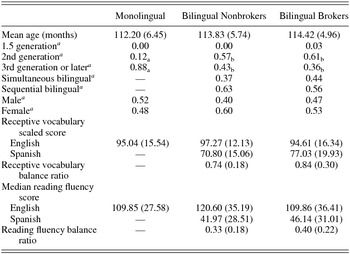
Parents filled out a questionnaire pertaining to child and parent demographics (e.g., countries of birth and languages spoken) and home literacy environment, including children's brokering or translating experiences. The characteristics of each language group can be found in Table 1. Overall, the language brokers were mainly second-generation children, with only one being a 1.5-generation immigrant (i.e., immigrated under age 12; Portes & Rumbaut, Reference Portes and Rumbaut2005). All of the bilingual language brokers were Latino American. Ninety-seven percent of the bilingual nonbrokers were Latino American, while the remainder were European American. Approximately 50% of the monolinguals were Latino American, 38% were African American, and 12% were European American. In both the brokers and the nonbrokers, the majority of parents reported origins in Mexico (55%), followed by the United States (37%), Puerto Rico (4%), Peru (1%), Ecuador (1%), and unreported (2%). As an additional confirmation of monolingual or bilingual status, parents were asked about the language status of their children. Moreover, children were asked before the testing sessions if they spoke any another languages besides English. All bilingual children reported that they spoke Spanish and English, whereas all monolingual children responded that they only spoke English (i.e., that they did not know another language besides English). Parents confirmed these assertions with their responses.
Characteristics of monolingual English-speaking and bilingual English–Spanish language brokers and nonbrokers

Note: Children were categorized as a simultaneous or a sequential bilingual based on parent response to a survey question asking whether their children learned one language first or both languages at the same time. Standard deviations are in parentheses. Higher scores indicate greater receptive vocabulary proficiency. The receptive vocabulary measures are scaled scores with a mean of 100 and a standard deviation of 15. For the reading fluency scores, a score of 0–79 indicates an “at risk” group, a score of 80–109 indicates “some risk,” and 110 and above indicate “low risk.” Language groups with subscript letters are significantly different at p ≤ .05.
a Values are based on the proportion of parent response.
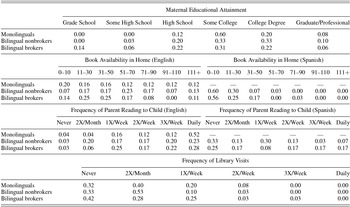
When assessing parental education, no significant differences were found between language groups, because most parents reported having attended “some college.” Table 2 displays the educational attainment levels of all parents who responded to the question. When assessing parental literacy support in the home, most parents reported that approximately 11–30 English age-appropriate books and 0–10 Spanish age-appropriate books were available in the home. Overall, parents read to or with their children approximately three times per week in English and once per week in Spanish. All parents reported visiting the library with their children about twice a month. Given there were no significant differences between the groups, these results suggest that the language groups did not receive differing levels of parental input and literacy support.
Maternal educational attainment and parental literacy support of the monolinguals, bilingual nonbrokers, and bilingual brokers

Note: Values are based on proportion of parents responding to each category. No significant differences were found between the groups (χ²s ≤ 2.99, ps > .05).
Defining language brokers and nonbrokers
Through a language usage questionnaire (Dorner et al., Reference Dorner, Orellana and Li-Grining2007; Orellana et al., Reference Orellana, Dorner and Pulido2003), bilingual children responded to questions about the frequency and extent of their translation duties on three dimensions. Typically, language brokers are defined by (a) people they translate for, (b) places in which these translations happen, and (c) type of items they translate (Acoach & Webb, Reference Acoach and Webb2004; Dorner et al., Reference Dorner, Orellana and Li-Grining2007). To meet language broker criteria, the bilingual children must have reported translating four or more things, within three or more locations, at least sometimes for an immediate family member (or every day for an extended family member or two extended family members sometimes). These criteria were chosen based on past research finding positive academic outcomes for those with these suggested levels of brokering experience (Dorner et al., Reference Dorner, Orellana and Li-Grining2007; Orellana et al., Reference Orellana, Dorner and Pulido2003).
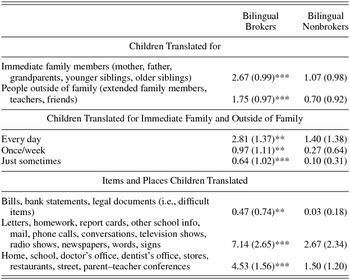
As seen in Table 3, significant group differences in brokering frequencies confirmed distinguishable groups. Overall, the brokers translated for more people and more often than the nonbrokers, translated a greater number of items, particularly difficult items (i.e., bills, bank statements, and legal documents), and translated in more places than the nonbrokers. Note that although some of the bilingual children were categorized as nonbrokers, this does not mean they never performed any translating duties. However, as a starting point, these criteria were used for two purposes: to be in line with past ethnographic research using these cutoffs (e.g., Dorner et al., Reference Dorner, Orellana and Li-Grining2007; Orellana et al., Reference Orellana, Dorner and Pulido2003) and to ensure that those categorized as language brokers were translating in a significant number of important situations. Creating a measure to quantify each and every translational duty for children would be difficult to implement. Therefore, categorical groups were necessary to answer our research questions (e.g., Dorner et al., Reference Dorner, Orellana and Li-Grining2007). However, as shown in Table 3, the language brokers and the bilingual nonbrokers were significantly different on every category of translation, including the number of people for whom they translated, how often they translated for them, and the number and type of items translated. Finding a significant difference in the category of “difficult items,” a type of translation that requires high-level adult skills to complete (Orellana et al., Reference Orellana, Dorner and Pulido2003) was particularly important. These difficult items require adult-level comprehension skills and present an extra level of cognitive demand on the language-brokering child (Tse, Reference Tse1996).
Mean (standard deviation) number of people, places, and items translated by the bilingual brokers and nonbrokers

Note: To qualify as a language broker, the child must have reported translating four or more items within three or more locations at least sometimes for an immediate family member (or every day for an extended family member or sometimes for two extended family members). Difficult items were those defined in past studies examining language brokers.
**p ≤ .01. ***p ≤ .001. The p values are indicative of significant differences across the bilingual brokers and the bilingual nonbrokers, using independent two-sample t tests.
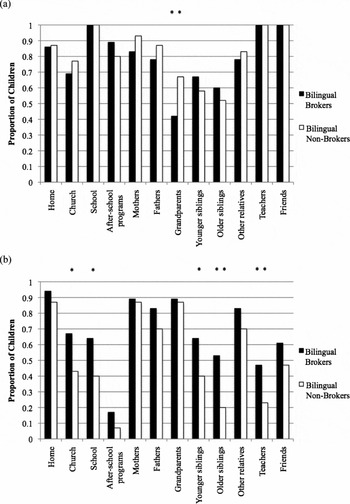
There were significant differences between the brokers and nonbrokers in the number of people and the environments in which they spoke English and Spanish. The language brokers were more likely to respond that they used Spanish (Figure 1b) with more people (e.g., siblings and teachers) and in more places (e.g., church and school) than the bilingual nonbrokers. Based on this information, this suggests that the language brokers used Spanish with a wider range of people. The nonbrokers reported more use of English with grandparents than did the language brokers (Figure 1a).
Where and with whom the bilingual children used (a) English and (b) Spanish. The asterisks indicate significant chi-square differences between the bilingual language brokers and the bilingual nonbrokers. *p ≤ .06. **p ≤ .05.

Linguistic profile of the brokers, nonbrokers, and monolinguals
Children's language fluency scores were assessed through English receptive vocabulary and reading fluency tests, as well as in Spanish for the bilingual children. To measure English receptive vocabulary skills of the children, the Peabody Picture Vocabulary Test—Fourth Edition (Dunn & Dunn, Reference Dunn and Dunn2007) was administered. The norm-referenced Spanish version of this test, the Test de Vocabulario en Imágenes Peabody (Dunn, Lugo, Padilla, & Dunn, Reference Dunn, Lugo, Padilla and Dunn1986), was administered in a similar format to the bilingual children. To assess English reading fluency, the oral reading fluency subtest from the Dynamic Indicators of Basic Early Literacy Skills—Sixth Edition (Good & Kaminski, Reference Good and Kaminski2002) was administered, in which each child read a passage for 1 min, while the number of words correctly read was recorded. The Spanish version of this measure from the Indicadores Dinámicos del Éxito en la Lectura—Seventh Edition (Cummings, Baker, & Good, Reference Cummings, Baker, Good, Baker, Good, Knutson and Watson2006) was administered to the bilingual children.
Children's mean scaled scores and standard deviations for these measures can be seen in Table 1. These scores were compared across the language groups to determine whether the language groups were equivalent in language proficiency. A two-way analysis of variance (ANOVA) with language group (bilingual brokers, bilingual nonbrokers, or monolinguals) and gender as between-subjects variables found no significant differences between the children's English receptive vocabulary or reading fluency across language groups and across gender, Fs (2, 86) < 1.16, ps > .05. No differences were found in the bilingual children's (i.e., bilingual brokers and bilingual nonbrokers) Spanish receptive vocabulary or reading fluency, nor was gender significant, Fs (1, 62) < 1.81, ps > .05.
In addition, balance ratios were calculated for the receptive vocabulary and reading fluency scores to understand if there were differences in the dominance of their English language system across the bilingual language brokers and nonbrokers. This score was calculated by dividing the children's Spanish scores by their English scores, with a score of 1 indicating perfect balance (e.g., Bialystok & Barac, Reference Bialystok and Barac2012). As seen in Table 2, no differences were found in the balance ratios between the two bilingual groups, indicating that the bilingual language brokers and the nonbrokers had a similar balance in their bilingualism, F (1, 62) ≤ 2.59, p > .05. Overall, these findings indicated no differences in linguistic skills of the language groups.
Materials and procedure
Children were tested individually in a quiet room of their school or after-school center. The English syntactic awareness task was presented in English to all of the children. The Spanish version of this task was administered to only the bilingual children. The EF tasks were administered in English to all of the children. As noted above, children's receptive vocabularies were assessed through the Peabody Picture Vocabulary Test—Fourth Edition (Dunn & Dunn, Reference Dunn and Dunn2007) and the Test de Vocabulario en Imágenes Peabody (Dunn et al., Reference Dunn, Lugo, Padilla and Dunn1986), as described above.
EF measures
Cognitive flexibility
The Delis–Kaplan Executive Function System—Trail Making Test (Delis, Kaplan, & Kramer, Reference Delis, Kaplan and Kramer2001) was used as a measure of cognitive flexibility. This test was composed of five conditions, or “trails,” allowing for assessments of issues in visual scanning (Condition 1), number sequencing (Condition 2), letter sequencing (Condition 3), or motor speed (Condition 5), while also measuring children's switching abilities (Condition 4). Children were presented with an arrangement of numbers and letters on a page. In the visual scanning trail (Condition 1), the children had to quickly mark off all of the 3s in the array of numbers and letters. In the number sequencing trail (Condition 2) and letter sequencing trail (Condition 3), the children connected the numbers and letters in order. In the switching trail (Condition 4), the children sequentially switched between number and letter circles, while maintaining both numerical and alphabetical order (i.e., 1-A-2-B-3-C . . .). Finally, in the motor speed trail (Condition 5), children were instructed to follow a dotted line that connected open circles as quickly as possible. The number of errors on each trail was recorded, as well as the time to complete each trail. This test is a widely used measure of visual attention and task switching (Demakis, Reference Demakis2004; Gouveia, Brucki, Malheiros, & Bueno, Reference Gouveia, Brucki, Malheiros and Bueno2007) and has been used in past literature with bilingual populations (e.g., Bialystok, Reference Bialystok2010), yielding a reliability coefficient of 0.90 or higher.
Inhibition
A flanker task (Eriksen & Eriksen, Reference Eriksen and Eriksen1974), used to measure inhibition, was administered via Superlab Stimulus Presentation software. Children indicated the direction of a red fish, which was continually flanked by four other black fish, by pressing a button on the right or left side of the keyboard. After 11 training trials, children responded to 108 trials, in which 50% of the trials were congruent (i.e., red fish matched the direction of the flanking fish) and 50% were incongruent (i.e., red fish faced the opposite direction). The number of accurate trials and the reaction time to each trial was recorded. This measure was used due to its frequent use in assessing inhibition (e.g., Bialystok & Barac, Reference Bialystok and Barac2012; Mezzacappa, Reference Mezzacappa2004; Yang, Yang, & Lust, Reference Yang, Yang and Lust2011).
Working memory
Forward and backward digit span tasks (Wechsler Intelligence Scale for Children—Fourth Edition; Wechsler, Reference Wechsler2003) were used to assess working memory. The Wechsler measure was chosen because it required the least amount of inhibition and cognitive flexibility to complete and yielded an average internal consistency reliability of 0.87. For the forward task, the experimenter read a list of single-digit numbers at the rate of one digit per second, and the children repeated the digits in the same order. Starting with two digits, the task became progressively more difficult on every other trial by adding a digit to the span length. Testing ceased when the children were unable to reproduce both trials of the same length. For the backward task, the digits were to be repeated backward. To score this test, the digit span length of the last correct trial was counted.
Syntactic awareness measure
A timed version of a grammaticality judgment task was developed in which children listened to sentences that were grammatical and semantically well formed (e.g., The woman prepares the meal for her three children), grammatical and containing a semantic anomaly (e.g., The dog prepares the meal for its three books), ungrammatical but semantically well formed (e.g., The woman prepare the meal for her three children), or ungrammatical and containing a semantic anomaly (e.g., The dog prepare the meal for its three books; adapted from Bialystok & Barac, Reference Bialystok and Barac2012). These measures are particularly useful when used in a timed format (i.e., yielding latency scores) as a measure of implicit language comprehension (Bialystok & Barac, Reference Bialystok and Barac2012; Gutiérrez, Reference Gutiérrez2013; Loewen, Reference Loewen, Ellis, Loewen, Elder, Erlam, Philp and Reinders2009). Fifty English sentences were presented via audio recordings of a female voice with a speaking rate of 100 words per minute, controlled randomly by SuperLab Stimulus Presentation software.
In eight training trials, children were introduced to the procedure, in which they were instructed to press the green button with a smiley face to indicate a grammatically correct sentence and the red button with a frown face to indicate a grammatically incorrect sentence. They were told to ignore the silly-sounding sentences and to respond with the correct answer, as quickly as possible. Accuracy and reaction times (i.e., latency from end of sentence) for each trial were measured once the sentence was finished and was recorded by the SuperLab software. By including semantic anomalies into the sentences, the children had to ignore the meaning of the sentences and focus exclusively on grammar, therefore engaging EFs during this task and providing accuracy and reaction times. In addition, a Spanish syntactic awareness task was created using the same types of sentences (e.g., grammatical and containing a semantic anomaly: “La gallina maneja un carro muy grande”; ungrammatical and semantically correct: “Ellos fue a la playa”), but with an alternate set of sentences. These sentences were created by a native Spanish speaker and were backtranslated by a separate native Spanish speaker. This version was administered to only the bilingual children through SuperLab with the same female voice and speaking rate as the English version.
RESULTS
To ensure adequacy of the statistics, the data were checked for missing values, outliers, and normality. Examination of the language proficiency scores showed the distributions to be within normal limits (skewness < –0.18). When examining the EF measures and the syntactic awareness tasks, the accuracy scores (skewness < –0.13) and reaction time means (skewness < 1.29) were normally distributed. A distribution of scores is considered significantly skewed when the value is greater than two standard errors of skewness (Tabachnick & Fidell, Reference Tabachnick and Fidell2007). Inverse efficiency scores were then calculated by dividing the children's mean reaction time on the correct trials by their accuracy, providing a basis for processing efficiency independent of speed-accuracy trade-offs (Townsend & Ashby, Reference Townsend, Ashby, Castellan and Restle1978; Yang et al., Reference Yang, Yang and Lust2011). However, these scores were positively skewed. Tukey's winsorization method then transformed less than 5% of the trials outside of the interquartile range (i.e., the difference between the upper and lower quartiles) to extreme values at the upper and lower quartiles, and the skewness was brought to an acceptable level (skewness < 0.93; Tukey, Reference Tukey1977). It must be noted that the inverse efficiency score, although useful to combine accuracy and reaction time, has limitations in its interpretation due to increases in sampling error and the relative weights of both speed and accuracy (for a review, see Bruyer & Brysbaert, Reference Bruyer and Brysbaert2011). To supplement these findings, both the accuracy and reaction times were analyzed independently. One monolingual child's data was excluded because of technical errors during testing, resulting in a monolingual sample of 25 children.
Links from bilingualism to the core areas of EF and syntactic awareness
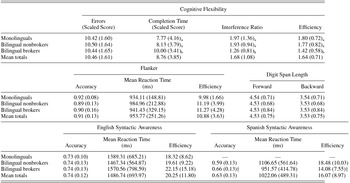
To understand any potential differences in EF or syntactic awareness between the language groups, we addressed initial differences in cognitive flexibility, inhibition, working memory, and syntactic awareness among the bilingual language brokers, bilingual nonbrokers, and monolinguals. Descriptive statistics for these variables can be found in Table 4.
Descriptive statistics for the executive function (cognitive flexibility, inhibition, working memory) tasks and syntactic awareness tasks

Note: Standard deviations are in parentheses. A higher scaled score indicates better performance, and a lower efficiency score or interference ratio indicates better performance. Scaled scores on the cognitive flexibility test range from 1 to 19. The maximum scores for the forward and backward digit span are 9 and 8, respectively. Language groups with different subscript letters are significantly different at p ≤ .05.
†p ≤ .09.
Cognitive flexibility
Preliminary tests found no differences among the language groups in their visual scanning ability, number/letter sequencing skills, or motor speed on the Trail Making Test, and no overall differences in gender, Fs (2, 86) ≤ 2.11, ps > .05. To examine perseverative errors on the trail presumed to measure cognitive flexibility, a one-way ANOVA was conducted, with language group (bilingual brokers, bilingual nonbrokers, or monolinguals) as a between-subjects variable. No differences in errors were found among the language groups, F (2, 89) = 0.02, p = .98.
When examining efficiency in completion of this trail (i.e., speed divided by accuracy), a main effect of language group was found, F (2, 89) = 3.28, p = .04, partial η2 = 0.07 (see Table 4). The language brokers were more efficient at this task than the nonbrokers and the monolinguals, ts (60) ≥ 1.99, ps ≤ .05. No differences were found between the nonbrokers and the monolinguals, t (54) = 0.34, p > .05. To verify these findings, the same differences were found when calculating scaled scores for completion time and when calculating an interference ratio ([switching trail completion time – letter sequencing trail completion time]/switching trail completion time) to account for shifting demands, ts (60) ≥ –2.58, ps ≤ .01. Together, these findings suggest that the language brokers are more efficient processors on this test of cognitive flexibility.
Inhibition
To examine language group differences in inhibition, accuracy scores on the Flanker Task were calculated and used in a mixed-model ANOVA with type of trial (congruent trials vs. incongruent trials) as a within-subjects variable and language group serving as the between-subjects variable. Preliminary analyses found no main effect of gender, no main effect of language group, F (2, 89) = 0.33, p > .05, nor any interaction effects between language group and trial type, F (2, 88) = 0.40, p > .05. Similar null findings were present when examining children's efficiency on this task, Fs (2, 88) < 0.89, p > .05, and when examining mean reaction time, Fs (2, 88) < 0.68, p > .05. Overall, no language group differences were found in inhibition abilities.
Working memory
The children's digit span lengths were assessed through one-way ANOVAs with digit span length (forward digit span length and backward digit span length) as the dependent variable, and language group (bilingual brokers, bilingual nonbrokers, or monolinguals) as the between-subjects variable. Preliminary analyses showed no main effects of gender. No language group differences were found in the forward digit span lengths, F (2, 89) = 0.01, p > .05, nor in the backward digit span lengths, F (2, 89) = 0.01, p > .05. This evidenced no differences in working memory among the brokers, nonbrokers, and monolinguals.
Syntactic awareness
An ANOVA using English syntactic awareness scores as the dependent variable and language group as the between-subjects variable, with English receptive vocabulary as a covariate, found no differences in the children's accuracy, F (2, 87) = 0.37, p > .05, mean reaction time, F (2, 87) = 0.45, p > .05, or efficiency (i.e., speed corrected for accuracy), F (2, 87) = 1.28, p > .05 (see Table 4 for descriptive statistics before correcting for receptive vocabulary). When using Spanish syntactic awareness scores as the dependent variable, with Spanish receptive vocabulary as a covariate, marginal differences were found between bilingual language brokers and nonbrokers for accuracy, F (1, 63) = 3.40, p = .07, and for efficiency, F (1, 63) = 2.99, p = .09. No significant differences were found between the brokers and the nonbrokers on their mean reaction time on the Spanish syntactic awareness task, F (1, 63) = 1.56, p > .05. Overall, the language brokers were slightly more accurate and efficient on the Spanish syntactic awareness task than were the nonbrokers.
Language group as a moderator of the link between EFs and syntactic awareness
Linkages between EFs and syntactic awareness in English
We expected that positive relations between the core components of EF (i.e., cognitive flexibility, inhibition, and working memory) and syntactic awareness would be found, given that better EF skills would be related to more efficient performance on the syntactic awareness task. This assumption was tested through a multiple regression analysis, using inverse efficiency scores (i.e., speed corrected for accuracy) on the English syntactic awareness task as the criterion variable. In multiple regression analyses, the relationship of each predictor to the criterion variable is measured through the slope of the regression line. Interactions were added to these models to understand how these regression lines depended on the level of the moderating variable (Aiken & West, Reference Aiken and West1991). In the current study, language group with three categories (bilingual broker, bilingual nonbroker, and monolingual) was used as the moderator variable, with the monolinguals as the omitted group in the regression models. A post hoc model was conducted in each instance to test the difference between the bilingual brokers and the bilingual nonbrokers by using the bilingual nonbrokers as the omitted group. To avoid multicollinearity with interaction terms, all predictor variables were mean centered.
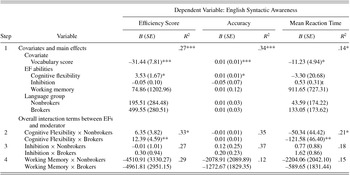
As seen in Step 1 of Table 5, the initial regression models included the covariate (i.e., English receptive vocabulary score), the predictor variables (i.e., cognitive flexibility inverse efficiency score, inhibition inverse efficiency score, and working memory backward digit span score), and the dummy-coded language group terms (i.e., bilingual brokers vs. bilingual nonbrokers). Receptive vocabulary score was included as a covariate based on strong associations with syntactic awareness in past literature (e.g., Barac & Bialystok, Reference Barac and Bialystok2012; Davidson et al., Reference Davidson, Raschke and Pervez2010) and its correlation with syntactic awareness performance upon initial investigation of correlation tables. Overall, this model was significant, R 2 = .27, F (6, 84) = 5.06, p < .01. Greater cognitive flexibility skills significantly predicted more efficient performance on the English syntactic awareness task (β = 0.21, p = .04). That is, a 1 SD improvement in efficiency in cognitive flexibility predicted a 0.21 SD increase in efficiency in processing time on the timed syntactic awareness task. Inhibition and working memory did not significantly predict performance on this task, nor did language group. To compare bilingual nonbrokers and bilingual brokers, the model was reanalyzed using the bilingual nonbrokers as the omitted group, yielding similar null findings between groups.
Regressions: EF, language group, and EF–language group interactions predicting syntactic awareness in English

Note: Monolinguals were the omitted group during dummy coding. To compare the bilingual brokers to the bilingual nonbrokers, a second model was conducted using the bilingual nonbrokers as the omitted group. EF, Effortful control.
*p ≤ .05. **p ≤ .01. ***p ≤ .001.
Similar results were obtained when predicting accuracy scores on the English syntactic awareness task, using the accuracy scores from the inhibition task and the cognitive flexibility task, R 2 = .34, F (6, 84) = 7.08, p < .01 (see middle of Table 5). Greater accuracy on the cognitive flexibility test (i.e., a greater scaled score for less errors) significantly predicted greater accuracy on the English syntactic awareness task (β = 0.18, p = .05). That is, a 1 SD improvement in accurate responding on the cognitive flexibility task predicted a 0.18 SD increase in accuracy on the syntactic awareness task. When predicting mean reaction time on the English syntactic awareness task, using reaction time of the predictor variables, cognitive flexibility did not explain unique variance in the criterion variable, although the overall model was still significant, R 2 = .14, F (6, 84) = 2.30, p = .04 (see right side of Table 5). Inhibition reaction time emerged as a marginally significant predictor of reaction time on the English syntactic awareness task (β = 0.19, p = .09). Working memory and language group (i.e., with monolinguals as the omitted group and then nonbrokers as the omitted group) were not linked to performance on any of the criterion variables.
Linkages between EFs and syntactic awareness in Spanish
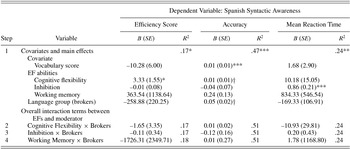
When examining the Spanish syntactic awareness measure, a similar multiple regression model was estimated using only the bilingual brokers and bilingual nonbrokers (see Table 6). This analysis included Spanish receptive vocabulary as a covariate and the same EF predictor variables as the analogous English model, except with the nonbrokers as the omitted group. The results showed that the model was significant, R 2 = .17, F (5, 60) = 2.46, p = .04. Similar to findings for English syntactic awareness, greater cognitive flexibility skills predicted more efficient performance on the Spanish syntactic awareness task (β = 0.27, p = .04). That is, a 1 SD improvement in efficiency in cognitive flexibility predicted a 0.27 SD increase in efficiency on the Spanish syntactic awareness task. Inhibition and working memory did not significantly predict performance on the Spanish syntactic awareness task, nor did language group.
Regressions: EF, language group, and EF–language group interactions predicting syntactic awareness in Spanish

Note: Bilingual nonbrokers were the omitted group during dummy coding. EF, Effortful control.
†p ≤ .09. *p ≤ .05. **p ≤ .01. ***p ≤ .001.
When predicting accuracy scores on the Spanish syntactic awareness task, using the accuracy scores of the predictors, the overall model was still significant, R 2 = .51, F (5, 60) = 12.22, p < .01. However, with this analysis, cognitive flexibility was marginally significant (β = 0.18, p = .06; see middle of Table 6). That is, a 1 SD improvement in accuracy on the cognitive flexibility test predicted a 0.18 SD increase in accuracy in responding on the Spanish syntactic awareness task. In addition, the language broker dummy-coded predictor was marginally significant, demonstrating that language brokers were slightly more accurate on the Spanish syntactic awareness task (β = 0.18, p = .06).
When predicting mean reaction time on the Spanish syntactic awareness task, using reaction time of the predictors, cognitive flexibility was no longer a unique predictor; however, the overall model was significant, R 2 = .24, F (5, 60) = 3.81, p < .01 (see right side of Table 6). Mean reaction time on the inhibition trials emerged as a unique predictor of mean reaction time on the Spanish syntactic awareness task (β = 0.48, p < .01). That is, a 1 SD improvement in reaction time on the inhibition task predicted a 0.48 SD improvement in reaction time on the Spanish syntactic awareness task.
Moderating role of language group on the link between EFs and syntactic awareness in English
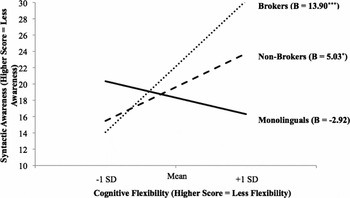
It was predicted that the relation between EFs (i.e., cognitive flexibility, inhibition, and working memory) and syntactic awareness would be moderated by language group (i.e., bilingual broker, bilingual nonbroker, or monolingual). The interaction terms between each area of EF (i.e., cognitive flexibility, inhibition, and working memory) and language group were individually added to the simple effects model using English syntactic awareness efficiency score as the criterion variable. The addition of the Cognitive Flexibility × Language Group interaction terms in Step 2 contributed to a significant change in variance explained by the model, ΔR 2 = .06, F (2, 82) = 3.66, p = .03, and the interaction model itself was significant, F (8, 82) = 4.95, p < .01 (see left side of Table 5). The coefficient on the Cognitive Flexibility × Brokers term was significant, suggesting that the regression lines for the brokers and monolinguals differed when examining cognitive flexibility's relation to English syntactic awareness. To compare the interaction terms of the nonbrokers to the language brokers, the model was reanalyzed with the nonbrokers as the omitted group, yielding a nonsignificant difference between the regression lines of the nonbrokers and the language brokers (B = 6.04, SE = 3.94, p = .12). When plotting the regression lines for the monolinguals, brokers, and nonbrokers, as seen in Figure 2, it can be seen that the link between cognitive flexibility and syntactic awareness for the brokers was the strongest, followed by the association for the nonbrokers, and then for the monolinguals. In contrast, the interaction terms for inhibition and working memory skills were not significant.
Regression lines for relations between cognitive flexibility and English syntactic awareness efficiency, moderated by language group. A lower score on the syntactic awareness measure indicates a better, more efficient score. The bilingual groups showed a stronger connection between their cognitive flexibility skills and their performance on this syntactic awareness measure. That is, when cognitive flexibility skills are stronger, then syntactic awareness skills are stronger as well for bilinguals. *p ≤ .05. ***p ≤ .001.

Upon post hoc probing, the plot of this significant interaction revealed that cognitive flexibility efficiency was differentially predictive of English syntactic awareness efficiency for each language group. The simple regression lines were tested using one-sample t tests to understand if the slopes were significantly different from zero (Aiken & West, Reference Aiken and West1991; Holmbeck, Reference Holmbeck1997; Tabachnick & Fidell, Reference Tabachnick and Fidell2007). As seen in Figure 2, there was a steep linkage between cognitive flexibility and efficiency on the English syntactic awareness task among the bilingual brokers, t (85) = 4.53, p < .01. This was also the case for the bilingual nonbrokers, though the positive association was less steep, t (85) = 2.12, p = .04. However, monolingual children's cognitive flexibility was not predictive of syntactic awareness, t (85) = –0.94, p > .05. This is suggestive of stronger linkages between cognitive abilities (i.e., cognitive flexibility) and performance on the English syntactic awareness task for the bilingual groups, particularly the language brokers.
When adding the interaction terms to the model using English syntactic awareness accuracy as the criterion variable, the interaction terms did not explain significantly more variance in the overall model, ΔR 2s < .83, ps > .05. However, when English syntactic awareness mean reaction time was used as the criterion variable, there was a significant change in the model when the Cognitive Flexibility × Language Group interaction terms were added, ΔR 2 = .07, F (2, 82) = 3.48, p = .04. In addition, the overall model was significant, F (8, 82) = 2.69, p = .01 (see right side of Table 5). Post hoc probing of this interaction displayed similar regression line patterns as found with the efficiency scores in Figure 2: brokers B = –99.85, t (85) = –3.16, p < .01; nonbrokers B = –19.10, t (85) = –0.61, p > .05; monolinguals B = 33.02, t (85) = 1.01, p > .05. This is suggestive of stronger linkages between cognitive abilities (i.e., cognitive flexibility) and English syntactic awareness reaction time for the language brokers.
Moderating role of language group in the link between EFs and syntactic awareness in Spanish (brokers vs. nonbrokers)
To test these interaction effects using the Spanish syntactic awareness task, the same interaction terms were added to the regression model using Spanish syntactic awareness efficiency as the criterion variable (see Table 6). The interaction terms did not explain significantly more variance in the overall model (ΔR 2s ≤ .01, ps > .05). Similar null findings were found when the interaction variables were added to the models using Spanish syntactic accuracy and mean reaction time as the criterion variables. Performance on the Spanish syntactic awareness task was not differentially correlated with EF performance for the brokers and the nonbrokers.
Summary of results
In sum, the results suggest that language brokers have better cognitive flexibility skills than both bilingual nonbrokers and monolinguals. Moreover, the results isolated the component of cognitive flexibility as a predictor of English syntactic awareness performance, particularly when accuracy is taken into account. For reaction time alone, inhibition skills began to play a part, however, only at a marginal level. It is of the most importance that the linkage between cognitive flexibility and English syntactic awareness reaction time and efficiency in completing the task was moderated by language group, suggesting that cognitive flexibility was differentially linked to syntactic awareness for the language brokers, bilingual nonbrokers, and monolinguals. These correlations were most pronounced for the language brokers. That is, better cognitive flexibility skills served as a protective factor for speed and efficiency in processing English syntactic awareness tasks among language brokers.
For Spanish syntactic awareness, cognitive flexibility was also an important factor when accuracy was taken into account. In addition, inhibition emerged as a predictor of reaction time on this task, regardless of accuracy. Overall, the language brokers were slightly more accurate than the bilingual nonbrokers, regardless of speed of responding, on the Spanish version of this task. The findings did not show differential linkages between EFs and syntactic awareness in the bilingual groups on the Spanish measure of syntactic awareness.
DISCUSSION
The present investigation predicted that the quality of the core areas of EF (i.e., cognitive flexibility, inhibition, and working memory) and syntactic awareness would be heightened in bilingual children, and particularly language brokers, given their practice of translating routinely, in comparison to their monolingual peers. Next, the current study examined the correlations between these core areas of EF and syntactic awareness in bilingual (brokering and nonbrokering) children. The results of past studies suggest that EF skills may be particularly important to bilinguals, given that evidence supports differences in the neural structure of bilinguals and that bilinguals face greater cognitive demands than monolinguals in an effort to inhibit other language interference (e.g., Baum & Titone, Reference Baum and Titone2014; Green, Reference Green1998; Grady et al., Reference Grady, Luk, Craik and Bialystok2015; Kovelman et al., Reference Kovelman, Baker and Petitto2008). It is our contention that EF skills may be even more salient for the development of the bilingual language broker, who must not only inhibit interference from another language but also exhibit cognitive flexibility and other EF skills when asked to translate from one language to another (Guo et al., Reference Guo, Liu, Misra and Kroll2011; Hernandez et al., Reference Hernandez, Dapretto, Mazziotta and Bookheimer2001; Yudes et al., Reference Yudes, Macizo, Morales and Bajo2012). As such, we predicted that the associations between EF and syntactic awareness would be stronger for brokering bilinguals and nonbrokering bilinguals.
Enhanced cognitive flexibility in language brokers
Overall, the language brokers displayed advantages over both the monolinguals and the bilingual nonbrokers in their efficiency on the cognitive flexibility task. When assessing children's time to complete the cognitive flexibility test, and the amount of interference from the switching demands of the task, the language brokers outperformed the other children, distinguishing themselves as a group with more efficient mental flexibility skills. Although overall bilingual advantages were not found (a finding that conflicts with the results of a handful of studies; e.g., Barac & Bialystok, Reference Barac and Bialystok2012; Bialystok & Barac, Reference Bialystok and Barac2012), these results are in line with past research findings showing EF benefits in adult interpreters and translators, or research examining bilingual adults who must frequently switch between their languages (e.g., Prior & Gollan, Reference Prior and Gollan2011; Soveri et al., Reference Soveri, Rodriguez-Fornells and Laine2011).
Language brokers are immersed in an environment that requires them to maintain both of their language systems in the same context (Morales & Hanson, Reference Morales and Hanson2005; Tse, Reference Tse1996). This parallel activation requires language brokers to “train” their cognitive flexibility skills to deal with these competing demands (Baum & Titone, Reference Baum and Titone2014). According to Costa et al. (Reference Costa, Hernández, Costa-Faidella and Sebastián-Gallés2009), bilingual nonbrokers typically have a greater separation between the usages of their language systems, which could help to explain why no cognitive flexibility enhancements were found for the bilingual nonbrokers in the current study. For instance, when bilinguals use Spanish exclusively at home and English exclusively at school, there is a greater boundary between their English and Spanish usage. In this sociolinguistic environment, bilingual nonbrokers are more likely to focus on a single language (Costa et al., Reference Costa, Hernández, Costa-Faidella and Sebastián-Gallés2009). This greater degree of separation may result in less reliance on the EF system to switch between language systems (Costa et al., Reference Costa, Hernández, Costa-Faidella and Sebastián-Gallés2009; Soveri et al., Reference Soveri, Rodriguez-Fornells and Laine2011).
Although cognitive flexibility enhancements were apparent, overall advantages were not found on the inhibition task or the working memory task for the bilingual language brokers or nonbrokers. In terms of inhibition, it may be that only early advantages (i.e., preschool and early school years) are found for bilinguals, and these abilities stabilize much earlier than cognitive flexibility developments (Best & Miller, Reference Best and Miller2010; Bialystok, Martin, & Viswanathan, Reference Bialystok, Martin and Viswanathan2005). Rapid developments in the preschool years have been found in past research (e.g., Carlson & Meltzoff, Reference Carlson and Meltzoff2008; Martin-Rhee & Bialystok, Reference Martin-Rhee and Bialystok2008). Moreover, when bilingual advantages have been found in past studies on working memory tasks, these have been attributed to the particular task relying more heavily on other areas of EF (e.g., Bialystok & Feng, Reference Bialystok and Feng2009).
Stronger associations between cognitive flexibility and English syntactic awareness for bilingual brokers and nonbrokers
The most important point is that the linkages between core areas of EF and syntactic awareness were examined in each language group. Although EFs work in conjunction, the individual components of EF can shape complex cognition in different ways (Miyake et al., Reference Miyake, Friedman, Emerson, Witzki, Howerter and Wager2000). Teasing apart the role of each core area of EF can help inform researchers of the importance of these cognitive bases in different bilingual language learners (i.e., nonbrokers vs. brokers). For bilinguals, a link between cognitive flexibility and syntactic awareness was established in both the English and Spanish versions of the syntactic awareness task when accuracy was taken into account (i.e., accuracy scores alone and inverse efficiency scores), but not when examining mean reaction time. However, inhibition emerged as a marginal predictor of mean reaction time on the English syntactic awareness task and a significant predictor on the Spanish syntactic awareness task for both the language brokers and the bilingual nonbrokers. In contrast, working memory was not related to performance on either the English or the Spanish syntactic awareness measure for any of the children. However, it may be that the working memory demands were not significant enough to find an association.
Differential linkages between cognitive flexibility and (English) syntactic awareness emerged for the language brokers, bilingual nonbrokers, and monolinguals when examining the different outcomes of the syntactic awareness tasks. For both efficiency and reaction time, cognitive flexibility was not related to performance on the syntactic awareness task for the monolingual children. However, a stronger association between cognitive flexibility and English syntactic awareness was found for the bilingual groups, with this relation being especially pronounced for the language brokers. That is, when bilinguals had better cognitive flexibility skills, this predicted a more rapid and also a more efficient response to the timed syntactic awareness measure. For the bilingual language brokers, this relation was even more relevant when the syntactic awareness measure was administered in English.
Although the relation between cognitive flexibility and Spanish syntactic awareness did not differ between the bilingual language brokers and bilingual nonbrokers, the brokers were slightly more accurate than the nonbrokers. When examining inhibition, this relation did not differ within the language groups. Overall, our interaction finding indicates that higher cognitive flexibility scores were associated with higher syntactic awareness scores more strongly in the bilingual children than in the monolingual children, at least on a timed syntactic awareness measure in English that requires engagement of the EF system (Bialystok & Barac, Reference Bialystok and Barac2012; Gutiérrez, Reference Gutiérrez2013; Loewen, Reference Loewen, Ellis, Loewen, Elder, Erlam, Philp and Reinders2009).
These results are in line with bilingual models of language development suggesting that the cognitive and linguistic domains are inextricably linked for bilinguals (e.g., Baum & Titone, Reference Baum and Titone2014; Bialystok & Craik, Reference Bialystok and Craik2010; Green, Reference Green1998). That is, greater EF skills may allow for bilingual children to meet the cognitive demands of dual language inhibition and retrieval, which involves experience-dependent neuroplasticity of the brain (Baum & Titone, Reference Baum and Titone2014; Diamond, Reference Diamond2013). Skilled language learners must seamlessly integrate all features of their language system, which may be aided by the EF system to maintain and coordinate these linguistic elements (e.g., Cartwright et al., Reference Cartwright, Marshall, Dandy and Isaac2010; Deák, Reference Deák2003). This neuroplasticity, which is the ability of the brain to modify its neural connectivity in response to cognitively stimulating environments, may be allowing bilinguals to more quickly and easily adjust to these environments.
The results of the current study are in line not only with past models suggesting inextricable links between cognitive and linguistic domains in bilinguals (for a review, see Baum & Titone, Reference Baum and Titone2014) but also with recent neuroimaging studies examining the role of frequent language switching in neuroplasticity (e.g., Guo et al., Reference Guo, Liu, Misra and Kroll2011; Hernandez et al., Reference Hernandez, Dapretto, Mazziotta and Bookheimer2001; Price et al., Reference Price, Green and von Studnitz1999). Because performance on the English syntactic awareness task was similar across groups, the monolinguals could have been using other mechanisms to complete the task (e.g., the frequency with which monolinguals hear grammatically correct English; McDonald, Reference McDonald2006), as suggested by current research pointing to differential monolingual experiences with language (Baum & Titone, Reference Baum and Titone2014). It was important to distinguish between the bilingual brokers and nonbrokers, because this is one of many variations of bilingualism that exists (Baum & Titone, Reference Baum and Titone2014).
Cognitive flexibility and inhibition independently predicting accuracy and reaction time on the syntactic awareness measures
These results also add to existing research examining the potential contribution of EF to linguistic developments (e.g., Foy & Mann, Reference Foy and Mann2013b), particularly by isolating each component of EF. Various EF skills speak to different ways that attention may be directed, with cognitive flexibility referring to the ability to shift attention and inhibition referring to the ability to ignore distractions (Miyake et al., Reference Miyake, Friedman, Emerson, Witzki, Howerter and Wager2000). Allocating attention to the appropriate information in one's environment is important to learning, a theory that has been supported by evidence examining constructs such as vocabulary acquisition (e.g., St. Clair-Thompson & Gathercole, Reference Clair-Thompson and Gathercole2006) and literacy development (e.g., Deák, Reference Deák2003).
The results of the current research show that different core EF skills are likely associated with various syntactic awareness outcomes on this timed measure, at least for some language groups. It is interesting that our findings showed differing links for inhibition and cognitive flexibility, where there were specific associations between cognitive flexibility and accuracy scores, and between inhibition scores and mean reaction time. Distinguishing between these outcomes is important because they may have different implications for subsequent literacy processing skills (e.g., Altemeier et al., Reference Altemeier, Abbott and Berninger2008; Christopher et al., Reference Christopher, Miyake, Keenan, Pennington, DeFries and Wadsworth2012). That is, the ability to more easily inhibit semantic anomalies and shift between information on a timed syntactic awareness task may have implications for broader linguistic developments, such as reading fluency and reading comprehension (Cromdal, Reference Cromdal1999). In addition, as reflected in its link with mean reaction time, strong inhibition skills may assist individuals with responding more quickly and controlling prepotent responding (i.e., inhibit multiple word meanings) during a timed measure (e.g., Dixon et al., Reference Dixon, Salley and Clements2006). This may have particular implications for word recognition and the learning of “sight words” (e.g., Christopher et al., Reference Christopher, Miyake, Keenan, Pennington, DeFries and Wadsworth2012). In contrast, cognitive flexibility may be more important in decision-based responding, and subsequently reading accuracy and reading comprehension. Reading comprehension may require the proper shifting of attention during the act of reading in order to successfully understand the text (Cartwright et al., Reference Cartwright, Marshall, Dandy and Isaac2010).
Limitations and future directions
Although we believe our findings are compelling, several limitations must be noted. In this research we made the decision to administer the EF tasks exclusively in English because English was expected to be, and was, both monolingual and bilingual children's dominant language. Nevertheless, it may be that EF skills operate differently in a nondominant language. Our results are also limited by the lack of multiple measures of EF skills, although we believe that this research serves as an important first step in understanding the complex relation between EF skills and linguistic skills and experiences. In addition, it is possible that older language brokers may show a different pattern of results. Although the parents of the language brokers reported that they had been engaging in minor brokering experiences prior to age 9, by age 9, it was clear from their reports that they were engaging in brokering in significant ways and in important situations. What we were not able to determine from children's reports is exactly when children began brokering, and when they began brokering in important ways. This limitation will need to be addressed in future research.
Finally, due to the use of naturally occurring groups, limitations in directionality and causality are present. We must also recognize that selection may be at work (Valdes, Chavez, & Angelelli, Reference Valdes, Chavez, Angelelli and Valdes2003; Valenzuela, Reference Valenzuela1999; Villanueva & Buriel, Reference Villanueva and Buriel2010), where it could be that children with certain characteristics (e.g., female or oldest child), or children with higher baseline levels of EF, are more likely to become language brokers. Background characteristics such as high proficiency in both languages or personality characteristics such as being extroverted and good-natured are linked to being a successful language broker (Valdes et al., Reference Valdes, Chavez, Angelelli and Valdes2003), which is an issue that should be explored in future research. However, we were mainly interested in children reaching a threshold level of language-brokering experiences on an everyday basis in order to be considered a broker. These criteria, in combination with specific child characteristics, could create a more holistic picture of the language broker.
Future investigations are needed to more thoroughly assess how different types of translational experiences, as well as frequency of translation experiences, relate to the development of specific EF skills. Nevertheless, the present study provides a glimpse into the potential cognitive benefits of bilingualism, particularly for bilingual children dealing with language translation. In addition, this study provides evidence that certain EF skills may be called upon, particularly for bilinguals, when completing syntactic awareness tasks.
ACKNOWLEDGMENTS
We thank the children, parents, and staff for their generous cooperation on this project. We also thank Grayson Holmbeck for his assistance with the moderation analyses and Kathleen Kannass and Dina Birman for their helpful comments on an earlier version of this research. Part of this research was made possible by a Schmitt Fellowship Award (to V.R.R.). Portions of this research were presented at the 2013 biennial meeting for the Society for Research in Child Development, Seattle, Washington.