


Introduction
Subjective well-being, or happiness, is usually defined as a combination of frequent positive affect, infrequent negative affect and a high level of satisfaction with life (Diener et al. Reference Diener, Sandvik, Pavot, Strack, Argyle, Michael and Schwarz1991, Reference Diener, Suh, Lucas and Smith1999). Individuals reporting low levels of well-being are at twice the risk of suffering a major depressive episode (Keyes, Reference Keyes2002). This finding, along with evidence that positive emotions can speed recovery from the physiological effects of negative emotions (Fredrickson & Levenson, Reference Fredrickson and Levenson1998; Tugade & Fredrickson, Reference Tugade and Fredrickson2004), improve broad-minded coping skills (Fredrickson & Joiner, Reference Fredrickson and Joiner2002), and prevent depressive relapses (Fava & Ruini, Reference Fava and Ruini2003) suggest that increasing well-being may serve to protect individuals from mental health problems such as depression. In addition to this, greater recognition of the positive impact subjective well-being can have on many desirable life outcomes including career success, marriage and health (for reviews see Lyubomirsky et al. Reference Lyubomirsky, King and Diener2005a; Pressman & Cohen, Reference Pressman and Cohen2005) has resulted in increased attention to the factors that contribute to well-being and how an individual's level of well-being can be increased (e.g. Seligman et al. Reference Seligman, Steen, Park and Peterson2005, Reference Seligman, Rashid and Parks2006).
Evidence supporting the idea that it is possible to increase well-being has steadily been accumulating (e.g. Sin & Lyubomirsky, Reference Sin and Lyubomirsky2009). In a recent meta-analysis, Mazzucchelli et al. (in press) reported evidence that an existing clinical intervention, behavioural activation (BA), may enhance well-being in normative populations. This is an important finding since it suggests that BA may be a parsimonious intervention, not only having utility as a treatment for depression, but also as a preventive strategy to protect against illness and promote psychological well-being.
BA emphasizes ‘structured attempts at engendering increases in overt behaviours that are likely to bring the patient into contact with reinforcing environmental contingencies’ (Hopko et al. Reference Hopko, Lejuez, Ruggiero and Eifert2003, p. 700). The approach evolved out of the ‘reinforcement’ explanation of depression, which proposes that the behaviour of depression is the result of a loss or lack of response-contingent positive reinforcement (Ferster, Reference Ferster1973; Lewinsohn, Reference Lewinsohn, Friedman and Katz1974). Based on this theory, Lewinsohn and colleagues developed a behavioural treatment of depression in which patients monitored and scheduled specific pleasant or meaningful activities in order to increase their frequency (Lewinsohn, Reference Lewinsohn, Thorensen and Krumboltz1976; Lewinsohn et al. Reference Lewinsohn, Sullivan and Grosscup1980).
A number of other variants of BA have been developed, most notably Jacobson and colleagues’ contextual approach (Jacobson et al. Reference Jacobson, Martell and Dimidjian2001; Martell et al. Reference Martell, Addis and Jacobson2001; for a review of other variants see Mazzucchelli et al. Reference Mazzucchelli, Kane and Rees2009). Jacobson and colleagues emphasized the role of an individual's life circumstances and avoidance in depression (Jacobson, Reference Jacobson1994). Certain aspects of a person's life circumstances can trigger depression and particular ways of responding to these circumstances can maintain it. Avoidance (e.g. of interpersonal situations, occupational or daily-life demands, and distressing thoughts or feelings) is viewed as a coping strategy to avoid the short-term distress associated with pursuing potentially mood-enhancing reinforcers at the longer-term cost of reducing opportunities of contacting these very reinforcers thereby creating or exacerbating life problems. Increased activation and engagement is presented as a strategy to break this cycle.
The initial objective of Jacobson and colleagues’ individually delivered BA protocol is to increase patients’ awareness of avoidance patterns by monitoring and reviewing daily behaviour. Once these patterns are recognized, the principal objective becomes one of helping patients identify and re-engage with activities and situations that are reinforcing and consistent with their long-term goals. Many of the same behaviourally focused activation strategies used in cognitive therapy (Beck et al. Reference Beck, Rush, Shaw and Emery1979) are used in this approach, including self-monitoring mood and activity, structuring and scheduling daily activities, and exploring alternative behaviours related to achieving goals. In addition, this protocol includes the establishment or maintenance of routines, and behavioural strategies for targeting rumination, including an emphasis on the function of ruminative thinking and on moving attention away from the content of ruminative thoughts towards direct, immediate, experience.
Clearly, BA interventions differ in terms of their complexity. Jacobson and colleagues’ protocol includes a significant emphasis on helping patients understand the function of their behaviour. It also includes components not included within other BA interventions such as ‘attending to experience’ or ‘mindfulness’. While this protocol has the strongest evidence base (Mazzucchelli et al. Reference Mazzucchelli, Kane and Rees2009), it remains to be seen whether all the components included in this intervention are necessary.
Mindfulness has roots in Buddhist and other contemplative traditions where conscious attention and awareness are actively cultivated. Mindfulness has been defined as ‘the awareness that emerges through paying attention on purpose, in the present moment, and non-judgementally to the unfolding of experience moment by moment’ (Kabat-Zinn, Reference Kabat-Zinn2003, p. 145). In line with this definition, recent research has proposed that mindfulness consists of a number of facets, such as non-reactivity, observational awareness, acting with awareness and concentration, describing, and non-judgemental attitude towards experience (Baer et al. Reference Baer, Smith, Hopkins, Krietemeyer and Toney2006).
Recently, attention has been given to the concept of mindfulness since research has shown that its enhancement through training results in desirable outcomes for a variety of medical conditions and psychological presentations including chronic pain, anxiety disorders, substance abuse, insomnia, and anger management (Baer, Reference Baer2003; Grossman et al. Reference Grossman, Niemann, Schmidt and Walach2004). Mindfulness-based cognitive therapy (MBCT) which incorporates mindfulness in an attempt to change an individual's awareness of, and relationship to, unwanted thoughts and feelings, has also been found to prevent relapse in recurrent depression (Teasdale et al. Reference Teasdale, Segal, Williams, Ridgeway, Lau and Soulsby2000). However, there have been few studies, of the use of mindfulness meditation to specifically enhance well-being (for a review of relevant mindfulness research see Fredrickson, Reference Fredrickson, Eid and Larsen2008).
A great deal of the research with BA and mindfulness has been conducted with clinical populations and it is important to look at how interventions like these could serve a preventative role in mental health. However, to be cost-effective, efficient methods of delivering these interventions need to be found. Moreover, the minimally sufficient components necessary for such interventions to be effective need to be established. The aim of the present research is to determine whether a group-contextual BA intervention can be used in a ‘real-world’ setting to increase the well-being of non-clinical individuals. In pursuing this aim, the present research aimed to take an initial step towards developing a group intervention protocol to enhance well-being.
Two primary hypotheses were formulated:
H1: The intervention will reduce psychological distress and enhance subjective well-being.
H2: These effects will be maintained at a 1-month follow-up.
A number of key constructs relating to BA and mindfulness were measured as a preliminary step to investigating mechanisms of change. This exploratory investigation prompted a secondary hypothesis.
H3: A measure of positive activity change and measures of mindfulness will increase in response to the intervention.
Method
Participants
The Curtin University of Technology Human Research Ethics Committee approved the research protocol. Participants were recruited from the community via a press media feature article advertising courses ‘for people interested in increasing their happiness level’ (McKimmie, Reference McKimmie2007). Individuals interested in participating were scheduled for an on-site evaluation to ascertain study eligibility and provide written informed consent. Individuals were screened using the Mini International Neuropsychiatric Interview (Sheehan et al. Reference Sheehan, Lecrubier, Sheehan, Amorim, Janavs, Weiller, Hergueta, Baker and Dunbar1998). Those who did not meet the criteria for a major Axis I psychiatric disorder according to DSM-IV criteria (APA, 1994) were eligible to participate and, once written informed consent was obtained, were assigned to one of two therapy groups based on availability. Individuals who met the criteria for a major Axis I psychiatric disorder were offered alternative treatment.
Of the 19 volunteers who completed the intake assessment, 18 were eligible for participation. Two volunteers declined because of difficulty accessing scheduled groups, resulting in 16 participants who commenced the intervention. The one excluded volunteer was screened out because of major depression.
Of the 16 participants who commenced the intervention ten (62%) were female, and the average age was 51.4 (s.d. = 10.4, range = 39–72) years. All participants were Caucasian. With respect to marital status, 11 (69%) were married or in a de-facto relationship, three (19%) were single, and the remaining two (12%) were divorced or widowed. With respect to educational level, 14 (88%) had completed high school, and 12 (75%) had also completed a university degree or diploma.
Research design
A 2 (therapy group: 1, 2) × 4 (time: pretest, post-BA, post-mindfulness, follow-up) mixed design was employed. The 16 participants were assigned to one of two therapy groups (n = 6, n = 10). Because the primary interest of the present study was the effectiveness of BA on well-being, the BA module was provided before the mindfulness module so that the latter did not contaminate the impact of the former. Outcome measures were completed prior to the initial intervention session, after the BA module (at the 4th intervention session), after the mindfulness module (at the 8th intervention session), and 4 weeks after the intervention had concluded (see Table 1).
Experimental design of study

O, Outcome measures administered; X, exposure to intervention.
Measures
The following outcome measures were collected: Depression Anxiety Stress Scales 21 (DASS-21; Lovibond & Lovibond, Reference Lovibond and Lovibond1995), Happiness Measures (HM; Fordyce, Reference Fordyce1988), Positive and Negative Affect Scales (PANAS; Watson et al. Reference Watson, Clark and Tellegen1988), and Satisfaction with Life Scale (SWLS; Diener et al. Reference Diener, Emmons, Larsen and Griffin1985). The following process measures were also collected: Activity and Circumstances Change Questionnaire (ACCQ; Sheldon & Lyubomirsky, Reference Sheldon and Lyubomirsky2006) and Five Factor Mindfulness Questionnaire (FFMQ; Baer et al. Reference Baer, Smith, Hopkins, Krietemeyer and Toney2006). The ACCQ was used to evaluate the extent to which participants experienced both activity change (e.g. a change in goals, projects, or strivings; diet, exercise, or other self-maintenance activity; conscious attitudes or mental approach to life) and circumstantial change (e.g. monetary situation; living arrangements; relationship status). High scores on the ACCQ are reflective of positive activity change. The FFMQ measure yields a score for five elements of mindfulness: observing, describing, acting with awareness, non-judging of inner experience, and non-reactivity to inner experience. High scores on the FFMQ are reflective of the presence of this quality or skill. Questionnaires assessing participant satisfaction with, and perceived usefulness of, each of the intervention modules were also completed. Items were rated on a 7-point Likert-type scale where higher ratings indicated higher levels of satisfaction or perceived usefulness.
Procedure
Intervention
The BA module sought to identify and promote engagement with reinforcing activities and contexts consistent with each participant's long-term goals. Specific content included psycho-education regarding well-being and happiness, setting long- and short-term goals, self-monitoring activity and mood using activity logs in order to identify the impact of particular activities on mood, structuring and scheduling daily activities, identifying and understanding avoidance using a version of the Trigger Response Avoidance Pattern/Alternative Coping (TRAP/TRAC) model, making conscious decisions about behaviour (ACTION – Assess how this behaviour serves you, Choose to either avoid or activate, Try out whatever behaviour has been chosen, Integrate any new behaviours into a routine, Observe the outcome, Never give up), strategies to overcome procrastination and avoidance (such as graded task assignments, managing situational contingencies, acting towards a goal), and exploring alternative behaviours related to achieving goals. This module was based heavily on the protocol developed by Martell and colleagues (Reference Martell, Addis and Jacobson2001), although content focused on increasing well-being rather than treating depression. Notable deviations from the Martell's protocol included omitting instruction in ‘attending to experience’ or mindfulness. Further, since participants were not depressed, it did not make sense to include a behavioural formulation of individuals’ present emotional state, although functional analysis of particular avoidance behaviours was incorporated into this module. Participants received a workbook (T. G. Mazzucchelli, unpublished work) and attended four weekly 2-hour group sessions over 4 weeks.
In Martell and colleagues’ (Reference Martell, Addis and Jacobson2001) protocol ‘attending to experience’ or mindfulness could be incorporated throughout their BA intervention. However, since their protocol does not provide specific guidelines as to how to teach individuals to engage in attention to experience, or particular activities that allow this component to be separated from the rest of the intervention, the mindfulness module used in the study was based on sessions 1, 2 and 5 of the protocol detailed by Segal et al. (Reference Segal, Williams and Teasdale2002). Participants attended three weekly 2-hour group sessions that included live meditation practice. Participants were also given handouts relating to the practice of mindfulness meditation, and encouraged to monitor their home practice. The module deviated from the protocol described by Segal et al. (Reference Segal, Williams and Teasdale2002) by being shorter and removing discussions on depression and the cognitive model of emotions. Mindfulness was presented as a skill by which participants could (a) become more conscious of the choices they make in their behaviour on a day-to-day basis, and (b) savour positive experiences.
In the final session homework, the content from both modules, positive changes that had occurred over the course of the intervention, and ideas to maintain these changes were reviewed. At the conclusion of this session the post-intervention questionnaire booklet was completed.
Facilitators
The intervention was facilitated by four postgraduate clinical psychologist trainees. Two facilitators led each subgroup. Facilitators participated in a weekly on-site supervision meeting chaired by T.M., a registered clinical psychologist who has been in practice for 13 years, has a behaviour therapy background, training in meditation, and experience in delivering both. The facilitators had previous exposure to both BA and MBCT through their postgraduate training.
Results
Participant attendance
The average number of sessions attended by the 16 participants was six out of a possible eight (s.d. = 2.55). Completion of each module was defined as attending at least three of the four sessions. On the basis of this, 13 (81%) participants completed the BA module and 10 (62%) participants completed the mindfulness module. The attrition rate was not significantly different across subgroups: post-BA [χ2(1, n = 16) = 0.01, p = 0.93], or post-mindfulness [χ2(1, n = 16) = 0.95, p = 0.33]. This attrition is comparable with studies of treatment for patients with depression (Simons et al. Reference Simons, Levine, Lustman and Murphy1984). Participants who failed to completed the BA module reported more anxiety at pretest than those that completed the BA module [dropouts: mean = 6.33, s.d. = 3.05; completers: mean = 2.08, s.d. = 2.25; t(14) = 2.79, p < 0.05]. Reasons cited for attrition included illness (n = 2), holidays or competing commitments (n = 3), and dissatisfaction with the intervention (n = 1). The latter participant did not attend after the first session because he did not believe that the BA approach would make him any happier. Similarly, another participant who withdrew because of competing commitments noted that he was seeking strategies that would give him ‘peace of mind’ or ‘calmness’. Despite dropping out of the intervention, in most cases the individuals still participated in the evaluation meaning that only two participants failed to complete the questionnaire booklet at the post-BA assessment period, and three participants failed to complete the questionnaire booklet at follow-up.
Primary outcome measures
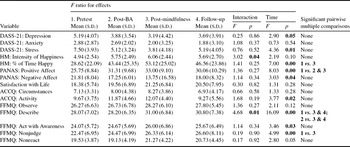
At pretest the mean DASS-21 scores fell within the normal range for depression, anxiety and stress. The mean PANAS scores fell within the normal range, but the mean SWLS score fell within the slightly dissatisfied range. The mean HM intensity score and time happy scores also fell slightly more than 1 s.d. below the mean of a normative sample. Table 2 presents the mean scores and standard deviations on each study variable at pre-intervention, post-BA, post-mindfulness, and at follow-up using an intention-to-treat analysis whereby missing data were replaced with the last observed response, a common and conservative method to estimate intervention effects (Hollis & Campbell, Reference Hollis and Campbell1999). For each outcome, changes across time were tested with a 2 (therapy group: 1, 2) × 4 (time: pretest, post-BA, post-mindfulness, follow-up) mixed ANOVA. A univariate approach was preferred to a multivariate approach because the research questions focused on individual outcomes rather than on an emergent or latent system of outcomes. In addition, alpha levels for the main analyses remained at 0.05 because each ANOVA was hypothesis-drivenFootnote †. Bonferroni corrections were applied to all follow-up tests.
Means, standard deviations and F ratios of effects for major study variables over time for intention-to-treat analysis

ACCQ, Activity and Circumstances Change Questionnaire; BA, Behavioural Activation; DASS-21, Depression Anxiety Stress Scales 21; FFMQ, Five Factor Mindfulness Questionnaire; HM, Happiness Measures; PANAS, Positive and Negative Affect Scales.
Figures in bold indicate a significant result.
Significant therapy group × time interactions were investigated to determine whether they had confounded the main effect for time. Only one outcome, the intensity item of the HM, showed a significant therapy group × time interaction. Further investigation indicated that the treatment effect was qualitatively different across the two therapy groups at post-mindfulness and follow-up. This prevented any general statements being made about treatment effects on these occasions for this particular outcome.
Significant decreases over time were found on the Depression and Stress scales of the DASS-21 and on the Negative Affect (NA) scale of the PANAS. Significant increases over time were found for the time happy item of the HM and on the Positive Affect (PA) scale of the PANAS. Follow-up tests revealed a significant increase in time happy from pretest to post-mindfulness, and in PA from pretest to post-BA and from pretest to post-mindfulness. F values and p values for these tests are reported in Table 2. These results support Hypothesis 1.
Pretest to post-BA effect sizes (Cohen's d = d’/√[1 − r], where d’ = [meaninitial − meanpost]/s.d.pooled) (Cohen, Reference Cohen1988) were in the moderate range for depression (0.34), stress (0.65), intensity of happiness (0.32), time happy (0.62), PA (0.60) and NA (0.62). Post-mindfulness the effect sizes were in the large range for stress (0.91), time happy (1.04) and PA (0.81) and the moderate range for depression (0.47), intensity of happiness (0.45), NA (0.62) and satisfaction with life (0.44). At follow-up the effect size for stress (0.58) and time happy remained large (0.78), while moderate effect sizes were observed for depression (0.38), anxiety (0.33), PA (0.44) and NA (0.47). These results are consistent with Hypothesis 2.
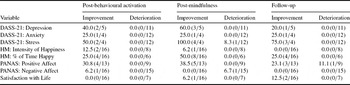
In order to provide an indication of the proportion of participants who benefited from the intervention, the proportion of participants who evidenced both statistically reliable (Jacobson & Truax, Reference Jacobson and Truax1991) and clinically significant change (Wise, Reference Wise2004) was determined. Due to the heterogeneous nature of the sample, a test for clinically significant change was run for each primary outcome measure selecting only those cases where the pre-intervention score was such that it could show clinically significant change. For measures of psychological distress, clinically significant improvement was defined as (a) a pre-intervention score in the clinical range, (b) a reliable change score >1.96, and (c) a mid-, post-intervention and/or a follow-up score that was in the non-clinical range. For measures of well-being, clinically significant improvement was defined as (a) a pre-intervention in the below-average or average range, (b) a reliable change score >1.96, and (c) a movement from the below-average range at pre-intervention to the average or above-average range at mid-, post-intervention and/or follow-up, or a movement from the average range at pre-intervention to the above-average range at mid-, post-intervention and/or follow-up. Consistent with past research, a score of ±1 s.d. from the mean of a normative group on a measure of well-being was considered ‘average’ (e.g. Nietzel et al. Reference Nietzel, Russell, Hemmings and Gretter1987; Sheldrick et al. Reference Sheldrick, Kendall and Heimberg2001; Wise, Reference Wise2004). Table 3 gives the percentage of participants at each stage of the intervention that showed clinically significant changes across outcomes. Up to 50.0% (mean = 23.7%) of participants who commenced the intervention and were capable of showing clinically significant improvement on at least one outcome measure did show such clinical improvement on outcome measures after the BA module. This figure increased to 100.0% (mean = 35.7%) after the mindfulness module. At 1-month follow-up, up to 75% (mean = 22.6%) of participants were still showing clinically significant improvement. These results provide support for Hypothesis 2. No participants demonstrated a clinically significant deterioration on outcome measures after the BA module, but one participant showed a clinically significant deterioration after the mindfulness module (one on the DASS-21: Stress scale and the PANAS: Negative Affect scale). At follow-up a different participant showed a clinically significant deterioration on the PANAS: Positive Affect scale.
Percentage of participants that showed clinically significant change (n = 16)

DASS-21, Depression Anxiety Stress Scales 21; HM, Happiness Measures; PANAS, Positive and Negative Affect Scales.
Number of participants who showed clinically significant change out of those possible appear in parentheses.
Process measures
Significant time effects were found for the Activity scale of the ACCQ and the Act with Awareness and Non-judge subscales of the FFMQ. A significant therapy group × time interaction and time effect was found for the Describe subscale of the FFMQ. Further investigation indicated that the treatment effect was qualitatively different across the two therapy groups at post-BA and follow-up which prevented any general statements being made about treatment effects on these occasions for this particular outcome. From post-BA to post-mindfulness, however, the treatment showed the same trend in each of the two therapy groups. Follow-up tests revealed a significant increase in the Describe and Non-judge subscales of the FFMQ from pretest to post-mindfulness and in the Describe subscale of the FFMQ from pretest to follow-up, from post-BA to post-mindfulness, and from post-BA to follow-up. F values and p values for these tests are reported in Table 2. These results support Hypothesis 3.
Pretest to post-BA effect sizes were all negligible or small except positive activity change which was in the moderate range (0.50). Pretest to post-mindfulness effect sizes were in the moderate range for positive activity change (0.58), and non-judge (0.58) and the moderate range for describe (0.42) and non-react (0.43). At follow-up the effect sizes for describe (0.38) and non-judge (0.54) were in the moderate range. These results support Hypothesis 3.
Satisfaction measures
Twelve participants completed satisfaction questionnaires after the BA component and 13 after the mindfulness component. Participants rated both components highly (post-BA: mean = 5.42, range = 4.00–7.00; post-mindfulness: mean = 5.41, range = 4.20–6.83), indicating that the majority of participants were ‘satisfied’ or ‘very satisfied’ with the programme and its effects.
Discussion
This preliminary study of the effectiveness of a group-delivered BA and mindfulness intervention is encouraging with significant and large decreases in psychological distress and increases in several indices of subjective well-being. Improvements in outcome measures were observed after the BA component which then continued through the mindfulness component of the intervention. There was also evidence of maintenance at 1-month follow-up. Half of the participants reported a clinically significant improvement in the amount of time they felt happy after the intervention, and a quarter of participants at follow-up. The effect sizes for the primary outcome measures achieved in this study compare favourably to other studies that have attempted to increase measures of well-being (Mazzucchelli et al. in press; Sin & Lyubomirsky, Reference Sin and Lyubomirsky2009). The intervention also demonstrated a high level of acceptability as indicated by the good ratings on the client satisfaction questionnaires. These results are important since they are consistent with the notion that BA may not only be effective in treating depression, but also have utility as a preventive strategy for non-clinical populations to protect against illness and promote psychological well-being.
Consistent with expectations, over the course of the intervention a significant increase in positive activity was observed, but not circumstances. Moreover, a significant increase in facets of mindfulness was observed after the mindfulness phase of the intervention. Previous studies have found that increased activity targeted by BA is associated with increased well-being (Mazzucchelli et al. in press). It is noteworthy that well-being effects were greater after the mindfulness component. It is possible that participants’ acquisition of mindfulness skills interacted with increased activity to enhance the impact of BA. However, other explanations are also possible. For instance, it is possible that the mindfulness component added nothing and that the well-being effects were greater because of the accumulated benefit over time from the BA component, or even that the good result after mindfulness was due to the mindfulness component alone. Since the present study was an evaluation of a single intervention made up of two discrete phases, it is not possible to conclude which of these possibilities explains the present results. A study which compares these two interventions or in which some participants receive mindfulness first and then BA and other participants receive these components in the reverse order would clarify the issue. In any case, the notion that mindfulness is a useful component of contextual BA cannot be ruled out.
It is also possible that the different components of this intervention are suited to different individuals. In the present study one participant verbally reported that he did not find the meditation useful. Another participant dropped out noting that he was seeking ‘peace of mind’ and ‘meditation or calmness training’. The finding that anxiety was significantly related to early drop-out is interesting. BA does not specifically equip individuals with skills to manage anxiety and it is tempting to speculate that if the mindfulness module had been scheduled first, or a rationale had been provided for the relevance of BA for anxiety, these participants may not have been lost to the intervention. Perhaps BA is useful for individuals who are not actively engaged with reinforcing activities, for others it is more important to build skills that allow the cultivation of ‘calmness’ and observation and savouring of the rewarding experiences that are already occurring. Each of these possibilities highlights the importance of individualized formulations when selecting appropriate interventions.
While gains were maintained at 1-month follow-up, they were not maintained at the same (large) level as they were immediately post-intervention. This is not unexpected given that measures of process also declined indicating a return of (particularly) positive activity to pre-intervention levels. It has been suggested that increased well-being will only be sustained if strategies to impede adaptation are employed in an ongoing fashion (Lyubomirsky et al. Reference Lyubomirsky, Sheldon and Schkade2005). The outcome of the present study suggests that further emphasis should be put into this area.
The implications of this research for the practitioner are that clients, regardless of their clinical status, will benefit from exposure to BA techniques such as setting personal life goals, monitoring activity and mood, identifying and understanding patterns of avoidance, and developing strategies to overcome this avoidance. Training in mindfulness skills may further enhance these benefits. Thus, practitioners are encouraged to incorporate these techniques into their clinical work. Practitioners may wish to deliver such interventions in a group format, as was done in this study; however, clients may also benefit from receiving these ideas individually, perhaps as a relapse prevention strategy or to boost well-being after recovering from a mental health condition.
A number of limitations of the present research must be acknowledged. As this was an open trial we cannot conclude that the improvements seen were not a function of other uncontrolled variables such as practitioner contact or merely the passage of time. However, the changes produced on measures of positive activity change and mindfulness suggests some degree of specificity of this intervention.
There was significant attrition – 19% for the BA module and 38% for the mindfulness module. Attrition was not generally associated with the intervention. Only one participant reported this to be the reason for dropping out of the intervention. It is more likely that attendance at group sessions for a voluntary intervention served as a disincentive for those who experienced very busy lives. However, the high rate of attrition in the context of the small sample size is a limitation.
Participants were recruited from the community through the local print media, effectively selecting themselves. Although this limits the ability to generalize results to the broader population, those who enrolled in the programme were probably representative of those who would be interested in such an intervention. This lends external validity to the study (Chambless & Hollon, Reference Chambless and Hollon1998).
These limitations point to the current findings as being promising but preliminary. The results justify further research using randomized, controlled trials with larger sample sizes and longer follow-up. Comparison conditions comparing the different intervention components or counterbalancing the order of the intervention components would clarify the relative effectiveness of the two components. Potential moderators and mediators of intervention effects such as preference for intervention component, pre-intervention activity level and avoidance also need to be investigated.
This study provides the first evidence that a BA and mindfulness-based group programme is acceptable and can be effective in increasing the well-being of non-clinical adults. The results also provide some evidence that gains can be maintained over time. BA and mindfulness meditation interventions may provide a useful framework for further research with non-clinical populations who wish to enhance their well-being and learn skills that may protect them against depression and other mental health problems.
Summary of main points
(1) Subjective well-being has a positive impact on psychological adjustment and adaptation and is a worthy goal for psychological intervention.
(2) Behavioural activation (BA) may be a parsimonious intervention, not only having utility as a treatment for depression, but also as a preventive strategy to protect against illness and to promote well-being.
(3) Jacobson and colleagues’ (Reference Jacobson, Martell and Dimidjian2001) contextual BA intervention may be more effective in treating depression than earlier variants of BA, but it is more complex and requires testing of its components.
(4) The present BA and mindfulness intervention is associated with significant and large decreases in psychological distress and increases in several indices of well-being. The present results cannot rule out that mindfulness is an important component of contextual BA.
(5) BA and mindfulness interventions provide a useful framework for further research with non-clinical populations who wish to enhance their well-being and learn skills that may protect them against depression and other mental health problems.
Acknowledgements
The authors thank Stephen Bright, Shannon Burgess, Stephanie Haley and Nadia Jones for facilitating the therapy groups.
Declaration of Interest
None.
Learning objectives
Upon reading this paper, participants will be able to:
(1) Discuss the rationale for psychological interventions to increase the well-being of non-clinical populations.
(2) Define behavioural activation and mindfulness.
(3) Discuss the effects of a group behavioural activation and mindfulness intervention on the psychological distress and well-being of a non-clinical population.




Comments
No Comments have been published for this article.