Supercapacitors
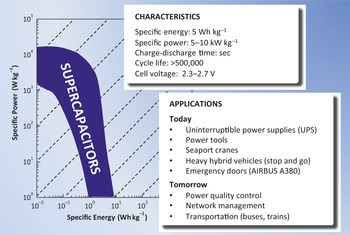
Supercapacitors are currently considered to be one of the most promising electrochemical storage devices.Reference Simon and Gogotsi1,Reference Naoi and Simon2 In recent decades, many types of supercapacitors have been proposed;Reference Simon and Gogotsi1,Reference Naoi and Simon2 however, currently, almost all supercapacitors available on the market are electrochemical double layer capacitors (EDLCs). For this reason, this article focuses only on EDLCs. In these devices, the charge is electrostatically stored at the electrode-electrolyte interface, ideally, without faradaic reactions. Typically, EDLCs contain activated carbon (AC) as the electrode active material and a quaternary ammonium salt dissolved in propylene carbonate (PC) or acetonitrile (ACN) as the electrolyte. These conventional EDLCs have operative voltages in the range of 2.3–2.7 V. They can be charged and discharged within seconds, displaying high power (up to 10 kW kg–1). Moreover, they have an extremely high cycle life (>500,000) (Figure 1). Because of these characteristics, supercapacitors today are conveniently used in a large number of applications where rapid charge-discharge capability and reliability are required.Reference Pandolfo and Hollenkamp3,Reference Ruch, Cericola, Foelske, Kötz and Wokaun4 For instance, in electric vehicles (EVs), supercapacitors can be coupled with batteries or fuel cells to deliver the high power needed during acceleration and to recover energy during braking. Furthermore, supercapacitors are used in wind turbines, seaport cranes, and power tools.
Supercapacitors: characteristics and applications. Their electrostatic charge storage mechanism enables high power outputs and extraordinary long cycle life. Such devices are nowadays largely employed as a power supply, either alone or coupled with other energy storage devices (e.g., battery or fuel cells). However, an increase in their energy density would enable, in the near future, a considerably wider range of applications.Reference Simon and Gogotsi1–Reference Pandolfo and Hollenkamp3

In 2009, the supercapacitors market was USD$275 million, while in 2014, it is expected to be on the order of USD$725 million.Reference Uchi5 This considerable market increase (more than twofold in five years) is mainly due to two factors: consolidation of the traditional supercapacitor market, meaning that in traditional applications such as in heavy hybrid vehicles (stop and go) and uninterruptible power supplies, the market grows and additionally introduces these devices in new types of applications (e.g., automotive applications and wind turbines).Reference Simon and Gogotsi1 This latter point appears at the moment to be the most critical for successful deployment of supercapacitors. If supercapacitors could be introduced in applications such as electric vehicles and power quality systems, their market could further increase, becoming one of the most important among the energy storage devices. Nevertheless, in order to expand applications for supercapacitors, the energy (and power) of these devices need to be increased.
The specific energy (E) and power (P) of supercapacitors are defined by the equations E = 1/2CV Reference Naoi and Simon2 and P = 4 V 2/ESR, respectively. In these equations, C is the capacitance, V is the operative voltage, and ESR is the equivalent series resistance of EDLCs. The ESR is the internal resistance and limits the power capability of the capacitor and thus its application. Considering these equations, it is obvious that the enhancement of the operative voltage is the most effective way to increase both the energy and the power of EDLCs. Many studies show that it is not possible to realize EDLCs with voltages higher than 3 V when conventional solvents (ACN and PC) are used.Reference Ruch, Cericola, Foelske-Schmitz, Kötz and Wokaun6–Reference Chiba, Ueda, Yamaguchi, Oki, Saiki and Naoi8 Therefore, in the last few years, much effort has been dedicated to the development of electrolytes, allowing the realization of high voltage EDLCs (>3 V). Among the electrolytes proposed so far, those based on ionic liquids (ILs) are considered the most promising. An overview is given here about the progress (higher energy and safety) and use of ILs in supercapacitors, including the inactive electrode parts.
Ionic liquids as electrolytes for supercapacitors
ILs are generally composed of a bulky, asymmetric organic cation and a weakly coordinating inorganic/organic anion. ILs are typically nonflammable, have negligible vapor pressure, and display high chemical and thermal stabilities (also see the Introductory article in this issue).Reference Johnson9–Reference Randstroem, Appetecchi, Lagergren, Moreno and Passerini12 For these characteristics, ILs have attracted significant attention for applications as “green” solvents and recently have been intensively investigated as electrolytes and/or electrolyte components in several electrochemical devices.Reference Johnson9–Reference Randstroem, Appetecchi, Lagergren, Moreno and Passerini12 Many studies show that the use of electrolytes containing ILs allows the realization of EDLCs with operative voltages significantly higher than 3 V.Reference Balducci, Dugas, Taberna, Simon, Plée, Mastragostino and Passerini13–Reference Lazzari, Mastragostino and Soavi16 Because these electrolytes do not contain volatile organic compounds but only salts (ILs), they are often indicated as solvent-free electrolytes.
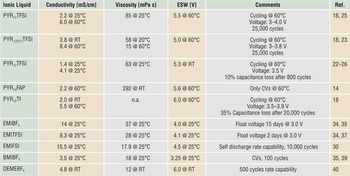
Mainly the two most promising and most often used families of aprotic ILs so far have been considered as potential electrolytes for EDLCs, based on pyrrolidiniumReference Balducci, Dugas, Taberna, Simon, Plée, Mastragostino and Passerini13–Reference Lewandowski, Olejniczak, Galinski and Stepniak26 and imidazoliumReference Kurig, Vestli, Janes and Lust27–Reference Wei, Sevilla, Fuertes, Mokaya and Yushin39 cations. Usually, pyrrolidinium-based ILs display a larger electrochemical stability window (ESW), meaning higher stability against oxidation and reduction than those based on imidazolium. High ESWs are desirable for the high voltages that supercapacitors can operate with and contribute strongly to the energy density of the device. On the other hand, the imidazolium-based ILs usually display higher conductivities and lower viscosities with respect to the former. In general, low viscosities and high conductivities are beneficial for all electrolytes and help to enable fast charge-discharge conditions. These different characteristics influence the energy as well as the power of EDLCs containing these ILs. As a matter of fact, by using pyrrolidinium-based ILs, it is possible to realize EDLCs with operative voltages as high as 3.5–3.7 V,Reference Balducci, Dugas, Taberna, Simon, Plée, Mastragostino and Passerini13–Reference Lewandowski, Olejniczak, Galinski and Stepniak26 while for EDLCs containing imidazolium-based ILs, this voltage is on the order of 3–3.2 V.Reference Kurig, Vestli, Janes and Lust27–Reference Wei, Sevilla, Fuertes, Mokaya and Yushin39 Because of their higher operative voltage, supercapacitors containing pyrrolidinium-based ILs display higher energy compared to those containing imidazolium-based ILs. However, since high conductivity and low viscosity are essential for fast charge-discharge capabilities, the imidazolium-based ILs display higher power. Table I compares the conductivity, viscosity, and ESW of several pyrrolidinium- and imidazolium-based ILs proposed as electrolytes in supercapacitors. The operative voltage as well as information about the performance of EDLCs containing these ILs is also given in the table.
Ionic liquids as electrolytes for supercapacitors.

Rate capability describes the capacitance retention at higher current densities applied to the supercapacitor. The better the rate capability, the better the capacitance retention at higher charge-discharge currents. Float voltage: constant voltage (e.g., 3.0 V) over time (voltage hold test) (e.g., 3.7 V). Note: RT, room temperature; CV, cyclic voltammogram; ESW, electrochemical stability window.
PYR14TFSI (N-methyl-N-butyl-pyrrolidinium bis(trifluoromethanesulfonyl)imide); PYR1(201)TFSI (N-methyl-N-methoxyethyl-pyrrolidinium bis(trifluoromethanesulfonyl)imide); PYR13TFSI (N-methyl-N-propyl-pyrrolidinium bis(trifluoromethanesulfonyl)imide); PYR14FAP (N-methyl-N-butyl-pyrrolidinium tris(pentafluoroethyl)trifluorophosphate); PYR14Tf (N-methyl-N-butyl-pyrrolidinium trifluoromethanesulfonate); EMIBF4 (1-ethyl-3-methylimidazolium tetrafluoroborate); EMITFSI (1-ethyl-3-methylimidazolium bis(trifluoromethanesulfonyl)imide); EMIFSI (1-ethyl-3-methyl imidazolium bis(fluorosulfonyl)imide); BMIBF4 (1-butyl-3-methylimidazolium tetrafluoroborate); DEMEBF4 (N,N-diethyl-N-methyl-N-(2-methoxyethyl)ammonium tetrafluoroborate); n.a. (not available).
Taking into account the results obtained so far, it appears clear that the use of ILs is extremely beneficial for the realization of high voltage supercapacitors. Due to their high operative voltage, IL-based EDLCs display energies significantly higher than those of conventional systems. Nevertheless, due to the relative high viscosity of these electrolytes, the ESR of these devices is presently considerably higher than that of EDLCs with conventional electrolytes. As a consequence, the power of IL-based EDLCs is often limited, particularly at room and lower temperatures. Since supercapacitors are high-power devices, it is clear that the limited power of IL-based EDLCs represents a drawback that needs to be overcome to allow for the use of these electrolytes in commercial devices.
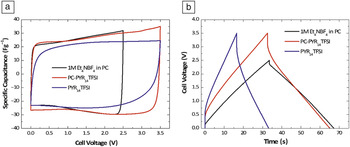
In order to increase the power of IL-based EDLCs, the use of mixtures containing ILs appears to be the most convenient way to take advantage of the beneficial properties of ILs. One approach that has been recently proposed involves the realization of mixtures containing two different ILs.Reference Lin, Taberna, Fantini, Presser, Pérez, Malbosc, Rupesinghe, Teo, Gogotsi and Simon19,Reference Palm, Kurig, Tõnurist, Jänes and Lust28 The use of these mixtures allows the development of solvent-free electrolytes with tailorable properties. One important advantage related to the use of such mixtures is the possibility to lower the melting point of IL-based electrolytes,Reference Palm, Kurig, Tõnurist, Jänes and Lust28 and, consequently, to widen the temperature range in which the EDLCs operate.Reference Lin, Taberna, Fantini, Presser, Pérez, Malbosc, Rupesinghe, Teo, Gogotsi and Simon19,Reference Palm, Kurig, Tõnurist, Jänes and Lust28 Nevertheless, considering the results obtained so far, devices containing mixtures still display rather high ESR. A second approach consists of the realization of mixtures containing ILs and organic electrolytes (e.g., PC and ACN). In these mixtures, the ILs simply act as a conducting salt. However, thanks to the low lattice energy of these compounds, it is possible to fabricate highly concentrated electrolytes. The use of such mixtures also represents a convenient strategy for the realization of tailorable electrolytes.Reference Ruiz, Huynh, Sivakkumar and Pandolfo20,Reference Krause and Balducci21 Depending on the IL/organic electrolyte ratio, such mixtures can display high conductivity, low viscosity, and wide ESW. Moreover, the high salt concentration in these electrolytes reduces the solvent volatility as well as flammability. Recent work shows that by using these kinds of electrolytes, it is possible to develop EDLCs having operative voltages as high as 3.5 V (see Figure 2), high power capability, and remarkable performance in terms of cycling stability.Reference Ruiz, Huynh, Sivakkumar and Pandolfo20,Reference Krause and Balducci21 Considering these results, the use of these mixtures seems to be a very promising strategy for realizing advanced EDLCs. Nevertheless, since they contain organic solvents, the safety of these electrolytes is lower compared to that of solvent-free systems.
Effects of different electrolytes, 1M Et4NBF4 (tetraethylammonium tetrafluoroborate) in PC (conventional electrolyte), propylene carbonate-(N-methyl-N-butyl-pyrrolidinium bis(trifluoromethanesulfonyl)imide) (PC-PYR14TFSI (1:1 wt.), a mixture of conventional solvent and ionic liquid), and PYR14TFSI (solvent-free electrolyte), on the operative voltage and specific capacitance of activated carbon electrodes. Comparison of (a) cyclic voltammograms (CVs) (scan rate: 20 mV s–1) and (b) voltage profiles upon galvanostatic cycling at room temperature (current density: 10 mA cm–2).Reference Balducci, Dugas, Taberna, Simon, Plée, Mastragostino and Passerini13,Reference Krause and Balducci21

Considering the points mentioned previously, it is clear that the introduction of new ILs displaying higher conductivity, lower viscosity, and wider ESW at room temperature (RT) would be the ideal solution for the realization of high voltage EDLCs displaying high power and high safety. So far, mainly pyrrolidinium- and imidazolium-based ILs have been investigated, and it is interesting to note that in the last few years, the number of new ILs considered for applications in supercapacitors has not increased significantly. For this reason, the development of new and advanced ILs is one of the main challenges to overcome. Alternative cations and anions, with respect to those used so far, should be considered. In order to realize such innovative ILs, the use of sulfonium-based cations and dicyanamide anions appears to be of interest, since these ions might lead to lower viscosity, higher conductivity, and lower costs.Reference Johnson9 Nevertheless, a detailed investigation of the properties of ILs containing these ions needs to be done in order to understand the possible advantages and limits of their use as electrolytes in supercapacitors.
Ionic liquids and electrode materials—active materials
Since supercapacitors store charge at the interface between the electrode and the electrolyte, it is clear that this process, which might depend on many aspects such as pore size distribution and ion size, is crucial to realize high energy EDLCs, and thus the use of carbon materials with high affinity for IL-based electrolytes is necessary.
Almost all ACs currently available have been developed for use either in aqueous or organic solvents, and consequently they display characteristics (e.g., pore structure, surface chemistry) optimized for these electrolytes. When these ACs are used in combination with electrolytes displaying higher viscosity and different dielectric constants than those of conventional electrolytes, their capacitance might be negatively affected.Reference Lazzari, Soavi and Mastragostino17,Reference Arbizzani, Biso, Cericola, Lazzari, Soavi and Mastragostino18,Reference Lewandowski, Olejniczak, Galinski and Stepniak26 In fact, several studies show that activated carbon might display lower capacitance in neat IL-based electrolytes than in conventional electrolytesReference Balducci, Dugas, Taberna, Simon, Plée, Mastragostino and Passerini13,Reference Lazzari, Mastragostino, Pandolfo, Ruiz and Soavi14 (see Figure 2). Taking this point into account, in order to introduce ILs in supercapacitors, the affinity of carbonaceous materials for these electrolytes also needs to be carefully considered. In the past, many groups worked on the development of carbon with high affinity for IL-based electrolytes. Carbon xerogel,Reference Lazzari, Soavi and Mastragostino17 polypyrrole-derived activated carbon,Reference Wei, Sevilla, Fuertes, Mokaya and Yushin39 microporous carbon,Reference Largeot, Taberna, Gogotsi and Simon15 carbon nanotubes, and carbon onionsReference Lin, Taberna, Fantini, Presser, Pérez, Malbosc, Rupesinghe, Teo, Gogotsi and Simon19 have been proposed as high-performance active materials for these electrolytes. These studies indicated that using carbon with good affinity for IL-based electrolytes makes it possible to achieve capacitances comparable with those of conventional (non-aqueous) electrolytes.
Ionic liquids and electrode materials—binders
In order to develop advanced EDLCs and, in general, advanced electrochemical storage devices, both the active and inactive components need to be carefully considered. Inactive components (e.g., binders necessary for device fabrication) might strongly affect performance, as well as the overall safety and environmental friendliness of EDLCs.Reference Simon and Gogotsi1,Reference Naoi and Simon2
So far, fluorinated thermoplastics binders, such as polytetrafluoroethylene (PTFE) and polyvinylidene difluoride (PVdF), have been widely used and represent state-of-the-art binders in EDLCs.Reference Kurzweil and Garche40 These binders can be advantageously used for the realization of composite electrodes to be combined with all types of electrolytes commonly used in EDLCs. Nevertheless, both PVdF and PTFE are rather expensive (ca. $20/kg). Moreover, while PTFE is usually used in water suspensions, PVdF requires the use of expensive (and in some case toxic) organic solvents.
Recently, sodium carboxymethyl cellulose (CMC) was proposed as an alternative binder for lithium-ion batteries and EDLC electrodes. CMC is environmentally more friendly (fluorine-free) and cheaper ($1–3/kg) than the state-of-the art binders mentioned earlier. Moreover, since CMC is soluble in water, this binder allows the use of aqueous slurries for electrode preparation, improving the overall safety of the EDLC manufacturing process. Recent work shows that the performance of CMC-based electrodes is comparable with that of electrodes based on conventional, fluorinated binders in several types of electrolytes in terms of capacitance and cycling stability.Reference Krause and Balducci21,Reference Krause, Kossyrev, Oljaca, Passerini, Winter and Balducci41,Reference Brandt, Isken, Lex-Balducci and Balducci42
Natural cellulose is the most abundant natural polymer. It is a renewable, natural resource produced from organic materials such as wood and cotton, which is manufactured and/or regenerated in the multi-ton scale every year. Cellulose is a cheap material, with an average production cost estimated between $0.5–2/kg, depending on the yearly production.Reference Jeong, Böckenfeld, Balducci, Winter and Passerini43 Considering these characteristics, it is evident that the introduction of cellulose as a binder in EDLCs would represent an important contribution for the realization of cheap and environmentally friendly devices. However, natural cellulose cannot be dissolved in water and is also insoluble in almost all organic solvents. For this reason, it cannot be easily introduced in the electrode manufacturing process to replace state-of-the-art binders. In order to use this natural compound in composite electrodes, alternative processing methods, with respect to the conventional processes, are needed.
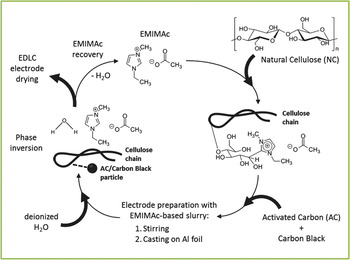
Among their unique properties, some ILs display the ability to dissolve cellulose too.Reference Phillips, Drummy, Conrady, Fox, Naik, Stone, Trulove, De Long and Mantz44–Reference Heinze, Dorn, Schöbitz, Liebert, Köhler and Meister47 Therefore, the use of ILs in supercapacitors might also offer the possibility to introduce beneficial binders, such as cellulose, in these devices. Figure 3 shows a scheme describing the steps necessary for the realization of composite electrodes containing natural cellulose as the binder. Such a procedure involves the use of the IL 1-ethyl-3-methylimidazolium acetate (EMIMAc). This IL is able to dissolve celluloseReference Heinze, Dorn, Schöbitz, Liebert, Köhler and Meister47 (dispersions of cellulose in this IL is commercially available from BASF). As proposed by Heinze et al., cellulose dissolves in EMIMAc due to the formation of covalent bonds between the C-1 carbon of the glucose unit and the C-2 of the imidazolium core.Reference Heinze, Dorn, Schöbitz, Liebert, Köhler and Meister47 Thanks to this ability, it is possible (and relatively easy) to realize slurries containing cellulose and the electrode active materials, which can be coated over current collectors for the fabrication of composite electrodes. Once the slurry is coated over the current collector, the removal of the EMIM acetate present on the wet electrodes is required. An elegant way to simultaneously remove and recover the EMIMAc consists of simply immersing the cast foil in water. Upon immersion, the bond between EMIM acetate and cellulose is cleaved. As a consequence, the hydrophilic IL dissolves in the aqueous phase, from which it can be easily recovered and recycled via evaporation of water, while the cellulose precipitates, thus binding the composite electrode. It is important to note that this preparation method, although involving the use of an IL, is very cost-effective, since EMIM acetate can be fully recovered.Reference Jeong, Böckenfeld, Balducci, Winter and Passerini43
Schematic representation of the preparation process of activated carbon electrodes based on natural cellulose binder. The ability of 1-ethyl-3-methylimidazolium acetate (EMIMAc) to dissolve natural cellulose is utilized to prepare a stable and homogeneous ionic liquid (IL)-based slurry. This is subsequently cast on an Al current collector to obtain the electrode layer that is, afterward, immersed in water in order to extract the IL via phase inversion. The electrode is finally dried, and the EMIMAc is completely recovered simply by water removal.Reference Böckenfeld, Jeong, Winter, Passerini and Balducci48 Note: EDLC, electrochemical double layer capacitor; n, undefined number of repeating units.

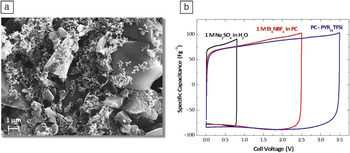
In a recent study, we showed that composite electrodes containing cellulose as a binder display uniform morphology and thermal stabilities comparable to those of conventional electrodes (see Figure 4a).Reference Böckenfeld, Jeong, Winter, Passerini and Balducci48 Moreover, as reported in Figure 4b, cellulose-based composite electrodes display high performance in terms of specific capacitance and cycling stability in all classes of electrolytes (aqueous, non-aqueous, and IL-based) proposed for EDLCs.Reference Böckenfeld, Jeong, Winter, Passerini and Balducci48 The performance of these cellulose-based electrodes can be further improved. Nevertheless, taking into account the results obtained so far with these electrodes, the introduction of cellulose as a binder in composite electrodes for EDLCs appears very promising. In fact, the introduction of an abundant and cheap material such as natural cellulose might contribute toward the development of high-performance, cheap, safe, and environmentally friendly EDLCs.
Morphological and electrochemical features of activated carbon electrodes employing natural cellulose as the binder. (a) Scanning electron microscopy micrograph of an electrochemical double layer capacitor (EDLC) electrode produced by the method reported in Figure 3. (b) Cyclic voltammograms (scan rate: 20 mV s–1) of cellulose-based EDLCs in different electrolytes at room temperature. The experiments highlight the high compatibility of this novel binder with all types of electrolytes used in supercapacitors.Reference Böckenfeld, Jeong, Winter, Passerini and Balducci48 Note: Et4NBF4, tetraethylammonium tetrafluoroborate; PYR14TFSI, N-methyl-N-butyl-pyrrolidinium bis(trifluoromethanesulfonyl)imide.

Conclusions
Supercapacitors are already one of the most important electrochemical storage devices, and their importance is expected to further increase in the future. In this article, we show that the use of ionic liquids (ILs) appears extremely favorable to develop high energy and safe supercapacitors. When used as electrolytes, ILs allow the realization of supercapacitors with operative voltages that are considerably higher (almost 1 V) than those with conventional electrolytes. Such high voltage supercapacitors display higher energies but lower powers compared to conventional systems. Since supercapacitors are high-power devices, it is clear that at present, the limited power of IL-based electrochemical double layer capacitors represents the main drawback for the introduction of these electrolytes in commercial devices. In order to overcome this limitation, the use of mixtures of ILs and organic solvents and/or the introduction of new types of ILs appears to be the most suitable strategies.
ILs can also contribute to the realization of safe and environmentally friendly supercapacitors. ILs are nonflammable, they have negligible vapor pressure, and they display high chemical and thermal stabilities. These properties make IL-based supercapacitors much safer than conventional systems. Moreover, the ability of some ILs to dissolve natural cellulose offers the possibility to introduce natural cellulose as a binder in supercapacitors. Taking into account the fact that cellulose is cheap and abundant, it is clear that the introduction of this material would represent an important contribution for the development of environmentally friendly supercapacitors.
Acknowledgments
The authors wish to thank the University of Münster, the Ministry of Innovation, Science and Research of North Rhine-Westphalia (MIWF) within the project “Superkondensator und Lithium-Ionen-Hybrid-Superkondensatoren auf der Basis ionischer Flüssigkeiten” and the Bundesministerium für Bildung und Forschung (BMBF) with the project “IES, Innovative Elektrochemische Superkondensatoren” (Contract Number 03EK3010) for financial support.