INTRODUCTION
The relatives’ contribution is often a prerequisite for successful palliative home care. Research has shown that the relatives’ burden are considerable, because they feel homebound (Axelsson & Sjödén, Reference Axelsson and Sjödén1998; Fakhoury & McCarthy, Reference Fakhoury and McCarthy1998; Rollison & Carlsson, Reference Rollison and Carlsson2002; Carlsson & Rollison, Reference Carlsson and Rollison2003) and isolated (Rollison & Carlsson, Reference Rollison and Carlsson2002; Carlsson & Rollison, Reference Carlsson and Rollison2003) and suffer from sleeping deficit (Axelsson & Sjödén, Reference Axelsson and Sjödén1998; Fakhoury & McCarthy, Reference Fakhoury and McCarthy1998; Rollison & Carlsson, Reference Rollison and Carlsson2002; Carlsson & Rollison, Reference Carlsson and Rollison2003). An evaluation by the Swedish National Board of Health and Welfare (Socialstyrelsen, 1999) revealed that relatives who cared for a next of kin at home were content but tired and sometimes exhausted. The fatigue in that study seemed to be attributed to mental rather than a physical burden. However, that study did not explicitly evaluate fatigue in relatives of patients in palliative home care. Some studies have shown that the most frequently reported reason for hospital admission is family exhaustion (Gomas, Reference Gomas1993; Hinton, Reference Hinton1994). Relatives have been shown to experience a different burden depending on where the patient were cared for and died (Carlsson & Rollison, Reference Carlsson and Rollison2003). Relatives of patients cared for at home regarded their situation as more physically burdensome and suffered greater sleep deficit than relatives whose ill family members were cared for at a hospital.
During the past decade, fatigue among cancer patients has received a great amount of scientific interest (Richardson, Reference Richardson1998; Stone et al., Reference Stone, Richards and Hardy1998; Fürst & Åhsberg, Reference Fürst and Åhsberg2001; Ahlberg, Reference Ahlberg2004). However, only a few studies have used validated instruments to examine fatigue in patients’ relatives. One of the few reported studies about fatigue among relatives in a home care setting is a study by Jensen and Given (Reference Jensen and Given1993). They found moderate to severe fatigue in 53% of the relatives. The only factor that significantly affected the degree of fatigue was how much the care influenced the relatives’ daily schedule. However, it is not clear from the study if the patients were treated in a palliative phase. The overall aim of this study was to gain a greater understanding of fatigue in relatives of patients cared for in palliative care settings.
METHODS
This study, with a descriptive, comparative, and cross-sectional design, was a pilot study for a bigger, longitudinal study. Relatives of patients in palliative care in Uppsala County (in seven different units) during a specific day were invited to participate in the study. The different care units provided either home care or institutional care. The staff identified the relative who had been or was the most involved in the patient's care and gave verbal and written information about the study. The questionnaire consisted of the Multidimensional Fatigue Inventory (MFI-20) and questions from the Karolinska Sleepiness Scale (KSS; Åkerstedt & Gillberg, Reference Åkerstedt and Gillberg1990) and the Karolinska Sleep questionnaire (KSQ; Kecklund & Åkerstedt, Reference Kecklund and Åkerstedt1992), and 15 demographic questions. The MFI-20 is a validated (Smets et al., Reference Smets, Garssen and Bonke1995) and much used instrument whose Swedish version has been validated (Fürst & Åhsberg, Reference Fürst and Åhsberg2001) and tested for reliability (Ahlberg, Reference Ahlberg2004). Population norm data have been reported by Schwarz et al. (Reference Schwarz, Krauss and Hinz2003).
Statistical Methods
Mean (M), standard deviation (SD), and range were calculated for descriptive purposes. Statistical comparisons between groups were conducted with a Mann-Whitney U test or Kruskal–Wallis depending on the numbers of groups. Chi-square tests and Spearman's correlation coefficients were used for correlation analysis. For comparison with norm data from the general public, corrections for age and gender were made for the MFI-20 in accordance with Hjermstad et al. (Reference Hjermstad, Fayers and Bjordal1998). A one-sample t test was employed to analyze whether the observed scores differed from expected scores more than could be attributed to chance. Statistical significance was accepted at p < .05.
Ethics
Ethical considerations in this study are individual autonomy and dependence, informed consent, and risk of causing emotional injury. To protect the relatives’ privacy, all contact with them was via the members of staff who had provided verbal and written information about the study. When the subjects had given verbal consent to participate in the study, they were given the questionnaire and an envelope for the completed questionnaire. All data have been treated as confidential information by the author, who was not involved in the patients’ care. All questions related to fatigue and sleeplessness and were not emotionally distressing. Because this was a pilot study, it was not reviewed by an ethics committee.
RESULTS
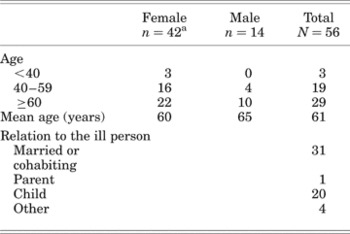
During the specific day 73 patients were registered in the county's seven palliative care units, and 56 (77%) relatives completed the questionnaire. Some characteristics of the relatives are presented in Table 1. There was a nearly equal gender representation, by the patients, with 29 men and 26 women. The mean age was 73 (range 32–93) years. The most common diagnoses in the patients were gastro-intestinal cancer (n = 22), genito-urinary cancer (n = 10), and lung cancer (n = 9).
Characteristics of the Relatives

aOwing to missing data, the sum of the subgroups might be lower than the corresponding total numbers of individuals.
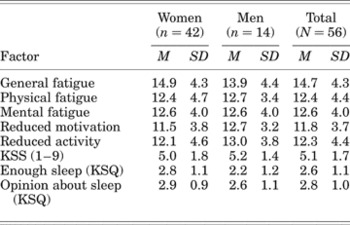
The most significant aspects of fatigue in this sample were general fatigue, mental fatigue, and physical fatigue. The verbal expressions that come closest to the relatives’ scoring on the KSS and KSQ (Table 2) were that they were neither alert nor sleepy (M = 5.1). Subjects scored between enough and insufficient sleep (M = 2.6) and perceived their sleep quality as neither good nor bad (M = 2.8). There were positive correlations between the three sleep questions and all fatigue dimensions (p < .05 to p < .0001).
Scores of Fatigue (MFI-20, Range 4–20), Sleepiness (KSS, Range 1–9) and sleep quality (two questions from KSQ range 1–4) by gender
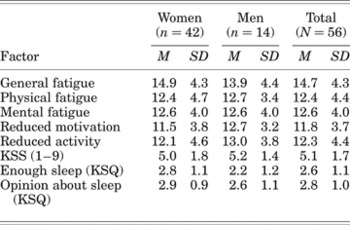
MFI: Multidimensional Fatigue Inventory; KSS: Karolinska Sleepiness scale; KSQ: Karolinska Sleep questionnaire.
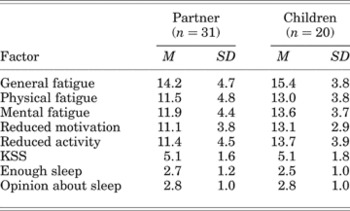
No significant differences were found with respect to gender (Table 2) or to the relation to the patient, that is, between relatives who were the partner and relatives who were the child of the ill person (Table 3). Two significant negative correlations were found to exist between age and fatigue, with younger relatives reporting more mental fatigue (−0.413, p < .01) and less activity (−0.371, p < .01) compared with older relatives.
Scores of Fatigue (MFI-20) and Sleepiness (KSS and KSQ) and the Relation to the Patient
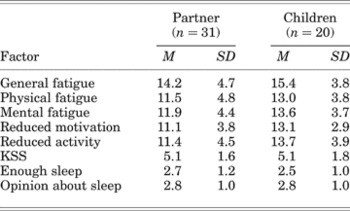
MFI: Multidimensional Fatigue Inventory; KSS: Karolinska Sleepiness scale; KSQ: Karolinska Sleep questionnaire.
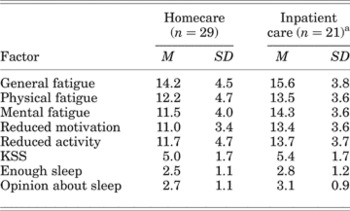
Table 4 shows fatigue and sleeplessness data relating to where the patients were being cared for. Relatives of patients care for in institutional care (n = 21) showed higher values for mental fatigue (Z = −2.741, p < .01) and reduced motivation (Z = −2.271, p < .05) compared with relatives of patients cared for at home (n = 29).
Scores of Fatigue (MFI) and Sleepiness (KSS and KSQ) Related to the Place of Care

MFI: Multidimensional Fatigue Inventory; KSS: Karolinska Sleepiness scale; KSQ: Karolinska Sleep questionnaire.
aOwing to missing data, the sum of the subgroups might be lower than the corresponding total numbers of individuals.
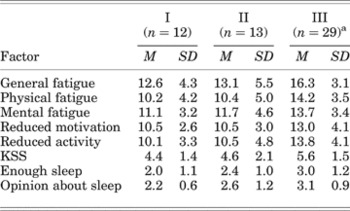
There were significant differences in all fatigue dimensions depending on the patients’ functional status. The post hoc analysis (using the Mann–Whitney U test) showed that relatives of patients who were mostly bedridden were significantly (p < .05 to p < .1) more tired but did not have significantly less motivation than relatives of mostly ambulatory patients (Table 5). More patients in residential care than patients cared for at home were bedridden (χ2 = 11.9, p < .01).
Differences in Fatigue Depending on the Patients’ Functional Status

I: mostly ambulatory; II: ambulatory for half the day, III: mostly bedridden; KSS: Karolinska Sleepiness scale.
aOwing to missing data, the sum of the subgroups might be lower than the corresponding total numbers of individuals.
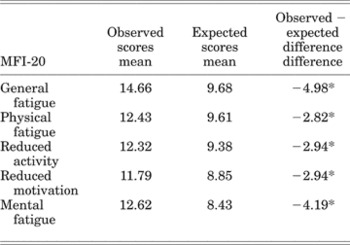
To compare the results with norm data, corrections for age and gender were made for the MFI-20 data. Relatives showed a significantly higher degree of fatigue than expected on every fatigue dimensions (p < .0001) compared with the general public of similar age and gender (Table 6).
Comparison between Relatives and Norm Data after Adjustment for Age and Gender

Scores range from 4 to 20. MFI-20: Multidimensional Fatigue Inventory.
*p < .0001.
DISCUSSION
The results of the present study show that the most significant aspects of fatigue in the relatives of palliative patients were general fatigue, mental fatigue, and physical fatigue, although the relatives slept fairly well and were not especially sleepy. No gender difference was seen. This is in contrast to the findings of Schwarz et al. (Reference Schwarz, Krauss and Hinz2003), who report that the women in their study had experienced more fatigue than men. However, previous studies have shown contradictory findings about gender. The study by Watt et al. (Reference Watt, Groenvold and Bjorner2000) showed small gender differences, but the variability among women was larger and more women had high fatigue scores. The findings from the current study are in accordance with this observation. However, no clear conclusion can be drawn, owing to the small sample size and the underrepresentation of male relatives.
It is reasonable to assume that the difference between relatives of patients in institutional care and relatives of patients cared for at home was due to the fact that patients in residential care are closer to death. The diseased functional status is associated with impending death. Therefore, when the patient is mostly bedridden, the care is both physically heavy and mentally distressing and the fatigue is strongly influenced by anticipatory grief. That the difference between residential and home care is highest in the mental fatigue dimension supports this explanation. Watt et al. (Reference Watt, Groenvold and Bjorner2000) found a strong association between mental fatigue and depression. Fatigue can be seen as both a cause of and a result of depression. In the present study no depression measurement was undertaken, so this connection is only a speculation.
Because generally accepted cutoff scores for fatigue are lacking, a comparison was done between relatives and norm data from the general public (Schwarz et al., Reference Schwarz, Krauss and Hinz2003). The results showed that relatives of patients cared for in a palliative care setting experience a greater degree of fatigue compared to a corresponding group from the general population, matched for gender and age. This result was reversed when fatigue in the general public increased with higher age. The pattern in the present study was that the youngest relatives were most tired, which trend was especially apparent in women. There is growing evidence that fatigue is the most common symptom in patients with cancer and is associated with most types of cancer treatments. Another relevant comparison group is therefore cancer patients at the end of radiotherapy. This group is well recognized for their high level of fatigue. The comparison with the results of two Swedish studies on fatigue in the past week and after completion of radiotherapy, respectively (Fürst & Åhsberg, Reference Fürst and Åhsberg2001; Ahlberg et al., Reference Ahlberg, Ekman and Wallgren2005), shows relatively comparable values. Yet the relatives in the present study reported higher scores on general and mental fatigue and more reduced motivation. The patients, on the other hand, had higher scores on the dimension “reduced activity.” Because of the lack of studies on relatives of patients in palliative care, the only comparison group found was relatives to end-stage renal disease (ESRD) patients (Schneider, Reference Schneider2003). Relatives in the present study showed higher values on every fatigue dimensions than did caregivers of ESRD patients. One result all comparison groups (above) had in common was that the highest scores were on the physical dimension. This is in contrast to the relatives in the present study, who had the highest score on the mental dimension.
The nonparticipants consisted of 10 women and 7 men. This gave an overrepresentation of male relatives. The nonparticipants among the children (n = 6) and partners (n = 9) of patients was equal. This study answered some questions, but it also raises new questions. For example, was it age per se that correlated with fatigue, or does the fatigue depend on the relationship? Younger relatives are mainly children of the ill. They still work and often also have a new family to care for. Moreover, they seldom cohabit with the ill relative, and this distance may result in more worry.
Finally, it is important to follow the development of fatigue over time. These questions can be answered with a longitudinal study design, with a sample consisting of both the patient's partner and the children.
CONCLUSION
The findings imply that fatigue is highly prevalent in relatives of patients in palliative care. The sample in this study scored higher in comparison with norm values and also in comparison with relatives of patients with end-stage renal disease. Their scores were similar to those of cancer patients undergoing radiotherapy. One conclusion of this pilot study must be that more research may be warranted.