The activity of hunting – essential for human survival, and consequently the survival of communities, since the first appearance of humans on earth – included all kinds of wildlife, namely land animals, sea animals and birds (Plato, Sophist 220; Buchholz, Jöhrens and Maull Reference Buchholz, Jöhrens and Maull1973). As it required physical strength, mental agility, skill, experience and the individual's participation in operations outside the social network, making it therefore isolated and dangerous, hunting came to constitute an ideal ideological medium for the creation and display of power (Hamilakis Reference Hamilakis, Kotjabopoulou, Hamilakis, Halstead, Gamble and Elefanti2003; Papageorgiou in press; Papageorgiou forthcoming).Footnote 1
The iconography of land hunting in the Aegean of the second millennium bc has occasionally attracted the interest of researchers due to the identity of the game – among which the bull, lion, goat, boar and deer hold a predominant position – and also because of the obvious symbolic charge of the activity depicted (Marinatos Reference Marinatos1993, 216–18; Morgan Reference Morgan and Morris1995, 171–80; Morgan Reference Morgan1998; Hamilakis Reference Hamilakis, Kotjabopoulou, Hamilakis, Halstead, Gamble and Elefanti2003; Papageorgiou in press; Papageorgiou forthcoming). Images of sea hunting, namely fishing, although initially considered the representation of a daily activity of the Aegean's inhabitants (Sakellarakis Reference Sakellarakis1974), have recently been included among such scenes of symbolic content, as fishing itself constitutes an impressive enterprise of a violent nature, requiring strength, agility, skill, and sometimes team spirit (Marinatos Reference Marinatos1993, 216–17; Papageorgiou Reference Papageorgiou2000, 964–6; Papageorgiou forthcoming; cf. also Doumas Reference Doumas, Kastrinaki, Orphanou and Giannadakis1987).
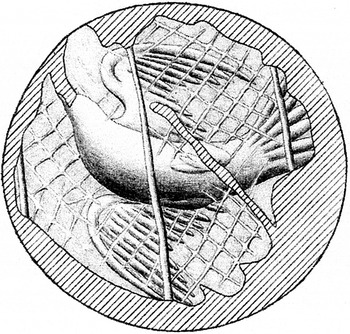
Absent from the iconographic repertoire of hunting in the second millennium bc, according to our knowledge to date, is the representation of the third category of hunting – the hunting of birds. An exception to this is a Late Minoan IB sealing from Agia Triada – its exact findspot is not known – which never attracted particular research interest (Fig. 1) (Müller and Pini Reference Müller and Pini1999, no. 123; Crowley Reference Crowley2013, no. E183). Represented here within a net (which implies human activity) is a bird with outstretched wings – in other words, captured in flight. Of interest is the detailed depiction of the net, on the edges of which are straps. The fact that the sealing comes from the bezel of a signet ring, apparently of gold, indicates the particular importance and symbolic value of the subject, which enriches the Aegean sacred iconography.
Sealing from the bezel of a signet ring with representation of a bird captured in a net. From Agia Triada, Crete, Late Minoan IB period (after Müller and Pini Reference Müller and Pini1999, no. 123).

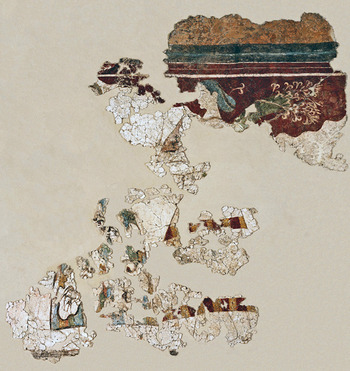
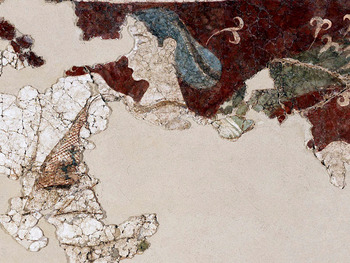
Newer information about the practice of trapping birds in the Aegean of the second millennium bc has emerged from the restoration of the frescoes from Xeste 3 in the Late Cycladic I / Late Minoan IA settlement of Akrotiri on Thera, a particularly important, and undoubtedly public, building which stands out among the public buildings in the Aegean of the second millennium bc in terms of size, but chiefly in terms of the state of preservation of the compositions that adorned its spaces.Footnote 2 The activities that took place in this community sanctuary – which, according to the now established view, concerned initiation rituals for both sexes (Marinatos Reference Marinatos1984, 73?84; Davis Reference Davis1986; Doumas Reference Doumas, Kastrinaki, Orphanou and Giannadakis1987; Marinatos Reference Marinatos1990; Reference Marinatos1993, 203-11; Koehl Reference Koehl, Driessen and Sackett2000, 134–43; Morgan Reference Morgan2000, esp. 937–41; Papageorgiou Reference Papageorgiou2000, esp. 962, 965–7; Boulotis Reference Boulotis2005, 35–9; Papageorgiou Reference Papageorgiou2008, 93–4; Vlachopoulos Reference Vlachopoulos, Brodie, Doole, Gavalas and Renfrew2008a; Reference Vlachopoulos, Boehm and Müller-Celka2010; Papageorgiou in press) – were overseen by the Great Nature Goddess, who is depicted in large scale in the spacious room (Room 3a) on the first floor of the building, among young female saffron gatherers, accepting an offering of the first yield of the harvest – the saffron stigmas, the final product of saffron gathering from which the precious substance is derived. The same activity of saffron collecting by young women unfolds on the east wall of Room 3a (Doumas Reference Doumas1992, pls. 116–21), precisely marking the time frame in which the religious festival represented took place: in the autumn, the season when the plant depicted (belonging to the undomesticated species Crocus cartwrightianus) was collected (Sarpaki Reference Sarpaki2000, 660–3; see also Tzachili Reference Tzachili1994; Sarpaki Reference Sarpaki and Danezis2001). Coexisting in the iconographic programme of Room 3 on the first floor of Xeste 3, however, are also signifiers of another season – of spring – namely wild roses and lilies that are being carried ceremoniously by two pairs of women of mature age in two processional compositions decorating the north and south walls (Fig. 2) of the corridor area 3b (Marinatos Reference Marinatos1976, 36–7 pl. 65; Doumas Reference Doumas1992, figs. 133–4; Televantou Reference Televantou1994, 374; Vlachopoulos Reference Vlachopoulos, Vlachopoulos and Birtacha2003, figs. 11, 20–3; Warren Reference Warren, Tabakaki and Kaloutsakis2006, 261, 263; Vlachopoulos Reference Vlachopoulos, Morris and Laffineur2007a, 114, pl. XXXa–b; Chapin Reference Chapin, Colburn and Heyn2008; Vlachopoulos Reference Vlachopoulos, Brodie, Doole, Gavalas and Renfrew2008a, 453, figs. 41:34, 41:36; Boulotis Reference Boulotis and Daniilidou2009, 464?5, 469?72, figs. 7?9; Vlachopoulos Reference Vlachopoulos, Boehm and Müller-Celka2010, 183 fig. 12a–b).Footnote 3 The architectural unit of corridor area 3b has a direct functional link with the large Room 3a, since it led into it from the building's service staircase 8 (Vlachopoulos Reference Vlachopoulos, Vlachopoulos and Birtacha2003, 521 fig. 16). This and the fact that the two pairs of women depicted are proceeding towards the interior of the room, where the seated Potnia is located, probably indicate that the gathered flowers they carry are to be offered to the Great Goddess. Among the women of the procession is also a woman with a sheaf of white lilies in her hands (Fig. 2), on whose upper arms is rendered a net pattern consisting of rhomboid meshes, with knots represented where they are joined. Small blue birds are depicted under the mesh (Figs. 3, 4).Footnote 4
Pair of women from the south wall of the corridor 3b on the upper floor of Xeste 3, Akrotiri. The second figure is carrying a sheaf of white lilies. On her right upper arm is rendered a net pattern with small blue birds (Akrotiri Excavations, Photographic Archive).

The upper torso of the woman with the white lilies and the net (Akrotiri Excavations, Photographic Archive).

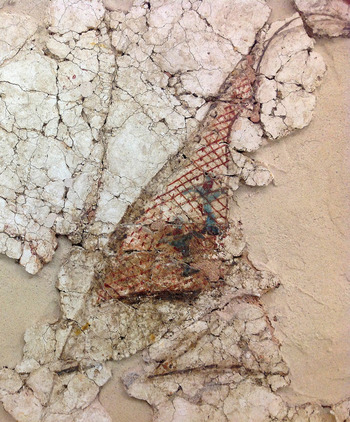
The right arm of the woman with the net (Akrotiri Excavations, Photographic Archive).

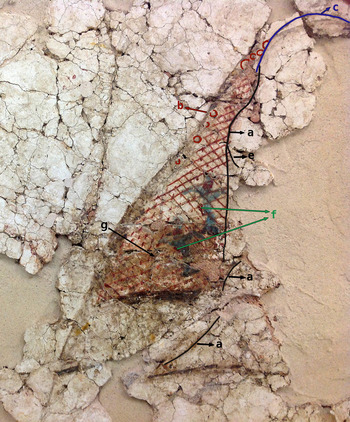
The net with the small blue birds has been viewed as a bodice with embroidered miniature swallows (Vlachopoulos Reference Vlachopoulos, Vlachopoulos and Birtacha2003, 515, 514 fig. 11; 2007a, 114; 2008a, 453) or as decoration of the bodice (Chapin Reference Chapin, Colburn and Heyn2008, 55–6, 67, figs. 2–1, 2–5:14c). However, carefully observing the details of the mesh pattern on the right arm of the figure, we must note that there are certain elements that are not consistent with this identification (Figs. 5, 6):
-
• ( Fig. 5:a ) The inner outline of the netting, painted in black line on the white surface of the upper arm, is irregularly curved. This detail alone refutes the hypothesis that it is a bodice. If that were the case we would expect the netting to also cover the upper arm and the surviving section of the shoulder. The figure seems to be wearing a transparent bodice – hence its depiction in white – with the edge of the sleeve being defined by a black horizontal line slightly above the right elbow. The traces of purple pigment observable as a seemingly soiled area in the lower portion of the sleeve perhaps suggest the existence of a broad purple band (Vlachopoulos Reference Vlachopoulos, Vlachopoulos and Birtacha2003, fig. 22) with its upper edge defined by a thick black border. On this border painted red meshes are discernible, thus confirming that the net covers the sleeve. We could assume that the net also covered the broad purple band in the lower portion of the sleeve but the deterioration of the organic purple pigment in this region, responsible in turn for the deterioration of the red net pattern over it, does not allow us to discern the bottom part of the net. However, the curved black line painted roughly parallel to the inner outline of the upper arm (Fig. 5:a) belongs in all probability to the inner outline of the net. Traces of purple pigment are also observable on the outer side of the right upper arm and shoulder, probably indicating a decorative stripe on the sleeve, which is also observable on the left sleeve (Vlachopoulos Reference Vlachopoulos, Vlachopoulos and Birtacha2003, fig. 22).
-
• ( Fig. 5:b ) A series of small black rings has been drawn on the stripe of the right sleeve and across the entire area occupied by the net pattern. The rings are denser in the area at the upper part of the arm and sparser as they descend downwards. It is noteworthy – and in complete accord with this – that at the points where the rings are more densely distributed, the meshes of the net are shorter in height, whereas they are longer where the rings are sparser. These rings could be considered a decorative motif of the stripeFootnote 5 but in this case we would have expected their rendering on the shoulder too.
-
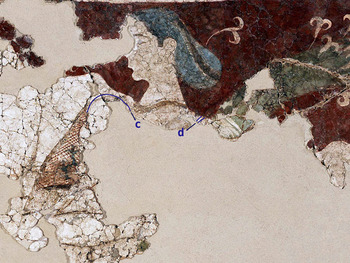
• ( Figs. 5:c , 6:c ) In the region of the right shoulder, where the inner outline of the net ends, is another black line starting at a different point, extending beyond that of the shoulder, and continuing at the neck below the necklace, slanting to the right and downwards. Correspondingly, on the left shoulder, two converging black lines are observable, heading left and down (Fig. 6:d).
-
• ( Fig. 5:e ) An eloquent detail can be observed in the upper part of the net: attached to its inner outline is a triangular area bordered in black containing faded netting, probably what remained after the deterioration of the red pigment.
-
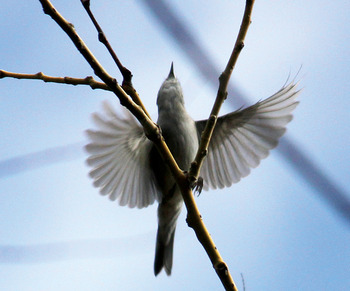
• ( Fig. 5:f ) The birds depicted under the net, the meshes of which are drawn in red above the blue of the birds, do not cover the entire arm, as in all cases of decorated garments (bodices) with patterns.Footnote 6 In the lower part of the birds' bellies an angular red line with a forked end, particularly evident in the case of the upper bird, can be distinguished. This shows the birds' feet hooked to the net, a detail which strengthens even further the idea that the birds do not constitute a decorative pattern. The birds, with blue-grey bodies, wings and heads, and characteristic red bands on the necks, are rendered frontally with heads up, legs entangled in the net and wings spread, as if suggesting an agonising effort to break free. The rendering of the primary feathers of the wings in outline in black (Fig. 5:g), which is certainly the impact of observing the living model (Fig. 7), is also found in other representations of birds (e.g. the blue birds of the ‘Porter's Lodge’ at Akrotiri: Doumas Reference Doumas1992, 27 fig.; Vlachopoulos Reference Vlachopoulos, Betancourt, Nelson and Williams2007b, 132–3 no. 1, pls. 15:6, 15:7; the birds on the Miniature Wall Painting of the West House in Akrotiri: Morgan Reference Morgan1988, pls. 91 [east wall), 94 [west wall]; and the blue birds of the House of Frescoes in Knossos, whose primary feathers are drawn in outline in blue: Evely Reference Evely1999, 217 fig.).
These details appear to overturn the hitherto accepted interpretation. Even if we were to accept the extreme case of a pattern of birds trapped in a net having been woven or embroidered onto a garment – a gown in this case, and under no circumstances a bodice – the significance of the fine black lines (Fig. 6:c,d) on either side of the base of the neck and on the shoulder of the female figure (Figs. 5–6), which would otherwise remain unintelligible, would have to be explained, along with the fact that the gown does not cover the shoulder, as would be expected. The line above the shoulder (Figs. 5:c, 6:c) is independent of that of the inner outline of the netting and in any case cannot be attributed to a probable error of the painter, particularly as there is no observable attempt to correct it. The lines on either side of the base of the neck (Fig. 6:c,d) could be considered as part of the bodice edge. However, in compositions where the edges of the open bodices are visible, they consist of two parallel lines (whereas in this case the lines at the left shoulder of the figure converge) which follow the vertical axis of the upper torso and are delineated obliquely towards it (see Cameron Reference Cameron1974, pls. 19, 24, 25, 32; Shaw Reference Shaw, Betancourt and Davaras1998, 59, 63–4, pls. 28–30, col. pls. B, F, H; see also the bodice edges on clay or ivory figures: Caskey Reference Caskey1986, pls. 36a–d, 38a, 41a,d,i, 42a,g, 71; Konstantinidi-Syvridi Reference Konstantinidi-Syvridi, Nosch and Laffineur2012, pls. LXIIa, LXIVd, LXVb; cf. Jones Reference Jones1998, 78–9). The presence of the black rings on the stripe of the right sleeve (Figs. 4, 5:b) would also remain unintelligible.
The right upper arm of the woman showing the net and its rigging, with highlighted details.

Details of the net highlighted on the shoulders of the woman.

Small bird in flight (photo: K. Birtacha).

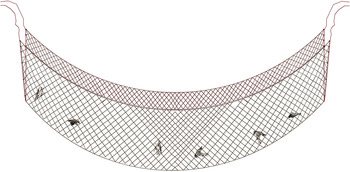
The most likely scenario, therefore, is that represented here is a woman who, apart from a sheaf of flowers, is carrying a folded net with small live birds (for a possible reconstruction of the net see Fig. 8) on her back and arms.Footnote 7 What may be a portion of the posterior of the net, shown protruding from under its front, can also be discerned (Fig. 5:e). With her right hand she holds straps which, threaded through a series of small rings, assist in carrying the net. At this point the realistic rendering of how the net gathers towards the shoulder as the straps stretch should be emphasised: the denser distribution of the rings on the upper arm and the lower height of the meshes in this area give the impression of realism in a most effective way (Figs. 4, 5). The painted, woven or embroidered pattern of swallows flying above rocks on the skirt of the leading figure in the corridor area 3b (see footnote 6) creates an interesting parallel to the captured birds in a net at the upper torso of the woman with the lilies, so much so that one might at first glance assume that it is supposed to be a painted net rather than a real one. In such a case, however, the painter would not have rendered the knotsFootnote 8 and the rigging (straps and rings) so realistically, while he would have taken care to cover the whole width of the arm with the netting pattern.
A possible reconstruction of the bird-catching net held by the woman (drawing by the author).

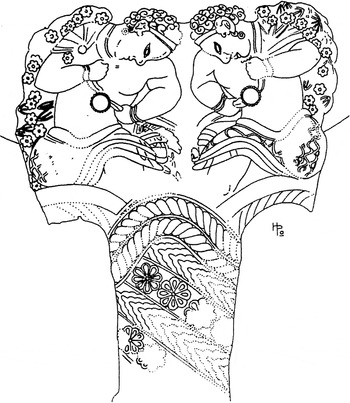
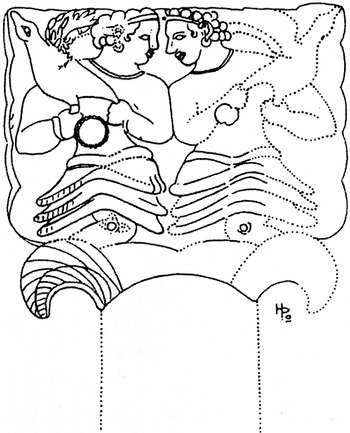
The way the net is being carried could be considered inventive.Footnote 9 However, with slight variations it is also seen in the way in which the two facing female figures depicted in relief on the ivory handle of a bronze mirror from the tholos tomb of Clytemnestra from the Late Helladic IIIB2 period carry a sack full of wild roses, although on the shoulder rather than on the back (Fig. 9) (Poursat Reference Poursat1977, 105–6 no. 331, pl. XXXV; Boulotis Reference Boulotis and Daniilidou2009, figs. 1–2). Always bearing in mind a living model, we should note that, for a net containing live birds that are frantically trying to escape, it is being carried in an admittedly unorthodox way, draped over a person's back and arms. The artist's specific choice could be a result either of the dictates of the iconographic programme which would determine the position of the woman at that particular point (in which case there was no space to render the net hanging from her right hand), or of his intention to retain the iconographic strength of the sheaf of white lilies.
Ivory handle of mirror with two female figures holding sacks with wild roses. From the tholos tomb of Clytemnestra, Mycenae, Late Helladic IIIB2 (after Poursat Reference Poursat1977, pl. XXXV).

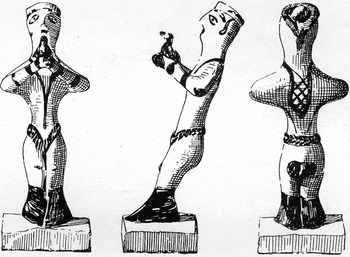
However, the way the net is being carried on the woman's back with the straps ending between her breasts is attested on the Late Minoan IIIA2 clay male figurine discovered by A. Evans on the bench in the Shrine of the Double Axes at Knossos (Evans Reference Evans1928, 339 fig. 192; Sapouna-Sakellaraki Reference Sapouna-Sakellaraki1971, 80 no. 187, pl. 46a; Rethemiotakis Reference Rethemiotakis1998, 26 no. 44, 112 no. 44, fig. 30) (Fig. 10). The man holds a stylised bird in front of his chest with both hands, and on his back is a painted net pattern enclosed in a broad ellipsoid frame, the lines of which extend on the front side of the body, where they converge and form a V-shaped opening. Evans thought that ‘he wears a sleeved jacket with a V-shaped slit in front and a broader opening laced together behind’ (Evans Reference Evans1928, 339). Sapouna-Sakellaraki considers the net pattern a motif to fill the back opening of the bodice (Sapouna-Sakellaraki Reference Sapouna-Sakellaraki1971, 80 no. 187, pl. 46a). Rethemiotakis has noted the tying straps that converge on the chest, but has identified the net pattern on the back with an epinotion (cape) decorated with a net pattern (Rethemiotakis Reference Rethemiotakis1998, 112 no. 44, fig. 30). A number of clay female figurines wear epinotia decorated with a scale or net design that covers the whole or most of the back and even part of the shoulders in some cases, in exactly the same way (Rethemiotakis Reference Rethemiotakis1998, 26 no. 47, 38 no. 130, 45 nos. 183-184, 111–12 no. 47, 130, 183, 184, figs. 16, 18, 19, 41). While it is not clear in the case of the female figurines whether this is a kind of garment or a net, we must stress that the ellipsoid shape of the net on the male figurine from the Shrine of the Double Axes in fact refers to a real net, the meaning of which is undoubtedly reinforced by the presence of the bird held in the hands of the man, who is identified as a worshipper. Furthermore his location on the bench near the figurine of the goddess with raised hands and a bird on her head, makes the act of offering obvious, providing us with a unique, albeit later, iconographic parallel.
Clay male figurine holding a bird and with a painted net on his back. From the Shrine of the Double Axes, Knossos, Crete, Late Minoan IIIA2 period (after Evans Reference Evans1928, fig. 192).

The birds on the Theran wall painting have been identified with small swallows (Vlachopoulos Reference Vlachopoulos, Vlachopoulos and Birtacha2003, 515, 524; 2007a, 114; 2008a, 453) or rock doves (Chapin Reference Chapin, Colburn and Heyn2008, 55–6). However, the larger size of adult rock doves would exclude identification with this species. As for the other proposal, we must note the natural resemblance of juvenile swallows capable of flight to adult birds,Footnote 10 the familiarity of the Theran wall painters with the representation of swallows (Doumas Reference Doumas1992, figs. 69, 72–6, 97–9, 146; Harte Reference Harte2000, 690–5 figs. 7–8), the blue colour – a convention for the rendering of grey – used here to depict the birds, the triangular-shaped tail with a black band defining its end, and red colour only in the throat area, while, by contrast, swallows have a forked tail and red in the area of the head. This suggests that we have here some other kind of bird (Fig. 5). Indeed, given that adult migratory birds capable of traversing long distances are, as a rule, trapped using nets, the assumption that this is what is taking place here is reasonable. The schematic and undetailed method of rendering does not of course allow the precise determination of a species but only the birds' inclusion in the broader order of migratory passerine birds. The fact, however, that the painter takes care to clearly show the red area on the neck perhaps has to do with his intention to portray a species identifiable to the viewer.Footnote 11
As we can infer from the rendering of the net covering the back and arms of the woman, the net must have been a square or rectangle with small rhomboid meshes, made from plant fibres.Footnote 12 The black rings evident at the outer outline of the right arm are likely to represent small metal rings, adapted to the vertical sides of the net through which the thin ropes used for folding and carrying the net were threaded.Footnote 13
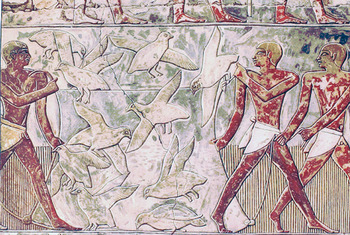
Despite the rarity of bird trapping using nets as a subject in the Aegean iconography of the second millennium bc, in neighbouring Egypt, with the rich avifauna of the Nile Delta and valley – a habitat for predominantly migratory birds, where even today millions of birds are hunted annually using techniques that have remained unchanged for thousands of years (Henein Reference Henein2010, 273–353) – the subject had appeared for the first time by the middle of the First Dynasty (c.2975–2935 bc) on a gaming disc found in the tomb of the chancellor Hemaka at Saqqara (Houlihan Reference Houlihan and Redford2001, 59; Henein Reference Henein2010, 273). Used here is a hexagonal clap-net, a type of net of composite construction that allows the capture of large numbers of birds of large size, and which is constantly present in scenes in pharaonic art related to bird hunting – an activity intended to provide food offerings or sacrifices for the illustrious dead (Henein Reference Henein2002; Reference Henein2010, 273–330, figs. 131–69; Altenmüller Reference Altenmüller, Engel, Müller and Hartung2008, esp. 1, 11–13; Bailleul-LeSuer Reference Bailleul-LeSuer2012b, 24 fig. 1:1).Footnote 14 Also depicted in these scenes, although rarely, is the square ground-net, which first appears in the Old Kingdom mastaba tomb of Mereruka (Sixth Dynasty, c.2325 bc) in a scene showing the trapping of quail (Fig. 11) (Duell Reference Duell1938, pl. 168; Henein Reference Henein2010, 345 fig. 183; Bailleul-LeSuer Reference Bailleul-LeSuer2012b, 25 fig. 1:5). It is depicted again in the New Kingdom tomb chapel of Nebamun (Eighteenth Dynasty, c.1350 bc) (Vandier Reference Vandier1969, 318–20, fig. 144:3; Henein Reference Henein2010, 345 fig. 183; Bailleul-LeSuer Reference Bailleul-LeSuer2012b, 25), also in a quail-trapping scene. This type of bird-trapping net, with cords threaded through its vertical sides, is carried open in Egyptian wall paintings by four male figures, each of whom holds the respective ends of the cords.
Detail of a wall painting from the mastaba tomb of Mereruka showing a scene of bird trapping with a net. Sixth Dynasty, c.2325 bc (after Duell Reference Duell1938, pl. 168).

A folded net similar in shape and construction to those in Egyptian wall paintings must also be what the woman in Xeste 3 is carrying.
The practice of trapping birds with nets, although known in sources from historical times (Homer, Odyssey 22.468; Aristophanes, The Birds 528, 1083; Diodorus Siculus 1.60; Buchholz, Jöhrens and Maull 1973, 103–6; Bub Reference Bub1991, 125–72), is depicted extremely rarely from the fifth century bc until Late Antiquity (Böhr Reference Böhr, Docter and Moormann1999, 78–9, pl. 7a; Chatzidimitriou Reference Chatzidimitriou2005, 123–4, 223 no. Ε28, pl. 54).Footnote 15 The rarity of its depiction in historical times may be associated with the view that the sport of bird hunting was practised by the middle rather than the aristocratic class, and as such was designated an unworthy pursuit for nobles (Plato, Laws 7.823–4; Böhr Reference Böhr, Docter and Moormann1999, 78).
Today the bird-catching net is still used by ornithologists for ringing birds (Fig. 12) and, although prohibited by law, by poachers in the Aegean and Cyprus. When it comes to migratory birds, trapping takes place during the migration periods, that is, spring and autumn. If in the case of Xeste 3 it does indeed concern migratory birds, then the activity coincides chronologically with the two transitional seasons (spring and autumn) symbolically indicated in the iconographic programme of Xeste 3, perhaps to show the timing of specific vegetation festivals which determined the local festival calendar (Boulotis Reference Boulotis and Daniilidou2009, 469–70). Considering the context of Xeste 3 we are obliged in principle to discuss the matter in the framework of the religious celebration of the renewal of nature represented on the first floor of the building. We must also iconographically equate the birds caught in the net with the sheaf of lilies. In both cases they represent an offering.Footnote 16
A modern bird-catching net (photo: M. Dretakis).

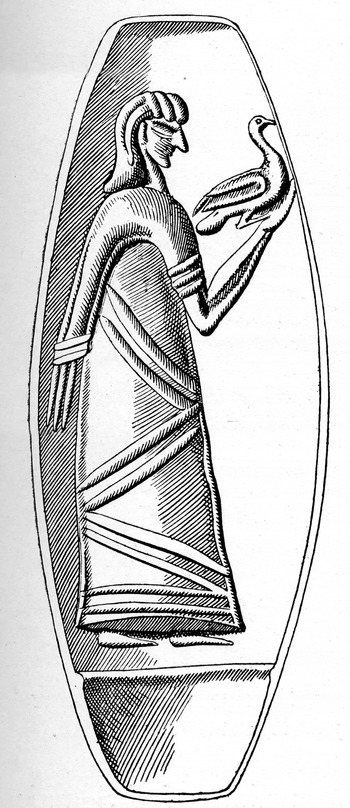
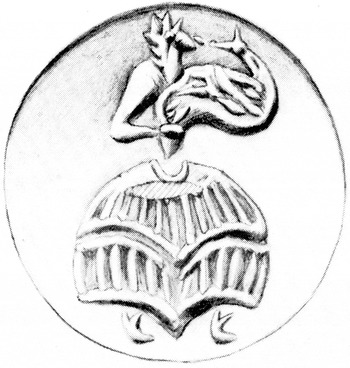
With this in mind, our discussion should include the few scenes which the Aegean iconography of the second millennium bc offers us, in relation to an interpretative approach involving the subject of bird offerings by human figures.Footnote 17 These include an amygdaloid seal of the Late Minoan I–II period apparently from Knossos (Fig. 13) (today in the Ashmolean Museum, Oxford) (Evans Reference Evans1935, 405 fig. 336; Hughes-Brock and Boardman Reference Hughes-Brock and Boardman2009, no. 318 with collected bibliography; Boulotis Reference Boulotis2008, 48 fig. 3a; Crowley Reference Crowley2013, 146 no. E 34) which represents a male figure holding on its open hand a bird and wearing a heavy, diagonally banded robe of reputedly Syrian type, which scholars have designated as indicating a priestly function (Evans Reference Evans1928, 785; 1935, 412; Marinatos Reference Marinatos1993, 127–8, fig. 88; Rehak Reference Rehak1994) or, more precisely, as illustrating both hieratical and political authority (Boulotis Reference Boulotis2008, 48, 50–1). A female figure with a flounced skirt, on a lenticular seal of the Late Minoan IB–II period (Fig. 14), also presumably from Knossos, appears to hold a bird with her bent left arm (Platon and Pini Reference Platon and Pini1984, no. 170; Wingerath Reference Wingerath1995, 69; Krzyszkowska Reference Krzyszkowska2005, 143 no. 254). Although the identification of the object held by the figure as a bird has now been accepted (for opposing views see Wingerath Reference Wingerath1995, 219 n. 395), we still do not have firm clues as to her status, that is, whether she is a worshipper or priestess holding an offering or a deity in the guise of Mistress of Animals (Krzyszkowska Reference Krzyszkowska2005, 143).Footnote 18 However, given that seals are often considered to depict, as pars pro toto, segments of larger narrative compositions (Blakolmer Reference Blakolmer2010), it would be reasonable to assume that the seals mentioned above depict figures who belong to processional compositions, and this will enhance more strongly their potential correlation with the woman from the procession of the first floor of Xeste 3. The very act of offering to the Great Goddess, as shown most discernibly on the wall painting of Xeste 3, recalls the Late Minoan ΙΙΙΑ2 clay male figurine from the Knossian Shrine of the Double Axes (Fig. 10) who holds a bird and apparently bears a net on his back as a codified sign of an especially significant rite. Although the male figure is included in the group of votaries, its presence in the scene represented on the bench in the Shrine, would not exclude, in my opinion, its possible identification with a priest. A representation of two seated women facing each other and holding birds with open wings by the legs (Fig. 15), which is part of the relief decoration of the ivory handle of a bronze mirror of the Late Helladic IIIB2 period from the tholos tomb of Clytemnestra at Mycenae, appears equally ambiguous (Poursat Reference Poursat1977, 106–7 no. 332/2900, pl. XXXV; Boulotis Reference Boulotis and Daniilidou2009, 468 fig. 2). This mirror, like the one with the female figures holding sacks full of wild rose blooms (Fig. 9), belonged to the distinguished occupant of the tomb. Boulotis (Reference Boulotis and Daniilidou2009, especially 477–81) convincingly argues that the dead woman had some hieratic distinction and makes a reasonable connection between the women with the roses on the mirror and some harvest ceremony that would have taken place in the exercise of the dead woman's hieratic duties.
Seal with representation of a ‘priest’ holding a bird. Apparently from Knossos, Crete, Late Minoan I–II period (after Evans Reference Evans1935, fig. 336).

Seal with representation of a female figure carrying a bird. Apparently from Knossos, Crete, Late Minoan IB–II period (after Platon and Pini Reference Platon and Pini1984, no. 170).

Ivory handle of mirror with two female figures holding birds. From the tholos tomb of Clytemnestra, Mycenae, Late Helladic IIIB2 (after Poursat Reference Poursat1977, pl. XXXV).

In the case of the woman from the first floor of Xeste 3, it must not escape our attention that the artist also clearly shows the method used to trap the birds through the depiction of the net. The same thing occurs with the Late Minoan IIIA2 figurine from the Knossian Shrine of the Double Axes, if the identification of the pattern on its back with a net is correct (Fig. 10), as on the Late Minoan IB sealing from Agia Triada (Fig. 1), where the subject of capturing birds with a net is portrayed. In the latter, the Minoan seal carver, following the principle of pars pro toto, focuses on the actual process of trapping, selecting it as an eloquent coded signifier of an act of undoubtedly symbolic/ritual content, as the sealing comes from the bezel of a signet ring, probably of gold. Since, indeed, the repertoire of Minoan gold signet rings derives, as has been argued (Lebessi, Muhly and Papasavvas Reference Lebessi, Muhly and Papasavvas2004, 18–19 n. 80 with collected bibliography; Rethemiotakis Reference Rethemiotakis2008, 82–3; Niemeier Reference Niemeier2010, 23–4), from the iconographic programmes of the palaces where the essence of the religious ideology of the Minoans is reflected, they must have been used by highly ranked officials, including priests. The reason that the net is so emphatically shown in all cases is perhaps related to the fact that hunting with a net is one of the safest ways to trap birds in order to offer them alive. It may, however, be intended to mark a specific ritual event of particular importance, which would have taken place during some religious festival. In the case of Xeste 3, more specifically, it is directly related to the identity of the female figure depicted. Due to their highly elaborated garments and the wealth of their jewellery, she and the rest of the processional troupe have been considered to be adorants who are members of the higher social order of the city (Vlachopoulos Reference Vlachopoulos, Boehm and Müller-Celka2010, 183), which is not incompatible with the hypothesis that they belong to the local hieratic class. If that is the case, it would be useful to examine the possible semantic signification of birds, particularly migratory, as beings that come and go, visiting other regions periodically (Pollard Reference Pollard1977, 14) and so defining the alternations of the seasons and the cycle of nature, and thus of life.Footnote 19 It is possible, of course, that, because of their temporary apparitions, migratory birds were considered to communicate with the deity itself as mediators or messengers. In such case, figures holding a net may belong to the priestly class, given that the priesthood must continuously and emphatically assert its power and its unique and exclusive position to communicate with the deity, among other things.Footnote 20 If so, the representation of the net as a signifier of hunting suggests an act that takes place in the framework of certain celebrations by specific individuals with a unique right. In this way it functions as a codified sign of their class, namely as a symbol of power.
Members of the local elite or of the priesthood of the Great Goddess, the mature women in the procession of the first floor, offer the Potnia wild roses, lilies and crocuses, plants with a special symbolic charge, the gathering of which in the spring and autumn was involved, as it seems, in the sacred economy of the period (Boulotis Reference Boulotis and Daniilidou2009). The presence of the live, probably migratory, passerine birds among the other offerings denotes events the exact content of which escapes us, or even beliefs consolidating the deeper relationship of the birds with the deity.Footnote 21 Their inclusion, however, in the iconographic programme of the first floor cannot be unrelated to how the Great Nature Goddess reveals herself in a landscape full of crocuses in the immediate vicinity of a reed bed, among which ducks and dragonflies fly, especially since she herself wears garments bedecked with flowers and saffron stigmas and necklaces with beads shaped like ducks and dragonflies (Doumas Reference Doumas1992, 131; Vlachopoulos Reference Vlachopoulos and Doumas2008b, 280; 2010, 183). In other words, the Potnia is represented as sovereign of the cosmos, the earthy, watery and airy worlds.
ACKNOWLEDGEMENTS
Special thanks are due to the director of the excavations at Akrotiri, Professor Christos Doumas, for the generous assistance that he offered me and for permission to publish the photographs in Figs. 2–6, to Mr Panagiotis Angelidis for our useful discussions, to Professor Nanno Marinatos and Dr Katerina Trantalidou for their productive suggestions, to Professor Peter Warren for his valuable comments, to Dr Giorgos Rethemiotakis, who drew my attention to the male figurine in Fig. 10, to Dr Vassilis Chrysikopoulos, who shared my enthusiasm for the explorations on Egyptian territory (to him already familiar), and to Mrs Anastasia Caramanis for all her efforts in the translation of the Greek text. Also to Dr Michalis Dretakis, ornithologist at the Natural History Museum of Crete, for suggestions regarding the possibility of identifying the birds depicted and for the photograph in Fig. 12. And, above all, to Kiki Birtacha for her continuous prompting, key suggestions and profound knowledge of the world of feathered travellers, into which she subtly introduced me – hence, the dedication of this article.