I. INTRODUCTION
Recently, there are considerable interests in exploiting high permeability of soft ferromagnetic metal/alloys to fabricate magnetic objects for the growing demands of electromagnetic (EM) compatibility devices application, such as EM wave absorbers or shielding materials. For this purpose, numerous efforts have been focused on the investigation of EM characteristics and absorbing mechanism of flaked ferromagnetic metal/alloy particles owing to their advantages of high saturation magnetization, low eddy current loss, and large permeability value.Reference Kim, Kim, Yoon and Lee1–Reference Qiao, Wen, Wei, Wang and Li6 So far, some magnetic metal/alloy flakes, such as Fe,Reference Kim, Kim, Yoon and Lee1 FeCo/C,Reference Wang, Lv, Huang, Kang and Gu2 Fe3Co2,Reference Zhou, Deng, Xie and Liang3, Reference Yang, Xu, Xia, Wang and Li4 FeCoNi,Reference Deng, Zhou, Xie and Zhang5 FeCuNbSiB,Reference Qiao, Wen, Wei, Wang and Li6 Fe–Cr–Si–Al,Reference Liu, Ma, Tong, Luo and Yan7, Reference Wang, Gong, Luo and Feng8 Fe–Co–Zr,Reference Wang, Gong, Luo and Feng8 FeSiB,Reference Zhou, Liu and Deng9 FeNi,Reference Walser and Kang10 etc., have been successfully fabricated. The theory discloses that shape anisotropy originating from flake-like structures may enhance the natural ferromagnetic resonant frequencies and exceed the Snoek’s limit. Interestingly, the modulation of intrinsic properties for flake-like structures can be achieved by tailoring its size, microstructure, morphology, and substitution of constituent elements. Among the above reported literatures, microstructural and morphological controls have been proved to be as effective as size and composition control in fine-tuning the properties and functions of flaked metal particles.
Despite its fundamental and technological importance of the flaked particles, very limited attention has been paid for systematical investigation of the relationship between the microstructure and properties (e.g., conductivity, dielectric, dynamic magnetic, and microwave absorption characteristics) of flaked metal particles.Reference Kim, Kim, Yoon and Lee1–Reference Tong, Guan, Xiao, Mou, Wang and Yan14
In contrast to other preparation methods, mechanical milling developed by BenjaminReference Benjamin15 is an advanced fabrication process to prepare ferromagnetic flaked metal powders with excellent microwave absorption properties. More importantly, this approach can realize the morphological and dimensional control of metal/alloy flakes in mass production. Herein, the purpose of this research is to study microstructure evolution of flake-shaped Fe particles with grinding speed and to establish the relationship between microstructure and properties (e.g., electrical, magnetic, and microwave absorbing properties). It will enable us to choose the suitable processing condition for obtaining the composites with excellent properties and to further clarify the absorption mechanism of flake-like Fe powders.
II. EXPERIMENTAL
A. Preparation of flaked Fe particles
Spherical Fe powders with an average diameter of 1–3 μm were purchased from commercial suppliers in China. Using the absolute ethanol as media, the raw Fe powders were milled for 10 h by a high-energy planetary ball milling. The ball-to-powder weight ratio was 10:1. The morphologies of the products were adjusted by changing the rotational speed (V) of ball milling from 70 to 250 revolutions per minute (rpm), in which V was used for both the terms “rotational speed” and “grinding speed.”
B. Characterization
The morphology and structure of the samples were characterized using a field emission scanning electron microscopy (Hitachi S-4800, Hitachi, Japan) and x-ray diffraction (XRD; Model D/maxMAX-RB, Rigaku,Tokyo, Japan). The dc electrical conductivity was measured by the standard four-point probe method on pressed rectangular of the flaked iron at room temperature. The as-prepared powders were homogenously dispersed in wax with a volume fraction of 30% (powder) and then pressed into coaxial samples of 3.0 mm in inner diameter and 7.0 mm in outer diameter. The complex permittivity (ε = ε′ − j ε″) and complex permeability (μ = μ′ − j μ″) of the coaxial samples in 2–18 GHz were measured using a vector network analyzer system (Agilent N5230, Agilent, US).
III. RESULTS AND DISCUSSION
For the flaked particles, the ratio of diameter to thickness (D/T) is the key factor to describe the resulting properties and thus determine the final use of the metal flakes.Reference Zhou, Deng, Xie and Liang3, Reference Liu, Ma, Tong, Luo and Yan7 To this end, we had systematically investigated the influences of the ball milling techniques, such as ball milling time, grinding speed, and ball-to-powder weight ratio, on synthesis of flaked Fe particles. Based on the experimental data, it can be confirmed that grinding speed plays an important role in determining the morphology and property of the products.
A. Morphological characterization
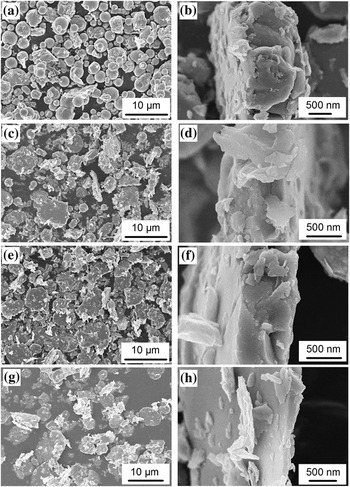
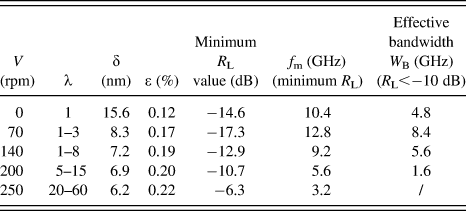
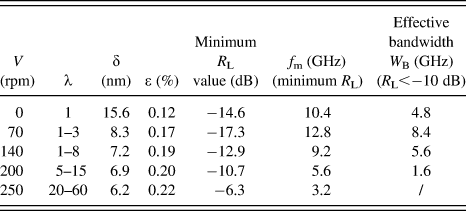
The morphological and dimensional evolution of the Fe particles during ball milling as a function of V is shown in Fig. 1. The spherical Fe particles with an average diameter of 1–3 μm are chosen as raw material. The initial particles, characterized by a narrow D/T distribution, are progressively broken and malleated, which lead to a decrease in the thickness of the flake and an increase in the D/T distribution. The detailed data of the D/T distribution of Fe particles with various V are listed in Table I. It is observed from Figs. 1(a) and 1(b), at relatively low V of 70 rpm, that the products are composed of spherical Fe particles and minor flaked Fe particles with ∼2 μm in thickness. Increasing the V (e.g., to 140 rpm) causes reduction in the number of spherical Fe particles and increase in the number of flaked Fe particles [see Figs. 1(c) and 1(d)]. Meanwhile, the thickness of flaked Fe particles decreases to ∼0.8 μm with the increasing V. Further increase of the V (e.g., to 200 rpm, even to 250 rpm) results in the total disappearance of spherical Fe particles and the appearance of thinner flaked Fe particles [e.g., 0.5 μm at 200 rpm shown in Figs. 1(e) and 1(f) and 0.2 μm at 250 rpm shown in Figs. 1(g) and 1(h)]. The thickness of each flake is below 1 μm, which will favor the decrease of eddy current loss.Reference Qiao, Wen, Wei, Wang and Li6
Scanning electron microscopy images of the products obtained by ball milling at various V: (a, b) 70 rpm, (c, d) 140 rpm, (e, f) 200 rpm, and (g, h) 250 rpm.

Diameter/thickness ratio (λ), average crystal size (δ), internal strain (ε), and EM-wave absorption properties of Fe flakes obtained with various grinding speeds (V).
B. Structural characterization
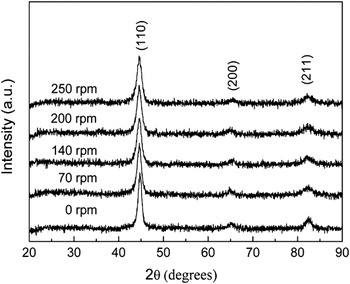
Figure 2 presents the XRD patterns measured in the resultant materials subjected to various V. Three diffraction peaks in the range of 20° < 2θ < 90° are associated with the (110), (200), and (211) planes of body-centered cubic lattice parameter of α-Fe, in accordance with the reported data (Joint Committee on Powder Diffraction Standards Card No. 06-0696). As the V increases, all peaks display a line broadening and a decrease in the intensities, implying a disordered crystal structure resulting from the reduction of crystal size and the increase of internal strain with V. The detailed data of the mean crystallite size (δ) and internal strain (ε) of Fe particles are calculated by the Hall–Williamson equationReference Kim, Chung, Kim and Jeon16 and summarized in Table I. It can be seen that δ decreases from 15.6 to 6.2 nm and ε increases from 0.12 to 0.22% as the V varies from 0 to 250 rpm. Thus, this indicates that flake-like Fe particles with controllable dimension and structures can be facilely realized by fine modulation of only the grinding speed.
X-ray diffraction patterns of the products obtained by ball milling at various V.

C. Conductivity
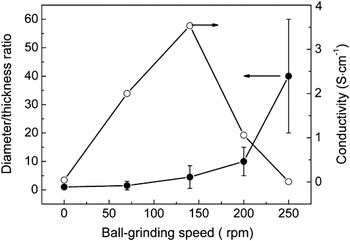
Figure 3 shows the variation of conductivity (σ) of the products with V. It is evident that conductivity exhibits an earlier raised and later decreased state with increasing V to a maximum value. The maximal value of conductivity for flaked particles is 3.534 S/cm at V = 140 rpm, which is approximately 80 times higher than that (0.0435 S/cm) of spherical particles at V = 0 rpm.
Conductivity σ and diameter/thickness ratio of the products obtained with various V.

In general, the conductivity behavior is known to be largely dependent upon their diameter, length, specific surface area, and surface conductivity, as well as the dispersion and the relative concentrations of the conductivity filler within the matrix.Reference Tong, Wu, Hua, Miao, Guan and Qian17 Obviously, in this study, the above phenomena can be associated with the variation in the morphology and microstructure of the products. The high-performance milling used is a combination of microforging, fracturing, and cold welding of iron powders with the help of the gravity and squeezing pressure of the grinding balls from their high-speed rotation. Usually, the quicker is the milling speed, the more easily iron particles are flattened and fractioned. The contribution of V to the conductivity mainly focuses on the following aspects: (i) the microforging role enhancing with the increasing V reduces the thickness of the flaked particles, which will decline the conductivity owing to the shortening of the mean free paths of the conduction electrons of the flaked metal by collisions with the boundaries of the particles.Reference Fuchs18, Reference Hoffmann and Vancea19 (ii) the augmented number of active atoms on the material surface proceeding from the fracturing role may improve the surface conductivity, resulting in the enhanced conductivity. (iii) the decreased crystallite size from 15.6 to 6.2 nm, which is below the critical value (30 nm) reported by the literatures,Reference Klemens and Gell20 make the conductivity reduce with V because of the strong crystallite size–dependent effect.Reference Soyez, Eastman, Thompson, Bai, Baldo, McCormick, DiMelfi, Elmustafa, Tambwe and Stone21 (iv) Additionally, the potential for reduced conductivity arises from the enhanced phonon scattering due to the presence of numerous vacancies and spaced grain boundaries in the material’s high defects.Reference Soyez, Eastman, Thompson, Bai, Baldo, McCormick, DiMelfi, Elmustafa, Tambwe and Stone21 Above all, some important conclusions can be achieved: when the grinding speed is below 140 rpm, the increasing surface with active atoms is the chief factor for the enhancement of the conductivity. On the contrary, the synergistic effect of the other factors, such as crystal size, defects, the thickness of the flaked particle, etc., may take a crucial role in the decreasing conductivity when the grinding speed is more than 140 rpm.
D. The dielectric performance
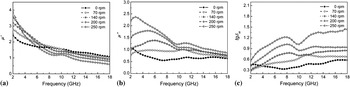
The influences of grinding speed (V) on the complex permittivity of the wax composites with 30 vol% Fe absorbers were systematically investigated, as shown in Fig. 4. Normally, iron is a dual loss matter with magnetic loss and dielectric loss; the dielectric loss includes conductance loss (tgδ c), dielectric relaxation loss (tgδ rel), resonance loss (tgδ res), and others,Reference Tong, Hua, Wu, Qin, Li and Gong12, Reference Tong, Wu, Hua, Miao, Guan and Qian17, Reference Fang, Ye, Zhang and Xie22, Reference Fang, Ye, Zhang, Zhang, Zhao and Yan23 which strongly depends on the conductivity, polarization model, size, morphology, and so forth.Reference Tong, Guan, Fan, Wang and Li24, Reference Fang, Ye, Xie, Wang, Zhao and Zhang25 For raw spherical Fe, the ε′ value is almost constant (ε′ = 15) over 2–18 GHz range and the ε″ value fluctuates in the range of 2.5–4.2. If the volume fraction of the absorbent remains constant (30 vol%) and V is increased from 70 to 250 rpm, the ε′, ε″, and tgδ E of wax composites containing 30 vol% flaked Fe absorbers take on a regular variation. Hereinto, the values of ε′, ε″, and tgδ E slightly decrease at V = 70 rpm owing to the drastically reducing mean crystallite size and increasing internal strain, resulting in the declined dielectric relaxation loss (tgδ rel). However, known from 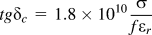 ,Reference Li26 the conductance loss (tgδ c) is directly proportional to σ. Thus, the comeback of the ε′ and ε″ values at V = 140 rpm may mostly be related to the supreme conductance loss (tgδ c) derived from the maximal σ.
Effect of the grinding speed on the complex permittivity (ε = ε′ − jε″) for the wax composites including 30 vol% Fe absorbers. (a) Real part ε′and (b) imaginary part ε″ of the complex permittivity, and (c) dielectric loss tgδ E.

When increasing V to 200 rpm, the ε′ and ε″ values are significantly augmented and are higher than those of the raw Fe. If V is further increased to 250 rpm, it can be observed from Fig. 4 that there is a sharp rise in the ε′, ε″ and tgδ E values, which are around 3, 4–6, and 2–3 times higher than those of the raw Fe, respectively. Based on Fig. 1 and Table I, the sharp increase of the ε′, ε″ and tgδ E at V ≥ 200 rpm may be due to the enhancement of the multiple polarizations containing space charge polarization from the increasing defects, orientation polarization from significantly increasing D/T ratio, and interface polarization from increasing surface area for flakes.Reference Zhou, Deng, Xie and Liang3 This indicates that the thin-flaked Fe absorbents may have higher storage and loss capability of the electric energy than the raw spherical Fe. In addition, an evident resonance peak occurs at 11–13 GHz on the ε″ plots and is reinforced with the increasing D/T ratio. Therefore, the resonance appearing at the permittivity is the intrinsic characteristics of the flaked Fe particles. Moreover, the resonant behavior is related to the multiple polarizations and is very sensitive to the variation in the morphology and microstructure of the as-obtained products.
E. Dynamic magnetic properties
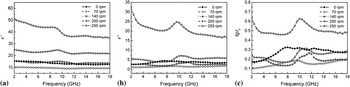
The permeability spectra from 2 to 18 GHz for the wax composites including 30 vol% of Fe absorbers were shown in Fig. 5, which were obtained with various V. From Fig. 5(a), it is seen that the μ′ values gradually decline with the increasing frequency for all the samples because of the eddy current loss induced by EM wave.Reference Liu, Itoh and Machida27 Moreover, it is found that, with increase of V, the μ′ values regularly increase in the low frequency range of 2–6 GHz and decrease in the high frequency range of 6–18 GHz. The variation in the μ′ values can be interpreted as due to the following reasons. First of all, the average crystal size δ decreases and the resulting surface charges increase by increasing V. This raises a larger demagnetizing field in Fe particles, causing the decrease of the μ′.Reference Li, Chen, Ong and Yang28 Second, it is well known that the permeability is inversely proportional to the coercivity H c and directly proportional to saturation magnetization M s.Reference Li, Chen, Ong and Yang28 Obviously, the enhancement of the D/T ratios with the increasing V favors the augment of the shape anisotropy for the resultant products, which thus increases the coercivity H c and decreases μ′. Third, from 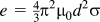 , where e is the eddy current loss coefficient, it is observed that the eddy current loss contributes to the changes of μ′. Therefore, the eddy current loss (equal to ef) is dependent on the thickness of the flake d or T, σ, and frequency f. When the V varies from 200 to 250 rpm, the thickness of the flakes is below the skin depth (1 μm)Reference Sugimoto, Maeda, Book, Kagotani, Inomata, Homma, Ota, Houjou and Sato29 and σ sharply declines. In this case, the effect of the eddy current loss can be neglected. Consequently, what determines μ′ of the thin flakes is the average crystal size and the D/T ratios. On the contrary, the eddy current loss plays a crucial role in the change of μ′ for the spherical Fe and thick Fe flakes formed at V = 0–140 rpm.
Effects of the grinding speed V on the complex permeability (ε = ε′ − jε″) for the wax composites including 30 vol% Fe absorbers. (a) Real part μ′ and (b) imaginary part μ″ of the complex permeability, and (c) magnetic loss tgδ M.

However, the μ″ and tgδ M values present a steady growth with the increasing V, suggesting the enhanced absorption of EM energy. The contribution of eddy current loss to the μ″ is relative with thickness (d) and the electrical conductivity σ according to  ,Reference Wu, Zhang, Hui, Xiao, Ge, Hines, Budnick and Taylor30 where μ 0 is the permeability of vacuum. Obviously, under the condition of V ≤ 140 rpm, the extent of increase in σ is higher than the extent of decrease in d, bringing about the ascending μ″. And when V ≥ 200 rpm, both d and σ decline with increasing V, and the thickness of flakes is below the skin depth.Reference Sugimoto, Maeda, Book, Kagotani, Inomata, Homma, Ota, Houjou and Sato29 In this case, the eddy current loss contribution to the μ″ can be neglected, but the natural resonance originating from the morphological variation of flaked Fe is mainly responsible for the increase in the μ″ and tgδ M values.Reference Qiao, Wen, Wei, Wang and Li6
Meanwhile, two wide peaks can be observed at 2–8 GHz and 10–14 GHz on the μ″ plots. Among them, the peak in the low-frequency range tones up and shifts toward the low-frequency range with increase of V. This indicates that the resonant behavior is very sensitive to the as-obtained products with different morphologies and structures. Also, the similar multiresonance behavior was observed in Co nanoplatelets,Reference Li, Huang, Qin and Ma31 flake-like nanocrystalline Fe3Co2 particles,Reference Zhou, Deng, Xie and Liang3 FeCoNi flake composite,Reference Deng, Zhou, Xie and Zhang5 and granular materials.Reference Toneguzzo, Viau, Acher, Guillet, Bruneton, Fievet-Vincent and Fievet32, Reference Mercier, Lévy, Viau, Fiévet-Vincent, Fiévet, Toneguzzo and Acher33 For granular materials, nonuniform resonance modes originating from the exchange energy contribution to the magnetization precession are possibly the mechanism for this multiresonant behavior. However, shape anisotropy and magnetoelastic effects of the thin flakes are responsible for their multiresonant behavior.Reference Yoshida, Ando, Shimada, Suzuki, Nomura and Fukamichi34 Apparently, in our studies, the low-frequency resonance peak (around 2–7 GHz) may be ascribed to the “exchange mode” resonance as a result of the small size effect, surface effect, and spin wave excitations, whereas the high-frequency resonance peak (around 10–14 GHz) may be associated with natural resonance.
F. Microwave absorption property
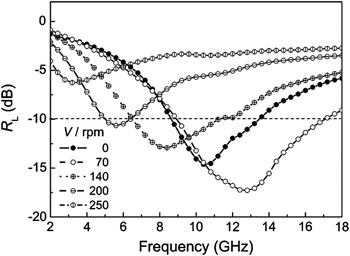
To further reveal the influence of grinding speed (V) on the microwave absorption properties of the Fe absorbers, the reflection loss (R L/dB) can be calculated by the following equations: R L(dB) = 20 log|(Z in − Z 0)/(Z in + Z 0)|,Reference Liu, Itoh and Machida27, Reference Li, Chen, Ong and Yang28 where Z0 and Z in are the impedance of free space and the input impedance at free space and materials interface, respectively. The impedance matching conditions is determined by the combinations of ε′, ε″, μ′, and μ″ at a given frequency (f = 2–18 GHz) and coating thickness (1.5 mm). The results were shown in Fig. 6 and Table I.
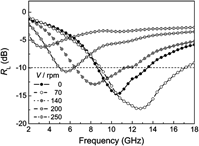
Frequency f dependence of the reflection loss (R L) for the wax composite coatings 30 vol% Fe absorbers obtained at various V with the same coating thicknesses (d = 1.5 mm).

As shown in Fig. 6, an effective bandwidth of spherical Fe particles obtained under the condition of V = 0 rpm (R L = ≤–10 dB, corresponding to 90% attenuation of the incident wave) is obtained in the 8.8–13.6 GHz frequency range, with the minimum R L value of −14.6 dB at 10.4 GHz. While the flaked Fe particles obtained at V = 70 rpm exhibit an optimal microwave absorption characteristic, the R L values less than −10 dB are recorded in the 8.8–17.2 GHz and the minimum R L of −17.3 dB is observed at 12.8 GHz. In comparison with spherical Fe particles with V = 0 rpm, the effective bandwidth (≤–10 dB) is apparently extended from 4.8 to 8.4 GHz and the absorbing intensity also enhances. Based on the EM parameters in Figs. 4 and 5, the above results imply that the matching and absorbing properties can be improved by appropriately decreasing the permittivity and increasing the permeability. When volume fractions (30 vol%) of the filler and coating thickness (1.5 mm) are kept unchanged, further increasing the V from 140 to 250 rpm leads to a significant change in the corresponding microwave absorption properties due to the morphological and microstructural evolution of the resulting absorbers. First, the R L curve is found to gradually shift to lower frequency with the increasing V. Second, the minimum R L value decreases with the increasing V. Third, the effective bandwidth becomes narrower in comparison with flaked Fe particles formed at V = 70 rpm. This demonstrates that the corresponding microwave absorption properties gradually decline with increasing V from 140 to 250 rpm.
It is well-known that broadband reflection loss depends on two conditions. One is impedance match between the coating containing the wax composite and free space to lead the microwave into the coating as much as possible; the other is the absorption of microwave inside the coating, which is usually determined by tgδ E and tgδ M. It is evident that increasing V from 140 to 250 rpm can improve the absorption properties, but the high permittivity and permeability cause the impedance mismatching between the coating containing the wax composite and free space.
Meanwhile, it is worth noting that the effective bandwidth (R L = ≤–10 dB) is 8.8 GHz, which is broader than those reported in the literature, i.e., α-Fe/Ba3Co1.8Fe23.6Cr0.6O41 (∼6.0 GHz and 1.6 mm),Reference Liu, Itoh and Machida27 Co nanoplatelets (∼1.2 GHz and 2 mm),Reference Li, Huang, Qin and Ma31 porous iron powders (1.2 GHz and 2 mm),Reference Tang, Tian, Zhao and Hu35 and Fe nanorods (5.4 GHz and 1.5 mm).Reference Fan, Guan, Wang and Tong36 Furthermore, the single-layered coating of 1.5 mm possesses an effective bandwidth (R L = ≤–10 dB, corresponding to the 90 % attenuation of the incident wave) of 8.8 GHz, which will be considered as a powerful absorber in practical utilization.
IV. CONCLUSION
Polymorphous Fe particles were prepared by the mechanical grinding approach in liquid environment, in which the morphological and structural modulation of the as-prepared products could be achieved by changing only the grinding speed. It is found that the grinding speed plays a crucial role in the modulation of the microstructure and properties of the resultant products. In this study, an increase of the grinding speed from 0 to 250 rpm leads to a decrease in the crystal size (15.6–6.2 nm), an augmentation in both internal strain (0.12–0.22%) and D/T ratio (1–60). The conductivity presents the maximal value at V = 140 rpm owing to the improvement of the surface conductivity. Thin-flaked Fe particles obtained at high grinding speed have higher values for the permittivity and permeability compared with spherical particles originating from multiple polarizations and the natural resonance, respectively. As a result of a proper EM matching and enhanced permeability, an optimal microwave absorption performance may be observed for the iron particles obtained at V = 70 rpm, with effective bandwidth (≤–10 dB) of 8.8 GHz for a coating thickness of 1.5 mm and a minimum R L of −32.55 dB at 3.2 GHz. Thus, the flaked Fe particles with excellent EM properties reported here can be good candidates for EM compatibility devices application in a wide frequency band.
ACKNOWLEDGMENTS
This work was financially supported by Special Grand Science–Technology Project in Zhejiang Province (No. 2010C11053), Natural Scientific Foundation of Zhejiang Province (Grant Nos. Y4100022 and Y4090636), New Bud Talents Grant from Zhejiang Province, and Science and Technology Projects from Jinhua City (Grant No. 2010A12066).