Introduction
Recreational skiing and snowboarding are popular activities in alpine regions, but they are associated with a considerable risk of injury. The incidence of alpine ski injuries has been described by multiple studies in the past.Reference Stenroos and Handolin1–Reference Niedermeier, Gatterer and Pocecco6 However, studies that rely on self-reported injury for data are prone to recall bias, and data from tertiary care providers can be biased because of patient selection.Reference Goulet, Hagel and Hamel7 A more accurate picture of skiing-related injuries can be gained with data from ski resort injury reports, paramedical organizations, and injury registries. Prospectively collected data from injury registries, such as data from emergency service dispatch centers, provide the most accurate depiction of the types of injuries.Reference Ekeland, Rødven and Heir8 Data from single institutions, especially those around ski resorts, with multiple medical facilities are less reliable due to selection bias. Instead, large-scale registry data focusing on a large geographic area are most accurate in terms of depicting the full spectrum of injuries.
Studies performed a few decades ago reported wide varying injury rates of 1.43–8.00 per 1,000 skiing days.Reference Kim, Endres and Johnson2,Reference Costa-Scorse, Hopkins and Cronin3,Reference Telgheder and Kistler9–Reference Burtscher, Gatterer and Flatz12 There have been constant improvements in safety gear and technical advancements in sporting equipment, especially modern ski bindings.Reference Posch, Burtscher and Schranz13–Reference Bailly, Laporte and Afquir15 There is also increasing awareness about injuries and education focused on injury prevention among the general population.Reference Ruedl, Pocecco and Brunner16 These advances mandate a re-evaluation of the types and frequency of skiing and snowboarding injuries.
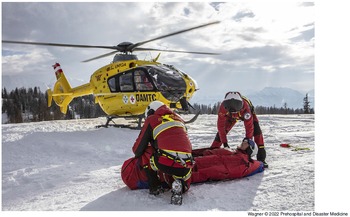
The public emergency dispatch center in the state of Tyrol (Austria) has been in service since 2008. This emergency service dispatch center receives all emergency phone calls within the area of Tyrol and coordinates all the rescues in the area. Patient evacuation from alpine territory is mostly performed terrestrially by ski-patrol services, and most ski resorts have on-call ski patrol services during opening hours. The old-fashioned “Akia” is used for patient transportation in the prone position, and the ski-doo is used for patients who can still sit upright. In patients with severe injuries, and in areas that are difficult to reach, helicopters are used for patient transportation. During the winter season, 16 helicopters are readily available for service in Tyrol. All these helicopters are equipped with a pilot, a paramedic, and an emergency physician (Figure 1). This is the highest number of rescue helicopters per square kilometers world-wide. However, the time efficiency of airborne rescue in alpine regions has never been scientifically investigated.
Airborne Rescue in this Region is Performed with Helicopters Equipped with a Pilot, a Paramedic, and an Emergency Physician.

Since March 2020, the coronavirus disease 2019 (COVID-19) pandemic has affected all fields of medical care, as the use of personal safety gear was also mandated for emergency services. The effects of COVID-19 precautions on the time efficiency of alpine rescue have not yet been evaluated.
The present study seeks to fill in the gaps in the literature mentioned above. To this end, the purpose of this study was: (1) to evaluate the types of injuries and compare them to those reported in previous studies; (2) to compare the time efficiency of airborne rescue and ski patrol; and (3) to compare the time efficiency of these services before the COVID-19 pandemic and after the pandemic, when the use of personal protective equipment was mandated.
Methods
This cross-sectional study was approved by the ethical committee of Innsbruck, Austria (1244/2021). The inclusion criteria were injuries on ski slopes that required emergency service assistance in the state of Tyrol in Austria. Data were obtained for five complete winter seasons, that is, from October 2016 through May 2021. A total of 10,143 patients met the inclusion criteria.
Data on all injuries were prospectively collected by the state emergency services dispatch center (Leitstelle Tirol gGmbH; Tyrol, Austria). This emergency dispatch center receives all emergency phone calls and coordinates all rescue missions. The emergency dispatch center collects data for each rescue mission, including time of arrival at the scene and time of arrival at the hospital, age of the patient, location of the patient, mechanism of injury, type of injury, injured anatomical region, and severity of the injury. Data are collected from the caller and the rescue services. Data on environmental conditions include local weather and distance of visibility, which are carefully evaluated to determine whether airborne rescue is possible. Patients with injuries that did not require the assistance of emergency services were not included in this study. In this region, COVID-19 protective measures with the use of personal protective equipment, including a FFP2 mask, were introduced in March 2020 for all emergency services, including airborne rescue services.
Descriptive statistics were used to describe the dataset. Numerical variables were expressed as mean, standard deviation (SD), and ranges. Categorical values were presented as absolute and relative frequencies. The incidence of injuries was described per thousand skier-days, in accordance with the findings of previous studies. Odds ratios (OR) were used to describe the strength of association between events. The chi-square test was deployed to calculate statistical significance for differences between categorical variables. The level of significance was set at <.05.Reference Mansournia, Collins and Nielsen17
Results
A total of 10,143 patients met the inclusion criteria, and their average age was 33.5 years (SD = 20.36).
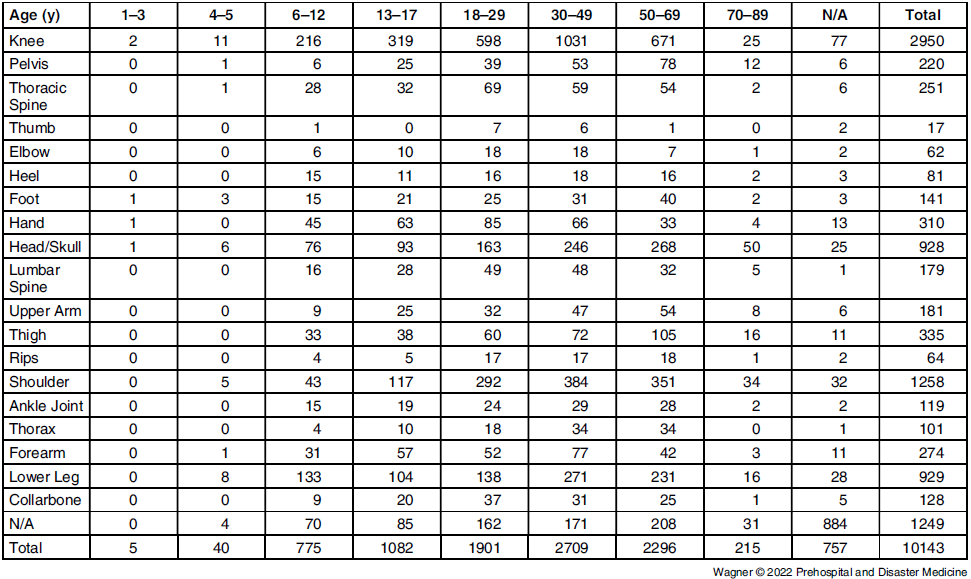
The most frequently injured region was the knee (n = 2,950; 30.2%), and it was followed, in descending order of incidence, by the shoulder (n = 1,258; 12.9%), the lower leg (n = 929; 9.5%), and the head (n = 928; 9.5%); Table 1. In some cases, more than one anatomical region was injured (n = 541; 5.9%).
Number of Injuries to Different Anatomic Regions According to Age

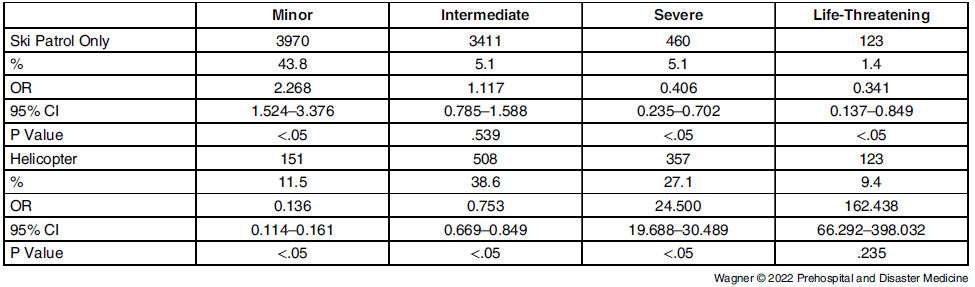
The average age of the included patients was 33.5 years (SD = 20.36). The ski patrol was involved in nearly all the injuries (n = 9,062; 98.6%), and 14.3% of the patients (n = 1315) required helicopter rescue. With regard to severity, most of the injuries were rated as minor (n = 4,003; 43.6%) or intermediate (n = 4,093; 44.5%). Injuries rated as severe (n = 475; 5.2%) and life-threatening (n = 128; 1.4%) were less common (Table 2). The majority of injuries rated as critical were injuries of the head (n = 118; 21%; OR = 3.119; 95% CI, 2.489–3.908; P <.05). Many of the accidents that occurred as a result of impact with a stationary object resulted in critical injury (n = 28; 34.1%; OR = 10.048; 95% CI, 6.304–16.016; P <.05). However, accidents caused by collision were less likely to result in a critical injury (n = 137; 20.4%; OR = 6.198; 95% CI, 4.989–7.700; P <.05). Overall, most of the injuries were classified as minor injuries (n = 3,631; 48.3%; OR = 3.284; 95% CI, 2.902–3.716; P <.05).
Severity of Injuries in Patients Rescued by Ski Patrol and Helicopter Services

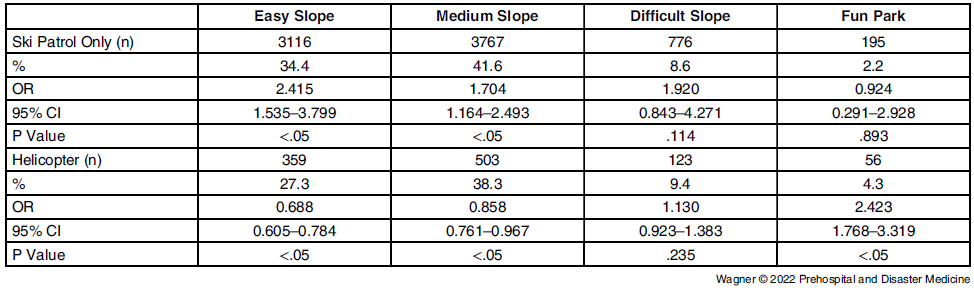
Most of the accidents with injuries in multiple regions occurred under conditions of sunshine and good visibility (n = 385; 71.2%; OR = 1.398; 95% CI, 1.155–1.692; P <.05). The most frequent causes of injury were falls (n = 7,315; 81.7%) and collisions (n = 672; 7.3%). The steepness of a slope is categorized as easy when the inclination is less than 25%; medium or intermediate when the inclination is less than 40%; and difficult when the inclination is more than 40%. Most injuries occurred on slopes for intermediates (n = 3,805; 41.4%) and slopes for beginners (n = 3,139; 34.2%), and fewer injuries occurred on slopes for experts (n = 782; 8.5%) and in the freestyle area (n = 198; 2.2%). In contrast to the findings for frequency, the severity of injuries was higher on slopes for experts (P <.001) and in the freestyle area (P <.001); Table 3. Patients who sustained injuries in the freestyle area required airborne rescue significantly more often (freestyle area, 28.3%; overall, 14.3%; P <.001).
Number of Injuries According to Slope

The mean duration from the emergency phone call until the emergency services reached the patient at the scene of injury was 17 minutes (SD = 11) when the helicopter was deployed; this was significantly shorter (P <.001) than when the ski-patrol service was deployed (31 minutes; SD = 21). The duration from phone call until arrival at the hospital was also much shorter with the helicopter (48 minutes; SD = 20) than with the ski patrol (one hour and three minutes; SD = 32 minutes). Ski patrol required 11 minutes longer (P <.001) to reach the patients on steeper slopes (intermediate and difficult) than on beginner slopes (32 minutes; SD = 22 versus 21 minutes; SD = 20). The helicopter required only one minute longer to reach patients on the steep terrain of difficult slopes.
Before the COVID-19 pandemic, the duration of time required for the patient to arrive at the hospital was significantly shorter than that after institution of safety measures after the COVID-19 pandemic (49 minutes versus 54 minutes; P <.001). This effect did neither differ between airborne and terrestrial rescue nor between any other factors.
Discussion
In the present study, a total of 10,143 alpine injuries were analyzed in detail. The most frequent site of injury was the knee, which is in agreement with the findings of numerous previous studies.Reference Stenroos and Handolin1,Reference Kim, Endres and Johnson2,Reference McBeth, Ball and Mulloy5,Reference Ekeland, Rødven and Heir8,Reference Telgheder and Kistler9,Reference Aschauer, Ritter and Resch18–Reference Davidson and Laliotis26 These study results show that the lower extremities sustain a slightly higher number of injuries; this is probably because patients with such injuries are unable to ambulate and require emergency services more often.Reference McBeth, Ball and Mulloy5,Reference Ruedl, Bilek and Ebner27 None of the previous studies have described the time efficiency of alpine rescue services.
Developments in safety measures, such as improvements in the preparation of ski slopes and signs for dangerous crossings and difficult territory, have led to an overall decline in the risk of injury.Reference Hildebrandt, Mildner and Hotter14,Reference Ruedl, Pocecco and Brunner16 The injury patterns have also changed, as bimodal distribution of many mild low-energy injuries on beginner slopes and a few severe injuries on difficult slopes was observed. Personal protective gear reduces the risk of injury on an individual level; therefore, awareness campaigns and education for injury prevention should be emphasized. The majority of injuries occurred in the knee, and modern ski bindings are intended to reduce the risk of such injuries.Reference Posch, Burtscher and Schranz13,Reference Werner and Willis28,Reference Ruedl, Helle and Tecklenburg29
In the area that was studied in the present study, a high number of airborne rescues were conducted. Airborne rescue plays a major role in the mountains. Over the course of five winter seasons, a total of 1,315 helicopter flights were recorded for alpine ski and snowboard injuries; to the authors’ knowledge, this number is higher than that reported in any previous study so far.Reference Stenroos and Handolin1,Reference Gaudio, Barbieri and Feltracco30–Reference De Roulet, Inaba and Strumwasser32 Airborne rescue is mandatory for search and rescue missions after avalanches, in off-piste areas, and in patients with life-threatening injuries; however, its deployment in easily accessible terrain should be evaluated. To the authors’ knowledge, the cost-effectiveness and clinical benefits of airborne rescue on ski slopes that are generally accessible by ski patrol have only been partially evaluated.Reference Blancher, Albasini and Elsensohn31,Reference De Roulet, Inaba and Strumwasser32 This study showed that airborne rescue has significant benefits in terms of time efficiency. However, most patients who were evacuated by airborne rescue services had no life-threatening injuries. This implies that the threshold for deploying airborne rescue services is too low in this region, and ski-patrol services could be deployed in more cases for transporting patients to hospitals.
This study assessed the time effectiveness of alpine rescues before and after the COVID-19 pandemic and found a five-minute prolongation with the use of personal protective equipment. No other studies were found for comparison. This is the first study to systematically assess time-effectiveness of airborne rescue and the influence of the COVID-19 safety measures on rescue in alpine regions. To date, this is the fourth-largest individual study on alpine skiing and snowboarding injuries based on sample size in general.Reference Telgheder and Kistler9 All the data were gathered electronically and in a standardized fashion from the emergency service dispatch center.
Limitations
This was a cross-sectional study without follow-up data. No information about individual personal protective gear and personal safety measures was available. Further, the patient sample was not divided into skiers and snowboarders. Finally, due to data protection policies, no information about the sex of the patients was provided to the authors.
Conclusion
The present findings indicate that the most frequent site of injuries on alpine slopes is the knee, and life-threatening injuries are rare. Airborne rescue is very time-effective, however clinical studies with patient follow-up should be emphasized to determine the impact of airborne rescue on patient outcome. The present findings indicate that the duration of all rescue operations has been prolonged as a result of the introduction of safety measures during the COVID-19 pandemic.
Conflicts of interest/funding
The authors declare that they have neither financial nor non-financial competing interests. This research did not receive any specific grant from funding agencies in the public, commercial, or not-for-profit sectors. None of the authors have any conflicting interest regarding this manuscript.
Author Contributions
All authors have been actively involved in writing and revising all sections of this manuscript.
Moritz Wagner conceived of the study, generated its design, drafted the manuscript, and acts as first author and as corresponding author.
Pfurtscheller Simon helped to gather the data, as well as drafting and editing the manuscript, and acts as co-author.
Dietmar Dammerer participated in the study design and acts as co-author.
Paul Nardelli participated in the study design and helped with data acquisition and acts as co-author.
Gerhard Kaufmann helped to draft the manuscript and acts as co-author.
Alexander Brunner participated in the study design, drafted the manuscript, and acts as senior author.
Acknowledgements
The authors wish to thank the state emergency dispatch center (Leitstelle Tirol Gemeinnützige GmbH, Tirol, Österreich) for providing the data and supporting the authors.