Introduction
Stripe rust is considered as one of the most destructive diseases affecting wheat. It limits the high production of wheat. For combating with stripe rust disease, numerous approaches have been made in worldwide. The use of fungicides has proved to be successful to reduce the damages to some extent; however, it has many side effects and not affordable by farmers of developing countries such as Pakistan (Chen, Reference Chen2007). The most operative, cost-effective and eco-friendly technique is growing genetically resistant varieties (Cabuk et al., Reference Cabuk, Aydin and Uncuoglu2011). Genetic resistance has been proposed as pyramiding of resistant genes. This results in a wheat variety equipped with a combination of more than one gene of resistance, such a variety will sustain longer against the pathogen as it is easy for the pathogen to take over one gene, but it requires a long time to take over more than one resistant gene (Singh et al., Reference Singh, William, Huerta-Espino and Rosewarne2004).
For gene pyramiding, identification of new or effective resistant genes in different germplasm is prerequisite (Sumíková and Hanzalová, Reference Sumikova and Hanzalova2010). The traditional way of gene postulation is very labour-intensive and time-consuming. It requires multipathotype testing in which a host cultivar is evaluated against a collection of isolates carrying different avirulence/virulence gene combinations (pathotypes) on the basis of phenotypic expressions in the form of infection types (ITs). During last two decades, marker-assisted selection (MAS) that laid down the foundation of plant molecular breeding has strengthened field of agriculture in general and plant breeding in particular (Naik et al., Reference Naik, Gill, Prakasa, Gupta, Tamhankar, Putjar, Gill and Ranjekar1998; Mukhtar et al., Reference Mukhtar, Rahman and Zafar2002). Rust resistance genes can be tagged with tightly linked DNA markers, and selection based on these markers improves the efficiency of breeding programmes with known genes (Todorovska et al., Reference Todorovska, Christov, Christova and Vassilev2009). With the advent of MAS, gene pyramiding, in which genes identified in different genotypes are deployed into a single cultivar that contains desired alleles at more than one locus, has become efficient (Joshi and Nayak, Reference Joshi and Nayak2010). Moreover, several resistance genes can be tracked simultaneously by testing for the presence of multiple molecular markers (multiplexing) at any stage of plant life cycle such as seed or seedling (Gold et al., Reference Gold, Harder, Townsley-Smith, Aung and Procunier1999). In addition, molecular markers are not affected by environment.
Bux et al. (Reference Bux, Ashraf, Hussain, Rattu and Fayyaz2012) postulated that the presence of Yr3, Yr5, Yr10, Yr15, Yr36, YrSP and YrCV resistant genes in synthetic hexaploids on the basis of virulence/avirulence during glass house screening, and also suggested the presence of some novel genes for stripe rust resistance. The plant materials used in this study were reported to be resistant at seedling and adult plant stage (Bux et al., Reference Bux, Ashraf, Hussain, Rattu and Fayyaz2012). In the present study, only these resistant synthetic lines along with some other resistant lines were screened again for their seedling resistance, and molecular markers were used to confirm the presence of the postulated genes using molecular markers that are reported to be linked with known stripe rust resistant genes.
Materials and methods
The resistant synthetic hexaploids of wheat used in this study are shown in Table S1 (available online), which acquired from Department of Wheat Wide Crosses and Cytogenetics of National Agriculture Research Council (NARC), Islamabad (Table S1, available online).
Pathogen/inoculum
The bulk inoculum of Puccinia striiformis f. sp. tritici, collected from different wheat growing of areas of Pakistan, was used for the screening of synthetic hexaploid of wheat. The inoculum has virulence for genes Yr1, Yr2, Yr6, Yr7, Yr8, Yr9, Yr17, Yr24, Yr26, Yr28, Yr29 and Yr31, and avirulent to Yr3, Yr5, Yr10, Yr15, YrSP and YrC.
Seedling evaluation
Approximately five to seven seeds of each genotype were planted in pots under greenhouse conditions. Four to six-week-old seedlings were inoculated with suspension of urediospore suspended in mixture of 30:70 (% v/v) mineral oil and petroleum ether. The inoculated plants were placed in open air for 2 h to evaporate the petroleum ether. Plants were transferred to a dew chamber set at 10°C with 16 h light and 8 h dark photoperiod for 48 h. The plants were then transferred to the greenhouse set at 6–10°C temperature (Rizwan et al., Reference Rizwan, Ahmad, Mujeeb-Kazi, Ghulam Mustafa, Javed Iqbal, Rattu and Ashraf2010).
Disease scoring
ITs were recorded at the two-leaf stage after inoculation using a 0–9 scale (McNeal et al., Reference McNeal, Konzak, Smith, Tate and Russell1971) when pustules were fully developed on Morocco. IT scores of 0–3 were considered as resistant, 4–6 intermediate resistance and 7–9 highly susceptible.
Molecular analysis through Yr-linked simple sequence repeats (SSRs)
Genomic DNA was isolated from young leaves of synthetic hexaploids (Cota-Sánchez et al., Reference Cota-Sánchez, Remarchuk and Ubayasena2006). All polymeric chain reactions (PCRs) were carried out in 10 μl reaction mixture containing 50–100 ng DNA template, 10 × PCR buffer, 1.5 mM MgCl2, 10 mM of dNTPs, 10 μm each primer and 1.25 units of the Taq DNA polymerase. In total, seven Yr-linked SSR markers were used and their PCR cycling conditions were followed as described for three Beltsville Agricultural Research Center (BARC) markers (Song et al., Reference Song, Fichus and Cregan2002), one Wheat Microsatellite Consortium (WMC) marker (Gupta et al., Reference Gupta, Balyan, Edwards, Isaac, Korzun, Roder, Gautier, Joudrier, Schlatter, Dubcovsky, De La Pena, Khairallah, Penner, Hayden, Sharp, Keller, Wang, Hardouin, Jack and Leroy2002), one satellite marker for A genome (CFA) marker (Sourdille et al., Reference Sourdille, Singh, Cadalen, Brown-Guedira, Gay, Qi, Gill, Dufour, Murigneux and Bernard2004) and one marker developed at University of California, Davis, CA, USA (UHW) marker (Dubcovsky, Reference Dubcovsky2006) (Table 1). The PCR products were separated on 1.5% agarose gel, stained with ethidium bromide, and visualized using an automatic gel imaging analysis system.
Description of marker along with PCR conditions

Statistical analysis
Allelic Polymorphic Information Content (PIC) for each microsatellite locus and genetic diversity were analysed with PowerMarker version 3.25 software (Liu and Muse, Reference Liu and Muse2005).
Results
Seven allele specific- or gene-linked markers were used to detect the presence of seven genes in synthetic hexaploid of wheat. The result of seedling screening showed that these wheat accessions were resistant at the seedling stage (Table S1, available online).
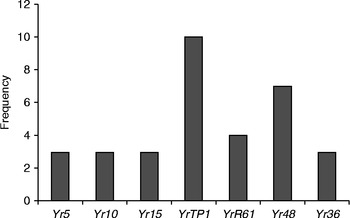
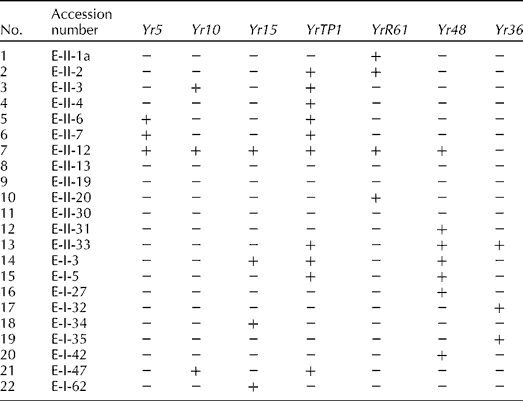
Molecular marker-based gene identification showed the presence of Yr5 in four accessions, Yr10 and Yr15 in three accessions, Yr36 in five accessions, Yr48 in seven accessions, YrR61 in six accessions, and YrTP1 in ten accessions of resistant hexaploid of wheat (Fig. 1). The result of study showed that EII-12 accession of synthetic hexaploid of wheat showed the presence of five yellow rust resistant genes on the basis of gene-linked markers (Table 2).
Frequency distribution of stripe rust resistant genes among resistant synthetic hexaploid of wheat.

Presence or absence of stripe rust resistant genes in wheat accessions

− , Absence of gene; +, presence of gene.
Molecular identification of Yr5
Xbarc124 located on 2B was used for the molecular identification of Yr5 gene. The marker amplified a band of 255 bp in three accessions of synthetic hexaploid of wheat, D67.2/P66.270//Ae. Squarrosa (497), D67.2/P66.270//Ae. Squarrosa (308) and SORA/Ae. Squarrosa (192).
Molecular identification of Yr10
Xpsp3000 was used for the identification of Yr10 gene. The marker amplified a band of 286 bp in three accessions that include, CETA/Ae. Squarrosa (417), SORA/Ae. Squarrosa (192) and 68.111/RGB-U//WARD/3/FG/4 RAB/5/Ae. Squarrosa (882).
Molecular identification of Yr15
Xbarc8 located on 1B amplified a band of 245 bp in SORA/Ae. Squarrosa (192), ALTAR 84/Ae. Squarrosa (192) and SCA/Ae. Squarrosa (518).
Molecular identification of Yr36
Xuhw89 identified a band of 126 bp in DOY1/Ae. Squarrosa (534), DOY1/Ae. Squarrosa (447) and 68.111/RGB-U//WARD/3/Ae. Squarrosa (511).
Molecular identification of Yr48
Xcfa2149 located on 2A identified a band of 255 bp for the presence of Yr48 genes in SORA/Ae. Squarrosa (192), 68.111/RGB-U//WARD RESEL/3/STIL/4/Ae. Squarrosa (385), DOY1/Ae. Squarrosa (534), ALTAR 84/Ae. Squarrosa (192), ALTAR 84/Ae. Squarrosa (198), GARZA/BOY//Ae. Squarrosa (311) and YAR/Ae. Squarrosa (783).
Molecular identification of YrR61
Xbarc124 reported to be linked with Yr61 amplified a band of 215 bp in CETA/Ae. Squarrosa (392), GAN/Ae. Squarrosa (335), SORA/Ae. Squarrosa (192) and CPI/GEDIZ/3/GOO//JO/CRA/4/Ae. Squarrosa (1018).
Molecular identification of YrTP1
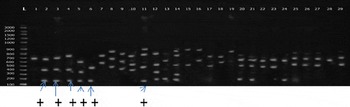
Xwmc47 located on 2B was used for the identification of YrTP1 in synthetic hexaploid. The expected band size was 167 bp. The marker identified the presence of the resistant genes in GAN/Ae. Squarrosa (335), CETA/Ae. Squarrosa (417), SKARV_2/Ae. Squarrosa (304), D67.2/P66.270//Ae. Squarrosa (497), D67.2/P66.270//Ae. Squarrosa (308), SORA/Ae. Squarrosa (192), DOY1/Ae. Squarrosa (534), ALTAR 84/Ae. Squarrosa (192), ALTAR 84/Ae. Squarrosa (198) and 68.111/RGB-U//WARD/3/FG/4 RAB/5/Ae. Squarrosa (882) (Fig. 2).
Molecular identification of YrTP1 gene in stripe rust resistant synthetic hexaploid of wheat using WMC447 (left to right lane correspond to serial number in Table S1 (available online)).

Allelic variation
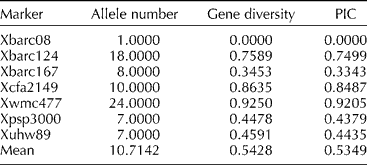
A total of 68 alleles were detected with the seven markers linked with resistant genes reported on A and B genomes were used to evaluate and characterize the genetic diversity of the 51 stripe rust resistant synthetic hexaploid wheat accessions. The number of alleles per locus ranged from 1 to 24. Genetic diversity values ranged from 0.34 to 0.93, with the highest genetic diversity value of 0.93 detected for marker Xwmc477. The lowest genetic diversity value was observed for marker Xbarc167. The mean genetic diversity values were observed to be 0.56.
In this study, the polymorphic index content value ranged from 0.33 to 0.92 with an average of 0.55. The highest number of alleles (n= 24) were detected for marker Xwmc477, which were linked to YrTP1 (Table 3).
Description of linked SSR/STS marker's along with PIC values

Discussion
An important field in which molecular markers are used in wheat resistance breeding is the determination of designated resistance genes in genotypes where the genetic background has not yet been clarified, like most commercial cultivars. Vanzetti et al. (Reference Vanzetti, Campos, Demichelis, Lombardo, Aurelia, Vaschetto, Bainotti and Helguera2011) postulated the presence of leaf rust resistant genes using the traditional methods of gene postulation and then they confirm the postulated genes, using the molecular markers linked the different leaf rust resistant genes. They concluded that this approach overcomes some of the problems associated with traditional gene postulation, such as gene interactions and plant stage of gene expression.
For the past few years, scientists are working on the molecular identification of genes (Vanzentti et al., Reference Vanzetti, Campos, Demichelis, Lombardo, Aurelia, Vaschetto, Bainotti and Helguera2011). PCR-based marker has been used to identify the presence of stem rust resistance genes in major Pakistani wheat cultivars. A total of 18 DNA markers were used to detect the presence of stem rust resistant genes in 117 Pakistani wheat varieties. With the help of using DNA markers, it was confirmed that most of the Pakistani wheat varieties are susceptible for the most dominant stem rust race Ug99 (Ejaz et al., Reference Ejaz, Iqbal, Shehzad, Rehman, Ahmed and Ali2012). Similarly, 83 Irani wheat genotypes were studied using sequence tagged site (STS) and sequence characterized amplified regions (SCAR) markers that were linked with five major leaf rust resistant genes (Kadkhodaei et al., Reference Kadkhodaei, Dadkhodaie, Assad, Heidari and Ghalamfarsa2012). The presence of genes for Scab and powdery mildew was studied using the molecular markers in 279 apply cultivars. (Patzak et al., Reference Patzak, Frantisek and Henychova2011) also concluded that molecular makers are very powerful tools for the identification of presence of resistance genes.
PCR molecular markers associated with resistance genes can easily select genotypes with one or multiple resistance genes. Molecular markers, especially PCR-based markers, can be used to identify resistance genes in cultivars, pyramid them in a suitable background, and to assist in selecting lines with appropriate gene(s) (Sumíková and Hanzalová, Reference Sumikova and Hanzalova2010). Zeng et al. (Reference Zeng, Han, Wang, Yuan, Wu, Zhang, Wang, Huang, Chen and Kang2014) postulated Yr5, Yr9, Yr10, Yr15, Yr17, Yr18 and Yr26 resistance genes using molecular markers in major Chinese wheat cultivars. Yr3, Yr5, Yr10, Yr15, Yr26, YrSP and YrCV genes have been found effective against the stripe rust. Out of these effective genes, the presence of Yr3, Yr5, Yr10, Yr15, YrSP and YrCV genes was predicted on the phenotypic basis in the synthetic hexaploid of wheat (Bux et al., Reference Bux, Ashraf, Hussain, Rattu and Fayyaz2012). In the present study, these resistant accessions were screened again to confirm their resistance and molecular markers, reported to be tightly linked with postulated genes as well some other genes, were used for the molecular marker-based identification of postulated resistant genes. This study showed the presence of Yr5, Yr15 and Yr10 genes were present in three synthetic wheat accessions, while YrTP1 was present in ten accessions, Yr36 in three accessions and Yr61 in four accessions of synthetic hexaploid wheat. For the validation and confirmation of these identified genes, the accessions carrying these genes can be tested against the inoculum that carries the virulence for these genes.
Resistant wheat accession EII-1a carrying only Yr61 can be crossed with EI-62 carrying Yr15, EII-31 carrying Yr48 and EI-32 carrying only Yr36 genes to pyramid all these four genes in one accession. In this way the durability for stripe rust resistance can be increased as if a gene is deployed alone in a variety it could be of little use as this gene can lose it effectiveness on the arrival of virulence. Not only in Pakistan but also in other parts of the world, development and adoption of high-yielding wheat varieties with single gene for resistance, has led to cultivation of fewer varieties over large area. This trend has resulted in the onset of new pathotypes of new pattern making the dominant variety susceptible. This was observed previously in Pakistan when the leading cultivars Pak 81 and Pirsabak 85 were seriously affected by the emergence of virulence for the stripe rust genes Yr9 and Yr7, respectively (Ahmad et al., Reference Ahmad, Rodriguez, Farid, Roidar and Panah1991; Afzal et al., Reference Afzal, Haque, Rauf, Ahmad and Firdous2010). Therefore, the breeding for the stripe rust resistance requires the utilization of genetic material that contains multigenic resistance, because if different combinations of genes are used then a variety can not only withstand the pathogen for longer time it can also be deployed in different regions (Pedersen and Leath, Reference Pedersen and Leath1988). The synthetic hexaploid wheat in this study could provide a valuable source for the improvement of stripe rust resistance of Pakistani bread wheat cultivars. These accessions can be used in wheat breeding programmes. As hybridization between synthetic hexaploids and bread wheat is feasible (Mujeeb-Kazi et al., Reference Mujeeb-Kazi, Alvina, Farooq, Rizwan and Ahmad2008). Many important genes related to rust have been transferred to wheat varieties using synthetic hexaploid of wheat. Hybridization of bread wheat with synthetic hexaploids enabled the introgression into its genome of genes that control resistance to leaf rust Puccinia triticina, stem rust Puccinia graminis Sr46 yellow rust P. striiformis including the Yr28 gene (Mujeeb Kazi et al., Reference Mujeeb-Kazi, Alvina, Farooq, Rizwan and Ahmad2008). Chuanmai 42 carrying YrCH42 stripe rust resistant gene was the first The International Maize and Wheat Improvement Center (CIMMYT) synthetic derivative released in the world, and the high yield potential wheat cultivar (Zhang et al., Reference Zhang, Yang, Peng, Li and Zheng2006).
In this study the synthetic accession EII-12 is reported to carry five different genes for stripe rust resistance, this accession should be tested using specific races and on the phenotypic validation this accession could contribute to gene pyramiding of stripe rust resistance genes. Similarly, the synthetic hexaploid possessing more than one gene can be crossed with stripe rust susceptible, but agronomically strong wheat variety to incorporate stripe rust resistant genes.
Supplementary material
To view supplementary material for this article, please visit http://dx.doi.org/10.1017/S1479262115000283
Acknowledgements
The research work has been funded by Higher Education Commission Pakistan (HEC). The authors of this paper are thankful to HEC for providing financial assistance to carry out the research work (project no. IPFP/HEC/2011/0213).