

Introduction
According to the 2015 World Population Prospects report (United Nations, Department of Economic and Social Affairs, Population Division, 2015) the population, aged 60 years and over, is expected to almost double in number globally by 2050. This trend is reflected in the Irish population aged 65 years and over, which is set to increase from 532 000 in 2011 to between 850 000 and 860 700 by 2026, and to close to 1.4 million by 2046 (Central Statistics Office, 2013). Complex mental and physical healthcare needs of this ageing population are set to rise in tandem, potentially placing major pressure on limited health resources.
A group set to cause a major strain on global health resources and impact on mental healthcare provision is the population with type 2 diabetes mellitus (T2DM). The growing number of individuals with T2DM is attributed to the rapidly rising number of people with sedentary lifestyle and obesity on a background of an ageing population, as T2DM prevalence increases with age. In 2014 the International Diabetes Federation estimated 387 million people to be living with diabetes, with numbers set to reach 592 million by 2035. The greatest number of people in 2014 with diabetes were between 40 and 59 years of age and contributing to further concern is the estimated figure of up to 179 million cases of undiagnosed diabetes (International Diabetes Federation, 2014). The prevalence of undiagnosed diabetes is estimated to be much higher for the population with severe mental illness with as many as 60–70% of all cases undiagnosed (Subramaniam et al. Reference Subramaniam, Chong and Pek2003; Taylor et al. Reference Taylor, Young, Mohamed, Paton and Walwyn2005; Voruganti et al. Reference Voruganti, Punthakee, Van Lieshout, MacCrimmon, Parker, Awad and Gerstein2007).
This paper will address the prevalence and potential mechanisms linking depression and cognitive impairment with diabetes, as well as implications for detection and management. The potential for brain health protection among people with T2DM through enhanced awareness, health promotion and lifestyle modification will also be highlighted. The authors prepared for this review from literature searches in the electronic databases PubMed and Cochrane Library. A search was performed on 5 August 2015, for human studies published in English, any date to present, using the search string: ‘type 2 diabetes mellitus OR diabetes mellitus OR diabetes AND (depression OR mental disorder OR emotional distress)’ and the search string ‘type 2 diabetes mellitus OR diabetes mellitus OR diabetes AND (dementia OR cognitive impairment OR mild cognitive impairment OR cognition)’. References of retrieved papers were manually searched.
Both type 1 (Biessels et al. Reference Biessels, Deary and Ryan2008) and type 2 diabetes mellitus (Cheng et al. Reference Cheng, Huang, Deng and Wang2012) are associated with brain and mental health complications. However, for the purpose of this review, diabetes will refer to T2DM as it accounts for 85–95% of all diabetes in high-income countries (International Diabetes Federation, 2013) and the term diabetes will be used interchangeably with T2DM.
Diabetes and depression
Depression has a multifactorial aetiology and although the precise underlying causal mechanisms remain poorly understood, it is widely accepted that a relationship exists between diabetes and depression. The incidence and prevalence of clinically relevant depressive symptoms has been found to be up to 30% among patients with diabetes, and odds of depression up to twice as high among groups with diabetes when compared with those without diabetes (Anderson et al. Reference Anderson, Freedland, Clouse and Lustman2001; Ali et al. 2006; Rotella & Mannucci, Reference Rotella and Mannucci2013a ). In addition, sub-syndromal depression and conditions such as dysthymia, anxiety, stress and distress occur commonly in individuals with diabetes (Das-Munshi et al. Reference Das-Munshi, Stewart, Ismail, Bebbington, Jenkins and Prince2007). A bidirectional link has been acknowledged in the literature with depression also considered a risk factor for the onset of diabetes. Previous meta-analyses of longitudinal studies have found that individuals with index depression have approximately a 40% increased risk of developing diabetes (Knol et al. Reference Knol, Twisk, Beekman, Heine, Snoek and Pouwer2006; Rotella & Mannucci, Reference Rotella and Mannucci2013b ).
While factors on a psychosocial and biological level have been suggested as potential mechanisms for this link the direction of association currently remains unclear.
Diabetes-related factors influencing risk of depression
One such psychological factor, which may influence risk of depression among individuals with diabetes, is the ‘psychological stress’ associated with management of a complex chronic illness such as diabetes (Musselman et al. Reference Musselman, Betan, Larsen and Phillips2003). Findings from a 2011 meta-analysis by Nouwen et al. (Reference Nouwen, Nefs, Caramlau, Connock, Winkley, Lloyd, Peyrot and Pouwer2011) add weight to this theory by finding individuals with either impaired glucose metabolism or undiagnosed T2DM not to be at an increased risk for depression compared with people with normal glucose metabolism; however, those with known T2DM had a significantly higher risk of having depressive symptoms. This suggests receiving a diagnosis of T2DM and the associated stress of managing a chronic illness, may confer a greater propensity to developing depression. Negative coping strategies are often a feature in patients diagnosed with diabetes with a frequent perception among diagnosed individuals that diabetes will negatively affect their future (Walker et al. Reference Walker, Smalls, Hernandez-Tejada, Campbell, Davis and Egede2012).
Diabetes disease specific factors have also been associated with the development of depression. Evidence exists for a higher rate of depression among insulin users when compared with non-insulin users (Hermanns et al. Reference Hermanns, Kulzer, Krichbaum, Kubiak and Haak2005; Li et al. Reference Li, Ford, Strine and Mokdad2008). A higher diabetes complication burden, including sexual dysfunction, peripheral neuropathy and nephropathy has also been shown to predict the development of depression (de Groot et al. Reference De Groot, Anderson, Freedland, Clouse and Lustman2001; van Steenbergen-Weijenburg et al. Reference Van Steenbergen-Weijenburg, van Puffelen, Horn, Nuyen, van Dam, van Benthem, Beekman, Rutten, Hakkaart-van Roijen and van der Feltz-Cornelis2011). These associations may reflect the severity of disease or an increased diabetes self-management burden.
Chronic hyperglycaemia contributing to oxidative stress and neural cell death in areas of the brain associated with affective regulation, including the hippocampus and frontal cortex, is another potential biological mechanisms by which diabetes may precede depression. There is support for this theory from animal studies suggesting apoptosis in the hippocampus and frontal cortex and reduced serum brain-derived neurotropic factor in mice models with comorbid depression and diabetes (Chen et al. Reference Chen, Wang, Zhang, Ma, Gu and Ho2014). Human imaging studies have also shown greater atrophy in temporal areas among individuals with diabetes compared with non-diabetic controls, thus suggesting a potential adverse impact on neurogenesis, which is associated with emotional and cognitive behaviour (Novak et al. Reference Novak, Zhao, Manor, Sejdić, Alsop, Abduljalil, Roberson, Munshi and Novak2011).
Diabetes, akin to depression itself is associated with impaired hypothalamus–pituitary–adrenal (HPA) axis activity. This in turn impairs stress responsiveness, particularly in uncontrolled or poorly controlled diabetes and can contribute to the development of depression (Chan et al. Reference Chan, Chan, Inouye, Vranic and Matthews2001).
Depression-related factors influencing risk of diabetes
Depression has been shown to impact adversely on compliance with medical treatment and people with depression are more likely to be overweight, have increased propensity to sedentary lifestyle and choose behaviours like smoking, and eat unhealthy diets, factors which may contribute to increased risk of developing T2DM (DiMatteo et al. Reference DiMatteo, Lepper and Croghan2000; Bonnet et al. Reference Borson, Scanlan, Brush, Vitaliano and Dokmak2005; Luppino et al. Reference Luppino, de Wit, Bouvy, Stijnen, Cuijpers, Penninx and Zitman2010).
A meta-analysis of observational studies, controlled trials and unpublished data by Kan et al. in 2013 found a small, but significant association between depression and insulin resistance, a prediabetes stage (Kan et al. Reference Kan, Silva, Golden, Rajala, Timonen, Stahl and Ismail2013). Biological theories underpinning this link include the effects of depression on the HPA axis increasing cortisol circulation and stimulating glucose production, lipolysis and circulating free fatty acids leading to decreased insulin secretion and sensitivity (Brown et al. Reference Bonnet, Irving, Terra, Nony, Berthezène and Moulin2004). Activation of a systemic inflammatory response by psychological stress has also been linked with increased cytokine production leading to insulin resistance (Howren et al. Reference Howren, Lamkin and Suls2009). There is conflicting evidence from the literature linking antidepressant use as a possible contributor to development of diabetes, due to effects on weight gain and hyperglycaemia and hypoglycaemia, however, a causal link is yet to be established (Abitbol et al. Reference Abitbol, Rej, Segal and Looper2015; Azevedo Da Silva et al. Reference Azevedo Da Silva, Dugravot, Balkau, Roussel, Fumeron, Elbaz, Canonico, Singh-Manoux and Nabi2015).
Shared mechanisms increasing incidence of both diabetes and depression
As the aforementioned information suggests both diabetes and depression may be driven by shared underlying behavioural and physiological mechanisms. Psychosocial factors such as adverse social and physical environments, worse diet and lower physical activity patterns are unsurprisingly associated with both conditions (de Vet et al. Reference De Vet, de Ridder and de Wit2011). Mutual factors such as poorer self-care in those with both diabetes and depression can serve to further increase blood glucose, which in turn may contribute to depressive symptoms and worsening diabetes self-management (Holt, Reference Holt2014).
Depression, diabetes and insulin resistance also share biological factors such an adverse impact on the HPA axis and an association with the pro-inflammatory pathway that raises systemic levels of cytokines, C-reactive protein and TNF-α, which in turn may increase the risk of the other condition (Shoelson et al. Reference Shoelson, Lee and Goldfine2006; Dantzer et al. Reference Dantzer, O’Connor, Freund, Johnson and Kelley2008; Champaneri et al. Reference Champaneri, Wand, Malhotra, Casagrande and Golden2010).
Reduced hippocampal volume has also been associated in imaging studies with both diabetes and untreated depression, suggesting impaired neurogenesis as a mutual risk factor (Elcombe et al. Reference Elcombe, Lagopoulos, Duffy, Lewis, Norrie, Hickie and Naismith2015). A more widely recognised shared vascular risk profile is suggested by other imaging studies that find evidence for an important subcortical component to depression comorbid with diabetes and structural alterations of the basal ganglia (Kumar et al. Reference Kumar, Gupta, Thomas, Ajilore and Hellemann2009).
Impact of depression in T2DM
Data from the literature suggests that depressive episodes diagnosed in those with diabetes are more long lasting (Peyrot & Rubin, Reference Peyrot and Rubin1999) and more likely recurrent (Lustman et al. Reference Lustman, Griffith and Clouse1988) with less treatment response to antidepressants found when compared with individuals with depression only (Lustman & Clouse, Reference Lustman and Clouse2005).
Results from the Diabetes, Attitudes, Wishes and Needs study in 2001 found that diabetes-related distress was common amongst people with diabetes and impacted adversely on diabetes self-management, but few received psychological treatment (Peyrot et al. Reference Peyrot, Rubin, Lauritzen, Snoek, Matthews and Skovlund2005). Poorer scores on measures of self-care, medical appointment attendance, gylcaemic control, quality of life and ability to perform activities of daily living, as well as increased rates of hospitalisation have been observed in individuals with diabetes and comorbid depression (Lustman & Clouse, Reference Lustman and Clouse2005; Gonzalez et al. Reference Gonzalez, Peyrot, McCarl, Collins, Serpa, Mimiaga and Safren2008).
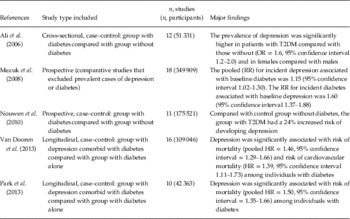
In addition, diabetes and comorbid depression is associated with higher healthcare costs (Hutter et al. Reference Hutter, Schnurr and Baumeister2010), increased mortality (Egede et al. Reference Egede, Nietert and Zheng2005) and a higher incidence of diabetic complications (Egede & Ellis, Reference Egede and Ellis2010). Such diabetic complications include diabetic retinopathy, nephropathy, neuropathy, macrovascular complications and sexual dysfunction (de Groot et al. Reference De Groot, Doyle, Kushnick, Shubrook, Merrill, Rabideau and Schwartz2012). Table 1 outlines findings of relevant meta-analyses addressing prevalence and impact of depression in populations with diabetes.
Major findings from meta-analyses of studies addressing prevalence and/or impact of depression co-morbid with diabetes (Yu et al. 2015)

T2DM, type 2 diabetes mellitus; OR, odds ratio; RR, relative risk; HR, hazard ratio.
Diabetes, cognitive impairment and dementia
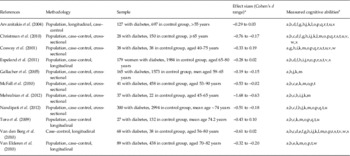
There is a growing body of literature linking diabetes to different stages of cognitive dysfunction and greater cognitive decline compared with controls without diabetes. A 2014 meta-analysis of 25 studies exploring cognitive functioning in non-demented adults with T2DM found significantly lower performance on all cognitive abilities with effect sizes ranging from −0.14 to −0.37 (Monette et al. Reference Monette, Baird and Jackson2014). Subtle diabetes-associated cognitive decrements, which are on an average 0.3–0.5 s.d. greater than those of people without diabetes are well recognised in the literature and unlikely to affect diabetes self-management (Brands et al. Reference Brown, Varghese and McEwen2005; van den Berg et al. Reference Van den Berg, Reijmer, de Bresser, Kessels, Kappelle and Biessels2009). However, cognitive deficits that meet the criteria for mild cognitive impairment (MCI), a clinical transitional state of cognitive function between the changes seen with normal cognitive ageing and those fulfilling the criteria for dementia and often Alzheimer’s disease (Albert et al. Reference Albert, DeKosky, Dickson, Dubois, Feldman, Fox, Gamst, Holtzman, Jagust, Petersen, Snyder, Carrillo, Thies and Phelps2011), are of a much greater magnitude. In a 2012 meta-analysis by Cheng et al., diabetes was found to be associated with a one to two fold increased risk for MCI, a 1.5 fold higher risk for Alzheimer’s disease and a two to three fold increased risk of vascular dementia (Cheng et al. Reference Cheng, Huang, Deng and Wang2012). Table 2 shows the magnitude of cognitive functioning deficits found in diabetes.
Differences in cognitive functioning between subjects with T2DM and controls without diabetes on classified cognitive abilities. Relevant studies adapted from a meta-analysis by Monette et al (2014).

a, general cognitive functioning −0.25 (−0.29, −0.22); b, attention −0.29 (−0.34, −0.24); c, divided attention/shifting −0.36 (−0.42, −0.31); d, focused attention −0.15 (−0.21, −0.08); e, selective attention −0.33 (−0.44, −0.22); f, working memory −0.20 (−0.24, −0.15); g, non-verbal reasoning −0.29 (−0.41, −0.17); h, fluency −0.26 (−0.30, −0.22); i, verbal phonemic fluency −0.28 (−0.34,−0.21); j, verbal semantic fluency −0.25 (−0.29, −0.21); k, processing speed −0.33 (−0.38, −0.29); l, oral task demands −0.14 (−0.24, −0.04); m, motor task demands −0.37 (−0.41, −0.32); n, motor speed −0.30 (−0.38, −0.23); o, memory −0.20 (−0.28, −0.12); p, learning and immediate recall −0.21 (−0.25, −0.17); q, story learning and immediate recall −0.18 (−0.23, −0.12); r, verbal learning and immediate recall −0.27 (−0.34, −0.20); s, visual learning and immediate recall −0.21 (−0.29, −0.13); t, delayed recall −0.20 (−0.24, −0.15); u, story delayed recall −0.18 (−0.24, −0.12); v, verbal delayed recall −0.22 (−0.28, −0.15); w, visual delayed recall −0.26 (−0.39, −0.14); x, visuospatial/visuoconstructional −0.18 (−0.25, −0.10).
a Cognitive ability for the diabetes group v. the non-diabetes control group comparison, average d (95% confidence intervals).
* All effect sizes are significant (p<0.05).
Cerebrovascular mechanisms in diabetes preceding cognitive impairment
Proposed cerebrovascular mechanisms linking diabetes with cognitive dysfunction include brain infarcts and white matter disease (Moran et al. Reference Moran, Phan, Chen, Blizzard, Beare, Venn, Münch, Wood, Forbes, Greenaway, Pearson and Srikanth2013). Chronic hyperglycaemia is associated with microvascular disease (McCrimmon et al. Reference McCrimmon, Ryan and Frier2012) and evidence that microvascular diabetic complications such as diabetic retinopathy (Bruce et al. Reference Bruce, Davis, Starkstein and Davis2014) and microalbuminuria (Bruce et al. Reference Bruce, Davis, Casey, Starkstein, Clarnette, Almeida and Davis2008) are predictive of increased risk of dementia in individuals with diabetes also adds weight to this cerebrovascular mechanism theory. Imaging studies have observed an increase in white matter hyperintensities associated with ischaemic change among people with diabetes compared with normoglycaemic controls (Harten et al. Reference Harten, van Leeuw, de Weinstein, Scheltens and Biessels2006) and white matter ischaemic change severity has been shown to be independently predictive of cognitive decline in a longitudinal study among an elderly population (Verdelho et al. Reference Verdelho, Madureira, Moleiro, Ferro, Santos, Erkinjuntti, Pantoni, Fazekas, Visser, Waldemar, Wallin, Hennerici and Inzitari2010).
Non-cerebrovascular mechanisms in diabetes preceding cognitive impairment
Brain insulin resistance has received much attention in the literature in recent years as a potential causal mechanism of Alzheimer’s disease (Talbot et al. Reference Talbot, Wang, Kazi, Han, Bakshi, Stucky, Fuino, Kawaguchi, Samoyedny and Wilson2012; Thambisetty et al. Reference Thambisetty, Metter, Yang, Dolan, Marano, Zonderman, Troncoso, Zhou, Wong, Ferrucci, Egan, Resnick and O’Brien2013). This theory is biologically plausible as effective insulin action in the brain is required for plasticity of neuronal synapses and facilitates learning and memory (Chiu et al. Reference Chiu, Chen and Cline2008; Zhao & Townsend, Reference Zhao and Townsend2009). The metabolic syndrome has been found to be associated with an increased risk of conversion from MCI to all-cause dementia in individuals with pre-diabetes, which adds further credibility to the theory of systemic and brain insulin resistance (Cooper et al. Reference Cooper, Sommerlad, Lyketsos and Livingston2015). Therapies targeting insulin resistance and impaired signalling both systemically and/or in the brain to slow down or prevent neurodegeneration, including Alzheimer’s disease, are currently being researched (Verdile et al. Reference Verdile, Fuller and Martins2015).
Cortical atrophy patterns akin to pre-clinical Alzheimer’s disease have been discovered in imaging studies among individuals with diabetes, with atrophy of the hippocampus and surrounding medial temporal lobe structures, regions which are associated with learning and memory problems (Moran et al. Reference Moran, Phan, Chen, Blizzard, Beare, Venn, Münch, Wood, Forbes, Greenaway, Pearson and Srikanth2013). Neuroimaging studies have also indicated a loss of brain connectivity, mainly in fronto-temporal areas, in patients with diabetes, which has been related to reduced information processing (Reijmer et al. Reference Reijmer, Leemans, Brundel, Kappelle and Biessels2013; Biessels & Reijmer, Reference Biessels and Reijmer2014). There is a suggestion that diabetes accelerates neurodegeneration and longitudinal case studies have shown the rate of global brain atrophy in individuals with diabetes to be up to three time that of non-diabetic controls (van Elderen et al. Reference Van Elderen, de Roos, de Craen, Westendorp, Blauw, Jukema, Bollen, Middelkoop, van Buchem and van der Grond2010; Kooistra et al. Reference Kooistra, Geerlings, Mali, Vincken, van der Graaf and Biessels2013).
The possibility that cognitive decrements in diabetes might be a result of the premorbid cognitive status of diabetes-prone individuals, thus indicating reverse causality, has also been considered in the literature (Bruce, Reference Bruce2015). Further, high quality studies are needed to explore this theory.
It is difficult to disentangle all factors that may contribute to cognitive dysfunction in diabetes but it is likely mechanisms accelerate one another with complex interplays and additive effects on a background of the normal ageing process (Luchsinger, Reference Luchsinger2012).
Synergistic effect of diabetes and depression
As well as increasing the risk of dementia individually, diabetes and depression have been shown to increase the incidence of dementia synergistically (Katon et al. Reference Katon, Rutter, Simon, Lin, Ludman, Ciechanowski, Kinder, Young and Von Korff2010). A 2015 population-based cohort study from Denmark found that having both depression and diabetes was associated with over two times the risk for developing all-cause dementia (Katon et al. Reference Katon, Lin, Williams, Ciechanowski, Heckbert, Ludman, Rutter, Crane, Oliver and Von Korff2015). Damage to overlapping neural circuits in the frontal-subcortical networks, implicated in cognitive and emotional dysfunction, are postulated as a mechanism for the synergistic effect of diabetes and depression on cognitive health (Sartorius et al. Reference Sartorius, Holt and Maj2014). These networks are sensitive to damage from diabetic metabolic changes including poorer glycaemic control, which has been found to be compounded by comorbid depression and higher cerebrovascular burden in a 2015 neuroimaging study (Kumar et al. Reference Kumar, Yang, Ajilore, Wu, Cohen, Lamar and Bhaumik2015). Higher levels of inflammatory markers in the group with comorbid depression compared with group with diabetes only was discovered in a 2015 cross-sectional case–control study among 276 elderly adults with diabetes and the presence of MCI had an additive effect on levels of inflammatory mediators (Gorska-Ciebiada et al. Reference Gorska-Ciebiada, Saryusz-Wolska, Borkowska, Ciebiada and Loba2015).
Such findings add impetus to the importance of prevention and timely intervention in order to effectively treat depression and manage cognitive impairment comorbid with diabetes thus potentially decreasing the incidence of dementia.
Impact of cognitive impairment and dementia on diabetes
Individuals with cognitive impairment comorbid with diabetes, as shown in the Action to Control Cardiovascular Risk in Diabetes trial, have increased risk of complications including severe hypoglycaemia (Punthakee et al. Reference Punthakee, Miller, Launer, Williamson, Lazar, Cukierman-Yaffee, Seaquist, Ismail-Beigi, Sullivan, Lovato, Bergenstal and Gerstein2012). Factors underlying this finding may include poorer diabetes control (Munshi et al. Reference Munshi, Capelson, Grande, Lin, Hayes, Milberg, Ayres, Weinger and Suhl2006). Evidence for poorer diabetes control in the form of hyperglycaemia impacting adversely on cognition also comes from the Health and Retirement Study (HRS) where participants with lower cognitive indices were found to have higher glycated haemoglobin (HbA1c) levels than those with higher cognitive indices (Okura et al. Reference Okura, Heisler and Langa2009). Worse diabetes self-management was demonstrated once again using data from the HRS in a 2012 cross-sectional observational study among 1398 individuals with diabetes, aged 60 years or older (Feil et al. Reference Feil, Zhu and Sultzer2012).
Executive function abnormalities likely to contribute to deficits in complex self-care behaviours have been found among older adults with diabetes in a number of studies and involve problem solving, planning, organisation, insight, reasoning and attention (Smith et al. Reference Smith, Else, Paul, Foster, Walker, Wesnes and Riby2014).
Other brain and mental health complications associated with diabetes
Brain health complications of diabetes are not limited to depression, cognitive impairment and dementia. A 2008 study by Li et al. has shown diabetes to be associated with greater overall burden of anxiety symptoms when compared with healthy controls (Li et al. Reference Li, Ford, Strine and Mokdad2008). Anxiety symptoms in particular can overlap with symptoms of hypoglycaemia and can have implications for diabetes self-care as patients may over-treat themselves as a result, increasing the risk of hyperglycaemia and further complications.
In addition, a recent cross-sectional study gathering data on psychiatric comorbidity in 19 countries among those with adult onset diabetes (52 095 participants) found a 1.6 fold increased risk of intermittent explosive disorder, 2.6 fold increased risk of binge eating disorder and 2.1 fold increased risk of bulimia nervosa following comorbidity adjustment (de Jonge et al. Reference De Jonge, Alonso, Stein, Kiejna, Aguilar-Gaxiola, Viana, Liu, O’Neill, Bruffaerts, Caldas-de-Almeida, Lepine, Matschinger, Levinson, de Girolamo, Fukao, Bunting, Haro, Posada-Villa, Al-Hamzawi, Medina-Mora, Piazza, Hu, Sasu, Lim, Kessler and Scott2014). Proposed linking mechanisms include disturbed glucose metabolism contributing to the onset and maintenance of binge eating disorder and bulimia nervosa (Raevuori et al. Reference Raevuori, Suokas, Haukka, Gissler, Linna, Grainger and Suvisaari2015). Suggestions for the mechanisms of association between intermittent explosive disorder and diabetes include low levels of HDL-cholesterol and reduced serotonin functioning, which have been associated with aggression and diabetes (Buydens-Branchey et al. Reference Buydens-Branchey, Branchey, Hudson and Fergeson2000).
Diabetes is also an independent risk factor for stroke disease. Individuals with diabetes, when compared with those without, have at least twice the risk for stroke following adjustment for demographic and other cardiovascular risk factors (Banerjee et al. Reference Banerjee, Moon, Paik, Rundek, Mora-McLaughlin, Vieira, Sacco and Elkind2012). Diabetes duration has been shown to increase ischaemic stroke disease risk and hyperglycaemia has been observed to worsen clinical outcomes post stroke (Kothari et al. Reference Kothari, Stevens, Adler, Stratton, Manley, Neil and Holman2002).
Prevention of diabetes brain health complications
Addressing modifiable risk factors for dementia is particularly important, as no disease modifying treatments currently exist for Alzheimer’s disease. A 2014 analysis of population-based data estimated that one in three cases of Alzheimer’s disease globally is attributable to seven modifiable risk factors; diabetes, hypertension in midlife, obesity in midlife, physical inactivity, smoking, depression or low educational attainment when taking non-independence into account as these factors frequently co-occur (Norton et al. Reference Norton, Matthews, Barnes, Yaffe and Brayne2014). Healthcare professionals responsible for the care of people with diabetes should therefore ensure they avail of every opportunity for health promotion and intervention to manage modifiable risk factors in this vulnerable group.
The importance of good glycaemic control in protecting brain health should also be empahsised in doctor–patient interactions. While the positive impact of healthy lifestyle behaviours and diabetes treatment compliance on glycaemic control is addressed in current practice guidelines (International Diabetes Federation, 2013), the relationship between poor glycaemic control and both increased rate of cognitive decline (Velayudhan et al. Reference Velayudhan, Poppe, Archer, Proitsi, Brown and Lovestone2010; Yaffe et al. Reference Yaffe, Falvey, Hamilton, Schwartz, Simonsick, Satterfield, Cauley, Rosano, Launer, Strotmeyer and Harris2012) and depressive symptoms (Aikens et al. Reference Aikens, Perkins, Lipton and Piette2009) is less often highlighted.
Formal diabetes educational interventions delivered at primary and secondary care levels should address the risk of the brain as an end organ vulnerable to diabetic complications and provide information on protective brain health behaviours. An emphasis may be best placed on positive healthy lifestyle behaviours and management of cardiovascular risk factors as well as optimisation of diabetes self-management, which may avoid alarming patients and increasing risk of distress.
Increasing public awareness of brain health complications of diabetes and promotion of healthy lifestyle choices are important steps in the primary prevention of T2DM in at-risk populations as well as in prevention, detection and timely intervention for individuals with diabetes brain health complications.
Awareness and detection of diabetes brain health complications
For those with chronic illness such as diabetes, the diagnosis of a comorbid psychiatric condition or cognitive impairment is undoubtedly challenging. This is reflected in a low rate of detection and treatment with up to 50% of cases of mental disorders and severe psychological distress going undetected and less than half of these cases receiving treatment (Katon et al. Reference Katon, Pedersen, Ribe, Fenger-Grøn, Davydow, Waldorff and Vestergaard2005; Li et al. Reference Li, Ford, Zhao, Balluz, Berry and Mokdad2010). Such findings suggest a need for education of clinicians to promote awareness of the increased risk of brain health complications among populations with diabetes, as well as training on how to detect and manage such complications.
Healthcare professionals treating individuals with diabetes must be aware of the psychological toll of the challenge of managing a chronic illness as well as the increased risk of depressive symptoms and cognitive impairment further compounding difficulties experienced. The Diabetes Attitudes Wishes and Needs 2 study includes over 16 000 participants from four continents and aimed to holistically assess diabetes care and needs among people with diabetes, healthcare professionals and family members in order to identify new avenues for improving diabetes care (Peyrot et al. Reference Peyrot, Burns, Davies, Forbes, Hermanns, Holt, Kalra, Nicolucci, Pouwer, Wens, Willaing and Skovlund2013). One measure used in this study is The Problem Areas in Diabetes (PAID-5). The PAID is a validated self-report measure which screens for diabetes-related emotional distress and correlates with measures of related concepts such as depression, social support, health beliefs and coping style, it also predicts future glycaemic control of the patient and is sensitive to change over time (Welch et al. Reference Welch, Weinger, Anderson and Polonsky1997, Reference Welch, Jacobson and Polonsky2003). The PAID is a useful tool for use in clinical practice to allow people to raise emotional and social aspects of their diabetes with health professionals, which in turn encourages exploration of the possible sources of distress.
Older adults are considered a high priority for depression screening and treatment as outlined in the 2015 American Diabetes Association Standards of Medical Care in older adults and it is advised that particular attention be paid to screening for complications in older adults that would lead to functional impairment (American Diabetes Association, Reference Ali, Stone, Peters, Davies and Khunti2015). The Patient Health Questionnaire (PHQ-9) (Spitzer et al. Reference Spitzer, Kroenke and Williams1999), the Beck Depression Inventory (BDI-II) (Beck et al. Reference Beck, Ward, Mendelson, Mock and Erbaugh1961), the Centre for Hospital Anxiety and Depression Scale (Zigmond & Snaith, Reference Zigmond and Snaith1983), the Center for Epidemiologic Studies Depression Scale (CESD) (Radloff, Reference Radloff1977) are the most well-validated screening questionnaires for depression among people with diabetes (Holt et al. Reference Holt, de Groot and Golden2014). These scales can be used to aid clinicians in distinguishing depression symptoms, as there may be some overlap between physical features of diabetes and psychiatric disorders, which these screening tools take into account.
Clinicians should have a high index of suspicion of a cognitive disorder complicating diabetes if older patients start to miss appointments, do not take medications or re-fill prescriptions, or finger prick testing is no longer performed with resultant deterioration in glycaemic control. Advice seeking should also be encouraged if patient or a loved one notices significant emotional or cognitive changes.
Global cognitive screening tests such as the Montreal Cognitive Assessment (Nasreddine et al. Reference Nasreddine, Phillips, Bédirian, Charbonneau, Whitehead, Collin, Cummings and Chertkow2005) or Mini-Cog (Borson et al. Reference Brands, Biessels, Haan, de Kappelle and Kessels2000), which are easy to use and have a good evidence base in detection of cognitive impairment, are recommended in older adults with diabetes with suspected cognitive impairment (International Diabetes Federation, 2013).
Management of brain health complications in type 2 diabetes
In addition to adoption of healthy lifestyle habits clinicians should be aware that early stage effective diabetes self-management is a key component of brain health protection in diabetes. Optimisation of glycaemic control and effective management of vascular risk factors is key to end organ protection as evidence suggests that chronic hyperglycaemia (Cukierman-Yaffe et al. Reference Cukierman-Yaffe, Gerstein, Anderson, Zhao, Sleight, Hilbrich, Jackson, Yusuf and Teo2009) is a risk factor for depression and cognitive impairment (Reijmer et al. Reference Reijmer, van den Berg, Ruis, Kappelle and Biessels2010) and that depression itself is a risk factor for development of Alzheimer’s disease (Norton et al. Reference Norton, Matthews, Barnes, Yaffe and Brayne2014).
The principles of management of depression in diabetes are the same as in that of the general population. There is evidence to suggest that successful pharmacological, psychological or combined approach treatment improves mood, and possibly mortality in such individuals (Mitchell, Reference Mitchell2012; Petrak et al. Reference Petrak, Baumeister, Skinner, Brown and Holt2015). Both cognitive behavioural therapy and selective serotonin reuptake inhibitors, which are weight neutral should be considered in treatment of depression concurrent with diabetes and have been associated with improvement in glycaemic control (Lustman & Clouse, Reference Lustman and Clouse2005). A randomised controlled trial (n=344) among adults with T1DM with persistent sub-optimal glycaemic control found the group who received a combination of motivational interviewing techniques and cognitive behavioural therapy had a significantly lower HbA1c level at 12 month follow-up when compared with usual care group or group who received motivational interviewing intervention only (Ismail et al. Reference Ismail, Maissi, Thomas, Chalder, Schmidt, Bartlett, Patel, Dickens, Creed and Treasure2010).
With cognitive impairment comorbid with diabetes clinicians must aim for early detection in order to introduce measures to optimise support of diabetes self-management in a timely manner to minimise further complication risk. A risk score, which consists of several clinical and demographic variables, has been developed and predicts the 10-year dementia risk (range 5–73%) specifically for patients with T2DM aged 60 years plus (Exalto et al. Reference Exalto, Biessels, Karter, Huang, Katon, Minkoff and Whitmer2013). Such tools may be helpful to clinicians in predicting those individuals with diabetes at high risk of developing dementia. Treatment targets and clinical care priorities may need adjustment in individuals diagnosed with cognitive impairment, with revision of clinical expectations, namely quick and informed patient response to blood glucose fluctuations and negotiation of complex dietary instructions. Agreement on optimal glycaemic control indices has not yet been reached despite associations of poor blood glucose control with cognitive decrements in individuals with diabetes. The use of intensive glycaemic control was not found to benefit functional outcomes in the Action to Control Cardiovascular Risk in Diabetes Memory in Diabetes study, this randomised controlled trial used intensive glucose lowering, which was found to be associated with increased mortality (Launer et al. Reference Launer, Miller, Williamson, Lazar, Gerstein, Murray, Sullivan, Horowitz, Ding, Marcovina, Lovato, Lovato, Margolis, O’Connor, Lipkin, Hirsch, Coker, Maldjian, Sunshine, Truwit, Davatzikos and Bryan2011). Further research efforts in the area of clinical management of patients who have diabetes with cognitive impairment and dementia are needed with a longer duration of study required before further direction on management can be given.
In conjunction with formal diabetes education, written instructions and visual supports may be helpful in tailored care for individuals with diabetes and cognitive dysfunction. Medication regimens may also need to be simplified in order to minimise iatrogenic risk and optimise treatment response. Additional one-to-one support may be necessary and more frequent routine reviews. Needs specific diabetes education for family and care givers may also be useful (Samaras & Sachdev, Reference Samaras and Sachdev2012). In addition, close links between primary care, diabetes specialists and mental healthcare teams may be beneficial in prevention and treatment of diabetic brain health complications as evidence exists for better outcomes for depression and glycaemic control with multi professional input among patients with comorbid depression and diabetes (Huang et al. Reference Huang, Wei, Wu, Chen and Guo2013; Atlantis et al. Reference Atlantis, Fahey and Foster2014; Coventry et al. Reference Coventry, Lovell, Dickens, Bower, Chew-Graham, McElvenny, Hann, Cherrington, Garrett, Gibbons, Baguley, Roughley, Adeyemi, Reeves, Waheed and Gask2015).
Conclusion
The rapidly ageing global population, carrying with it an increased prevalence of individuals with diabetes and associated complications has the potential to cause a major strain on health and social service provision globally.
The brain should be added to the suite of end organ complications such as heart, foot, eye and kidney that can be affected in diabetes. Primary prevention of T2DM by addressing modifiable risk factors from an early life stage remains a priority with evidence from the literature for an increased risk of dementia among individuals with accumulated risk factors including diabetes, depression and sedentary lifestyle habits (Norton et al. Reference Norton, Matthews, Barnes, Yaffe and Brayne2014). Education and training to enhance healthcare professional awareness of the potential for brain health adverse outcomes in populations with established diabetes is an essential first step in promoting patient awareness as well as improving detection of such adverse outcomes. It is hoped that effective management of depression and cognitive impairment in diabetes may ultimately reduce the incidence of dementia within this vulnerable population and improve overall brain health.
Acknowledgements
The authors declare that there are no conflicts of interest. This research received no specific grant from any funding agency, commercial or not-for-profit sectors.