I. Introduction
On 2 May 2019, plant-based food company Beyond Meat went public. At 9:30 a.m., the opening bell of the New York Stock Exchange rang. The stock took off. Over the next six and a half hours, shares of Beyond Meat traded hands 23,118,966 times, and by the end of the first day of trading the stock was up 163%. Few stocks rise that much in five years, letalone one day.
After ten years of hard work in the lab and later in grocery stores, Beyond Meat launched one of the most successful initial public offerings in history. From its initial valuation of $1.5 billion and price of $25, it grew to $13 billion in less than three months – a mind-blowing 859% increase in value.
As is well known today, Beyond Meat is a company that makes plant-based meat that, according to even many meat eaters, has the taste and texture of real meat. The company describes the process of creating the products on its website like this: “We use a simple process of heating, cooling, and pressure to create the fibrous texture of meat and layer in plant-based fats, binders, flavors, and colors” – sounds pretty good.
Wikipedia describes it somewhat less lovingly: “The burgers are made from pea protein isolates, rice protein, mung bean protein, canola oil, coconut oil, potato starch, apple extract, sunflower lecithin, and pomegranate powder. Beef products that ‘bleed’ are achieved by using red beet juice … The number of ingredients and processes involved in producing the products means that they are classified as ultra-processed foods in the NOVA food classification scheme”.Footnote 1 , Footnote 2
The year 2019 will likely be remembered as “the year of the meatless burger”. Beyond Meat and Impossible Foods achieved enormous media attention and reached record numbers of consumers, including many from the meat-eating public.
II. The clash: clean eating versus alternative proteins
Despite the meteoric rise of the plant-based food companies Beyond Meat and Impossible Foods, many companies are moving in a very different direction in their quest to meet consumer demand for a simpler label with familiar ingredients –what some refer to as a “clean label”. In its 2019 Global Clean Label Consumer Study, ingredient company Ingredion noted that consumers are increasingly looking for products that are free from additives and artificial ingredients. The study found that 78% of US consumers find it important to recognise the ingredients in the products that they buy (an increase from 66% in 2011).Footnote 3 The concept of clean-label products that contain simple and recognisable ingredients reflects a growing desire over the past few years for health-conscious consumers to know what they are putting into their bodies.
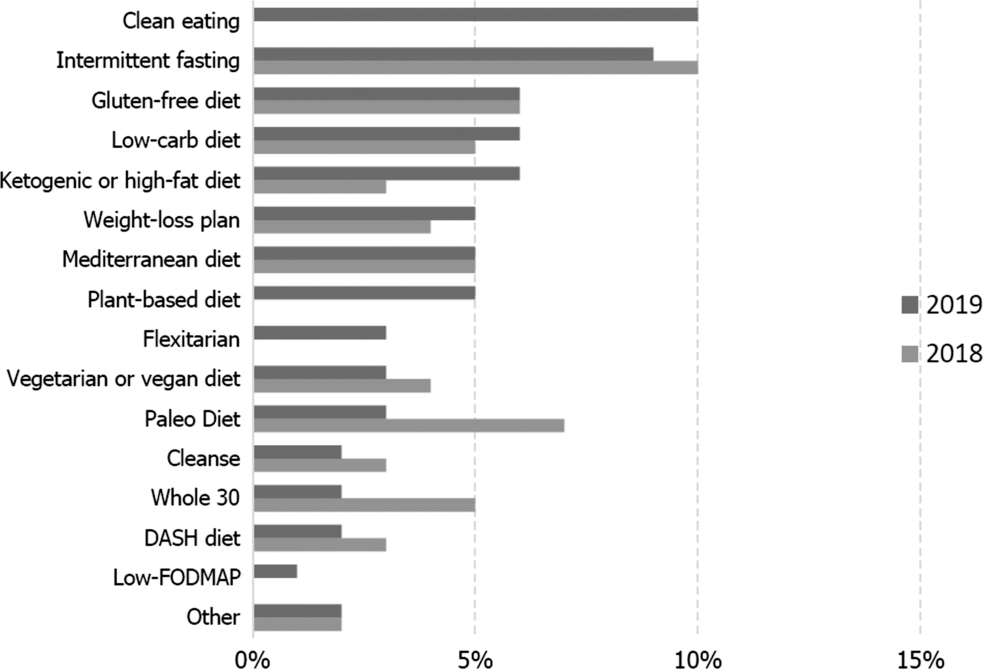
According to the International Food Industry Council (IFIC) in their annual Food and Health Survey, clean eating was the most widely cited diet in 2019 (Figure 1).Footnote 4
Popular diets in 2019.Footnote 5

Clean eating builds on two separate trends. The first is transparency. Consumers want companies to communicate clearly and understandably what ingredients are in their products. The second is natural (with a strong dose of simplicity). Consumers want to be able to recognise ingredients and they want as few of them as possible.
Companies are catching on, reformulating old products and developing new ones that aim to leverage this trend. In 2017, Panera announced that it was making its entire menu of food products free from artificial flavours, preservatives, sweeteners and colours as part of its commitment to clean eating and clean labels.
Panera is hardly the only company following this trend. Companies such as Campbell’s Soup and PepsiCo have implemented food transparency through clean labels, and there is a rise in food start-ups applying clean labels to their new products.
The promise of clean eating is simplicity – simple foods with ingredients that consumers recognise, with the implication being that such foods are safer and better for you. A “clean label” on a product flags for consumers the transparency and simplicity of the ingredient list for the product.
1. Clashing trends
The clean eating trend presents challenges for alternative protein companies such as Beyond Meat and Impossible Foods, but also for dozens of other companies, including big food brands such as Nestle and Unilever, who are pinning much of their future growth on the staying power of the ultra-processed plant-based food trend.
Unfortunately, the combination of ingredients and additives necessary to create a product that mimics the taste, sight, smell and touch of meat from an animal (what food scientists refer to as the organoleptic properties of a food) cannot be achieved with a clean label containing three simple ingredients. That does not necessarily make the products bad, but it does make them “unclean” from a clean label perspective.
This tension may not be obvious in the grocery store aisles quite yet, where alternative proteins are consistently breaking sales records, but the signals can be discerned if you look and listen carefully.
III. The investigation: tools that can explain and predict
1. Polling and focus groups
Polling and focus groups are the classic tools for understanding public opinion. They start from a simple premise: if you want to know what people think, you should ask them. The problem is people often do not know what they are concerned about. Furthermore, even when they can identify concerns, they may not be able to explain why they are concerned.
2. Social media monitoring
Social media offers a wealth of information that brands can track. Social media monitoring looks at metrics such as brand mentions, hashtags, competitor mentions and industry trends, collecting data on these metrics. Social media monitoring is a useful tool for things such as A/B testing campaigns and monitoring return on investment for ad buys. While great for keeping tabs on what has been going on, monitoring alone is not enough to explain why things happen.
3. Social listening
When companies adjust their strategies in response to the data they have collected and the metrics they have analysed, they begin the process of social listening. Where social media monitoring looks at metrics such as engagement rate and number of mentions, social listening dives deeper into the numbers to consider the mood, sentiment or feelings behind the data.
However, even social listening will fall short if companies do not get at the perceptions and sentiments that underlie the concerns.
There is no better illustration of the danger of asking consumers what they want – and not asking what sentiments lie beneath the concerns – than the case of PepsiCo, aspartame and diet soda. In 2015, Seth Kaufman, senior vice president of Pepsi and Flavors Portfolio, PepsiCo North America Beverages, announced, “We’ve done a ton of work on consumer calls, letters, along with primary research and social listening and the number one reason why U.S. consumers are drinking less diet cola is because of aspartame. This is about evolving consumer demand”.Footnote 6 Kaufman further explained, “Diet cola drinkers in the U.S. told us they wanted aspartame-free Diet Pepsi and we’re delivering. We recognize that consumer demand is evolving, and we’re confident that cola lovers will enjoy the crisp, refreshing taste of this new product”.Footnote 7
PepsiCo rolled out the new flavouring in 2017 to a huge marketing campaign. And yet, ten months after discontinuing the use of aspartame in Diet Pepsi, PepsiCo announced it was bringing the sweetener back to its product line. The company said in a statement, “For those consumers who love Diet Pepsi with aspartame, we have been exploring ways to make it available”. The decision to reintroduce aspartame suggests that the ingredient may not have been the primary cause of the decline of the diet drink market as social listening had suggested.Footnote 8 By giving consumers what they were asking for, PepsiCo apparently gave them a product they did not want.
This highlights the limitations of traditional consumer research and the need for better insights tools. To explain how the clash between clean eating and alternative proteins will unfold, companies need to understand the drivers of risk perception.
4. Risk communication
More and more companies are setting up behavioural science teams in order first to understand the root drivers of risk perception, and only then using social listening to measure perceptions and sentiments. With this roadmap in hand, they are developing risk communication engagement strategies to address consumer concerns identified before they become problems.
Risk communication refers to the collection and analysis of real-time information through social listening and other avenues to provide advice to organisations and individuals facing threats to their economic or social well-being. The ultimate purpose of risk communication is to enable people (eg executives, shareholders, investors and consumers) who feel at risk to take informed decisions.
A “risk” is anything that can go wrong. The difference between risk communication and crisis communication is the difference between what “could” happen and what “did” happen. Crisis communication is mostly about responding to events after the fact – a product malfunctioned or somebody was arrested – that suddenly change perceptions of a product’s safety or an organisation’s credibility. Risk communication is about crisis prevention, not crisis response.
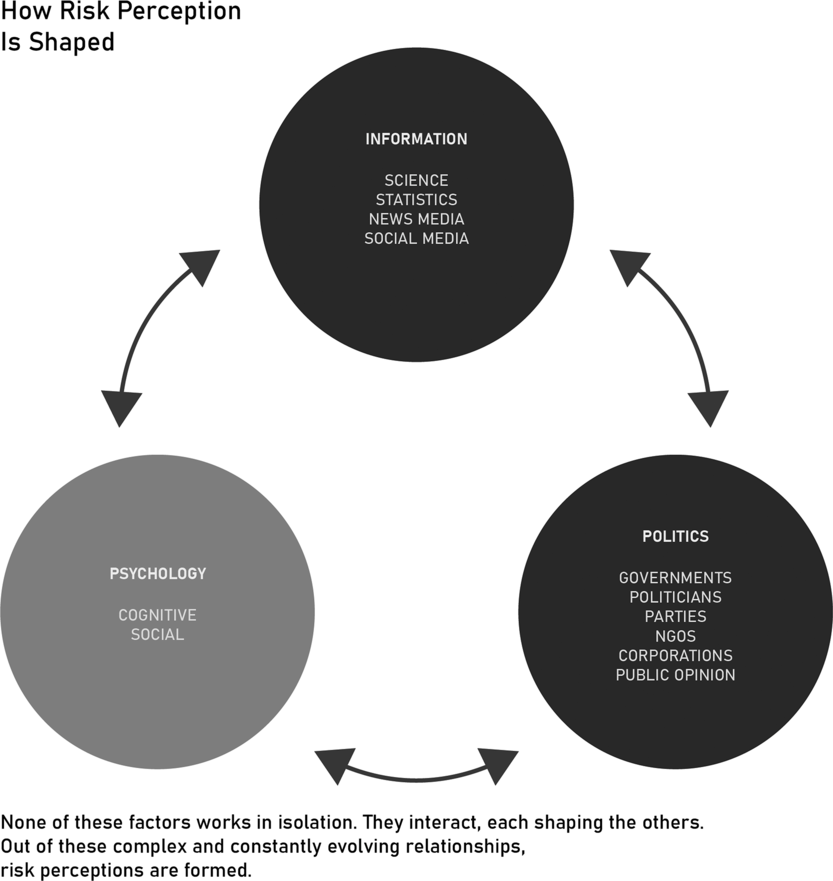
According to consumer insights firm Tactix, risk perception is the product of three principal factors: information, politics and psychology (Figure 2).Footnote 10 According to Paul Slovic, Founder and President of Decision Research and Professor of Psychology at the University of Oregon, “Increasingly, over the past two decades, companies have used the insights of behavioral science to reduce bias in boardrooms, improve strategic decision making, provide benefits for customers, enhance the effectiveness of marketing campaigns, and avoid making bad bets on major acquisitions or investments”.Footnote 11
How risk perception is shaped.Footnote 9

Governments have also taken notice of the potential of behavioural science, with the British government establishing the Behavioural Insights Team (BIT) and the US government setting up the Social and Behavioral Sciences Team (SBST) under the Obama administration to harness the power of cognitive behavioural science in policymaking.
By analysing millions of publicly available data points, behavioural scientists can identify patterns in how people engage with topics related to controversial products and technologies, which would have been impossible to discern in the past. Such patterns can be used to build a risk index for the key drivers of risk perceptions.
IV. The evaluation: what behavioural science tells us about processed foods
What does all this have to do with plant-based processed foods?
According to market research published by the Good Food Institute:
Plant-based foods are a booming business. Food manufacturers ranging from startups to leading CPGFootnote 12 companies to the world’s largest meat companies are innovating rapidly in this category. These next-generation plant-based meat, egg, and dairy products are increasingly competitive with animal products on the key drivers of consumer choice: taste, price, and accessibility. As a result, a growing number of mainstream consumers are buying plant-based options. In fact, these products are a key driver of growth at grocery retailers nationwide, outpacing overall food growth by more than five times. New SPINS retail sales data released March 3, 2020, shows that grocery sales of plant-based foods that directly replace animal products have grown 29% in the past two years to $5 billion.Footnote 13
The market for plant-based meat products appears healthy and growing, and yet, as previously mentioned, it runs counter to clean eating diet trends focused on simple ingredients and whole foods. Questions about processed foods go beyond consumer diet trends, extending to national and international public health organisations. Both the World Health Organization and the European Union have recommended that consumers reduce their consumption of ultra-processed foods.
While developers of plant-based foods would argue that there is an important distinction between an ultra-processed Dorito and an Impossible Burger, it remains to be seen whether consumers and public health officials will agree. Consumer insights firm Tactix wanted to understand where consumer perceptions of processed foods might be heading in different regions of the world and, importantly, what sentiments were driving those perceptions.
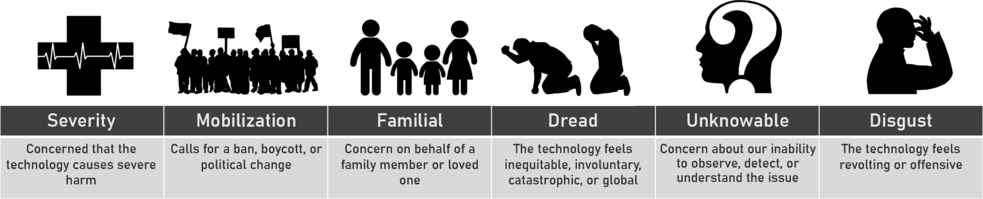
With these questions in mind, behavioural scientists at Tactix led by Paul S. Hillier analysed publicly available social media data from 1 September 2019 to 31 August 2020 in three geographical regions – North America, South America and Europe – to see how risk perception towards processed foods differed around the world and in comparison to fifteen other controversial technologies that they track. Tactix examined six indices (that build on the work of Paul Slovic on “dread” and the “unknown”,Footnote 14 as well as the work of Jonathan Haidt on “disgust”) (Figure 3).Footnote 15
Risk perception indices.Footnote 16

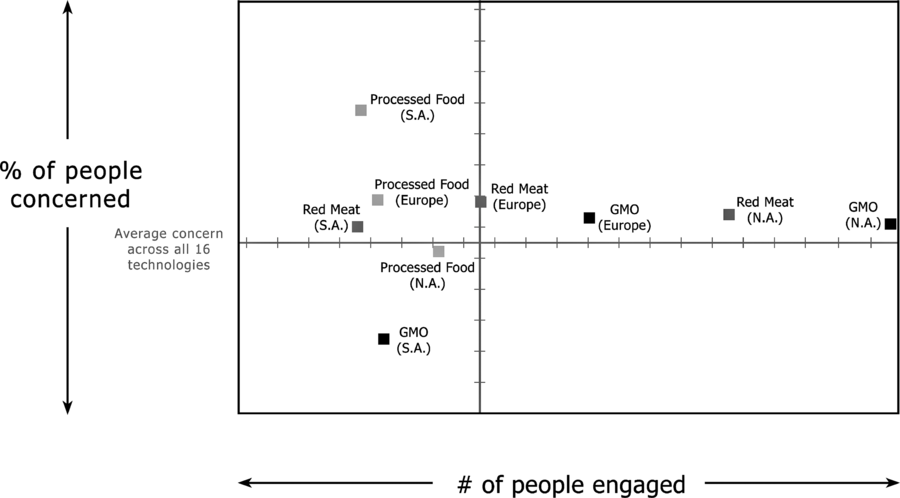
The number of people engaged in conversations about processed foods varied somewhat between each region (North America having slightly more). So, too, the percentage of people actively concerned varied considerably Footnote Footnote (in South America, a substantially higher percentage of people are actively concerned) (Figure 4).
Food product risk perception.Footnote 17 N.A. = North America; S.A. = South America.

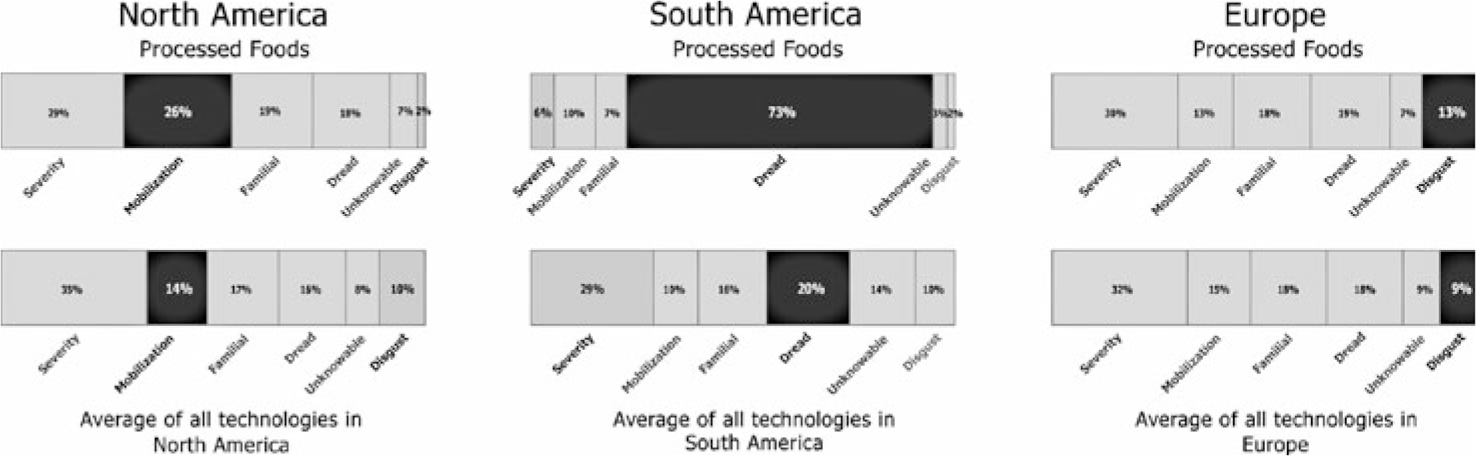
However, most importantly, the source of concern differed by region as well. In South America, processed foods were seen as disproportionately harming lower income families. As a result, concern about processed food in that region emanated from a sense of unfairness, generating feelings of dread (Figure 5).
Processed food risk perception.Footnote 18

In Europe, by contrast, processed foods generated above-average feelings of disgust when compared against fifteen other controversial technologies, which aggravates risk perceptions, while North Americans, on average, felt substantially less disgust towards processed foods.
Consumer perceptions of risk can lead people to mobilise in order to address concerns. It is also important to understand who is mobilising and why. The researchers at Tactix found that, in South America and Europe, the most vocal opponents of processed foods were those actively trying to reduce their intake, while the most vocal opponents in North America were people who are virtue-signalling that they have already cut these foods out of their diets.
V. Conclusion
There have been a number of policy proposals that would tax or even ban ultra-processed foods in some cases. Producers of processed foods who believe that their products can improve health or global sustainability will need to draw a distinction between their products and those that harm people and the planet. To do this, they will need to draw on the work of behavioural scientists to identify the drivers of risk perception and address the concerns identified. This would mean mitigating feelings of disgust in Europe and feelings of unfairness in South America.
Paul Slovic noted:
Whereas psychometric research implies that risk debates are not merely about risk statistics, some sociological and anthropological research implies that some of these debates may not even be about risk. Risk concerns may provide a rationale for actions taken on other grounds or they may be a surrogate for other social or ideological concerns. When this is the case, communication about risk is simply irrelevant to the discussion. Hidden agendas need to be brought to the surface for discussion.Footnote Footnote 19
When companies (or brand owners) are faced with public pressure to change a product or drop an ingredient, it can be difficult to differentiate between various types of concerns, and even more difficult to know which are likely to lead to behavioural change. Passive social listening tools are helpful for cataloguing brand mentions and visualising mobilisation, but more and more businesses are looking to behavioural science to build predictive models that anticipate mobilisation, allowing for early intervention. Behavioural science teams and tools will no doubt become the norm for food and agriculture, as well as companies working in other potentially controversial sectors such as biotechnology and chemicals, as they strive to anticipate issues and respond before they become problems.