In his recent edition of Aeschylus' Persae Footnote 1 Garvie prints the second strophe of the amoibaion
Otototoi! In vain did those many weapons, mixed together, come from the land of Asia – alas
– to Greece, a hostile country.
In his apparatus on 270 and 271 Garvie reports ἦλθ᾿ (or ἦλθεν) ἐπ᾿ αἶαν δῖαν (or δίαν) from all the manuscripts and scholia except for Lambeth 1203 with δάιαν. In his commentary he says, ‘δᾴαν, attested only in cod. Lambeth 1203 (according to Blomfield), gives excellent sense, and, when there are already three occurrences of the word in this epirrhema, one can hardly object to a fourth’.Footnote 2 He explains his rejection of αἶαν δῖαν because αἶαν χώραν is an awkward tautology, and the Homeric formulaic adjective δῖαν is unconvincing here, while West's Δίαν (‘the land of Zeus’) would be an allusion unlikely to be clear to the audience and with no obvious dramatic point.
I concur entirely with Garvie's stylistic judgement – indeed the repetition of such a thematic word is very much in keeping with the style of this amoibaion. The problem is with the supposed manuscript authority.
I have examined Lambeth 1203, by kind permission of the Lambeth Palace Librarian. It is relatively unusual in that it contains only Persae, and not the other plays of the Byzantine triad; Persae is bound together with Dionysius Periegetes, in a quite different hand. It was dated by TurynFootnote 3 to the fourteenth or fifteenth century, but Dr Christopher WrightFootnote 4 believes the Persae section could well be earlier. Lambeth 1203 is one of a collection of manuscripts made in the Levant around the end of the eighteenth century by Professor Carlyle (sometime Professor of Arabic in Cambridge) and Dr Philip Hunt. After his death Professor Carlyle's sister sent these manuscripts to Lambeth Palace; some of them were returned in 1817 to the Patriarch of Jerusalem (who resided in Constantinople). The provenance of 1203 is not clear; it bears the mark IA*, which might indicate the Iveron monastery on Mount Athos.
Blomfield's reading δᾴαν first appeared in his edition of the Persae;Footnote 5 his apparatus says ‘δαΐαν Lambeth. δίαν ceteri, quum scripti tum impressi.’ Most subsequent editors have followed him: Dindorf,Footnote 6 Weil,Footnote 7 Wecklein,Footnote 8 Sidgwick,Footnote 9 Wilamowitz,Footnote 10 Weir Smyth,Footnote 11 Mazon,Footnote 12 Murray,Footnote 13 Broadhead,Footnote 14 Groeneboom,Footnote 15 Page,Footnote 16 De Romilly,Footnote 17 BelloniFootnote 18 and Vílchez.Footnote 19 They each cite in their apparatus either ‘Lambeth 1203’ or ‘Blomfield e cod. det.’ or the like; I do not think any of them claims to have examined the manuscript. Only Hermann 1852 (δίαν),Footnote 20 Paley (δῖαν),Footnote 21 Prickhard (δίαν),Footnote 22 Hall (Δίαν),Footnote 23 West (Δίαν)Footnote 24 and Sommerstein (Δίαν)Footnote 25 reject Blomfield's reading.
Of Lambeth 1203 Blomfield says in his preface: ‘Sed nescio an vere dixerim librum istum a me collatum fuisse. Et enim quum occasio codicis evolvendi insperanti mihi oblata esset, summa cum festinatione, sine Aeschylo impresso, et memoriae tantum fidens, perlegi.’Footnote 26
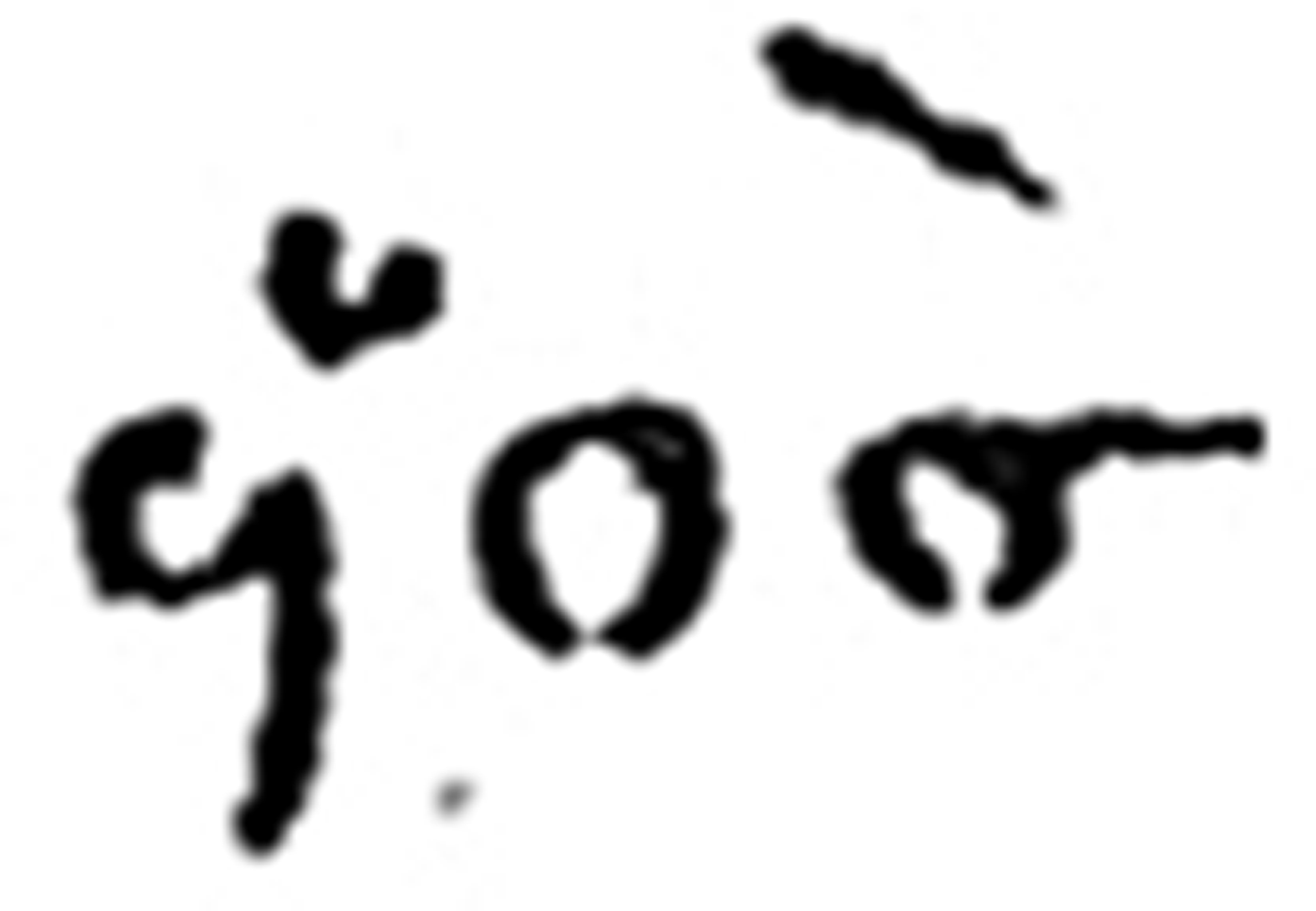
I see what led Blomfield to his reading in line 271. As
Figure 1shows, between the delta and the iota (which has the common two dots above it) in the word in question there is a clearly written curved stroke, joined on the line to both the letters before and after it. I doubt however whether this word is δαΐαν. The second letter resembles no other alpha I found in the manuscript; it is quite like one of the forms the scribe uses for sigma, for instance in the following δυσπότµος, though his usual sigma-iota has σ, not ϲ. The other occurrences of forms of δαΐος have normal alphas. This one cannot be an alpha unless the scribe simply omitted any downstroke; epsilon without the middle stroke, which is very small in some other instances, is less implausible. The manuscript is not in general carelessly written, and this particular word is very legible.
Figure 1

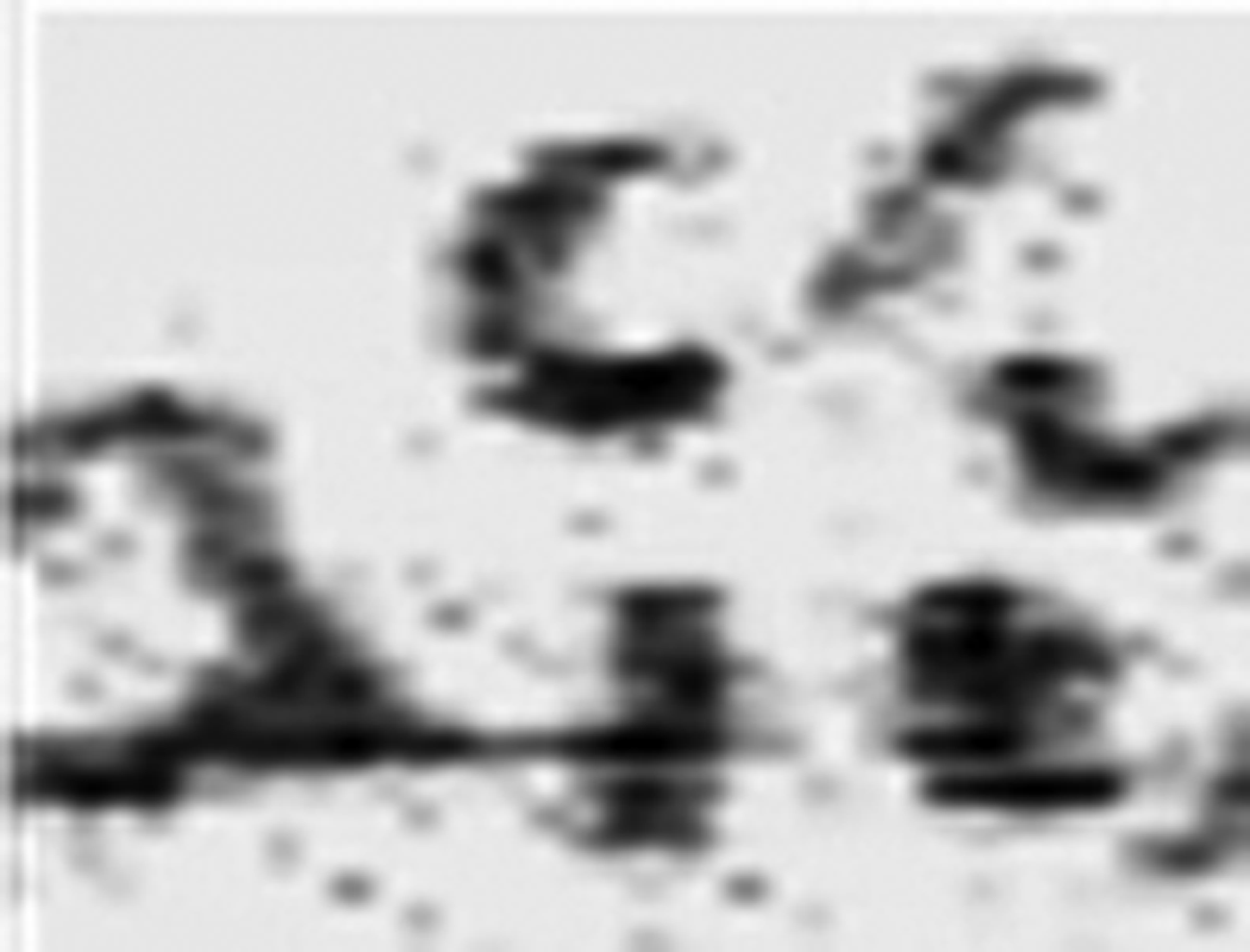
One possibility was suggested to me by a manuscript in the Bibliothèque Nationale, Par. Gr. 2785 (C in Garvie's apparatus),Footnote 27 which uses an abbreviation for final -αν which looks like a large lunate sigma. As
Figure 2shows, it is here written above the iota (the acute accent being positioned above the epsilon of the following word). C is related to the ε family (as West puts it poetically, ‘interdum in hac grege pascitur’),Footnote 28 and if in an exemplar, or the ancestor of an exemplar, of 1203 the word was similarly written, what appears in 1203 could be a mechanical copying of something the scribe did not recognize; but the difficulty with this idea is that 1203 has αν at the end of the word, so the abbreviation would have been in addition to, not a simple replacement for, the syllable αν.
Figure 2
Another possibility was suggested to me by Dr Wright – that the second and third letters of the word are upsilon and iota; there is a distinct resemblance to the appearance of that pair of letters in the υἱ of υἱόςFootnote 29 in line 6 – see
Figure 3.
Figure 3
Is it possible that the scribe intended δυίαν? Δυίαν may be a Greek – even an Aeschylean – word, an unusually formed adjective meaning ‘miserable’ from δύα. The manuscript has it in line 829 of a desperately corrupt passage of Supplices, where it is retained by Friis Johansen,Footnote 30 though West thinks it may be a relict of εἰδυίαν; he admits however that δύιος appears in a list of adjectives ending in ιος in Theognostus Canones AO II 58.9 Cramer;Footnote 31 and δύα itself occurs in lines 1010 and 1047 of Persae.
The true reading at Persae 271 remains unclear. But at all events, in future editions of the play, δᾴαν must be treated as a conjecture (though an attractive and plausible one), and δυίαν might be worth mentioning in the apparatus.
Lambeth 1203 merits further work in its own right. I have not made a full collation, and the interest of one would probably lie more in its relevance for the Byzantine transmission of Aeschylus than in any contribution to the reconstitution of his text. But the manuscript does demonstrate the openness of the recension. It has many points of resemblance to P (e.g. in 2 it has πΐστὰ ‘utroque accentu’, and in 262 it has ο written over the ω of µακροβίωτος).
However, in 601 it shares the strange error ὁµαίµων for ὁ δαίµων with H; in 300 δόµασι for δώµασιν with KMac, and in 1077 τοῖσδε for τοί σε with D. It demonstrates its connection with but sturdy independence of P in 215, where P, alone among Dawe's manuscripts,Footnote 32 has µερῶν as a γράφεται variant for µῆτερ; Lambeth 1203 puts µερῶν in the text, with µῆτερ as a γράφεται variant – apparently its only such. The most remarkable error is found in the passage 775–8:
He was killed treacherously in the palace by noble Artaphrenes, along with some friends whose duty it was. [Sixth was Maraphis, seventh Artaphrenes.]
778 is bracketed by many editors, as totally inconsistent with any other account of Persian history. The scribe of Lambeth 1203 wrote δεύτερος for ἕβδοµος. This is not a normal scribal error. Presumably he was thinking about what he was writing, realized that Artaphrenes had appeared a couple of lines earlier, and concluded that this must be a second Artaphrenes.