Introduction
Heat stress (HS) has been linked to reduced fertility in dairy cows in many countries (De Rensis & Scaramuzzi, Reference De Rensis and Scaramuzzi2003; Lopez-Gatius, Reference Lopez-Gatius2003), which leads to high economic losses. The optimum air temperature range for efficient milk production and reproduction has been established at 25–26°C (Hansen et al., Reference Hansen, Drost, Rivera, Paula-Lopes, Al-Katanani and Krininger2001; West, Reference West2003). However, in northeastern Spain, animals endure high temperatures (>25°C) for 20–31 days during the warm months (May–September) and up to 4 days during cold months (October–April) (Lopez-Gatius et al., Reference Lopez-Gatius, Garcia-Ispierto, Santolaria, Yaniz, Nogareda and Lopez-Bejar2006). HS is known to affect negatively the animal, causing an increase in rectal temperature (up to 41°C), reductions in dry matter intake, milk production, and fertility (Ealy et al., Reference Ealy, Drost and Hansen1993; Wolfenson et al., Reference Wolfenson, Thatcher, Badinga, Savio, Meidan and Lew1995; West, Reference West2003; Edwards et al., Reference Edwards, Saxton, Lawrence, Payton and Dunlap2005).
HS affects the ovarian follicles development, the oocyte competence and the embryo development, probably due to high levels of reactive oxygen species (ROS) (Ikeda et al., Reference Ikeda, Kodama, Fukuda, Shimizu, Murata, Kumagai and Tanaka1999; De S Torres-Junior et al., Reference De S Torres-Junior, de F A Pires, de As, de M Ferreira, Viana and Camargo2008; Roth et al., Reference Roth, Aroyo, Yavin and Arav2008). Their effects are especially harmful at 3 days before and 1 day after the insemination (Hansen et al., Reference Hansen, Drost, Rivera, Paula-Lopes, Al-Katanani and Krininger2001; García-Ispierto et al., Reference García-Ispierto, Lopez-Gatius, Bech-Sabat, Santolaria, Yaniz, Nogareda, De Rensis and Lopez-Bejar2007). When oocytes are matured under heat conditions they show lower rates of nuclear maturation, chromatin fragmentation, and a premature translocation of cortical granules (CG) (Ju & Tseng, Reference Ju and Tseng2004; Tseng et al., Reference Tseng, Chen, Chou, Yeh and Ju2004; Andreu-Vázquez et al., Reference Andreu-Vázquez, López-Gatius, García-Ispierto, Maya-Soriano, Hunter and López-Béjar2010), causing premature aging of bovine oocytes (Andreu-Vázquez et al., Reference Andreu-Vázquez, López-Gatius, García-Ispierto, Maya-Soriano, Hunter and López-Béjar2010).
In cells, ROS levels are normally blocked by antioxidant molecules (Miller et al., Reference Miller, Brzezinska-Slebodzinska and Madsen1993). Therefore, in an attempt to improve fertility rates in dairy cattle exposed to heat stress (HS) conditions, some antioxidants agents such as vitamins and some fatty acids have been used in vivo. Moreover, in vitro studies have also been developed, focusing on oocyte maturation/embryo culture (Hansen et al., Reference Hansen, Drost, Rivera, Paula-Lopes, Al-Katanani and Krininger2001; Zeron et al., Reference Zeron, Ocheretny, Kedar, Borochov, Sklan and Arav2001; Duque et al., Reference Duque, Diez, Royo, Lorenzo, Carneiro and Hidalgo2002; Gomez et al., Reference Gomez, Royo, Duque, Carneiro, Hidalgo and Goyache2003; Livingston et al., Reference Livingston, Eberhardt, Edwards and Godkin2004; Hidalgo et al., Reference Hidalgo, Diez, Duque, Prendes, Rodriguez and Goyache2005; Ikeda et al., Reference Ikeda, Kitagawa, Imai and Yamada2005; Leroy et al., Reference Leroy, Vanholder, Mateusen, Christophe, Opsomer and de Kruif2005) or steroidogenic activity of granulosa cells (Wolfenson et al., Reference Wolfenson, Roth and Meidan2000; Hansen et al., Reference Hansen, Drost, Rivera, Paula-Lopes, Al-Katanani and Krininger2001). Some of these studies take into account the oxidative stress produced during normal in vitro culture (Rajesh et al., Reference Rajesh, Shankar and Deecaraman2010) and some of them show the negative HS effects (Arechiga et al., Reference Arechiga, Vazquez-Flores, Ortiz, Hernandez-Ceron, Porras and McDowell1998; Lawrence et al., Reference Lawrence, Payton, Godkin, Saxton, Schrick and Edwards2004; Bilby et al., Reference Bilby, Block, do Amaral, Sa Filho, Silvestre and Hansen2006).
Vitamin A (all-trans retinol) and its metabolites are regulators of cell growth, differentiation of many types of cells (Hidalgo et al., Reference Hidalgo, Diez, Duque, Prendes, Rodriguez and Goyache2005), and have ROS scavenger activity (Ikeda et al., Reference Ikeda, Kitagawa, Imai and Yamada2005). The derivates from vitamin A have also an important role on reproduction (folliculogenesis, steroidogenesis, oocyte maturation and embryo development) (Gomez et al., Reference Gomez, Rodriguez, Goyache, Diez, Jose Royo and Moreira2004; Ikeda et al., Reference Ikeda, Kitagawa, Imai and Yamada2005; Chiamenti et al., Reference Chiamenti, Aguiar Filho, Freitas Neto, Chaves, Paula-Lopes and Lima2010). Due to their ROS scavenger activity, retinoids have been used in previous studies, some of them done under HS conditions. Therefore, an improvement in the conception rate (Gomez et al., Reference Gomez, Caamano, Rodriguez, De Frutos, Facal and Diez2006), a beneficial effect on cytoplasmic competence after in vitro maturation (Duque et al., Reference Duque, Diez, Royo, Lorenzo, Carneiro and Hidalgo2002; Gomez et al., Reference Gomez, Royo, Duque, Carneiro, Hidalgo and Goyache2003) and on embryo development rates to blastocyst, were reported (Lawrence et al., Reference Lawrence, Payton, Godkin, Saxton, Schrick and Edwards2004; Livingston et al., Reference Livingston, Eberhardt, Edwards and Godkin2004; Fouladi-Nashta et al., Reference Fouladi-Nashta, Gutierrez, Gong, Garnsworthy and Webb2007).
It has been widely accepted that HS can aggravate the negative energy balance (NEB) during lactation, predominantly due to a drop in dry matter intake (Collier et al., Reference Collier, Beede, Thatcher, Israel and Wilcox1992). Moreover, fatty acids in the diet seem to be valuable at improving NEB, having positive effects over the follicle, oocyte and embryo in dairy cows. Zeron Y. et al. (Reference Zeron, Ocheretny, Kedar, Borochov, Sklan and Arav2001) suggested that oleic acid concentration has an important role on temperature oocyte membrane adaptation, and high levels of it have been related with high embryo recovery rates (Leroy et al., Reference Leroy, Vanholder, Mateusen, Christophe, Opsomer and de Kruif2005; Fouladi-Nashta et al., Reference Fouladi-Nashta, Gutierrez, Gong, Garnsworthy and Webb2007). So, the use of fatty acids could improve fertility during warm months.
This study was designed to examine the effect of antioxidant products on heat-stressed oocytes identifying presumptive beneficial effects on in vitro oocyte maturation.
Materials and methods
Experimental design
Two study groups were established as follows: control oocytes (C) cultured at 38.5°C for 22 h; and heat-stressed (HS) oocytes subjected to 18–21 h of maturation at 41.5°C to simulate environmental conditions of heat stress (Tseng et al., Reference Tseng, Chen, Chou, Yeh and Ju2004). The effect of antioxidant agent addition to the maturation medium was assessed in three experiments using a different antioxidant agent in each of them: retinol (RO; n = 185), retinyl (RI; n = 236) and oleic acid (OA; n = 134).
Chemicals and reagents
All chemicals were purchased from Sigma (Madrid, Spain) unless otherwise indicated.
Collection of oocytes
Ovaries from heifers recovered at a slaughterhouse were placed in Dulbecco's phosphate-buffered saline solution (PBS) that was supplemented with 1% (v/v) antibiotic/antimycotic solution (AA; 10 000 units penicillin, 10 mg streptomycin and 25 mg amphotericin B per ml), and transported to the laboratory at room temperature. The mesovarium, oviduct and fat were removed, and afterwards the ovaries were washed twice in warm sterile PBS and kept at 37.5°C until the follicles punctured within 2 h of ovary recovery. Ovarian follicles (2–8 mm) were aspirated using an 18-gauge needle and 5 ml syringe and were placed in working medium (WM; TCM 199-Hepes and 1% v/v AA solution).
Cumulus–oocyte complex (COC) selection
Only oocytes enclosed in three or more layers of compact cumulus cells and presenting a homogeneous and translucent ooplasm were selected for in vitro maturation (IVM).
In vitro maturation
Selected COCs were washed twice in WM and placed randomly in groups of 20–25 in four-well dishes (Nunc Tm 150288; Biocen; Spain) that contained 500 μl of maturation medium (MM; TCM 199 supplemented with 20 μg/ml epidermal growth factor, 0.2 mM sodium pyruvate and 1% v/v AA solution) and the corresponding supplementation in each experiment. In the first one, RO was used at 1.43 μg/ml (5 μM) diluted in 0.03% (v/v) pure ethanol (Panreac 141086.1214). A study group with only ethanol as supplementation was established to confirm there was no effect of the vehicle over the oocyte. In the rest of experiments, RI was used at 0.28 μg/ml and OA at 0.05 mg/ml (200 μM). All procedures took place in a laminar flow cabinet within 2 h of follicular puncture.
COCs were cultured according to the experimental design in an atmosphere of 5% (v/v) CO2 in humidified air. Control and heat-stressed oocytes were incubated in two different CO2 incubators equipped with temperature and humidity probes.
COCs were morphologically assessed for cumulus cell expansion after 22 h of IVM. Afterwards, the COCs were denuded of cumulus cells by pipetting inside the wells and washing three times in PBS with 0.05 % (w/v) bovine serum albumin (BSA Fraction V).
Maturation medium was kept in Eppendorf tubes and recovered after centrifugation (2500 rpm, 37°C for 15 min) in order to be used for hormone determinations. Aliquots were kept at –20°C until analysis.
Cortical granule staining
Denuded oocytes were immersed in PBS that contained 0.4% (w/v) pronase E at 37.5°C for 1–2 min until zona pellucida digestion. The oocytes were then washed five times in PBS–BSA 0.05 % (w/v) and fixed in a PBS solution containing 4% (w/v) paraformaldehyde (Panreac, PRS 141451.1210) at refrigeration temperature for 30 min.
Oocytes were washed three times in PBS–BSA 0.05 % and then incubated for 5 min in a permeabilizing solution of PBS containing 0.3% Triton X100 and 0.05% (w/v) BSA at room temperature. Afterwards, the oocytes were washed five times in PBS–BSA 0.05%.
Oocytes were incubated in dark conditions for 30 min at room temperature in a 100 μg/ml fluorescein isothiocyanate-labelled lens culinaris agglutinin (FITC–LCA) solution and were washed five times to eliminate lectin excess.
Nuclear staining and mounting
Oocytes were immersed for 10–20 min in dark conditions at room temperature in a Hoechst 33342 (1 μl/ml; Invitrogen H1399) solution for nuclear staining and were then washed three times. The oocytes were mounted between a coverslip and a glass slide treated with poly-l-lysine. The antifade Vectashield mounting medium for fluorescence (Vector H-1000) was used. The coverslip was sealed with nail polish and preparations were kept at 4°C in dark conditions until analysis.
Oocyte evaluation
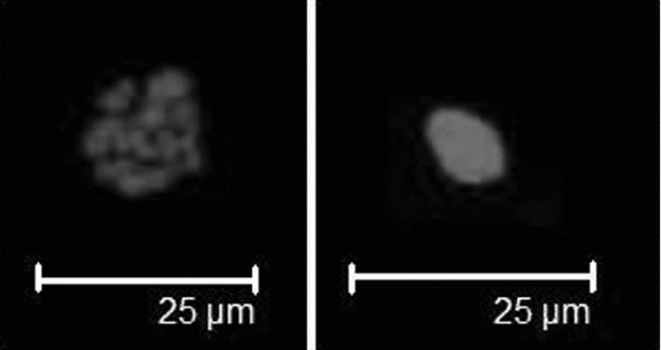
Nuclear and cytoplasmic maturation were evaluated in each oocyte. Nuclear stages were observed under an UV epifluorescence microscope (Nikon Eclipse TE 2000S) and a laser-confocal microscope (Leica TCS SP2). Metaphase II (MII) was considered to be the correct nucleus stage after oocyte maturation. Nuclear stages were classified according to a modified classification by Tseng (Tseng et al., Reference Tseng, Chen, Chou, Yeh and Ju2004; Andreu-Vázquez et al., Reference Andreu-Vázquez, López-Gatius, García-Ispierto, Maya-Soriano, Hunter and López-Béjar2010): Anaphase–Telophase I (A–T), normal MII (uniform alignment of the chromosomes on the spindle) or anomalous MII (nuclear contents appearing as a chromatin-like structure forming condensed aggregates or forming aberrantly distributed chromosomes; Fig. 1).
Laser-confocal microscopy images of Hoechst 33342-labelled bovine oocytes showing metaphase II (MII) and anomalous MII.

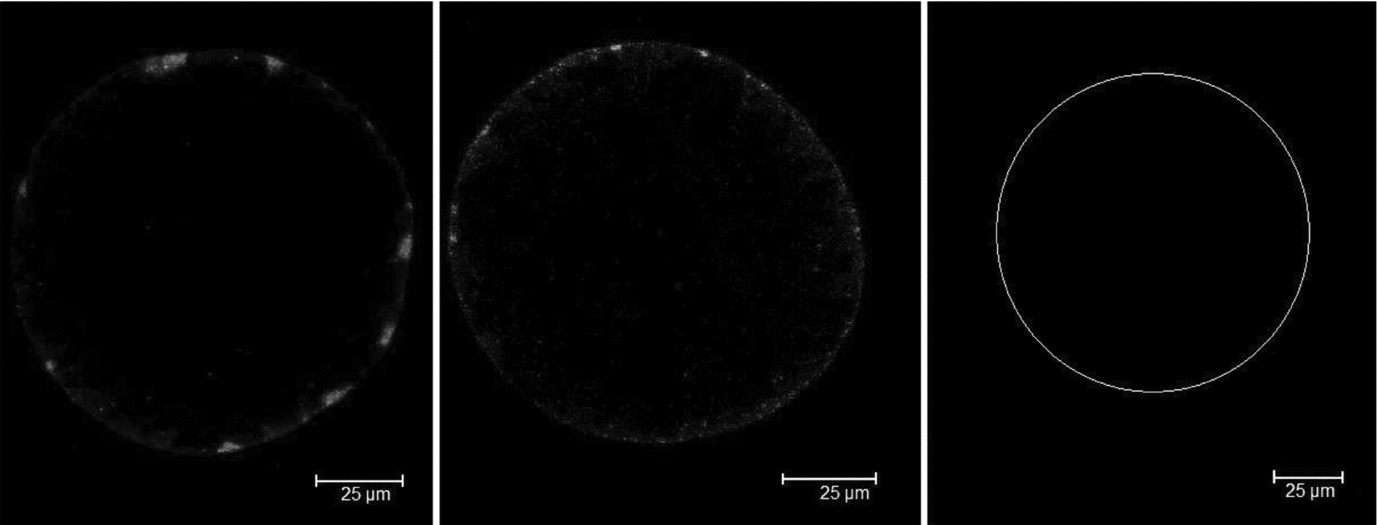
Translocation of CG to the oolemma was considered to be an indicator of correct cytoplasmic maturation (Damiani et al., Reference Damiani, Fissore, Cibelli, Long, Balise, Robl and Duby1996) and was checked under an UV epifluorescence microscope and a laser-confocal microscope for each oocyte. Four patterns of CG translocation were observed according to Hosoe & Shioya (Reference Hosoe and Shioya1997) classification: Pattern I (CGs distributed in clusters or large aggregates), pattern II (CGs individually dispersed and partially clustered), pattern III (correct distribution of CGs, completely dispersed in monolayer), pattern IV (no CG; Fig. 2).
Laser-confocal microscopy images of an equatorial section of FITC–LCA-labelled bovine oocytes showing representative cortical granule (CG) distribution patterns for the different groups: Pattern II, Pattern III, Pattern IV.
Hormone determinations
For each study group, the steroidogenic activity of cumulus cells was assessed in the maturation medium. Estradiol and progesterone concentrations were determined after IVM using commercial enzyme immunoassay kits (Neogen Corporation, EIA #402210 and EIA #402310 respectively) according to the manufacturer's instructions. Validation test were performed for each assay.
Statistical analysis
Only oocytes that reached the MII nuclear stage were included in the statistical analysis. The following data were recorded for each oocyte: replicate (1–7), antioxidant agent (RO or RI or OA), treatment (C versus HS), MII morphology (normal MII versus anomalous MII) and CG distribution pattern (I–IV).
The probability of differences in the proportions of oocytes showing anomalous MII and CG distribution pattern IV among replicates was determinate by chi-squared analysis.
The results of the nuclear and cytoplasmic maturation were expressed in percentage. The data were analyzed using contingency tables and Pearson's chi-squared statistical test using SPSS (version 15.0 for Windows, SPSS Inc., Chicago, IL, USA). Student's t-test for unpaired data was performed to evaluate hormone production, using the Welch correction for groups who did not have equal variances through GraphPad InStat (version 3.01, Windows 95, Graph-Pad Software, San Diego, USA). Significant differences were considered at P < 0.05.
Results
Heat stress effects on oocyte maturation
Heat-stressed oocytes showed lower MII percentages (P < 0.05) and a higher percentage of oocytes with CG pattern IV than the oocytes matured under control conditions (P < 0.010). The rise of pattern IV was at the expense of a decrease in the correct pattern III percentage.
Effect of antioxidant agents on oocyte nuclear maturation
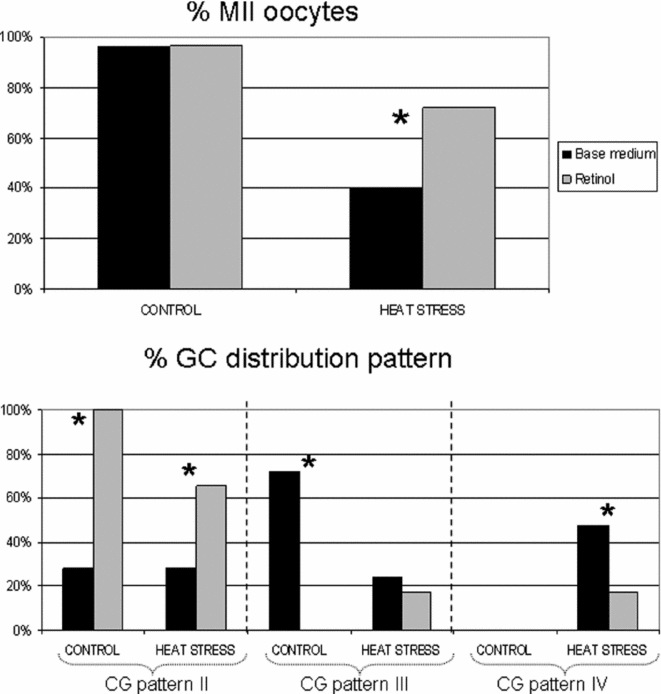
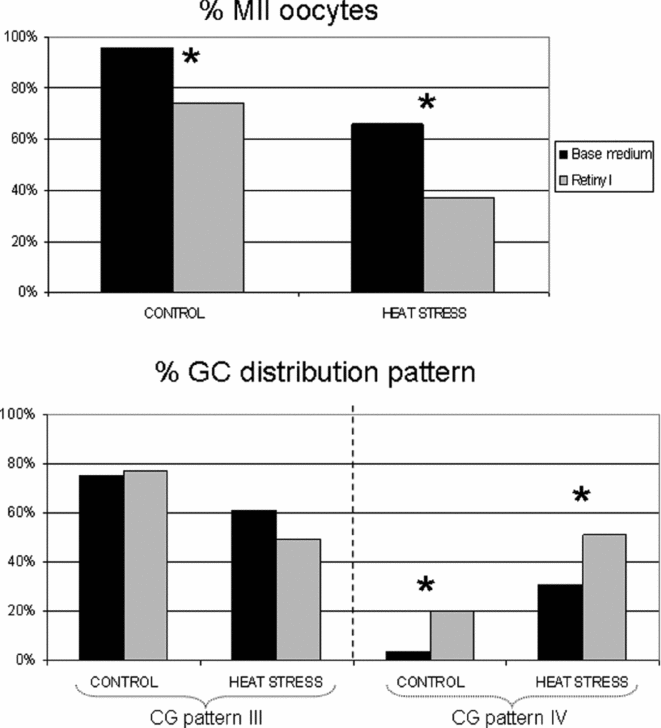
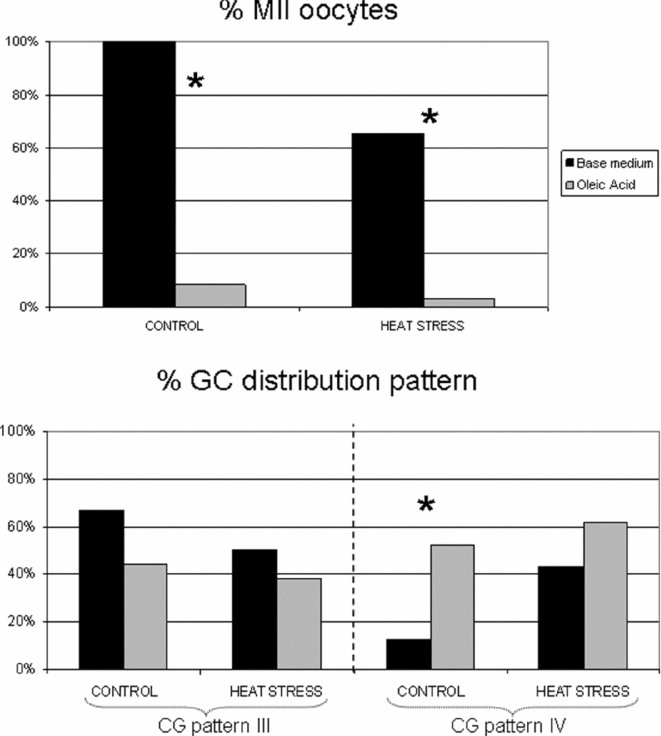
When retinol was added to the maturation medium, heat-stressed oocytes showed a higher percentage of correct nuclear maturation stage (P = 0.031; Fig. 3). Nevertheless, the addition of retinyl or oleic acid to the maturation medium reduced the percentage of MII oocytes regardless of the maturation conditions (C group P = 0.003, HS group P = 0.006; C and HS group P = 0.000, respectively) (Figs. 4 and 5).
Percentage of control and heat-stressed oocytes that reached the metaphase II stage and different cortical granule (CG) distribution patterns when retinol was added to the maturation medium. *P < 0.05.
Percentage of control and heat-stressed oocytes that reached the metaphase II stage and different cortical granule (CG) distribution patterns when retinyl was added to the maturation medium. *P < 0.05.
Percentage of control and heat-stressed oocytes that reached the metaphase II stage and different cortical granule (CG) distribution patterns when oleic acid was added to the maturation medium. *P < 0.05.
Effect of antioxidant agents on cortical granules distribution pattern
A reduction in the percentage of oocytes showing an exocytosis pattern (pattern IV) was observed under HS conditions (P = 0.010), when retinol was added to the medium (Fig. 3). It was linked to an increase in CG pattern II percentage. However, when retinyl was added to the maturation medium, cytoplasmic maturation was significantly altered in heat-stressed oocytes showing a lower CG pattern III percentage (P = 0.002) and a higher exocytosis pattern IV (P = 0.025) (Fig. 4). On the other hand, oleic acid supplementation did not significantly affect the cytoplasmic maturation patterns (Fig. 5).
Effect of antioxidant agents on steroidogenic activity
Neither retinol nor HS conditions had effects on steroidogenic activity.
Nevertheless, under physiological conditions, a slight increase on estradiol production (P = 0.0669) and a decrease on progesterone production was observed (P = 0.0275) when retinyl was added to the medium. On the other hand, oleic acid supplementation significantly increased estradiol availability (P = 0.0163), although no effect was found on progesterone.
Discussion
The current study demonstrated that heat stress dramatically affected oocyte maturation at nuclear and cytoplasmic level, in agreement with our previous findings (Andreu-Vázquez et al., Reference Andreu-Vázquez, López-Gatius, García-Ispierto, Maya-Soriano, Hunter and López-Béjar2010). Moreover, heat-stressed oocytes were less affected when retinol was added to the maturation medium, at least at a nuclear level.
The greater percentage of heat-stressed oocytes showing an aberrant progression to the second meiotic metaphase stage was probably as a result of chromosomal and meiotic spindle alterations, as described by other authors (Payton et al., Reference Payton, Romar, Coy, Saxton, Lawrence and Edwards2004; Tseng et al., Reference Tseng, Chen, Chou, Yeh and Ju2004; Roth & Hansen, Reference Roth and Hansen2005; Andreu-Vázquez et al., Reference Andreu-Vázquez, López-Gatius, García-Ispierto, Maya-Soriano, Hunter and López-Béjar2010). The higher proportion of oocytes showing CG distribution pattern IV, presumptive of premature exocytosis, under high temperatures has also been described previously (Andreu-Vázquez et al., Reference Andreu-Vázquez, López-Gatius, García-Ispierto, Maya-Soriano, Hunter and López-Béjar2010). This pattern, characterized by loss of a continuous CG layer, is the most common pattern produced in oocytes after fertilization or activation due to exocytosis. Thus, heat stress at the end of the IVM period seems to cause an advanced state of oocyte maturation (Payton et al., Reference Payton, Romar, Coy, Saxton, Lawrence and Edwards2004; Edwards et al., Reference Edwards, Saxton, Lawrence, Payton and Dunlap2005), resulting in CG loss, abnormality compatible with oocyte aging (Andreu-Vázquez et al., Reference Andreu-Vázquez, López-Gatius, García-Ispierto, Maya-Soriano, Hunter and López-Béjar2010).
HS affects follicle development and oocyte competence (Hansen et al., Reference Hansen, Drost, Rivera, Paula-Lopes, Al-Katanani and Krininger2001; García-Ispierto et al., Reference García-Ispierto, Lopez-Gatius, Bech-Sabat, Santolaria, Yaniz, Nogareda, De Rensis and Lopez-Bejar2007) due to high levels of ROS (Ikeda et al., Reference Ikeda, Kodama, Fukuda, Shimizu, Murata, Kumagai and Tanaka1999; De S Torres-Junior et al., Reference De S Torres-Junior, de F A Pires, de As, de M Ferreira, Viana and Camargo2008; Roth et al., Reference Roth, Aroyo, Yavin and Arav2008). Mammalian cells, including oocytes and early embryos, have evolved several mechanisms, as antioxidant molecules, to be protected against ROS damage. Antioxidants present in the oocyte, embryo and/or its environment include vitamins as A (retinol), C and E, pyruvate, glutathione (GSH), hypotaurine, taurine, and cysteamine (Guerin et al., Reference Guerin, El Mouatassim and Menezo2001).
Some in vivo studies described beneficial effects on the use of antioxidant agents or fatty acids in the diet improving fertility during the warm period of the year and also during NEB. It has been reported that dairy cow fertility can be improved at the second artificial insemination by a diet rich in retinol and β-carotenes during the warm months (Arechiga et al., Reference Arechiga, Vazquez-Flores, Ortiz, Hernandez-Ceron, Porras and McDowell1998). However, it has been suggested that a retinoid cumulative effect is needed to obtain an effective concentration in oviduct and uteri (Guerin et al., Reference Guerin, El Mouatassim and Menezo2001; Livingston et al., Reference Livingston, Eberhardt, Edwards and Godkin2004). This effect is due to beta-carotene metabolism and location of retinoid receptors. Those receptors are present in the COC, so it is suggested that retinoids could counteract HS effects by receptor mediated effects (Lawrence et al., Reference Lawrence, Payton, Godkin, Saxton, Schrick and Edwards2004). On the other hand, other nutritional management, involving fatty acids, improved some aspects on dairy cow fertility in the summer (Bilby et al., Reference Bilby, Block, do Amaral, Sa Filho, Silvestre and Hansen2006).
HS affects harmfully the oocyte maturation at both nuclear and cytoplasmic levels. However, in our study, nuclear oocyte maturation was improved when retinol was added to the maturation medium of heat-stressed oocytes. Vahedi et al. (Reference Vahedi, Zeinoaldini, Kohram and Farahavar2009) also reported a beneficial effect on bovine nuclear oocyte maturation when all-trans retinoic acid at 1 μM was supplemented in vitro at physiological conditions, observing an increase on development rate to MII. Nevertheless, the beneficial effects of retinol are noted only when the effects of heat stress were pronounced enough to reduce continued development of oocytes (Livingston et al., Reference Livingston, Eberhardt, Edwards and Godkin2004). However, there are controversial results regarding retinol effects on embryo development. Some studies suggested that ovine embryo development to blastocyst could be improved under oxidative stress conditions adding retinol at 6 µM (Rajesh et al., Reference Rajesh, Shankar and Deecaraman2010), and also bovine heat-stressed oocytes and embryos, after addition of retinol at 5 µM (Lawrence et al., Reference Lawrence, Payton, Godkin, Saxton, Schrick and Edwards2004; Livingston et al., Reference Livingston, Eberhardt, Edwards and Godkin2004). Nevertheless, these studies take into account the effect on the oocyte through the embryo development but not the retinoid effects done into the oocyte itself. Therefore, in this study we tried to elucidate the effects that retinoids exert into the oocyte itself under heat stress conditions.
On the other hand, a retinol effect on CG was observed in our study, decreasing the exocytosis pattern IV due to HS, but also increasing the CG pattern II oocytes. Although the correct maturation distribution pattern is a CG pattern III, the pattern II is considered an immature pattern but not an undesirable distribution. A possible explanation is that retinol could cause a delay effect on CG migration through the oolemma, not considering it as a negative effect. It has been described previously that other retinoids improve cytoplasmic maturation of bovine oocytes under physiological conditions (Hidalgo et al., Reference Hidalgo, Diez, Duque, Facal and Gomez2003), possibly because retinoids can act as antioxidant agents, regulating the expression of the gonadotrophin receptor, increasing midkine levels (MK; growth differentiation factor) in follicular fluid, suppressing cyclooxygenase synthesis and nitric oxide synthesis in follicle cells, cumulus-granulosa cells and oocytes (Ikeda et al., Reference Ikeda, Kitagawa, Imai and Yamada2005).
Nevertheless, when another retinoid was used (retinyl) a decrease in the correct oocyte maturation rate was observed, especially on the nuclear stage. This effect was seen using both culture conditions. So, retinyl seems to be useless at counteracting heat stress effects on bovine oocytes, at least at the concentration used in this study. To our knowledge there is no literature about effects of retinyl on bovine oocyte maturation, neither under physiological or heat stress conditions. However, retinyl has been used on embryos and did not show a beneficial effect on development or blastocyst rates (Lima et al., Reference Lima, Oliveira, Goncalves, Montagner, Reichenbach and Weppert2004). Retinoic acid supplementation helps murine embryos to overcome the 2-cell block (Hajializadeh et al., Reference Hajializadeh, Babaei, Nematollahi-Mahani and Azizollahi2008), and seems to be valuable in co-cultures of goat embryos with oviductal cells. So, it could be suggested that retinyl needs to be metabolised to be effective (Chiamenti et al., Reference Chiamenti, Aguiar Filho, Freitas Neto, Chaves, Paula-Lopes and Lima2010).
It has been reported that oleic acid is present in high concentrations in bovine oocyte membranes during winter and its low concentration in the summer is related to the poor quality of oocytes (Zeron et al., Reference Zeron, Ocheretny, Kedar, Borochov, Sklan and Arav2001). Nevertheless, our results showed a negative effect of oleic acid on metaphase progression, as described previously by Jorritsma et al. (Reference Jorritsma, Cesar, Hermans, Kruitwagen, Vos and Kruip2004), and did not improve cytoplasmic oocyte maturation under heat stress, at least at the concentration used in this study. However, the addition of oleic acid in the maturation medium seemed to not cause any effect on nucleus of bovine oocytes in a previous study (Leroy et al., Reference Leroy, Vanholder, Mateusen, Christophe, Opsomer and de Kruif2005). To our knowledge there are no other studies that take into account the effect of oleic acid on oocyte cytoplasmatic maturation. It is necessary to take into account that the concentrations used in this study could be not appropriate to improve oocyte maturation under heat stress conditions.
HS affects steroidogenic activity as well as oocyte development. Although no effect was found in hormone production when antioxidant agents were added to the culture medium under HS, some effects were noticed on physiological conditions, except using retinol. Our findings suggested that retinyl supplementation was able to maintain the cumulus oophorus cell phenotype, maintaining estradiol secretion, and avoiding its premature luteinisation, thus decreasing progesterone availability for the oocyte. These findings do not correspond with an in vitro study in gilts, in which an increase in progesterone secretion, but not in estradiol concentration, was reported in those oocytes cultured after an in vivo injection of vitamin A before mating (Whaley et al., Reference Whaley, Hedgpeth, Farin, Martus, Jayes and Britt2000). Finally, oleic acid supplementation was able to increase estradiol availability per oocyte, as described in another study in which estradiol production by granulose cells was also stimulated, but at higher concentrations than that used in our study (500 μM; Vanholder et al., Reference Vanholder, Leroy, Van Soom, Opsomer, Maes, Coryn and de Kruif2005).
In conclusion, heat stress increased the rate of aged oocytes after in vitro maturation, and the use of retinol as supplementation in the maturation medium could be a useful way of improving nuclear maturation in bovine heat-stressed oocytes. However, the addition of retinyl or oleic acid to the medium was not a useful approach to improve maturation of heat-stressed oocytes, at least at the concentrations used in this study. So, further studies are needed in this direction to elucidate the existence of effective concentrations of the assessed antioxidant agents.
Acknowledgements
This study was supported by Spanish Ministry of Science and Innovation, MICINN, Ref. RTA2008–00070-C02–02. Maya-Soriano M.J. was supported by a PIF Grant from the Universitat Autònoma de Barcelona, Barcelona, Spain.