Introduction
Questions about relationships between species diversity and physical gradients have traditionally focused on richness estimators and community composition (e.g. Terborgh, Reference Terborgh1977; Brehm et al., Reference Brehm, Süssenbac and Fiedler2003). However, an examination of changes in morphological characteristics along gradients can also yield significant ecological and evolutionary insights. Studies on tropical altitudinal gradients are of particular interest due to the potential changes associated with regional and worldwide climate changes (Williams et al., Reference Williams, Jackson and Kutzbach2007). The increase in altitude leads to an increase in the stability and persistence of habitats (Roff, Reference Roff1990), a decrease in habitat heterogeneity (Kavanaugh, Reference Kavanaugh and Ball1985; Brehm et al., Reference Brehm, Süssenbac and Fiedler2003) and an increasingly unfavourable environment for the average organism (McCoy, Reference McCoy1990). As the altitude increases, the temperature and partial pressure of respiratory gases decrease due to the increase in precipitation and wind velocity. These factors contribute to a harsh, limiting abiotic environment (Hodkinson, Reference Hodkinson2005), which influences the diversity and composition of organisms at high altitudes (Mani, Reference Mani1968; Hodkinson, Reference Hodkinson2005). They also can affect two morphological characteristics, body size and wing state, which are critical to the dispersal of many insects such as beetles (e.g. Lövei and Sunderland, Reference Lövei and Sunderland1996; Gutiérrez and Menéndez, Reference Gutiérrez and Menéndez1997).
In the literature, studies reporting the relationship between altitude and insect body size have not been consistent. For instance, studies have reported that body size increases with altitude in weevils (Ectemnorhinini; Chown and Klok, Reference Chown and Klok2003) and queen bumblebees (Bombus festivus; Dillon et al., Reference Dillon, Frazier and Dudley2006), a trend that follows temperature differences when resources are not limited (Smith et al., Reference Smith, Hines, Richmond, Merrick, Drew and Fargo2000; Hodkinson, Reference Hodkinson2005). The majority of studies have reported decreases in insect body size with altitude, e.g. the striped ground cricket (Allonemobius socius; Mousseau, Reference Mousseau1997), worker bumblebees (Bombus festivus; Dillon et al., Reference Dillon, Frazier and Dudley2006), flower-head-feeding fruit flies (Tephritidae; Kubota et al., Reference Kubota, Loyola, Almeida, Carvalho and Lewinsohn2007), dung beetles (Phanaeini; Herzog et al., Reference Herzog, Hamel-Leigue, Larsen, Mann, Soria-Auza, Gill, Edmonds and Spector2013), a carabid species (Carabus tosanus; Tsuchiya et al., Reference Tsuchiya, Takami, Okuzaki and Sota2012), and in general surveys of insect communities (Janzen et al., Reference Janzen, Ataroff, Fariñas, Reyes, Rinco, Soler, Soriano and Vera1976; Guevara and Avilés, Reference Guevara and Avilés2013). Some studies have reported no relationship, e.g. butterflies of Costa Rica (Hawkins and DeVries, Reference Hawkins and DeVries1996) and geometrid moths in Ecuador (Brehm and Fiedler, Reference Brehm and Fiedler2004). Clearly, more work is needed. One of the goals of this study is to determine the relationship between body size and altitude in Neotropical carabid beetles.
The question of why flightlessness occurs is of long-standing interest (e.g. Darwin, Reference Darwin1859; Darlington, Reference Darlington1943). Since wings are important not only for flight but also for other behaviours such as courtship, crypsis, mimicry, hunting, escape and dispersal (Hammond, Reference Hammond, Erwin, Ball and Whitehead1979; Wagner and Liebherr, Reference Wagner and Liebherr1992), the evolution of wings is possibly the most important adaptation that accounts for the success of insects (Ikeda et al., Reference Ikeda, Nishikawa and Sota2012). Yet, the loss of wings has evolved in nearly all insect orders, and repeatedly so in the family Carabidae (Harrison, Reference Harrison1980; Kavanaugh, Reference Kavanaugh and Ball1985; Roff, Reference Roff1990; Lövei and Sunderland, Reference Lövei and Sunderland1996; Harrison and Roberts, Reference Harrison and Roberts2000).
As ectotherms, insects are especially useful models for the study of morphological changes because of their sensitivity to changes in the abiotic environment (Dillon et al., Reference Dillon, Frazier and Dudley2006). Carabid beetles (Coleoptera: Carabidae) are useful as model organisms for ecological studies. They are a highly diverse taxon (Erwin, Reference Erwin1996), relatively easy to collect by active and passive methods and to identify, and have a well-known biology (Lövei and Sunderland, Reference Lövei and Sunderland1996). Due to the high variation in dispersal ability both within and among species, carabid beetles are ideal for the study of flight condition, having both short- and long-winged forms (Gutiérrez and Menéndez, Reference Gutiérrez and Menéndez1997). Carabid beetles found in tropical regions also have highly varied wing morphology, with a high proportion of species capable of flight and presumably higher vagility (Thiele, Reference Thiele1977; Erwin, Reference Erwin and Ball1985). Although flightlessness may be more common in temperate zones than in tropical regions (Erwin, Reference Erwin, Erwin, Ball, Whitehead and Halpern1979), a high incidence of loss of flight has been observed in high-altitude communities of carabid beetles, not only in temperate North America (Darlington, Reference Darlington1943) but also in the tropical Andes (Moret, Reference Moret2009). Increased habitat stability and decreased heterogeneity might also favour the development of loss of flight (Kavanaugh, Reference Kavanaugh and Ball1985; Roff, Reference Roff1990).
In this study, we examine three morphological characteristics of carabid beetles – body length, wing condition and flight muscle length – along an altitudinal gradient in the cloud forests of the Andes of southeastern Peru. Carabid beetles have been sampled only in the lowland rainforests of Peru and the surrounding Andean region (e.g. Erwin, Reference Erwin1991; Moret, Reference Moret2005, Reference Moret2009). Furthermore, wing state has been reported for carabid beetles collected in other Neotropical regions, e.g. the Greater Antilles (Darlington, Reference Darlington1970) and Ecuador (Moret, Reference Moret2005, Reference Moret2009), but not along an altitudinal gradient. Specifically, we address how body length and flight capability change with changing altitudes within different tribes and for the carabid beetle assemblage as a whole. We predict a decrease in body length and flight capability with increasing altitude because of both increasing environmental homogeneity and abiotic constraints. We also compare these responses to altitude between an old-growth forest and an anthropogenically disturbed area, both of which cover similar altitudinal ranges. Because of the relative instability of disturbed habitats, many species of carabid beetles would be likely to be more vagile, with a higher degree of dispersal ability needed to maintain populations.
Materials and methods
Collections of Carabidae
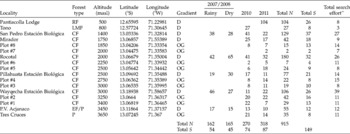
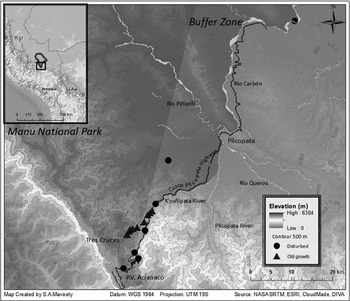
Carabid beetles were collected on two gradients, located < 4 km apart in southeastern Peru, K'osñipata Valley (Table 1; Fig. 1). The first gradient is located outside the eastern border of the Manu National Park and follows the Cusco–Pilcopata highway (Fig. 1). The first gradient, extending from 1400 to 3450 masl, was sampled at approximately 500 m intervals at five sites in the cloud forest zone, with two additional lowland collection sites at 500 and 800 m to analyse the complete altitudinal gradient. Although the Cusco–Pilcopata highway was finished in the 1960 s (Young and León, Reference Young and León1999), a road has existed in the K'osñipata Valley since at least the late nineteenth century. Since then, the areas adjacent to the road have experienced disturbance associated with vehicular traffic, minor agricultural efforts and timber extraction; we designated this gradient disturbed forest. The second gradient, located within the protected area of the Manu National Park, follows an Incan trail, the Trocha Union. The old-growth gradient, extending from 1850 to 3650 masl, was sampled at approximately 250 m intervals at nine sites that the Andes Biodiversity and Ecosystem Research Group (ABERG) had already established. Since this forest was not logged or cleared (compared with the disturbed forest), we designated this gradient the old growth. Collections on this gradient were made in the mature forest, while the collections in the other gradient were made alongside the road where plants in the early succession stage, such as grasses and Cecropia, occur sporadically, and mature forest may be 5–10 m from the edge of the road. Due to the limitations of our study, sampling was replicated by only these two altitudinal gradients.
Summary of the collection sites with corresponding forest type, altitude, latitude and longitude, gradient and number of individuals and morphospecies collected

RF, rainforest; D, disturbed; LMF, lower montane forest; CF, cloud forest; OG, old growth; EF, elfin forest; P, Puna.
+ Measured by man hours at each locality.
Map of the study area and the location of the collection sites

At each site, carabid beetles were collected by hand. This consisted of sifting through leaf litter on the forest floor and examining above-ground vegetation to a height of approximately 1.5 m. Hand collections sampled only epigeic (surface-dwelling) carabids and possibly exhibited bias based on size or sampling location. Due to the nocturnal behaviour of most carabid beetles, collections were made at night. Hand collections are preferred to pitfall traps in the tropics as the latter often have a lower yield of abundance and diversity (Maveety et al., Reference Maveety, Browne and Erwin2011). Search effort was recorded for each site (Table 1). For the disturbed gradient, monthly collections were made from September 2007 to July 2008, with additional collections being made during December 2008, June 2010 and June 2011. Collections on the old-growth gradient were completed during June–July 2010 and May–August 2011.
Carabid beetles were identified to tribe and genus using lowland Neotropical Carabidae keys by Reichardt (Reference Reichardt1977) and Erwin et al. (Reference Erwin, Kavanaugh and Moore2003). As no taxonomic keys exist for carabid beetles of the tropical montane forests of Peru, specimens were identified to morphospecies based on external morphology, i.e. without distinguishing between sexes; this has been a useful approach for species inventories (Oliver and Beattie, Reference Oliver and Beattie1996). Specimens were preserved in 95% ethanol upon collection and are currently on loan to the National Museum of Natural History of the Smithsonian Institution, Washington, DC.
Body length
A random sample of individuals was measured for each morphospecies, with n= 5 for the 2010 and 2011 collections and n= 10 for the 2007/2008 collections. When morphospecies spanned more than one altitudinal zone, at least one individual was measured from each zone. (Table S1 (available online) lists the total number of individuals collected and Table 1 lists the sample of individuals used for this study.) Sample size for some morphospecies was limited to the number of individuals collected. Two body length measurements were recorded: apparent body length (ABL) and standard body length (SBL). ABL is the length from the extreme anterior part of the mandible to the extreme posterior part of the abdominal terga or elytra (Cieglar, Reference Cieglar2000). This is the measurement most commonly accepted for ecological studies (Erwin and Kavanaugh, Reference Erwin and Kavanaugh1981). SBL measurements were also made because specimens vary in size depending on collection and preservation. SBL is the sum of three fixed measurements of the dorsal cuticle: 1, length of the head; 2, length of the pronotum; 3, length of the elytra.
Flight condition
Wing state was determined by lifting the elytra of a specimen and examining whether a wing was present and, if present, in what state. Wing structure is generally classified as: (i) macropterous – alate, or fully winged; (ii) brachypterous – reduced wings; (iii) micropterous – wings reduced to stumps or not present (following Darlington, Reference Darlington1936; Gutiérrez and Menendez, Reference Gutiérrez and Menéndez1997). Table 2 lists the description of the possible wing states. Because both brachypterous and micropterous individuals are incapable of flight, i.e. flightless, both groups are referred to as ‘brachypterous’ (Kavanaugh, Reference Kavanaugh and Ball1985).
Description of the wing state, with the number of carabid morphospecies (S) and individuals (N) collected per state along the entire altitudinal gradient

In addition to wing state, flight condition was evaluated by measuring the flight muscle, which is attached to the metasternum (MS) and is reduced along the length of the median longitudinal suture in brachypterous specimens (Forsythe, Reference Forsythe1987). The cuticular medial length of the MS was measured as a proxy for wing muscle and adjusted to account for differences in the size of the carabid specimens using a ratio of MS:ABL. Flight muscle measurements were made for the same subset of individuals as for analyses of the body length.
Some morphospecies were dimorphic for wing state, i.e. individuals of a morphospecies were found in both macropterous and brachypterous forms. For all analyses of wing state, dimorphic morphospecies were not included (so that any morphospecies representing more than one wing state would not be counted twice). However, for flight muscle analyses, dimorphic morphospecies were included (because we examined the relative differences in muscle length).
Data analysis
ABL was examined both seasonally (rainy and dry seasons, 2007/2008 collections) and inter-annually (2007/2008, 2010 and 2011 collections) to detect any differences observed in body length between seasons and among years. For seasonal comparison of body length, data were based on individuals from the 2007/2008 collections, which included samples from both the rainy season (November to April) and the dry season (May to October). (Detailed description of the seasons can be found in Rapp and Silman, Reference Rapp and Silman2012.) Seasonal and inter-annual differences were compared via a single-factor, completely randomized design analysis of variance, but if variances were heterogeneous (as determined by the F max test), the Games–Howell test (Sokal and Rohlf, Reference Sokal and Rohlf1995) was used. Body length and flight capability (length of the flight muscle and percentage of brachyptery) were examined on the altitudinal gradient (by regression) for each tribe that spanned three or more altitudinal zones. In addition, regression was conducted for the combined carabid beetle assemblage, based on all individuals measured for each morphospecies at each altitudinal zone. Altitudinal trends in flight muscle were also analysed independent of the wing state (i.e. macropterous or brachypterous individuals) for each tribe that spanned three or more altitudinal zones (by regression), and for the carabid beetle assemblage as a whole. Data are reported as means with 95% confidence intervals (CI).
Morphological changes in carabid beetles were also compared between the disturbed and old-growth regions. For this analysis, the length of the disturbed gradient was truncated at 2000 m to match the altitudinal span of the old-growth gradient (1850–3650 m). Group comparison t-tests (assuming unequal variances) were run to compare the differences in mean ABL and MS:ABL ratio for tribes that occurred in both regions. To avoid type I error associated with calculating multiple inference tests, the α value is often adjusted by the Bonferroni correction (Sokal and Rohlf, Reference Sokal and Rohlf1995). However, as suggested by Moran (Reference Moran2003), the Bonferroni correction increases the chances of committing a type II error, especially for ecological studies, so the α value was standardized at 0.05. All data analyses were performed in the Microsoft Excel.
Results
Body length
A total of 915 carabid beetles were measured, representing a total of 149 morphospecies (Table 1). ABL was a proxy for the sum of the three SBL measurements (ΣSBL). There was a significant positive correlation (r= 0.97, degree of freedom (df) = 912, F= 1.3 × 10⁴, P< 0.0001) between the ABL and ΣSBL. Based on these data, SBL was approximately 82.8% of ABL. For the entire dataset, ABL was 7.41 ± 0.22 mm; the length ranged from 1.94 to 23.64 mm.
There was no significant difference in ABL among the three different years of collection (Games–Howell comparison, P>0.05). For the 2007/2008 collections, ABL was larger during the dry season (7.49 ± 0.072 mm) than in the rainy season (7.09 ± 0.096 mm, Games–Howell comparison, P< 0.05). Since there was no inter-annual difference, we used data from all years in the following analyses for comparisons between altitude and the disturbed versus old-growth region.
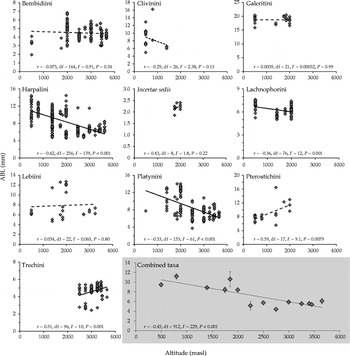
A total of 19 tribes were sampled and 10 spanned at least three altitudinal zones, qualifying for regression analysis of ABL versus altitude (Fig. 2); the tribes presented were monophyletic (T.L. Erwin, personal communication). Six tribes (Bembidiini, Clivinini, Galeritini, incertae sedis, Lebiini and Pterostichini) did not show a significant trend between ABL and altitude. For three tribes (Harpalini, Platynini and Lachnophorini), the relationship between ABL and altitude was negative, but the relationship was positive for Trechini. When the tribes were divided by subfamily, there was still no singular pattern. When the carabid assemblage as a whole was examined, ABL was negatively correlated with altitude (Fig. 2). Although the high abundances of Harpalini and Platynini at first appeared to be driving the combined taxa trend, there was still a negative relationship between ABL and altitude when these tribes were removed (r= − 0.43, df = 495, F= 115, P< 0.001). Furthermore, when carabid beetle taxa were combined, the body length of beetles found at or below 2000 m (
 $$\bar {>x} $$
= 8.93 ± 0.16) was significantly larger than that of beetles found in the upland from 2250 to 3650 m (
$$\bar {>x} $$
= 5.65 ± 0.084, t= 17, df = 415, P< 0.001).
Altitudinal trends in the ABL of carabid beetles for tribes that spanned at least three altitudinal zones. The bottom right panel represents the ABL (mean ± 95% CI) for all 19 tribes, with regression based on all individuals at each altitudinal zone. A solid trend line indicates a significant correlation, and a dashed trend line indicates no significant correlation. Note: there is a variation in the y-axis and body length.

Flight condition
Thirteen morphospecies were found to be dimorphic for wing state. Among the dimorphic morphospecies, there were 85% more brachypterous than macropterous individuals. Two of the dimorphic morphospecies were found within only one altitude zone; the remaining 11 morphospecies did not show any trend in wing morphology with altitude zone. All 13 dimorphic morphospecies occurred in the disturbed region, with 6 out of 13 also occurring in the old-growth forest. For all dimorphic morphospecies, there was 71% brachyptery among the individuals found in the disturbed region and 90% among those found in the old-growth forest. A total of 136 morphospecies were monomorphic; there was no significant difference observed between the number of macropterous (S= 78) and brachypterous (S= 58) morphospecies (G= 2.95, df = 1, P>0.05).
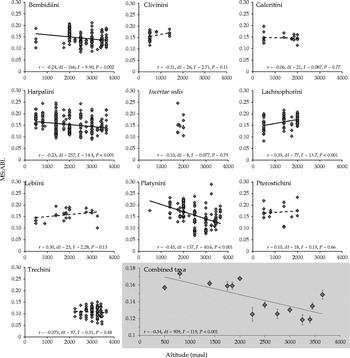
The length of the flight muscle was highly variable with altitude among the 10 tribes that spanned at least three altitudinal zones (Fig. 3). The MS:ABL ratio of three tribes (Bembidiini, Harpalini and Platynini) was negatively correlated with altitude; that of Lachnophorini was positively correlated. Six tribes did not exhibit a trend in MS:ABL ratio with altitude (Clivinini, Galeritini, incertae
sedis, Lebiini, Pterostichini and Trechini). When the tribes were divided by subfamily, there was still no singular pattern. For the combined carabid beetle assemblage, the length of the flight muscle decreased significantly with altitude (Fig. 3). Although the high abundances of Bembidiini, Harpalini and Platynini also appeared to be driving the combined taxa trend of a negative relationship between the length of the flight muscle and altitude, there was still a negative relationship when those tribes were removed (r= − 0.49, df = 324, F= 104, P< 0.001). Furthermore, when the carabid beetle taxa were combined, the flight muscle of beetles found at or below 2000 m (
$$\bar {>x} $$
= 0.16 ± 0.0014) was significantly longer than that of beetles found in the upland from 2250 to 3650 m (
$$\bar {>x} $$
= 0.13 ± 0.0016, t= 15, df = 12, P< 0.001).
Altitudinal trends in the flight muscle length (MS:ABL) of carabid beetles for tribes that spanned at least three altitudinal zones. The bottom right panel represents the MS:ABL ratio (mean ± 95% CI) for all 19 tribes, with regression based on all individuals at each altitudinal zone. A solid trend line indicates a significant correlation, and a dashed trend line indicates no significant correlation.

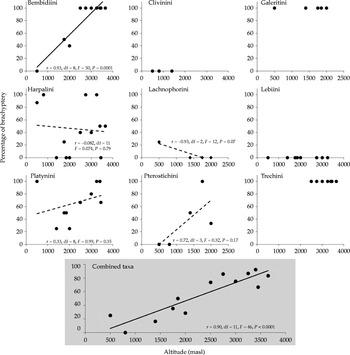
Tribal information about the percentage of brachyptery is reported in Fig. 4; incertae sedis was excluded because it was represented by one dimorphic species, Andinodontis maveetyae. Clivinini and Lebiini were always macropterous; Galeritini and Trechini were always brachypterous. Otherwise, only one tribe, Bembidiini, showed a significant increase in the percentage of brachyptery on the altitudinal gradient while the remaining four tribes showed no trend. The percentage of brachyptery for the carabid beetle assemblage significantly increased with altitude (Fig. 4).
Altitudinal trends in the percentage of brachyptery by tribe. The bottom panel represents the total percentage of brachypterous morphospecies from all 19 tribes. A solid trend line indicates a significant correlation, and a dashed or no trend line indicates no significant correlation.

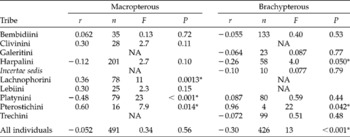
Flight muscle was also examined within each wing state class, i.e. macropterous and brachypterous. For macropterous specimens, Lachnophorini and Pterostichini were significantly positively correlated with altitude; Platynini was significantly negatively correlated (Table 3). For combined taxa, there was no trend for the correlation of the flight muscle of macropterous specimens with altitude. For brachypterous specimens, Harpalini demonstrated a negative correlation, and Pterostichini a positive correlation, of the MS:ABL ratio with altitude, and the combined brachypterous assemblage demonstrated a negative correlation.
Correlation of flight muscle (MS:ABL) with altitude between the macropterous and brachypterous individuals for tribes that spanned at least three altitudinal zones

NA indicates that a tribe had no individuals designated for either of the two wing state groups.
* Significantly correlated (P< 0.05).
Wing state was also examined in relation to the body length. To maintain maximum statistical power, individuals were divided into only two groups based on the body length: ‘small’ ( < 7 mm,
$$\bar {>x} $$
= 5.12 ± 0.14 mm) and ‘large’ (>7 mm,
$$\bar {>x} $$
= 11.52 ± 0.48 mm). For ‘small’ beetles, there was no significant difference observed between the number of macropterous (S
m= 31) and brachypterous morphospecies (S
b= 35) (G= 0.24, df = 1, P>0.05). In contrast, for ‘large’ beetles, there were twice as many macropterous morphospecies as brachypterous morphospecies (S
m= 49 and S
b= 24; G= 8.74, df = 1, P< 0.01). This trend was reinforced by a larger MS:ABL ratio in the large-sized (0.156 ± 0.0034) group when compared with the small-sized (0.131 ± 0.0035) group (t= 5.0, df = 64, P< 0.0001).
Comparison of the gradients
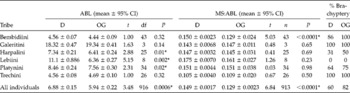
Of the 19 tribes, seven were found on both gradients. Since incertae sedis had just one individual on the old-growth gradient, only six of the seven tribes could be used for gradient analysis. Harpalini, Lebiini and Platynini had significantly larger ABLs in the disturbed region than in the old-growth forest; the remaining three tribes were not found to be significant (Table 4). When the entire carabid assemblage was examined, ABL was found to be significantly larger in the disturbed region. Only one tribe, Bembidiini, demonstrated a significant difference between the two gradients in relation to the length of the flight muscle (MS:ABL) which was reduced on the old-growth gradient (Table 4). For the entire carabid assemblage, the length of the flight muscle was also found to be significantly reduced on the old-growth gradient.
ABL, flight muscle (MS:ABL) and wing state (% Brachyptery) of carabid beetles between the disturbed (D) and old-growth (OG) gradients for tribes that occurred on both gradients+

+ Results for ABL and MS:ABL were obtained by group comparison t-tests; tribal information of brachyptery was included for completeness.
* Significantly different (P< 0.05).
Discussion
At the family level, the carabid beetle assemblage demonstrated a decrease in both body length and flight capability with increasing altitude. At the finer-grained classification level represented by tribes, we observed all possible outcomes (i.e. positive, negative and no relationship between altitude and body length vs. flight capability). When the disturbed and old-growth forests were compared, carabid beetles demonstrated increased dispersal ability and size in the disturbed region.
Body length
The relationship between body length and altitude varied by tribe, with all possible relationships being found: positive; negative; no relationship. This suggests that variation in life-history strategies may influence how carabid tribes respond to altitude. Decreased temperatures during development, such as those seen on an altitudinal gradient, are thought to limit insect body size (Mousseau, Reference Mousseau1997), and this may be responsible for the negative correlation observed in some tribes. However, behavioural adaptations that compensate for cold temperatures, such as burrowing (Sømme et al., Reference Sømme, Davidson and Onore1996), typical of tribes Clivinini and Trechini, might explain why there are both relationships between altitude and body length.
At the family level, a negative relationship between altitude and insect body length was found for the carabid beetle assemblage; we predicted a negative relationship between body length and altitude because of four potential constraints on an altitudinal gradient: decrease in resource diversity; reduced habitat area; less favourable environment; decrease in primary productivity at high altitudes (McCoy, Reference McCoy1990). Decrease in resource diversity could limit body size because of the limited availability of energy (Chown and Klok, Reference Chown and Klok2003). An unfavourable environment, such as that found with decreased temperature and partial pressure of respiratory gases associated with increasing altitude (Hodkinson, Reference Hodkinson2005), could limit the body size during development (Mousseau, Reference Mousseau1997). Finally, a reduction in primary productivity at higher altitudes could exert an effect on size if food scarcity and/or habitat scarcity inhibit growth. Andersen (Reference Andersen1988) suggested that larger carabid beetles in a community in Norway are associated with larger items of prey. Since Neotropical carabid beetles of the high-altitude Andes are mostly predaceous with some seed feeders (Moret, Reference Moret2005), primary productivity could have a direct and/or indirect effect. Finally, there could be a thermal component to the negative correlation. Bergmann's rule predicts larger-sized homeothermic animals in colder environments due to decreased heat loss, but ectotherms may follow the inverse pattern due to the increased metabolic rates of smaller organisms (Shelomi, Reference Shelomi2012).
However, it is most likely that the negative relationship between altitude and body length was observed for the carabid beetle assemblage because of (i) the variation in altitudinal patterns among the tribes and (ii) the change in both abundance and composition in the representation of the tribes along the altitudinal gradient. Although we outlined trends for 10 tribes that spanned three or more altitudinal zones, the remaining tribes that spanned two or less zones were exclusively represented by rare morphospecies. The trend observed in the ABL across the assemblage also reflects primarily those tribes with a high abundance of individuals. Furthermore, carabid beetles were found to have a high turnover in species composition along the altitudinal gradient (Maveety et al., Reference Maveety, Browne and Erwin2013). For the tribe Harpalini, for example, three relatively large-sized genera, Arthrostictus, Notiobia and Selanophorus, with an average body length of 10 mm, were encountered from 500 to 2000 m. They are replaced between 1400 and 3650 m by a genus with smaller-sized adults, Pelmatellus, with an average body length of 6 mm. There was no correlation with altitude within each size group, supporting the idea that species replacement along the altitudinal gradient may be driving body length.
Flight condition
Darlington (Reference Darlington1936) suggested that degeneration of flight muscle might be a secondary result of the loss of flight following the atrophy of wings. Trends found within the tribes generally supported the loss of flight where brachyptery and the length of the flight muscle were correlated, although the pattern was variable among the tribes. Bembidiini, that exhibited a negative correlation between altitude and flight muscle, also showed increased brachyptery with increasing altitude. In contrast, tribes that were represented by only one wing state, either completely macropterous (Lebiini) or brachypterous (Galeritini and Trechini), had no change in the length of the flight muscle along the altitudinal gradient.
The larger proportion of brachypterous morphospecies at high altitudes (Harrison, Reference Harrison1980) may partly be due to the decreased temperature and changes in the physical properties of air, i.e. increasingly thinner air becomes a problem for the generation of lift (Altshuler et al., Reference Altshuler, Dudley and McGuire2004; Dillon et al., Reference Dillon, Frazier and Dudley2006) and makes flight more costly. However, loss of flight is not the only solution for the problem of an increasingly harsh abiotic environment. For example, hummingbirds show increased wing size to compensate for aerodynamic demands along a Neotropical altitudinal gradient (Altshuler et al., Reference Altshuler, Dudley and McGuire2004). In future studies, it would be useful to examine whether the wing length of macropterous beetles also changes along an altitudinal gradient.
We suggest two hypotheses (which are not mutually exclusive) that may explain the increase in the incidence of flightlessness observed with increasing altitude: potential for dispersal and constraints to the use of energy. Since dispersal can be important for acquiring food and finding a mate (Kavanaugh, Reference Kavanaugh and Ball1985; Zera and Denno, Reference Zera and Denno1997), selection may favour flight when there is high habitat heterogeneity and more complex habitat dimensionality. Most carabid species are capable of flight in often patchy tropical lowlands (Kavanaugh, Reference Kavanaugh and Ball1985; Roff, Reference Roff1990; Brehm et al., Reference Brehm, Süssenbac and Fiedler2003). However, as altitude increases, environments become increasingly homogeneous (Darlington, Reference Darlington1970; Noonan, Reference Noonan and Ball1985; Roff, Reference Roff1990). Furthermore, habitat stability and persistence are also thought to increase, with both factors favouring selection for flightlessness (Darlington, Reference Darlington1943; Kavanaugh, Reference Kavanaugh and Ball1985; Roff, Reference Roff1990). In addition, if stochastic disasters are reduced for uniform and continuous habitats, flight will not necessarily be an advantage and flightlessness might be adaptive in those areas (Darlington, Reference Darlington1936; den Boer et al., Reference den Boer, Van Huizen, den Boer-Daanje, Aukema and den Bieman1980). The loss of flight is often prevalent among species inhabiting historically stable habitats such as montane habitats where a high degree of dispersal is presumably not necessary (Wagner and Liebherr, Reference Wagner and Liebherr1992; Gutiérrez and Menéndez, Reference Gutiérrez and Menéndez1997). For example, in a dimorphic north-temperate carabid beetle (Pterostichus melanarius), brachypterous wing morphs are more common in populations occupying more stable habitats (Niemelä and Spence, Reference Niemelä and Spence1991). Furthermore, macroptery in planthoppers (Delphacidae) (Denno et al., Reference Denno, Roderick, Olmstead and Döbel1991) decreases in more persistent habitats in relation to altitude. The high population densities often found at high altitude (Hodkinson, Reference Hodkinson2005) place beetles in close proximity to one another, and flight may not be the most efficient means of finding a mate.
A second hypothesis for increased brachyptery at higher altitudes focuses on the trade-off between the energy required for the development of morphological flight apparatus versus the increased costs of energy associated with high altitudes (Hodkinson, Reference Hodkinson2005). The cost of flight apparatus may outweigh the cost of reproduction and survival at high altitudes because of the energy limitation of the habitat (Mani, Reference Mani1968; Ikeda et al., Reference Ikeda, Nishikawa and Sota2012). The wings of an insect, constituting 10 to 20% of the total body mass, can be expensive in the use of energy (Roff, Reference Roff1990). If energy resources are scarce and/or energy is expended more rapidly in colder temperatures that occur at high altitudes, there could be a trade-off between expending energy on wing development and flight versus the energy needed for survival, growth and reproduction (Erwin, Reference Erwin, Erwin, Ball, Whitehead and Halpern1979; Hodkinson, Reference Hodkinson2005).
Comparison of the gradients
A reduction in the body size of carabid beetles has often been reported for disturbed areas (Blake et al., Reference Blake, Foster, Eyre and Luff1994; Ribera et al., Reference Ribera, Dolédec, Downie and Foster2001; Rainio and Niemelä, Reference Rainio and Niemelä2003; Šerić Jelaska and Durbešić, Reference Šerić Jelaska and Durbešić2009). Niemelä et al. (Reference Niemelä, Kotze, Ashworth, Brandmayr, Desender, New, Penev, Samways and Spence2000) suggested that there should be a negative correlation between carabid beetle size and the degree of disturbance due to the increased survival rate of smaller beetles in disturbed areas. However, in our study, there was variability observed in body length among the tribes but the carabid beetle assemblage as a whole exhibited larger body lengths in the disturbed region; these results do not support the hypothesis suggested by Niemelä et al. (Reference Niemelä, Kotze, Ashworth, Brandmayr, Desender, New, Penev, Samways and Spence2000), and could possibly be due to low statistical power. Dung beetles in Indonesia, on the other hand, have also been reported to demonstrate increasing body length with greater levels of disturbance (Shahabuddin et al., Reference Shahabuddin, Hidayat, Manuwoto, Noerdjito, Tscharntke and Schulze2010). Alternatively, body length may vary because of the change in species between the two gradients that could be linked to changes in food sources (Lövei and Sunderland, Reference Lövei and Sunderland1996).
In general, flight muscle length did not change for tribes that occurred on both gradients. Although some tribes were either completely macropterous or brachypterous, the remaining tribes exhibited a greater percentage of brachyptery on the old-growth gradient, even though it was non-significant. Increased macroptery has been reported for disturbed habitats (e.g. Ribera et al., Reference Ribera, Dolédec, Downie and Foster2001) and was expected owing to the need for increased dispersal ability to find more suitable habitats (Thiele, Reference Thiele1977).
Conclusion
The results from this study indicate that the relationship between altitude and wing state is complex for an Andean elevation gradient, with the results depending upon which tribes are examined and whether the forest on that gradient was disturbed. Body length and incidence of flightlessness were highly variable along the altitudinal gradient when examined by tribe; this variability could be attributed to the limited sample size for dividing the data among the tribes. The results from this study raise the question of whether a trend observed at the family level is the result of the variation within the groups, such as different species present at different altitudes or different habitats. The more robust comparison may be the variation in morphology for the same species along a cline (Shelomi, Reference Shelomi2012). Future studies should take into account not only the variability of taxa but also the heterogeneity and disturbance of the habitat. More exhaustive sampling as well as increased replications of gradients and altitude zones would reduce the sampling error and increase the precision of estimates.
Supplementary material
To view supplementary material for this article, please visit http://dx.doi.org/10.1017/S1742758414000356
Acknowledgements
This study was financially supported by the Fulbright Program, the National Museum of Natural History at the Smithsonian Institution, the Entomological Society of America and Wake Forest University. Collection and export permits were obtained from the Peruvian Ministry of Agriculture, Instituto de Recursos Naturales and Servicio Nacional de Áreas Naturales Protegidas por el Estado, with the help of the Entomology Department at the Museo de Historia Natural de la Universidad Nacional Mayor de San Marcos. The authors thank the Amazon Conservation Association (ACCA), PeruVerde and ProNaturaleza for logistical support. They especially thank W.E. Conner, Wake Forest University, for useful comments on an earlier version of the manuscript, and T.L. Erwin, Smithsonian National Museum of Natural History, for expertise and help with the identification of carabid beetles.