Significant Outcomes
Maintenance electroconvulsive shock (ECS) on energy metabolism.
ECS altered respiratory chain complexes activity.
ECS altered creatine kinase activity.
The alterations on energy metabolism were related to brain area and time after the ECS.
Limitations
The alterations on energy metabolism did not changes in energy metabolism were not similar, sometimes increased and sometimes decreased the creatine kinase and respiratory chain activities in the rat brain.
Introduction
Electroconvulsive therapy (ECT) remains a widely used efficacious treatment for a variety of complicated psychiatric disorders, including, major depression, schizophrenia, catatonia and bipolar I (1–4). It has been shown to be effective between 85 and 90% of cases of major depression in comparison with antidepressant medications that have been shown to be effective in 60–65% of cases (Reference Shergill, Katona, Helmchen, Henn, Lauter and Sartorius5).
A strategy used to reduce the frequency of ECT after an acute course is the continuation and maintenance of ECT, which decline the risk for relapse and recurrence of affective disorders and schizophrenic disorders (Reference Palinska, Makowska, Sobów, Hese and Kaoszewska6). Maintenance ECT is defined as treatment extending beyond 6 months; it is intended to prevent recurrence (7).
The animal model equivalent of ECT, electroconvulsive shock (ECS), has many effects in experimental animals, and these findings have contributed to explain the therapeutic and side-effects of ECT (Reference Newman, Gur, Shapira and Lerer8). In animal model of maintenance ECS was showed alteration in the lipid peroxidation and protein damage in the rat brain (Reference Jornada, Feier and Barichello9). However, ECS increased antioxidant enzyme activities, but did not alter oxidative damage in the hippocampus (Reference Barichello, Bonatto and Feier10). Moreover, electroconvulsive stimulation increased expression of DARPP-32 in the rat brain (Reference Rosa, Souza and Souza11). Still, mitochondrial respiratory chain enzymes activities were increased after ECS (Reference Búrigo, Roza and Bassani12) and creatine kinase activity was decreased in the rat brain after acute and chronic ECS (Reference Búrigo, Roza and Bassani13).
In fact, studies have indicated that metabolism impairment may be involved in pathophysiology of some neuropsychiatric disorders, such as bipolar disorder and major depression (Reference Kato and Kato14–Reference Rezin, Cardoso and Gonçalves16). Moreover, it is well described that inhibition of creatine kinase activity has been implicated in the pathogenesis of a number of diseases, especially in the brain. Creatine kinase is important for normal energy homeostasis by exerting several integrated functions, such as temporary energy buffering, metabolic capacity, energy transfer and metabolic control. The creatine kinase is express in two forms, muscle-type MM-CK together with mitochondrial sMt-CK and brain-type BB-CK together with uMt-CK (Reference Andres, Ducray, Schlattner, Wallimann and Widmer17). The brain, like other tissues with high and variable rates of ATP metabolism, presents high phosphocreatine concentration and creatine kinase activity (Reference Khuchua, Qin and Boero18,Reference Schlattner and Wallimann19). In addition, mitochondria plays a crucial role in ATP production, a process carried out by the respiratory chain complexes I, II, III and V (Reference Chinnery and Schon20).
Therefore, considering that mechanisms underlying ECT therapeutic and side-effects are still poorly known, in this work we evaluated the creatine kinase and mitochondrial respiratory chain (I, II, II–III and VI) activities in the brain of rat after maintenance electroshock.
Experimental procedure
Animals and study design
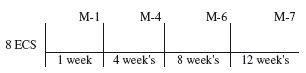
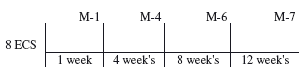
Adult male Wistar rats (250–300 g) were obtained from our own breeding colony. They were caged in groups of five with free access to food and water and were maintained on a 12-h light-dark cycle (lights on 07:00 h), at a temperature of 23 ± 1 °C. The experiments were performed between 16:00 and 17:00 h. In the first experimental step, animals received the traditional eight sessions ECS protocol (Reference Barichello, Bonatto and Feier10): an ECS session per day every other day. After the eighth ECS, the rats were exposed to weekly ECS on the first month, every 2 weeks on the second month and once a month on third month of maintenance. This new model animals is shown in Fig. 1, it was designed similar to the clinical trial usually maintenance ECT (Reference Jornada, Feier and Barichello9). In summary, 9th shock (M-1) after 1 week post last eight ECS, 12th (M-4) after 4 weeks post last ECS, 14th (M-6) after 8 weeks post last eight ECS and 15th (M-7) after 12 weeks post last ECS. In all protocols (M-1, M-4, M-6 and M-7), the animals were killed by decapitation at different times after last ECS: immediately after, 48 h, 7 days (n = 5 animals per group). The prefrontal cortex, cerebellum, hippocampus, striatum and cortex were dissected out immediately after the rat was killed and stored at −70 °C (Reference Lucca, Comim and Valvossori15). In vivo studies were performed in accordance with National Institutes of Health guidelines and with the approval of the local ethics committee.
In the first experimental step (eight ECS sessions), animals received an ECS per day every other day. After the eighth shock, rats received one ECS once a week per 4 weeks resulting in the groups M-1 (after 1 week post last ECS) and M-4 (after 4 weeks post last ECS). In the group M-6 (after 8 weeks post last ECS), they received one shock to each 2 weeks. In the last group M-7 (after 12 weeks post last ECS), they received one shock for month.
Electroconvulsive stimulation
The ECS was applied through bilateral ear clip electrodes. The stimulus parameters were 150 V, 60 Hz, sine wave, during 2 s. Each stimulation elicited tonic-clonic seizure. The sham groups were handled identically to the ECS-treated rats except no current was passed.
Sample preparation
Hippocampus, prefrontal cortex, cerebellum, cortex and striatum were homogenised (1:10, w/v) in sucrose, EDTA, tris, heparin buffer, pH 7.4 (250 mM sucrose, 2 mM ethylenediaminetetraacetic acid, 10 mM Trizma base and 50 IU/ml heparin). The homogenates were centrifuged at 800 × g for 10 min and the supernatants kept at −70 °C until used for creatine kinase activity determination. The maximal period between homogenate preparation and enzyme analysis was always less than 5 days.
Creatine kinase activity
Creatine kinase activity was measured in brain homogenates pre-treated with 0.625 mM lauryl maltoside. The reaction mixture consisted of 60 mM Tris-HCl, pH 7.5, containing 7 mM phosphocreatine, 9 mM MgSO4 and approximately 0.4–1.2 µg protein in a final volume of 100 µl. After 15 min of preincubation at 37 °C, the reaction was started by the addition of 0.3 µmol of ADP plus 0.08 µmol of reduced glutathione. The reaction was stopped after 10 min by the addition of 1 µmol of hydroxymercuribenzoic acid. The creatine formed was estimated according to the colorimetric method of Hughes (Reference Hughes21). The colour was developed by the addition of 100 µl 2% α-naphthol and 100 µl 0.05% diacetyl in a final volume of 1 ml and read spectrophotometrically after 20 min at 540 nm. Results were expressed as nm/min × mg protein.
Respiratory chain enzyme activities
Protein content was determined by the method described by Lowry et al. (Reference Lowry, Rosebough, Farr and Randall22) using bovine serum albumin as standard. NADH dehydrogenase (complex I) was evaluated by the method described by Cassina and Radi (Reference Cassina and Radi23) by the rate of NADH-dependent ferricyanide reduction at 420 nm. The activities succinate-2,6-dichloroindophenol-oxidored uctase (complex II) and succinate: cytochrome c oxidoreductase (complexes II–III) were determined by the method described by Fischer et al. (Reference Fischer, Ruitenbeek and Berden24), measured by cytochrome c reduction from succinate. The activity of cytochrome c oxidase (complex IV) was assayed according to the method described by Rustin et al. (Reference Rustin, Chretien and Bourgeron25), measured by following the decrease in absorbance due to the oxidation of previously reduced cytochrome c at 550 nm. The activities of the mitochondrial respiratory chain complexes were expressed as nmol/min × mg protein.
Statistical analysis
All data are presented as mean ± standard error of the mean. Differences among experimental groups in the assessment of creatine kinase and respiratory chain enzymes activities were determined by one-way analysis of variance (ANOVA), followed by Tukey post hoc test when ANOVA was significant; p values less than 0.05 were considered to be statistical significant.
Results
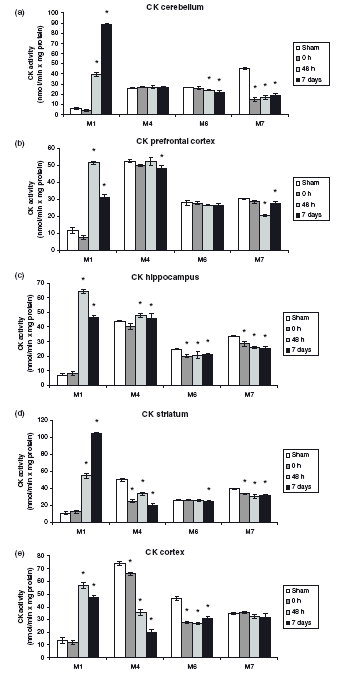
In the cerebellum creatine kinase activity increased in comparison with the control group at 48 h and 7 days in the M1 group. In contrast, in the M6 group at 48 h and 7 days and M7 group at 0 and 48 h and 7 days, we demonstrated a decrease in creatine kinase activity, compared with the control group (Fig. 2; p < 0.05).
Creatine kinase activity in the (a) cerebellum, (b) prefrontal cortex, (c) hippocampus, (d) striatum and (e) cortex of rats submitted to a maintenance protocol. Rats were submitted to a maintenance protocol (150 V, 60 Hz, sine wave, during 2 s) or sham manipulate. Values are expressed as mean ± standard error of the mean (n = 5 for each group) *Different from sham (control) (p < 0.05).
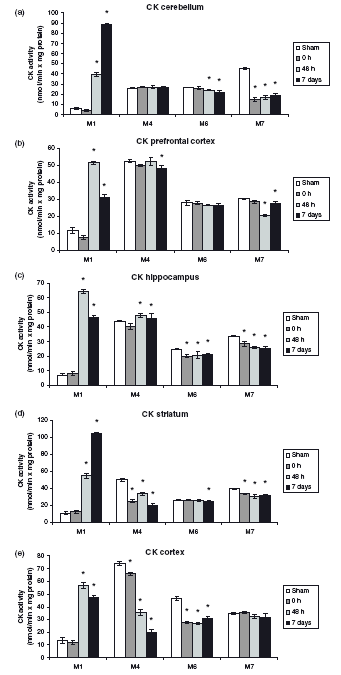
We observed a similar pattern of creatine kinase activity in the prefrontal cortex after maintenance ECS. In the M1 group, we demonstrated a significant increase in the creatine kinase activity at 48 h and 7 days and a decrease in the creatine kinase activity at 7 days in the M4 group and 48 h and 7 days in the M7 group (Fig. 2; p < 0.05).
As shown in Fig. 2, maintenance ECS increased creatine kinase activity at 48 h and 7 days in the M1 and M4 groups and decreased creatine kinase activity at 0 and 48 h and 7 days in the M6 and M7 groups in the hippocampus (p < 0.05).
In the striatum, we observed a significant increase in the creatine kinase activity in the M1 group at 48 h and 7 days after maintenance ECS; however, the creatine kinase activity decreased in the M4 and M7 groups at 0 and 48 h and 7 days and in the M6 group at 7 days (Fig. 2; p < 0.05).
The maintenance ECS increased the creatine kinase activity in the M1 group at 48 h and 7 days and decreased the creatine kinase activity in M4 and M6 groups at 0 and 48 h and 7 days in the cortex, in comparison with the control group (Fig. 2; p < 0.05).
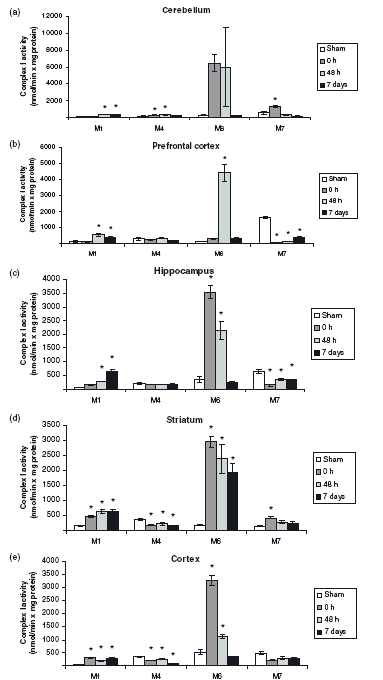
The complex I activity increased after the maintenance ECS in the M1 group at 48 h and 7 days in the prefrontal cortex (Fig. 3; p < 0.05), hippocampus (Fig. 3; p < 0.05) and cerebellum (Fig. 3; p < 0.05) and at 0 and 48 h and 7 days in the striatum (Fig. 3; p < 0.05) and cortex (Fig. 3; p < 0.05).
Complex I activity in the (a) cerebellum, (b) prefrontal cortex, (c) hippocampus, (d) striatum and (e) cortex of rats submitted to a maintenance protocol. Rats were submitted to a maintenance protocol (150 V, 60 Hz, sine wave, during 2 s) or sham manipulate. Values are expressed as mean ± standard error of the mean (n = 5 for each group) *Different from sham (control) (p < 0.05).
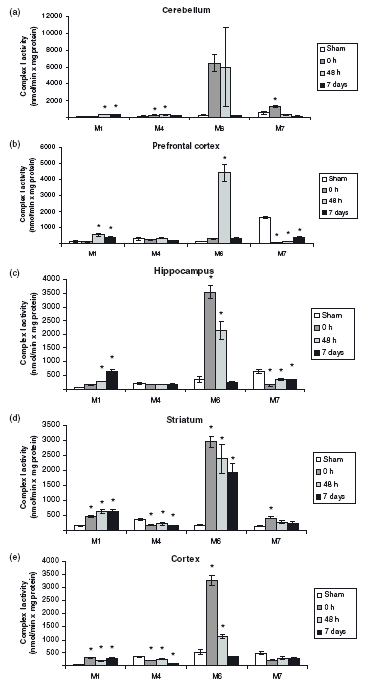
In the cerebellum, the complex I activity increased after the maintenance ECS in the M4 group at 0 and 48 h (Fig. 3; p < 0.05), however, in striatum (Fig. 3; p < 0.05) and cortex (Fig. 3; p < 0.05) decreased in the M4 group at 0 and 48 h and 7 days after the maintenance ECS. The complex I activity increased in the striatum (Fig. 3; p < 0.05) in the M6 group at 0 and 48 h and 7 days; in the hippocampus (Fig. 3; p < 0.05) and cortex (Fig. 3; p < 0.05) at 0 and 48 h and in the prefrontal cortex (Fig. 3; p < 0.05) at 48 h after the maintenance ECS. In the cerebellum and striatum (Fig. 3 and Fig. 3; p < 0.05), the complex I activity increased in the M7 group at 0 h, in contrast to prefrontal cortex and hippocampus (Fig. 3; p < 0.05) the complex I activity decreased in the M7 group at 0 and 48 h and 7 days after the maintenance ECS.
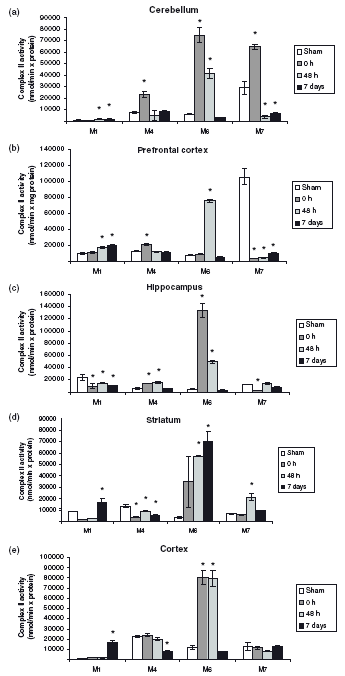
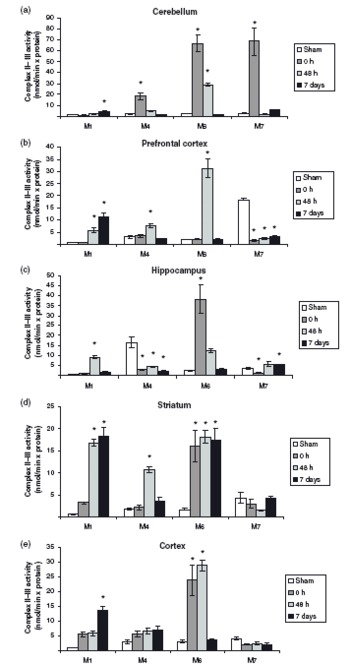
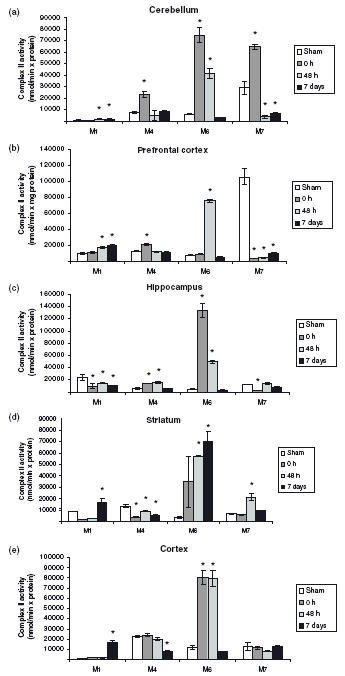
Fig. 4 shows the effects of maintenance ECS on the complex II activity. In the cerebellum and prefrontal cortex (Fig. 4; p < 0.05), the complex II activity increased in M1 group at 48 h and 7 days and in M4 group at 0 h; in striatum and cortex (Fig. 4; p < 0.05) the complex II activity increased in the M1 group only at 7 days, however, in the hippocampus in the group M1 the complex II activity decreased at 0 and 48 h and 7 days after the maintenance ECS. The complex II activity increased in the hippocampus at 0 and 48 h (Fig. 4; p < 0.05) and decreased in the striatum at 0 and 48 h and 7 days (Fig. 4; p < 0.05) and in the cortex at 7 days (Fig. 4; p < 0.05) in the M4 group, compared with control group. The complex II activity increased in the M6 group in cerebellum, hippocampus and cortex at 0 and 48 h (Fig. 4; p < 0.05), in the prefrontal cortex at 48 h (Fig. 4; p < 0.05) and in the striatum at 48 h and 7 days (Fig. 4; p < 0.05), compared with control group. The complex II activity increased in the M7 group in the cerebellum at 0 h (Fig. 4; p < 0.05) and in the striatum at 48 h (Fig. 4; p < 0.05) and decreased in the M7 group in the cerebellum at 48 h and 7 days (Fig. 4; p < 0.05), in the prefrontal cortex at 0 and 48 h and 7 days (Fig. 4; p < 0.05) and in the hippocampus at 0 h (Fig. 4; p < 0.05) after the maintenance ECS compared with control group.
Complex II activity in the (a) cerebellum, (b) prefrontal cortex, (c) hippocampus, (d) striatum and (e) cortex of rats submitted to a maintenance protocol. Rats were submitted to a maintenance protocol (150 V, 60 Hz, sine wave, during 2 s) or sham manipulate. Values are expressed as mean ± standard error of the mean (n = 5 for each group) *Different from sham (control) (p < 0.05).
The complex II-III activity increased in the cerebellum in the M1 group at 7 days, in M4 and M7 groups at 0 h and in the M6 group at 0 and 48 h (Fig. 5; p < 0.05). In the prefrontal, the complex II-III activity increased in the M1 group at 48 h and 7 days and in the M4 and M6 groups at 48 h, however, decreased in the M7 group at 0 and 48 h and 7 days, compared with control group (Fig. 5; p < 0.05). In the hippocampus, the maintenance ECS increased the complex II-III activity in the M1 group at 48 h and in the and M6 group at 0 h and in the M7 group at 7 days, in contrast decreased in the M4 group at 0 and 48 h and 7 days and in the M7 group at 0 h (Fig. 5; p < 0.05). The complex II-III activity increased in the striatum after maintenance ECS in the M1 group at 48 h and 7 days, in the M4 group at 48 h and M6 group at 0 and 48 h and 7 days (Fig. 5; p < 0.05), compared with control group. In the cortex, the complex II-III activity increased in the M1 group at 7 days and in the M6 group at 0 and 48 h (Fig. 5; p < 0.05).
Complex II-III activity in the (a) cerebellum, (b) prefrontal cortex, (c) hippocampus, (d) striatum and (e) cortex of rats submitted to a maintenance protocol. Rats were submitted to a maintenance protocol (150 V, 60 Hz, sine wave, during 2 s) or sham manipulate. Values are expressed as mean ± standard error of the mean (n = 5 for each group) *Different from sham (control) (p < 0.05).

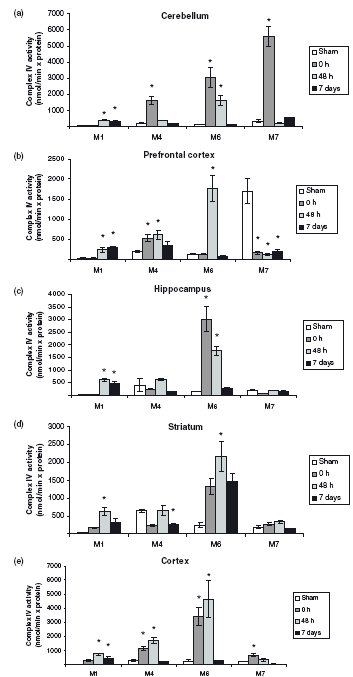
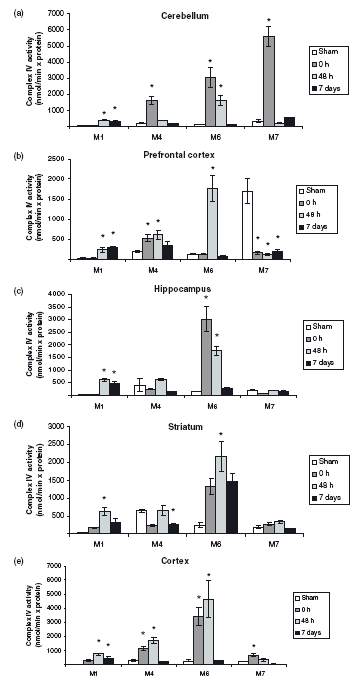
The complex IV activity increased in the M1 group in cerebellum, prefrontal cortex, hippocampus and cortex at 48 h and 7 days and in the striatum at 48 h (Fig. 6; p < 0.05), compared to control group. In the M4 group, the complex IV activity increased in the cerebellum at 0 h (Fig. 6; p < 0.05), in prefrontal cortex (Fig. 6; p < 0.05) and cortex (Fig. 6; p < 0.05) at 0 and 48 h and decreased in the striatum at 7 days (Fig. 6; p < 0.05), compared with control group. In the M6 group, the complex IV activity increased in cerebellum, hippocampus and cortex at 0 and 48 h, and in prefrontal cortex and striatum at 48 h (Fig. 6; p < 0.05), compared to control group. The maintenance ECS increased the complex IV activity in cerebellum and cortex at 0 h and decreased in the prefrontal cortex at 0 and 48 h and 7 days in the M7 group compared with control group (Fig. 6; p < 0.05).
Complex IV activity in the (a) cerebellum, (b) prefrontal cortex, (c) hippocampus, (d) striatum and (e) cortex of rats submitted to a maintenance protocol. Rats were submitted to a maintenance protocol (150 V, 60 Hz, sine wave, during 2 s) or sham manipulate. Values are expressed as means mean ± standard error of the mean (n = 5 for each group) *Different from sham (control) (p < 0.05).
Discussion
In this study, we demonstrated that creatine kinase activity increase on M1 (minor interval between sessions) and creatine kinase activity decrease on M4, M6 and M7 (greater intervals between sessions) and we also showed that mitochondrial respiratory chain (I, II, II–III and IV) was altered in the rat brain after maintenance ECS.
The phosphocreatine – creatine – creatine kinase system is important for normal energy homeostasis (Reference Khuchua, Qin and Boero18) by exerting several integrated functions in cells, such as temporary energy buffering, metabolic capacity, energy transfer and metabolic control (Reference Saks, Kuznetsov, Kupriyanov, Miceli and Jacobus26). The brain of adult rats has a high phosphocreatine concentration and creatine kinase activity (Reference Khuchua, Qin and Boero18).
Our group, recently, showed inhibition of the creatine kinase activity and increase of the mitochondrial chain enzymes activity in the rat brain after ECS (Reference Búrigo, Roza and Bassani12,Reference Búrigo, Roza and Bassani13). In contrast, Erakovic and colleagues (Reference Erakovic, Zupan, Varljen, Laginja and Simonic27) showed that after acute and chronic ECS the activity of creatine kinase was increased in different regions from central nervous system. It may be possible that these changes could occur because of rapidly increased brain energy demands. Moreover, the creatine kinase activity was reduced in the frontal lobe from patients with Alzheimer's disease (AD), Pick's disease and diffuse Lewy body disease (DLBD) and CK-BB-specific mRNA was reduced in AD and DLBD (Reference Aksenova, Aksenov and Payne28). In this study, we showed that creatine kinase activity increased or decreased dependent of intervals between sessions after maintenance ECS. Creatine kinase maintains cellular energy homeostasis and guarantee stable, locally buffered ATP/ADP ratios (Reference Andres, Ducray, Schlattner, Wallimann and Widmer17). We suggest that creatine kinase activity changed after ECS may lead to an imbalance ATP/ADP ratio.
In addition, some studies showed that reductions of regional cerebral blood flow or regional cerebral metabolic rate occur after ECT, especially in cerebral cortex, suggesting a possible suppression of brain activity (Reference Nobler and Sackeim29), associated with better clinical outcome (Reference Nobler, Sackeim and Prohovnik30). Another study performed by Webb et al. (Reference Webb, O'Donnell, Draper, Horner and Phillips31), which was measured brain-type creatine kinase in the serum of 31 depressed patients undergoing bilateral ECT, it was demonstrated that ECT did not cause a significant alteration in serum brain-type creatine kinase concentration during the 6 h following the treatment.
Moreover, other study from our group demonstrated that maintenance ECS oxidative damage can occur in some regions of brain depending on the time and number of ECS sessions, but oxidative damage after maintenance ECS is not a universal finding in the rat brain (Reference Jornada, Feier and Barichello9). Moreover, we demonstrated alterations on oxidative damage parameters in several regions of brain up to 30 days (Reference Barichello, Bonatto and Feier10,Reference Hughes21) and we found a delayed (up to 120 days) increase in oxidative damage after multiple ECS (Reference Feier, Jornada and Barichelo32).
Studies conducted using our ECT animal model found and elevation in S100B protein (an astrocyte marker), which may represent an important glial activation (Reference Busnello, Leke and Oses33), change in adenosine nucleotides, which is involved in physiological and pathological conditions of brain metabolism (Reference Busnello, Oses and Da Silva34) and altered DARPP-32 expression (Reference Rosa, Souza and Souza11).
Chronic and acute models of ECT also demonstrated being capable of inducing the elevation of the brain-derived neurotrophic factor (BDNF) and the expression of its receptor gene, trkB on rats' brain (Reference Lindefors, Brodin and Metsis35). Furthermore, ECT increases glial cell line-derived neurotrophic factor (GDNF) serum levels in patients with drug-resistant depression (Reference Zhang, Zhang and Sha36). In fact, BDNF and GDNF are involved with mood disorder.
Respiratory enzyme complexes located in a structure of inner mitochondrial membrane, the mitochondrial respiratory chain are responsible to obtain cell energy. One study from our group showed that mitochondrial respiratory chain enzymes activities were increased after acute ECS in the hippocampus, striatum and cortex of rats. In this study, the complex II activity was increased after chronic ECS in the cortex, while hippocampus and striatum were not affected. Succinate dehydrogenase, however, was inhibited after chronic ECS in striatum, activated in the cortex and not affected in hippocampus, however, the complex IV was not affected by chronic ECS in the hippocampus, striatum and cortex (Reference Búrigo, Roza and Bassani12), suggesting that brain metabolism is altered by ECS. In this data, we showed that maintenance ECS increased or decreased mitochondrial respiratory chain, dependently of treatment regime, complex type and brain area. The reason for this different alteration in this study is unclear, but could be related to desensitisation to the maintenance ECS or yet for adaptation mechanism of mitochondria.
In conclusion, our results showed that creatine kinase and mitochondrial respiratory chain activities were altered in hippocampus, prefrontal cortex, striatum, cerebellum and cortex after maintenance ECS, but was time related after last ECS session. The importance of the role energy metabolism plays in the biochemical processes unleashed by ECS remains to be answered in future studies.
Acknowledgements
This study was supported in part by grants from ‘Conselho Nacional de Desenvolvimento Científico e Tecnológico' (CNPq-Brazil – J. Q. and E. L. S.) and from the Instituto Cérebro e Mente (J. Q.) and UNESC (J. Q. and E. L. S.). J. Q. and E. L. S. are recipients of CNPq (Brazil) Productivity fellowships. G. Z. R. is holder of a CAPES studentship.