Introduction
In nursing home care for people with dementia, there has been a growing focus on deinstitutionalization and residents’ psychosocial well-being (Verbeek et al., Reference Verbeek, van Rossum, Zwakhalen, Kempen and Hamers2009). Over the past few decades, new care models that are more resident- or demand-oriented and directed toward small-scale and homelike environments have been developed worldwide (e.g. Malmberg and Zarit, Reference Malmberg and Zarit1993; Berkhout et al., Reference Berkhout, Boumans, Nijhuis, Van Breukelen and Abu-Saad2003; Rabig et al., Reference Rabig, Thomas, Kane, Cutler and McAlilly2006; Verbeek et al., Reference Verbeek, van Rossum, Zwakhalen, Kempen and Hamers2009). In the Netherlands, this concept is often referred to as group living home care or small-scale care (te Boekhorst et al., Reference te Boekhorst, Depla, de Lange, Pot and Eefsting2007; Verbeek et al., Reference Verbeek, van Rossum, Zwakhalen, Kempen and Hamers2009). This concept entails care being provided in a homelike environment in which residents and informal caregivers determine the organization of daily life together with a small number of staff. The organization of daily life is analogous to a normal household. Hot meals are prepared on the wards together with residents, and part of the laundry is done here as well. Daily life and care provision are adjusted to resident's lifestyle and preferences as much as possible. This concept of care provides a different care and living climate for residents compared to typical nursing homes and hereby aims to optimize residents’ psychosocial well-being. Indeed, modest beneficial effects for residents’ quality of life have been found for group living home care or small-scale care compared to regular nursing homes (Funaki et al., Reference Funaki, Kaneko and Okamura2005; Kane et al., Reference Kane, Lum, Cutler, Degenholtz and Yu2007; te Boekhorst et al., Reference te Boekhorst, Depla, de Lange, Pot and Eefsting2009; Verbeek et al., Reference Verbeek, Zwakhalen, van Rossum, Ambergen, Kempen and Hamers2010a).
Small-scale homelike care, however, also changes the organizational context and influences the staff's work environment. Little research has been conducted to gain insight into how the different organizational structure accompanying this care model influences important job characteristics, such as care staff's perceived job demands, decision authority, and social support. These are important job characteristics according to one of the most prominent occupational stress models, the Demand-Control-Support (DCS) model of Karasek and Theorell (Johnson et al., Reference Johnson, Hall and Theorell1989; Karasek and Theorell, Reference Karasek and Theorell1990). Job demands refer to workload, including work and time pressure, decision authority refers to organizationally mediated possibilities for workers to make decisions about their work (Karasek, Reference Karasek1979; Karasek, Reference Karasek and Stellman1998), and social support refers to helpful social interaction available on the job with both coworkers and supervisors (Johnson and Hall, Reference Johnson and Hall1988). The relationship between organizational contexts and perceived job characteristics is not only an underexposed field of research in dementia care but also in other fields (Morgeson et al., Reference Morgeson, Dierdorff and Hmurovic2010).
Insight into the effects of new organizational contexts on staff's job characteristics is important because it is well known that job characteristics, such as job demands, decision authority, and social support, are related to staff's well-being and turnover (e.g. van der Doef and Maes, Reference van der Doef and Maes1999b; Willemse et al., Reference Willemse, de Jonge, Smit, Depla and Pot2012). The DCS model assumes that job control and social support buffer the potentially adverse effects of high demands and may even create positive consequences in jobs with high demands. The most adverse health outcomes are expected in jobs with both high levels of demand and low levels of control and social support.
Both in practice and research, concerns and diverse opinions exist about the impact of small-scale care on the jobs of care workers. For example, it has been stated that because care workers have a broader range of duties, performing care as well as domestic tasks such as cooking and cleaning, they could experience more job demands (te Boekhorst et al., Reference te Boekhorst, Willemse, Depla, Eefsting and Pot2008). This could, however, also create less job demands because care workers have less fixed times or deadlines during the day in which they, for example, have to get residents ready before meals served by a central kitchen. Consequently, there are also less employees of other services that come in and out of the wards to return laundry or ask questions, for example, creating interruptions for care workers. These interruptions have been found to have a negative impact on the amount of time that care workers perceive to have to do their work (Bowers et al., Reference Bowers, Lauring and Jacobson2001). Furthermore, an important and widely discussed aspect of small-scale care is that healthcare workers in small-scale care take care of a smaller group of residents and they, therefore, tend to work alone more often and see each other less frequently. This most likely creates an enriched job by bringing more responsibilities to the job (Berkhout et al., Reference Berkhout, Boumans, Nijhuis, Van Breukelen and Abu-Saad2003), which is likely to positively influence staff's perceived decision authority; it is also suggested to result in less perceived support from coworkers (de Rooij et al., Reference de Rooij, Luijkx, Declercq, Emmerink and Schols2012).
Two earlier studies have investigated the effect of the concept of small-scale care on staff's job characteristics. Using a small sample of small group living homes and large scale nursing homes (te Boekhorst et al., Reference te Boekhorst, Willemse, Depla, Eefsting and Pot2008; Verbeek, Reference Verbeek2011), these studies found that staff working in small-scale group living homes perceived less job demands, more decision authority and, unexpectedly, more coworker social support. In both studies, no differences were found for supervisor support between small-scale group living homes and nursing homes. However, these studies have two important limitations.
First, earlier studies only included a small sample of small group living homes and nursing homes. Second, they did not take into account the possible differences in staffing levels and resident-related workload between the small-scale and regular settings, as these are found to differ between the two settings (te Boekhorst et al., Reference te Boekhorst, Depla, de Lange, Pot and Eefsting2009; Pot and de Lange, Reference Pot and de Lange2010; Verbeek et al., Reference Verbeek, Zwakhalen, van Rossum, Ambergen, Kempen and Hamers2010b) and are likely to influence staff's perceived job characteristics (Edvardsson et al., Reference Edvardsson, Sandman, Nay and Karlsson2008; Skovdahl et al., Reference Skovdahl, Fahlstrom, Horttana, Winblad and Kihlgren2008; Flynn and McKeown, Reference Flynn and McKeown2009). Residents are found to be less severely impaired (te Boekhorst et al., Reference te Boekhorst, Depla, de Lange, Pot and Eefsting2009; Verbeek et al., Reference Verbeek, Zwakhalen, van Rossum, Ambergen, Kempen and Hamers2010b) and staffing levels of direct care staff tend to be higher (Pot and de Lange, Reference Pot and de Lange2010) in small-scale care settings compared with typical nursing homes. If these differences are not taken into account, the impact of the concept of small-scale care on job demands could be overestimated. It has been found that resident-related workload, or in other words the residents’ need for assistance in activities of daily living, and the prevalence of behavioral symptoms are positively related to staff's perceived job demands (Edvardsson et al., Reference Edvardsson, Sandman, Nay and Karlsson2008; Skovdahl et al., Reference Skovdahl, Fahlstrom, Horttana, Winblad and Kihlgren2008). Furthermore, staffing levels are often thought to be the most important (Flynn and McKeown, Reference Flynn and McKeown2009), if not only, predictor (Bishop et al., Reference Bishop, Squillace, Meagher, Anderson and Wiener2009) of staff's perception of job demands.
The aim of the present study is to shed more light on the relationship between small-scale care and staff's perceived job characteristics using a large sample of a wide range of facilities providing nursing home care for people with dementia, taking resident-related workload and staffing levels into account. We chose to study the relationship between the concept of care and job characteristics using the DCS model (Johnson et al., Reference Johnson, Hall and Theorell1989; Karasek and Theorell, Reference Karasek and Theorell1990). This model has been used as a theoretical base when studying the effect of the implementation of resident-oriented care models in the past (Berkhout et al., Reference Berkhout, Boumans, Nijhuis, Van Breukelen and Abu-Saad2003), although most of these studies have been conducted in general hospitals. Based on earlier studies, it was hypothesized that small-scale care is related to fewer job demands, more decision authority, and more coworker support. No relationship was expected to be found between small-scale care and supervisor support.
Methods
Design and sample
For the present study, cross-sectional data from the first measurement cycle (between November 2008 and May 2009) of the Living Arrangements for people with Dementia study (LAD-study), including 136 living arrangements, were used. The LAD-study is an ongoing monitoring study of the developments and variety in Dutch nursing home care for people with dementia (Willemse et al., Reference Willemse, Smit, de Lange and Pot2011). All participating living arrangements had dementia-specific care wards or dementia-specific homes and were non-private, receiving state reimbursement dependent on the referral status of the resident.
In each participating living arrangement, 15 healthcare workers were randomly selected. In arrangements with 15 healthcare workers or less, all were selected. All healthcare workers, regardless of their level of nursing education, working in the living arrangement, were eligible to participate, except for temporary workers and staff with a flexible contract working at different locations in the care organization. In the Netherlands, the educational level ranges from no education till level 5. Most care workers in nursing home care have educational level 3, which is referred to as certified nursing assistant in the USA. Furthermore, there are healthcare workers with educational level 1 or 2, which are both referred to as care assistants, and registered nurses with educational level 4 or 5.
A total of 1,952 questionnaires were distributed to care staff and 1,147 care workers participated and met our criteria, resulting in a response rate of 59%. For the aim of this paper we excluded the small number of participants that had worked less than one year in the profession (n = 13; 1.1%) or were working less than 8 hours a week (n = 15; 1.3%). We chose to do so because the number of respondents who had just started to work in the profession or were working a very limited number of hours per week was very small which would have made it difficult to use the variables as confounding variables if these groups were included.
Furthermore, 12 residents per living arrangement were randomly selected to participate in the study. Again, when the living arrangement did not have more than 12 residents, no randomized selection was conducted but every resident was included for participation. The response rate was 83%, yielding information from 1,366 residents.
Measures
Indicators of small-scale care
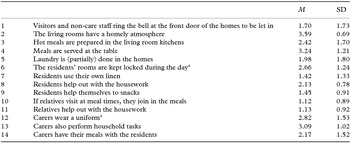
In line with an earlier publication using data from the LAD-study (Smit et al., Reference Smit, de Lange, Willemse and Pot2012), two indicators for small-scale care were used. The first indicator is the extent to which small-scale care characteristics are integrated into the range of living arrangements. This was assessed using a questionnaire based on the statements of a concept map concerning the ideals of small-scale group living home care (te Boekhorst et al., Reference te Boekhorst, Depla, de Lange, Pot and Eefsting2007), the “Group Living Home Care Characteristics Questionnaire” (te Boekhorst et al., Reference te Boekhorst, Depla, Pot, de Lange and Eefsting2011). The questionnaire includes statements that reflect characteristics of small-scale group living home care and is assessed during an interview with a care manager of the living arrangement. The manager is asked to respond to the statements by indicating to what extent the characteristics are integrated into the living arrangement providing nursing home care to people with dementia. The questionnaire has a 5-point Likert scale format, ranging from (0) “never” to (4) “always”. A principal axis analysis (PAF) showed one factor with relatively high loadings (>0.4) on 14 items (Cronbach's α = 0.87). The items are presented in Table 1. After adding all items, the scale ranges from 0 to 56. A higher score indicates that the living arrangement has integrated more small-scale care characteristics. Items 6 and 12 have to be reversed before calculating sum scores. The second indicator is the total number of residents with dementia in the living arrangement.
Items of “Group living home care characteristics questionnaire” (n = 120)

aThese items have been reversed before calculating the mean score so that a higher score indicates more small-scale care for all items.
Job characteristics
Measures for job characteristics (job demands, decision authority, and coworker and supervisor social support) were derived from the Leiden Quality of Work Questionnaire (LQWQ) (van der Doef and Maes, Reference van der Doef and Maes1999a), a frequently used instrument when studying the DCS model. All job characteristics were measured on a 4-point scale ranging from (1) “strongly disagree” to (4) “strongly agree”. For each job characteristic, a mean score ranging from 1 to 4 was calculated.
Job demands were measured with the work and time pressure scale (Cronbach's α = 0.76; 5 items). The items addressed the degree to which the pressure of work and time urgency dominate the work environment, e.g. “I have enough time to provide good care to residents.”
The decision authority scale (α = 0.71; 4 items) measured the extent to which care staff is able to make their own decisions, e.g. “I continuously have to do what others tell me to do.”
Social support was operationalized as social support from the supervisor and social support from coworkers. The social support from the supervisor scale (α = 0.92; 4 items) measured the extent to which management is supportive, e.g. “I feel appreciated by my supervisor.” The social support from coworker scale (α = 0.85; 4 items) assessed the extent to which care staff is supportive of one another, e.g. “People I work with are helpful in getting the job done.”
Confounders
In addition to staff characteristics, which were taken into account in earlier studies (te Boekhorst et al., Reference te Boekhorst, Willemse, Depla, Eefsting and Pot2008; Verbeek et al., Reference Verbeek, Zwakhalen, van Rossum, Ambergen, Kempen and Hamers2010a), resident and living arrangement characteristics were also assessed because they were considered to be potential confounders as well.
Staff characteristics
Staff's demographic characteristics (age, gender, and educational level) and employment status (employment in profession, length of service, and contract hours a week) were assessed.
Resident characteristics
The resident characteristics assessed were the assistance residents needed in activities of daily life (ADL), neuropsychiatric symptoms, and residents’ demographic characteristics. Activities of daily living were assessed using the Katz index of ADL (α = 0.91; Katz, Reference Katz1983). The total score ranges from 1 to 7. A higher score on the Katz index of ADL means more dependence in ADL. Neuropsychiatric symptoms were measured using the abridged 12-item paper-and-pencil version of the Neuropsychiatric Inventory (α = 0.78) (de Jonghe et al., Reference de Jonghe, Kat, Kalisvaart and Boelaarts2003) with a range of 0–36, with a higher score indicating more neuropsychiatric symptoms. Residents’ age and gender were assessed as demographic variables. The mean age of the residents in the living arrangements was calculated and a variable was created for the percentage of female residents within the living arrangements.
Living arrangement characteristics
The characteristics of the living arrangement focused on staffing levels. Both direct care staff ratio and staff's skill mix were assessed using the timetables for the direct care staff. Both total hours per week, including nightshifts, and the educational level of all shifts were recorded. The total hours per week, including nightshifts, were divided by the number of residents cared for by staff and by seven days to obtain the standardized measure for staff ratio: hours per resident per day (HPRD) (Spilsbury et al., Reference Spilsbury, Hewitt, Stirk and Bowman2011). The educational level of all shifts was assessed to be able to create a variable for the living arrangement's skill mix. The total hours that care workers with educational level 3, which is equivalent to certified nursing assistant (CNA) in the USA, or higher, worked in the living arrangement per day was divided by the total hours per day to obtain the proportion of higher educated healthcare staff.
Procedure
In each living arrangement, a care manager was interviewed to assess the amount of small-scale care characteristics and the number of residents with dementia on the site. Self-report questionnaires assessing the four job characteristics and staff's demographics were sent to the healthcare workers’ home address. The questionnaires could be anonymously returned to the researchers in a pre-stamped envelope. Insight into resident's ADL dependency and behavioral problems was gained through observational questionnaires that were completed by their primary healthcare staff contact. Healthcare workers were invited to participate voluntarily and were informed about the process and aim of the study. Written informed consent was not obtained, as consent to participate was received by voluntary return of a completed questionnaire. Staffing levels, staff ratio, and skill mix were assessed using care staff's actual timetables.
Statistical analysis
Multiple multilevel linear regression analyses were performed to study the relationship between the two small-scale care indicators of living arrangements for people with dementia and care workers’ perceived job characteristics. Staff, resident, and living arrangement characteristics were considered to be potential confounders. For each job characteristic, we assessed which of the potential confounders correlated significantly with both the small-scale care indicators and the job characteristics. The potential confounders that were found to correlate significantly (p < .05) with both were added to the analyses. The unadjusted and adjusted analyses are presented. Furthermore, the variance between living arrangements explained by the indicators of small-scale care was calculated.
The healthcare staff in our sample are nested within living arrangements, which means that our data have a hierarchical nature with two levels (living arrangement and healthcare worker level). Therefore, it was first tested (likelihood ratio test) whether a model including a random intercept significantly improved the fit of the model with the data. Because this test confirmed the two-level structure of our data, multilevel linear regression analysis was used. The data in this study were analyzed using SPSS for Windows (version 19.0) and MLwin (version 2.21).
Living arrangements with a resident response of less than 50% were excluded from the analyses because these do not provide representative aggregated scores for the resident characteristics, which are used as confounding variables in the analyses. Furthermore, healthcare workers with missing values on any of the key study variables were excluded. This reduced the final number of living arrangements, participating staff, and residents to 120, 1,001, and 1,240, respectively.
The 16 living arrangements that were excluded were compared with the 120 living arrangements in the final sample using independent sample t-tests to determine if these two groups differed with respect to the indicators of small-scale care, job characteristics, and confounders. No significant differences were found.
Ethics
Our study investigates routine, daily practice in nursing home care for people with dementia. Healthcare staff and residents in this study do not receive particular treatment and are not asked to behave in a particular way. Furthermore, the healthcare workers do not have to spend a considerable amount of time completing the questionnaire (15–20 minutes per questionnaire). Finally, data of people with dementia are only collected via observation by the healthcare workers. Therefore, the Medical Research Involving Human Subjects Act (WMO) does not apply to this study and no formal ethical scrutiny was required (see also Willemse et al., Reference Willemse, Smit, de Lange and Pot2011).
Results
Staff, resident, and living arrangement characteristics
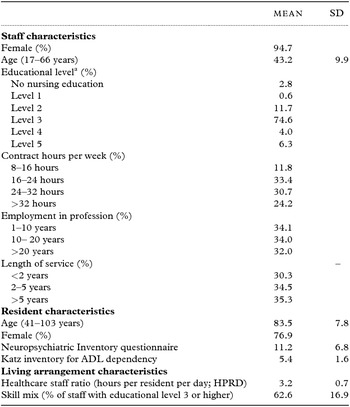
As shown in Table 2, the sample age of healthcare staff was 43.2 years on average. Most of the staff had educational level of 3. Of the respondents, 33.4% were working 16 to 24 hours a week. The residents with dementia had a mean age of 83.5 years. Approximately 77% of them were female. The sample scored high on the Katz ADL inventory (M = 5.4), meaning that the residents needed help in almost all domains of daily living. The mean score on the NPI-Q scale for neuropsychiatric symptoms was 11.2. On average, the living arrangement's staff ratio was 3.2 hours per resident per day (HPRD), and almost two-thirds of these hours were occupied by staff with an educational level of 3 or higher.
Staff (n = 1,001), resident (n = 1,240), and living arrangement (n = 120) characteristics

aDutch educational levels: level 2 is equivalent to nursing assistant (NA), level 3 to certified nursing assistant (CNA), and level 4 and 5 to registered nurse (RN).
Small-scale care indicators
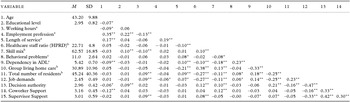
There was much variety between the participating living arrangements in terms of the characteristics of small-scale care (Table 3). The arrangements ranged from 8 to 51 and had a mean score of 30.9 (SD = 11.0) for the “Group living home care characteristics questionnaire.” Table 1 shows the characteristics of small-scale care that were most often integrated in our sample; they were “living rooms have a homelike atmosphere” and “meals are served at table.” The characteristic “hot meals are prepared in the living room kitchens” was less often integrated. Characteristics of small-scale care that were least often integrated in daily care concerned resident's relatives being part of the household, assisting with housework, and joining meals when they visit. The average total number of residents with dementia in the living arrangements was 45.2 (SD = 40.4). The number of residents ranged from 6 to 240. As expected, the two indicators of small-scale care were negatively correlated (–0.25**).
Pearson intercorrelations of variables (N = 1,001)a

*p < 0.05; **p < 0.01
aOrdinal data–higher scores indicating more working hours, longer employment in profession, and longer length of service.
bVariable is measured at the living arrangement level.
cAggregated scores of all the individual scores of the residents per living arrangement.
Small-scale group living home care and job characteristics
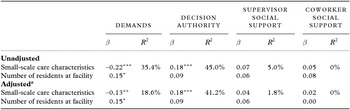
The unadjusted analyses showed significant associations between the “Group living home care characteristics questionnaire” score and two of the four job characteristics: job demands and decision authority (Table 4). More small-scale care characteristics were negatively related to staff's perceived job demands (β = –0.22***) and positively related to decision authority (β = 0.18***). The total number of residents with dementia in the living arrangement was only found to be associated with job demands (β = 0.15*). The number of residents was positively related to staff's perceived job demands.
The unadjusted and adjusted relationship between indicators of small-scale care and job characteristics (N = 1,001)

*p < 0.05; **p < 0.01; ***p < 0.001
aAdjusted for variables that significantly correlated with the small-scale indicator and the job characteristic.
Also after adjusting for confounding variables, more small-scale care characteristics were found to be related to less perceived job demands and more decision authority. Additionally, more residents with dementia in the facility were also found to be related to more perceived job demands after the analysis was adjusted for confounding variables.
The association found in the score on the “Group living home care” questionnaire with job demands was less stronger after adjusting for length of service of care staff, resident characteristics, and staff ratio (β = –0.22 in unadjusted vs. –0.13 in adjusted analyses), while the association with decision authority was the same after adjusting the analysis (β = 0.18 vs. 0.18). Furthermore, the variance in job demands between living arrangements explained by small-scale care indicators was considerably smaller after adjusting the analysis for confounding variables (35% vs. 19%). A large part of the variance seemed to be explained by the living arrangement's staffing levels instead. For decision authority, 41% of the variance between living arrangements, adjusted for confounding variables, was explained by small-scale care indicators.
Coworker and supervisor social support did not reach significance. This indicates that there is no association between small-scale care indicators and staff's perceived social support.
Discussion
This study investigated the relationship between two indicators of small-scale care and staff's perceived job characteristics in nursing home care for people with dementia. It was found that both small-scale care indicators were related to staff's perceived job demands. Therefore, when more characteristics of small-scale care were integrated in nursing home care for people with dementia and as the facility had less residents with dementia in total, staff perceived less time and work pressure. Additionally, as more characteristics of small-scale care were integrated, staff perceived more decision authority regardless of the number of residents in the facility. Both of these results support our hypothesis. These results indicate that small-scale care (measured by the number of group living home care characteristics) has a positive effect on staff's psychosocial work environment. Small-scale care indicators were not found to be related to coworker and supervisor support. Our finding with regard to coworker support did not support our hypothesis.
There are some methodological issues in the current study to be considered. First, sample characteristics in this study such as staff ratio and the proportion of staff with more than two years of experience in the facility are comparable to those of other, international studies on nursing home care (e.g. Zimmerman et al., Reference Zimmerman2005; studies included in Spilsbury et al., Reference Spilsbury, Hewitt, Stirk and Bowman2011). This increases the validity of our findings for other countries.
One limitation is that a causal relationship between small-scale care and job characteristics cannot be demonstrated because of the cross-sectional design used in this study. However, it is unlikely that lower job demands will lead to more small-scale care, for example. But perhaps healthcare workers with specific personal characteristics that make them less likely to perceive high levels of job demands are more likely to work in living arrangements providing small-scale care. Second, a fixed, small sample of care staff and residents in the participating living arrangements was randomly selected and studied. The number of staff and residents in these living arrangements varies, and therefore, the representativeness of the sample may vary as well. Furthermore, the random selection of staff and residents from living arrangements with several wards implies that the selected care workers were not necessarily taking care of the residents that were selected in the facility. However, resident's functioning is taken into account in the analyses, as differences have been found between typical nursing homes and group living homes. This is thought to be caused by selection criteria for admission to group living homes (te Boekhorst et al., Reference te Boekhorst, Depla, de Lange, Pot and Eefsting2009; Verbeek et al., Reference Verbeek, Zwakhalen, van Rossum, Ambergen, Kempen and Hamers2010b). Therefore, a global measure per living arrangement of a random sample of residents should be sufficient for information on resident's functioning. Finally, further research is needed to gain more insight in the psychometrics of the questionnaire measuring the degree of group living home characteristics. In our study, this questionnaire is reported only by a manager. It is unknown if different scores would appear if a different type of rater, such as care workers or resident's family, were asked to fill in the questionnaire. A strength of the present study, compared to earlier studies (te Boekhorst et al., Reference te Boekhorst, Willemse, Depla, Eefsting and Pot2008; Verbeek et al., Reference Verbeek, Zwakhalen, van Rossum, Ambergen, Kempen and Hamers2010a), is that it not only adjusted for confounding variables of staff characteristics where needed but also took resident characteristics and staffing levels into account. Furthermore, by studying the relationship between indicators of small-scale care and staff's job characteristics, the present study acknowledged that small-scale care is a continuum and that characteristics of small-scale care are increasingly integrated, at least to some extent, in the whole range of facilities providing nursing home care for people with dementia (Pot, Reference Pot2013). This is in contrast to earlier studies that have studied the effect of small-scale care by comparing a sample of small-scale group living homes with a sample of regular nursing homes, not explicitly taking the actual integration of small-scale care characteristics into account.
The relationship found between small-scale care characteristics and job demands was in line with the earlier findings of te Boekhorst et al. (Reference te Boekhorst, Willemse, Depla, Eefsting and Pot2008) and Verbeek (Reference Verbeek2011). However, as has been suggested by earlier studies, it was found that this relationship was less strong when it was adjusted for staffing levels. Therefore, part of the relationship between small-scale care and job demands is caused by the fact that facilities with more small-scale care characteristics often have a higher staff ratio and a bigger proportion of higher educated staff (see Table 3 and Pot and de Lange, Reference Pot and de Lange2010). A reason for the higher direct staff ratio is that small-scale care often implies that healthcare workers have integrated tasks, including domestic tasks. For example, meals are prepared in the ward or in the home and laundry is (partially) done in the ward. As a consequence, a bigger part of the budget is allocated to direct care staff instead of employees of other services, such as a central kitchen or a linen room. Thus, one could argue that a higher staff ratio is part of small-scale care and should not be adjusted for or should be treated as a mediator. However, the aim of this study was to gain more insight into the effect of small-scale care on staff's job characteristics besides the possible accompanying effects of well-known factors influencing staff's psychosocial work environment, such as staffing levels and resident's functioning. Our study confirms that small-scale care in itself is related to less perceived time and work pressure.
There are two aspects of small-scale care that could explain this finding. First, the concept of care could decrease the tension staff can experience between wanting to do their best for residents and what they actually can do (Edberg et al., Reference Edberg, Bird, Richards, Woods, Keeley and Davis-Quarrell2008) by changing the priority given to different types of tasks. Organizations with many characteristics of small-scale care focus on the wishes and needs of individual residents (resident-oriented) rather than on the tasks that need to be performed (task-oriented). This means that they often do not have strict rules and regulations (te Boekhorst et al., Reference te Boekhorst, Willemse, Depla, Eefsting and Pot2008; Verbeek, Reference Verbeek2011), and the work related to residents’ needs and wishes is assigned higher priority.
Second, although the opposite is sometimes suggested, it is likely that healthcare workers in small-scale care perceive less job demand because they have integrated tasks. As a result, they may experience less interruptions by colleagues providing other services and do not need to deal with their colleagues' time schedules.
Our study gives insight into the influence of the size of living arrangements. Initially, small-scale care was provided in small archetypical houses. Recently, the concept of small-scale care is provided in a wide range of facilities ranging from small group living homes to larger nursing homes (Willemse et al., Reference Willemse, Smit, de Lange and Pot2011). Our findings suggest that care workers perceive less work and time pressure in facilities that have integrated, small-scale care characteristics in a rather small facility. This possibly relates to the fact that larger facilities providing small-scale care often have more central services compared to smaller facilities providing small-scale care, creating relatively more “deadlines” and interruptions for healthcare workers (Pot and de Lange, Reference Pot and de Lange2010). These findings are in line with earlier research showing that the larger the unit staff is working on, the more time pressure they perceive (Pekkarinen et al., Reference Pekkarinen, Sinervo, Perala and Elovainio2004).
In line with what was hypothesized in the introduction and found in earlier studies (te Boekhorst et al., Reference te Boekhorst, Willemse, Depla, Eefsting and Pot2008; Verbeek, Reference Verbeek2011), we found that more small-scale care characteristics are related to the staff perception of more decision authority. Given the smaller groups of residents living together, staff members often work alone and, as a consequence, are more autonomous in organizing daily life with residents and informal caregivers. In terms of work or job design, one might suggest that the organizational structure of small-scale care is organic; care workers have integrated tasks which create a structure that is decentralized and less formalized, as the work design is autonomous and allows greater flexibility and adaptability. This is in contrast to the more mechanistic organizational structure in traditional nursing homes in which jobs are more specialized, where more services exist with distinct tasks, the flow of work is standardized, decision-making is centralized, and rules and procedures are relatively formalized such that workers perform in a predictable manner (Morgeson et al., Reference Morgeson, Dierdorff and Hmurovic2010).
Our results regarding supervisor support are in line with findings of earlier research (te Boekhorst et al., Reference te Boekhorst, Willemse, Depla, Eefsting and Pot2008; Verbeek, Reference Verbeek2011), but our finding that small-scale care indicators are not related to coworker support are contradictory to earlier findings. Previous studies found that staff in small-scale care facilities perceived more coworker support than staff in regular nursing homes. It is possible that the care model currently is less innovative than it was at the time of the previous studies. As assumed by te Boekhorst et al. (Reference te Boekhorst, Willemse, Depla, Eefsting and Pot2008), working in a relatively innovative form of care might have increased team spirit, thereby increasing the amount of coworker social support. Furthermore, earlier studies compared a group of small-scale group living homes with a number of regular nursing homes, while the current study examined the integration of two indicators of the concept of small-scale care. In this study, we did not find support for the suggestion of de Rooij and colleagues (Reference de Rooij, Luijkx, Declercq, Emmerink and Schols2012) that care workers in small-scale group living homes might experience diminished support.
Practical implications
High levels of time and work pressure and low levels of decision authority are known to create high-strain jobs. Because small-scale care has been found to be related to less job demands and more decision authority, this study confirms earlier findings that this concept of care could enhance healthcare staff's work environment in nursing home care for people with dementia. A healthy work environment is not only important for staff's own well-being, but is also known to positively influence resident outcomes and quality of care (e.g. Kramer et al., Reference Kramer, Maguire and Brewer2011; Aiken et al., Reference Aiken2012; Kirwan et al., Reference Kirwan, Matthews and Scott2013).
In the Netherlands, care organizations often choose to provide small-scale care in a somewhat larger setting for efficiency reasons. This study, however, showed that more residents in a facility are related to relatively more perceived job demands. Thus, if care organizations plan to provide small-scale care in a larger setting, they should review how they ensure that the positive impact of the provision of small-scale care on perceived job demands can be retained.
Making the most of the positive influence of small-scale care on staff's perceived job demands is especially important because research has revealed that worries exist regarding staffing levels and workload among directors of long-term care facilities around the world (Brazil et al., Reference Brazil, Maitland, Ploeg and Denton2012; Schoenmakers, Reference Schoenmakers2012).
The findings of our study provide directions to overcome this bottleneck. This study suggests that, in contrast to what is often believed, perceived time and work pressure is not exclusively a matter of staffing levels. The care model and the accompanying organizational structure also influence staff's perceived workload and strain as has been stated by other researchers as well (e.g. Pekkarinen et al., Reference Pekkarinen, Sinervo, Perala and Elovainio2004). Care organizations should review their concept and philosophy of care and accompanying organizational climate and structure to conduct the organizational interventions needed to improve healthcare staff's work environment.
Ongoing attention for the concept and philosophy of care is also important because it has been found that without a clear philosophy of care, decisions made by staff are arbitrary, uninformed and most likely unsafe (Orme and Maggs, Reference Orme and Maggs1993). This is even more important in small-scale care where care workers work more autonomously and as a consequence have higher levels of decision authority.
Thus, the presence of a clear philosophy of care in homes for people with dementia will increase the chance that decisions made by staff are appropriate and will have a beneficial impact on resident outcomes and quality of care as one would expect based on the literature on healthy work environments (e.g. Kramer et al., Reference Kramer, Maguire and Brewer2011; Aiken et al., Reference Aiken2012; Kirwan et al., Reference Kirwan, Matthews and Scott2013).
Conflict of interest
None.
Description of authors’ roles
Bernadette Willemse collected, analyzed, and interpreted the data, drafted the paper, and helped design the study. Marja Depla helped in analyzing and interpreting the data and in drafting the paper, as did Dieneke Smit. Dieneke Smit also helped to design the study and to collect the data. Anne Margriet Pot (principal investigator of the LAD study) designed and supervised the study, helped to interpret the data, and drafted the manuscript. All authors read and approved the final paper for publication.
Acknowledgments
The LAD-study is supported by a grant from the Netherlands Ministry of Health, Welfare and Sports and the patient organization Alzheimer Nederland.