Introduction
Schizophrenia is a serious neuropsychiatric disorder that typically affects young individuals, causing lifelong disability. The core symptoms of the disorder include positive symptoms, such as hallucinations and delusions; negative symptoms, such as social withdrawal, blunted emotions, and apathy; and deficits in cognitive and executive functions. It also leads to a higher suicide risk and a shorter life span. The disease imposes a significant socioeconomic burden on patients, families, caregivers, and society at large.Reference Chong, Teoh and Wu1 Currently available pharmacotherapies are only partially effective against negative symptoms or cognitive dysfunction, and are hindered by a high rate of incomplete remission and relapse seen in schizophrenia patients.Reference Emsley, Chiliza and Asmal2 The etiology of schizophrenia is complex. Genetic studies provide evidence that schizophrenia is familial with complex polygenic inheritance and gene–environment interactions.Reference Hosák and Hosakova3 Among the environmental and otherwise acquired risk factors that may contribute to the pathogenesis of the disease are neonatal hypoxic birth injury, trauma, neuro-inflammation, psychosocial stress, substance abuse, viral infections, and others.Reference Hosák and Hosakova3 Imaging studies have often revealed structural or functional abnormalities in prefrontal, temporal, and parietal cerebral cortices, as well as in other subcortical brain regions of schizophrenia patients.Reference Karlsgodt, Sun and Cannon4 Disturbances in neurotransmission in several neurotransmitter systems, including dopamine, serotonin, glutamate, γ-aminobutyric acid (GABA), and acetylcholine, and consequent alterations in functions of brain pathways, neural circuitry, and cellular signal transduction cascades may contribute to the pathophysiology of the disease, and are considered targets for antipsychotic drugs.Reference Baldessarini and Tarazi5, Reference Lewis and Sweet6
Standard management of schizophrenia follows the biopsychosocial model. The aim is to reduce psychotic and negative symptoms by use of antipsychotic drugs. In addition, psychotherapy and cognitive rehabilitation aim to ameliorate behavioral and cognitive dysfunction in schizophrenia patients.Reference Baldessarini and Tarazi5 Available pharmacotherapies are classified into two main classes. The first class includes the typical antipsychotics. These act mainly by blocking dopamine D2 receptors, with a clinical efficacy correlating with the potency of D2 blockade. They include agents such as haloperidol, chlorpromazine, fluphenazine, and others. The second class constitutes the atypical antipsychotic drugs, which display higher affinity for serotonin 5-HT2A over D2 receptors, and include agents such as clozapine, olanzapine, quetiapine, and others.Reference Baldessarini and Tarazi5 The clinical superiority of one class of drugs over the other is still debated. The Clinical Antipsyhotic Trials of Intervention Effectiveness (CATIE) in the US and the European First Episode Schizophrenia Trial (EUFEST) in Europe concluded that the two classes of antipsychotic drug are equipotent in their clinical efficacies.Reference Lieberman, Stroup and McEvoy7, Reference Davidson, Galderisi and Weiser8 However, these agents differ with regard to their pharmacokinetic profiles and adverse effects. The typical agents are known to carry a higher risk of extrapyramidal movement disorders, such as akathisia, dystonia, and tardive dyskinesia, in comparison to the atypical agents. Some agents from both classes tend to induce metabolic dysregulation, leading to obesity, diabetes, hypertension, hyperlipidemia, and a higher risk of cardiovascular events. Other undesirable side effects include hyperprolactinemia, sedation, constipation, and the risk of cardiac dysrhythmia in the form of prolongation of the QT interval in the EKG, as well as agranulocytosis and lower seizure threshold as seen with clozapine.Reference Baldessarini and Tarazi5 In addition, non-adherence to antipsychotic medications is often a major obstacle during treatment, as it increases the risk of relapse, re-hospitalization, and lowers quality of life and clinical outcomes for patients.Reference Haddad, Brain and Scott9 As such, there are certainly unmet clinical needs in the arena of schizophrenia pharmacotherapy. These limitations have prompted a search for new therapeutic approaches to find novel targets/pathways for improved treatment of the disease.
Metabolomics for Identification of Psychosis-Specific Biomarkers
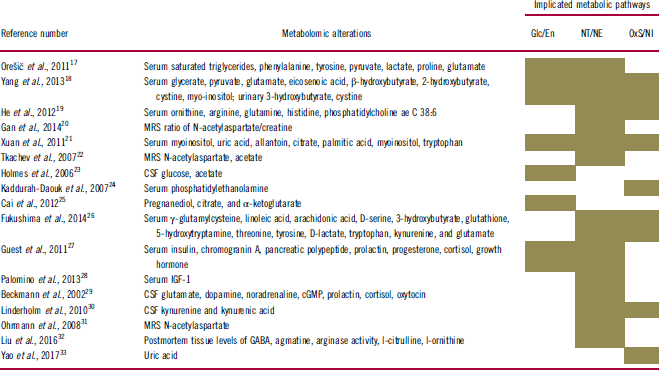
There is an urgent need for translational research to discover disease-specific biomarkers in psychiatric disorders, including schizophrenia.Reference Jones, Menniti and Sivarao10 Biomarkers (molecular, functional, anatomical, and cellular) have the potential to help detect individuals at risk for a given disorder, confirm diagnosis, identify patients with high-risk behaviors such as aggression or suicidal ideation, help with treatment selection, predict prognosis, and guide the development of novel and improved medications.Reference Atkinson, Colburn and DeGruttola11, Reference Weickert, Weickert and Pillai12 In psychotic disorders, different methodological approaches have been used to search for such biomarkers, including genomics, transcriptomics, metabolomics, proteomics, lipidomics, epigenetics, immunology, electroencephalography, and imaging techniques.Reference Pickard13 Metabolomics, the systematic study of the molecular profile found in body fluids and tissues in a given disorder (also known as the metabolome), carries particular promise.Reference Sethi and Brietzke14 In metabolomics, metabolome-wide association studies (MWAS) helped to reveal links between metabolic phenotypes and disease risk factors in the general population.Reference Holmes, Wilson and Nicholson15, Reference Griffiths, Koal and Wang16 A significant body of literature (summarized in Table 1)Reference Orešič, Tang and Seppänen-Laakso17–Reference Yao, Zhou and Keshavan33 has investigated the metabolome of patients with psychoses. This work focused on cohorts with various related psychotic disorders, including schizophrenia, first-episode psychosis, and bipolar psychosis. First episode psychosis is a heterogeneous category of patients but mainly includes patients with early symptoms of schizophrenia who have not received pharmacological treatments. Bipolar psychosis is part of the spectrum of affective psychoses but probably shares the final common pathway with other psychoses. As such, metabolomics research with these various cohorts yields a comprehensive understanding of the abnormal metabolic pathways in psychosis, including glucose energy metabolism, neurotransmitter systems, endocrine factors, and antioxidant systems. These biomarkers have the potential of serving as characteristic metabolic fingerprints for psychotic disorders, may help in classification of patients into different subtypes of psychotic disorders, and may constitute novel targets for metabolomic-based pharmacotherapies or act as predictors for patients’ response to current treatments.Reference Chan, Gottschalk and Haenisch34 Additional studies are still needed to validate the use of metabolomic biomarkers for patients’ stratifications or predictions to treatment response to antipsychotic drugs.
Summary of main studies addressing the metabolomic profile of schizophrenia patients

Abbreviations: Glc/En: glucose energy metabolism; NT/NE: neurotransmitters and neuroendocrine factors; OxS/NI: oxidative stress and neuroinflammation.
Dysfunction in glucose energy metabolism and endocrine dysfunction
The first aspect of the schizophrenia metabolome is the elevation of several fatty acid and ketone body levels. In comparison to healthy controls, schizophrenia patients have higher levels of saturated triglycerides and lactate.Reference Orešič, Tang and Seppänen-Laakso17, Reference Yang, Chen and Sun18 Serum levels of glycerate, pyruvate, eicosenoic acid, β-hydroxybutyrate, and myoinostiol are also increased, along with elevated urine β-hydroxybutyrate (a biochemical pattern with 90% accuracy in diagnosing schizophrenia).Reference Orešič, Tang and Seppänen-Laakso17 Related energy metabolism abnormalities were found in the cerebrospinal fluid (CSF) of schizophrenia patients as well. Drug-naïve patients with first-episode psychosis were shown to have elevated glucose and reduced acetate and lactate levels in their CSF in comparison to healthy controls.Reference Holmes, Tsang and Huang23
The elevated glucose, decreased intermediates of the Krebs cycle, and elevated fatty acid levels, are thought to indicate a state of impaired glucose utilization, insulin resistance, and upregulation of fatty acid catabolism, both in the peripheral and central nervous system (CNS).Reference Harris, Guest and Wayland35 Insulin in the CNS plays a role in regulating neuronal receptor expression and synaptic plasticity including memory and cognitive functions.Reference Harris, Guest and Wayland35 Changes in glucose metabolism and insulin signaling have been demonstrated in post mortem brain tissues of patients with psychosis.Reference Harris, Guest and Wayland35 Even though metabolic dysfunction is frequently detected in schizophrenia patients as a common side effect of antipsychotic agents, its established presence in first-episode and drug-naïve patients with psychoses suggests that this adverse event may be disease-specific and not the result of drug treatment.Reference Harris, Guest and Wayland35, Reference Harris, Pietsch and Cheng36
In addition to insulin resistance, schizophrenia has been associated with several other endocrinopathies, implicated in sleep, dopamine regulation, and neurotrophic effects. First-episode schizophrenia patients were found to have higher levels of insulin, chromogranin A, pancreatic polypeptide, prolactin, progesterone, and cortisol, as well lower levels of growth hormone.Reference Guest, Schwarz and Krishnamurthy27 These findings suggest that dysfunction of the hypothalamic–pituitary–adrenal–gonadal axis may contribute to the pathophysiology of schizophrenia. Finally, the insulin-like growth factor-1 (IGF-1) plasma levels were shown to be elevated in patients with first-episode schizophrenia and positively correlated with the negative symptoms of the disease, suggesting that IGF-1 may play a role in the pathophysiology of negative symptoms.Reference Palomino, González-Pinto and Martinez-Cengotita28
Alterations in neurotransmitters, amino acids, and neuroendocrine factors
The serum levels of several amino acids are altered in patients with schizophrenia. Elevation of serum glutamate level is a consistent finding in studies with different psychoses, which suggests that glutamate is a common pathway implicated in the pathophysiology of schizophrenia and other idiopathic psychotic disorders.Reference Orešič, Tang and Seppänen-Laakso17, Reference Yang, Chen and Sun18, Reference Fukushima, Iizuka and Yokota26, Reference Beckmann and Gattaz29 Glutamate is a major excitatory neurotransmitter in the brain that underlies excitotoxcity and oxidative stress.Reference Plitman, Nakajima and de la Fuente-Sandoval37 According to the ketamine model of schizophrenia, which states that non-competitive antagonists of the N-methyl-D-aspartate (NMDA) receptor such as ketamine and phencyclidine (PCP) can transiently induce symptoms of acute psychosis, reduced activation of glutamatergic NMDA receptors on inhibitory interneurons leads to excessive glutamate release by pyramidal neurons, mainly in the hippocampus.Reference Lisman, Coyle and Green38 In addition, the elevation of glutamate may result from being an important energy source in the brain. Dysfunctional of gluco-regulatory mechanisms in schizophrenia patients may lead their brains to resort to glutamate and lipids as alternative fuel sources.Reference Lisman, Coyle and Green38
The kynurenine pathway is an enzymatic cascade that degrades tryptophan to several downstream metabolites with various neurotoxic and neuroprotective effects.Reference Harris, Guest and Wayland35 Tryptophan has been found to be elevated in the CSF of adult schizophrenia patients, along with one of its metabolites, kynurenic acid (KYNA), and its precursor kynurenine. KYNA is an antagonist at NMDA and α7 nicotinic receptors (α7 nAChR).Reference Linderholm, Skogh and Olsson30 The kynurenine pathway interacts dynamically with the immune system. Its disturbance in schizophrenia has been shown to be associated with increased prostaglandin E2 and cyclo-oxygenase-2 (COX-2) expression, and increased pro-inflammatory cytokines.Reference Muller, Myint and Schwarz40 These pro-inflammatory changes may trigger a cascade of intracellular events that eventually lead to the development of schizophrenia symptoms. In addition, KYNA may antagonize glutamate neurotransmission at the NMDA receptor, contributing to glutamatergic dysfunction reported in the disease.Reference Muller, Myint and Schwarz40
N-acetylaspartate, a marker for neuronal integrity and quantity, was reduced in the cerebral cortex of schizophrenia patients in comparison to normal controls using magnetic resonance spectroscopy (MRS). This may be consistent with neuronal damage during neurodevelopment and subsequent impairment in neuronal cortical migration.Reference Gan, Cheng and Duan20, Reference Ohrmann, Kugel and Bauer31 N-acetylaspartate was also found to be upregulated in oligodendrocytes in postmortem prefrontal cortical tissue of schizophrenia patients, potentially implying lower acetate levels and dysfunction in myelin biosynthesis and subsequent impairment in glutamatergic neurotransmission, contributing to excitotoxicity.Reference Tkachev, Mimmack and Huffaker22
Another alteration in schizophrenia patients is the elevation in arginine levels and its downstream metabolite agmatine.Reference Liu, Jing and Collie32 Agmatine regulates the glutamate system, and its abnormal levels may trigger glutamatergic dysfunction.Reference Liu, Jing and Collie32 Another downstream metabolite of arginine is GABA. Tissue GABA levels were found to be reduced in brains of schizophrenia patients, with an elevation in the glutamate/GABA ratio; an effect that is consistent with the known GABAergic deficit of the disorder.Reference Liu, Jing and Collie32 Furthermore, endogenous nitric oxide synthase, an enzyme that metabolizes arginine to nitric oxide, was found to be reduced in schizophrenia patients. This may underlie the regional cerebral hypoperfusion seen in these patients, given nitric oxide’s vascular regulatory role.Reference Orešič, Tang and Seppänen-Laakso32 Finally, increased serum proline has been found to be sensitive and specific for schizophrenia, regardless of antipsychotic treatment.Reference Orešič, Tang and Seppänen-Laakso17 Increased proline is thought to impair the function of glutamic acid decarboxylase, thereby reducing levels of GABA and impairing GABA signaling, contributing to the GABAergic deficit.Reference Volk, Gonzalez-Burgos and Lewis41
Oxidative stress and neuroinflammation
Neuroinflammation is likely to play an important role in the pathophysiology of schizophrenia. A recent systematic review found converging neuropathological and neuroimaging evidence of neuroinflammation in schizophrenia, including microglial activation, astroglial vacuolation, oligodendroglial apoptosis, and disordered myelination.Reference Najjar and Pearlman42 Potential contributory pathophysiologic elements include the high rate of generation of reactive oxygen species, mitochondrial dysfunction, and the multiprotein oligomer inflammasome, which promotes the maturation and secretion of pro-inflammatory cytokines.Reference Calabrese, Giordano and Crupi43 Biomarkers of oxidative stress, neuroinflammation, and excitotoxicity are likely to be altered early on in patients with psychoses. Glutathione, an endogenous antioxidant, and its precursor γ-glutamyl cysteine (γ-GluCys) were significantly reduced in schizophrenia patients in comparison with healthy controls.Reference Yang, Chen and Sun18 Furthermore, cystine, the rate-limiting substrate for glutathione synthesis, has been reported to be depleted in the serum of these patients, along with an elevation of 2-hydroxybutryrate, a byproduct of cystine synthesis.Reference Kaddurah-Daouk, McEvoy and Baillie24 Another study found a significant reduction of phosphatidylcholine (PC) ae C38:6, reflecting changes in their signaling pathways.Reference He, Yu and Giegling19 Elevation in uric acid levels have also been reported in schizophrenia patients, denoting increased purine catabolism as a response to oxidative stress in schizophrenia.Reference Yao, Zhou and Keshavan33
Metabolomics and Schizophrenia Pharmacotherapy
The metabolomic profile of schizophrenia has been shown to dynamically change with treatment. For example, treatment with the atypical antipsychotic risperidone was shown to partially normalize uric acid, tryptophan, myoinositol, pregnanediol, citrate, and α-ketoglutarate levels in CSF of schizophrenia patients.Reference Xuan, Pan and Qiu21, Reference Holmes, Tsang and Huang23 A magnetic resonance spectroscopy study showed that effective treatment of schizophrenia patients with atypical antipsychotics for 6 months normalized reductions in NAA/Cr.Reference Gan, Cheng and Duan20 These studies indicate the antipsychotic drugs may mediate, at least in part, their therapeutic benefits by normalizing deficits in metabolomic biomarkers. It also supports the use of these biomarkers as neuronal maps to better characterize the pharmacokinetic properties of medications, and as tools to predict patients’ response to treatment.
Insights from metabolomic studies in schizophrenia provide rationales for medication trials in schizophrenia. Subcutaneous administration of IGF-1 has been tried therapeutically in an attempt to increase the reported lower levels of IGF-1 in schizophrenia patients.Reference Bou Khalil44 The role of excitotoxicity and antioxidant stress in schizophrenia explains how the tetracycline antibiotic minocycline may improve negative symptoms of schizophrenia when added to standard medications.Reference Liu, Guo and Wu45, Reference Ghanizadeh, Dehbozorgi and OmraniSigaroodi46 Minocycline inhibits microglial activation and exerts a neuroprotective effect through its anti-inflammatory, antioxidant, and anti-apoptotic properties, in addition to modulation of the glutamate-induced excitotoxicity pathway.Reference Zhang and Zhao47 Nitric oxide enhancers and inhibitors, as well as agents regulating its hydrolysis by phosphodiesterase inhibitors, are emerging as potential therapeutic strategies.Reference Shim, Shuman and Duncan48 A preliminary study suggested that 12-month treatment with N-acetylcysteine, a neuroprotective glutathione precursor, improved symptoms of early psychosis in schizophrenia patients, although it did not halt progressive cortical atrophy seen in the disease.Reference Breier, Hummer and Liffick49 Trials have also focused on dysfunctional neurotransmitter systems in schizophrenia, including NMDA receptor enhancers,Reference Harvey50 AMPA receptor modulators (which augment opening of NMDA channels),Reference Goff, Romero and Paul51 dopamine D1 receptor agonists, α7 nAChR agonists, and kynurenergic modulators (such as inhibitors of kynurenine 3-monooxygenase and kynurenine aminotransferase II inhibitors).Reference Kegel, Bhat and Skogh52–Reference Wonodi, Stine and Sathyasaikumar55 These strategies based on metabolomically derived pathophysiologic biomarkers have all shown promise in preclinical studies and in few early stage clinical trials to improve core deficits of schizophrenia or subset of symptoms of the disease including negative symptoms and cognitive deficits. Nonetheless, failures in late-stage clinical trials, either due to the lack of sustained efficacy or due to the development of undesirable adverse events, have hampered the approval of these agents for improved treatment of schizophrenia.Reference Goff, Lamberti and Leon56–Reference Javitt, Carter and Krystal59
Conclusion
Different metabolic, neurotransmitter, endocrine, and neuroinflammatory pathophysiological elements appear to be altered in schizophrenia patients, and may be considered disease-specific biomarkers as suggested by several metabolomic studies. These carry the promise of becoming clinically relevant diagnostically and therapeutically. In addition, metabolomic fingerprints, when combined with other “omics” data, may provide a more comprehensive approach for better understanding of the pathophysiology of schizophrenia, for selecting the most optimal therapeutic agent, and for predicting patient’s response to treatment. Novel and much-needed metabolomic-based therapies that can delve deeper into the core deficits of schizophrenia and normalize its pathophysiology may prove to be the ultimate intervention for the improved treatment of schizophrenia and other idiopathic psychotic disorders.