


Besides making a welcome contribution to current debates on the choice of electoral institutions, “Historical Knowledge and Quantitative Analysis: The Case of the Origins of Proportional Representation” (Kreuzer Reference Kreuzer2010) has important methodological implications for the study of politics. In this rejoinder, I build on Kreuzer's article in two steps. First, I reflect, at a conceptual level, on why and how historical research and political science are tightly related to each other. Second, I apply some of those ideas to the reexamination of the process through which proportional representation (PR) was introduced in advanced democracies at the turn of the 20th century.
HISTORICAL RESEARCH AND POLITICAL SCIENCE
From a methodological point of view, the study of politics is witnessing an emerging (even if tentative) consensus in the past few years. On the one hand, most researchers now accept that standard large–N statistical methods are necessary to establish the existence of empirical regularities. On the other hand, they also acknowledge that the historical analysis of an event or set of events may have several advantages over quantitative analysis: it reduces measurement error, it helps sort observationally equivalent theories, and it may have a generative role in the production of theory.Footnote 1 As a result, the use of qualitative evidence has spread from historical institutionalism, where it was always one of its constitutive elements (Hall and Taylor Reference Hall and Taylor1996), to the rest of the discipline, mainly under the banner of “analytic narratives” or “rational choice history” (Bates et al. Reference Bates2000; Elster Reference Elster2000).
In arguing (conceptually and through an enlightening discussion on the adoption of PR) that “the quality of quantitative research directly depends on the closeness of its dialogue with historical knowledge” (Kreuzer Reference Kreuzer2010, 383), Kreuzer also insists on the role that historical research plays in generating and testing theoretical propositions. However, in what I judge to be a more ambitious move, he maintains that historical work, when properly conducted, may be a particularly suitable method to test the causal structures of a large swath of the theoretical work currently done in political science. The crux of this position can be stated succinctly. Although still crucial for testing many causal propositions, standard statistical methods may be inadequate to capture the underlying strategic structure that characterizes most, if not all, political (and, for that matter, social) events. That is, they may be insufficient to fully identify the players of the game; inspect their beliefs, payoffs, and alternative strategies; properly examine the sequence of decisions; and verify the equilibrium conditions of the final outcome.Footnote 2
To pin down the methodological consequences of that claim, let me turn to the debate over the causes behind electoral reform. In Boix (Reference Boix1999), I argued that PR was adopted when the emergence of social democratic parties threatened the electoral and parliamentary viability of already established parties. I then verified that claim employing a cross-sectional regression in which the main variable of interest was an interactive term (of left threat and nonleft fragmentation). Drawing on detailed historical evidence, Kreuzer replicates my data collection and indeed confirms the model (after correcting for measurement error and subjecting it to several robustness checks), showing that it outperforms all other available explanations. Still, it is evident, in light of Kreuzer's analysis, that the statistical model I employed was too blunt a tool to validate the main theoretical variables that shaped the electoral viability of parties and, therefore, their incentives to block or initiate an electoral reform: their spatial location, level of voter support, and potential capacity to become the focal point around which nonsocialist voters coordinate. Naturally, nothing prevents us from devising the appropriate econometric tests to estimate the effect of such things as electoral location, voter strength, or the mechanical effects of electoral rules on every party's position toward PR. (I tackle such a strategy later in this response.) However, that task becomes more arduous to accomplish for other steps in the historical sequence that led to PR: examining the incentives of individual parliamentarians, understanding how they were aggregated at the party level, disentangling their “true” preferences from strategic behavior, and reconstructing the institutional process through which PR made it into law. Even if each element can be treated statistically, all must be reconciled through some kind of (theoretically informed) historical narrative. In fact, employing standard econometric techniques may even be impractical if PR was one of the several measures of electoral reform (e.g., upper house reform, executive veto, malapportionment, universal suffrage) parties were interested in—there we are confronted with several dependent variables and a complex system of equations to be developed.
Kreuzer's insistence on history as a tool to probe the causal structure of politics implies a more demanding application of historical knowledge that is common in our discipline (and also increasingly so in economics). A substantial number of articles (and books) are now built as a combination of some (either formalized or nonformal) theory followed by a brief description of a few cases that appear to corroborate the main point (or one of the main points) of the model. The problem that such a methodological strategy faces is that, even if the procedure applied to select cases is the proper one (Fearon and Laitin Reference Fearon, Laitin and Goodin2009), historical narratives are so rich in content (i.e., they contain so many potential explanatory variables) that one can find almost all kinds of causal stories in them. Hence, if we want to apply any kind of historical evidence in a fruitful manner (i.e., to achieve the self-ascribed goals of political science), our use of history should track, to employ some microeconomic terminology, the structure of comparative statics analysis. As is well known, the latter consists of the examination of how outcomes (or equilibria) change with respect to changes in the parameters of the model. Similarly, our historical and qualitative information must be deployed to show how a shift in one part of the game (e.g., the payoffs of politicians) changes another part of the underlying strategic structure (e.g., certain partisan decisions). To go back to the case of PR, merely describing an episode of electoral reform (or describing several episodes sequentially) will not suffice. The historical evidence should be organized to show that theory and evidence are well aligned with each other throughout the different “moments” that integrate a model of electoral choice: the relevant actors (parliamentarians and party organizations), the initial electoral market and the corresponding preferences of parties, their beliefs about the effects of reform, and the nods of the reform game. To accomplish this, the researcher will typically have to craft the historical study as a sequence of cross-country comparisons of the parameters that are relevant at each nod of the underlying game that has been put forward.Footnote 3
In the remainder of this rejoinder, I attempt to satisfy Kreuzer's methodological “plea” as to how to employ history in the study of politics, hopefully exemplifying how this type of historical research may be done in general. I do so through the examination of two key “moments” in the comparative history of electoral reform. First, I describe the expected interests of different parties (conservatives, liberals, and Christian Democrats) toward PR as a function of their position in the electoral market. I employ detailed historical evidence to corroborate the plausibility of the model. That discussion is followed by the statistical analysis of the extent to which those “objective” conditions were correlated with the public positions political parties assumed toward the adoption of PR.Footnote 4 Second, I indicate how those partisan preferences were translated (through partisan strategic interactions in the context of different constitutions and legislative settings) into actual policy outcomes. Although those two crucial dimensions of electoral reform do not encompass all components of the strategic game of electoral reform, their historical analysis shows that the theoretical explanation I offer [and that relies on the model in Boix (Reference Boix1999)] matches the country-by-country episodes of electoral reform (or nonreform) of the period under analysis.Footnote 5 In line with Kreuzer's predictions, those two examples also show that a more thorough engagement with history (ideally informed by some theoretical model) has a positive impact on theory formation: it pushes the researcher to generate a much richer theoretical understanding of the political events under study. In the particular case of PR, it has led me to differentiate more clearly between types of electoral markets, pay attention to individual versus party preferences, consider the way in which preference heterogeneity was reconciled, and examine the constraints that institutions imposed on all players.
STRUCTURE OF ELECTORAL MARKETS AND PARTY INTERESTS
Until the turn of the twentieth century, elections were contested and parliamentary seats were allocated under plurality or majoritarian rules everywhere. Given the coordination properties of those rules (Cox Reference Cox1997; Duverger Reference Duverger1954), the already established parties had strong incentives to maintain them. However, the decision of trade unions, which had so far supported liberal candidates, to endorse strictly working class political platforms led to the emergence of social democracy as a viable political alternative, the transformation of the structure of electoral competition in most advanced countries, and the erosion of the electoral advantage that the existing majoritarian rules conferred to nonsocialist parties.Footnote 6 In turn, those changes pushed electoral reform to the forefront of the political agenda of non-socialist parties (and many socialist parties as well) in all countries except those where socialist parties were small or did not exist (Canada, Greece, Japan, and the United States).
The electoral growth of social democracy was a necessary but not sufficient condition to obtain PR. Parties favored PR as a function of two conditions, which I present in Boix (Reference Boix1999) and now further elaborate on: first, the type of electoral market in which the old parties competed with each other, and second, the extent to which the old parties shared voters with the new party (which, to a good extent, was a function of the breadth of the franchise).Footnote 7
For the sake of simplicity, we can classify electoral markets into two broad types: “segmented” and “competitive”. A segmented electoral arena is one in which the support of each party is highly concentrated in a particular geographic area or social sector. As a result, vote flows across parties are minimal. A competitive or shared electoral market is one in which parties contend for the vote of at least some fraction of the electorate. As I discuss later, almost all parties ran candidates in both types of constituencies (competitive and noncompetitive). However, one of the two kinds generally prevailed within each party, therefore determining the overall incentives of each party toward PR. Still, whenever those two types of constituencies were equally important to the party (as in the case of cross-class parties) and the party was decentralized, parties tended to split internally over PR.
In segmented markets, the position of each party toward PR should have been simply determined by the extent to which the new entrant (a social democratic party) threatened its hegemony in its electoral segment. In more competitive electoral arenas, the position of old or established parties was shaped by the extent to which they were dominant in the electoral arena (vis-à-vis the other old parties) conditional on the entry of third parties. A dominant party was the party that could become the focal point around which nonsocialist voters would eventually coordinate. Dominant parties should have had a strong incentive to block PR on the expectation that the status quo would let them absorb all or most of the voters of a nondominant old party. In turn, nondominant parties should have preferred PR.
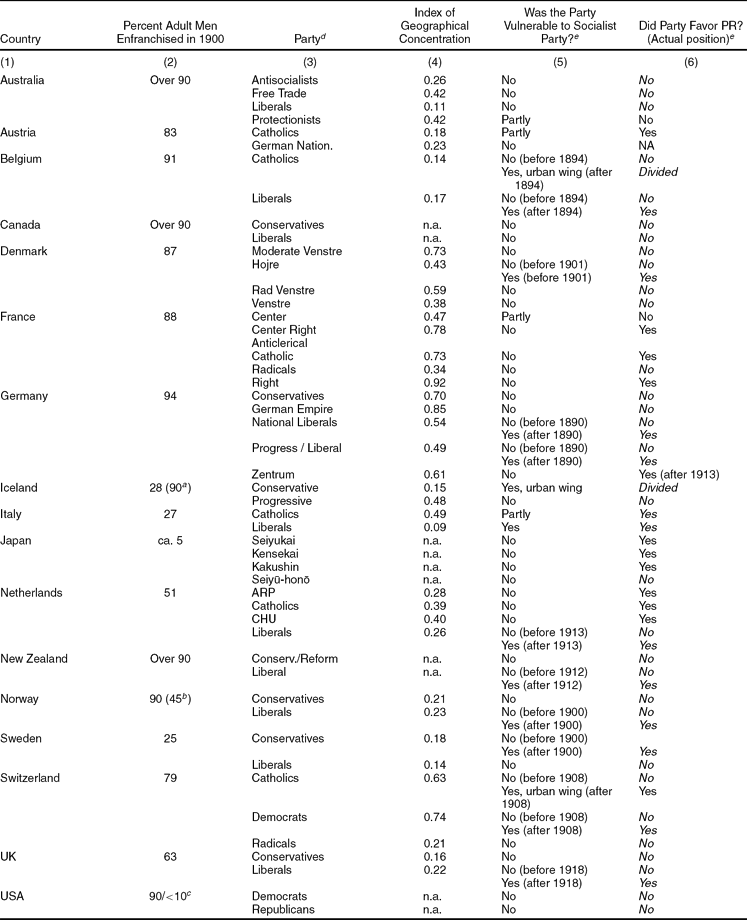
I use the average level of geographic concentration of parties (ranging from 0 to 1, with the latter indicating that party i received all support from a single constituency) before World War I to proxy for the type of electoral market in which each party operated.Footnote 8 The measure is reported in Table 1, Column 4. Column 1 lists countries and Column 3 enumerates those political parties of some significance, that is, those that polled 5% or more of the votes in the election before World War I or in the election before the electoral reform if the latter took place before 1910.Footnote 9 A higher level of concentration implies a more segmented, less competitive electoral market.
Electoral Markets and Partisan Preferences Toward Proportional Representation

a In 1916.
b In 1899.
c Around 90 percent for white men in non-Southern states; 10 percent or less for black men in the South (Boix Reference Boix2003; Keyssar 2000).
d The parties coded are those polling 5 percent or more of the votes in the last election before World War One or in the election before the electoral reform if the latter took place before 1910. The rule has two exceptions: I include the German Conservatives because of their pivotal role in Prussia (which had a key constitutional role in Germany); in France, I examine political families instead of parties since a considerable number of MPs ran under very loose political coalitions.
e For those countries where a socialist party grew to poll over 15 percent of the vote, I report the vulnerability and the actual position of non-socialist parties both for the period before the socialist party crossed that threshold and for the period after it had.
Segmented Electoral Markets
Given that socialist parties grew, with the exception of Finland, in industrial working class constituencies and in segmented markets, urban-based traditional parties should have pushed for PR to minimize their losses at the parliamentary level. In contrast, rural parties should have supported the status quo.Footnote 10 Rural parties should have also preferred non-PR rules for two additional reasons. First, they discouraged ambitious politicians from breaking away from their own party. Second, the process of industrialization and the migration to cities intensified the overrepresentation of rural-based parties over time—in Germany, for example, the malapportionment index grew from 7% in 1871 to 20% in 1912.
As theoretically expected, the Belgian, Dutch, and German liberal parties, all of which had their electoral strongholds in cities, were consistently in favor of adopting PR as soon as social democratic parties started to make large inroads in working class constituencies (Carstairs Reference Carstairs1980; Daalder Reference Daalder and Daalder1990; Goblet Reference Goblet d'Alviella1900; Hermens Reference Hermens1941; Rustow Reference Rustow1950).Footnote 11 Similarly, Denmark's Højre, also urban based, was frantically in favor of PR after the rise of the Socialist party reduced its share of seats in Copenhagen city and province from 71% in 1890 to just 25% after 1895 (Elklit Reference Elklit, Grofman and Lijphart2002, 134–36). In Iceland, urban-based Conservatives also favored PR (Hardarson Reference Hardarson, Grofman and Lijphart2002, 137).
In contrast, and in line with the set of incentives stated previously, Venstre, the Danish equivalent to the Liberal party and a farmers’ party, supported the status quo up until the 1915/1920 reforms (Elklit Reference Elklit, Grofman and Lijphart2002, 30–39). The growth of social democracy did not affect it directly, and the existing majoritarian system allowed it to curb the growth of Radical Venstre, which broke away from Venstre in 1905 and represented urban radical and agricultural laborers (and that maintained an electoral alliance with the Socialist party until the full introduction of PR in 1920) (Luebbert 1987). In fact, because its support was concentrated outside Copenhagen's metropolitan area, in the first reform of 1915, Venstre accepted introducing PR in that area in exchange for the maintenance of plurality rule in the rest of the country (Elklit Reference Elklit, Grofman and Lijphart2002, 34–36). Iceland's agrarian Progressives (as well as some Conservative MPs from rural areas) were against PR (Hardarson Reference Hardarson, Grofman and Lijphart2002, 137). In Switzerland, the Radicals, who were hegemonic among Protestant urban upper and rural middle strata and, therefore, well sheltered from the growth of the Socialist party, opposed PR. Under the two-round majority system in place, they usually won less than half of all votes but more than 60% of all seats (Lutz Reference Lutz and Colomer2004, 283–85). Finally, in France, the secular center parties and the Radicals, both of which relied heavily on the French peasantry, resisted the introduction of PR soon after it made its way into parliamentary discussions in 1907 (Buell Reference Buell1920; Stuart Reference Stuart1920).Footnote 12
In contrast to urban and rural parties, cross-class, cross-sector parties should have been internally divided toward PR. Indeed that was the case for the Belgian and Italian Christian democrats, whose electoral basis was fairly distributed across the country. The Belgian Catholic party was split between rural representatives, who benefited substantially from plurality rule, and Brussels parliamentarians, whose seats were directly jeopardized by the formation of a Liberal-Socialist cartel. A first proposal (very similar to the Danish solution of 1915) that only introduced PR in urban districts failed to pass. The second and definitive project, imposed by the urban wing of the party with the frontal opposition of most rural Catholic MPs, established PR nationally, but tailored the size of districts to minimize its effects in rural constituencies: two thirds of all districts had 4 or fewer seats (Carstairs Reference Carstairs1980; Goblet Reference Goblet d'Alviella1900; Woeste Reference Woeste1933). In Italy, support for the Popular party was thinly spread across the country (mostly owing to the recent creation of the party), and there were only local strongholds in the rural districts of Northern and Central Italy: the few Catholic MPs present in the 1913 parliament favored PR (Hermens Reference Hermens1941, 155).
In Germany, the Netherlands, and Switzerland, Christian democratic parties were geographically concentrated and relatively unaffected by the growth of socialism in their own constituencies. They should have preferred a majoritarian system. Still, in Switzerland, the national Catholic party campaigned for PR in the three referenda of 1900, 1910, and 1918. Its support for PR has to be interpreted as a strategy to dislodge the Radical party, which had controlled the federal government since 1848, from power. However, in several cantons such as Luzern and Fribourg, where the majoritarian system rewarded the Catholic party, the local organization actually campaigned against PR (Lutz Reference Lutz and Colomer2004, 285–86). Germany's Zentrum opposed PR until 1913—it is possible that its policy shift responded, as in the Swiss case, to an interest in breaking the hold that Liberals and Protestant Conservatives maintained over the imperial executive. In the Netherlands, the two main Protestant parties, ARP and CHU, were notoriously hurt by the structure of constituencies and their rather dispersed electoral base—their seat share in parliament was about 25% lower than their vote share—and this may have contributed to their support for PR.
Competitive Markets (1): Broad Franchise and Center-Based Old Parties
Consider now the case of electoral arenas where the old parties’ electorates are, to some extent, overlapping. The dominant party should prefer the status quo to squeeze the other party out of the electoral arena. Dominance is a function of, at least, two things: the party's position in the policy space and the size of the overall electoral space. To see why, assume a one-dimensional space (left–right) with two old parties, liberals and conservatives, and a new contestant, the socialist party. Consider first the case in which the franchise is already quite broad (perhaps universal) and in which liberal and conservative platforms are already distributed, with some divergence, around the median voter (of the whole space). (Column 2 in Table 1 displays the percentage of enfranchised men around 1900.) At some point, trade unions shift from endorsing liberal candidates to supporting socialist politicians: former left-wing liberal voters now vote for the latter, the liberal base shrinks, and this decline pushes moderate voters to rally around the conservative platform. Hence, the conservative party, which is the dominant party, should reject PR. The reverse applies to the liberal party.
Those theoretical expectations match the cases of Britain, New Zealand, and Australia. After the miners’ unions began endorsing Labour candidates in a few constituencies in the 1900s, the British Liberal party attempted to amend the plurality system with an alternative vote system (Morris Reference Morris1921). This would have maintained the Liberal lead in the Left camp, allowed Labour to pick some seats, and minimized their joint losses against Conservative candidates in three-cornered fights (Blewett Reference Blewett1972). After World War I, however, with Labour running its own candidates in most districts and Liberals split between Asquithians and LloydGeorgians, most Liberal MPs changed their mind and restlessly pursued a change in the electoral system. In fact, they supported the first Labour cabinet in 1923–24, conditional on the passage of a PR bill. In contrast, Conservatives opposed any change: in the famous Carlton Hotel meeting of 1922, Conservative MPs (particularly those who held safe constituencies) voted to abandon a Liberal-Conservative coalition by an overwhelming majority, convinced that the existing electoral system would make them the front runners against Labour in the impeding general election (Butler Reference Butler1963, 40–48, 58–67; Cook Reference Cook1975, 175 ff.; Pugh Reference Pugh1978).
Until World War I, Liberals dominated New Zealand's political arena based on a coalition of small farmers and urban workers. In response to the gradual rise of Labour, the Liberal premier introduced a two-round majoritarian system in 1908 to reduce the dangers of a split Left vote. Once all socialist platforms joined the “United Labour Party” in 1912, the Liberal party committed to PR in the 1914 electoral campaign. Yet, as in the United Kingdom, the Reform Party's long tenure in power from 1912 to 1928 made it impossible for Liberals to reform the electoral law and forced them, after a gradual process of decline, to merge with the former into the National Party (Milne Reference Milne1966, 28–48).
In Australia, the structure of electoral competition was also one of broad suffrage with a dominant party blocking any electoral reform; however, in that case, the identity of the dominant party varied regionally. The Protectionist party outvoted Free Trade (renamed the Anti-Socialist party in 1906) by a ratio of 3 to 1 in Victoria. In turn, Free Trade votes doubled those of Protectionists in the rest of the country. The rise of Labor eroded the support of both parties, but each one became the focal point of nonsocialist voters in a different part of Australia. As in the cases of the British and New Zealander Liberal parties, the Australian Protectionist party first floated a system of preferential voting. However, as Labour become stronger, the Anti-Socialists agreed to support the status quo in trade policy and Radical Protectionist MPs (mostly from Victoria) joined the Labor ranks, fusion among the two non-Socialist parties was swiftly achieved in 1909, with each party withdrawing their candidates in their nonhegemonic states (La Nauze Reference La Nauze1965; Loveday Reference Loveday, Martin and Parker1977; Overacker Reference Overacker1952).
Competitive Markets (2): Narrow Franchise and Right-Based Old Parties
The identity of the dominant party (and its position toward PR) differed in those countries where the electoral market was competitive but the franchise remained relatively narrow (until the turn of the twentieth century). Because the right to vote was based on an income or property requirement, both the voters and liberal and conservative parties were concentrated in the right segment of the electoral space. Accordingly, when the franchise was sharply expanded, the liberal party usually became the dominant party to combat union-endorsed socialist candidates because it was the only one that could attract voters on its left—and could therefore absorb the strategic vote of conservative voters as well. Under this structure of competition, conservatives should have favored PR, and liberals should have opposed it.
That story fits the case of Sweden. Although not completely nationalized in terms of their electoral base, Swedish Liberals and Conservatives used to have partly overlapping electorates, at least in towns and among some agrarian strata (Boix Reference Boix2004; Lewin, Jansson, and Sörbom Reference Lewin, Jansson and Sörbom1972). However, because Conservatives were wedded to the old constitutional order, they were believed to be at an electorate disadvantage and hence fought for and indeed imposed (with the aid of the upper house, which they controlled) PR, as the franchise was sharply broadened from around one-third to three-fourths of adult males in 1911. Liberals, instead, assuming that the expansion of suffrage rights would work to their benefit, defended the status quo (Lewin Reference Lewin1988, 71–87; Verney Reference Verney1957, 138–69).
Halfway between Britain and Sweden, Norway fits a similar pattern of strategic behavior. After the proportion of enfranchised men doubled to about 90% in 1899 and unions broke away from Liberal candidates, Socialist candidates rapidly controlled urban working class constituencies (Luebbert Reference Luebbert1991). Still, it was only after the Norwegian Labour party increased its share of the national vote from less than 10% in 1903 to more then 32% in 1915, and given that the political antagonisms between the urban and rural areas made a nonsocialist coalition impossible, that Liberals accepted PR “not (by) a sense of equalitarian justice but [by] the fear of rapid decline with further Labour advances across the majority threshold” (Rokkan Reference Rokkan1970, 158; see also Aardal Reference Aardal, Grofman and Lijphart2002, 183–86).
Italian Liberals, who had no independent conservative party to their right, also supported PR as a way to minimize the effects of introducing universal male suffrage, which tripled the number of enfranchised men, after World War I. This was particularly true for Liberal MPs of Northern and Central Italy, “afraid that, with the majority system in force, the two mass parties, the Socialists and the ‘Popolari’, would sweep” the constituencies of those areas (Hermens Reference Hermens1941, 156–57).
Robustness Check
The historical analysis of the cases seems to support very well the theory—with the exception, perhaps, of several Christian democratic parties and part of the French legislature. To check the robustness of the theory, Column 5 (in Table 1) summarizes the theoretical expectations by indicating how vulnerable each party was to the entry of a socialist party. To recap what has otherwise been developed previously in detail, parties were not vulnerable if there was no socialist threat (e.g., Japan), they were rural (e.g., Denmark's Venstre), or they could become a focal point of nonsocialist voters (e.g., Britain's Tories). Otherwise, they are coded as vulnerable (or partly vulnerable if only some of their members faced a direct threat from socialist parties).Footnote 13
According to our theoretical expectations, being vulnerable should push a party to support PR. Column 6 reports every party's public position toward PR. Those cases in which the party is “objectively” vulnerable and ended up supporting PR are predictive successes and are marked in italics. The success rate is very high. Among nonsocialist parties, 80% of those that should have opposed PR positioned themselves publicly against PR, and 100% of those that benefited from it pushed for its adoption. When we include socialist parties [coded following Penadés (Reference Penadés, Maravall and Sánchez-Cuenca2008)], the success rates are 76% and 100%, respectively.
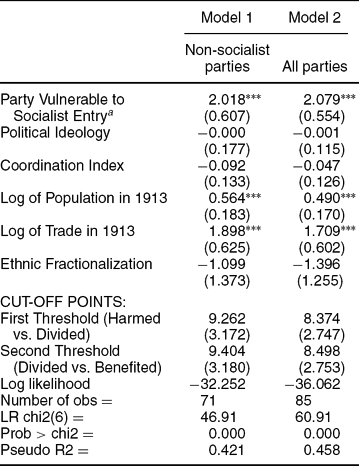
Table 2 checks the robustness of the theoretical model by regressing the position publicly favored by the party on whether the party was “objectively” vulnerable. Both measures take the value of 0 (against PR), 1 (party divided over PR), and 2 (in favor of PR). The analysis includes the following control variables: size of the country, party ideology (ranging from 1 for Extreme Left to 7 for Extreme Right), per capita income in 1900, logged value of trade openness in 1913, logged value of population in 1913, and the measures of coordination developed by Cusack, Iversen, and Soskice (Reference Cusack, Iversen and Soskice2007) and by Martin and Swank (Reference Martin and Swank2008). In the data set, each party from a country without a significant socialist party (one getting more than 15% of the vote) is coded as a single observation or data point. In the remaining countries, parties are coded twice: first, for the period without a socialist party, and, again, for the period with a socialist party. Results do not change if we exclude the data points for a period without a socialist threat in those countries in which socialist parties eventually became a threat.
Electoral Vulnerability and Partisan Positions Toward Proportional Representation
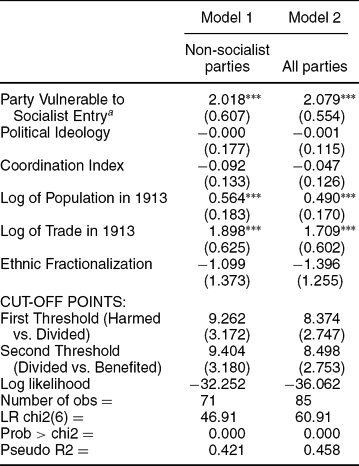
Estimation: Ordered Probit. Standard errors in parentheses.
aIn second column the variable is: for non-socialist parties, vulnerability; for socialist parties, party predicted to favor PR according to Penadés (Reference Penadés, Maravall and Sánchez-Cuenca2008).
***p < 0.01.
Table 2 reports two estimations: the first is based on nonsocialist parties, and the second adds socialist parties [coded in their position following Penadés’ (Reference Penadés, Maravall and Sánchez-Cuenca2008) classification]. Party preferences are certainly shaped by the strategic model that I elaborated. Whereas the probability that a party harmed by PR would support it is only 16%, the probability that a party benefited by PR would lobby for it reaches 99% (holding all other variables at their median values). Neither the Cusack-Iversen-Soskice index of coordination nor ethnic fractionalization is statistically significant.Footnote 14 Trade is statistically significant and, corroborating Rogowski (Reference Rogowski1987), positively correlated with the likelihood of preferring PR. Population is significant and, contrary to received wisdom (Dahl and Tufte Reference Dahl and Tufte1973), it increases the probability of supporting PR.Footnote 15
ENACTING PROPORTIONAL REPRESENTATION
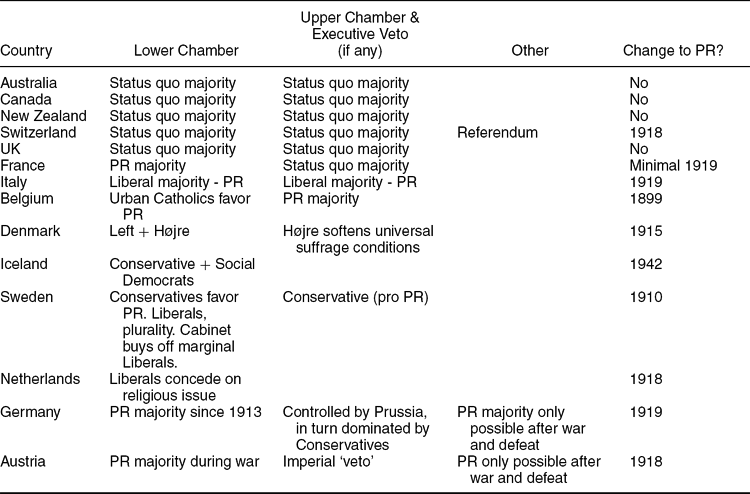
The alignment of party preferences, shaped by their strategic concerns, was crucial to determining the fortunes of electoral reform in the advanced world at the turn of the 20th century. However, the actual introduction of PR also depended on each country's specific constitutional system and, particularly, on both the partisan composition of parliament and actual parliamentary negotiations taking place within each chamber and across chambers. Table 3 summarizes the process of electoral reform across countries.
Enacting Proportional Representation
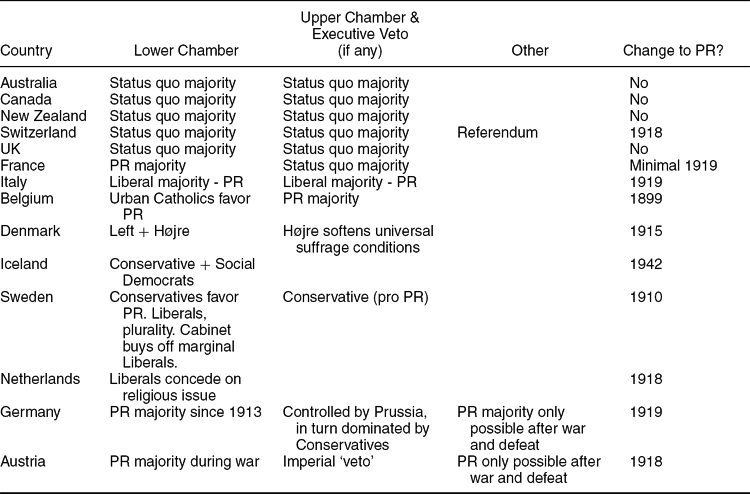
In six countries, the pro-PR party (or parties) never had a majority of seats in any of the two houses of parliament: Australia, Canada, New Zealand, Switzerland, the United Kingdom, and the United States. Accordingly, and with the exception of Switzerland, PR was never enacted. The Swiss parliament was bypassed by a national referendum. However, it took Socialists and Catholics three attempts to introduce PR. In the context of a growing Socialist party, and because a parliamentary debate was a constitutional precondition to hold a referendum, the Radical-dominated parliament delayed that debate for almost five years until a general strike in 1918 forced the government to organize it.
In France, only one of the two chambers had a pro-PR majority. By 1914, most of the members of the Chamber of Deputies supported PR and eventually voted for it after World War I. In contrast, the French Senate, where rural interests were overrepresented, was adamantly opposed to it.Footnote 16 The final bill approved in 1919 designed “in theory to give partial satisfaction to the supporters of PR” (. . .) “was in practice a rather complicated majority system” (Campbell Reference Campbell1958, 95): it reduced the effective electoral threshold from 35% (the threshold under a single-member district system) to 29%, and the disproportionality index actually jumped from an average of 7% before the war to 14.5% in 1919 and 10.7% in 1924.
In the remaining countries, PR eventually gathered the support of a majority of legislators (in line with the predictions of the previous section) in both houses.Footnote 17 Given the common right-wing bias of the upper house, support in the two houses and electoral reform became automatic whenever the Conservative party (or the Liberal party in Italy and the Netherlands, where there was no separate Conservative party) pushed for PR: in Belgium (where the Catholic party enacted it over the opposition of its rural wing) in 1899; in Denmark in 1915 (with a coalition of Conservatives, who used their dominant position in the upper house as a bargaining chip, Social Democrats and Radical Venstre); in Italy (where the Liberal party occupied both the right and center of the policy space) in 1919; and in Iceland (where the Conservative party finally allied with the social democrats to defeat the Agrarian Progressives) in 1942. In Sweden, the Conservative party, short of an absolute majority in the lower house, compensated a few Liberal MPs to vote for PR. Similarly, in the Netherlands, the religious parties “acceded to [PR] because in compensation for PR the Liberals agreed to vote for a solution of the century-old school controversy” (Hermens Reference Hermens1941, 339).Footnote 18
The timing of reform in Germany gives further evidence of the role of constitutional decision-making rules in explaining the adoption of PR. A broad coalition formed by Liberals, the Center party, and the Social Democrats, controlling the majority of seats in the Reichstag, favored PR since 1913 (when the Zentrum party embraced it) and committed formally to it as a joint policy at least since 1917. Yet, with the Bundesrat or upper house effectively in the hands of Prussia, where Conservatives prevailed electorally, they had to wait until the collapse of Imperial Germany to introduce PR. It was also after the breakdown of Austria-Hungary in October of 1918 that the Austrian provisional assembly, controlled by Catholics and Social Democrats, introduced a PR system two months later (Strong Reference Strong1939).
CONCLUSION
Following Kreuzer's call to engage in a detailed historical analysis of the interests and choices of political agents at the turn of the twentieth century confirms and enriches the theoretical model I developed in Boix (Reference Boix1999): PR was adopted at the behest of those already established parties that had become electorally vulnerable, conditional on the overall partisan and institutional context in which they made policy.




Comments
No Comments have been published for this article.