Introduction
Marijuana is the most commonly abused illicit drug in many countries including the USA (WHO, 1997; NSDUH, 2005). It is often the first illicit drug to be used, with the majority of users starting during adolescence (Pacula et al. Reference Pacula, Grossman, Chaloupka, O'Malley, Johnston and Farrelly2000; Gfroerer et al. Reference Gfroerer, Wu and Penne2002). Adolescent marijuana use is associated with a twofold increased risk for schizophrenia (Andreasson et al. Reference Andreasson, Allebeck, Engstrom and Rydberg1987; Zammit et al. Reference Zammit, Allebeck, Andreasson, Lundberg and Lewis2002; Henquet & van Os, Reference Henquet and van Os2008). Although this link between marijuana misuse and schizophrenia has already been well replicated in large prospective epidemiologic studies (van Os et al. Reference van Os, Bak, Hanssen, Bijl, de Graaf and Verdoux2002; Stefanis et al. Reference Stefanis, Delespaul, Henquet, Bakoula, Stefanis and van Os2004; Henquet et al. Reference Henquet, Krabbendam, Spauwen, Kaplan, Lieb, Wittchen and van Os2005), whether adolescent marijuana use is causally related to subsequent schizophrenia remains uncertain (Degenhardt et al. Reference Degenhardt, Hall and Lynskey2003; Kumra, Reference Kumra2007; Murray et al. Reference Murray, Morrison, Henquet and Di Forti2007; DeLisi, Reference DeLisi2008; Henquet & van Os, Reference Henquet and van Os2008; D'Souza et al. Reference D'Souza, Sewell and Ranganathan2009; Hickman et al. Reference Hickman, Vickerman, Macleod, Lewis, Zammit, Kirkbride and Jones2009; Sewell et al. Reference Sewell, Ranganathan and D'Souza2009).
Animal studies suggest that adolescence is a sensitive time period during which the effects of marijuana on the developing brain may be most deleterious (Schneider & Koch, Reference Schneider and Koch2003; Murray et al. Reference Murray, Morrison, Henquet and Di Forti2007). Tetrahydrocannabinol (THC), the psychoactive component in marijuana, activates brain cannabinoid receptors (cannabinoid receptor type 1, CB1 or CNR1) (Wilson & Nicoll, Reference Wilson and Nicoll2002). Chronic THC administration in adolescent rats, but not adult or pre-pubescent THC exposure, leads to enduring cognitive deficits in adulthood, including learning and memory deficits and prepulse inhibition abnormalities commonly observed in schizophrenia patients (O'Shea et al. Reference O'Shea, Singh, McGregor and Mallet2004, Reference O'Shea, McGregor and Mallet2006; Schneider & Koch, Reference Schneider and Koch2007). THC-related cognitive deficits are associated with changes in Fos protein expression within brain regions rich in CNR1, including the hippocampus, cerebellum and basal ganglia (Wegener & Koch, Reference Wegener and Koch2009). CNR1 activation by THC and other cannabinoids has also been shown to induce apoptosis through a complex cascade of kinases and caspases (Chan et al. Reference Chan, Hinds, Impey and Storm1998; Downer et al. Reference Downer, Fogarty and Campbell2003). CNR1-induced apoptosis is preceded by phosphorylation of p38 (Derkinderen et al. Reference Derkinderen, Ledent, Parmentier and Girault2001; Powles et al. Reference Powles, te Poele, Shamash, Chaplin, Propper, Joel, Oliver and Liu2005), a member of the mitogen-activated protein kinases (MAPKs).
Despite clear evidence from animal studies that THC induces neural cell death, human studies have been less certain regarding the harmful effect of marijuana on brain structure (Quickfall & Crockford, Reference Quickfall and Crockford2006; Lorenzetti et al. Reference Lorenzetti, Lubman, Whittle, Solowij and Yucel2010; Martin-Santos et al. Reference Martin-Santos, Fagundo, Crippa, Atakan, Bhattacharyya, Allen, Fusar-Poli, Borgwardt, Seal, Busatto and McGuire2010) or on cognitive function (Fried et al. Reference Fried, Watkinson and Gray2005; Jockers-Scherubl et al. Reference Jockers-Scherubl, Wolf, Radzei, Schlattmann, Rentzsch, Gomez-Carrillo de Castro and Kuhl2007; Rodriguez-Sanchez et al. Reference Rodriguez-Sanchez, Ayesa-Arriola, Mata, Moreno-Calle, Perez-Iglesias, Gonzalez-Blanch, Perianez, Vazquez-Barquero and Crespo-Facorro2010; Fernández-Serrano et al. Reference Fernández-Serrano, Pérez-García and Verdejo-García2011; Rabin et al. Reference Rabin, Zakzanis and George2011; Yücel et al. Reference Yücel, Bora, Lubman, Solowij, Brewer, Cotton, Conus, Takagi, Fornito, Wood, McGorry and Pantelis2012). The first published literature review of in vivo neuroimaging studies concluded that ‘(structural brain) abnormalities generally have not been identified with chronic (marijuana) use’ (Quickfall & Crockford, Reference Quickfall and Crockford2006). However, two subsequent reviews of additional studies indicate that marijuana use is associated with medial temporal lobe volume decrement (Lorenzetti et al. Reference Lorenzetti, Lubman, Whittle, Solowij and Yucel2010; Martin-Santos et al. Reference Martin-Santos, Fagundo, Crippa, Atakan, Bhattacharyya, Allen, Fusar-Poli, Borgwardt, Seal, Busatto and McGuire2010). Studies published after 2008 provide strong support that marijuana use is associated with brain volume deficits (Ashtari et al. Reference Ashtari, Cervellione, Cottone, Ardekani, Sevy and Kumra2009, Reference Ashtari, Avants, Cyckowski, Cervellione, Roofeh, Cook, Gee, Sevy and Kumra2011; Medina et al. Reference Medina, McQueeny, Nagel, Hanson, Yang and Tapert2009, Reference Medina, Nagel and Tapert2010; Mata et al. Reference Mata, Perez-Iglesias, Roiz-Santianez, Tordesillas-Gutierrez, Pazos, Gutierrez, Vazquez-Barquero and Crespo-Facorro2010; Lopez-Larson et al. Reference Lopez-Larson, Bogorodzki, Rogowska, McGlade, King, Terry and Yurgelun-Todd2011; McQueeny et al. Reference McQueeny, Padula, Price, Medina, Logan and Tapert2011; Solowij et al. Reference Solowij, Yucel, Respondek, Whittle, Lindsay, Pantelis and Lubman2011). For example, marijuana users have reduced frontal and lingual cortical thickness (Lopez-Larson et al. Reference Lopez-Larson, Bogorodzki, Rogowska, McGlade, King, Terry and Yurgelun-Todd2011), smaller hippocampal volumes (Ashtari et al. Reference Ashtari, Avants, Cyckowski, Cervellione, Roofeh, Cook, Gee, Sevy and Kumra2011), and cerebellar vermis abnormalities correlate with poor cognitive function (Medina et al. Reference Medina, Nagel and Tapert2010). In schizophrenia patients, some (Szeszko et al. Reference Szeszko, Robinson, Sevy, Kumra, Rupp, Betensky, Lencz, Ashtari, Kane, Malhotra, Gunduz-Bruce, Napolitano and Bilder2007; Bangalore et al. Reference Bangalore, Prasad, Montrose, Goradia, Diwadkar and Keshavan2008; Rais et al. Reference Rais, Cahn, Van Haren, Schnack, Caspers, Hulshoff Pol and Kahn2008, Reference Rais, van Haren, Cahn, Schnack, Lepage, Collins, Evans, Hulshoff Pol and Kahn2010; Peters et al. Reference Peters, de Haan, Vlieger, Majoie, den Heeten and Linszen2009; Dekker et al. Reference Dekker, Schmitz, Peters, van Amelsvoort, Linszen and de Haan2010; Ho et al. Reference Ho, Wassink, Ziebell and Andreasen2011b; James et al. Reference James, Hough, James, Winmill, Burge, Nijhawan, Matthews and Zarei2011) but not all studies (Wobrock et al. Reference Wobrock, Sittinger, Behrendt, D'Amelio and Falkai2009; Cohen et al. Reference Cohen, Rasser, Peck, Carr, Ward, Thompson, Johnston, Baker and Schall2011) find that, compared to patients who are non-users, patients with co-morbid marijuana use have greater frontotemporal and cerebellar deficits. Szeszko et al. (Reference Szeszko, Robinson, Sevy, Kumra, Rupp, Betensky, Lencz, Ashtari, Kane, Malhotra, Gunduz-Bruce, Napolitano and Bilder2007) reported that schizophrenia patients with marijuana misuse had smaller anterior cingulate gray matter (GM) volumes. Schizophrenia patients who continued to use marijuana have greater GM volume loss than non-users (Rais et al. Reference Rais, van Haren, Cahn, Schnack, Lepage, Collins, Evans, Hulshoff Pol and Kahn2010). In a recent study, our group reported that schizophrenia patients with marijuana misuse had smaller frontotemporal white-matter (WM) volumes than patients without heavy marijuana use (Ho et al. Reference Ho, Wassink, Ziebell and Andreasen2011b). We also found that heavy marijuana use in conjunction with specific CNR1 gene variants (rs12720071-G-allele carriers) contributed to greater WM brain volume deficits and cognitive impairment among schizophrenia patients (Ho et al. Reference Ho, Wassink, Ziebell and Andreasen2011b).
In the current study, we evaluated the effects of another cannabinoid-related gene, MAPK14, on magnetic resonance imaging (MRI) brain morphometry in schizophrenia patients. Schizophrenia has been linked to a pathophysiological failure to mount an effective response to an apoptotic insult (Jarskog Reference Jarskog2006). There is also supporting evidence that apoptosis is down-regulated in schizophrenia (Benes Reference Benes2006). Because CNR1-induced apoptosis is preceded by p38 MAPK phosphorylation (Derkinderen et al. Reference Derkinderen, Ledent, Parmentier and Girault2001; Powles et al. Reference Powles, te Poele, Shamash, Chaplin, Propper, Joel, Oliver and Liu2005), we wanted to see how genetic variations within genes encoding both mediators of CNR1-induced apoptosis may influence brain morphology in the presence of marijuana misuse among schizophrenia patients. Our hypothesis was that patients with specific MAPK14 genotypes are more vulnerable to the effects of heavy marijuana misuse and would show greater brain volume deficits than patients without marijuana misuse.
Method
Subject selection
The study sample consists of 235 patients with schizophrenia-spectrum disorders who were recruited through the University of Iowa Mental Health Clinical Research Center (MHCRC). Our subjects participated in various MHCRC research studies approved by the University of Iowa human subjects research review board. All the subjects gave written informed consent to undergo research assessments, which included a morphometric MR brain scan and blood sampling for DNA analyses. These subjects have been included in a previous report (Ho et al. Reference Ho, Wassink, Ziebell and Andreasen2011b).
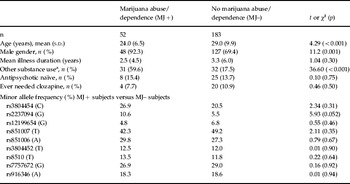
Demographic, clinical and genetic characteristics of the sample are summarized in Table 1. Most of the subjects (94%, n = 221) met DSM-IV criteria for schizophrenia; 6.0% (n = 14) had schizo-affective disorder. The subjects were of Caucasian ancestry and were predominantly male (74.5%). They were relatively young, with a mean age of 27.9 years (s.d. = 9.44), and had become psychiatrically ill recently at the time of study enrollment. The mean age at illness onset was 24.9 years (s.d. = 8.4) and the mean duration of illness was 3.2 years (s.d. = 5.7).
Demographic, clinical and genetic characteristics of the study population by marijuana status

a Lifetime alcohol and/or non-marijuana illicit drug abuse/dependence.
Substance use
Subjects were assessed for substance use (including alcohol and illicit drugs) using the semi-structured interview instrument, the Comprehensive Assessment of Symptoms and History (CASH; Andreasen et al. Reference Andreasen, Flaum and Arndt1992). Information on substance use history from multiple sources was available (including the subject, family members and medical records) and used to determine lifetime substance abuse or dependence diagnoses meeting DSM-IV criteria (Ho et al. Reference Ho, Flaum, Hubbard, Arndt and Andreasen2004). The CASH evaluates eight drug categories: alcohol, barbiturates/hypnotics, opioids, cocaine, amphetamines/stimulants, phencyclidine, hallucinogens and marijuana. For a given drug category, the subjects are asked if they have ever used the drug, pattern of use, period of heaviest use, and associated impairment relating to DSM abuse and dependence diagnostic criteria. We have good inter-rater reliability in our CASH alcohol/illicit drug ratings (mean intra-class r = 0.75, s.d. = 0.16).
We contrasted patients with marijuana abuse or dependence [MJ + , n = 52 (i.e. 33 patients with marijuana abuse and 19 patients with marijuana dependence)] against 183 patients who never met DSM criteria for marijuana abuse or dependence (MJ–). MJ+ patients were significantly younger, more likely to be male and to have co-morbid alcohol and/or non-marijuana illicit substance misuse (Table 1, p ⩽ 0.001). Otherwise, the two groups were comparable with respect to other sociodemographic measures, illness characteristics and antipsychotic treatment (p ⩾ 0.30).
Selection of tag single nucleotide polymorphisms (tSNPs) and genotyping
In this study we investigated tSNPs so as to maximally represent common genetic variants in the population. Nine MAPK14 tSNPs were selected using Haploview (Barrett et al. Reference Barrett, Fry, Maller and Daly2005) (aggressive tagging 2-marker haplotype r 2 ⩾0.8) and the HapMap CEU population SNP database (www.hapmap.org, Release 22/Phase II). These tSNPs (all of which are synonymous) span approximately 81 kb at chromosome 6p21.3-p21.2. To genotype the study participants, DNA was prepared by high-salt extraction from whole blood (Lahiri & Nurnberger, Reference Lahiri and Nurnberger1991) and assayed using Infininium II assay BeadChips (Illumina, USA). Genotype call rates were 100% for each of the nine MAPK14 tSNPs. Illumina makes use of their proprietary software to ascertain genotyping quality. A 10% GenCall score (i.e. the 10th percentile rank for all GenCall scores of the study samples at a given locus) ⩾0.7 constitutes high-quality genotype data. The mean 10% GenCall score for the nine MAPK14 tSNPs was 0.83 (s.d. = 0.15). We selected the CNR1 rs12720071 SNP because this variant has been previously associated with reduced WM brain volumes and heavy marijuana use (Ho et al. Reference Ho, Wassink, Ziebell and Andreasen2011b). The genotype call rate for CNR1 rs12720071 was also 100% (10% GenCall score = 0.84).
MRI acquisition and image processing
High-resolution morphometric brain MR data were collected using one of two imaging protocols. For subjects enrolled into the study before the year 2000, MRI brain scans were acquired on a 1.5-T GE (General Electric Medical Systems, USA) Signa MR scanner. In this imaging protocol (termed ‘MR5’), three-dimensional (3D) T1-weighted images were obtained in the coronal plane using a spoiled Gradient Recalled Acquisition in the Steady State (GRASS) sequence (SPGR) [parameters: echo time (TE) = 5 ms, repetition time (TR) = 24 ms, numbers of excitations (NEX) = 2, nutation angle = 45°, field of view (FOV) = 26 × 24 × 18.8 cm, matrix = 256 × 192 × 124]. Two-dimensional (2D) proton density (PD) and T2 sequences were acquired as follows: 3.0- or 4.0-mm-thick coronal slices, TR = 3000 ms, TE = 36 or 96 ms (PD/T2), NEX = 1, FOV = 26 × 26 cm, matrix = 256 × 192. For subjects recruited in 2000 or later, we used a 1.5-T Siemens Avanto scanner (Siemens AG, Germany). In this more recent imaging protocol (termed ‘MR6’), the T1 sequence was obtained in the coronal plane as a 3D volume using SPGR (parameters: TE = 6 ms, TR = 20 ms, flip angle = 30°, FOV = 16 × 16 × 19 cm, matrix = 256 × 256 × 124, NEX = 2). The MR6 T2-weighted images were acquired in the coronal plane using a 2D fast spin–echo sequence (parameters: TE = 85 ms, TR = 4800 ms, slice thickness/gap = 1.8/0.0 mm, FOV = 16 × 16 cm, matrix = 256 × 256, NEX = 3, number of echoes = 8, 124 slices).
MR images were processed using our locally developed BRAINS2 (Brain Research: Analysis of Images, Networks, and Systems, version 2) software package (Magnotta et al. Reference Magnotta, Harris, Andreasen, O'Leary, Yuh and Heckel2002). Detailed descriptions of the image analysis methods have been provided elsewhere (Andreasen et al. Reference Andreasen, Cizadlo, Harris, Swayze, O'Leary, Cohen, Ehrhardt and Yuh1993, Reference Andreasen, Flashman, Flaum, Arndt, Swayze, O'Leary, Ehrhardt and Yuh1994, Reference Andreasen, Rajarethinam, Cizadlo, Arndt, Swayze, Flashman, O'Leary, Ehrhardt and Yuh1996; Harris et al. Reference Harris, Andreasen, Cizadlo, Bailey, Bockholt, Magnotta and Arndt1999). In brief, the T1-weighted images were spatially normalized and resampled so that the anterior–posterior axis of the brain was realigned parallel to the anterior–posterior commissure line, and the interhemispheric fissure was aligned on the other two axes. The T2-weighted images were aligned to the spatially normalized T1-weighted image using an automated image registration program (Woods et al. Reference Woods, Cherry and Mazziotta1992). These images were then subjected to a linear transformation into standardized stereotaxic Talairach atlas space (Talairach & Tournoux, Reference Talairach and Tournoux1988) to generate automated measurements of frontal, temporal, parietal and occipital lobes (Andreasen et al. Reference Andreasen, Rajarethinam, Cizadlo, Arndt, Swayze, Flashman, O'Leary, Ehrhardt and Yuh1996). To further classify tissue volumes into GM, WM and cerebrospinal fluid (CSF), we used a discriminant analysis method of tissue segmentation based on automated training class selection that used data from the T1 and T2 sequences (Harris et al. Reference Harris, Andreasen, Cizadlo, Bailey, Bockholt, Magnotta and Arndt1999). In this study, we examined total and lobar (Talairach atlas-based frontal, temporal and parietal subdivisions) GM and WM brain volumes and lateral ventricles.
To enhance MR5 and MR6 data compatibility, MR6 scans were resampled into the same resolution and image size as the MR5 scans so as to simulate similar amounts of partial volume effects in voxels that bordered two tissue types. To verify our ability to combine data from the two MR protocols, we have acquired both MR5 and MR6 scans on 60 patients (Ho et al. Reference Ho, Andreasen, Ziebell, Pierson and Magnotta2011a). Brain volume differences between the two imaging sequences were small (median difference = 0.19%). Intra-class correlations (ICCs) were high across the regions of interest (median ICC = 0.97). Hence, MR5 and MR6 data are compatible for combined statistical analyses.
Statistical analyses
Analyses were performed using Haploview (Barrett et al. Reference Barrett, Fry, Maller and Daly2005) and SAS version 9.2 (SAS Institute, USA). Inter-correlations between the nine MAPK14 tSNPs were analyzed with pair-wise linkage disequilibrium (LD) statistics within Haploview. Because only a minority of the sample had heavy marijuana misuse, we grouped patients with marijuana abuse and patients with marijuana dependence together (n = 52) for statistical analyses. Furthermore, as there were no significant group differences in sociodemographics, illness characteristics, MRI brain volumes or MAPK14 tSNP allele frequencies between patients without prior marijuana exposure (n = 106) and patients whose marijuana use had not met DSM criteria for marijuana abuse or dependence (n = 77) (data not shown but available upon request), these patients were grouped together (n = 183) for comparison with patients with marijuana abuse or dependence. Group differences on categorical variables were tested using the χ2 test and continuous variables the independent group t test or ANCOVA.
Statistical analyses were conducted in stages to reduce Type I errors, which may arise from multiple comparisons. To assess brain volume–MAPK14 relationships, we first tested the effects of each MAPK14 genotype (minor allele carriers versus major allele homozygotes) on total cerebral GM or WM volumes using the adaptive false discovery rate (FDR) procedure (Benjamini & Hochberg, Reference Benjamini and Hochberg2000). For each general linear model, total cerebral brain volume was entered as the dependent measure and genotype as the independent variable. On MAPK14 genotypes in which the total cerebral brain volume test was statistically significant (FDR-adjusted p ⩽ 0.05), follow-up analyses were carried out to further assess brain volume–MAPK14 relationships between patients with versus patients without marijuana abuse/dependence. In each follow-up ANCOVA, the dependent variable was frontal, temporal or parietal lobar brain volume. Genotype, marijuana misuse (presence versus absence of lifetime marijuana abuse or dependence) and genotype × marijuana misuse interaction terms were the independent measures. Covariates included in all ANCOVAs were intracranial volume, age, gender, imaging protocol, antipsychotic treatment (lifetime antipsychotic exposure) and alcohol/non-cannabis illicit substance abuse/dependence. Intracranial volume adjusts for cranial size differences among subjects. Age, gender, antipsychotic exposure and alcohol/other illicit substance use (presence versus absence of lifetime alcohol abuse/dependence or non-marijuana illicit substance abuse/dependence) have previously been shown to affect brain volumes, and may potentially confound brain volume–MAPK14 relationships. We included imaging protocol (i.e. MR5 versus MR6 scanning protocol) as a covariate in the statistical models even though we have previously shown that these two scanning sequences provide comparable neuroimaging data (Ho et al. Reference Ho, Andreasen, Ziebell, Pierson and Magnotta2011a).
Results
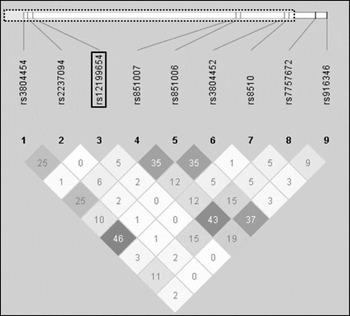
Genotype distributions of the nine MAPK14 tSNPs were in Hardy–Weinberg equilibrium (p ⩾ 0.08). These MAPK14 tSNPs were not in LD with one another (Fig. 1; pair-wise r 2 ⩽0.46). Allele frequency distributions for MAPK14 tSNPs did not differ significantly between MJ+ and MJ– subjects (see Table 1).
Pair-wise linkage disequilibrium (R 2) between nine mitogen-activated protein kinase 14 (MAPK14) tag single nucleotide polymorphisms (tSNPs) and their relative genomic positions to the p38α MAPK14 gene (dotted line box).

Relationships between MAPK14 tSNPs, brain volumes and marijuana misuse
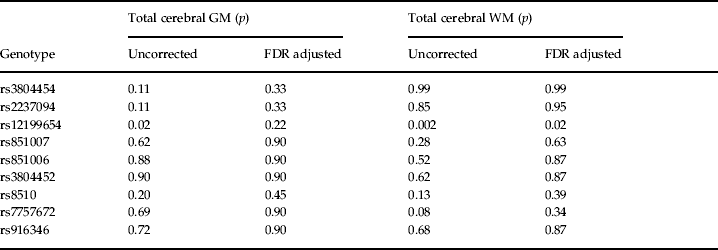
Table 2 summarizes the effects of MAPK14 tSNPs and total cerebral brain volumes. After accounting for multiple testing, only rs12199654 was significantly associated with total cerebral WM volumes (F = 9.41, FDR-adjusted p = 0.02). The effects of rs12199654 on total cerebral GM volume were not statistically significant (F = 5.17, FDR-adjusted p = 0.22, uncorrected p = 0.02). None of the remaining eight MAPK14 tSNPs were significantly associated with total cerebral GM volumes (F ⩽ 2.60, FDR-adjusted p ⩾ 0.11) or with total cerebral WM volumes (F ⩽ 3.18, FDR-adjusted p ⩾ 0.34).
Relationshipsa between nine MAPK14 tSNPs and total cerebral brain volumes
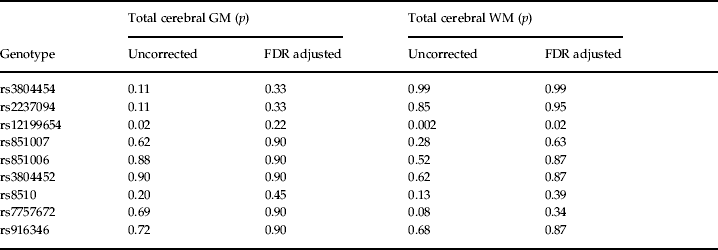
MAPK, Mitogen-activated protein kinase; tSNP, tag single nucleotide polymorphism; GM, gray matter; WM, white matter; FDR, false discovery rate.
a ANCOVA (uncorrected and FDR-adjusted p values) assessing the main effects of the MAPK14 genotype on total cerebral GM or WM volumes (covariates: intracranial volume, age, sex, imaging protocol, antipsychotic treatment and alcohol/non-cannabis drug abuse/dependence).
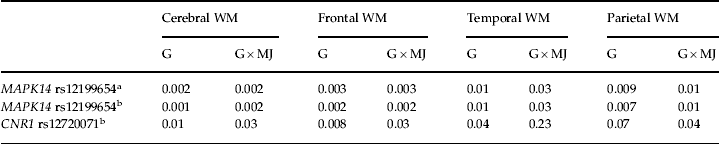
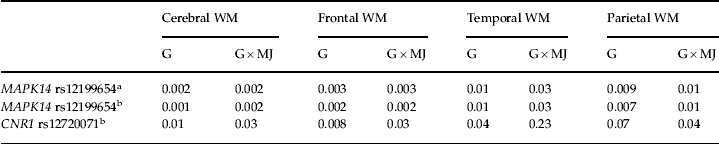
Next, we examined the effect of rs12199654 on total cerebral and lobar WM volumes in patients with versus without marijuana misuse (Table 3). There were significant main effects for the rs12119654 genotype and genotype × MJ interaction on total cerebral, frontal, temporal and parietal WM volumes. Among patients with marijuana misuse, rs12199654-A homozygotes had significantly smaller WM volumes than G-allele carriers (F ⩾ 4.91, df = 1,51, p ⩽ 0.03). By contrast, WM volumes did not differ significantly among MJ– patients across the rs12199654 genotype groupings (F ⩽ 0.22, df = 1,182, p ⩾ 0.64).
ANCOVA main effects of the MAPK14 rs12199654 genotype (alonea and in conjunction with CNR1 rs12720071b) on white-matter (WM) brain volumes among schizophrenia patients with or without marijuana misuse
G, Genotype; G × MJ, genotype interaction with marijuana misuse.
b With both genotypes included in the ANCOVA (covariates: intracranial volume, age, sex, imaging protocol, antipsychotic treatment and alcohol/non-cannabis drug abuse/dependence).
Independent effects of MAPK14 rs12199654 and CNR1 rs12720071 on WM brain volumes in association with marijuana misuse
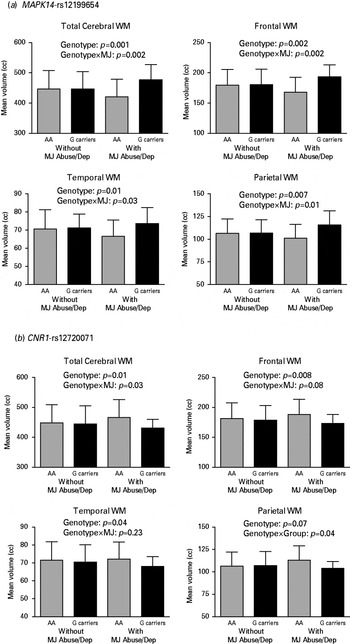
When the CNR1 rs12720071 genotype was included in the ANCOVA general linear models, the main effects of the MAPK14 rs12199654 genotype and genotype × marijuana misuse interaction on WM volumes did not change substantially and remained statistically significant (Table 3 and Fig. 2a; F ⩾ 6.66, df = 1,234, p ⩽ 0.01). After controlling for the effects of MAPK14 rs12199654, there were significant main effects of CNR1 rs12720071 on total cerebral, frontal and temporal WM volumes (Table 3 and Fig. 2b; F ⩾ 6.76, df = 1,234, p ⩽ 0.01). The effects of CNR1 rs12720071 on parietal WM volumes approached but did not achieve statistical significance (p = 0.07). There were also significant CNR1 rs12720071 genotype × MJ interaction effects on total cerebral, frontal and parietal WM volumes (F ⩾ 4.72, df = 1,234, p ⩽ 0.03), such that rs12720071-G-allele carriers with heavy marijuana use had significantly smaller WM volumes than their A homozygote counterparts (Fig. 2b, F ⩾ 4.74, df = 1,51, p ⩽ 0.03). However, among MJ– patients, WM volumes did not differ significantly across CNR1 rs12720071 genotype groupings (F ⩽ 0.07, df = 1,182, p ⩾ 0.79). There were no significant CNR1 rs12720071 genotype × marijuana misuse interactions on temporal WM volumes.
Mean (error bars show standard deviation) white-matter (WM) brain volumes of patient subgroups and ANCOVAs showing independent effects of genotype [(a) mitogen-activated protein kinase 14 (MAPK14) rs12199654 or (b) cannabinoid receptor 1 (CNR1) rs12720071] and genotype × marijuana misuse interaction (genotype × MJ) on WM brain volumes. Subgroup samples subdivided based on genotype and presence/absence of lifetime marijuana abuse or dependence (MJ Abuse/Dep).

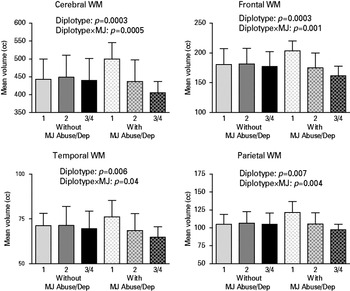
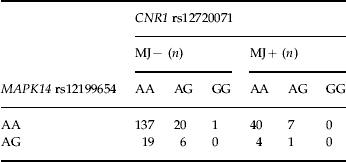
To further illustrate the additive effects of these two genes known to mediate a common biological pathway, we categorized subjects into three distinct diplotypes based on the number of ‘risk’ alleles within MAPK14 rs12199654(A) and within CNR1 rs12720071(G) associated with smaller WM volumes (Table 4). Patients with the MAPK14 rs12199654-AG and CNR1 rs12720071-AA diplotype had one ‘risk’ allele. Patients with the MAPK14 rs12199654-AA and CNR1 rs12720071-AA diplotype or the MAPK14 rs12199654-AG and CNR1 rs12720071-AG diplotype had two ‘risk’ alleles. Patients with the MAPK14 rs12199654-AA and CNR1 rs12720071-AG diplotype or the MAPK14 rs12199654-AA and CNR1 rs12720071-GG diplotype had three or four ‘risk’ alleles. There were significant main effects of diplotype grouping (p ⩽ 0.007) and diplotype × marijuana misuse interaction (p ⩽ 0.04) on WM brain volumes (Fig. 3). A greater number of MAPK14-CNR1 ‘risk’ alleles was associated with a smaller WM volume only among subjects with marijuana misuse.
Mean (error bars show standard deviation) white-matter (WM) brain volumes of mitogen-activated protein kinase 14 (MAPK14) rs12199654 and cannabinoid receptor 1 (CNR1) rs12720071 diplotype groupings (see Table 4 footnote) subdivided by patients with or without marijuana abuse/dependence and independent effects of diplotype and diplotype × marijuana misuse interaction (diplotype × MJ) on WM brain volumes.

Study sample distribution (n) of MAPK14 rs12199654 and CNR1 rs12720071 diplotype groupingsa subdivided by patients with (MJ+) or without (MJ–) marijuana abuse/dependence
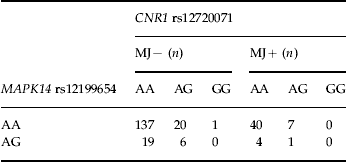
a Based on the number of ‘risk’ alleles (i.e. MAPK14 rs12199654-A allele or CNR1 rs12720071-G allele) associated with smaller white matter (WM) brain volumes: one ‘risk’ allele: patients with MAPK14 rs12199654-AG and CNR1 rs12720071-AA diplotype; two ‘risk’ alleles: patients with MAPK14 rs12199654-AA and CNR1 rs12720071-AA diplotype or MAPK14 rs12199654-AG and CNR1 rs12720071-AG diplotype; three or four ‘risk’ alleles: patients with MAPK14 rs12199654-AA and CNR1 rs12720071-AG diplotype or MAPK14 rs12199654-AA and CNR1 rs12720071-GG diplotype.
Discussion
In the present study, we investigated the relationships between MAPK14 and CNR1 genetic variants and brain volumes of schizophrenia patients stratified by severity of marijuana misuse. These two genes were examined because CNR1 and p38α MAPK have been implicated in THC-induced apoptosis. We found that, in the case of heavy marijuana use, specific allelic combinations of these two cannabinoid-related genes were associated with smaller WM brain volumes. The MAPK14 rs12199654-A-allele and the CNR1 rs12720071-G-allele each had independent effects on diffuse WM volume decrement among schizophrenia patients with heavy marijuana use. Such marijuana misuse–MAPK14–CNR1 inter-relationships may mediate increased apoptosis, disrupt WM maturation, and heighten disease vulnerability within subgroups of schizophrenia patients.
CNR1 is a member of the superfamily of G-protein-coupled receptors. CNR1 transduction occurs through Gi/o proteins interacting with a wide variety of second messengers including phosphorylation of MAPK, inhibition of adenylyl cyclase and regulation of ion (calcium and potassium) channels (Howlett & Mukhopadhyay, Reference Howlett and Mukhopadhyay2000; Turu & Hunyady, Reference Turu and Hunyady2010). CNR1 stimulation by THC and other CNR1 agonists is followed by p38 MAPK activation in various neural cell types (Derkinderen et al. Reference Derkinderen, Ledent, Parmentier and Girault2001). Of the four known p38 MAPKs in mammals (α, β, γ and Δ), p38α (MAPK14) is the most well-characterized isoform (Mielke & Herdegen, Reference Mielke and Herdegen2000). These p38 MAPK family members are approximately 60% identical in their amino acid sequences, but are encoded by different genes and have different tissue expression patterns. p38α is widely expressed at significant levels in multiple cell types, including neural cells (Lee et al. Reference Lee, Park, Che, Han and Lee2000). MAPK14 is localized to chromosome 6p21.3-p21.2, a schizophrenia susceptibility locus (Vawter et al. Reference Vawter, Barrett, Cheadle, Sokolov, Wood, Donovan, Webster, Freed and Becker2001). There are several alternatively spliced variants of p38α itself. Each isoform has different but overlapping substrate specificities and mechanisms of activation (Yagasaki et al. Reference Yagasaki, Sudo and Osada2004; Casar et al. Reference Casar, Sanz-Moreno, Yazicioglu, Rodriguez, Berciano, Lafarga, Cobb and Crespo2007; Cuadrado & Nebreda, Reference Cuadrado and Nebreda2010). MAPKs have been implicated in numerous biological processes (Cuadrado & Nebreda, Reference Cuadrado and Nebreda2010). Besides CNR1-associated activation, the p38 MAPK pathway is also triggered in response to stress and inflammation (Kyriakis & Avruch, Reference Kyriakis and Avruch2001). Furthermore, MAPKs play important roles in regulating developmental processes such as cell proliferation, differentiation and survival (Cuenda & Rousseau, Reference Cuenda and Rousseau2007).
Previous studies suggest that MAPK14 may be associated with schizophrenia (Vawter et al. Reference Vawter, Ferran, Galke, Cooper, Bunney and Byerley2004; Olsen et al. Reference Olsen, Hansen, Jakobsen, Djurovic, Melle, Agartz, Hall, Ullum, Timm, Wang, Jonsson, Andreassen and Werge2008; Xu et al. Reference Xu, Li, Zhang, Zhang, Zhang, Huang, Sun, Ren, Sui and Liu2010). There is reduced MAPK14 gene expression in the dorsolateral prefrontal cortex of subjects with schizophrenia (Vawter et al. Reference Vawter, Ferran, Galke, Cooper, Bunney and Byerley2004). Xu et al. (Reference Xu, Li, Zhang, Zhang, Zhang, Huang, Sun, Ren, Sui and Liu2010) reported the combined effects of two microRNA transcripts (i.e. mir-30e and mir-24) and their respective target gene sites (including mir-24-MAPK14 rs3804452 gene–gene interaction) were nominally associated with schizophrenia risk. In the current study we did not find any significant associations between the rs3804452 SNP on brain volumes, marijuana misuse or interaction effects. Olsen et al. (Reference Olsen, Hansen, Jakobsen, Djurovic, Melle, Agartz, Hall, Ullum, Timm, Wang, Jonsson, Andreassen and Werge2008) reported that three MAPK14 SNPs (i.e. rs9470207, rs6908372 and rs9462156) were weakly associated with schizophrenia.
Given that CNR1 and p38α are both vital components within the cascade pathways mediating THC-induced apoptosis, our findings suggest that genetic variants within CNR1 and MAPK14 may contribute to WM brain volume deficits through the deleterious effects of heavy marijuana use. Among schizophrenia patients without heavy marijuana misuse, we observed no significant differences in brain volumes across CNR1 and MAPK14 genotype or diplotype groupings. The MAPK family of proteins plays an important role in the regulation of oligodendrocyte differentiation and Schwann cell myelination (Fragoso et al. Reference Fragoso, Haines, Roberston, Pedraza, Mushynski and Almazan2007; Haines et al. Reference Haines, Fragoso, Hossain, Mushynski and Almazan2008). CNR1 has been found in oligodendrocytes (Moldrich & Wenger, Reference Moldrich and Wenger2000; Rodriguez et al. Reference Rodriguez, Mackie and Pickel2001) and in subventricular oligodendrocyte progenitor cells. Cannabinoid-mediated cellular signaling has been shown to control post-natal subventricular zone oligodendrogenesis (Arevalo-Martin et al. Reference Arevalo-Martin, Garcia-Ovejero, Rubio-Araiz, Gomez, Molina-Holgado and Molina-Holgado2007), and enhance oligodendrocyte lineage cell survival during neurodevelopment (Molina-Holgado et al. Reference Molina-Holgado, Vela, Arevalo-Martin, Almazan, Molina-Holgado, Borrell and Guaza2002). Thus, our findings of associations between MAPK14 and CNR1 genetic variations and WM brain volumes are consistent with the roles of MAPK and CNR1 in maintaining neural integrity. Alternatively, the effects of MAPK14 rs12199654 on WM brain volume deficits may be unrelated to THC-induced apoptosis. p38 MAPKs serve diverse functions, including determination of cell survival during neurodevelopment and in mediating stress and immune responses. Aberrant neurodevelopment (Murray & Lewis, Reference Murray and Lewis1987; Weinberger, Reference Weinberger1987) and abnormalities in immunoreactivity (Meyer et al. Reference Meyer, Feldon and Yee2009) have been implicated in the neurobiology of schizophrenia. Other limitations of the current study include our small sample size of patients with marijuana misuse, lobar brain volume measures, absence of healthy comparison groups and potential confounding effects from co-morbid substance misuse. Our findings should therefore be considered preliminary and require further replication. Future studies will also need to examine healthy controls and subjects without concurrent alcohol and non-marijuana substance use to establish the specificity of the effects of these genetic polymorphisms on brain structure.
In conclusion, the current study indicates that, in the case of heavy marijuana use, specific MAPK14 and CNR1 genotypic combinations may mediate brain morphometric differences in schizophrenia patients.
Acknowledgments
This research was supported in part by National Institute of Mental Health (NIMH) grants MH68380, MH31593, MH40856, MH80128 and MH43271, and by Ortho-McNeil Janssen Scientific Affairs. Drs Andreasen, Ho and Wassink have received grant support from Ortho-McNeil Janssen Scientific Affairs.
Declaration of Interest
None.