Over the last few decades there has been a growing interest in language processingFootnote 1 and in the relationship between processing mechanisms and mental grammar. One area that has attracted much interest with regard to processing is syntactic ambiguity resolution. There are different types of models that account for the processing of ambiguous sentences: The main distinction can be drawn between principle- and constraint-based models. Whereas principle-based models hypothesize that initial processing is guided by syntactic principles, constraint-based models assume the interaction of lexical, pragmatic, and frequency constraints. Another difference is that principle-based models assume language-universal processing, whereas constraint-based models assume that processing is guided by language-specific constraints. Because the two types of models make different predictions with regard to the influence of nonsyntactic information, their validity has been tested in various studies of syntactic ambiguity processing, with heterogeneous results (e.g., Altmann, Reference Altmann1998; MacDonald & Seidenberg, Reference MacDonald, Seidenberg, Traxler and Gernsbacher2006).
Although most empirical studies that examine syntactic ambiguity concentrate on processing in the first language (L1), research on second language (L2) learners can provide interesting information on general processing as well as on the mechanisms that guide L2 processing. In the past, most SLA research has focused on L2 learners’ access to Universal Grammar (UG). Only in recent years have nonoptimal processing mechanisms been discussed as a source of difficulties in SLA (Fernández, Reference Fernández2003; Juffs, Reference Juffs1998, Reference Juffs, Slabakova, Montrul and Prévost2006; Juffs & Harrington, Reference Juffs and Harrington1995, Reference Juffs and Harrington1996; Klein, Reference Klein, Klein and Martohardjono1999). Such an approach implies a dissociation between grammar and processing development in language learners. Although it is possible for advanced L2 learners to attain nativelike grammatical knowledge, the difference between L1 and L2 processing might be of a more fundamental nature. Hence, L2 learners might employ specific processing strategies to compensate for a relative lack either of access to grammatical knowledge or of processing capacity. One such specific processing strategy could entail that L2 learners rely more heavily on lexical and semantic cues than native speakers (Clahsen & Felser, Reference Clahsen and Felser2006). If processing is assumed to be language-specific, L1 to L2 transfer might be observable. Investigating the nature of L2 processing can provide a better understanding not only of how learners process the language input but also how they access and acquire the L2 grammar (Carroll, Reference Carroll1999). Therefore, whether there is a fundamental difference between L1 and L2 processing is a central research question in L2 processing research.
Previous L2 processing studies focused on immersed and highly proficient learners (e.g., see Harrington, Reference Harrington and Robinson2001, and Juffs, Reference Juffs2001, for reviews on L2 sentence processing). Many of these studies found nativelike processing in L2 learners, which, however, seemed to be somewhat delayed in comparison to native speakers. Juffs (Reference Juffs1998), for example, found that learners’ processing was similar to that of a native-speaker control group in a self-paced reading study of the main verb versus reduced relative clause (RC) ambiguity but that the learners’ processing ability seemed to be “less robust” (p. 133) than native-speaker ability. This observation was especially true for learners whose L1 was typologically different from English. In an eye-tracking study of prepositional phrase (PP)-attachment preferences with French learners of English, Frenck-Mestre and Pynte (Reference Frenck-Mestre and Pynte1997) found a similar tendency—namely, slightly longer fixation times and higher regression rates for the learners than for the native-speaker control group. Like Juffs (Reference Juffs1998), they found a similar sensitivity to verb subcategorization for learners as for native speakers. However, the learners also displayed nonnativelike processing effects—namely, L1 lexical interference—and a preference to attach the PP to the most recently processed element when the PP was not part of the verb’s subcategorization frame. Another widely investigated construction is the so-called subject-object ambiguity. Sentences like After Bill drank the water proved to be poisoned have been found to elicit similar garden-path effects in L2 learners of different L1 backgrounds and in native speakers (Juffs & Harrington, Reference Juffs and Harrington1996). In an experiment that includes an additional plausibility manipulation, Felser and Roberts (Reference Felser and Roberts2004) found that advanced Greek learners of English were more strongly influenced by plausibility information than native speakers and that they had more difficulty recovering from an initial misanalysis.
Williams, Möbius, and Kim (Reference Williams, Möbius and Kim2001) also investigated L2 learners’ sensitivity to plausibility manipulations, using a self-paced reading task with sentences that involved adjunct extractions such as Which friend did the gangster hide the car for late last night? in which the fronted wh-phrase was either a plausible or an implausible object of the verb hide. The results indicate that the learners, like the native-speaker controls, initially analyzed the wh-filler as the direct object of the verb and that the subsequent reanalysis was more difficult if the wh-filler was a plausible direct object. However, the plausibility effects seemed to be more immediate for the native speakers than for the learners, which indicates that the groups differed in their ability to recover from misanalysis.
Another question in L2 processing research is to what extent learners are influenced by their L1. This issue has been widely investigated within the framework of the competition model (MacWhinney, Reference MacWhinney and Robinson2001), which assumes that processing is guided by certain cues. These cues are, for example, based on word order, case, and agreement, and their strength varies crosslinguistically. Beginning L2 learners are predicted to transfer cues from their L1 to their L2 before cue strengths change with increasing proficiency and exposure (e.g., Su, Reference Su2001). Another line of research on L1 influence in L2 processing focuses on syntactic ambiguities, especially on RC attachment ambiguities such as Someone shot the servant of the actress who was on the balcony, for which crosslinguistic attachment preferences have been reported (see, e.g., Cuetos, Mitchell, & Corley, Reference Cuetos, Mitchell, Corley, Carreiras, Garcia-Albea and Sebastian-Galles1996, for an overview). Studies with learners from different L1 backgrounds and at different proficiency levels reported by Dussias (Reference Dussias2003; Dussias & Sagarra, Reference Dussias and Sagarra2007), Frenck-Mestre (Reference Frenck-Mestre, Herrida and Altarriba2002), and Rah and Adone (Reference Rah and Adone2008) suggested that transfer of preferences found in the learners’ L1 decreases with increasing proficiency.
Overall, the results from these studies suggest that advanced L2 learners show highly nativelike processing, which, nevertheless, seems to be less automatic in comparison to native speakers’ processing. Moreover, learners seem to have more difficulties recovering from initial misanalyses (see also Hopp, Reference Hopp2006). Fundamental differences with regard to the processing of syntactic structure, as suggested by Clahsen and Felser (Reference Clahsen and Felser2006), may, alternatively, explain learners’ processing difficulties. According to their shallow structure hypothesis (SSH), learners do not process the input in the same way as native speakers but rather construct a shallow representation, which is less detailed and based on lexical, semantic, and pragmatic information as well as on surface-level association of different elements in the sentence. In support of their hypothesis, Clahsen and Felser cited behavioral (Felser & Roberts, Reference Felser and Roberts2007; Marinis, Roberts, Felser, & Clahsen, Reference Marinis, Roberts, Felser and Clahsen2005) as well as electrophysiological studies (Hahne & Friederici, Reference Hahne and Friederici2001). However, the SSH has also been widely criticized, both on theoretical and on experimental grounds (see, e.g., Dekydtspotter, Schwartz, & Sprouse, Reference Dekydtspotter, Schwartz, Sprouse, Grantham O’Brien, Shea and Archibald2006).
Hence, further research on various syntactic constructions using different experimental methods is necessary to better understand to what extent the mechanisms that underlie L2 processing differ from those in L1 processing. In this respect, possible proficiency effects might be revealing because fundamental differences are unlikely to simply disappear with increasing proficiency. Only a few studies addressed such possible proficiency effects. Some processing studies have compared balanced and unbalanced bilinguals (Fernández, Reference Fernández2003) or different L1 groups (Juffs, Reference Juffs1998, Reference Juffs, Slabakova, Montrul and Prévost2006; Williams et al., Reference Williams, Möbius and Kim2001), but there have been hardly any studies that compare unbalanced bilinguals at different proficiency levels. The present study addresses this issue by testing the offline and online processing of the main verb versus reduced RC ambiguity with two groups of German learners of English as a second language (ESL) at different proficiency levels. This approach can provide interesting insights not only into L2-processing mechanisms but also into the development of such mechanisms with increasing proficiency. Previous monolingual and bilingual research on syntactic ambiguities, in general, and main verb versus reduced RC ambiguity, in particular, will first be reviewed. Then these structures will be compared in English and in German and implications of crosslinguistic differences will be examined. Finally, the results of the present study as well as their implications for L1 and L2 processing research will be discussed.
BACKGROUND
Sentences such as (1), which involve the potential confusion of a main verb and a reduced RC, may cause a conscious surprise effect and subsequent reanalysis. This phenomenon is also called a garden-path effect (Bever, Reference Bever and Hayes1970).
(1) The horse raced past the barn fell.
The temporary ambiguity is due to the fact that the verb raced may either be interpreted as the passive participle of a reduced RC or the simple past of the transitive verb. Because the parser seems to exhibit an initial preference for the simple sentence interpretation over the embedded clause reading, when the main verb is encountered, the sentence needs to be reanalyzed and the initial interpretation needs to be revised.
The preference for the main clause over the reduced RC analysis can be explained by the principle-based garden-path model (Frazier, Reference Frazier and Garfield1987; Frazier & Fodor, Reference Frazier and Fodor1978). This model assumes that initial parsing decisions are made exclusively on the basis of two language-universal structural principles: minimal attachment and late closure. These principles require incoming sentence material to be integrated into the currently processed structure in such a way that the smallest number of structural nodes is needed without violating any grammatical rules.Footnote 2 For sentences as in (1), the initial parse thus analyzes raced as an intransitive main verb rather than as the predicate of an embedded RC because the latter interpretation requires an additional complementizer phrase (CP)-node.
Criticism of the garden-path model (Frazier, Reference Frazier and Garfield1987; Frazier & Fodor, Reference Frazier and Fodor1978) is based on the fact that sentences like (2) do not cause such a strong garden-path effect as sentences like (1), although the verb interviewed is also ambiguous between simple past and past participle.
(2) The homeless people interviewed in the film are exceptionally articulate.
This finding is captured by constraint-based models (MacDonald, Reference MacDonald1994, Reference MacDonald1997; Snedeker & Trueswell, Reference Snedeker and Trueswell2004; Trueswell & Kim, Reference Trueswell and Kim1998). These models do not rely on purely structure-based principles but on the interaction of syntactic, lexical, pragmatic, and frequency information. The different types of information impose constraints of different strengths, which compete and are evaluated against one another.
To test the validity of such a constraint-based sentence processing model, MacDonald (Reference MacDonald1994) conducted a self-paced reading experiment with sentences as in (3).
(3) a. The leader defeated in the election resigned one day later.
b. The leader defeated every amendment to the Bill.
c. The leader beaten in the election resigned one day later.
d. The leader attacked almost every day resigned after the election.
In sentence (3a), the verb defeated is ambiguous and thus might initially be misanalyzed as a transitive verb. In contrast, a sentence like (3c) is unambiguous because the verb beaten is unambiguously marked as a past participle and thus the sentence must be analyzed as a reduced RC. In addition to sensitivity to such a morphological constraint, constraint-based models also predict that if a good cue follows the verb, as in (3a), it rules out a direct object reading and favors the reduced RC reading. Therefore, the garden-path effect in (3a) should be reduced in comparison to (3d). The phrase almost every day in (3d) is a bad cue because the initial part of this phrase could be the beginning of a direct object phrase and therefore does not exclude a direct object reading. The transitive reading can only be excluded after the word day in the phrase almost every day has been read. Hence, when encountering the main verb, the initial parse cannot be maintained in contrast to sentences as in (3a), in which the main verb follows a good cue such as in the election.
MacDonald’s (Reference MacDonald1994) self-paced reading experiment confirms these predictions for native speakers of English, in that reading times in the disambiguating region were longer for sentences like (3d) than for sentences like (3a). Furthermore, there was a difference in the reading times for the embedded verbs of sentences such as (3a) and (3c), which suggests that readers are sensitive to the difference between morphologically ambiguous and unambiguous verbs. A further piece of evidence in support of a constraint-based model stems from the observation that reaction times in the ambiguous region were longer for sentences with good cues than for sentences with poor cues. MacDonald attributed this finding to the fact that sentences with good cues impose two competing constraints: the preference for the structurally simpler direct object reading and the postambiguity cue that favors the reduced RC reading. Although this experiment provides evidence that competing constraints play a role in the L1 processing of the main verb versus reduced RC ambiguity, the exact nature of these constraints and the way they compete is far from resolved in the monolingual processing literature. Although McKoon and Ratcliff (Reference McKoon and Ratcliff2003) argued that processing difficulties with the main verb versus reduced RC ambiguity are related to the event templates of the verbs that might be used in these constructions, there is evidence (Hare, Tanenhaus, & McRae, Reference Hare, Tanenhaus and McRae2007; McRae, Hare, & Tanenhaus, Reference McRae, Hare and Tanenhaus2005) that the difficulties are instead due to the interaction of various constraints based on verb semantics, frequency, and argument structure.
The main verb versus reduced RC ambiguity is also interesting for L2 processing research because it can reveal (a) whether learners experience similar garden-path and reanalysis effects as native speakers and (b) whether learners show the same sensitivity to morphological, word-order, and argument-structure cues as native speakers. Juffs (Reference Juffs1998, Reference Juffs, Slabakova, Montrul and Prévost2006) tested MacDonald’s (Reference MacDonald1994) findings on L2 learners. He conducted an online self-paced reading and grammaticality judgment experiment with proficient Romance and Asian ESL learners. He found that these ESL learners processed main verb versus reduced RC ambiguities as in The bad boys criticized almost every day were playing in the park in a similar way as native English speakers. The learners showed evidence of being led to a garden path when the initial participle looked like a transitive main verb and the following adverbial adjunct did not provide a good cue to the correct analysis. This result suggests that the learners were sensitive to verb argument structure and morphological information during parsing. Learners with typologically different L1s such as Chinese, Japanese, and Korean, in which RCs do not follow but precede the head noun, had more difficulty processing ambiguous sentences of this type and were less accurate in their grammaticality judgments than learners whose L1 was typologically similar to English (i.e., Romance speakers). This result indicates that the L1 and the similarities between the L1 and the L2 have some influence on L2 processing mechanisms, although the question of whether learners actually transfer processing strategies from their native language was not directly addressed by Juffs’s (Reference Juffs1998, Reference Juffs, Slabakova, Montrul and Prévost2006) experiment. Like the studies reported by MacDonald, Juffs’s results are in line with the predictions of constraint-based models because they show that learners are sensitive to lexical and morphological information when processing syntactic ambiguities.Footnote 3
Further evidence for L1 influence on L2 processing of main verb versus reduced RC ambiguities comes from an eye-tracking study with English learners of French (Frenck-Mestre, Reference Frenck-Mestre, Kroll and De Groot2004). In this study, the learners had the same difficulty with the transitive reading in (4b) as with the structurally more complex reduced RC reading in (4a).
(4) a. Le sous-marin détruit pendant la guerre a coulé en quelques secondes.
“The submarine destroyed during the war sank in a few seconds.”
b. Le sous-marin détruit pendant la guerre un navire de la marine royale.
“The submarine destroyed during the war a ship from the royal navy.”
Frenck-Mestre attributed this difficulty with the transitive reading to L1 influence, given that, in English, the adjunct that intervenes between the verb and the direct object as in (4b) is not acceptable. This transitive reading is so difficult for the learners that processing this type of sentences takes them as long as the more complex construction in (4a). Hence, Frenck-Mestre’s study suggests that learners are more strongly influenced by word-order cues from their L1 than by structural complexity, a finding that contradicts the SSH (Clahsen & Felser, Reference Clahsen and Felser2006). However, this conclusion is not in line with the findings reported by Juffs (Reference Juffs1998, Reference Juffs, Slabakova, Montrul and Prévost2006), which suggest that learners were able to process word-order cues in a similar way as the native-speaker control group. Moreover, it has to be considered that a sentence like (4b) is biased toward the reduced RC reading because if the verb détruit “destroy” was read as the main verb, it would be in the present tense and thus pragmatically incompatible with the cue pendant la guerre “during the war,” which refers to a past event.
Further research on the processing of the main verb versus reduced RC ambiguity in L2 learners with different materials is therefore necessary to better understand how L2 learners process this ambiguity. Moreover, the testing of different L1-L2 constellations might provide further insights into the issue of L1 influence on aspects other than word order. The testing of German ESL learners in the present study might be particularly interesting in this regard because the target constructions in German and English not only differ in word order but reduced RC constructions are also ungrammatical in German. Hence, the current study allows for the testing of L1 influences on L2 processing in two different respects. By testing two learner groups at different proficiency levels, the present study also tests the influence of proficiency on the learners’ processing. Because the learners who took part in Juffs’s (Reference Juffs1998, Reference Juffs, Slabakova, Montrul and Prévost2006) studies were immersed in English and highly proficient, it may not be surprising that they adopted highly nativelike processing strategies. The present experiment tests whether Juffs’s observations can be confirmed for learners who have not learned their L2 in an immersion context and thus might not have acquired nativelike processing strategies. The main verb versus reduced RC ambiguity in English and in German will now be examined to better understand the possible processing difficulties German ESL learners might face when reading these structures in English.
RCs IN ENGLISH AND GERMAN
Following the minimalist grammar framework (Chomsky, Reference Chomsky1995), a nonreduced English RC can be analyzed as (5a). The corresponding German structure is illustrated in (5b).
(5) a. [CP [IP [DP the leaderi [CP whoi [IP [DP ti [was [VP [V defeated ti] …
b. [CP [IP [DP der Vorsitzendei [CP deri [IP [VP [V ti besiegt] wurde] …
the leader who defeated was
“The leader who was defeated…”
c. [CP [IP [DP the leaderi [CP Oi [IP [DP ti[VP [V defeated ti] …
d. *[CP [IP [NP der Vorsitzendei [CP Oi [IP [VP [V besiegt ti] …
the leader defeated
“The leader defeated…”
As illustrated in the English example in (5a) and its German counterpart in (5b), the nonreduced RC construction is quite similar in English and in German. In contrast, there is no German counterpart to the English reduced RC construction in (5c) because, in German, the relative pronoun must be lexically realized. A structure like (5d), which parallels the English construction in (5c), is ungrammatical in German.Footnote 4
As a result of these crosslinguistic differences, German ESL learners might have some difficulties acquiring and processing English reduced RCs. If this is the case, the difficulties are expected on the embedded verb, especially if it is unambiguously marked as a past participle. If the embedded verb is ambiguous, learners are expected to initially process it as a transitive main verb, which would result in a strong garden-path effect when the actual main verb is encountered. This prediction only holds if German ESL learners are sensitive to the difference between regular and irregular verbs (see, e.g., Birdsong and Flege, Reference Birdsong, Flege, Do, Domínguez and Johansen2001, for a discussion). The main verb versus reduced RC ambiguity will also allow one to test this prediction.
The postambiguity cue provides a further opportunity to investigate crosslinguistic influences in German ESL learners. English native speakers appear to be sensitive to the difference between good and poor postambiguity cues. This sensitivity can be attributed to the fact that, in English, the direct object must directly follow the case-assigning verb (Haegemann, Reference Haegemann1994).Footnote 5 If the verb is followed by an adjunct phrase, as in the good cue conditions, the direct object reading is blocked in favor of the reduced RC reading. In German, by contrast, word order is freer than in English. Given that German ESL learners are to some extent influenced by their L1, it is possible that they do not rely on word-order cues as strongly as the English native speakers (MacWhinney, Reference MacWhinney and Robinson2001). If this is the case, these learners are not expected to be sensitive to the difference between good and poor cues in the same way as the native-speaker control group.
THE PRESENT STUDY
Predictions and Research Questions
Given the differences between English and German, the learners who participated in the present study are expected to have some difficulties acquiring and processing RCs in their L2. Learners’ particular online reading time patterns are expected to provide insight into their processing. It might thus become apparent whether L2 learners are sensitive to verb morphology and to postambiguity cues and to what extent they are influenced by their L1. L1 influence might be the reason for learners’ difficulties with unambiguous embedded verbs, which force them to construct an embedded reduced RC. Ambiguous verbs are not predicted to elicit any difficulties at this point but are expected to trigger a strong garden-path effect when the disambiguating main verb is encountered. In the cue region, poor cues should be easier to read for native speakers than good cues that force a reduced RC reading. However, it is possible that the learners are not as sensitive as native speakers to good and poor cues due to L1 influence. In this case, no cue effect is expected for the learners, neither in the cue region itself nor in the following disambiguating region.
If L1 influence subsides with increasing proficiency, the described effects (i.e., difficulties with the reduced RC reading and insensitivity to the postambiguity cue) are expected to be stronger for the intermediate learners than for the advanced learners. An interesting question in this regard is whether our proficient but nonimmersed learners are sufficiently advanced to show nativelike processing effects, whether the effects will be reduced in comparison to the intermediate learners, or whether there will be no differences at all between the groups. The comparison of the two proficiency groups might thus provide insights into the development of L2 processing. Moreover, if nonnativelike processing is found in the intermediate but not in the advanced group, this would indicate that L1-L2 differences are gradual rather than fundamental.
It is also conceivable that neither of the L2 groups will show any evidence for L1 influence. In this case, the learners’ processing could either be completely nativelike or it could deviate from the native speakers’ processing in ways not directly related to L1 influence. It might be the case, for example, that L1 and L2 processing differ with regard to the processing of competing constraints of different strengths, as it is assumed by constraint-based processing models (see MacDonald, Reference MacDonald1994). According to constraint-based models, reading times on the cue region should be highest in the ambiguous good cue condition because, in this condition, different constraints compete and must be evaluated against each other. Because this prediction was made for L1 processing, it is possible that learners, who might not have the same processing resources available as native speakers (Ardila, Reference Ardila2003; Hasegawa, Carpenter, & Just, Reference Hasegawa, Carpenter and Just2002), do not compute different constraints but rather go for one single interpretation. Therefore, whether the learners take longest to process the cue region of the ambiguous good cue condition would indicate whether they consider competing constraints in the same way as native speakers.
Additionally, the present experiment aims to investigate the relationship between the learners’ underlying grammatical knowledge and their processing strategies. It is conceivable that the learners’ grammaticality judgments might not differ significantly from those of the native speakers, despite a significant difference between the reading times of the groups. This would be in line with previous studies that suggested that difficulties in SLA are related to processing factors rather than to grammatical competence (Juffs, Reference Juffs1998; Juffs & Harrington, Reference Juffs and Harrington1996; Schachter & Yip, Reference Schachter and Yip1990; White & Juffs, Reference White, Juffs, Flynn, Martohardjono and O’Neill1998). The present study thus addresses the following research questions:
1. Are nonimmersed German ESL learners able to process English main verb versus reduced RC ambiguities?
2. Are ESL learners’ difficulties more related to crosslinguistic grammatical differences or to processing factors?
3. Does nonnativelike processing subside with increasing proficiency, or are there fundamental differences between L1 and L2 processing?
Investigating these questions can help us better understand the mechanisms that underlie L2 learners’ processing and the way these processing mechanisms develop with increasing L2 proficiency.
Participants
Two groups of German learners of English and an English native-speaker control group took part in the study on a voluntary basis. The learners were all undergraduate students of English. Participants of the first group were in their first or second semester; participants of the second group were in their final (i.e., higher than eighth) semester. These two groups can be distinguished by the total time they have been learning English and the time they have spent in English-speaking countries. All learners also completed a grammar test before the actual experiment to determine whether participants within a group were approximately at the same proficiency level.
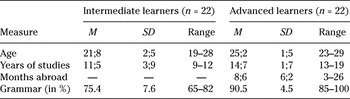
The grammar test was a slightly abridged pencil-and-paper version of the Oxford Placement Test (2007). Some biographical data of the two learner groups are summarized in Table 1. The 22 English native speakers were all exchange students at German universities. All of them were born and had grown up in English-speaking countries, and none of them had lived in Germany for more than 1 year. Although they were living in Germany at the time of testing, they reported that English was still their dominant language, which they used on a regular basis. Their mean age was 25;3 years (range = 20–39, SD = 6.3) and 14 of them were female. All participants had normal or corrected to normal vision and were naïve with respect to the purpose of the study.
Biographical data for the learner groups

Note
“Years of studies” corresponds to the number of years learners have learned English, and “months abroad” corresponds to the number of months spent in English-speaking countries.
Materials and Method
In the online self-paced reading task, three types of experimental sentences were used: unambiguous sentences as in (6a), ambiguous sentences with a good cue as in (6b), and ambiguous sentences with a poor cue as in (6c).
(6) a. The brown sparrow seen by the hungry cat pecked at an insect.
b. The brown sparrow noticed on an upper branch pecked at an insect.
c. The brown sparrow noticed almost every day pecked at an insect.
The materials were designed in a similar way as in the experiments by MacDonald (Reference MacDonald1994) and Juffs (Reference Juffs1998, Reference Juffs, Slabakova, Montrul and Prévost2006). The unambiguous sentences were disambiguated via verb morphology. The good cue ruled out a transitive reading of the sentence because the verb was directly followed by an adjunct.Footnote 6 The poor cue, in contrast, left open the transitive interpretation until the last word of that region.
There were 10 experimental sentences for each of the three conditions. Additionally, there were 10 ambiguous and 10 unambiguous sentences with main verb resolution such as (7a) and (7b), which functioned as distracters, as well as 10 filler sentences.
(7) a. The brown sparrow noticed an insect on an upper branch.
b. The brown sparrow saw an insect on an upper branch.
The experimental items were not presented word by word but chunkwise in five segments (i.e., the subject, the ambiguous verb, the cue region, the disambiguous verb, and the wrap-up region) to reduce processing load for these relatively complex constructions. The different segments, identified in (8) with slashes, were matched for length and syllable number.
(8) The brown sparrow | noticed | almost every day | pecked | at an insect.
All parts of the overall 60 sentences were presented in font size 32, in white letters against a black background in the center of a 19-in. TFT screen. The software used was PXLAB (Irtel, Reference Irtel2007). The sentences were presented in a pseudorandomized order, in such a way that no two sentences of the same structure directly followed one another. For each segment in each sentence, the participants pressed a key when they were ready to view the next segment, thus determining their own reading speed. As each new segment appeared, the previous segment disappeared, thereby preventing the participant from seeing the entire sentence on the screen. This type of task has been used in comparable experiments (Juffs, Reference Juffs1998, Reference Juffs, Slabakova, Montrul and Prévost2006; MacDonald, Reference MacDonald1994) and has been found to obtain similar results as alternative measures (e.g., Ferreira & Henderson, Reference Ferreira and Henderson1990; Just, Carpenter, & Woolley, Reference Just, Carpenter and Wolley1982). In this noncumulative centered presentation, the participants are not aware of the length of the sentence and how many words are to follow, which encourages immediate processing (Mitchell & Green, Reference Mitchell and Green1978). The task is based on the assumption that increased reaction times for a particular segment indicate a processing difficulty in that region.
The learners started the experiment with the grammar test, which was followed by the self-paced reading and the grammaticality judgment tasks. Before completing the self-paced reading task, the learners saw a list of all words and word forms that appeared in the study and they were encouraged to ask the experimenter for the meaning of any words they did not know.Footnote 7, Footnote 8 The aim of this procedure was to ensure that reading times were not biased by vocabulary difficulties.
The actual self-paced reading task was preceded by instructions and practice items. Participants were instructed to read the experimental sentences silently and as quickly and as carefully as possible. They were told that they were to answer questions about some of the sentences. After each five or six sentences (10 times per participant in the entire self-paced reading task), the experiment was interrupted and participants were asked a comprehension question about the last sentence they had read. This was to ensure that participants read the sentences attentively. The entire self-paced reading task took participants approximately 20 min to complete.
The self-paced reading task was followed by a pencil-and-paper grammaticality judgment task in which participants were asked to decide whether they considered a sentence to be a correct English sentence. The task included the 30 experimental sentences with RC resolution as well as 15 ungrammatical versions of these sentences. There were also 15 ungrammatical filler sentences of various constructions to match the number of grammatical and ungrammatical sentences in this task. The ungrammatical sentences included different grammatical mistakes such as missing inflections, missing prepositions and articles, or word-order mistakes.
Results
One-, two-, and three-factor ANOVAs, with subjects and items as random variables, were conducted. Alpha was set at .05 for all statistical tests.
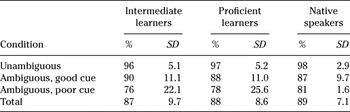
Accuracy.Table 2 shows the percentage of accurate grammaticality judgments in the three experimental conditions for the L2 learners and the native speakers. The total percentage of correct answers includes the ungrammatical versions of the experimental sentences as well as the ungrammatical filler sentences.
Mean percentages of correct answers

First, the general performance of the three groups in this task was compared by running a one-factor ANOVA on the total percentages of correct answers. This analysis did not yield a significant effect, F(2, 63) = 1.134, p = .325, which suggests that the overall performance in this task did not differ significantly.
To investigate whether the three groups differed in their judgments for any of the three experimental structures, we conducted a two-factor ANOVA with structure as a within-subjects factor and with group as a between-subjects factor. This analysis yielded a significant effect for structure, F 1(2, 126) = 44.293, p < .0001; F 2(2, 54) = 12.968, p < .0001. There was no significant effect for group, F 1(2, 63) = 0.280, p = .756; F 2(2, 27) = 0.165, p = .849, and the interaction between the two variables was not significant, F 1(4, 126) = 0.404, p = .806; F 2(4, 54) = 0.390, p = .815. Tests for pairwise contrasts showed that all differences between each of the three structures were significant—unambiguous versus ambiguous good cue: F 1(1, 63) = 46.118, p < .0001; F 2(1, 9) = 24.917, p < .0001; unambiguous versus ambiguous poor cue: F 1(1, 63) = 58.481, p < .0001; F 2(1, 9) = 33.071, p < .0001; ambiguous good cue versus ambiguous poor cue: F 1(1, 63) = 24.862, p < .0001; F 2(1, 9) = 19.731, p < .0001. This indicates that all three groups judged the (correct) ambiguous good cue sentences ungrammatical more often than the unambiguous sentences. The ambiguous poor cue structures seemed to be judged ungrammatical more often than either of the other two structures. Hence, the grammatical knowledge of the learners and the native speakers about the main verb versus reduced RC ambiguity does not differ significantly in this offline task, in which subjects have time to think about their judgments.
Reading Times. The online self-paced reading task was designed to investigate whether this similarity between L1 and L2 processing also holds under time pressure. Reading times were computed for all segments of all sentences. For the main analyses, the sentences that the participants considered to be incorrect in the grammaticality judgment task were not excluded because participants’ offline judgments might have been influenced by different factors than their online self-paced reading. Therefore, a sentence might be successfully processed and understood but nevertheless judged ungrammatical. Because not every experimental sentence was followed by a comprehension question, sentences for which the comprehension question had been answered incorrectly were not excluded from analysis. Note that this exclusion would have affected only a very small number of sentences because the rate of correctly answered comprehension questions was higher than 98% for all participants of all three groups. This high level of accuracy indicates that all participants understood the sentences in this type of presentation and were paying attention to the task.
Each group’s responses were screened for outliers that were three standard deviations above or below the mean for that language group for each region of every sentence. The purpose of this procedure, which led to the deletion of 1.2% of the intermediate learners’ data, 1.4% of the advanced learners’ data, and 2.8% of the native speakers’ data, was to exclude moments where participants lost concentration for reasons not related to the experiment. Following MacDonald (Reference MacDonald1994) and Juffs (Reference Juffs1998), the analysis was focused on the ambiguous verb region, the cue region, and the disambiguating region; however, reading times for the ambiguous verb and the cue region were not combined because it would have yielded segments of very different lengths, and the reading times for the ambiguous and the disambiguating verb could not be compared. Additionally, this distinction of the two regions allows us to analyze the respective predictions for the embedded verb region and the cue region.
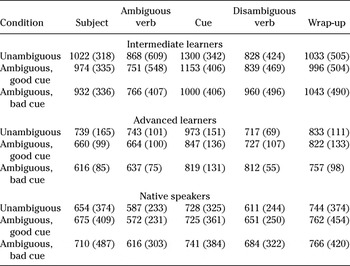
The L2 learners’ reading times were longer than those of the native speakers in all five regions and for all three structures, as illustrated in Table 3. To analyze this further, statistical tests on the three regions of interest—namely, the ambiguous verb, the cue, and the disambiguous verb—were conducted. First, response times in these regions were analyzed with a three-factor ANOVA of Group × Structure × Region, for which subject and item analyses were conducted with repeated measures on the variables structure and region. There was a significant effect for region, F 1(2, 126) = 101.624, p < .0001; F 2(2, 54) = 223.641, p < .0001, for structure, F 1(2, 126) = 10.427, p < .0001; F 2(2, 54) = 25.570, p < .016, and for group, F 1(2, 63) = 7.879, p < .001; F 2(2, 27) = 54.986, p < .0001, and all interactions were also significant: Structure × Group, F 1(4, 126) = 6.850, p < .0001; F 2(4, 54) = 16.677, p < .016; Region × Group, F 1(4, 126) = 9.179, p < .0001; F2(4, 54) = 20.681, p < .0001; Structure × Region, F 1(4, 252) = 27.501, p < .0001; F 2(4, 54) = 21.699, p < .0001; Structure × Region × Group, F 1(8, 252) = 5.771, p < .0001; F 2(8, 108) = 4.409, p < .0001. To investigate further specific patterns for the three groups in the different regions as well as complex interactions, separate one-factor repeated measures ANOVAs for structure were conducted for each group in each of the three regions.
Mean reading times (in ms) of the reduced RC resolution condition by group and by region

Note
SDs are in parentheses.
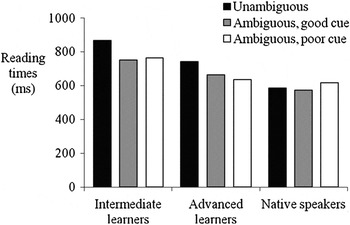
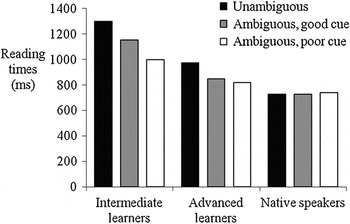
In the ambiguous verb region, as illustrated in Figure 1, there was a significant effect for structure for the intermediate learners, both in the analysis with subjects as a random variable, F 1(2, 42) = 8.021, p < .001, and in the analysis with items as a random variable, F 2(2, 18) = 5.640, p < .013. Tests for pairwise contrasts with this group showed a significant difference between the unambiguous structures and each of the ambiguous structures, respectively—unambiguous versus ambiguous good cue: F 1(1, 21) = 39.291, p < .0001; F 2(1, 9) = 27.675, p < .0001; unambiguous versus ambiguous poor cue: F 1(1, 21) = 42.831, p < .0001; F 2(1, 9) = 29.829, p < .0001; ambiguous good cue versus ambiguous poor cue: F 1(1, 21) = 17.994, p < .0001; F 2(1, 9) = 16.473, p < .0001. There was also a significant main effect for structure in the advanced learners, F 1(2, 42) = 10.878, p < .0001; F 2(2, 18) = 4.576, p < .025, but the effect did not reach statistical significance in the native speaker group, F 1(2, 42) = 1.525, p = .232; F 2(2, 18) = 0.497, p = .617.
Reading times for the ambiguous verb.

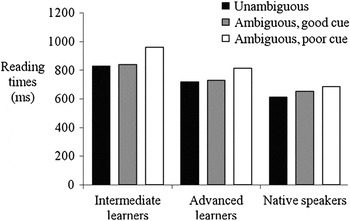
Statistical analyses of the cue region, as illustrated in Figure 2, also yielded a significant effect for structure for the intermediate learners, F 1(2, 42) = 17.739, p < .0001; F 2(2, 18) = 12.947, p < .001. Tests for pairwise contrasts with this group showed that all differences were significant in this region. For the advanced learners, there was also a significant main effect for structure, F 1(2, 42) = 23.894, p < .0001; F 2(2, 18) = 3.697, p < .045. Tests for pairwise contrasts with this group were only significant between the unambiguous and the ambiguous good cue structure, F 1(1, 21) = 21.049, p < .0001; F 2(1, 9) = 17.235, p < .0001, and between the unambiguous and the ambiguous poor cue structure, F 1(1, 21) = 36.124, p < .0001; F 2(1, 9) = 25.113, p < .0001. There were no significant effects for the native speakers in the cue region, F 1(2, 42) = 0.207, p = .769; F 2(2, 18) = 0.062, p = .940.
Reading times for the cue.

The last region analyzed was that of the disambiguating verb, where the garden-path effect is expected. Figure 3 provides the reading times for this region. In the disambiguating verb region, all three groups showed significant main effects for structure, F 1(2, 42) = 8.056, p < .004; F 2(2, 18) = 6.129, p < .009 for the intermediate learners, F 1(2, 42) = 14.583, p < .0001; F 2(2, 18) = 5.762, p < .012 for the advanced learners, and F 1(2, 42) = 4.659, p < .015; F 2(2, 18) = 4.782, p < .022 for the English native speakers. Tests for pairwise contrasts showed that, in all groups, there was a significant difference between ambiguous poor cue sentences and ambiguous good cue sentences—intermediate learners: F 1(2, 21) = 25.739, p < .0001; F 2(2, 9) = 21.647, p < .0001; advanced learners: F 1(2, 21) = 19.832, p < .0001; F 2(2, 9) = 22.496, p < .0001; native speakers: F 1(2, 21) = 14.030, p < .0001; F 2(2, 9) = 17.912, p < .0001—as well as between ambiguous poor cue and unambiguous sentences—intermediate learners: F 1(2, 21) = 33.049, p < .0001; F 2(2, 9) = 31.887, p < .0001; advanced learners: F 1(2, 21) = 29.111, p < .0001; F 2(2, 9) = 26.429, p < .0001; native speakers: F 1(2, 21) = 25.352, p < .0001; F 2(2, 9) = 21.585, p < .0001. The difference between unambiguous sentences and ambiguous sentences with a good cue was only significant for the native speakers, F 1(2, 21) = 15.576, p < .0001; F 2(2, 9) = 12.118, p < .0001.
Reading times for the disambiguous verb.

To ensure that the effects obtained in the online task were not attributable to participants’ difficulties with the sentences they later judged ungrammatical in the offline grammaticality judgment task, additional analyses were conducted exclusively on the sentences judged grammatical. Separate one-factor repeated measures ANOVAs were also conducted for structure for each group in each of the three regions. In the ambiguous verb region, there was a significant effect for the intermediate learners, F 1(2, 42) = 6.225, p < .001; F 2(2, 18) = 7.567, p < .023. Tests for pairwise contrasts yielded a significant difference between the unambiguous and each of the ambiguous structures, respectively—unambiguous versus ambiguous good cue: F 1(1, 21) = 34.122, p < .0001; F 2(1, 9) = 32.745, p < .0001; unambiguous versus ambiguous poor cue: F 1(1, 21) = 33.178, p < .0001; F 2(1, 9) = 30.129, p < .0001. There was also a significant effect in the advanced learners, F 1(2, 42) = 10.241, p < .001; F 2(2, 18) = 3.439, p < .035, but not in the native-speaker group, F 1(2, 42) = 0.469, p = .617; F 2(2, 18) = 0.138, p = .507. Statistical analyses of the cue region yielded significant main effects for the intermediate learners, F 1(2, 42) = 8.243, p < .001; F 2(2, 18) = 9.437, p < .001, and the advanced learners, F 1(2, 42) = 7.113, p < .001; F 2(2, 18) = 6.134, p < .021. Tests for contrasts showed that, for the intermediate learners, all pairwise differences were significant—unambiguous versus ambiguous good cue: F 1(1, 21) = 25.143, p < .0001; F 2(1, 9) = 23.017, p < .0001; unambiguous versus ambiguous poor cue: F 1(1, 21) = 28.828, p < .0001; F 2(1, 9) = 24.382, p < .0001; ambiguous good cue versus ambiguous poor cue: F 1(1, 21) = 23.928, p < .0001; F 2(1, 9) = 20.092, p < .0001—whereas, for the advanced learners, there were only significant contrasts between the unambiguous and each of the ambiguous structures, respectively—unambiguous versus ambiguous good cue: F 1(1, 21) = 40.376, p < .0001; F 2(1, 9) = 34.817, p < .0001; unambiguous versus ambiguous poor cue: F 1(1, 21) = 43.256, p < .0001; F 2(1, 9) = 39.571, p < .0001. There were no significant effects for the native speakers, F 1(2, 42) = 0.207, p = .769; F 2(2, 18) = 0.062, p = .940, in this region. On the disambiguating verb, all three groups showed significant main effects, F 1(2, 42) = 7.301, p < .013; F 2(2, 18) = 8.422, p < .001 for the intermediate learners, F 1(2, 42) = 14.004, p < .0001; F 2(2, 18) = 3.583, p < .021 for the advanced learners, and F 1(2, 42) = 10.639, p < .001; F 2(2, 18) = 3.195, p < .029 for the English native speakers. Tests for pairwise contrasts showed that, in all groups, there was a significant difference between ambiguous poor cue sentences and ambiguous good cue sentences—intermediate learners: F1(2, 21) = 43.175, p < .0001; F2(2, 9) = 40.459, p < .0001; advanced learners: F 1(2, 21) = 38.913, p < .0001; F 2(2, 9) = 39.992, p < .0001; native speakers: F 1(2, 21) = 34.198, p < .0001; F 2(2, 9) = 41.343, p < .0001—as well as between ambiguous poor cue and unambiguous sentences—intermediate learners: F 1(2, 21) = 38.389, p < .0001; F 2(2, 9) = 29.742, p < .0001; advanced learners: F 1(2, 21) = 34.998, p < .0001; F 2(2, 9) = 29.273, p < .0001; native speakers: F 1(2, 21) = 28.565, p < .0001; F 2(2, 9) = 26.023, p < .0001. The difference between unambiguous sentences and ambiguous sentences with a good cue was only significant for the native speakers, F 1(2, 21) = 12.105, p < .001; F 2(2, 9) = 10.373, p < .001.
DISCUSSION
Offline Processing
In sum, all participants judged the grammaticality of the sentences quite successfully, and there were only small and statistically insignificant differences between the learners and the native speakers. However, there was a significant effect for structure, in that all three groups made more incorrect judgments for the ambiguous structures, especially with a poor cue, which indicates that these structures are considered to be less acceptable than the unambiguous structures. This result is in line with the observations made by Juffs and Harrington (Reference Juffs and Harrington1996), who found that native speakers show a tendency to judge garden-path sentences ungrammatical. This tendency might be related to the fact that ambiguities are often avoided in normal conversation and, thus, are unfamiliar to the speakers. Thus, the learners’ performance with these constructions does not necessarily imply that they do not master them, but instead their performance parallels the native speakers’ pattern. It could certainly be argued here that the learners have not attained nativelike knowledge but rather that the native speakers’ performance was unexpectedly poor. However, the high levels of correct answers in the ambiguous good cue and especially in the unambiguous conditions indicate that the learners mastered the main verb versus reduced RC ambiguity.
One aim of the present study was to test whether processing differences between L2 learners and native speakers were related to grammar or processing difficulties. The results for the grammaticality judgments indicate that both learner groups mastered the main verb versus reduced RC ambiguity and were able to process them offline, whereby the ambiguous structures, especially those with a poor cue, which were expected to elicit a garden-path effect, were judged incorrect more often than the unambiguous structures by all three groups. The self-paced reading task will now be examined to determine whether similar difficulties and effects in the online processing of the main verb versus reduced RC ambiguity are found.
Online Processing
When the participants’ online reading patterns are examined, it was found that the intermediate learners took longest to read all segments of all structures. This finding is in line with previous studies that also found longer reading times in L2 learners (e.g., Juffs, Reference Juffs1998; Juffs & Harrington, Reference Juffs and Harrington1995, Reference Juffs and Harrington1996). However, longer reading times might simply be related to a relative lack of automaticity or to the learners’ insecurity about the task and the testing situation. For this reason, qualitative differences between learners and native speakers in the ambiguous, the cue, and the disambiguating regions might provide insight into the mechanisms that underlie L2 learners’ processing.
Whereas the learners’ and the native speakers’ patterns are quite similar in the disambiguating region, in that they all took longest to process the ambiguous poor cue condition, there are some significant differences between the learners’ and the native speakers’ processing patterns. Whereas the native speakers did not show any effects in the ambiguous region and the cue region, the learners’ reading times increased in the unambiguous compared to the ambiguous conditions. The finding that the native speakers did not show any effect for structure in the ambiguous or the cue regions might be related to the relatively high number of experimental sentences in comparison to the fillers, in that the native speakers became used to the sentences relatively quickly. Furthermore, the difference between good and poor cues might not have been noticeable enough with the presentation of sentences in chunks, especially if participants read the sentences quickly.Footnote 9 However, the fact that the native speakers showed a graded response in the disambiguating region, with poor cues posing more reanalysis problems than good cues, indicates that they were not completely insensitive to the experimental manipulations. The learners, whose overall reading times were slower, seemed to be influenced by the experimental manipulations at earlier points of the sentences.
It was predicted that if the learners are influenced by their L1, they might show processing difficulties at the embedded verb and at the cue region of the unambiguous condition because, at these regions, they are forced to construct a reduced RC. This pattern is indeed what was found in both learner groups, the effects being clearest for the intermediate learners. Both groups took longer to process the embedded verb and the cue region of the unambiguous condition in comparison to the two ambiguous conditions. Although this effect can be explained in terms of L1 influence, it is also possible that the effect is purely a morphological one, caused by the difference between the irregular verbs in the unambiguous conditions and the regular verbs in the ambiguous conditions. Thus, difficulties with the irregular verbs might have caused the longer processing times on the embedded verb of the unambiguous condition, which might have spilled over to the cue region. Although a similar effect has been found in previous L2 studies (Birdsong & Flege, Reference Birdsong, Flege, Do, Domínguez and Johansen2001), such an explanation is unlikely in this case because the irregular past participles in the present experiment were short and highly frequent verbs forms such as seen, known, and eaten. It is improbable that the learners, who had been learning English for many years and had attained quite a high proficiency level, had difficulties processing these verbs. Another argument against a purely morphological explanation comes from the results for the sentences with main verb resolution, as illustrated in (9).
(9) a. The brown sparrow noticed an insect on an upper branch.
b. The brown sparrow saw an insect on an upper branch.
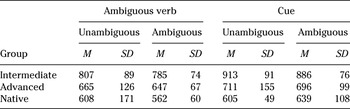
If the irregular verbs caused the learners’ processing difficulties on the embedded verb and the cue region of the unambiguous conditions, a similar effect in the sentences with main verb resolution, in which the main verb was irregular in the unambiguous condition but regular in the ambiguous condition, would be expected. Hence, the learners are expected to take longer for the unambiguous verb and possibly also for the following direct object. The reading times for the two regions are summarized in Table 4.
Mean reading times (in ms) of the main verb resolution condition by group and by region

Although the learners’ reading times were indeed slightly higher for the unambiguous than for the ambiguous condition, these effects did not reach statistical significance. Separate repeated measures ANOVAs with structure as the within-subjects factor were performed for each group and for each region. For the intermediate learners, there were no significant effects for structure, neither on the verb, F 1(1, 21) = 3.564, p = .073; F 2(1, 18) = 0.637, p = .783, nor on the direct object region, F 1(1, 21) = 0.882, p = .298; F 2(1, 18) = 0.265, p = .312. The same was true for the advanced learners, both on the main verb, F 1(1, 21) = 3.487, p = .076; F 2(1, 18) = 0.982, p = .251, and in the direct object region, F 1(1, 21) = 1.049, p = .317; F 2(1, 18) = 0.167, p = .183, and for the native speakers on the main verb, F 1(1, 21) = 1.211, p = .284; F 2(1, 18) = 0.364, p = .227, and in the direct object region, F 1(1, 21) = 2.909, p = .103; F 2(1, 18) = 0.078, p = .494. These results suggest that irregular verbs per se do not elicit longer reading times in the learners. However, the learners seem to be sensitive to the difference between verbs in the simple past and participle forms and are, as a result, able to interpret the sentences.
An alternative explanation for the learners’ longer reading times for the reduced RC in the unambiguous condition could be a crosslinguistic influence from the learners’ L1, which does not license reduced RCs. However, it is also conceivable that the learners’ difficulties with the conditions that force a reduced RC interpretation from early on are related to the learners’ difficulties in constructing deep syntactic representations. To avoid such deep structural representations, the learners might hold on to the simpler structure as long as possible and show long reading times when forced to construct a reduced RC reading. This strategy would be in line with the SSH (Clahsen & Felser, Reference Clahsen and Felser2006), which states that L2 learners do not assign a complete syntactic structure to a sentence but rather construct a shallow representation on the basis of surface information. The construction of a reduced RC involves operator movement as well as passive movement and thus forces learners to construct a hierarchical structural representation with movement traces. Following Clahsen and Felser, learners should have considerable difficulties building up such a structure (see also Felser and Roberts, Reference Felser and Roberts2007, and Marinis et al., Reference Marinis, Roberts, Felser and Clahsen2005, for experiments on learners’ processing of wh-dependencies). On the basis of the present data, it cannot be excluded that the learners’ higher reading times on the embedded RC of the unambiguous conditions are caused by a shallow processing of this structure. However, this explanation is unlikely if other studies on L2 learners’ processing of similar constructions are considered. The studies reported by Juffs (Reference Juffs1998, Reference Juffs, Slabakova, Montrul and Prévost2006) indicate that typological differences between the learners’ L1 and L2 can cause L2 processing difficulties. In the study by Frenck-Mestre (Reference Frenck-Mestre, Kroll and De Groot2004), the learners did not seem to have any difficulties with a complicated structure similar in their L1 and their L2. The results of the present study are in line with this conclusion, because German ESL learners were found to have difficulties processing a structure not licensed in their L1. Moreover, the learners’ sensitivity to complex morphological and syntactic information argues against a shallow processing explanation.
This sensitivity to syntactic information also appears in the processing of the cue region. If the learners’ relatively shorter reading times on the cue region of the ambiguous conditions are assumed to indicate that they avoid the reduced RC interpretation and prefer constructing a direct object reading whenever possible, then a clear garden-path effect in the disambiguating region of the ambiguous conditions would be expected. This is indeed what was found, at least in the poor cue condition. The fact that such an effect was not found after good cues indicates that the learners are sensitive to the cue manipulation. A good cue makes the direct object reading improbable and thus forces the learners to revise their initial interpretation and to construct a reduced RC interpretation. This sensitivity to a good cue would also explain the finding that reading times in the cue region of the ambiguous good cue condition were higher than in the ambiguous poor cue condition, an effect that only reached statistical significance for the intermediate learners. Therefore, the learners seem to be sensitive to the difference between good and poor cues, which implies that they know and apply the verb’s argument structure as well as English word-order rules. Given that word order in German is freer than in English, if German ESL learners are influenced by their L1 when processing English sentences, such a result would not be anticipated because the learners are expected to respond to different word-order cues than the ones on which native English speakers rely. Although influence of L1 word order was reported by Frenck-Mestre (Reference Frenck-Mestre, Kroll and De Groot2004) with similar constructions, the present results do not provide evidence for L1 word-order influence in the learners’ processing. Hence, this finding indicates that L1 influence with regard to a certain phenomenon does not imply that learners resort to their L1 on every possible occasion.
The sensitivity to morphological, argument-structure, and word-order cues is compatible with the predictions of constraint-based processing models. These models predict that a simple transitive construction is preferred over a reduced RC when a transitive verb is encountered, but the reduced RC reading can be forced by the combined constraints of the cue and the verb. The intermediate learners’ results are in line with these predictions because, for this group, the processing of the cue region seems to have been (a) most difficult for unambiguous sentences in which a reduced RC interpretation was forced, (b) difficult for good cue sentences in which a reduced RC interpretation was forced in most but not all cases, and (c) least difficult for poor cue sentences, which did not force the dispreferred interpretation. The intermediate learners took longest to read the poor cue sentences in which the disambiguating verb forced a reduced RC interpretation. The effects were similar for the advanced learners. Although the difference between good and poor cue sentences in the cue region did not reach statistical significance, at the disambiguation point, the good cue condition facilitated processing compared to the poor cue and was equal to the unambiguous condition. Hence, the advanced learners were sensitive to the cue manipulation, although it could be argued that the effect of the cue was somewhat delayed. This delay was even clearer in the native-speaker group and is probably related to the fact that the cue region was presented as a chunk, which led both the advanced learners and the native speakers to read through the cue region quickly. Therefore the difference between good and bad cue sentences only appears in the following region.
The comparison of the two proficiency groups in the present study provides insight not only into the development of L2 learners’ processing ability but also into the question of whether the differences between L1 and L2 processing are fundamental or whether they subside gradually with increasing proficiency. The two learner groups differed in terms of speed rather than in terms of qualitatively different processing patterns. Both groups showed similar difficulties with reduced RCs, which resulted in longer reading times in the unambiguous conditions as soon as a reduced RC interpretation became unavoidable and in a garden-path effect when the direct-object reading turned out to be wrong. Both groups also showed a similar sensitivity to postambiguity cues and thus to combined argument-structure and word-order information, apart from the fact that, for the advanced learners, the difference between good and poor cues only reached statistical significance in the following disambiguating verb region. This effect is probably related to the advanced learners’ faster reading times, which were in between the intermediate learners and the native speakers. This finding indicates that the advanced learners’ processing was more confident and automatic than the intermediate learners, which facilitated the processing of difficult constructions such as reduced RCs and the recovery from misanalyses. The answer to the third research question is therefore mixed. On the one hand, the advanced learners were found to be influenced by their L1, just like the intermediate learners. Therefore, more research with yet more advanced learners is necessary to resolve the question of whether L1 influence in L2 processing may be overcome. On the other hand, differences between L1 and L2 processing in terms of processing automaticity and the ability to recover from initial misanalyses were found to subside gradually with increasing proficiency, which suggests that there is no fundamental difference between L1 and L2 processing.
CONCLUSION
Overall, the results of the present study indicate that a model of L2 sentence processing needs to account for sensitivity to argument structure, including verbal morphology. Furthermore, the results suggest that one interpretation is selected by the L2 parser when encountering an ambiguity, which can lead to garden-path effects and difficulties in recovering from initial misanalyses later. Therefore, L2 learners appear to apply similar processing strategies as native speakers.
Nevertheless, the pattern observed in the learners differs in some ways from that of the English native speakers. Although the differences could be caused by a L2-specific parsing strategy as assumed by the SSH (Clahsen & Felser, Reference Clahsen and Felser2006), it is also possible that the learners had difficulties with a structure that does not exist in their L1. Because studies with similar materials and learner groups of different L1 backgrounds (Juffs, Reference Juffs1998, Reference Juffs, Slabakova, Montrul and Prévost2006) also suggest that L1-L2 differences can cause processing difficulties for L2 learners, the second possibility seems more plausible.
The comparison between offline and online tasks confirms the dissociation between parsing performance and grammatical knowledge found in the previous studies that have examined immersed and more proficient learners (Harrington, Reference Harrington and Robinson2001; Juffs, Reference Juffs2001). In the present study, differences between learners and native speakers were insignificant for the grammaticality judgments, although there were some significant between-group effects in the self-paced reading task. This finding suggests that differences between L2 learners and native speakers might generally be attributed to processing factors.
The comparison of two learner groups at different proficiency levels indicates that the advanced learners had difficulties with reduced RCs similar to the intermediate learners. However, the advanced learners were generally faster and more successful in recovering from misanalyses. This finding indicates that the differences between learners and native speakers are not fundamental and subside with increasing proficiency. Because the present study only tested two groups that were quite homogeneous with regard to their language backgrounds, more research with learner groups of various backgrounds and proficiency levels is necessary to better understand the development of L2 processing.
APPENDIX
LIST OF EXPERIMENTAL ITEMS
Relative Clause Resolution (Unambiguous)
The tired soldiers beaten in the fierce battle attacked the enemy again.
The brown sparrow seen by the hungry cat pecked at an insect.
The famous man known by every student was a very nice person.
The small girl forgotten in the buzzing crowd looked for her parents.
The brave fireman seen on the burning roof saved the helpless people.
The angry boy beaten by one of his friends was full of bruises.
The black dog hidden in his garden hut barked at the postman.
The strict teacher told off in the afternoon held a boring lesson.
The small sharks eaten by the skilled hunter were very aggressive.
The old woman seen in the rose garden liked gossip very much.
Relative Clause Resolution (Ambiguous, Good Cue)
The tired soldiers warned about the dangers attacked the enemy again.
The brown sparrow noticed on an upper branch pecked at an insect.
The famous man invited by every student was a very nice person.
The small girl lost in the buzzing crowd looked for her parents.
The brave fireman rescued from the burning roof saved the helpless people.
The angry boy hit in the football pitch was full of bruises.
The black dog found in his garden hut barked at the postman.
The strict teacher criticised in his English course held a boring lesson.
The small sharks caught in the fishing net were very aggressive.
The old woman visited in the rose garden liked gossip very much.
Relative Clause Resolution (Ambiguous, Poor Cue)
The tired soldiers warned almost every day attacked the enemy again.
The brown sparrow noticed almost all the time pecked at an insect.
The famous man invited nearly every month was a very nice person.
The small girl lost almost every month looked for her parents.
The brave fireman rescued almost every day saved the helpless people.
The angry boy hit almost every day was full of bruises.
The black dog found almost all the time barked at the postman.
The strict teacher criticised almost every day held a boring lesson.
The small sharks caught almost every week were very aggressive.
The old woman visited almost every day liked gossip very much.
Main Verb Resolution (Ambiguous)
The tired soldiers warned their comrades about the dangers.
The brown sparrow noticed an insect on an upper branch.
The famous man invited all students to his garden house.
The small girl lost her parents in the buzzing crowd.
The brave fireman rescued the people from the burning roof.
The angry boy hit his brother in the football pitch.
The black dog found a big bone in his garden hut.
The strict teacher criticised his students in the afternoon.
The small sharks caught a big fish in the evening.
The old woman visited her neighbours in the afternoon.
Main Verb Resolution (Unambiguous)
The experienced soldiers talked to their comrades about the dangers.
The brown sparrow saw an insect on an upper branch.
The famous man showed his garden to all the students.
The small girl joined her parents in the buzzing crowd.
The brave fireman saw the people on the burning roof.
The angry boy beat his brother in the football pitch.
The black dog saw a big bone in his garden hut.
The strict teacher held his lesson in the afternoon.
The small sharks ate a big fish in the evening.
The old woman saw her neighbours in the afternoon.