INTRODUCTION
The remote-distance islands of Pacific Oceania could serve as exemplary places for tracing the archaeological evidence of an initial settlement horizon of a region. Worldwide, archaeological narratives need to begin with clarifying the timing and circumstances of first settlement periods, yet often archaeologists have encountered problems of (a) where to look for those oldest sites; (b) how to know for sure that the oldest horizon has been found; (c) how to refine the dating technicalities in ancient contexts and with possibly questionable dating materials; and (d) how to integrate the findings into meaningful models of regional settlement and further research questions. Investigations in the Mariana Islands have addressed each of those problems, and the details are presented here for defining the dating and context of the first regional settlement horizon at 1500 BC in the remote-distance islands of Pacific Oceania.
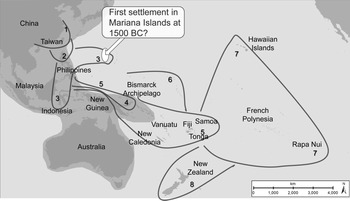
In a large-scale view of Pacific Oceania as a whole, the settlement horizon in the Mariana Islands at 1500 BC was the first among several steps in an “incremental growth model” (Carson Reference Carson2018: 368–371). According to the incremental growth model, people had expanded through increasingly larger portions of the Pacific region, from at least 1500 BC all the way through AD 1300 (Figure 1), involving substantially different contexts across geographic space and through more than 2800 years. The first step in this grand narrative naturally has attracted special attention, as the findings would affect the fundamental framing of the archaeology of the entire region. Furthermore, the environmental and social setting at 1500 BC in the Mariana Islands can be distinguished accurately in its own terms, without relying on inferences made from studies in other areas at different time periods. The context of initial settlement likely changed for the people who migrated into varied parts of the Pacific at separate time periods, for example in terms of the sea level, coastal habitat, population dynamics, social structure, and other factors.
Large-scale view of the incremental growth model in Pacific Oceania. Shaded region to the west = Near Oceania, settled by 50,000 years ago Unshaded region to the east = Remote Oceania, settled after 1500 BC 1. cord-marked pottery by 3000 BC; 2. red-slipped pottery by 2000 BC; 3. red-slipped pottery with lime-infilled decoration by 1500–1300 BC; 4. red-slipped pottery with dentate-stamped decoration by 1350 BC; 5. red-slipped pottery with dentate-stamped decoration by 1000–800 BC; 6. plain pottery by AD 100–200; 7. non-pottery settlement by AD 1000–1200; 8. non-pottery settlement after AD 1300; Updated after Carson et al. (Reference Carson, Hung, Summerhayes and Bellwood2013) and Carson (Reference Carson2018).

In the northwest tropical Pacific, a settlement horizon of 1500 BC in the Mariana Islands has forced a revision in thinking about where, when, and how people first inhabited the remote Pacific Oceanic islands region. This point was exposed through the substantive evidence of a cross-regional “pottery trail” that revealed the oldest settlement horizon in the Marianas, with distinctive pottery inside this horizon (Carson et al. Reference Carson, Hung, Summerhayes and Bellwood2013). Previously, Remote Oceanic settlement had been understood from the perspective of a distinctive dentate-stamped Lapita pottery assemblage that originated about 1500–1350 BC in the Near Oceanic islands at the east of New Guinea before spreading farther eastward with people crossing into the Remote Oceanic islands of Southern Melanesia and West Polynesia slightly later (Kirch Reference Kirch1997). The oldest Lapita pottery layers now have been clarified as close to 1350 BC in the Near Oceanic islands such as in the Bismarck Archipelago (Summerhayes Reference Summerhayes2007), and the movement across to the Remote Oceanic islands occurred primarily after 1100 BC in sites of New Caledonia Vanuatu, Fiji, Tonga, and Samoa (Denham et al. Reference Denham, Bronk Ramsey and Specht2012). By comparison, the earlier horizon of similar decorated pottery in the Mariana Islands at 1500 BC would require a new framework for accommodating the regional settlement at a few centuries earlier, in a different geographic area at the northwest corner of the Pacific, under separate environmental conditions of higher sea level and other factors prior to 1100 BC, and linked with an ultimate homeland region directly in Island Southeast Asia rather than in the Near Oceanic islands at the east of New Guinea.
The body of evidence from the Marianas contradicts the claims by external critics who have called for rejecting the radiocarbon (14C) dating older than 1300–1100 BC that would be older than the Lapita-associated dating in Melanesia and Polynesia. For instance, a 14C database compilation had claimed that some of the older dating samples were “non-cultural” and gave no reason for ignoring others (Rieth and Athens Reference Rieth and Athens2019), despite the availability of a comprehensive critical dating review that substantiated the early Marianas dating (Carson and Kurashina Reference Carson and Kurashina2012; see also Carson Reference Carson2014a). Meanwhile, a study of marine reservoir effect at one site of Unai Bapot in Saipan had produced results of suspiciously wide variance from each other (Petchey et al. Reference Petchey, Clark, Winter, O’Day and Litster2017), and those results were incompatible with the site’s reported stratigraphy and dating (Carson Reference Carson2008) as well as with the other previously calculated marine reservoir correction in the Mariana Islands (Carson Reference Carson2010). While those criticisms possibly could be entertained as cautionary advice, they now can be overturned by the results of continued archaeological findings and 14C dating from three key sites in the Mariana Islands as presented here.
Given the ancient Marianas site settings at 1500 BC in ancient inter-tidal or shallow sub-tidal zones, the search for the oldest settlement horizon has required palaeo-environmental reconstructions to clarify where and how deep to excavate (Carson Reference Carson2011, Reference Carson2014b, Reference Carson2016), as well as multiple pairings of taxon-specific marine samples with short-lived charcoal specimens in secure contexts (Carson Reference Carson2010, Reference Carson2017a; Carson and Hung Reference Carson and Hung2017). Toward these goals, three sites of three different islands have produced the most thorough documentation of occupation layers, palaeo-environmental contexts, associated pottery and artifact assemblages, food middens, refined dating, consistent and reliable marine reservoir correction, and cross-constraining dating in coherent sequences (Carson Reference Carson2014a, Reference Carson2016). The site records from Ritidian (in Guam), House of Taga (in Tinian), and Unai Bapot (in Saipan) reveal that people about 1500 BC had targeted certain of the ancient shoreline niches, during a time of slightly higher sea level and different coastal ecology that began to change after 1100 BC.
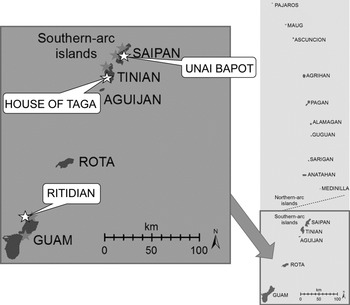
In order to clarify the crucial first step in the Pacific-wide incremental growth model, the first settlement horizon of the Mariana Islands is reviewed here, in terms of the technical and methodological issues of 14C dating of this horizon at the three definitive sites of Ritidian, House of Taga, and Unai Bapot (Figure 2). This information refers to the beginning point of Pacific Oceanic archaeological narratives, with further implications for conceptualizing a holistic Asia-Pacific view in world archaeology. The early Marianas settlement horizon may be applied for developing first-inhabitation models in other regions of the world. The issues of ancient site context and dating technicalities are applicable and relevant more broadly for defining the factual parameters of archaeological findings toward building stronger explanatory models in general.
Earliest sites of the Mariana Islands. Updated after Carson (Reference Carson2016).

ANCIENT LAYER CONTEXTS AND DATING MATERIALS
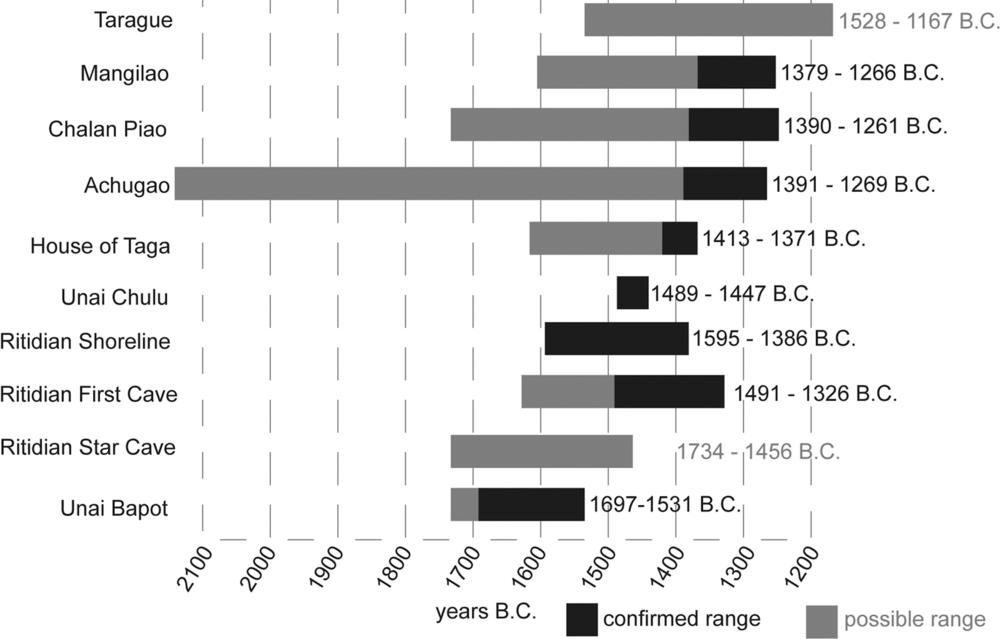
The proposed dating of 1500 BC for first Marianas settlement definitely was the case for at least one site, although the dating could be interpreted as slightly later in other cases (Figure 3). So far, the archaeological layers of an initial cultural horizon have been verified in at least eight sites of three of the larger southern islands of the archipelago. The precise dating naturally differed from one site to another, but all cases pre-dated 1100 BC. The dating was older than 1500 BC at Unai Bapot in Saipan, and similar older dating could be interpreted for the outer limits of the probability ranges in a few other sites. Overall, though, the results indicate that people had been living in these islands at least since 1500 BC.
Summary of potential and confirmed radiocarbon dating ranges of earliest settlement in the Mariana Islands. Updated after Carson and Kurashina (Reference Carson and Kurashina2012).

The pre-1100 BC habitation sites had involved post-raised houses at the edges of seashores, where those contexts have created special challenges for 14C dating. Little or no charcoal has survived in reliable contexts of these ancient layers of palaeo-lagoon facies and inter-tidal surge zones. Shellfish remains were abundant, but confident marine reservoir correction first would need to be demonstrated. These same issues have been noticed throughout the western Pacific region, where people initially lived in post-raised houses at ancient seashores and then eventually were forced to shift their lifestyles after the sea level began its drawdown, after 1100 BC in the Marianas but at slightly later age in other areas (Nunn and Carson Reference Nunn and Carson2015).
People lived at these ancient shoreline habitations during a highstand of sea level at 1.8 m higher than the present condition, and importantly the terminal dating of the highstand at 1100 BC could constrain the age of the first settlement horizon. Superimposed over the ancient habitation layers, the post-1100 BC drawdown of sea level can be inferred in sudden storm-surge debris thrown over the palaeo-beach surfaces, followed by steady accumulation of stabilized backbeach contexts, consistently dating from 1100 BC and continuing steadily. Concentrations of branch coral debris have been dated directly around 1100 BC, and the superimposed habitation deposits in stable backbeach zones have dated from 1100 BC onwards. The mid-Holocene highstand of sea level at 3000 through 1100 BC has been documented through exposed relicts of ancient coral reefs, stranded tidal notches along shorelines, and portions of ancient reefs as exposed during excavations in measured locations and with direct 14C dating (Carson Reference Carson2011, Reference Carson2014b, Reference Carson2016; Dickinson Reference Dickinson2000, Reference Dickinson2001, Reference Dickinson2003; Kayanne et al. Reference Kayanne, Ishii, Matsumoto and Yonekura1993).
The post-1100 BC stable backbeach layers contained abundant charcoal in secure contexts for 14C dating, often paired with shellfish remains for obtaining a direct marine reservoir correction. Given this observation, paired contexts were identified in multiple sites and contexts, targeting Anadara sp. shells that appeared as the most abundant food midden category in the pre-1100 BC layers and continuing through AD 100. After AD 100, Anadara sp. shellfish populations dwindled in the Marianas, with the changing shoreline habitats. In these older habitation layers, Anadara sp. shells were found in dense middens, and excavations have identified clusters of shells inside secure contexts of discrete rubbish pits, heated-stone hearths, and in situ broken pottery.
The eight early site instances were confirmed through a critical review of the possible early settlement dating (Carson and Kurashina Reference Carson and Kurashina2012; see also Carson Reference Carson2014a). The critical review started with clarifying the stratigraphic layers and associations of the dated samples, and then it proceeded with evaluating the context of each material sample that had been dated by 14C. Next, other issues were assessed in terms of the sample material itself, possible concerns with marine reservoir correction of different shells, and relationship with a demonstrable assemblage of artifacts, midden, and other material indicators that could define the dated context in each case. In this procedure, several sites were rejected as potential candidates of first settlement in the Marianas region, while the remaining eight sites were confirmed as pre-dating 1100 BC and containing the diagnostic material signature of the first settlement horizon.
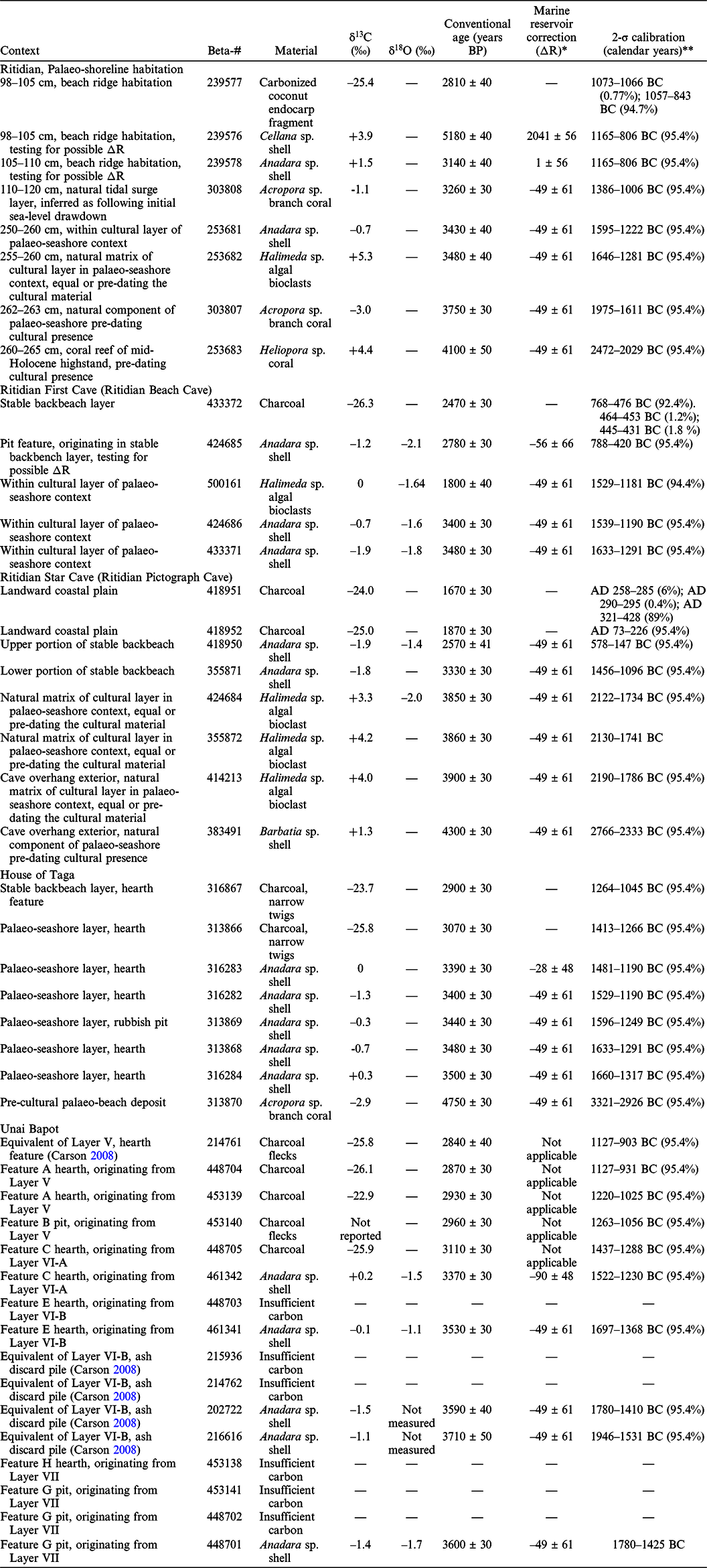
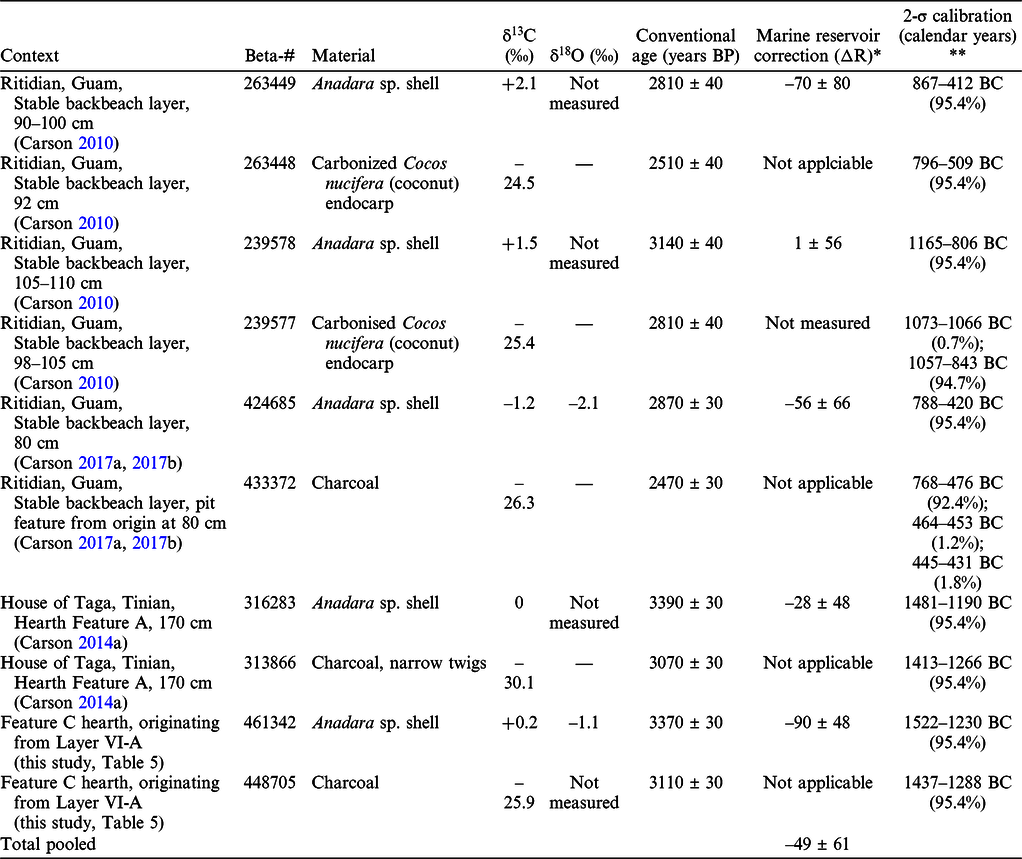
Of the eight identified earliest Marianas sites, three of those sites (Ritidian in Guam, House of Taga in Tinian, and Unai Bapot in Saipan) have supported continued excavations, and the results have affirmed a cultural presence in the region by 1500 BC (Tables 1 and 2). The issues of relevance for the 14C dating will be presented here, for example in terms of clarifying the archaeological layer contexts, refining the marine reservoir correction, and cross-comparing the age ranges in stratified sequences of layers. Details have been reported elsewhere for the overall site excavation results, palaeo-habitat contexts, pottery forms and styles, shell and stone tools, shell ornaments, food middens, house structural ruins, ancient beachfront habitats, and other aspects of Ritidian (Carson 2012, 2014c, Reference Carson2017a, Reference Carson2017b, Reference Carson2017c), House of Taga (Carson Reference Carson2014a; Carson and Hung Reference Carson, Hung, Carver, Gaydarska and Monton-Subias2015), and Unai Bapot (Carson Reference Carson2008; Carson and Hung Reference Carson and Hung2017).
Radiocarbon dating results of early site layers at Ritidian, House of Taga, and Unai Bapot.

* Marine reservoir corrections followed the calculations as shown in Table 2.
** Calibrations were by the OxCal program (Bronk Ramsey and Lee Reference Bronk Ramsey and Lee2013), using the IntCal13 and Marine13 calibration curves (Reimer et al. Reference Reimer, Bard, Bayliss, Beck, Blackwell, Bronk Ramsey, Buck, Cheng, Edwards, Friedrich, Grootes, Guilderson, Haflidason, Hajdas, Hatté, Heaton, Hoffmann, Hogg, Hughen, Kaiser, Kromer, Manning, Niu, Reimer, Richards, Scott, Southon, Staff, Turney and van der Plicht2013).
Calculation of marine reservoir corrections at Ritidian, House of Taga, and Unai Bapot.

* Marine reservoir corrections were calculated with the Deltar online software package (Reimer and Reimer Reference Reimer and Reimer2017).
** Calibrations were by the OxCal program (Bronk Ramsey and Lee Reference Bronk Ramsey and Lee2013), using the IntCal13 and Marine13 calibration curves (Reimer et al. Reference Reimer, Bard, Bayliss, Beck, Blackwell, Bronk Ramsey, Buck, Cheng, Edwards, Friedrich, Grootes, Guilderson, Haflidason, Hajdas, Hatté, Heaton, Hoffmann, Hogg, Hughen, Kaiser, Kromer, Manning, Niu, Reimer, Richards, Scott, Southon, Staff, Turney and van der Plicht2013).
MARINE RESERVOIR CORRECTION
For a localized marine reservoir correction, Anadara sp. shells offered the most attractive option, as these shells were abundant in the food middens of the earliest cultural horizon and continuing into the next superimposed layers where charcoal was more abundant later. With these circumstances, the slightly later-aged contexts could provide direct pairing of Anadara sp. shells in secure contexts with charcoal specimens ideally of short-lived taxa such as nutshells or narrow twigs. This approach was successful for five confident contexts in three separate sites, including three discrete cases at the Ritidian Site in Guam, one case at House of Taga in Tinian, and one more case at Unai Bapot in Saipan.
For the localized marine reservoir correction, the five pried samples produced a pooled value of –49 ± 61 years variation from the expected marine model calibration curve (see Table 2). Importantly, all five cases had produced results within the error range of each other, therefore adding confidence to the total result. The individual measurements had produced values of –70 ± 80, 1 ± 56, –56 ± 66, –28 ± 4, and –90 ± 48 years. The correction was minimal, and the consistent results indicted confidence is using this calculation.
This paired-sample approach must be stressed as involving pairings in secure stratigraphic contexts. In this approach, secure context is necessary for achieving a reliable result in any single instance, such as the discrete contexts of heated-stone hearths at House of Taga in Tinian and at Unai Bapot in Saipan. The case at Unai Bapot furthermore was specifically inside the contents filling a broken pottery bowl, found in a hearth. This detail-oriented approach proved its usefulness, as the results were consistent with each other in five separate contexts of three different islands.
The paired-sample approach was not possible for the contexts of the initial cultural horizon itself that lacked reliable charcoal in confident stratigraphic positions inside the palaeo-lagoon deposits. The approach therefore aimed to find pairings as old as possible that would be relevant for the pre-1100 BC time range of the palaeo-lagoon settings. Indeed, some of the samples did extend into this older period.
The oldest successful paring was dated at 1437–1288 BC in Unai Bapot of Saipan, followed by a next-oldest instance at 1413–1266 BC at House of Taga in Tinian, and therefore the marine reservoir correction can apply at least to this time range if not older. Additionally, the calculation was consistent in later context at Ritidian in Guam, dated in the corresponding charcoal samples at 1073–843 BC, 867–412 BC, and 796–509 BC. If the calculation was consistent over those several centuries and across different contexts, then the calculation can be applied confidently to the slightly older contexts as well.
This approach with the marine reservoir correction was successful for a consistent result of a minimal value of –49 ± 61 years, yet a separate study had produced a radically different interpretation of 218 ± 68 years for samples from a different excavation at Unai Bapot in Saipan (Petchey et al. Reference Petchey, Clark, Winter, O’Day and Litster2017). Several problems of this alternative study can be listed here.
-
1. The excavation had produced several charcoal-based dates from the palaeo-lagoon layer that otherwise had been impossible in any other study (Clark et al. Reference Clark, Petchey, Winter, Carson and O’Day2010). Those charcoal dates curiously were nearly identical from 260 cm depth inside the palaeo-lagoon layer all the way upward through 150 cm depth inside the next super-imposed layer of a stable backbeach, clustering around 1100 BC and consistent with the region-wide dating for the stable beachbeach formation post-dating the palaeo-lagoon layer.
-
2. The paired samples in this alternative case were selected from approximate 10-cm excavation levels and not from directly paired points of features such as described for the larger region-wide study.
-
3. The paired samples were selected solely from the deeper zone at 230–260 cm depth, instead of from the depths closer to 150 cm with the stable backbeach that more likely would produce more reliable results.
-
4. The pairings were for three different depth intervals, with three statistically different results of the marine reservoir correction values of 282 ± 44 at 230–240 cm depth, of 186 ± 50 at 240–250 cm depth, and of 147 ± 49 at 250–260 cm depth. These results offer little or no agreement with each other, but they would produce a pooled value of 205 ± 48 instead of the slightly larger value of 218 ± 68 as was proposed.
-
5. The poor agreement of these pairings can be contrasted against the consistent cross-corroboration of the five pairings as reported here for Ritidian, House of Taga, and Unai Bapot (see Table 2).
-
6. The unusually large correction value of 205 ± 48 (or 218 ± 68) would indicate a problem with the source material. Petchey et al. (Reference Petchey, Clark, Winter, O’Day and Litster2017) suggested that the problem was with the Anadara sp. shells, although this suggestion could not contend with the fact that Anadara sp. pairings had been successful in the other instances as already noted here and specifically at Unai Bapot. In this case, a problem with the source material most likely involved the charcoal that was used as the basis for the alternative calculation at Unai Bapot.
-
7. The alternative calculation of 218 ± 68 by Petchey et al. (Reference Petchey, Clark, Winter, O’Day and Litster2017) did not attempt to account for the quite different result of –49 ± 61 as reported here for the demonstrably secure contexts at three sites of Ritidian, House of Taga, and Unai Bapot extending at least as early as 1437–1288 BC. At a minimum, the alternative study would need to be revised for accommodating the other established findings.
-
8. When applying standard protocol of evaluating the sample context and cross-agreement among the pairing results, the alternative calculation by Petchey et al. (Reference Petchey, Clark, Winter, O’Day and Litster2017) would be rejected as unusable. The results were internally inconsistent, and moreover they were inconsistent and incompatible with the findings as used here for the marine reservoir correction of –49 ± 61.
RITIDIAN IN GUAM
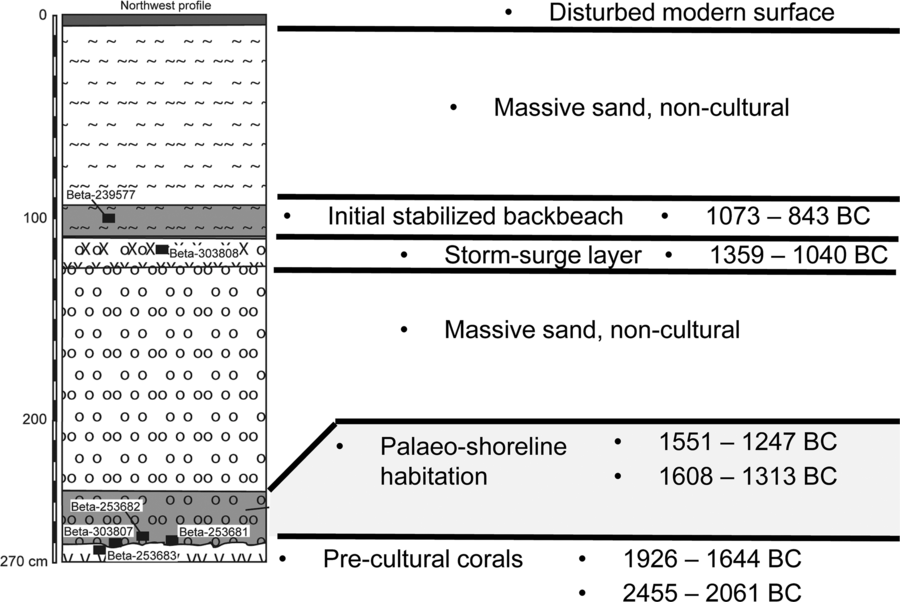
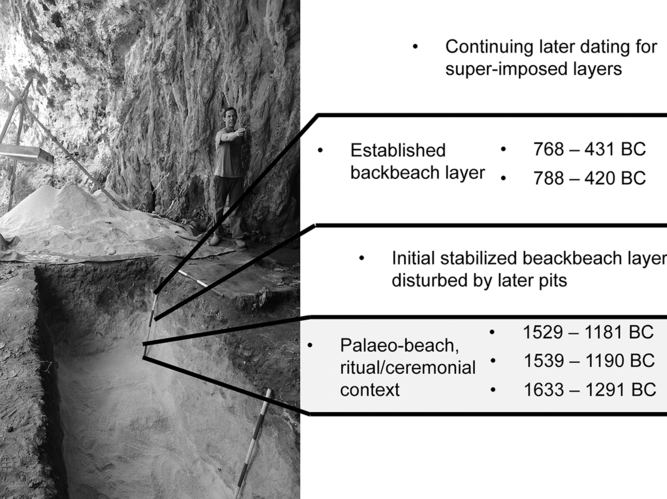
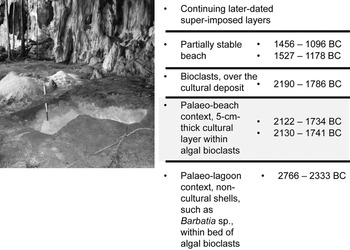
The Ritidian Site has revealed an earliest settlement horizon inside a deeply buried layer in three locations, including an ancient shoreline habitation (Figure 4) and two ritual cave areas (Figures 5 and 6), dated close to 1500 BC. The earliest cultural layer in all three cases contained definitive early red-slipped pottery and finely decorated varieties, sets of distinctive shell beads and other ornaments, and concentrations of shellfish remains that all were characteristic of the earliest settlement period and then not found in later contexts. Later, those ancient layers were covered by storm-surge debris and several more recent sedimentary units, dated from 1100 BC onwards and containing diagnostically different assemblages of artifacts and food middens.
Excavation profile and dating at the palaeo-shoreline habitation of Ritidian in Guam. Updated after Carson (Reference Carson2017a). Details are in Table 1.

Summary of dating at the First Cave (or Ritidian Beach Cave) of Ritidian in Guam. Updated after Carson (Reference Carson2017a). Details are in Table 1.

Summary dating at the Star Cave (or Ritidian Pictograph Cave) of Ritidian in Guam. Updated after Carson (Reference Carson2017a). Details are in Table 1.

The excavation profiles show that the 14C dating results all were congruent with their stratigraphic order. The initial cultural horizon was dated directly, as well as constrained by dating in the contexts directly beneath (pre-dating) and above (post-dating) the target of interest of the initial settlement horizon. Due to the absence of reliable charcoal inside this initial cultural horizon, the dating needed to rely on the strategy for calculating a localized marine reservoir correction specifically for Anadara sp. shells.
The initial cultural horizon here was emplaced inside a thick bed of Halimeda sp. algal bioclasts, certainly referring to an inter-tidal or shallow sub-tidal setting of a palaeo-lagoon. At Ritidian and other sites of Guam, these bioclasts have been dated directly by 14C, with results in accordance with their stratigraphic positions, close correspondence with each other within the same contexts, and overall match with other marine sample materials (Carson and Peterson Reference Carson and Peterson2012). Although a precise marine reservoir correction for these bioclasts may yet be refined, the overall findings so far would suggest compatibility with other marine specimens such as Anadara sp. shells in the same palaeo-lagoon contexts. The individual bioclasts of Halimedia sp. definitely are short-lived specimens, as generally they live for 1 or 2 years maximum before they fade to white color and fall to the lagoon floor, or else they live for a shorter time before they are removed in tidal surge action and deposited onto a beach surface.
In addition to the bed of palaeo-lagoon bioclasts, underlying coral formations were verified at positions that now are approximately 1.8 m above present sea level, thus matching the conditions of the mid-Holocene highstand of sea level. One such example was directly at the palaeo-shoreline habitation locality at Ritidian, where Heliopora sp. coral was dated at 2455–2061 BC, then immediately covered by branch coral at 1926–1644 BC, before the next event of the formation of the Halimeda sp. algal bioclast bed dated at 1608–1313 BC (see Figure 4). Even with caution about accepting the localized marine reservoir correction for these sample materials, the results corroborate each other in stratigraphic order.
Within the initial cultural horizon at Ritidian, suitable dating material included the algal bioclasts directly, as well as Anadara sp. shells if they could be confirmed in secure contexts of cultural association. Importantly, the lower pre-cultural zone, deeper in the palao-lagoon bed, contained no Anadara sp. shells whatsoever, where instead the shells of Barbatia sp. indicated a pre-cultural context. The initial cultural horizon therefore marked the first appearance of Anadara sp. shells, along with the sudden occurrence of other shellfish remains, animal bones, pottery, stone and shell tools, body ornaments, and discrete pit features.
As already noted, charcoal was either absent or poorly preserved in the palaeo-lagoon bed, and the rare occurrences of charcoal flecks tended to indicate post-depositional infiltration. In cases of scraping apparent charcoal from pottery fragments, a precautionary acid wash resulted in insufficient actual carbon inside those samples. With these circumstances, the Anadara sp. shells and other marine samples could be dated inside the initial cultural horizon, using the marine reservoir correction of -49 ± 61 years.
At the palaeo-shoreline habitation at Ritidian, Anadara sp. shell in the initial cultural horizon layer produced a dating of 1551–1247 BC, largely overlapping with the dating of 1608–1313 BC for the Halimeda sp. algal bioclasts of the same layer. This result was consistent with the overall dating profile. The lower (older) pre-cultural corals produced slightly older dates, outside the range as indicated for the cultural horizon. The next dated layer was more than 1 m higher in the profile, and it referred to the formation of a stable backbeach immediately at the onset of a lowering of sea level around 1100 BC.
At the First Cave (or Ritidian Beach Cave), the initial cultural horizon was dated by two Anadara sp. shells at 1633–1291 BC and 1539–1190 BC, consistent with one sample of Halimeda sp. algal bioclasts at 1529–1181 BC. These results matched well with the dating for the initial habitation at the nearby palaeo-shoreline locality. A lower position for a pre-cultural context was not dated in this locality, but the next superimposed layer was dated well after 1100 BC in a stable backbeach setting.
At the Star Cave (or Ritidian Pictograph Cave), the initial cultural horizon did not include Anadara sp. shells, and the other available shells and animal bones were considered unreliable for 14C dating. Instead, this horizon was a mere 5 cm in thickness, entirely inside the palaeo-lagoon bed of Halimeda sp. algal bioclasts. This horizon contained broken pottery, stone flaking cores and utilized-edge flakes, pieces of shell adzes, burned coral debris, bones of fish and birds, and shellfish remains of sea urchin, chiton, and other taxa. This particular cave was a highly specialized ritual setting, where people used unique forms of artifacts and deposited different kinds of foods than otherwise would be seen at a regular daily residential site. None of the materials in the oldest cultural horizon were seen in the lower pre-cultural zone deeper in the palaeo-lagoon bed, nor were they found in the superimposed 10–20 cm of the same bed of bioclasts covering the initial cultural horizon.
The dating results at the Star Cave indicated that the initial cultural horizon had been emplaced inside a pre-existing bed of algal bioclasts, directly dated at 2190–1766 BC, 2130–1741 BC, and 2122–1734 BC. Within the immediately lower and definitely pre-cultural bioclasts, Barbatia sp. shell was dated at 2766–2333 BC, therefore suggesting that the palaeo-lagoon bed accumulated at a rate of a few centuries for every 5 cm of vertical stratigraphy in the bed. By comparison, the next superimposed layer of a stable backbeach had produced two Anadara sp. shell dates of 1527–1178 BC and 1456–1096 BC, consistent with the expectation of dating a few centuries later than the palaeo-lagoon bed.
The results at the Star Cave would require careful interpretation. Most cautiously, a date range of a few centuries can be proposed, clustered around 1500 BC. The initial cultural horizon must have pre-dated the context indicated by the next superimposed layer, therefore suggesting a dating prior to the context of two Anadara sp. shells at 1527–1178 BC and 1456–1096 BC. Meanwhile, the target of interest was either equal with or slightly later than the age of the algal bioclasts in the upper limit of the palaeo-lagoon bed, in this case involving dates of 2190–1766 BC, 2130–1741 BC, and 2122–1734 BC.
HOUSE OF TAGA IN TINIAN
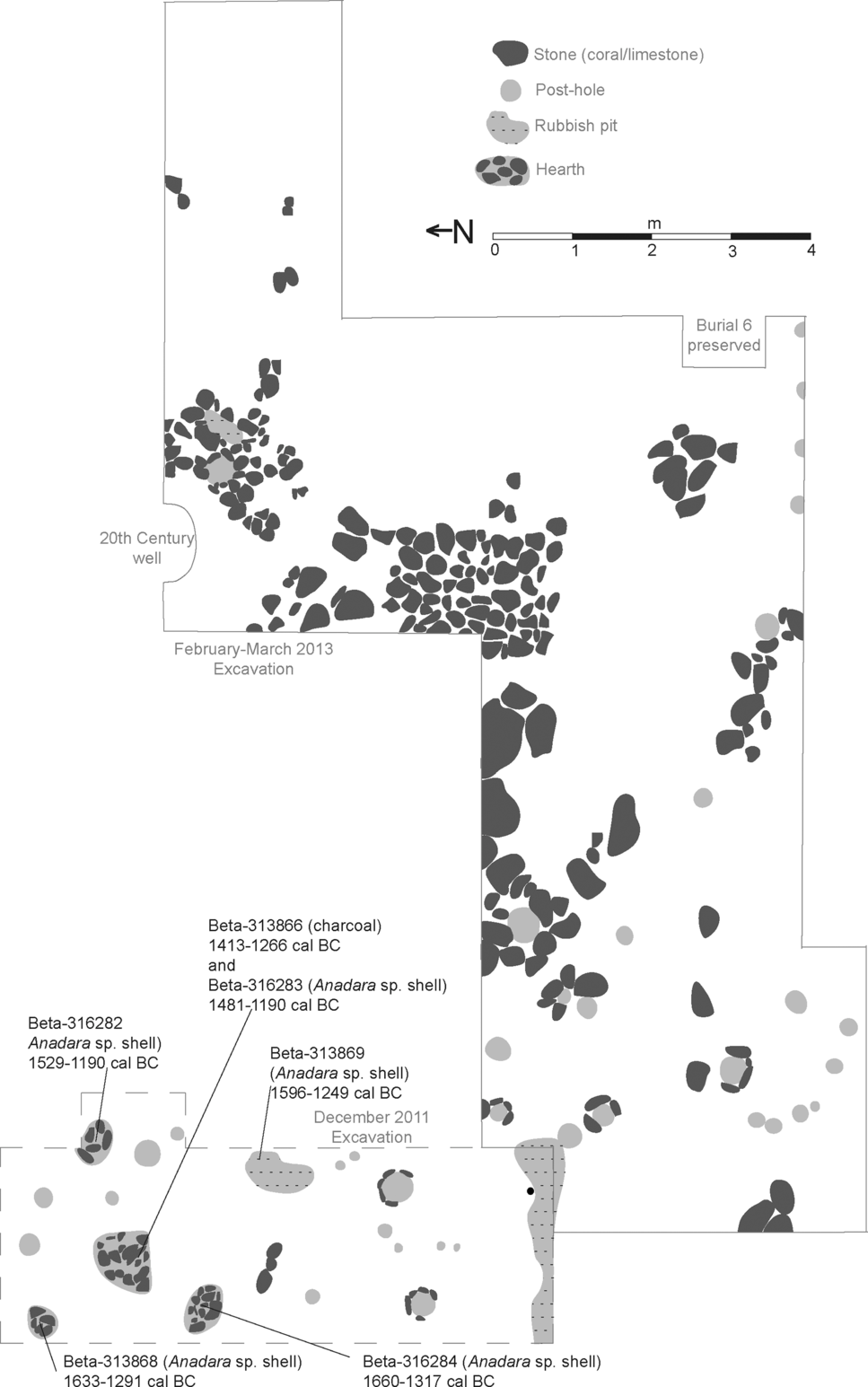
Excavation near Hosue of Taga in Tinian uncovered more than 90 m2 in a series of layers, extending back to the time of the initial cultural horizon in the context of a palaeo-seashore setting (Figure 7). Within this large excavation exposure, the oldest cultural layer included a seaward (south) component in an ancient inter-tidal or sub-tidal zone, where no reliable charcoal was preserved, as well as a landward (north) component where heated-stone hearths and rubbish pits retained small traces of charcoal. The remnants of ancient house posts were distributed throughout the area, indicating that the houses had been raised over the water’s edge at the palaeo-shoreline setting.
Lowest cultural layer and dating at House of Taga in Tinian. Updated after Carso and Hung (2015) and Carson (Reference Carson2016). Details are in Table 1.

For the most confident 14C dating of the initial settlement horizon, dating samples were collected from four heated-stone hearths and one rubbish pit in the most stable landward (north) area, outside the strongest effects of the tidal zone. In these secure contexts, one hearth had retained sufficient narrow-twig charcoal for direct paring with Anadara sp. shell, with results of 1413–1266 BC for the charcoal and 1481–1190 BC for the shell. The other instances provided dates for Anadara sp. shells at 1660–1317 BC, 1633–1291 BC, 1596–1249 BC, and 1529–1190 BC. All of these results were confidently supportive of each other.
For comparison with the age of the initial cultural horizon, dates were obtained for the immediately underlying pre-cultural coral and for the next superimposed layer of a stable backbeach. The underlying pre-cultural layer contained corals at 3321–2926 BC, definitely older than the cultural horizon but not close enough in age to impose a constraint on the dating. The next superimposed layer of a stable backbeach contained abundant charcoal in hearths, wherein one sample in the most secure contest was dated at 1264–1048 BC, possibly supplying a slight constraint for the dating results of the lower cultural horizon.
The dating results overall indicated an initial cultural horizon around 1500 BC or slightly later. If all of the dating samples referred to a single concise event, then their overlapping values would point to a dating close to 1400 BC. If instead the dating samples referred to slightly different points in time, then they could suggest an extended cultural use of the site for some decades or perhaps a few centuries while the associated layer accumulated.
UNAI BAPOT IN SAIPAN
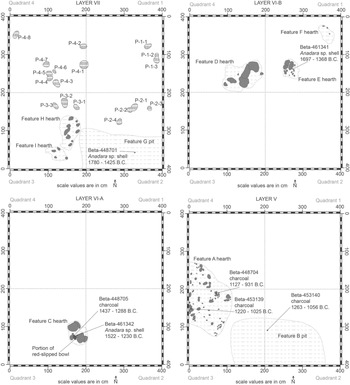
The most definitive excavation at Unai Bapot in Saipan was performed in 2016, uncovering a deeper layer in a portion of the site that previously had not been explored (Carson and Hung Reference Carson and Hung2017). This deeper layer naturally would refer to an age equal with or older than the superimposed layers that had been dated at least as old as 1500 BC in a prior nearby excavation (Carson Reference Carson2008). The 2016 excavation revealed a series of layers that contained secure contexts of hearths and pits for 14C dating of specific samples, including a direct pairing of Anadara sp. shell with charcoal to confirm the regional marine reservoir correction (Figure 8). Several post remnants indicated that houses had been positioned here, raised on posts close with the ancient shoreline.
Lower four cultural layers and dating at Unai Bapot in Saipan. Updated after Carson and Hung (Reference Carson and Hung2017). Details are in Table 1.

The 2016 excavation revealed three distinctive cultural layers in the contexts definitely pre-dating the formation of a stable backbeach after 1100 BC. These three lowest cultural layers all referred to the palaeo-seashore setting of the last centuries of the mid-Holocene highstand of sea level. At other sites of the region, the contexts prior to 1100 BC generally were contained within singular sedimentary units, but Unai Bapot was uniquely informative with three distinguished layers.
The deepest cultural layer, equivalent with the initial cultural horizon, was dated by one Anadara sp. shell inside a pit feature, dated at 1780–1425 BC. This result could be constrained by the next superimposed layer, wherein the time difference between the two layers likely was quite narrow. The next layer still was part of the palaeo-shoreline setting that pre-dated 1100 BC, and it was dated by Anadara sp. shell in a hearth, at 1697–1398 BC. This same sedimentary unit was found in a nearby excavation, where two Anadara sp. shells inside small ash piles had produced dates of 1946–1531 BC and 1780–1410 BC (Carson Reference Carson2008).
The third cultural layer inside the palaeo-shoreline setting was instructive for the preservation of reliable charcoal for 14C dating of this ancient context. This extremely rare circumstance was due to the preservation of charcoal as well as Anadara sp. shell inside the in situ breakage of an earthenware bowl, as part of a heated-stone hearth feature. The charcoal in this case was dated at 1437–1288 BC, and the shell was dated at 1522–1230 BC.
Other than the one case of charcoal in the third layer at Unai Bapot, charcoal flecks and concentrations in the lower three layers proved to be insufficient for 14C dating. After acid wash treatment, the field samples from the excavations were reduced to extremely faint or zero constituent charcoal. Accordingly, the only successful dating for charcoal in the palaeo-shoreline context here was for the single case in the third layer.
The next (fourth) layer in the sequence referred to the formation of the stable backbeach context, after the initial drawdown of sea level about 1100 BC. A hearth provided two charcoal samples with dates of 1220–1025 BC and 1127–931 BC, and a pit feature provided charcoal with a dating of 1263–1056 BC. These results were comparable with the dating of charcoal for the same layer in a nearby excavation, dated at 1127–903 BC (Carson Reference Carson2008).
The findings at Unai Bapot collectively point to a date around 1500 BC or slightly earlier for the initial cultural horizon, in the context of a palaeo-shoreline setting. This palaeo-shoreline setting must have pre-dated the next sedimentary context of a stable backbeach around 1100 BC. In this case, three separate cultural layers can be distinguished in positions that pre-dated 1100 BC, and they were progressively older with depth in accordance with the stratigraphic profile of the site.
CONCLUSIONS
As illustrated here, an initial cultural horizon can be identified in its general parameters, and then its context and dating can be refined. The research of a horizon around 1500 BC in the Mariana Islands was successful only after initial investigations could clarify that the oldest cultural layers were deeply buried in palaeo-shoreline contexts that were entirely disconnected from modern-day surface observations. Additionally, the knowledge about those ancient shorelines enabled a reasonable strategy for obtaining reliable dating materials of specific shell taxa, and then a marine reservoir correction could be calculated by pairings of shell samples with charcoal in multiple instances.
In terms of the larger Pacific Oceanic region, the findings from the Marianas at 1500 BC have re-framed the chronological narrative of how, when, and where people first lived in different areas of this vast region (see Figure 1). Based on this starting point, all other chronological questions at a region-wide sale would need to be reformulated. For instance, the initial cultural horizon in the Marianas at 1500 BC definitely pre-dated the Lapita-associated expansion into Southern Melanesia and West Polynesia after 1100 BC.
The successful approach in the Mariana Islands easily could be applied in other island settings, toward testing or refining the region-wide increment growth model for Pacific Oceania. Currently, the region-wide model indicates the approximate dates of when people had migrated into different areas, in a number of separate steps, yet the specific contexts and dates still need to be refined for each area, following the example as shown here for the Mariana Islands. In this strategy, the initial settlement horizon can be identified and dated directly, rather than relying on detached reviews of pre-existing databases that often have been incomplete and misleading.
At least three lessons from the Marianas case may be instructive for research about initial cultural horizons in other regions of the world. The first point is to be aware of the palaeo-landscape settings that may guide research more productively for finding ancient layers that otherwise would have been missed, possibly pre-dating the expected date range of a region. The second point is to clarify the contexts of the identified cultural layers and of the individual dating samples within those layers, as the fundamental basis before evaluating any dating results. The third point is to acknowledge that an initial cultural horizon likely accumulated over some period of time, and therefore its internal dating materials could produce slightly different ages within a site and across a set of sites.
ACKNOWLEDGMENTS
This manuscript was improved through discussions at the 2019 Radiocarbon and Archaeology Conference, notably for increasing the confidence in the marine reservoir calculation. Funding is acknowledged with the Guam Preservation Trust 2007–11, the Chiang Ching-kuo Foundation Grant RG021-P-10 of 2011–13, and the Australian Research Council Discovery Project DP150104458 of 2015–17.