Introduction
Recurrent respiratory papillomatosis (RRP) is a rare benign disease caused by the human papillomavirus (HPV) characterised by wart-like growths in the airway, with a prevalence of 1.42 per 100 000 in the United Kingdom.Reference Donne, Keltie, Cole, Sims, Patrick and Powell1 In children, the condition is typically more aggressive and recurrent in nature compared to adult onset, often requiring frequent surgical intervention to maintain a functional voice and safe airway.Reference Benedict and Derkay2 In 2015, a prevalence study reported that microdebridement was the most common technique in the UK, comprising 37.5 per cent of all procedures performed.Reference Donne, Keltie, Cole, Sims, Patrick and Powell1 Other techniques included laser, cold steel dissection, suction diathermy and radiofrequency cold ablation, otherwise known as coblation, which consisted of only 3.3 per cent of all procedures.
In 2012, the National Institute for Health Care and Excellence (NICE) released Interventional Procedural Guidance on the use of coblation for RRP.3 NICE recommended that coblation procedures should only be performed with special arrangements for clinical governance, consent, audit or research due to a lack in the quality and quantity of evidence to support its safety and efficacy for treatment of RRP.
In children, the current literature is limited to one case report and a small case series. In 2011, Rachmanidou et al. reported successful management of a thirty-two-month-old child with a large papillomatous lesion in the anterior glottis with coblation.Reference Rachimandou and Modayil4 The report highlighted minimal damage to underlying tissues and operating in a bloodless field as the main benefits of the technique. In 2014, a small case series of three paediatric patients reported similar advantages of coblation, citing milder post-operative mucosal oedema secondary to the lower operating temperatures of coblation (60–65°C) compared to conventional diathermy and laser surgery.Reference Zhou, Sun, Wang, Dai, Han and Han5
The primary aim of this study is to assess the safety and efficacy of coblation for the treatment of RRP in children compared to the currently favoured microdebrider technique. To our knowledge, this is the largest single-centre study in children, and the first to compare the safety profile and time interval between surgical procedures for coblation and microdebridement, which are the two most frequently used techniques in our centre.
Materials and methods
Data were collected retrospectively for all paediatric patients with RRP undergoing surgical intervention at Royal Manchester Children’s Hospital over an eight-year period from January 2014 to December 2021. Patients were identified using the International Classification of Diseases (ICD10) clinical code ‘D14’ (‘Benign neoplasm of middle ear & respiratory system’). Electronic patient records and operation notes were reviewed to exclude any patients listed under this code without RRP. Demographics, age at diagnosis, use of adjuvant medical therapies, surgical technique, complications and time interval between surgical procedures were recorded. Some patients underwent both coblation and microdebrider surgical techniques throughout the course of their disease. The time interval between procedures for coblation and microdebridement were compared using the two-sample t-test. Correlation between age at diagnosis and number of procedures performed was calculated using the Pearson correlation co-efficient. Chi-square test was used to compare complication rate. P of less than 0.05 was considered statistically significant.
Results
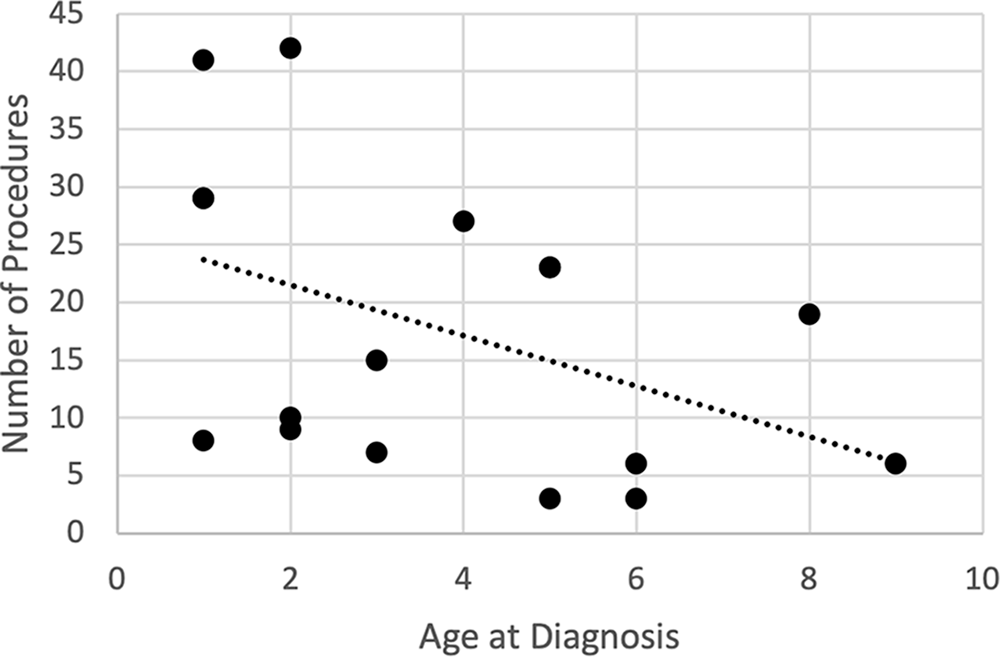
Seventeen children (11 male, 6 female) diagnosed with RRP underwent a total of three hundred operations, including 182 coblation (60.7 per cent) and 113 microdebrider (37.7 per cent) procedures over the eight-year period. Children were followed up for a median of five years after their first surgical procedure (range = 1–8 years). A median of 15 procedures were performed per child (range = 3–42), and the median age at diagnosis was three years (range = 1–9 years). Age at diagnosis was negatively correlated with the number of procedures performed (p = 0.04) (Figure 1).
Negative correlation between age at diagnosis and number of procedures (p = 0.04).

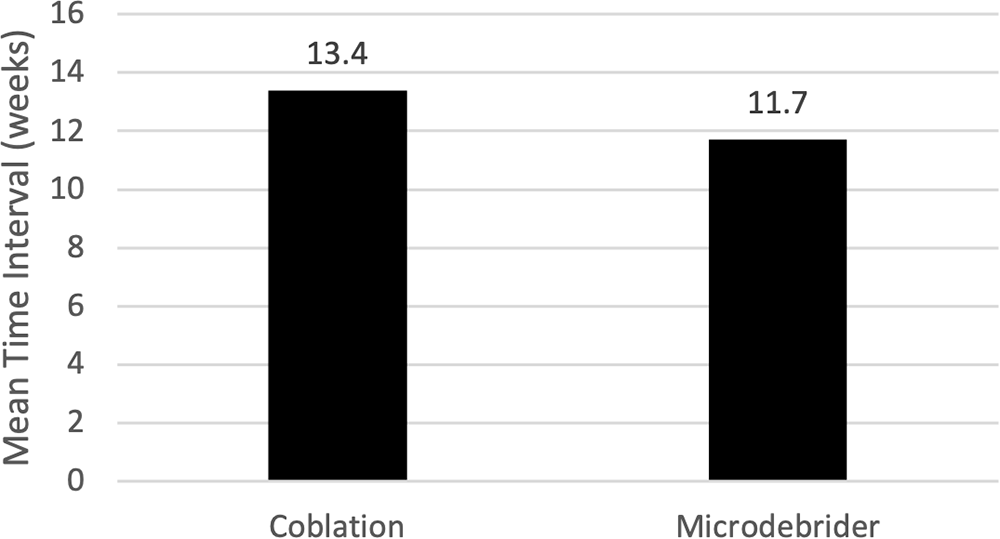
The mean time interval after coblation before the next procedure was 13.4 weeks, compared to 11.7 weeks for microdebridement (Figure 2); there was no statistically significant difference in the time interval between the two techniques (p = 0.21).
Mean time interval between procedures after coblation or microdebridement (p = 0.21).

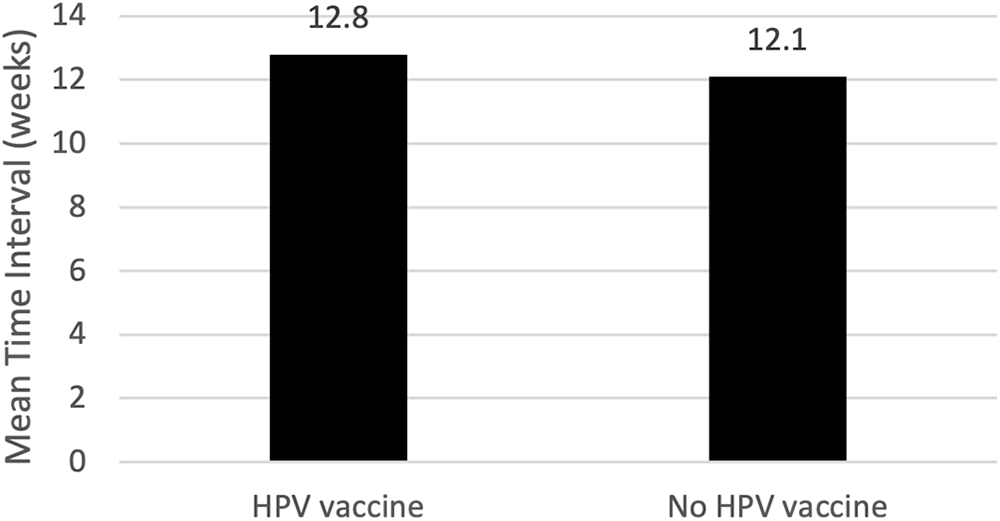
Fourteen children (82.4 per cent) underwent a mixture of both techniques throughout the clinical course of their treatment. New glottic web formation was reported after eight microdebrider (7.1 per cent) and seven coblation (3.8 per cent) procedures (p = 0.22). There were no other complications reported. Five children (29.4 per cent) were given the HPV vaccine, and one child diagnosed at thirteen months old received intralesional cidofovir at another trust before transfer of care. There was no significant difference in the time interval between procedures for patients with or without adjuvant administration of the HPV vaccine (p = 0.65) (Figure 3).
Mean time interval between procedures with or without administration of the human papillomavirus (HPV) vaccine (p = 0.65).

Discussion
There are various modalities for the surgical treatment of RRP in children. Microdebridement is currently the favoured technique in the UK, with coblation comprising only 3.3 per cent of procedures performed in 2015.Reference Donne, Keltie, Cole, Sims, Patrick and Powell1 This study demonstrates a comparable time interval between procedures and safety profile for coblation versus the microdebrider technique.
Procedural benefits of coblation include the facility to ablate, coagulate, apply suction and irrigate, all with one instrument.Reference Rachimandou and Modayil4 This enables a near-bloodless field to be maintained, optimising visualisation and operative efficiency, as there is no need to change instruments or apply adrenaline patties to achieve haemostasis. The coblation wand has a malleable tip improving access to more difficult-to-reach papillomata compared to a rigid microdebrider. The suction function allows papillomatous lesions to be medialised away from important underlying laryngeal structures, such as the vocal folds to help avoid glottic web formation. This enables precise tissue ablation, minimises thermal damage to adjacent normal mucosa and reduces the risk of post-operative scarring.
Diagnosis at a younger age is known to be a poor prognostic factor for disease severity in children with RRP.Reference El Achkar, Duarte, Carlos, Leon, Ribeiro-Silva and Pignatari6–Reference Xi, Wang, Wang, Wang, Zhang and Zhao9 This matched our results, which demonstrated a statistically significant negative correlation between the total number of procedures performed and the age of diagnosis for patients within our eight-year study period. Furthermore, complications such as glottic web formation were only reported in patients diagnosed at five years old or younger. However, this may be attributed to the increased total number of surgical procedures these children were exposed to before disease regression in adolescence.
Various outcome measures have previously been used to monitor the efficacy of surgical treatment modalities in RRP, including post-operative pain score, voice handicap index, Derkay severity score and the time interval between surgical procedures.Reference Awad, Shamil, Aymat-Torrente, Gibbins and Harris10–Reference Hock, Kennedy, Howell, Friedman, de Alarcon and Khosla13 Although time interval is the most documented and widely used outcome measure, it is important to recognise its limitations as an outcome measure, as the date for the next elective procedure is scheduled by the operating surgeon. However, if the disease is intra-operatively assessed as severe, the surgeon will typically reduce the time interval before the next elective procedure to ensure maintenance of voice quality and a safe airway. Parents and carers are also advised to contact departments to expedite procedures if symptoms have deteriorated faster than expected. Although these factors add value to the use of time interval as a marker for efficacy, the Derkay score provides a more objective assessment of severity and has been previously validated.Reference Hester, Derkay, Burke and Lawson14 However, more research is required to find a true objective measure of disease burden in RRP to help inform surgical planning.
The majority of patients underwent a mixture of surgical techniques (82.4 per cent) throughout the course of their disease, which was due to the personal preference of the operating surgeon. Therefore, when comparing the safety profile of the two techniques, there may have been residual mucosal damage from previous procedures using a different modality. However, patients in our cohort that developed glottic webbing after microdebridement had never previously undergone a coblation procedure, and only two patients had previously undergone microdebridement prior to webbing from coblation. This adds validity to the reported complication rates, despite variation in the surgical techniques performed on each patient.
The HPV vaccine has proven efficacy as an adjuvant treatment for RRP in adults. A recent systematic review concluded a reduction in the number of surgical procedures required after vaccination as the primary benefit.Reference Rosenberg, Philipsen, Mehlum, Dyrvig, Wehberg and Chirila15 The HPV vaccine for RRP in children or Juvenile-onset RRP (JoRRP) has shown promise for disease prevention.Reference Park, Carbone and Preciado16 In Australia, the HPV vaccination programme (females between 12–26 years old in 2007–2009) reported a reduction in the incidence of RRP from 0.16 to 0.02 per 100 000 from 2012 to 2016 secondary to reduced maternal transmission.Reference Novakovic, Cheng, Zurynski, Booy, Walker and Berkowitz17 Currently, the British Laryngeal Association advises that administration of the HPV vaccine in children under nine years old is considered off-label, and should only be used via shared-decision making with patients and relatives alongside consultation with the host Trust’s Medicines Evaluation Committee.18 This study found no significant difference in the time interval between surgical procedures for children who did or did not receive the vaccine, supporting current evidence that its role in reducing disease severity in children already diagnosed with RRP remains uncertain.
In 2012, NICE highlighted a lack in the quantity and quality of evidence to support the use of coblation in patients with RRP.3 They also acknowledged that due to the rarity and variation in severity of RRP, establishing good level 1 or level 2 evidence is difficult, emphasising the importance of large case series. Since then, only one additional paper has been published on the use of coblation in children with RRP.Reference Zhou, Sun, Wang, Dai, Han and Han5 To our knowledge, this is the largest single-centre case series in a paediatric population and provides evidence to support its efficacy and safety as a surgical intervention.
Conclusion
This study has demonstrated a comparable efficacy and complication rate for coblation in children with RRP versus the currently favoured microdebrider technique, supporting its use as a safe and effective alternative for surgical management. The aggressive and recurrent nature of RRP in children can have a significant impact on their quality of life with repeated surgical procedures until regression in adolescence. Therefore, as clinicians, we should make every attempt to optimise our surgical technique to help minimise complications, limit hospital attendances and reduce the burden of disease for children with RRP.
Financial support
This research did not receive any specific grant from funding agencies in the public, commercial, or not-for-profit sectors.
Competing interests
The senior author conducts educational sessions for Smith & Nephew, receiving honoraria for this. None of the authors receive financial incentives from Smith & Nephew and have no conflicts of interest.
Ethical statement and informed consent
Formal ethics approval was not sought as this study was conducted retrospectively with anonymised patient records. All patient data was handled in accordance with Caldicott principles and information governance to ensure confidentiality and privacy. The requirement for informed consent was waived because of the retrospective design.