INTRODUCTION
The most well known examples of Amphinomida (to the careless diver at least) are the fireworms, common in shallow warm and temperate water, which easily break off their chaetae when touched, causing pain and sometimes rather serious wound infections (e.g. Fauchald, Reference Fauchald1977). Amphinomida is a well delineated clade within aciculate polychaetes, although its position within Aciculata has not yet been resolved. The clade is identified by a series of morphological apomorphies: nuchal organs situated on a caruncle, a ventral muscular eversible proboscis with thickened cuticle on circular lamellae, and calcareous chaetae (Fauchald & Rouse, Reference Fauchald and Rouse1997; Pleijel et al., Reference Pleijel, Rouse and Vannier2004). Amphinomida comprises approximately 200 described species and 25 genera (Glasby et al., Reference Glasby, Hutchings, Fauchald, Paxton, Rouse, Watson Russell, Wilson and Beesley2000; Rouse & Pleijel, Reference Rouse and Pleijel2001). The worms, from what is known, are mainly scavengers or predators on sessile prey, feeding by rasping with their muscular chitinized lip (Fauchald & Jumars, Reference Fauchald and Jumars1979), although some, such as Archinome rosacea and Pherecardia sp. have been shown to feed on more active prey (Day, Reference Day1967; Ward et al., Reference Ward, Jenkins and Van Dover2003).
Amphinomida is currently divided into three families: Amphinomidae, Archinomidae and Euphrosinidae, with Amphinomidae exhibiting most of the morphological diversity. The bulk of the species in Amphinomidae live in shallow warm and temperate waters. In contrast, Euphrosinidae are more common in cold waters, while a single member of Archinomidae has been recorded from hydrothermal vents both in the Indo-Pacific and Atlantic Oceans (Ward et al., Reference Ward, Jenkins and Van Dover2003). Although no apomorphies have been identified for the three different groups, morphological differences between Amphinomidae and Euphrosinidae include the shape of the notopodia, the shape of the branchiae, chaetae and orientation of the prostomium (Kudenov, Reference Kudenov, Petersen and Kirkegaard1991; Fauchald & Rouse, Reference Fauchald and Rouse1997). To date, the relationships between Amphinomidae and Euphrosinidae have not been addressed and Rouse & Pleijel (Reference Rouse and Pleijel2001) suggested that one of them might be paraphyletic with respect to the other. In 1991, Kudenov erected the family Archinomidae for the hydrothermal vent species Archinome rosacea (Blake, Reference Blake1985). This taxon was originally placed in Euphrosinidae as Euphrosine rosacea, but has also a number of features that suggest an amphinomid affinity (Kudenov, Reference Kudenov, Petersen and Kirkegaard1991; Fauchald & Rouse, Reference Fauchald and Rouse1997). In this study, we use molecular data from the nuclear genes 18S rDNA and 28S rDNA to investigate the phylogenetic position of Archinome and the delineations of Euphrosinidae and Amphinomidae.
MATERIALS AND METHODS
Taxa
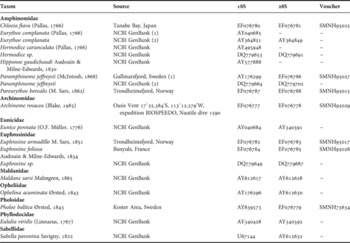
Included taxa are listed in Table 1 with GenBank accession numbers, vouchers, and sampling areas/sites. Voucher specimens are deposited at the Swedish Museum of Natural History. Eunice pennata was included as an outgroup since previous morphology-based analyses have indicated a close relationship between Eunicida and Amphinomida (Rouse & Fauchald, Reference Rouse and Fauchald1997). Additionally, two other members of Aciculata, two from Scolecida and one from Canalipalpata were included in the study. Some previously published sequences were obtained from NCBI GenBank, although for three of the species only 18S was available.
Taxa, collection site, NCBI GenBank accession numbers, and voucher specimen numbers.

DNA sequencing
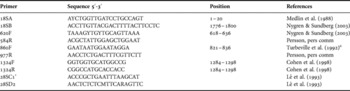
Extraction of DNA was done with the DNAeasy Tissue Kit (Qiagen), following the protocol supplied by the manufacturer. About 1800 base pairs (bp) of 18S were amplified in two overlapping fragments of around 1100 bp each, using for the 5′-fragment the primers 18SA–1115R, and for the 3′-fragment 18SB–620F. About 800 bp of the D1/D2 region of 28S was amplified, using the primers C1′ and D2 (Table 2). Polymerase chain reaction (PCR) mixtures contained ddH2O, 10X Buffer, 25 mM MgCl2, 2, 5 mM dNTP, 2, 5 µl of each primer (10 mM), 0, 25 µl TaKaRa LA Taq DNA Polymerase (5units/ µl) and 3 µl template DNA in a mixture of total 50 µl. The temperature profile was as follows: 96°C/240s -(94°C/30s-46°C/30s-72°C/60s)*45cycles-72°C/480s. PCR products were purified with the QIAquick PCR Purification Kit (Qiagen). The 18S gene was sequenced using for the 5′-fragment the primers 18SA, 620F, 584R and 1115R, while for the 3′-fragment the primers 18SB, 860F, 1324F and 1324R were used (Table 2). 28S was sequenced using C1′ and D2 (Table 2). Each sequence mixture contained 1 µl primer (5 mM), 4 µl DTCS Quick Start Mix, purified amplification product and ddH2O. The sequence reaction profile was as follows: (96°C/20s-50°C/20s-60°C/240s)*29 cycles for the 18S primers, while the 28S primers had an annealing temperature of 55°C. Sequences were obtained from a BeckmanCoulter CEQ8000.
Polymerase chain reaction and sequencing primers.

Note. Position numbers refer to the Autolytus prolifer (O.F. Müller, 1784) 18S sequence (GenBank Accession No. AF474295); F, Forward; R, Reverse. aModified from original primer by Nygren and Sundberg (2003).
Alignment and analyses
Overlapping sequence fragments were merged into consensus sequences using SeqMan 4.0 (DNAStar), and aligned with Clustal X (Thompson et al., Reference Thompson, Gibson, Plewniak, Jeanmougin and Higgins1997) with default settings, 10/0.2 for gap/gap length penalties. All regions that could not be unambiguously aligned in the alignments were excluded, totalling 257 characters. Alignments are available at TreeBase, http://www.treebase.org. PAUP* 4.0b10 (Swofford, Reference Swofford2002) was used for the parsimony (PA) and maximum likelihood (ML) analyses, with heuristic search and TBR (tree bisection and reconnection) branch swapping. Clade support was assessed using non-parametric bootstrapping with 5000 replicates and ten random additions for the PA, and with 100 replicates for ML. Bayesian phylogenetic analyses (BA) were conducted with MrBayes 3.1.2 (Ronquist & Huelsenbeck, Reference Ronquist and Huelsenbeck2003). Analyses were run three times for each dataset with four chains for 1,000,000 generations. 250,000 generations were discarded as burn-in. The results from each dataset analysis were compared, and when values approached similar mean values for all parameters they were considered to have converged. Models used for the molecular data were obtained by running the datasets in MrModelTest (Nylander, Reference Nylander2004) for the BA, and in ModelTest (Posada & Crandall, Reference Posada and Crandall1998) for the ML. MrModeltest suggested GTR+I+G for 18S, and GTR+G for 28S. The datasets were tested for incongruence using the Shimodaira–Hasegawa (SH) test (Shimodaira & Hasegawa, Reference Shimodaira and Hasegawa1999) in PAUP*, with RELL (resampling estimated log-likelihood) 1000 bootstrap replicates, and using the incongruence length difference (ILD) test (Farris et al., Reference Farris, Källersjö, Kluge and Bult1995) implemented in PAUP* (as the partition homogeneity test) using 100 replicate heuristic searches. The 18S and 28S trees within the 95% confidence interval from the Bayesian analyses were used in the SH test. Both tests failed to demonstrate incongruence between the data sets. ModelTest suggested GTR+I+G for the combined dataset, which was used in ML, while in MrBayes, the combined dataset was partitioned into 18S and 28S, and each partition had its respective model according to MrModelTest.
RESULTS AND DISCUSSION
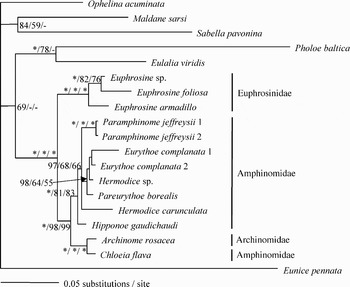
The combined dataset consists of 2552 characters, of which 677 are variable and 325 are parsimony-informative. The three BAs converged on similar log-likelihood values, mean values for all parameters, and clade probabilities. The 50%-majority rule consensus tree from the BA supports 14 nodes, of which ten have clade credibilities >95%. The ML tree supports 11 nodes, all of which were recovered by the BA, and five of these have bootstrap values above 95%. The bootstrap of the PA provided >50% support for nine nodes, all of which are present in the BA and ML. There are no topological incongruencies between the three analyses, and the differences between them relate solely to weaker or no support in ML and PA for some groups that were recovered in the BA. All three analyses provide strong support to the nodes of interest for the position of Archinome and the relationships between Amphinomidae and Euphrosinidae.
Amphinomida is a well supported clade within Aciculata based on a number of morphological apomorphies (e.g. Fauchald & Rouse, Reference Fauchald and Rouse1997), but both the position of Amphinomida within Aciculata and the delineation of Archinomidae, Amphinomidae and Euphrosinidae remains uncertain (Fauchald & Rouse, Reference Fauchald and Rouse1997; Rouse & Pleijel, Reference Rouse and Pleijel2001). Whereas the first issue is outside the scope of this study and requires a much larger taxon sampling outside Amphinomida, our data permit us to assess the position of Archinome and the interrelationships of the three families.
When Archinome rosacea was originally described, it was assigned to Euphrosinidae as Euphrosine rosacea by Blake (Reference Blake1985). He remarked on the similarities to amphinomids in the distribution pattern of notochaetae and the lack of ringent chaetae, but referred to these similarities as ‘superficial’. Kudenov (Reference Kudenov, Petersen and Kirkegaard1991) rejected the original placement in Euphrosinidae but also a position within Amphinomidae and instead introduced the new family name Archinomidae, together with the generic name Archinome for the single species A. rosacea. Subsequently, it has been suggested that both Archinomidae and Euphrosinidae may be nested within Amphinomidae (e.g. Fauchald & Rouse, Reference Fauchald and Rouse1997; Rouse & Pleijel, Reference Rouse and Pleijel2001; Pleijel et al., Reference Pleijel, Rouse and Vannier2004). Kudenov (Reference Kudenov and Dauvin1994) in an abstract referred to a morphology-based phylogenetic analysis of the three families. He stated that minimally one of these families was paraphyletic but did not specify any further results, and the full study has not been published.
Our topologies provide strong support for Amphinomidae and Euphrosinidae as sister groups, and we can therefore reject earlier suggestions that the two taxa have a nested relationship. A number of morphological characters separate the two families, but in the absence of knowledge about the closest relatives to Amphinomida it is not obvious which of these are apomorphic for either group. Our conclusion is therefore at present founded solely on molecular data.
In contrast to both Blake (Reference Blake1985) and Kudenov (Reference Kudenov, Petersen and Kirkegaard1991), the molecular data used in this study unequivocally also show that Archinome belongs within Amphinomidae. Among the included taxa, Archinome is most closely related to Chloeia flava and these two taxa form a sistergroup to the remaining amphinomids (Figure 1). Kudenov (Reference Kudenov, Petersen and Kirkegaard1991) pointed out a series of similarities between Archinome and Chloeia (plus Notopygos which is not present among our terminals), including the number of ciliated tracts on the caruncle, the position of the branchiae, the presence of dorsal cirri, the limited chaetal kinds, and the body-shape. Whereas he interpreted these similarities as homoplastic (‘superficial’), our tree topology instead suggests that their occurrences in Archinome, Chloeia and, possibly, Notopygos, are actually homologies. Seen in this light, Kudenov's diagnosis of the family Archinomidae actually consisted of a mixture of autapomorphies for Archinome rosacea and more general features, some of which are present in Amphinomidae and some in the whole of Amphinomida.
Majority rule consensus tree from the Bayesian analyses (BA) of the combined data. The first values for each node represent clade credibility support from the Bayesian analyses, the second are bootstrap support from the maximum likelihood analyses, and the third are bootstrap support from the parsimony analyses. *, support value of 100; -, no support. The nodes Eurythoe complanata ↔ Hermodice sp. (support values not shown) have low support in BA and no support in the other analyses.

From a nomenclatural viewpoint this leaves us with two choices: either transfer Chloeia to Archinomidae (possibly followed by other taxa that were not included in our analysis), or treat Archinomidae as a junior synonym to Amphinomidae. We opt for the second alternative. Furthermore, our study also provides strong support for a sister-group relationship between Euphrosinidae and Amphinomidae, and thus that both these clades can be retained as family-level taxa in line with traditional classifications.
ACKNOWLEDGEMENTS
We thank Stéphane Hourdez and Didier Jollivet for specimens of Archinome, Greg Rouse for valuable comments on the manuscript, and the following persons and institutions for providing working facilities: Michel Bhaud, Laboratoire Arago, France; Kristineberg Marine Research Station, Sweden; Yoshihisa Shirahama, Seto Marine Biological Laboratory, Japan; and Jon-Arne Sneli, Trondhjem Biological Station, Norway. Financial support for F.P. was provided by Formas (grant #2004-0085), the Japan Society for the Promotion of Science, Kristineberg Marine Research Station (European Community ARI-programme) and Trondheim Marine Systems Research Infrastructure (European Community ARI-programme). The research of P.S. is financially supported by the Swedish Research Council.