Implications
This experiment determined the effect of offering a preferred feed between 2400 and 0600 h and varying the quantity of feed offered throughout the 24 h on the feed intake and behaviour of non-lactating dairy cows. We found that both methods of feed allocation increased feed intake between 2400 and 0600 h. However, combining both treatments did not provide a further improvement to intake. Neither method of allocation had a negative effect on daily rumination or resting time. Further research is required to determine if these allocation methods could be utilised where manipulating the feeding pattern of cows is desirable.
Introduction
A thorough understanding of dairy cattle feeding behaviour is required to develop complimentary feeding strategies that increase performance of modern dairy systems. Dawn and dusk are peak feeding times for cows, with the dusk grazing event accounting for approximately 40% of total daily feeding time (Taweel et al., Reference Taweel, Tas, Dijkstra and Tamminga2004; John et al., Reference John, Garcia, Kerrisk, Freeman, Islam and Clark2017). In comparison, minimal feeding activity occurs between 2400 and 0600 h, with this period accounting for between 10% and 15% of total daily feeding time (John et al., Reference John, Garcia, Kerrisk, Freeman and Clark2016b). Gregorini (Reference Gregorini2012) highlighted several factors that influence diurnal feeding patterns, such as photoperiod, satiety hormones, diurnal variation in pasture quality and predatory instincts. The daily light cycle is theorised to regulate melatonin (hunger) and serotonin (satiety) levels, with melatonin regulating several physiological pre-meal responses (Gregorini, Reference Gregorini2012). Diurnal changes in forage nutritive value, with total soluble carbohydrates increasing throughout the day, also make dusk the ideal time to graze (Delagarde et al., Reference Delagarde, Peyraud, Delaby and Faverdin2000), with Horadagoda et al. (Reference Horadagoda, Fulkerson, Nandra and Barchia2009) showing cows prefer forage with greater water-soluble carbohydrate (WSC) content. Maximising rumen fill at dusk (Williams et al., Reference Williams, Doyle and Egan2014), when predation is most likely to occur, provides a pool of slow release energy to last throughout the night (Gregorini, Reference Gregorini2012). These factors highlight the complexity governing the natural feeding behaviour of cows.
Feed availability is the primary motivation for dairy cows to return to the dairy in an automatic milking system (AMS) (Prescott et al., Reference Prescott, Mottram and Webster1998) and as such, offering fresh feed is the main incentive used to encourage voluntary cow traffic (Kerrisk, Reference Kerrisk2009). As a result, it is largely the cows’ decision when to move to a new paddock, often causing robot utilisation to be highly variable throughout the 24 h, as cows prefer to rest during the night. John et al. (Reference John, Clark, Freeman, Kerrisk, Garcia and Halachmi2016a) highlighted the link between feeding patterns and robot utilisation in AMS and the potential to improve robot utilisation, to be more uniform throughout 24 h by manipulating the diurnal feeding patterns of cows. However, current understanding of how varying both feed quantity and quality through time affects cow feeding patterns is limited.
Bach et al. (Reference Bach, Iglesias, Calsamiglia and Devant2007) observed no difference in milk yield, milking frequency, number of cows fetched (cows forced to return to the dairy by the farmer) and dry matter intake (DMI) after manipulating feed quantity (8 kg/cow per d v. 3 kg/cow per d of concentrate) at the milking robot in AMS. This suggests that manipulation of feeding behaviour requires feed provided during the day to be independent of the robot. In the study by John et al. (Reference John, Clark, Freeman, Kerrisk and Rawnsley2013), a farmer offering varying quantities of feed in each of three daily allocations (40 : 40 : 20%) achieved consistent robot utilisation throughout the 24 h. It is likely that the smaller pasture allocation offered between 1700 and 0200 h provided incentive for cows to seek out fresh feed between 2400 and 0600 h, as this allocation is likely to have been quickly depleted, though this concept still requires validation in a controlled environment.
The objective of this experiment was to determine the effect of temporal variation in feed quality and quantity on cow feeding activity between 2400 and 0600 h. We hypothesised that the feeding behaviour of non-lactating dairy cows will increase between 2400 and 0600 h when offered a high WSC feed type or when the greatest proportion of the daily feed allocation was offered. We also hypothesised that DMI could be increased between 2400 and 0600 h without decreasing the daily DMI.
Materials and methods
Animals and treatments
Use of animals was approved by the University of Sydney’s Animal Ethics Committee (2015/905). The experiment was conducted between 13 October and 16 November 2016 at the University of Sydney research farm ‘Mayfarm’. Total rainfall recorded during the experimental period was 36.2 mm. The light and dark cycle was approximately 13 h/11 h, with sunrise and sunset occurring at 0600 and 1900 h, respectively. The mean (±SD) minimum and maximum temperature was 10.9°C (±3.8) and 26.5°C (±3.7), respectively, with an absolute maximum of 35.1°C.
Eight non-lactating Holstein-Friesian cows (659 ± 103 kg liveweight, 88 ± 32 months old, 4.1 ± 2.3 lactation number, 156 ± 28 days pregnant, mean ± SD) were used for the duration of the experiment. Fourteen days before the experimental period, cows were weighed and allocated to individual pens. Cows were offered 15 kg of Lucerne hay cubes (DM = 90.7%, NDF = 43.7%, ADF = 34.6%, CP = 19.1%, WSC = 3.8%, DM digestibility = 63.1%, metabolisable energy = 9.1 MJ/kg of DM, cube dimensions = 32 mm3) and gradually built up to AL access. The ‘preferred’ hay cubes (DM = 89.6%, NDF = 47.3%, ADF = 35.4%, CP = 11.8%, WSC = 10.7%, DM digestibility = 59.3%, metabolisable energy = 8.5 MJ/kg of DM, cube dimensions = 32 mm3) were also gradually introduced over this period to build up to AL access. Cows were randomly assigned to four treatments (n = 2 cows per treatment) 7 days before the experimental period and offered feed according to the treatment allocated. Following this period, each group progressed to the next treatment in the following sequence: ad libitum (AL), AL with preferred feed (AL + P), variable allocation (VA) and variable allocation with preferred feed (VA + P). The daily DMI for the last 4 days of each AL and AL + P treatment was used to calculate the feed allocation for the VA and VA + P treatments occurring in the following week. Pens measured 30 × 10 m in dimension and were separated by a two-wire fence. Water was available AL in each pen. The pen’s grassed surface was mown on the first day of each period to ensure the hay cubes offered was the only source of DM.
The experiment duration was 28 days, divided into four periods of 7 days in a 4 × 4 Latin square design. Cows were weighed on the first day of each period prior to the 0600 h feeding using a Thunderbird SS1000 system (Thunderbird, Australia). Each period consisted of 3 days of habituation followed by 4 days of data collection. Each day had four feeding periods (0600 to 1200, 1200 to 1800, 1800 to 2400 and 2400 to 0600 h) and depending on the assigned treatment, cows were offered lucerne cubes either AL or restricted, in combination with offering a ‘preferred’ feed cube in feeding period between 2400 and 0600 h (Table 1). To maintain an AL feed state (when applicable), cows were offered 13.5 kg DM at the start of each feeding time. The feed remaining at the end of each feeding period was weighed and then replenished to the designated quantity. The DMI for each of the four feeding times was calculated daily for each cow.
Feed type and quantity offered to cows (Bos taurus) in the four daily feeding periods for each treatment

AL = Ad libitum treatment; L = Regular feed (Lucerne hay); ∞ = AL; no. = proportion of daily allocation offered. AL + P =AL treatment with preferred feed; P = Preferred feed (oat/ryegrass/clover hay +20% molasses); VA = Variable allocation treatment; VA + P = Variable allocation treatment with preferred feed.
Cows were fitted with ngHR-Tags (SCR, Israel), as validated by Molfino et al. (Reference Molfino, Clark, Kerrisk and Garcia2017), to record three behaviour states: feeding, resting and ruminating. The tags recorded the dominant behaviour exhibited each min and used to calculate the duration (min) performing each behaviour per h.
Feed samples
Fresh feed subsamples were collected from each 20 kg bag of feed and pooled each day for analysis of DM content. Feed weight for both pre- and post-feeding was recorded for each cow and for each feeding time. The difference between pre- and post-feeding feed weight was used to determine gross intake per cow for each feeding time and was converted to DM intake using the DM% obtained from the corresponding day feed sample.
Feed samples were dried at 70°C for 48 h and ground to < 1 mm. Dry matter content was determined for each sample. Ground samples were sub-sampled and analysed for ADF (Ankom Technologies, 2014a) and NDF (Ankom Technologies, 2014b) using an Ankom200 fibre analyser. Total nitrogen was determined by combustion (Association of Official Analytical Chemists (AOAC), 1995) using a Leco FP-628 Nitrogen Determinator (Leco Corporation, St. Joseph, MI) and used to calculate CP (CP% = 6.25 × sample nitrogen %). Water soluble carbohydrate was determined by water extraction (AFIA, 2014). The equations reported by Oddy et al. (Reference Oddy, Robards and Low1983) and Primary Industries Standing Committee (2007) were used to determine DM digestibility and metabolisable energy, respectively.
Statistical analysis
Data were analysed using Genstat 16th Edition (VSN International, UK), with significant effects stated at P < 0.05. Normality of data was determined with normal probability plots. The mean predicted DMI was determined for each treatment (AL, AL + P, VA, VA + P) using restricted maximum likelihood variance components analysis, with cow 1, 2 … 8, day 1, 2, 3, 4 and week 1, 2, 3, 4 included as random factors. The mean predicted DMI for the interaction between treatment (AL, AL+P, VA, VA+P) and feeding period (0600 to 1200, 1200 to 1800, 1800 to 2400, 2400 to 0600 h) was determined using the same model.
Cow behaviour (feeding, ruminating and resting) was recorded for four cows (four of eight collars failed) at 1 min intervals and then summed as 60 min blocks. The proportion of time spent at each behaviour (feeding, ruminating and resting) was determined using generalised linear mixed model, with fixed effects of treatment AL, AL + P, VA, VA + P and hour 0, 1 … 23 and random effects of cow 1, 2, 3, 4, day 1, 2, 3, 4 and week 1, 2, 3, 4.
Results
Daily DMI was 7% to 10% greater (P < 0.001) for AL feeding (AL = 23.1 and AL + P = 22.9 kg DM) compared with the restricted feeding treatment (VA = 21.6 and VA + P = 20.9 kg DM). There was no difference in daily DMI between the AL and AL + P treatments, likewise for the VA and VA + P treatments. An interaction (P < 0.001) between treatment and time was observed for DMI (Figure 1). DMI was greater between 2400 and 0600 h for the AL + P treatment compared with the AL treatment. No difference for DMI is observed between the VA and VA + P treatments for any feeding period. The VA and VA + P treatments featured lower DMI during the 0600 to 1200 and 1200 to 1800 h feeding periods and greater DMI during the 1800 to 2400 and 2400 to 0600 h feeding periods compared with the AL and AL + P treatments. Within the 2400 to 0600 h feeding period, DMI for the VA treatment was 35% and 46% greater than the AL + P and AL treatments, respectively.
Total daily dry matter intake (kg) per cow (Bos taurus) for each treatment during the 0600 to 1200 h ( ), 1200 to 1800 h (
 ), 1800 to 2400 h (
 ) and 2400 to 0600 h (
 ) periods. Significant differences denoted by subscripts a, b …, i. AL = standard feed ad libitum; AL + P, standard feed AL, replaced by a preferred feed between 2400 and 0600 h; VA = standard feed at variable rate throughout the 24 h; VA + P, standard feed at a variable rate throughout the 24 h, replaced by a preferred feed between 2400 and 0600 h.

Four of the ngHR-Tags suffered battery failure, limiting data capture to four cows, whilst a fifth tag failed in the final week of the experiment. Total daily feeding time was greater (P < 0.01) for the AL + P, VA and VA + P treatments (2.0, 2.0 and 2.1 h/day, respectively) compared with the AL treatment (1.3 h/day). Feeding patterns throughout the 24 h also varied between treatment (P < 0.001) (Figure 2). Cows on the AL treatment followed a diurnal feeding pattern, with feeding activity greatest in the morning (0900 to 1100 h) and in the afternoon (1700 h). Minimal feeding activity occurred between 2000 and 0500 h. Cows on the AL + P treatment had similar feeding activity to the AL treatment, with increased feeding activity occurring at 2400 h and again at 0500 h compared with the AL treatment. Cows on the VA and VA + P treatments exhibited spikes in feeding activity at each feeding time (0600, 1200, 1800, 2400 h). The VA + P treatment had greater feeding activity at 2400 h compared with the VA treatment.
Probability of cows (Bos taurus) feeding throughout the 24 h when offered standard feed ad libitum (AL,  ), standard feed AL, replaced by a preferred feed between 2400 and 0600 h (AL+P,
 ), offered standard feed at variable rate throughout the 24 h (VA,
 ) and offered standard feed at a variable rate throughout the 24 h, replaced by a preferred feed between 2400 and 0600 h (VA + P,
 ). Each point on the x-axis represents occurrence of behaviour for an entire hour (e.g. 18 = 1800 to 1859 h).

Total daily rumination time was similar for all treatments (AL 4.9, AL + P 6.1, VA 5.3 and VA + P 5.0 h/day). The pattern of rumination activity throughout the 24 h varied (P < 0.01) between treatments (Figure 3). The AL + P treatment had higher probability of ruminating between 0100 and 0400 h compared with the AL treatment, with the VA + P treatment showing a similar tendency during the same period. The VA treatment had a greater probability of ruminating between 1400 and 1700 h with another peak at 0400 h, whilst a lower probability of ruminating was observed at 2200 h.
Probability of cows (Bos taurus) ruminating throughout 24 h when offered standard feed ad libitum (AL,  ), standard feed AL, replaced by a preferred feed between 2400 and 0600 h (AL + P,
 ), offered standard feed at variable rate throughout the 24 h (VA,
 ) and offered standard feed at a variable rate throughout the 24 h, replaced by a preferred feed between 2400 and 0600 h (VA + P,
 ). Each point on the x-axis represents occurrence of behaviour for an entire hour (e.g. 18 = 1800 to 1859 h).

The total time spent resting was similar for all treatments (AL 13.5, AL + P 11.6, VA 12.7 and VA + P 11.8 h/day). However, resting activity did vary throughout the 24 h for each treatment (P < 0.001) (Figure 4). The AL + P treatment cows followed a similar resting pattern throughout the 24 h to the AL treatment cows; though it was notably lower at 0100 h. The VA and VA + P treatment cows also followed a similar resting pattern throughout the 24 h, with the VA + P treatment cows recording a lower probability of lying between 2300 and 0100 h. In comparison with the AL and AL + P treatments, the VA and VA + P treatments showed a lower probability of cows resting between 1600 and 1700 h.
Probability of cows (Bos taurus) resting throughout the 24 h when offered standard feed ad libitum (AL,  ), standard feed AL, replaced by a preferred feed between 2400 and 0600 h (AL + P,
 ), offered standard feed at variable rate throughout the 24 h (VA,
 ) and offered standard feed at a variable rate throughout the 24 h, replaced by a preferred feed between 2400 and 0600 h (VA + P,
 ). Each point on the x-axis represents occurrence of behaviour for anentire hour (e.g. 18 = 1800 to 1859 h).

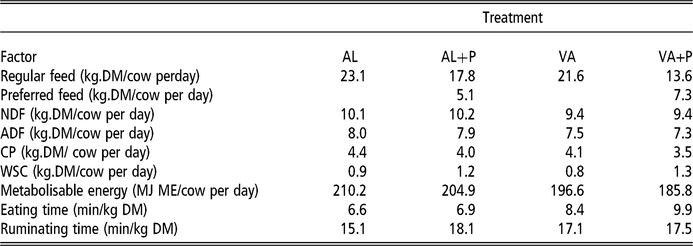
Descriptive statistics for feed and nutrient intake and feeding and ruminating time per of each feed type, nutrients and metabolisable energy and the time spent eating and ruminating per kg of DM ingested are shown in Table 2.
Descriptive statistics for daily dry matter intake of feed (regular and preferred feed), nutrients (NDF, ADF, CP and water-soluble carbohydrate (WSC)) and metabolisable energy and time spent eating and ruminating per kg of feed ingested per cow (Bos taurus)

AL = Ad libitum treatment; AL +P = AL treatment with preferred feed; VA = Variable allocation treatment; VA + P = Variable allocation treatment with preferred feed. WSC = water-soluble carbohydrate.
Discussion
In this experiment, we demonstrated how variable allocation and/or offering a preferred feed can increase feeding activity and DMI of cows during the period between 2400 and 0600 h. When cows were placed on the AL treatment, which provided our baseline feeding behaviour, cows followed a diurnal feeding pattern which was typical of other studies observations (Stobbs, Reference Stobbs1970; Gibb et al., Reference Gibb, Huckle and Nuthall1998), with the smallest proportion of intake (18%) occurring between 2400 and 0600 h. When a preferred feed was offered between 2400 and 0600 h (AL + P), the cows redistributed their timing of feed intake across 24 h, with the DMI for the 2400 to 0600 h feeding period increasing by 21%, whilst total daily DMI remained the same. The DMI achieved by the AL and AL + P treatments exceeded the calculated maintenance requirement of the cows, however, were comparable with previous studies offering AL Lucerne hay (Buchman and Hemken, Reference Buchman and Hemken1964). As DMI was already far greater than maintenance, this could have limited the potential for the preferred feed to further increase DMI. We attribute the increased DMI between 2400 and 0600 h to the cows’ preference in consuming feed with greater WSC levels, as observed by Horadagoda et al. (Reference Horadagoda, Fulkerson, Nandra and Barchia2009). Though CP levels also varied between feed types, potentially causing cows to prioritise intake of the preferred feed to prevent excessive intake of rumen degradable protein (Tolkamp et al., Reference Tolkamp, Kyriazakis, Oldham, Lewis, Dewhurst and Newbold1998), further driving cows’ preference for the preferred feed. Under the VA treatment, as a result of varying the quantity of feed offered throughout the 24 h, cows’ diurnal feed intake pattern was effectively inverted, achieving the greatest proportional DMI between 2400 and 0600 h. Despite the failure of four sensor tags, the data collected were still valuable. The feeding activity of cows on the VA and VA + P treatments is characterised by short periods of intense feeding activity when fresh feed was offered; this synchronisation of feeding activity with feed allocation was also observed by DeVries et al. (Reference DeVries, von Keyserlingk and Beauchemin2003). Combining both preferred and variable feeding into a single treatment (VA + P) provided no additional increase to feed intake between 2400 and 0600 h. Whilst we have shown using variable allocation or offering a preferred feed type can increase feeding activity at night, implementing these practices in AMS will require further research.
Dry matter intake and feeding activity were increased in this experiment when a preferred feed was offered between 2400 and 0600 h. However, where a second feed type (grazed soya bean, WSC = 10.0%) has previously been offered in a pasture-based AMS (Kikuyu pasture, WSC = 8.5%), no improvement in milk yield or voluntary cow traffic was observed (Clark et al., Reference Clark, Horadagoda, Kerrisk, Scott, Islam, Kaur and Garcia2014). It is possible the small difference in WSC between the two feeds provided insufficient motivation to increase voluntary traffic. The cows’ ability to learn when a higher quality feed is going to be offered also needs to be questioned. In our experiment, feed was brought to the cows, allowing cows to determine feed type immediately, potentially exaggerating the effect of offering a preferred feed. In contrast, cows were required to voluntarily traffic in Clark et al. (Reference Clark, Horadagoda, Kerrisk, Scott, Islam, Kaur and Garcia2014), requiring cows to anticipate when the soya bean was going to be offered. In addition, the soya bean was only offered during the day, which is opposite to the philosophy of the present study, possibly limiting improvements in robot utilisation; though detailed robot utilisation was not recorded so this cannot be confirmed. Our study highlights the potential for a preferred feed to increase cows’ motivation to feed at night. However, the optimal way to implement this strategy in both pasture-based and indoor AMS requires further investigation.
The large difference in the distribution of DMI and feeding activity of cows in the AL and VA treatments demonstrates the importance of varying feed quantity rather than just offering a new allocation of feed at night. The study by Dalley et al. (Reference Dalley, Roche, Moate and Grainger2001) further emphasised this point, as increasing the number of pasture allocations from 1 per day to 6 equal allocations per day, including one at 0330 h, only increased feeding activity between 2200 and 0600 h by 2%. Furthermore, offering an additional allocation of pasture (totalling three allocations or three-way grazing (3WG)) had a minimal effect on robot utilisation between 2400 and 0600 h (Lyons et al., Reference Lyons, Kerrisk and Garcia2013). In the study by John et al. (Reference John, Clark, Freeman, Kerrisk and Rawnsley2013), Farm A featured a consistently high level of robot utilisation throughout the 24 h and is likely attributable to Farm A’s variable allocation feeding strategy. In the same study, Farm B, also utilising 3WG but with a different pattern of variable allocation, had large variability in robot utilisation throughout 24 h. Therefore, the method of varying pasture allocations through time is important. The method used by Farm A to vary feed quantity throughout 24 h is similar to our VA treatment, whereby the smallest allocation of feed was offered at dusk, the period when cows most actively feed, and thus increasing cows’ appetite at night, resulting in both increased feeding activity and robot utilisation during the night.
The cows on both the VA and VA + P treatments consumed 36% of their daily intake (approximately 7.8 kg DM) rather than the 40% targeted between 2400 and 0600 h. Time was not a limiting factor, as a similar study observed maximum intake of 14.1 kg DM for a single 6 h period (John et al., Reference John, Garcia, Kerrisk, Freeman and Clark2016b). Rather, it is likely that cows compromised daily DMI in favour of resting between 2400 and 0600 h, with the addition of a preferred feed unable to further increase the cows’ desire to feed. This is also seen in Helmreich et al. (Reference Helmreich, Hauser, Jungbluth, Wechsler and Gygax2014), where cows fed AL in an indoor AMS allocated only 15% of their total daily feeding time between 2200 and 0500 h, with the cows spending the majority of this period in the lying area. This was also observed in the feeding and lying behaviour of the cows in the present study, with minimal feeding activity recorded, and a high probability of cows lying and ruminating between 0100 and 0400 h. Therefore, no more than 35% of the total daily ration should be allocated between 2400 and 0600 h when implementing a variable allocation strategy on farm.
Our main consideration for obtaining data on lying and rumination behaviours was to ensure there was no negative affect on cow welfare under the various feeding regimes tested. Despite the limited data collected in our experiment, cows were observed following a diurnal pattern in their ruminating and lying behaviour, as per the results of Schirmann et al. (Reference Schirmann, Chapinal, Weary, Heuwieser and von Keyserlingk2012). Importantly, the implementation of the variable allocation strategies did not negatively affect total lying or rumination time. Perhaps, the most interesting behaviour observed was the increased feeding activity recorded for the VA and VA + P treatments between 1600 and 1800 h. This coincided with the smallest feed allocation (10%) and resulted in the cows ‘picking’ at the ground in search for feed, which we attribute to their allocation of feed cubes being exhausted before the end of the 1200 to 1800 h feeding period. This is further highlighted by the low eating time per kg of DMI, which was observed to be approximately half that of cows grazing herbage (Gregorini et al., Reference Gregorini, Clark, Jago, Glassey, McLeod and Romera2009). Despite having adequate feed within a 24 h period, this picking behaviour indicates the crepuscular nature of cow feeding activity, which should be exploited in the design of feeding management practices for pasture-based AMS. A commercial pasture-based AMS with high levels of robot utilisation throughout the 24 h appears to have utilised this principle, with a fresh allocation of pasture offered at 1700 h likely to have increased voluntary cow traffic (John et al., Reference John, Clark, Freeman, Kerrisk and Rawnsley2013). However, the conditions in the present study are vastly different to a commercial pasture-based dairy and cannot currently be recommended to farmers. Rather, these concepts will be the focus of future investigation.
Conclusion
The present study has shown that the use of both variable allocation and variable feed types can be used to manipulate the diurnal feeding behaviour of dry dairy cattle without adversely affecting resting or ruminating behaviour. Variable allocation provided the greatest increase in feed intake between 2400 and 0600 h, whilst providing a preferred feed also increased feeding intake at night. However, the use of variable allocation was associated with a decrease in daily DMI compared with AL treatments. Combining both variable allocation and preferred feed provided no additional increase to feed intake between 2400 and 0600 h compared with variable allocation alone. Further experiments to test this concept on the farm are required to determine if variable allocation can improve robot utilisation and if so, how to optimise such a management strategy.
Acknowledgements
The authors gratefully acknowledge the Dairy Research Foundation for its support of the Dairy Science Group and the investors of the FutureDairy project (Dairy Australia, NSW Department of Primary Industries, The University of Sydney, and DeLaval). The authors acknowledge Dr. Evelyn Hall for her statistical input.
A. J. John, 0000-0003-3134-3041, S. C. Garcia, 0000-0002-2742-0262, K. L. Kerrisk, 0000-0003-2465-8969
Declaration of interest
The authors acknowledge that there are no known conflicts of interest in relation to this publication.
Ethics statement
Use of animals was approved by the University of Sydney’s Animal Ethics Committee (2015/905).
Software and data repository resources
None of the data was deposited in an official repository.