


Introduction
The stigmatization and discrimination of Muslims in France
The perception of religious groups—particularly Muslims—and the resulting intergroup relations constitute a major societal and political issue. In France, attitudes toward Muslims have become central to public debate and policy-making, particularly in discussions surrounding secularism, the regulation of religious expression, national identity, and the fight against “Islamic fundamentalism” (Firmonasari et al., Reference Firmonasari, Udasmoro and Mastoyo2020). These debates help shape political discourse and influence public support for restrictive or security-oriented policies.
In Europe, and particularly in France—home to the largest Muslim population in Europe—the number of individuals identifying as Muslim has increased in recent decades (Buijs et al., Reference Buijs and Rath2002; “Europe’s Growing Muslim Population,” 2017). In France, Muslims represent the second largest religious community after Catholics, numbering over 5.4 million, or more than 8% of the population (“L’Islam en France,” 2023). Despite their number, Muslims remain one of the most stigmatized and discriminated minorities, facing both religious-based attacks and discrimination in domains such as employment and housing (Ferhat, Reference Ferhat2020; Mayer et al., Reference Mayer, Michelat and Tiberj2013). For example, Muslims face substantial discrimination in hiring processes compared with other religious groups (Valfort, Reference Valfort2017). Recent data also suggest a sharp rise in anti-Muslim acts, with the Ministry of the Interior predicting a 30% increase in 2023, exacerbated by international events such as the Hamas attacks in Israel (Cazaux, Reference Cazaux2024). Taken together, these patterns underline the importance of understanding how Muslims are perceived in contemporary France.
A key driver behind such discrimination lies in the pervasive stereotypes of Muslims, often wrongfully associated with radical Islamism. This association, widely conveyed in media representations, contributes to the stigmatization and negative perception of Muslims in French society (Ameline et al., Reference Ameline, Ndobo and Roussiau2019; Yusof et al., Reference Yusof, Hassan, Hassan and Osman2013). Research shows that media representations tend to associate Muslims with terrorism, a link that is reflected in social representations within the general population (Da Silva et al., Reference Da Silva, Amadio, Sarg, Domingo and Benbouriche2024; Ginguené et al., Reference Ginguené, Leveaux, Parant, Préau and Laguette2023). For example, Matthes and colleagues (Reference Matthes, Schmuck and Von Sikorski2019) showed that the way in which the media presented terrorist attacks and characterized their threat could have an impact on support for Islamophobic policies. Similarly, increasing the salience of terrorist attacks has been shown to heighten implicit hostile responses toward Muslims (Arnoult et al., Reference Arnoult, Selimbegović, Hirschberger, Pyszczynski and Chatard2023).
As a result of these negative stereotypes, essentially composed of negative traits, Muslims often become targets of Islamophobia, a form of prejudice that manifests through both active and passive discriminatory behaviors (Bleich, Reference Bleich2011). This discriminatory perception of Muslims has significant consequences on their daily lives, leading to active and passive prejudice, reduced sympathy for Muslim victims in hate-crimes context (in comparison with other victims), and biased responses in rapid-decision situations (Erentzen et al., Reference Erentzen, Schuller and Gardner2021; Unkelbach et al., Reference Unkelbach, Goldenberg, Müller, Sobbe and Spannaus2009). More recently, Wiemers and colleagues (Reference Wiemers, Stasio and Veit2024) have shown that Muslims are the target of diverse stereotypes, incorporating intersectional aspects linked to gender and ethnic origin.
Given the impact of these negative stereotypes and their role in shaping Islamophobic attitudes, it seems essential to explore the underlying mechanisms of these stereotypes in French society. Understanding how Muslims are evaluated is therefore essential not only for documenting intergroup relations, but also for analyzing political preferences and support for public policies affecting religious minorities. Negative stereotypes and threat perceptions have consistently been shown to predict endorsement of restrictive or security-oriented policies, as well as political intolerance toward Muslims (Godefroidt, Reference Godefroidt2023; Matthes et al., Reference Matthes, Schmuck and Von Sikorski2019; Sides and Gross, Reference Sides and Gross2013). Moreover, emotions associated with outgroup evaluation (such as anger, fear, pity, or disgust) play a central role in shaping behaviors, political attitudes, and responses to institutional debates surrounding Islam in France (Dumont et al., Reference Dumont, Yzerbyt, Wigboldus and Gordijn2003; Huddy et al., Reference Huddy, Feldman, Taber and Lahav2005, Reference Huddy, Feldman, Cassese, Stritzke, Lewandowsky, Denemark, Clare and Morgan2009; Lerner et al., Reference Lerner, Gonzalez, Small and Fischhoff2003; Mackie and Smith, Reference Mackie, Smith, Mikulincer, Shaver, Dovidio and Simpson2015; Vasilopoulos, Reference Vasilopoulos2018; Wirtz et al., Reference Wirtz, Van Der Pligt and Doosje2016). In this perspective, examining stereotype content, perceived threat, and intergroup emotions provides a relevant framework for understanding broader political dynamics related to the treatment of Muslim minorities.
Stereotyping religious groups: insights from the Stereotype Content Model
To better understand the formation and persistence of these stereotypes, the Stereotype Content Model (SCM; Fiske et al., Reference Fiske, Cuddy, Glick and Xu2002, Reference Fiske, Cuddy and Glick2007; Fiske, Reference Fiske2018) provides a relevant theoretical framework. This model assumes that stereotypes, emotions, and behavioral tendencies are systematically linked and organizes social perception around two core dimensions: warmth and competence (Cuddy et al., Reference Cuddy, Fiske and Glick2007). Prior research converges on two main dimensions of social judgment: a horizontal dimension related to warmth or communion and a vertical dimension related to competence or agency (for a review, see Koch et al., Reference Koch, Yzerbyt, Abele, Ellemers and Fiske2020; Wojciszke and Abele, Reference Wojciszke and Abele2008). The horizontal dimension is reflected in traits such as morality, trustworthiness, sincerity, kindness, and friendliness, whereas the vertical dimension encompasses traits such as efficacy, skill, creativity, confidence, intelligence, and assertiveness (Cuddy et al., Reference Cuddy, Fiske and Glick2008; Koch et al., Reference Koch, Yzerbyt, Abele, Ellemers and Fiske2020). These two dimensions reflect the fundamental questions people ask when evaluating others: whether a group is perceived as having benevolent or hostile intentions, and whether it is capable of acting on those intentions (Carrier et al., Reference Carrier, Louvet and Rohmer2014, 97). For clarity, we use the terms horizontal dimension and warmth, as well as vertical dimension and competence, interchangeably throughout the paper.
Indeed, combinations of warmth and competence are associated with distinct emotional and behavioral responses toward social groups (Cuddy et al., Reference Cuddy, Fiske and Glick2007). A stereotype of low warmth and low competence will generate emotions of contempt and behaviors of active and passive prejudice, whereas a stereotype of high warmth and high competence will generate emotions of admiration and behaviors of active and passive facilitation. In contrast, an ambivalent stereotype of low warmth and high competence will generate emotions of envy and behaviors of both passive facilitation and active prejudice, whereas a stereotype of high warmth but low competence will generate not only emotions of pity and behaviors of active facilitation, but also passive prejudice. The SCM is also grounded in the social structure hypothesis, which posits that perceptions of warmth and competence are shaped by perceived intergroup relations (cooperative or competitive) and social status (Fiske et al., Reference Fiske, Cuddy, Glick and Xu2002; Fiske, Reference Fiske2015; Seghouat et al., Reference Seghouat, Bourguignon, Herman, Vonthron, Bobillier-Chaumon, Gangloff and Gilbert2021). Groups perceived as competitive tend to be judged lower in warmth, whereas high-status groups tend to be evaluated as more competent.
Beyond its relevance for understanding interpersonal perceptions, the Stereotype Content Model also provides insights into politically significant outcomes. Evaluations of warmth and competence shape intergroup emotions, which, in turn, predict behavioral tendencies— including exclusion, aggression, help, or association—relevant for understanding support for public policies and institutional responses to minority groups (Cuddy et al., Reference Cuddy, Fiske and Glick2007; Fiske et al., Reference Fiske, Cuddy, Glick and Xu2002; Fiske, Reference Fiske2018). Such socio-cognitive processes have been shown to influence endorsement of security-oriented or exclusionary policies toward Muslims and to structure political reactions through the emotions associated with outgroup evaluation (Mackie et al., Reference Mackie, Smith and Ray2008; Mackie, Reference Mackie, Smith, Mikulincer, Shaver, Dovidio and Simpson2015; Sides and Gross, Reference Sides and Gross2013; Wirtz et al., Reference Wirtz, Van Der Pligt and Doosje2016).
Fiske and colleagues (Reference Fiske, Cuddy and Glick2007) showed that religious groups are positioned differently along the warmth and competence dimensions. For instance, Catholics tend to be perceived as high in both warmth and competence, whereas Jews are typically perceived as high in competence but lower in warmth. However, these early applications focused primarily on a limited set of religious groups. Notably, Muslims were not systematically included in these comparisons. Subsequent research indicates that when Muslims are not the reference group (i.e., the majority and dominant) within the population, they are perceived as less warm and competent, making them targets of both active and passive prejudice (Fiske, Reference Fiske2017, Reference Fiske2018). In comparison, Fiske (Reference Fiske2017) indicates that Jews are never perceived as high warmth, even when Judaism is prominent in the country (but are perceived as high competence). Catholics, in contrast, are perceived as high on both dimensions when they are the dominant religion, but more moderate when they are in the minority. Interestingly, studies of religious groups do not include Atheists/Agnostics, Protestants, Buddhists, and Hindus (Fiske, Reference Fiske2017, Reference Fiske2018).
Several studies have focused specifically on the perception of Muslims, showing that lower perceived warmth toward Muslims was associated with greater support for heightened security measures and counterterrorism policies (Sides and Gross, Reference Sides and Gross2013). Social judgment is also shaped by contextual and population characteristics, such as values and political orientations (e.g., adherence to certain individual values, openness to change, or conservatism; Walsh and Tartakovsky, Reference Walsh and Tartakovsky2021). For instance, in Germany, Muslims are perceived as less warm than non-Muslims, although perceptions vary with social proximity and status (Hess and Börner, Reference Hess and Börner2023). Similar context-dependent effects have been observed in other settings, such as Canada, where intergroup contact is associated with more favorable attitudes toward Muslim minorities (Zafar and Ross, Reference Zafar and Ross2015).
Present research
Therefore, this research investigates stereotypes related to Muslims (in comparison with the main religious groups in France) through the prism of the Stereotype Content Model (Fiske, Reference Fiske2018), and the “Big Two” dimensions of the social judgment (i.e., Horizontal and Vertical dimensions; Koch et al., Reference Koch, Yzerbyt, Abele, Ellemers and Fiske2020). To our knowledge, there is no comparative study of the different religious groups in France using the Stereotype Content Model. Existing research has primarily focused on the United States, before the emergence of the Islamic State, or on limited comparisons, often excluding a comprehensive analysis of multiple religious groups (e.g., Fiske, Reference Fiske2017, Reference Fiske2018; Hess and Börner, Reference Hess and Börner2023; Sides and Gross, Reference Sides and Gross2013). This study therefore proposes a comparative analysis of the main religious groups in France in a contemporary context, marked by terrorist attacks. This approach is also relevant for understanding how such perceptions may shape broader socio-political attitudes in contemporary France. In addition, few studies have jointly examined attitudes toward Muslims and the psychosocial variables underlying them.
Indeed, in this research, we focus on social judgment that individuals make toward France’s main religious groups (Gautier, Reference Gautier2022): Atheists/Agnostics, Buddhists/Hinduists, Catholics, Jews, Muslims, and Protestants. Our aim is to compare these groups in terms of stereotype content, with a specific focus on predicting attitudes toward Muslims.
Beyond this descriptive contribution, the present research integrates key psychosocial antecedents of attitudes—such as warmth, competence, perceived threat, intergroup emotions, social status, and intergroup relations—within a single analytical framework. Although these variables are often examined separately in the literature, they have rarely been considered jointly to predict attitudes toward Muslims. Bringing them together within the SCM framework helps clarify the psychological processes underlying Islamophobia and identify potential levers for reducing discriminatory attitudes. Given the current context of growing Islamophobia in France, and that Muslims are not the majority and dominant group, we hypothesize that Muslims will be perceived as low in both warmth and competence (Fiske, Reference Fiske2017, Reference Fiske2018).
Three operational hypotheses have been formulated:
H1: Muslims should be perceived as lower on the horizontal dimension than other religious groups.
H2: Muslims should be perceived as lower on the vertical dimension than other religious groups.
H3: Attitudes toward Muslims should be more negative than toward other religious groups.
These hypotheses are tested in a student sample (Study 1) and in a general population sample (Study 2) to examine how results vary across different socio-demographic contexts, as well as political and religious orientations. This approach follows recommendations emphasizing the context-dependence of stereotype content across socio-demographic and ideological environments (Fiske, Reference Fiske2017; Walsh and Tartakovsky, Reference Walsh and Tartakovsky2021). Investigating two different samples therefore allows us to examine this contextual heterogeneity, in line with Henry’s (Reference Henry2008) call to move beyond single student sample designs to capture the variability of intergroup evaluations across social environments.
Moreover, a meta-analysis of Studies 1 and 2 examines how attitudes toward Muslims are predicted by stereotype dimensions, perceived threat, intergroup emotions, social status, and intergroup contact. These psychosocial variables were selected based on prior research on the determinants of intergroup attitudes. Within the Stereotype Content Model, warmth, competence, and intergroup emotions are central predictors of behavioral tendencies (Cuddy et al., Reference Cuddy, Fiske and Glick2007; Cuddy et al., Reference Cuddy, Fiske and Glick2008). The social structure hypothesis further identifies social status and intergroup relations (cooperation vs. competition) as key antecedents of social judgment (Fiske et al., Reference Fiske, Cuddy, Glick and Xu2002; Seghouat et al., Reference Seghouat, Bourguignon, Herman, Vonthron, Bobillier-Chaumon, Gangloff and Gilbert2021). In addition, perceived threat is a well-established predictor of negative attitudes toward minority groups (Stephan et al., Reference Stephan, Boniecki, Ybarra, Bettencourt, Ervin, Jackson, McNatt and Renfro2002; Stephan and Stephan, Reference Stephan, Stephan and Oskamp2000), whereas intergroup contact has been shown to foster more positive attitudes and reduce prejudice (Allport, Reference Allport1954; Dovidio et al., Reference Dovidio, Gaertner and Kawakami2003).
For all studies, statistical analyses were performed using JASP (version 0.17), JAMOVI (version 2.3.28.0), and IBM SPSS (version 23) software.
Study 1
Procedure
The first study relied on an online questionnaire administered to students from two French universities (Université Lyon 2 and Université de Lorraine) through the Qualtrics platform. Participants were recruited through institutional channels (Moodle announcements, email invitations, and in-class presentations). Participation was entirely voluntary and carried no incentive. Before accessing the questionnaire, all respondents were presented with an information page outlining the general purpose of the study and were required to confirm their consent. The sample was heterogeneous in terms of study level, with a predominance of psychology and social science students. After providing consent, participants completed the survey individually on their personal devices. More detail on socio-demographic characteristics of this sample is provided in the “Participants” section and in Table 4.
Participants were asked four (randomized) blocks of questions concerning France’s six main religious groups: Atheists/Agnostics; Buddhists/Hinduists; Catholics; Muslims; Jews; and Protestants. The order of appearance of the blocks was also randomized.
For each religious group, adherence to 12 stereotypical traits was measured on a scale ranging from 1 (not at all) to 7 (completely). These traits correspond to the horizontal and vertical dimensions of social judgment (Koch et al., Reference Koch, Yzerbyt, Abele, Ellemers and Fiske2020), inspired by Fiske’s model (Fiske et al., Reference Fiske, Cuddy, Glick and Xu2002; Fiske et al., Reference Fiske, Cuddy and Glick2007, Reference Fiske2018), and integrating the dimension of morality (Ellemers, Reference Ellemers2017; Leach et al., Reference Leach, Ellemers and Barreto2007). For the horizontal dimension, the traits “benevolent,” “altruistic,” “honest,” “sincere,” “sociable,” and “warm” were selected. For the vertical dimension, the traits “persevering,” “voluntary,” “ambitious,” “self-confident,” “competent,” and “efficient” were selected. These traits were selected from several studies on the assessment of social judgment (e.g., Louvet et al., Reference Louvet, Cambon, Milhabet and Rohmer2019; Rohmer and Louvet, Reference Rohmer and Louvet2011; Seghouat et al., Reference Seghouat, Bourguignon, Herman, Vonthron, Bobillier-Chaumon, Gangloff and Gilbert2021), based on the recommendations of Friehs and collaborators (Reference Friehs, Kotzur, Böttcher, Zöller, Lüttmer, Wagner, Asbrock and Van Zalk2022), who recommend selecting more than three items for each dimension for better model fit.
Participants also reported emotions toward each group. Four groups of emotions (inspired by Cuddy et al., Reference Cuddy, Fiske and Glick2007; Fiske et al., Reference Fiske, Cuddy and Glick2007) were submitted to participants, asking them to indicate how strongly (on a scale of 1 to 7) they felt them: admiration, respect—envy, jealousy—compassion, sympathy—disgust, contempt.
Additional questions based on the social structure hypothesis (Fiske et al., Reference Fiske, Cuddy, Glick and Xu2002; Fiske, Reference Fiske2015, Reference Fiske2018; Seghouat et al., Reference Seghouat, Bourguignon, Herman, Vonthron, Bobillier-Chaumon, Gangloff and Gilbert2021) and perceived threat (Stephan and Stephan, Reference Stephan, Stephan and Oskamp2000) were asked on Likert scales (1 to 7). Two questions were asked on perceived social status; one question on perceived collaborative intergroup relations; one question on perceived competitive intergroup relations; and two questions on perceived symbolic threat.
Attitudes toward each group were measured using feeling thermometers ranging from 0 (very unfavorable) to 100 (very favorable). Participants were told that 50 denoted neither a favorable nor an unfavorable attitude toward the group in question.
Participants
The total sample consisted of 161 student participants, who completed the questionnaire in its entirety (see Table 4). Post hoc power analyses using G*power software indicated satisfactory statistical power (>.80, Cohen, Reference Cohen1988; Faul et al., Reference Faul, Erdfelder, Lang and Buchner2007, Reference Faul, Erdfelder, Buchner and Lang2009).
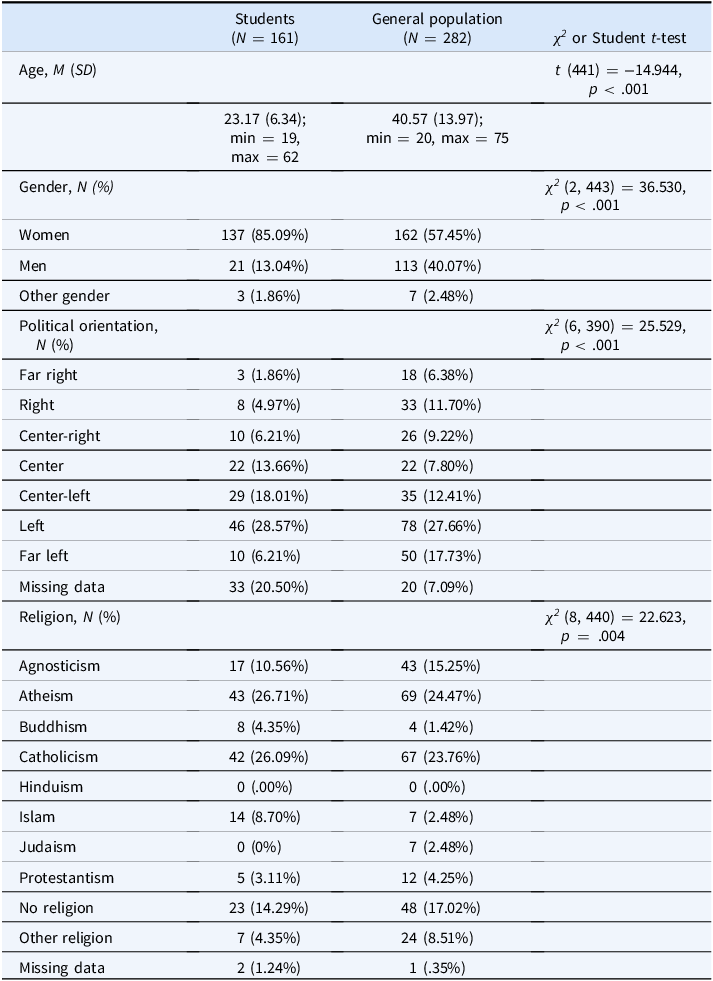
The average age of the sample was 23.17 years. The sample was made up of 137 women, 21 men, and 3 individuals who did not identify themselves as either women or men. Most participants declared their political orientation to be left-wing, center-left, or center. The extreme right was the least represented political party in the sample. Most participants declared themselves atheists or Catholics. The sample did not include any Jewish or Hindu participants.
Results and interpretation
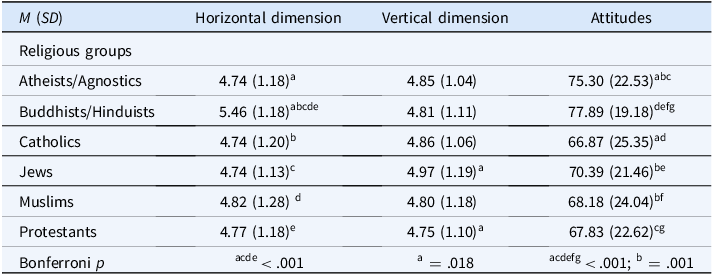
For each religious group, reliability analyses revealed sufficient Cronbach’s alphas for each dimension (α min = .903). Hypotheses were tested using ANOVAs with Bonferroni-adjusted post hoc comparisons. The results are summarized in Table 1. This table presents the mean scores, standard deviations, and Bonferroni-adjusted post hoc comparisons for each religious group on the horizontal dimension, the vertical dimension, and attitudes.
Means for each religious group and inter-group post hoc (Bonferroni)

Table 1. Long description
The table compares religious groups on horizontal dimension, vertical dimension, and attitudes. It has 8 rows and 4 columns. The columns are labeled M (SD), Horizontal dimension, Vertical dimension, and Attitudes. The row labels are Religious groups, Atheists/Agnostics, Buddhists/Hindus, Catholics, Jews, Muslims, Protestants, and Bonferroni p. Each row provides mean scores, standard deviations, and Bonferroni-adjusted post hoc comparisons for each religious group. Notable trends include varying mean scores and standard deviations across different religious groups for each dimension and attitudes.
Note. Within each column, the superscript letters indicate significant pairwise differences between groups. For example, the letter “ a ” appearing next to both Atheists/Agnostics and Buddhists/Hinduists denotes that these two groups differ significantly on the horizontal dimension.
Significant differences were observed across religious groups on the horizontal dimension (F(5,160) = 21.59, p < .001, part-η 2 = .119), but hypothesis H1 was not supported. Buddhists/Hindus are perceived as higher in warmth than other groups, and Muslims do not significantly differ from most groups (except for Buddhists/Hindus).
For the vertical dimension, only limited differences were observed (F(5,160) = 2.43, p = .034, part-η2 = .015), and hypothesis H2 was not supported. Only one significant difference can be observed with Jews perceived as slightly more competent than Protestants.
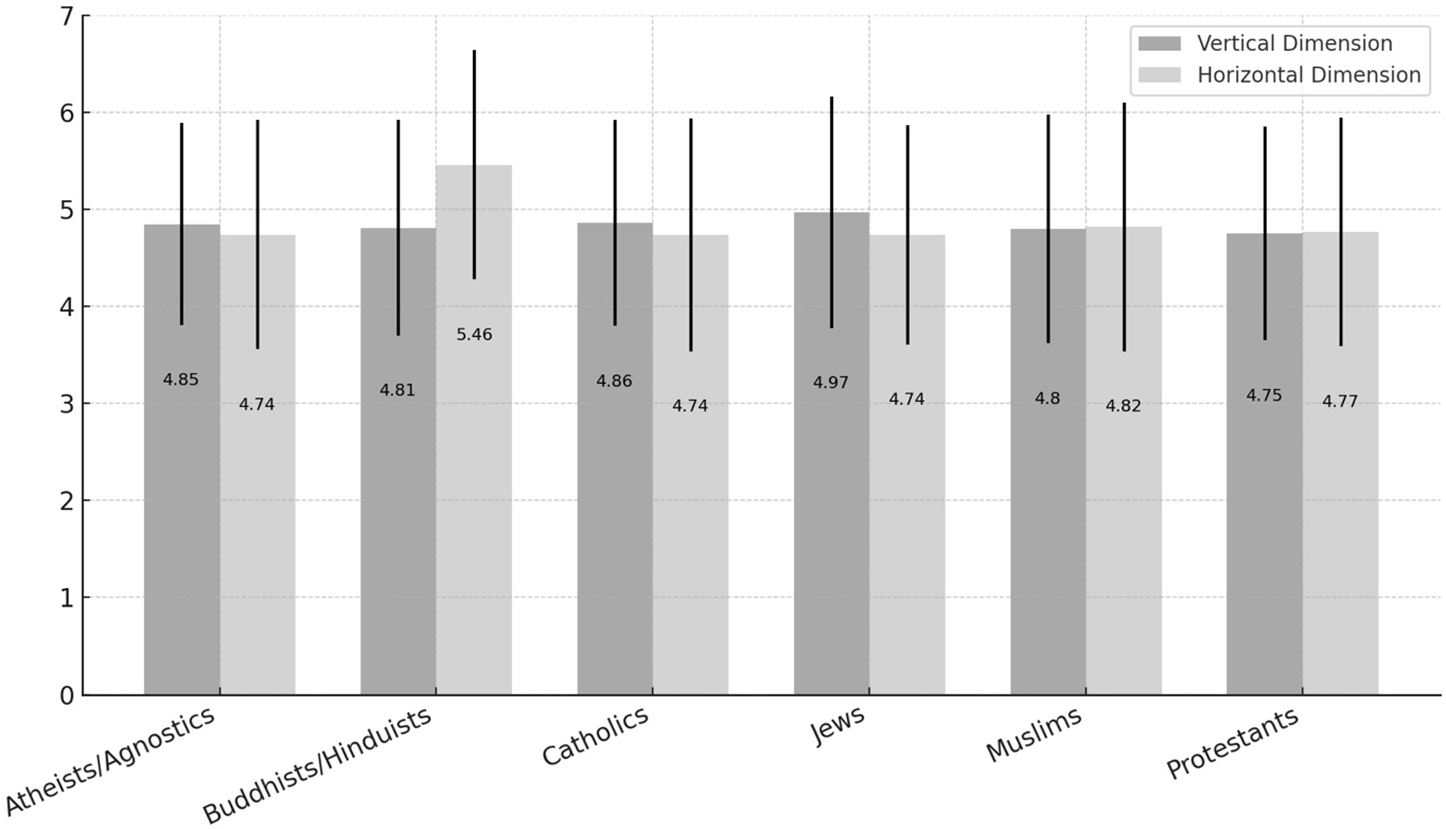
The means and standard deviations for the horizontal and vertical dimensions from Study 1 are presented in Figure 1.
Graphical representation of means and standard deviations for horizontal and vertical dimensions in Study 1.

Finally, significant differences in attitudes were observed across groups (F(5,158) = 12.60, p < .001, part-η2 = .074), but hypothesis H3 was not supported. Attitudes toward Buddhists/Hindus are more positive than toward Catholics, Jews, Muslims, and Protestants. Attitudes toward Atheists/Agnostics are more positive than toward Catholics, Muslims, and Protestants. Attitudes toward Catholics are therefore the most negative.
Overall, the student sample does not display the expected pattern of more negative evaluations toward Muslims. On the contrary, Atheists/Agnostics, Catholics, and Jews are perceived as the lowest on the warmth dimension, and Protestants are perceived as the lowest on the competence dimension. Catholics, in contrast, are subject to the most negative attitudes.
These findings contrast with previous research conducted in contexts where Muslims are a minority group (Fiske, Reference Fiske2017, Reference Fiske2018; Hess and Börner, Reference Hess and Börner2023; Sides and Gross, Reference Sides and Gross2013). Instead, the clearest demarcation is that of Buddhists/Hinduists, who are perceived as significantly warmer, and benefit from more favorable attitudes than other groups. These unexpected results motivated the replication of the analysis in a general population sample.
Study 2
Procedure
As in Study 1, the second study relied on an online questionnaire (Qualtrics). Unlike Study 1, this survey targeted a broader segment of the French population. The survey was disseminated primarily through Facebook (personal accounts, community groups, interest-based discussion spaces). Participants were encouraged to share the survey, resulting in a snowball sampling strategy aimed at increasing socio-demographic diversity. Participation was entirely voluntary, and no compensation was offered. Upon accessing the online questionnaire, participants were first presented with an introductory page outlining the general purpose of the study, data protection principles, and their rights as respondents. They were required to indicate their agreement to participate by selecting the consent option before proceeding to the survey items.
The survey used the same structure and measurement instruments as in Study 1, allowing direct comparison across both samples. The recruitment strategy made it possible to reach adults of varied ages, political orientations, and religious affiliations, thus ensuring stronger socio-demographic heterogeneity than in Study 1. Full details on the composition of the sample are reported in the “Participants” section and in Table 4. As with Study 1, post hoc power analyses indicated satisfactory statistical power (>.80, Cohen, Reference Cohen1988).
Participants
The sample consisted of 282 participants who completed the questionnaire in its entirety (see Table 4). The average age was 40.57 years. The sample was made up of 162 women, 113 men, and 7 people who did not identify themselves as women or men. Most participants declared a left-wing or far-left political orientation. As in the first study, far-right orientations were underrepresented. Finally, most participants declared themselves to be atheists, Catholics, of no religion or agnostics. None of the participants in the sample identified themselves as Hindu.
Results and interpretation
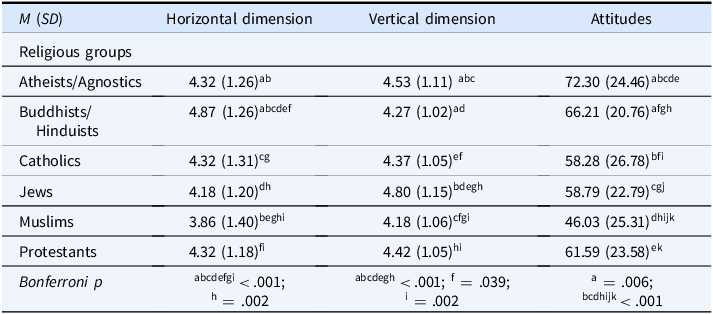
As in Study 1, reliability analyses indicated satisfactory internal consistency across dimensions (α min = .824). Hypotheses were also tested using ANOVAs with Bonferroni-adjusted post hoc comparisons. The results are summarized in Table 2. This table presents the means, standard deviations, and Bonferroni-adjusted post hoc comparisons for each religious group on the horizontal and vertical dimensions as well as on attitudes in Study 2.
Means for each religious group and inter-group post hoc (Bonferroni)

Table 2. Long description
A table comparing religious groups on horizontal and vertical dimensions and attitudes. The table has 8 rows and 4 columns. Column headers are Horizontal dimension, Vertical dimension, Attitudes, and Bonferroni p. Row labels are Religious groups, Atheists/Agnostics, Buddhists/Hindus, Catholics, Jews, Muslims, and Protestants. Each row provides mean values and standard deviations for each dimension and attitudes, along with post hoc comparisons. Notable trends include variations in mean values and standard deviations across different religious groups for each dimension and attitudes.
Note. As in Table 1, superscript letters identify significant pairwise differences within each column. When two groups share the same superscript, this indicates that their scores differ significantly on that specific dimension.
Significant differences were observed across groups on the horizontal dimension (F(5,281) = 29.02, p < .001, part-η2 = .094), supporting hypothesis H1. These results partially replicate Study 1, with Buddhists/Hindus perceived as higher in warmth than other groups. Importantly, Muslims are perceived as lower in warmth than all the other religious groups.
Significant differences were also observed on the vertical dimension (F(5,281) = 24.99, p < .001, part-η2 = .082), partially supporting hypothesis H2 and partially replicating the results of Study 1. Jews are perceived as more competent than all other religious groups. Conversely, Muslims are perceived as less competent than all other religious groups except Buddhists/Hindus, who are themselves perceived as less competent than Atheists/Agnostics and Jews.
Significant differences in attitudes were observed across religious groups (F(5,265) = 52.67, p < .001, part-η2 = .166), supporting hypothesis H3, but contrasting with the results of Study 1. Attitudes toward Muslims are more negative than toward all other religious groups. Attitudes toward Atheists/Agnostics are more positive than toward Buddhists/Hindus, Catholics, Jews, Protestants, and Muslims. Finally, Buddhists/Hinduists enjoy more positive attitudes than Catholics, Jews, and Muslims.
To summarize, within the general population, Muslims are perceived as less warm and competent than other religious groups and are evaluated more negatively. These findings are consistent with our hypotheses and prior research (Fiske, Reference Fiske2017, Reference Fiske2018; Hess and Börner, Reference Hess and Börner2023; Sides and Gross, Reference Sides and Gross2013).
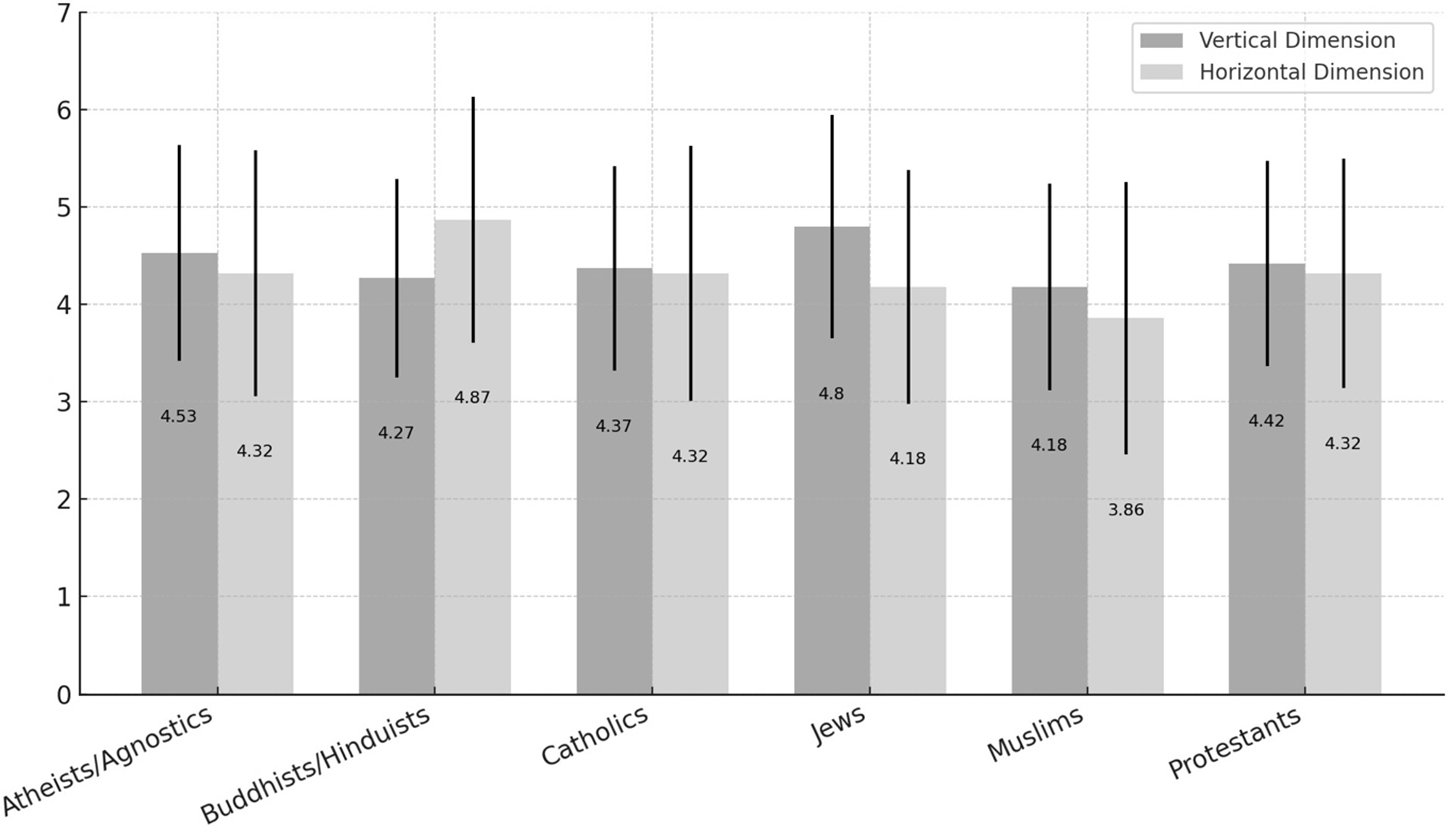
The means and standard deviations for the horizontal and vertical dimensions from Study 2 are presented in Figure 2.
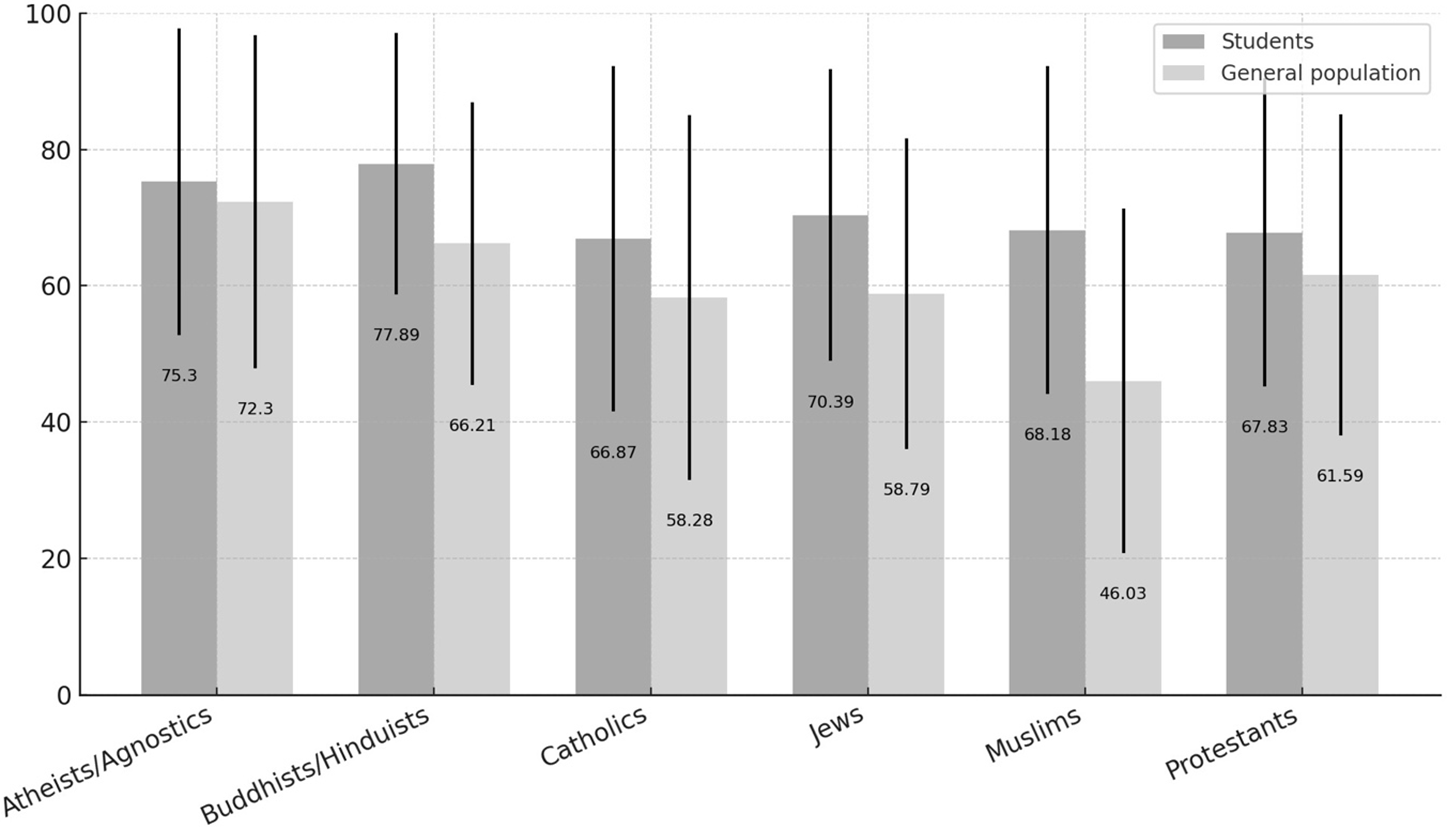
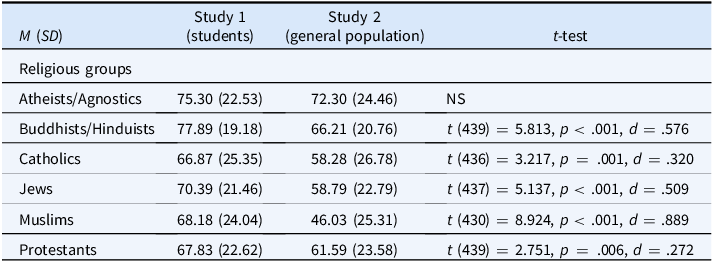
However, these results contrast with those of Study 1, where Muslims were not perceived as lower on either dimension, nor evaluated more negatively. Indeed, comparing the two samples reveals significant differences in attitudes across religious groups. Table 3 specifically highlights these differences using independent-samples t-tests, allowing a direct comparison of attitudes across the two populations. As expected, attitudes in the general population are significantly more negative than in the student sample for all groups, except Atheists/Agnostics (see Table 3 and Figure 3). When comparing effect sizes (Cohen’s d, Table 3), the largest difference is observed for Muslims. Muslims are the only group with an average attitude below the neutral midpoint (50) in the general population sample (M = 46.03, SD = 25.31). This pattern aligns more closely with our hypotheses and with the broader context of rising Islamophobia in France.
Graphical representation of means and standard deviations for horizontal and vertical dimensions in Study 2.

Graphical representation of means and standard deviations for attitudes toward religious groups in Studies 1 and 2.

Means of attitudes for each religious group and results of the t-test between the two samples

Table 3. Long description
The table presents the means and standard deviations of attitudes towards various religious groups, comparing two studies: one with students and one with the general population. It includes the results of independent-samples t-tests for each group. The table has 7 rows and 4 columns. The columns are labeled ‘M (SD)’, ‘Study 1 (students)’, ‘Study 2 (general population)’, and ‘t-test’. The rows are labeled with different religious groups: Atheists/Agnostics, Buddhists/Hindus, Catholics, Jews, Muslims, and Protestants. Each row provides the mean and standard deviation for both studies and the t-test results, including t-value, degrees of freedom, p-value, and Cohen’s d. Notable trends include significant differences in attitudes for all groups except Atheists/Agnostics, with the largest difference observed for Muslims.
To account for the differences observed between the two studies, we examined whether they could be explained by socio-demographic characteristics. The two databases were combined and Student’s t-test and Chi2 tests were performed to estimate whether the two samples differed in their socio-demographic characteristics (see Table 4). Indeed, the results show that the two samples differ in terms of age, gender, religion, and political orientation.
Descriptive statistics of the samples

Table 4. Long description
A table comparing demographic and socio-political characteristics of students and the general population. The table has 10 rows and 5 columns. Column headers are Students (N = 161), General population (N = 282), χ2 or Student t-test, and Age, Gender, Political orientation, and Religion. Row labels include Age, Gender, Political orientation, and Religion. Age is presented as mean (SD) with min and max values. Gender is divided into Women, Men, and Other gender with percentages. Political orientation includes categories from Far right to Far left with percentages. Religion includes categories from Agnosticism to Missing data with percentages. Notable trends include a higher percentage of women among students and a higher percentage of men in the general population. Students are predominantly left-leaning, while the general population shows a more varied political orientation. Agnosticism and Atheism are the most common religions among students, while Catholicism is more prevalent in the general population.
We then examined how these differences relate to variations in social judgment. More specifically, we analyzed which psychosocial factors predict attitudes toward Muslims when accounting for socio-demographic variables. We focused on attitudes toward Muslims, as it is on this variable that we can observe a notable difference between the two studies, and an explicit expression of prejudice in Study 2 (see Table 3 and Figure 3).
Meta-analysis of Studies 1 and 2
Procedure and participants
A second series of analyses were conducted to investigate the antecedents of social judgment toward Muslims, drawing on the Social Structure Hypothesis (Fiske et al., Reference Fiske, Cuddy, Glick and Xu2002; Fiske, Reference Fiske2015, Reference Fiske2018; Seghouat et al., Reference Seghouat, Bourguignon, Herman, Vonthron, Bobillier-Chaumon, Gangloff and Gilbert2021).
Results and interpretation
To compute composite measures of perceived social status, power, symbolic threat, and intergroup competition, reliability analyses (Pearson correlations and Cronbach’s alphas) were conducted. All correlations were found to be significant, except for the “intergroup competition” factor, for which correlations were either insignificant or had a poor correlation index. Reliability analyses indicated satisfactory internal consistency across dimensions except among intergroup competition items (p < .001; α > .60). Consequently, competition and collaboration were treated as separate indicators.
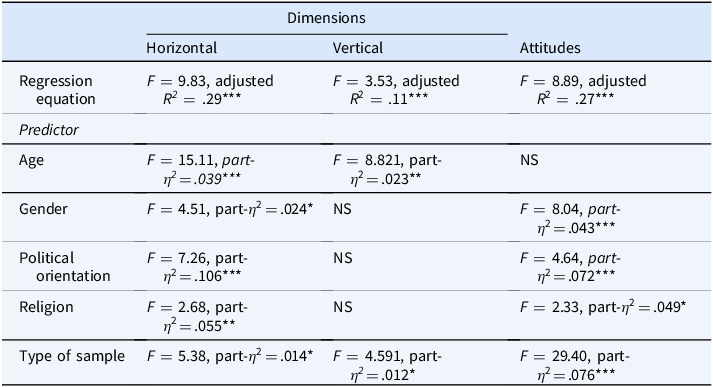
General linear models were conducted to examine the role of socio-demographic factors (age, gender, political orientation, religion, and sample type) in shaping social judgment and attitudes toward Muslims. Results are summarized in Table 5. This table reports, for each predictor, its specific contribution (F-values and partial η2 ) to the horizontal and vertical dimensions of social judgment, as well as to attitudes toward Muslims, allowing us to identify which socio-demographic factors have the strongest explanatory power.
General linear models (GLMs) for the two dimensions of social judgment and perceived attitudes toward Muslims

Table 5. Long description
The table presents the results of general linear models examining the impact of socio-demographic factors on social judgment and attitudes toward Muslims. It includes three main columns: Horizontal, Vertical, and Attitudes, each detailing the regression equation and predictor contributions. The regression equations provide F-values and adjusted R-squared values. Predictors include Age, Gender, Political orientation, Religion, and Type of sample, with their respective F-values and partial eta-squared values. Notable trends include significant contributions from Age, Gender, Political orientation, and Type of sample across different dimensions.
Note. *p < .05, **p < .01, ***p < .001.
As expected, social judgment and attitudes were influenced by socio-demographic characteristics and sample type. To identify predictors of attitudes toward Muslims while accounting for socio-demographic differences, the “inverse propensity score weighting” technique was applied (Bauquier et al., Reference Bauquier, Ginguené, Leroy, Doumergue, Lebrun, Della Vecchia, Mabire-Yon, Leveaux, Sagaon-Teyssier and Préau2024; Guo and Fraser, Reference Guo and Fraser2014; McCaffrey et al., Reference McCaffrey, Ridgeway and Morral2004).
This approach uses a propensity score derived from participants’ socio-demographic characteristics to reweight observations, ensuring comparability between the student and general population samples.
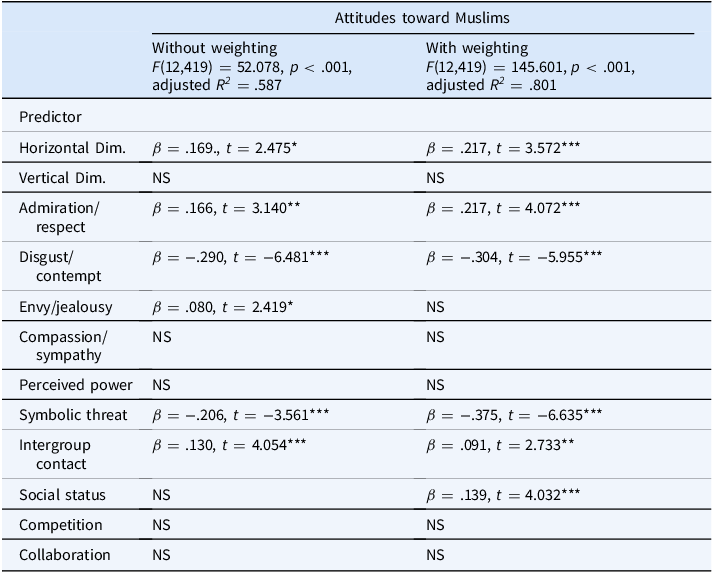
To identify predictors of attitudes toward Muslims, a multiple linear regression (input method) was run on attitudes, based on the two dimensions of social judgment, perceived emotions, and social structure variables (perceived power, perceived symbolic threat, intergroup contact, perceived social status, perceived competitive relationship, perceived collaborative relationship). This linear regression was run both without weighting, and with the propensity score obtained previously, to identify variations in the model. Results are summarized in Table 6. In this table, each model reports standardized coefficients (β) and associated t-values, allowing the reader to compare the relative contribution of each predictor. Variables marked as NS do not significantly predict attitudes in the corresponding model.
Multiple linear regressions on attitudes toward Muslims, with and without inverse propensity score weighting

Table 6. Long description
The table presents a comparison of predictors of attitudes toward Muslims using multiple linear regression, both without weighting and with weighting. It includes standardized coefficients (β) and associated t-values for each predictor. The table has 13 rows and 4 columns. The columns are labeled ‘Without weighting’ and ‘With weighting’, each containing F-values, p-values, and adjusted R-squared values. The rows are labeled with predictors: Horizontal Dim., Vertical Dim., Admiration/respect, Disgust/contempt, Envy/jealousy, Compassion/sympathy, Perceived power, Symbolic threat, Intergroup contact, Social status, Competition, and Collaboration. Each cell contains β values and t-values or ‘NS’ indicating non-significance. Notable trends include significant predictors like Horizontal Dim., Admiration/respect, Disgust/contempt, Envy/jealousy, Symbolic threat, and Intergroup contact in both models, with varying degrees of significance.
Note. *p < .05, **p < .01, ***p < .001.
For instance, in both models, symbolic threat shows a strong negative association with attitudes, illustrating how threat perceptions reliably predict more unfavorable views.
Both regression models are statistically significant. Diagnostic tests (Variance Inflation Factor, VIF and tolerance, TOL) indicate no issues of severe multicollinearity (VIF<5; TOL > .20, Bressoux, Reference Bressoux2010).
Furthermore, the percentage of variance explained increases sharply after using inverse propensity score weighting. The results show an increase in the adjusted R 2 of .214 after weighting (adjusted R 2 = .801). Weighting also modifies the relative importance of predictors. Emotions of envy/jealousy are no longer a significant predictor after weighting, whereas social status becomes significant.
Based on the weighted model, attitudes toward Muslims are primarily predicted by perceived symbolic threat, followed by intergroup emotions (disgust/contempt and admiration/respect) and warmth-related judgments (i.e., horizontal dimension). Intergroup contact and perceived social status also contribute positively, although to a lesser extent.
Higher perceived warmth, admiration, contact, and social status are associated with more favorable attitudes, whereas higher perceived symbolic threat and feelings of disgust or contempt predict more negative attitudes.
Discussion and conclusion
The impact of social context on perceptions of Muslims
The results reveal opposing attitudes and stereotypes toward Muslims in Studies 1 and 2. On the one hand, in the “student” sample (Study 1), Muslims stand out rather positively from other religious groups. On the other hand, the opposite result is observed within the “general population” sample (Study 2); Muslims would be perceived as lower on horizontal and vertical dimensions (Low warmth/Low competence) compared with other religious groups. The general population’s perception of Muslims as low warmth and low competence is in line with our initial hypotheses and the literature on Islamophobia and stereotyping of Muslims. Indeed, Fiske (Reference Fiske2017, Reference Fiske2018) shows that when Muslims are not the reference group (i.e., majority and dominant) within the population, the latter are perceived either as weak on both dimensions, or as of low warmth and moderate competence. Moreover, Muslims would be perceived as lower on both dimensions than Jews and Catholics (Fiske et al., Reference Fiske, Cuddy, Glick and Xu2002). These results are replicated by Grigoryev et al. (Reference Grigoryev, Fiske and Batkhina2019), who show that Western Islamic groups are perceived as less warm and less competent than Western Christian groups. In the present study, this contrast is particularly noteworthy from a political perspective, as it suggests that the diversification of socio-demographic and ideological profiles within the general population is associated with more negative perceptions of Muslims, even in contexts that are not dominated by right-wing orientations, thereby pointing to the broader diffusion of exclusionary attitudes beyond clearly identifiable political groups.
However, these contrasted results highlight that negative stereotypes are not automatic within the French context itself and that the characteristics of the sample are crucial for social judgment. These results support the recommendations of Van Assche and colleagues (Reference Van Assche, Noor, Dierckx, Saleem, Bouchat, De Guissme, Bostyn, Carew, Ernst-Vintila and Chao2020), who suggest greater consideration of ecological validity in social psychology studies, particularly when it comes to studying intergroup relationships. Indeed, the social judgment that individuals may make about Muslims is highly dependent on the social context in which the research is conducted. When Muslims are the reference group, they would be perceived as high on both dimensions (i.e., perception High/High, warm, and competent; Fiske, Reference Fiske2017). This influence of social context and population characteristics is also underlined by Walsh and Tartakovsky (Reference Walsh and Tartakovsky2021), who highlight that the structural characteristics of the sample (such as, for example, adherence to certain individual values, openness to change, or conservatism) impact social judgment (here, with regard to people of immigrant background). Indeed, our findings suggest that variations in social perception are closely tied to the socio-political composition of populations, highlighting how attitudes toward Muslims are embedded within broader ideological and generational dynamics that structure political attitudes in contemporary France.
Beyond their theoretical implications, these findings are also relevant considering current political debates in France. Research shows that stereotypes and threat perceptions inform preferences for exclusionary policies, institutional regulation of Islam, and the political treatment of minority groups (e.g., Matthes et al., Reference Matthes, Schmuck and Von Sikorski2019; Sides and Gross, Reference Sides and Gross2013; Wirtz et al., Reference Wirtz, Van Der Pligt and Doosje2016). Indeed, social judgments of Muslims—particularly when they involve low perceived warmth or heightened threat—contribute to shaping support for security-oriented policies, restrictions on religious expression, and broader attitudes toward multiculturalism and secularism. In this respect, the observed patterns provide insight into the social foundations of political polarization around Islam in France, as well as the conditions under which exclusionary or security-oriented discourses may resonate more strongly within certain segments of the population and may contribute to the effectiveness of political actors who mobilize around themes of security, identity, and cultural threat. The contextual differences observed between the two samples therefore shed light on how socio-demographic and ideological environments contribute to politically meaningful attitudes toward Muslims in contemporary France, contributing to the structuring of political polarization around Islam-related issues.
Interplay of warmth, threats, and intergroup emotions in forming attitudes toward Muslims
In contrast, even though social judgment varies, the results reveal that beyond the sample characteristics, attitudes toward Muslims are influenced by a specific perception in terms of psychosocial variables. The results of these studies support the relevance of using the Stereotype Content Model and the social structure hypothesis (Fiske et al., Reference Fiske, Cuddy, Glick and Xu2002; Fiske, Reference Fiske2015, Reference Fiske2018; Seghouat et al., Reference Seghouat, Bourguignon, Herman, Vonthron, Bobillier-Chaumon, Gangloff and Gilbert2021) in understanding attitudes toward Muslims. The proportion of variance in attitude explained by the weighted regression model (Study 3) is particularly high (adjusted R 2 = .801).
However, although the Stereotype Content Model seems to be a relevant theoretical framework for predicting attitudes and behavioral intentions toward an outgroup, only one of the two dimensions emerges from the analyses. Indeed, of the two dimensions, it is the horizontal dimension of warmth (and not the vertical dimension of competence) that seems to predict attitudes. These results suggest that a stereotypical perception of Muslims as having low warmth would be linked to more negative attitudes toward them (and vice versa). In contrast, seeing them as more or less competent would not be related to attitude valence.
These findings are consistent with prior research showing that the horizontal dimension (i.e., communion) plays a more central role than competence in shaping group evaluations (Wojciszke et al., Reference Wojciszke, Abele and Baryla2009; Wojciszke and Abele, Reference Wojciszke and Abele2008). Indeed, “considerable evidence suggests that warmth judgments are primary: warmth is judged before competence, and warmth judgments carry more weight in affective and behavioral reactions” (Fiske et al., Reference Fiske, Cuddy and Glick2007, 77). Thus, behavioral intentions toward the outgroup are primarily driven by perceived morality—often linked to perceived threat—rather than competence (Brambilla et al., Reference Brambilla, Sacchi, Pagliaro and Ellemers2013). The results also highlight the importance of perceived (symbolic) threat in shaping attitudes toward Muslims. This threat can be both realistic—linked to security concerns—and symbolic—related to perceived challenges to cultural norms and values. These perceptions have been widely associated with more negative attitudes toward Muslim populations (Ciftci, Reference Ciftci2012; Wike and Grim, Reference Wike and Grim2010; Wirtz et al., Reference Wirtz, Van Der Pligt and Doosje2016).
The combination of negative stereotypes and perceived threat—mediated by moral emotions such as disgust, anger, or pity—has been shown to predict negative attitudes toward Muslims (Wirtz et al., Reference Wirtz, Van Der Pligt and Doosje2016). In line with this, our results confirm that intergroup emotions play a significant role in shaping attitudes, particularly those associated with active or passive forms of prejudice, such as disgust/contempt and admiration/respect (Cuddy et al., Reference Cuddy, Fiske and Glick2007). Indeed, the results of our two studies suggest the relevance of considering stereotype content (especially the horizontal dimension), perceived threat, and intergroup emotions jointly to predict attitudes toward Muslims. In addition to these central predictors, our combined and weighted analyses (Study 3) also reveal small but significant positive effects of perceived social status and intergroup contact on attitudes toward Muslims, indicating that contact and status perceptions contribute—albeit modestly—to reducing negative evaluations. This pattern echoes findings from other multicultural contexts, such as Canada, where interreligious contact significantly predicts more favorable views of Muslim minorities (Zafar and Ross, Reference Zafar and Ross2015).
From social perceptions to political dynamics
Taken together, our findings highlight a consistent pattern; attitudes toward Muslims are primarily shaped by perceived threat, followed by intergroup emotions and warmth-related judgments, when competence plays a less important role. Additional factors such as intergroup contact and perceived social status also contribute, albeit more modestly, to shaping these attitudes.
More specifically, these results emphasize the central role of perceived (symbolic) threat in shaping attitudes toward Muslims. This suggests that such attitudes may be structured around concerns related to security, identity, and cultural cohesion. In this respect, they resonate with the cultural backlash framework (Norris and Inglehart, Reference Norris and Inglehart2019), which posits that perceived threats to traditional values and social norms can fuel support for more conservative or exclusionary political positions. They are also consistent with research on status threat (Mutz, Reference Mutz2018), highlighting how perceived challenges to the social and cultural dominance of majority groups can shape political attitudes and preferences. In this sense, perceptions of Muslims may become embedded in broader value- and status-based conflicts shaping political attitudes toward immigration, secularism, and national identity. These dynamics are known to underpin support for restrictive or security-oriented public policies, as well as regulatory approaches to religious expression (Sides and Gross, Reference Sides and Gross2013; Wirtz et al., Reference Wirtz, Van Der Pligt and Doosje2016).
More importantly, these findings help explain why certain political discourses may resonate more strongly within the population. Emotionally charged narratives emphasizing cultural threat, identity loss, or security risks are likely to be particularly effective in contexts where such perceptions are already salient in public discourse (Brader, Reference Brader2020; Wodak, Reference Wodak2015). In this sense, perceived threat and associated moral emotions—such as disgust or contempt—can be understood as key mechanisms through which political actors mobilize public opinion, particularly in debates surrounding immigration, secularism, and national identity. Such mechanisms are also consistent with research on populist radical right discourse, which emphasizes the role of perceived cultural threat and the construction of symbolic social and political boundaries between majority populations and minority groups (Mudde, Reference Mudde2007).
The prominence of intergroup emotions further reinforces this dynamic. Emotions such as disgust and contempt contribute to boundary-making processes and may legitimize exclusionary attitudes, whereas admiration and respect are associated with more inclusive orientations (Cuddy et al., Reference Cuddy, Fiske and Glick2007). These affective mechanisms are central to the development of political polarization, as they shape not only individual attitudes but also the intensity and rigidity with which these attitudes are held, particularly on issues related to Islam and religious diversity. This is consistent with previous research on affective polarization, which shows that social identities—including religion—have become increasingly aligned with partisan divisions, thereby reinforcing the intensity of political conflict (Iyengar et al., Reference Iyengar, Lelkes, Levendusky, Malhotra and Westwood2019).
At the same time, the positive—albeit modest—effects of intergroup contact and perceived social status suggest potential avenues for reducing negative attitudes. By fostering more frequent and meaningful interactions between groups, as well as by challenging status-based perceptions, it may be possible to mitigate the salience of threat and reduce the intensity of negative emotions (Dovidio et al., Reference Dovidio, Gaertner and Kawakami2003; Gaertner et al., Reference Gaertner, Dovidio, Banker, Houlette, Johnson and McGlynn2000; Pettigrew and Tropp, Reference Pettigrew and Tropp2006). From this perspective, our findings point to potential levers for countering polarization and promoting more inclusive forms of political engagement and, more broadly, contributing to democratic resilience.
Methodological considerations and limitations
The methodological choices adopted in this research require careful consideration, particularly given the tension between analytical control and ecological validity in the study of social judgment. Perceptions of religious groups are shaped by socio-demographic, political, and media contexts (Ameline et al., Reference Ameline, Ndobo and Roussiau2019; Fiske, Reference Fiske2017; Hoffmann and Miller, Reference Hoffmann and Miller1997; Margolis, Reference Margolis2018), making reliance on a single homogeneous population potentially problematic. We therefore deliberately employed two complementary recruitment strategies. Study 1 relied on university students, a population commonly used to investigate cognitive and affective mechanisms underlying stereotypes but characterized by well-documented socio-demographic specificities, including younger age, higher education, and more left-leaning orientations. Study 2 recruited participants through social networks and snowball sampling, increasing heterogeneity in age, political orientation, and religious affiliation, while also introducing other sources of sampling bias. In particular, right-wing and far-right respondents were underrepresented, and some religious groups were absent or only weakly represented.
The contrast between the two samples should therefore be considered not only as a limitation but also as an analytical strength. Comparing socially distinct populations allowed us to examine how social evaluations vary across socio-demographic and ideological environments, in line with research emphasizing ecological validity in studies of stereotypes and intergroup relations (Van Assche et al., Reference Van Assche, Noor, Dierckx, Saleem, Bouchat, De Guissme, Bostyn, Carew, Ernst-Vintila and Chao2020). This design also responds to longstanding critiques of the reliance on student samples in social psychology (Gallander Wintre et al., Reference Gallander Wintre, North and Sugar2001; Jones and Sonner, Reference Jones and Sonner2001). Rather than abandoning student samples, Henry (Reference Henry2008) recommends complementing them with more diverse populations. The contrasting patterns observed across our two studies support this approach and suggest that differences in attitudes may reflect broader socialization environments, exposure to diversity, political orientations, and age structures rather than any single socio-demographic characteristic.
The composition of the general population sample nevertheless warrants particular attention. Despite its left-leaning profile and the underrepresentation of right-wing and far-right respondents, who tend to express stronger anti-Muslim attitudes (Hafez, Reference Hafez2014; Vidgen et al., Reference Vidgen, Yasseri and Margetts2022), this sample still evaluated Muslims more negatively than other religious groups. Although this does not establish population prevalence, it suggests that the observed pattern cannot simply be attributed to an overrepresentation of respondents holding more conservative political orientations. This interpretation is consistent with recent large-scale surveys documenting substantial levels of discrimination against Muslims in France. Both the 2024 FRA report and a 2025 IFOP survey show that Muslims report markedly higher levels of discrimination and racist behaviors than the general population or members of other religious groups, with religion frequently identified as a primary reason for these experiences (European Union Agency Kraus and Lasserre, Reference Kraus and Lasserre2025; for Fundamental Rights, 2024). These findings underline both the magnitude and the specifically religious dimension of anti-Muslim prejudice in France and reinforce the relevance of examining the psychosocial processes associated with such attitudes.
At the same time, the general population sample was recruited through Facebook diffusion and snowball sampling rather than probabilistic methods and cannot be considered representative of the French population. To reduce the influence of compositional differences when combining the two datasets, we applied inverse propensity score weighting based on age, gender, political orientation, and religious affiliation. This procedure improves comparability between the samples and reduces the extent to which the observed associations reflect differences in sample composition rather than underlying psychosocial mechanisms. However, such statistical adjustment cannot substitute for probabilistic sampling. Accordingly, the present research should be understood as exploratory; its primary aim is not to estimate the prevalence of attitudes in the French population, but to identify psychosocial mechanisms that may exacerbate or mitigate negative evaluations across different social contexts.
Several limitations also concern the measures used. First, the valence of the traits assessing the horizontal and vertical dimensions was not controlled and may have influenced participants’ evaluations (Rohmer and Louvet, Reference Rohmer and Louvet2012). Future research should therefore control item valence and, where appropriate, incorporate it into the analyses. Second, stereotypes were assessed explicitly, and responses may consequently have been affected by social desirability (Nederhof, Reference Nederhof1985), particularly among university students, who may be especially attentive to egalitarian norms (Henry, Reference Henry2008). Social desirability may encourage less direct expressions of prejudice that can be justified without explicit reference to group membership (Ndobo, Reference Ndobo and Ndobo2010). Nevertheless, this bias does not appear to have systematically suppressed negative evaluations in our data; student participants expressed relatively unfavorable attitudes toward some religious groups and particularly favorable attitudes toward others, whereas the general population sample expressed markedly negative attitudes toward Muslims despite completing the same anonymous questionnaire. Social desirability may therefore coexist with underlying stereotypes rather than fully account for the differences observed between samples, consistent with evidence that social norms can regulate the expression of prejudice without necessarily eliminating stereotype-based judgments (Crandall et al., Reference Crandall, Eshleman and O’Brien2002).
A related limitation concerns the distinction between stereotype content, stereotype endorsement, and stereotype application. Stereotype activation does not necessarily imply that individuals personally endorse or use the stereotype when judging members of the target group (Devine, Reference Devine1989; Kunda and Spencer, Reference Kunda and Spencer2003). Although the present research focused on stereotype content, our measures do not allow us to clearly determine whether responses reflect knowledge of socially shared stereotypes or personal adherence to them. The behavioral consequences of stereotypes are also likely to depend on individual and contextual regulation, including motivations to maintain positive intergroup relations, exposure to counter-stereotypical information, self-related motives, and attentional processes (Blair, Reference Blair2002; Devine, Reference Devine1989; Unkelbach et al., Reference Unkelbach, Goldenberg, Müller, Sobbe and Spannaus2009).
Future research should therefore seek to distinguish more clearly between stereotype content, personal endorsement, and application. One possibility would be to combine explicit measures with implicit measures such as the Implicit Association Test (Greenwald et al., Reference Greenwald, McGhee and Schwartz1998, Reference Greenwald, Poehlman, Uhlmann and Banaji2009), while recognizing the ongoing debate regarding the validity of the IAT as an indicator of unconscious stereotypes and discriminatory behavior (Blaison et al., Reference Blaison, Chassard, Kop and Gana2006; Oswald et al., Reference Oswald, Mitchell, Blanton, Jaccard and Tetlock2013). Another approach, inspired by research on the silent zone of social representations (Abric, Reference Abric and Abric2005; Flament et al., Reference Flament, Guimelli and Abric2006; Guimelli et al., Reference Guimelli, Lo Monaco and Deschamps2010), would be to compare responses provided from the presumed perspective of others with responses given in participants’ own names. Such designs may help disentangle socially shared stereotype content from individual endorsement.
Finally, because stereotypes toward religious groups are highly context-dependent (Fiske, Reference Fiske2017; Walsh and Tartakovsky, Reference Walsh and Tartakovsky2021), these findings should be replicated in other social and cultural environments, particularly where Muslims occupy different majority/minority or dominant/non-dominant positions. Cross-cultural comparisons would provide a stronger test of the role of social context in structuring stereotype content. Experimental designs would also complement the present correlational approach by allowing the causal contribution of specific psychosocial mechanisms, such as symbolic threat or intergroup emotions, to be isolated more precisely.
In conclusion, this research shows that in a context where discrimination against Muslims is high, stereotyping is neither automatic nor uniform. Rather, social evaluations depend strongly on the socio-demographic and ideological characteristics of the population surveyed. In our student sample—characterized by younger age, higher education, and predominantly left-leaning political orientations—Muslims were not evaluated more negatively than other religious groups. By contrast, in the more heterogeneous general population sample, attitudes toward Muslims were substantially more negative, despite its left-skewed political profile. When accounting for socio-demographic differences, our analyses reveal that attitudes toward Muslims are primarily predicted by perceived threat, followed by emotions of disgust/contempt, warmth-related judgments, admiration/respect, perceived social status, and intergroup contact. These findings highlight the central role of psychosocial mechanisms in shaping attitudes toward a religious minority that occupies a highly salient position in public debate in contemporary France. More broadly, these results contribute to understanding how such perceptions may translate into politically meaningful attitudes. Perceptions of threat and warmth are known to inform support for exclusionary, security-oriented, or regulatory policies targeting Muslims, as well as broader debates surrounding immigration, secularism, and national identity. Taken together, these findings underscore the importance of considering both social context and psychosocial predictors while analyzing intergroup attitudes and the political treatment of minority religious groups.
Financial support
The authors have no funding to report. Given the sensitive nature of the data, the data and replication files cannot be made publicly available.
Competing interests
The authors have no competing interests to report.
Stéphéline Ginguené, PhD, is a Postdoctoral Researcher at Université Lumière Lyon 2, France. Her research lies at the intersection of social and health psychology, with a societal perspective, and focuses on two main areas: social representations, stereotypes, and emotions related to minority and stigmatized groups; and the psychosocial processes affecting individuals’ quality of life in the context of chronic illness.
David Bourguignon, PhD, is Full Professor of Social Psychology at the Université de Lorraine, France. His research focuses on intergroup relations and identity processes, with a particular interest in the stigmatization of low-status groups, including unemployed people and groups stigmatized on the basis of sexual orientation or religious beliefs.
Pierre Bouchat, PhD, is a Professor of social psychology at the Université de Lorraine, France, and a fellow of the Institut Universitaire de France. His research focuses on the long‑term psychosocial effects of war. He is also interested in the role of collective emotions at the individual, intra‑, and inter‑group levels.
Marie Préau, PhD, is a Professor of Social Psychology at Université Lumière Lyon 2 and Director of the INSERM U1290 RESHAPE Research Unit, France. Her research focuses on the psychosocial processes involved in the prevention and management of chronic diseases, including HIV, infectious diseases, cancer, and stroke. She is particularly involved in participatory, community-based, and intervention research, conducted in diverse socio-cultural contexts in France and internationally and co-constructed with the populations concerned.

 Open access

