Introduction
Technologies that powered the Green Revolution such as the use of high-yielding varieties, chemical fertilizers and pesticides, coupled with the expansion of the area under irrigation transformed India from a net food importer in the 1950s and 1960s to a self-sufficient nation in the 1980sReference Donald, Eugene, Pannu and Sheokand1. However, the techniques that were used to increase agricultural yield have led to significant surface and ground water contamination, an increased incidence of pests and diseases, and loss of biodiversity2–Reference Pimentel, Harvey, Resosudarmo, Sinclair, Kurz, McNair, Crist, Shpritz, Fitton, Saffouri and Blair6. Increased production costs and indebtedness are other problems faced by farmers in India2, Reference Eyhorn, Ramakrishnan and Mäder7–Reference Rao9. All these problems have created an interest in organic agriculture among farmers, researchers, policy-makers and other stakeholders.
Organic agriculture is an integrated production system based on active agro-ecosystem management rather than external inputs10. Organic agriculture includes both certified and non-certified food systems. Farming systems that actively follow organic principles are considered organic, even if the agro-ecosystem or the farm is not formally certified as organicReference Scialabba and Nærstad11. Studies from across the world have shown that both economic factors, such as increased income, reduction in the input cost and the opportunity to get a premium price for the harvest12–Reference Lampkin, Lampkin and Padel16, and non-economic factors, such as improved soil fertility, environmental protection, quality food products and healthReference Reganold17, Reference Lotter, Seidel and Liebhardt18, influenced the farmer's decision to adopt organic farming.
With a total of 1.02 million ha in organic production, India has the largest number of organic farms (340,000) in the world, registering a growth increase of 87% in the export of organic products over the past 3 yearsReference Willer and Lukas19. Different factors have persuaded farmers to convert. In Kerala,Reference Sherief, Anilkumar, Husain, Jeyawardana, Neuhoff, Halberg, Alföldi, Lockeretz, Thommen, Rasmussen, Hermansen, Vaarst, Lück, Carporali, Jensen, Migliorini and Willer20 homestead farmers growing coconut were persuaded by socio-psychological factors such as education, risk orientation and knowledge, while the negative impact of conventional agriculture on environment and revenue influenced the farmers in KarnatakaReference Murthy, Dhananjaya and Naik21. However, low yield, lack of organic manures and lack of technical knowledge were the major constraints for adopting organic farming in MaharashtraReference Tarde, Shirke, Khandve and Chavai22.
The above few studies focused on specific crops, except for a study about organic cotton farming and its impact on the livelihood of small and medium-sized farmers in Madhya PradeshReference Eyhorn23. However, little research has been carried out at farm scale for resource-poor, organic, small farmers, taking into account the way in which activities of non-governmental organizations (NGOs) may impact on perception and possibilities to convert from conventional to organic farming. Therefore, the present study was undertaken in three states of India, namely Madhya Pradesh, Tamil Nadu and Uttarakhand, with the following research questions:
1. What are the barriers for conversion to organic farming?
2. What are the motives for conversion to organic farming?
3. What are the advantages and challenges in practicing organic farming?
Understanding these would help researchers, policy-makers and other stakeholders to develop strategies to increase the adoption of organic farming in India, where it is expected particularly to benefit smallholder farmers.
Methods
The research was designed to cover three states of India in order to represent three very different situations in terms of agro-ecological conditions, farming system, market access and activities of NGOs promoting organic farming. The states chosen were Madhya Pradesh, Tamil Nadu and Uttarakhand (Fig. 1).
Location of the surveyed states in India.

Context of organic farming in the case areas
The function of the NGOs in the three states is described below.
BioRe India in Madhya Pradesh
BioRe India is a private agribusiness company, promoting organic cotton production in Madhya Pradesh and export to Europe. The company started as a non-commercial experiment to help cotton farmers reduce their debt and secure a sustainable livelihood and became an enterprise with the social responsibility to combine ecology with economic profitReference Eyhorn, Mader and Ramakrishnan24. At present, the BioRe India project is active in the Nimar Valley, involving 6400 smallholders who cultivate 6502 ha of cotton and produce more than 3963 tonnes of seed cotton per year.
An independent but related organization, the BioRe Association, runs a training center offering education in organic farming and provides interest-free credit to farmers to develop infrastructure such as biogas facilities, vermicomposts, irrigation facilities and provisions for safe drinking water. BioRe Association also provides farmers with farm inputs such as seeds, de-oiled castor, rock phosphate, botanical and microbial pesticides, etc., if needed. The company also provides vocational training and advisory services. BioRe enters into 5-year purchase guarantee contracts with farmers, purchases the seed cotton at prevailing market rates and pays an up to 20% price premium at the end of the season to the farmers who have completed the 3-year conversion period. In the first year, farmers receive the inputs on a credit basis, while in the following years input costs are adjusted with the price premium from the previous year.
Center for Indian Knowledge System (CIKS) in Tamil Nadu
CIKS is an NGO active in Kancheepurm, Thiruvannamalai, Dindugal and Nagapattinam districts of Tamil Nadu and farmers were all still in the conversion period during the time of study. The NGO provides short-term training programs and follow-up training sessions for practicing organic farming. The farmers were trained on various aspects of organic farming such as soil conservation, enriching soil fertility, pest and disease identification and their organic management techniques, kitchen gardening, compost and vermicompost production, biopesticide preparation, etc. Monthly meetings were arranged for each organic farmers' group at the behest of the NGO to discuss organic farming and the farmers' experience in practicing it. During the initial stages of the conversion period, inputs such as traditional variety seeds, biofertilizers, green manure seeds, neem cake, etc., were supplied by the organization through the project. Demonstration fields were set up in all four districts, these fields served as learning centers for the farmers and helped to create awareness about organic farming among the farmers of neighboring villages also.
An organic farm production society was established in each of the four districts. Currently, most of the marketing activities are taken care of by these societies by direct contact with consumers living near cities. The societies sell the products to consumers with a 10% price premium. Under certain circumstances CIKS also buys organic products on its own from the farmers with a 10% premium and sells them directly in markets located as far away as Chennai, the state capital.
Navdanya in Uttarakhand
Navdanya is active in 16 states of India, although it mainly focuses on Uttarakhand. It has trained 200,000 farmers in organic production. Navdanya provides short-term training programs and follow-up training sessions for farmers interested in organic farming and for farmers interested in being self-reliant in the input use of locally available resourses. It also arranges exposure visits to other organic farms. Navdanya has its own community seed bank, conserved indigenous varieties and organic farm spread over a 20-acre area of in Uttarakhand, north India. This farm is used as a demonstration farm for the farmers. Navdanya buys organic products from farmers with a 10% price premium. Most of the organic farmers are linked to the local market. In some instances there is a direct marketing link between Navdanya's consumer members and producer members, and in a few cases a door-to-door organic vegetable basket delivery is operated.
Agroecological conditions
Madhya Pradesh lies in the central part of India. Three districts of Madhya Pradesh—Barwani, Khargaon and Khandwa—were identified for data collection. These are classified under the agroecological region/subregion-5.2/ I5Dm4 as hot semi-arid ecosystems with deep black soils, and average annual rainfall is 800–1000 mm with a mean temperature of 24–25°CReference Velayutham, Mandal, Mandal and Sehgal25. Cotton is the main crop which, on a national scale, covers only 5% of the total cropped area, but consumes 28% of the total pesticide usage in IndiaReference Choudhary and Gaur26. Most of the cotton was intercropped with soybean, pigeon pea and urad bean. Conventional farmers used fertilizers and manures for soil nutrient management and pesticides for managing pests and diseases. Organic farmers used organic inputs such as DOC (castor de-oiled cake), farmyard manure, compost and neem cake, and biodynamic inputs such as BD500 (cow horn manure) and CPP (cow pat pit manure) for soil fertility managementReference Panneerselvam, Hermansen and Halberg27, and they used bio-pesticides such as beevicides (Beauveria bassiana), veralac (Verticillium lecani) and neemzalthe extract from neem seed kernel for managing pests and diseases in cotton and other crops.
Tamil Nadu is the southernmost state of India. Four districts—Kanchipuram, Tiruvannamalai, Nagappattinam and Dindugal—were identified for data collection. These are classified under the agroecological region/subregion-8.3/ H1Dm4 eastern ghat as a hot semi-arid ecosystem with red loamy soilsReference Velayutham, Mandal, Mandal and Sehgal25. Rice is the major crop, which is mostly sown in July–August and harvested in November–January, whereas pulses and peanut typically are grown from January to April. Conventional farmers of the state, who took part in the study, used fertilizers and manures for soil nutrient management and used pesticides for managing pests and diseases. Organic farmers, on the other hand, used farmyard manure, vermicompost, bio-fertilizers, green manure and neem cake for soil fertility management, and bio-pesticides such as neem oil, amirtha karaisal, five-leaf extract, pheromone traps and panchakaviyam for controlling pests and diseases.
Uttarakhand lies in the northern part of India. Four districts—Dehradun, Tehri Garwal, Uttarkashi and Rudraprayag—were chosen for the data collection. Uttarakhand is classified under the agroecological region/subregion-14.4/A3 (B/A) 9 Kumaun Himalayas as a warm perhumid to perhumid ecosystem with red and yellow soilsReference Velayutham, Mandal, Mandal and Sehgal25. The major crops grown in this state are rice, maize, millet and pulses from June to October, and wheat, oats, mustard and potatoes from November to April. Most of the farms included in the study grew diverse crops using locally available resources and preserved some of the harvest for seed purposes. Conventional farmers used synthetic chemicals in the form of fertilizers and pesticides for soil nutrient and pest management. Organic farmers used compost, farmyard manure, green manure and crop rotation for soil nutrient management, and natural pesticides along with physical traps, crop rotation, etc., for managing pests and diseases.
Data collection and analysis
BioRe India involves 6400 smallholders in Madhya Pradesh, CIKS is active in four districts involving 1600 smallholders and Navdanya is working in Uttarakhand with several thousands of farmers for organic production. From these populations, 20 villages (five villages from each of the four districts in Tamil Nadu and Uttarakhand; seven villages from each of two districts and six villages from one district in Madhya Pradesh) were randomly selected from each state. In each of those villages, two organic farmers were randomly selected from lists of organic farmers supplied by the NGOs. Matching conventional farms similar in basic characteristics were identified from the list provided by the local advisor. Thus, two organic and two conventional farmers from each village, totaling 40 organic and 40 conventional farmers, were interviewed in each of the three states. Pre-testing of the questionnaire was done in December 2007 and data were collected in spring 2008. Three people in total, one from each state, were trained in using the questionnaire by the first author by interviewing a few farmers in each state. The questionnaire was prepared in a Hindi version for data collection in Madhya Pradesh and Uttarakhand, whereas the original version of the questionnaire in English was used for Tamil Nadu. Data were collected by these three trained people. Data were further screened to avoid inadvertent inclusion of incomplete data or data from large farms in the study. After preliminary screening, the data were used for further statistical analysis.
The questionnaire for organic farmers included questions on: (1) demographic aspects of farmers, such as age, family size, education and main occupation; (2) motives for conversion to organic farming; (3) farmer's experience of the advantages and challenges of practicing organic farming; (4) farmer's experience related to changes in cropping pattern, biodiversity, market access and credit issues. The questions for conventional farmers included: (1) demographic aspects, such as farmer's age, family size, education and main occupation; (2) barriers for conventional farmers for conversion to organic farming; (3) perceptions about organic farming in relation to production and market issues.
To understand the farmers in the best way possible, the questions on motives for conversion to organic were open ended, which provided more scope for the farmers to construct answers to explain their own motives at the time of conversion. Most of the farmers mentioned one or two motivating factors describing their own expectations from organic farming. Similarly, the question on barriers was open ended to enable the farmers to describe their perceptions in their own words instead of limiting them to those conceived by the project team.
A ranking procedure was used to measure farmers' experience with the advantages and challenges of organic farming by a prepared set of possible replies. Organic farmers were asked to rank four out of eight possible advantages of organic farming, such as improved soil fertility, environmental benefits, avoidance of chemicals, increased health benefits, reduction of input cost, higher price, higher yield and assured market for the organic products. Likewise, organic farmers were asked to rank four out of six possible challenges, such as insufficient manure, difficulties in pest and disease control, weed control, unavailability of labor, low yield and problems with market price they had encountered. To determine the top four advantages in each state, we used a scale-ranking method. A four-point scale was attached to each of the possible responses, with 4, 3, 2 and 1 points assigned to the responses chosen by the farmer as first, second, third and fourth advantage, respectively. The same method was applied to find the top four challenges in each state. The points were then totaled under each item and divided by N (N=39 for Madhya Pradesh, 40 for Tamil Nadu and Uttarakhand) to obtain mean values of individual items.
The farmers who practiced organic agriculture were given the choice of answering ‘yes/no/do not know’ on the questions on whether they had experienced changes in the cropping pattern, improved access to market and credit, and increased biodiversity in organic systems. Similarly, conventional farmers were asked to choose ‘yes/no/do not knows’ to the questions related to organic farming to know their perceptions about it.
Data were analyzed using SPSS (SPSS Inc., Chicago, Illinois, USA). Differences with P-values less than 0.05 were considered statistically significant. Chi-square tests were used to test for difference in distribution patterns in conventional farmers' perceptions in all the three states studied. Similar tests were performed on organic farmers' experience. The relationship between answers on the different issues and farmer age, education and experience was tested using AMOSTM17.0 (Analysis of Moment Structures).
Results
Demographic characteristics
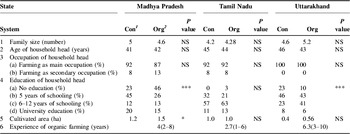
The general demographic characteristics in each case area are presented in Table 1. Demographic characteristics were similar for organic and conventional farms in all three case areas, although education of household head differed significantly in Madhya Pradesh and Uttarakhand. In Madhya Pradesh, a larger proportion of organic farmers had no education compared to conventional ones, whereas in Uttarakhand organic farmers had on average a higher education—fewer had no education and a higher proportion had 6–12 years of schooling. Average family size was found to be 4–5 and the average age of farmers ranged from 41 to 45 in all surveyed case areas. Farming was the main occupation for all organic and conventional farmers.
Demographic characteristics of conventional and organic farmers in three states of India.

1 Conventional farming system.
2 Organic farming systems.
* P<0.05; **P<0.01; ***P<0.001. NS, not significant.
All the surveyed farms were small, cultivating less than 2 ha. The cultivated area was similar for organic and conventional farms in Tamil Nadu and Uttarakhand, while a significant difference was found in Madhya Pradesh, where organic producers had a larger area than conventional producers (Table 1). In Madhya Pradesh, they had practiced organic farming for 4 years (2–8 years) and most of the farms were certified except for a few farms in conversion. In Tamil Nadu, organic farming had been practiced for 2.7 years (1–6 years), and all the farms were non-certified. The farmers in Uttarakhand had farmed organically for 6.3 years (3–10 years) and 85% of the farms were non-certified.
Barriers to conversion for conventional farmers
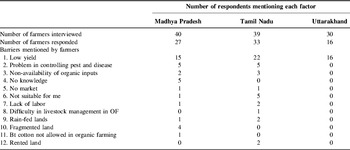
The responses of conventional farmers to the open-ended questions regarding the barriers are listed in Table 2. The response was low on this question, with only 68, 85 and 53% of surveyed farmers responding in Madhya Pradesh, Tamil Nadu and Uttarakhand, respectively. The chi-square test showed that there were significant differences in the barriers identified by the conventional farmers across the states, although low yield was first on the list in all three case areas. In Madhya Pradesh and Tamil Nadu, the control of pests and diseases was also regarded as a problem. Lack of technical knowledge, fragmented land (difficult for group certification) and lack of organic inputs were the other barriers as perceived by conventional farmers in Madhya Pradesh. Interestingly, one farmer from Madhya Pradesh identified as a barrier the fact that Bt cotton is not allowed in organic farming, and five farmers from Tamil Nadu felt that organic farming was not suitable for their style of farming. Other barriers were lack of organic inputs, labor requirements, tenancy and lack of a market among Tamil Nadu farmers.
Barriers for conversion to organic farming as described by conventional farmers.

Note: Nine farmers in Madhya Pradesh and 10 farmers in Tamil Nadu mentioned two barriers.
Chi-square test showed a significant difference (P<0.001) across the states mentioning barriers.
Conventional farmers' perception of organic farming
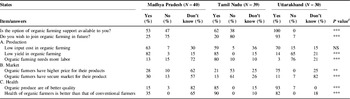
The response to open-ended questions on barriers was low in all three states, maybe due to difficulties in framing the answer. Hence, farmers were asked to answer ‘yes/no/do not know’ on production issues, market access and health benefits in organic farming (Table 3). The chi-square test showed that the distribution pattern of answers differed in all three states for all the issues, except for low input cost which had a similar pattern. In Madhya Pradesh and Tamil Nadu, there was less opportunity to convert to organic farming than in Uttarakhand, since BioRe in Madhya Pradesh selects the farmers they deem suitable for the certification process, and in Tamil Nadu, the NGOs also had to restrict the number of farmers in taking part in the organic farming project. Hence, the option of organic is not available to all the farmers despite it being a non-certified organic system. In contrast, all the farmers in Uttarakhand had the option to join, and Navdanya provided technical expertise for interested farmers, but not much support in terms of credit and organic inputs, unlike other NGOs in Tamil Nadu. In terms of farmers wishing to convert to organic farming in the near future, the figures for Madhya Pradesh, Tamil Nadu and Uttarakhand were 25, 20 and 93%, respectively.
Conventional farmers' perceptions about organic farming.

1 Chi-square test was done for testing whether the answer has similar distribution in three states. NS, not significant.
* P<0.05; **P<0.01; ***P<0.001.
The majority of the conventional farmers perceived organic farming having reduced input costs in all three case areas (Table 3). However, yield and labor issues were differently weighted in the case areas. Conventional farmers in Madhya Pradesh and Tamil Nadu were most concerned about low yield, while Uttarakhand farmers were least concerned. Likewise, Tamil Nadu farmers were concerned with labor issues, while Uttarakhand farmers were not and Madhya Pradesh farmers were unsure of labor issues.
Most of the conventional farmers in Madhya Pradesh were not sure of a price premium and market assurance for the organic products, whereas their counterparts in Tamil Nadu feared the lack of a market and premium price for the organic products (Table 3). Uttarakhand farmers, on the other hand, had positive thoughts about the price but were not sure of the market. Tamil Nadu and Uttarakhand farmers had a positive attitude toward product quality and health, while Madhya Pradesh farmers were unaware of that.
We investigated whether the answers on production, market and health issues were influenced by the farmer's age and education using AMOS. The results showed that farmer's age and education did not influence the answer in all three case areas. AMOS was also used to investigate which factors influenced some farmers' willingness or interest to convert in the near future. The results showed that low input cost was the main determinant in Madhya Pradesh, while a price premium along with health benefits were the main determinants in Tamil Nadu. The production, price premium and health factors influenced 93% of the farmers in Uttarakhand.
Organic farmers' reasons for converting to organic farming
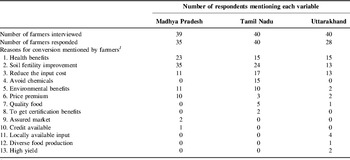
The reasons given by the organic farmers for converting to organic farming are listed in Table 4. All the interviewed farmers in Tamil Nadu responded, while four farmers in Madhya Pradesh and 12 farmers in Uttarakhand refused. This still resulted in a response rate that was higher than for conventional farmers. In Madhya Pradesh, 35, 34, 19 and 4 farmers listed one, two, three and four reasons, respectively, whereas 40, 36, 11 and 3 farmers listed one, two, three and four reasons, respectively, in Tamil Nadu. In Uttarakhand, 28, 15 and 2 farmers listed one, two and three reasons, respectively.
Reason to convert to organic farming as described by organic farmers.

1 Chi-square test showed that distribution of answers was not similar in all three states.
The chi-square test showed that there were significant differences in the reasons across states, although a few of the factors (soil fertility improvement; low input cost and health) were common at the top of the list. The major difference was that the wish to avoid chemicals was mentioned only in Tamil Nadu. The reasons for local availability of organic inputs, diversified production and higher yield were mentioned only in Uttarakhand, and credit and market access were mentioned in Madhya Pradesh.
The experience of organic farmers
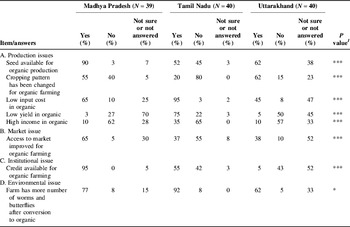
The experience of organic farmers with production, marketing, institutional and environmental issues investigated by predetermined questions is presented in Table 5. The chi-square test showed that there were significant differences among the three states with regard to the experiences of farming organically. A significant proportion of Uttarakhand organic farmers answered ‘do not know’ or was not sure on all issues compared to the other two states, and also in Madhya Pradesh farmers refused to answer on some issues, especially on yield.
Organic farmers' experience on production, market, institutional and environmental issues.

1 Chi-square was used to test whether the answer has a similar distribution in the three states.
* P<0.05; **P<0.01; ***P<0.001.
Overall, the farmers found that the change to organic farming had positive effects due to the better availability of seeds, input cost reduction and improved farm biodiversity. Thus, the supporting institutions provided seed material in most of the cases and hence more than 50% of the farmers in all the three case areas felt they had better availability of seeds. More farmers in Madhya Pradesh and Uttarakhand than in Tamil Nadu changed their cropping pattern/system after conversion to organic farming. More intercropping activities with cotton and a proper crop rotation with legumes were the major changes in Madhya Pradesh, whereas mixed cropping of millet, maize and pulses dominated on organic farms compared to monocropping on conventional farms in Uttarakhand. In Tamil Nadu, the surveyed region is known as the rice bowl, with rice cultivated under irrigation sometimes throughout the year. Understandably, the peculiarity of flooded rice cultivation provides very little opportunity for intercropping, which is reflected in the low percentage of positive responses that resulted from other non-rice changes in the cropping system.
A significant proportion of organic farmers experienced a cost reduction in Tamil Nadu and Madhya Pradesh but not in Uttarakhand. Respectively 70 and 45% of organic farmers were not sure of yield reduction in Madhya Pradesh and Uttarakhand, and 27 and 50% of farmers experienced no yield reduction in the organic system. However, reduction in yield concerned the Tamil Nadu farmers.
More farmers from Madhya Pradesh had access to a market than from the other two states. Similarly, credit access was better for Madhya Pradesh farmers since the BioRe company offered interest-free credit. A significant proportion of organic farmers in Tamil Nadu also received credit help from the NGO, but Uttarakhand farmers did not. In all three case areas, organic farmers felt increase in farm biodiversity might be due to higher crop diversity, intercropping and an increase in the population of beneficial insects due to avoidance of harmful chemicals, fertilizers and pesticides.
We investigated whether the answers on different issues were influenced by the farmers' age, education and years having been converted, using AMOS. The results showed that the farmers' education had no influence on the answers in all three case areas. However, the years of conversion were positively associated with experiencing reduced costs in all three cases, with increased income in Tamil Nadu, and with increased yield in Madhya Pradesh. Refusal to answer questions on cost issues was associated with the farmers' age in Madhya Pradesh, where younger farmers responded more willingly to these types of questions.
Ranking advantages in practicing organic farming
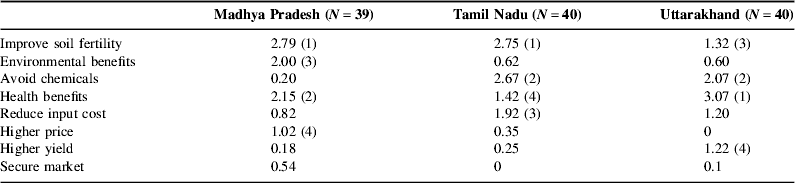
Organic farmers had positive thoughts about improvement in soil fertility and health benefits as they ranked these factors among the advantages, although they were not tested. The farmers ranked improved soil fertility as the largest advantage of farming organically in two of three states, and as the third-largest advantage in Uttarakhand (Table 6). Health benefits ranked as number 1, 2 and 4 in Uttarakhand, Madhya Pradesh and Tamil Nadu, respectively. The avoidance of chemicals ranked as number 2 of the advantages of farming organically in two states. Only in Tamil Nadu did reduced input costs rank among the four most important advantages. Interestingly, the farmers in Uttarakhand ranked increased yield, which was not the case in the other two states. The price premium and market access did not figure among the top four advantages in Tamil Nadu and Uttarakhand. It is clear that organic farmers had a problem with market access for crops other than cotton in Madhya Pradesh with price premium listed as number 4 advantage. However, these two factors not having been listed in the other two states is understandable.
Organic farmers' experience on advantages of organic farming.
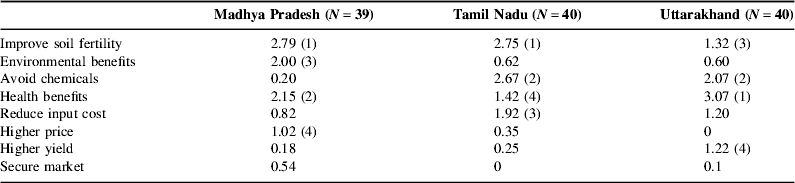
Values in ( ) are rank.
Challenges encountered in organic farming
The ranking of the challenges in organic farming were different and specific to case area (Table 7). Low yield was perceived as the biggest challenge in Tamil Nadu (high-input farms and also most of the farms were in the conversion period), but ranked lower in the other two states. Control of pests and diseases ranked number 1 as a challenge in Madhya Pradesh. Cotton is cultivated on only 4% of the farmed area but consumes more than 50% of pesticides in India. Hence, this factor is a real challenge for organic cotton producers. It was the second-largest challenge for Uttarakhand farmers. Lack of manure was a particular challenge in Tamil Nadu and Uttarakhand, whereas lack of labor was a particular issue in Madhya Pradesh and Tamil Nadu. Lack of manure was not a major challenge in Madhya Pradesh due to organic inputs being supplied by BioRe. In Uttarakhand, most of the farmers in hilly areas practiced mixed cropping. Hence, access to manure and control of weeds and pests in mixed cropping figured as major challenges. Interestingly, the weed control issue did not figure as a major challenge among the organic farmers of Tamil Nadu and Madhya Pradesh.
Organic farmers' experience on challenges encountered in organic farming.

Values in ( ) are rank.
Discussion
Barriers to conversion for conventional farmers
This study showed that across these three states and settings, the inclination to convert was not influenced by the age and educational status of the farmer. This result differs from others studies where particularly the young and better educated farmers converted to organic farmingReference Duram28–Reference Comer, Ekanem, Muhammad, Singh and Tegegne33. Instead, production issues were the most prominent reason, although the high level of ‘do not know’ responses also indicates a lack of knowledge and understanding about organic farming in all three case areas, although with variations between areas. Open-ended questions about barriers showed that farmers in all three case areas were more concerned about production barriers than market or institutional barriers, which is consistent with other studiesReference Lampkin, Lampkin and Padel16, Reference Murthy, Dhananjaya and Naik21, Reference Dabbert, Lampkin and Padel34–Reference Rigby, Young and Burton39. Therefore, this study suggested that farmer age and education were not the determining factor for not converting, but rather a lack of understanding and fears about low yield were the major concerns. Hence, farmers need strong institutional support and an assured price premium with market access to offset the production barriers such as yield reduction.
Organic farmers
The difference in the reasons for and experiences with organic farming in the case areas probably has a regional background, such as farming systems and institutional support. There was a higher response from organic farmers than from conventional farmers even for the open-ended questions, which might be due to increased knowledge and awareness after conversion. However, there are differences in responses between the case areas among the organic farmers. The higher response from Tamil Nadu organic farmers might be due to the fact that they are in the conversion period and hence keenly observe the variables and find it easy to answer compared to the other two states. The lower percentage of poorly educated farmers in addition to strong NGOs support may be the other reason for the higher response from Tamil Nadu. The low response from Uttarakhand organic farmers might be because the conversion has had little impact on the low-input farms.
This study showed that when external support is available (market, technical and institutional), some farmers were motivated to improve the production, environment and health factors in all three case areas. Overall, in all the three cases, a reduction in input cost, improved soil fertility and health benefits were the main reasons for converting to organic farming. Similar results have also been reported in other studiesReference Padel31, Reference Padel32, Reference Padel35, Reference Padel40–Reference Fairweather44. Nevertheless, a substantial number of farmers were motivated by the price premium for certified organic cotton in Madhya Pradesh and few farmers in the other two states.
There is a difference between acceptance and ranking of the benefits of organic farming. In Tamil Nadu, input cost reduction ranked lower than expected, although 95% of the farmers accepted a cost reduction. Similarly, in Madhya Pradesh, the majority of the farmers accepted a cost reduction and actually incurred only one-third of the conventional costReference Panneerselvam, Hermansen and Halberg27 and still they ranked this lower as an advantage. This could be because organic farmers had to rely on biodynamic inputs and bio-pesticides from BioRe in Madhya Pradesh and organic inputs from the NGO in Tamil Nadu. In Uttarakhand, input cost reduction, the second top most motivating factor for conversion, was not ranked in the major advantages. This is understandable since most of the farms were under a low-input management system and spent less on input compared to the other two statesReference Panneerselvam, Hermansen and Halberg27.
The relative yields in organic farming are directly related to the intensity of prevailing farming systems and the level of external input before conversionReference Halberg, Rosegrant, Sulser, Knudsen, Høgh-Jensen, Halberg, Knudsen, Alrøe and Kristensen45. Our findings regarding the yield aspects in low-input farms in the studied areas of Uttarakhand and high-input farms in Tamil Nadu were, in general, in agreement with the above statement. In Uttarakhand, some organic farms experienced yield increases. Higher yields of rice and millet were noticed in organic farming in Uttarakhand12. In Madhya Pradesh, the yield reduction was of less concern to organic farmers who were compensated through input cost reduction and a higher price premium. However, a substantial number of farmers observed yield increases after 4 years of conversion. Other studies reported up to 20% higher cotton yieldsReference Eyhorn23, Reference Shah, Verma, Bhamoriya, Ghosh and Sakthivadivel46, Reference Venugopalan, Rajendran, Chandran, Goswami, Challa and Damre47. The yield issue in Tamil Nadu is very clear, indicating that conversion of high-input farms resulted in a yield reduction during the conversion period, with organic rice yield merely 80% of the conventional rice yield in Tamil NaduReference Panneerselvam, Hermansen and Halberg27. In Karnataka, the neighboring state to Tamil Nadu, rice yield was 21% lower in the first year of conversion (as also found in our study) and 22% higher in the organic over the conventional system after 4 years of conversion12. Thus, a yield increase is expected after 4 years of conversion, unlike in the developed world where organic yield is found to be lower even after the conversion periodReference Halberg and Kristensen48, Reference Stonehouse, Weise, Sheardown, Gill and Swanton49. Interestingly, the low-input farms of Uttarakhand, also in the area of our study, experienced higher yields when adopting agro-ecological methodsReference Panneerselvam, Hermansen and Halberg27. Studies from the USA also report that organic systems increase yield in drier areasReference Pimentel, Hepperly, Hanson, Douds and Seidel50, Reference Hanson, Lichtenberg and Peters51. Therefore, the low-input farms of Uttarakhand are highly suitable for large-scale conversion to organic agriculture.
Increased farm income by reducing the input cost and achieving a higher price premium is considered as the foremost advantage of organic farming in IndiaReference Eyhorn, Ramakrishnan and Mäder7, 12. However, in the present study, not all three case areas saw a significant improvement in the farm income. This could be because only cotton received a price premium and other rotational crops were sold at conventional price although a cost reduction was observed in Madhya Pradesh. In Uttarakhand, on the other hand, all the crops received a 10% price premium but there was not much of a cost reduction. In Tamil Nadu, an input cost reduction along with a 10% price premium to all crops resulted in an increase in income for 35% of the farms. This difference is due to some farms being in the post-conversion period (no yield reduction for 22% of the farms) and some farms in the conversion period where yield reduction was observed. However, the net margin was found to be non-significant between conventional and organic systems in all the three case areasReference Panneerselvam, Hermansen and Halberg27. Acknowledging that the farming systems, geographical characteristics and institutional settings vary by state, caution should be taken in generalizing these results to the whole of India. Moreover, the conditions for organic farming vary for the different areas.
Conclusions and Implications
In this study, conventional producers identified production and marketing barriers as a constraint to adopting organic farming. Organic farmers were more concerned with health, environmental and production factors (such as pest control and lack of manure in all case areas, and low yield in Tamil Nadu) when institutional support is available. The study concludes that yield reduction and the issue of controlling pests and diseases without chemicals were considered as both a challenge for the organic farmers and a barrier for the conventional farmers. Mixed responses were obtained on yield aspects, with yields tending to decrease initially, and then to increase after the conversion period was completed. Yields increased on some farms in Uttarakhand and Madhya Pradesh because most of the farms there are in the post-conversion period, while Tamil Nadu farms found that yields had reduced, which is due to the farms being in the conversion period.
A balanced view on the disadvantages and benefits also needs to be presented and discussed in farmer communities. Indian farmers have a low level of technical knowledge about organic production methods unless supported by NGOs and private institutions, and thus marginal and small farmers need to acquire knowledge and training to practice organic farming. Private institutional support is available for specific crops to attract the lucrative organic export market, but farmers are lacking knowledge and in some cases inputs to grow the full range of rotational crops, that are imperative in a well-functioning organic production system. Thus, one of the biggest potentials lies in establishing organic markets for rotational crops and to provide institutional support, as was the case in Tamil Nadu. However, since this support was available only for a limited period due to the finiteness of the organic project fund, most of the conventional farmers were afraid to convert. Thus, it is important that a long-term strategy for the support is developed. Therefore, grassroots organizations, governments and research institutions need to cooperate in providing information, advice, training and financial support during the conversion period to marginal and small farmers for them to reap the benefits of organic farming.
Organic markets are expected to increase in India due to the driving demand for quality organic food by the rising income of middle classes. Therefore, marginal and small farmers should be encouraged to form organic farmers' associations, such as in the case area of Tamil Nadu, to facilitate the marketing of a variety of crops—organically certified or not—at the local market. This helps to increase farm profit and reduces the vulnerability of market access for specific certified organic products. Growing only specific crops for the organic export market is not advisable because it makes farms more vulnerable to the volatile export market and reduces farm biodiversity. Hence, a government scheme for compensating yield loss during the conversion period and the provision of a price premium for non-certified organic products would benefit the farmers and the environment. Subsidies for organic inputs, and supporting organic producers and organic consumer associations may be a viable option to increase the adoption of organic farming in India. Moreover, the diversion of public money from fertilizer subsidies alone to the development and use of agro-ecological cultivation methods, such as composting, legume seeds and biological pest management, should be considered.
Acknowledgements
We thank the International Centre for Research in Organic Food System (ICROFS) for funding this research through the GlobalOrg project. Thanks in particular to the staff of Navdanya, CIKS and BioRe India for extending their help in data collection.