Covered mortgage bonds are debt instruments that are collateralized by a dedicated pool of mortgage loans that the issuer holds on its own balance sheet. The familiar mortgage-backed security (MBS) used in the modern U.S. mortgage market, in contrast, is issued against a pool of mortgages that have been taken off the balance sheet of the institution that originated the loans.Footnote 1 As the MBS market experienced severe distress in 2007 and 2008, the U.S. Department of the Treasury urged market participants to consider covered bonds as an alternative mechanism for funding mortgages.Footnote 2 Secretary Paulson recommended this form of finance because issuers of covered bonds keep more “skin in the game” than participants in MBS structures and so have stronger incentives to maintain strict loan underwriting standards. In making its recommendation, the Treasury also pointed to a 200-year record of success with covered bonds in continental European mortgage markets. This article offers a different perspective by examining the farm mortgage debenture movement of the 1880s, which was the second of three unsuccessful attempts to introduce covered mortgage bonds into the U.S. mortgage market before 1930.Footnote 3 The goal is to explain how the innovation was successfully brought to market, to identify the contribution covered bonds made to the integration of the national farm mortgage market, and to assess the role that debentures played in the western farm mortgage crisis of the 1890s when nearly every company that had issued the new security failed.
Before 1880 western farm mortgage lending was dominated by mortgage companies that originated loans in the Midwest and Great Plains and then brokered the whole loans to investors in the northeast and Europe. In the 1880s some of these companies began to place mortgages into trust accounts and to issue bonds (called debentures) against this security. An important feature of the debenture movement is that the introduction of these new securities did not simply displace brokerage; instead, the two funding methods were used side by side within the same markets and even by the same mortgage companies.
The key to understanding the farm debenture movement as a financial innovation, therefore, is to explain why only some mortgage companies issued covered mortgage bonds and why they were used to fund only some mortgages. The explanation offered here focuses on differences in how risk was shared and how loans were marketed under debentures and brokerage. I argue that only well-established mortgage companies could bear the additional risk that was involved in issuing debentures and that the innovation was used by them to fund mortgages that were particularly difficult and costly to broker. These observations are developed in the first section of the article and then tested empirically on balance sheet data for an 1890 cross-section of western mortgage companies and on an 1887 sample of individual mortgage loans that were either brokered or placed behind debentures by the J. B. Watkins Mortgage Company of Lawrence, Kansas.
The Watkins loan sample also provides an unusual opportunity to explore Secretary Paulsen's claim that covered mortgage bonds provide their issuers with strong incentives to maintain strict loan underwriting standards. It turns out that debentures created a new asymmetry of information in the mortgage market because investors observed less about the loans that were placed behind these bonds than they did about whole mortgage loans that were brokered. The asymmetry provided mortgage companies with an opportunity to apply different loan underwriting standards in the two markets and I find that Watkins used his debenture program to fund loans on which credit risk and lending costs were higher than on the brokered loans he sold outright to investors. I conclude, therefore, that the introduction of covered mortgage bonds broadened the western farm mortgage market and contributed to its rapid expansion just before the onset of the western agricultural mortgage crisis of the 1890s. The demise of the farm debenture movement provides a cautionary lesson about the stability and incentives for credit risk management within covered mortgage bond programs as we once again consider introducing the innovation into the U.S. mortgage market.
FARM MORTGAGE BANKING IN THE 1880S: FROM LOAN BROKERAGE TO DEBENTURES
The background to the debenture movement of the 1880s was a pattern of significant regional differentials in mortgage rates during the late nineteenth century that ranged from under 6 percent in the savings-rich northeast to 10 percent or higher in the Great Plains, south and west. Lance Davis first identified these differentials as part of a broad pattern of capital market segmentation and later investigations found that variation in the cost of mortgage credit across space were driven in large part by differences in mortgage lending risk and in the transactions costs associated with lending across regional boundaries.Footnote 4 Both sources of differentials provided opportunities for arbitrage that were taken up by a cadre of specialized mortgage companies that appeared in burgeoning agricultural areas to sell western loans to investors in eastern and European markets.Footnote 5 Mortgage companies did so by providing distant investors with an entire bundle of services. They hired and supervised loan agents who located borrowers, assembled loan applications, and monitored mortgagors and their land after a loan was closed. The companies hired office staff, meanwhile, to screen applications, to prepare and record loan documents, and to collect and disburse loan payments.Footnote 6
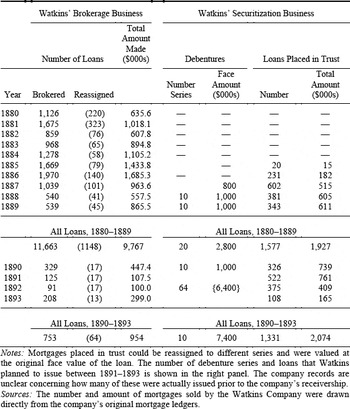
The number and size of these mortgage companies grew rapidly during the 1870s and 1880s. The J. B. Watkins Company of Lawrence, Kansas, for example, was established in 1873 but within just seven years claimed an office staff of ten and dozens of loan agents in Kansas, Nebraska, and Texas. By then the company sold its loans through offices in New York and London, and employed independent agents who operated in 11 other northeastern cities.Footnote 7 The left panel of Table 1 shows that between 1880 and 1886 Watkins sold more than $1 million in loans each year and serviced about $5 million of outstanding loans.Footnote 8 In 1887 Watkins added a debenture program to his operation that grew rapidly in size and importance as Watkins placed nearly 40 percent of the loans he marketed behind debentures in the first three years and nearly two-thirds of the loans after 1890 (see the right panel of Table 1). The introduction of a debenture program did not affect the methods that a mortgage company used to originate and service loans. What changed, instead, was the risk-sharing arrangement between the company and investors, the method used to market mortgage loans, and the amount of information about the loans that the company shared with investors.Footnote 9
J. B. WATKINS MORTGAGE BROKERAGE AND DEBENTURE OPERATIONS

Notes:
Mortgages placed in trust could be reassigned to different series and were valued at the original face value of the loan. The number of debenture series and loans that Watkins planned to issue between 1891–1893 is shown in the right panel. The company records are unclear concerning how many of these were actually issued prior to the company's receivership.
Sources:
The number and amount of mortgages sold by the Watkins Company were drawn directly from the company's original mortgage ledgers.
Which Companies Issued Debentures? Risk Bearing Under Brokerage and Debentures
Under brokerage, the individual investor purchased a whole mortgage loan and owned all the benefits and risks associated with the borrower's promised loan payments. The mortgage company served as the investor's agent in this transaction and was provided with incentives to select and service loans carefully by the same mechanisms that are used in the modern loan sales market—loan participations and recourse agreements.Footnote 10 Participations were created by dividing each brokered loan into a first mortgage that was assigned to the investor and a second lien, junior to the investor's interest, that the company took as a commission.Footnote 11 Recourse provided the mortgage company with additional incentives as it committed to repurchase any loan that went into delinquency. If a borrower missed one payment, a company typically paid the investor from its own funds and sought collection; if the default became persistent, the company repurchased the loan from the investor and initiated foreclosure proceedings on its own behalf.Footnote 12
A mortgage broker committed to repurchasing delinquent loans because it “could not allow client[s] to suffer the loss of a single dollar” without losing their confidence and business.Footnote 13 Maintaining this policy was costly and risky for mortgage companies, but they regularly honored their commitment even though they were not legally bound to do so.Footnote 14 Brokers, instead, offered recourse to investors as a moral or implicit promise that created a flexible risk-sharing arrangement between the two.Footnote 15 Most importantly, mortgage companies could legally suspend recourse in order to preserve financial capital and continue operations even when the borrowers they served came under general distress. If the recourse commitments had been legally binding, then these thinly capitalized intermediaries would have failed in the same circumstance.Footnote 16 Investors agreed to a possible suspension of recourse under brokerage, therefore, to avoid sharing the deadweight losses that would have been generated had the loan servicing operation of their mortgage company been disrupted at the very time that loan renegotiation and monitoring would have been most valuable.Footnote 17 To accommodate this solution, mortgage companies built and maintained reputations for suspending recourse only to avoid a costly financial failure.Footnote 18
By issuing debentures, a mortgage company strengthened and formalized its risk-bearing obligations. Debentures were debt contracts between the company and investors that were secured by pools of mortgages that the company owned and placed into trust. The company employed a trustee to certify that the loans and supporting documents satisfied criteria stipulated in a trust agreement, but the trustee did not monitor the company's loan origination or servicing operations, guarantee the performance of the loans, or underwrite the company's debentures.Footnote 19 The trustee was required, however, to take possession and to dispose of the underlying mortgage pools on behalf of debenture holders if the company defaulted on its scheduled payments.Footnote 20 So under a debenture program, therefore, investors purchased the debt obligations of the mortgage company that originated and serviced a specified pool of mortgages.
The difference in the risk-sharing arrangements under debentures and brokerage helps to explain the timing and character of the farm mortgage debenture movement. Prior to 1880 western mortgage companies were too small to originate well-diversified pools of mortgage loans and too poorly capitalized to protect against default, so they relied exclusively on brokerage and implicit recourse agreements, even though debentures were well-known to market participants.Footnote 21 Debentures became feasible in the 1880s after some farm mortgage brokers had established track records of success and grown in size. Larger size permitted companies to originate more spatially diversified mortgage pools and to absorb the fixed administrative and legal expenses associated with a debenture operation. A record of success, on the other hand, provided the company with access to lower-cost forms of internal and external financial capital to buffer shocks in the payment stream generated by the mortgage pools. Older, reputable companies were also better positioned, relative to young firms, to market brokered loans alongside, and in support of, their new debenture programs.Footnote 22 For all these reasons, the debenture movement was likely to have been an outgrowth of existing, successful mortgage brokerage operations and not an innovation brought to the market by new mortgage companies.Footnote 23 To test this prediction, the pattern of debenture use for a sample of mortgage companies is examined in the next section.
Which Loans Were Funded? Marketing Under Brokerage and Debentures
Under debentures, the investor, as well as the mortgage company, faced different costs and risks than under brokerage. The investor's expected net return on a brokered loan was influenced by its individual characteristics—its size and term and, given that the company might renege on recourse, its risk characteristics.Footnote 24 Because brokers had to make allowance for investors’ preferences over these loan characteristics, the marketing system they employed was cumbersome and costly. Brokers offered mortgages to investors on a take-it-or-leave-it basis by provisionally assigning loans to them and mailing the applications and supporting documents back east for their approval.Footnote 25 If a loan was rejected, it had to be reassigned to a second investor. The number of reassignments that Watkins handled each year shown in the second column of Table 1 accounted for slightly less than 10 percent of the brokered loans sold.
The assignment system of marketing brokered mortgage loans imposed substantial costs on both parties. The investor had to expend time and effort, and sometimes employ legal counsel, to assure that their assigned loan was well-secured. The exercise had to be repeated, moreover, if the first loan assigned by the company proved to be unacceptable.Footnote 26 The company spent its own time and effort placing a reassigned loan, of course, but also paid interest to investors on the funds they had invested until a loan was successfully assigned.Footnote 27 Brokers had good reason, therefore, to choose loans that investors were most likely to accept—those that were typical in legal form, size, maturity, and risk characteristics.Footnote 28 Borrowers with loans that fell outside these parameters would have paid a premium to offset higher expected marketing costs, and some loans would have been too irregular to broker at all.Footnote 29 There was room in 1880, accordingly, for an innovation that could reduce the high and variable costs involved in marketing brokered loans.
Debenture bonds represented a solution because they offered investors an asset that was homogeneous in amount and term, regardless of the characteristics of the individual loans that secured them.Footnote 30 The investor's risk on a debenture, moreover, depended on the income generated by the entire mortgage pool that secured the bond and not on the characteristics of any single loan.Footnote 31 The marketing system used for debentures, as a result, was more efficient and less costly than under brokerage. A single trustee, rather than hundreds of individual investors, evaluated loan applications and mortgage papers; reassignments were eliminated since the company could easily meet the trust requirements that it had written; and each mortgage no longer had to be divided into a first and second note since the company received all of its cash flow.Footnote 32 These simplifications lowered marketing costs relative to brokerage for all mortgages, but the savings would have been greatest for loans that were difficult to broker because of unusual size, term, or risk characteristics. To test this prediction, I estimate below the decision rule that Watkins used in 1887 to allocate loans between his debenture and brokerage programs.
The marketing system under debentures was streamlined relative to brokerage, but created an additional asymmetry of information since investors no longer inspected the application and supporting documents for the loans they funded.Footnote 33 Debenture holders relied on three mechanisms to prevent mortgage companies from exploiting this informational advantage: the trust arrangement through which debentures were issued, supervision by state regulatory authorities, and the mortgage company's incentive to uphold underwriting standards in order to protect its own financial and reputational capital.
It turns out that investors relied most heavily on the mortgage company's “skin in the game” because regulation and trust arrangements provided weak supervisory oversight during the 1880s. Regulation, to begin with, came too late as “foreign” western mortgage companies operating in Connecticut, New York, and Massachusetts were not required to report even basic financial data to investors until 1889—years after the debenture movement began to expand rapidly. Even when eastern state regulators published this information, moreover, they cautioned investors that the data were self-reported and that no funding existed for regular on sight examinations of the loan underwriting operations of companies located hundreds of miles away.Footnote 34 I have noted earlier, as well, that the trustees who administered debenture programs for the mortgage companies were also not required to directly monitor their western lending operations.
The first substantial external examination of western mortgage companies did not occur, in fact, until eastern regulators were required to audit the companies that entered receivership in the early and mid-1890s. These inquiries revealed numerous examples of lax underwriting standards and violations of trust agreements that were particularly egregious when failing companies used all available measures to postpone default.Footnote 35 This evidence underscores the critical role that the issuer's own “skin in the game” played in controlling the informational asymmetry that was associated with debentures and that is inherent in any covered mortgage bond program. The behavior of failing companies tells us much less, of course, about the decisions mortgage companies made regarding the quality of debenture loans when they were solvent and still had incentives to maintain strict underwriting standards. I use the Watkins loan sample in the last section of the article to examine this important issue.
WHICH COMPANIES ISSUED DEBENTURES?
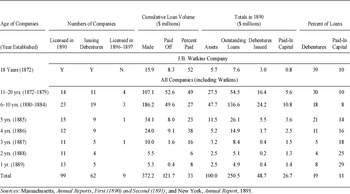
Table 2 summarizes information that was reported in 1890 to the New York and Massachusetts regulators who supervised the western “foreign” mortgage companies that operated in the two states.Footnote 36 The companies are grouped in the table by the years in which they were organized so that each row reports the group total or average for companies of a particular age.Footnote 37 The data highlight both the success and limits of the debenture movement. On the one hand, debentures were a widely deployed innovation that had a substantial impact on the western farm mortgage market—62 of 99 mortgage companies that were licensed in these two states had established debenture programs by 1890. These programs, moreover, together funded one-tenth of the outstanding western farm mortgage debt.Footnote 38 On the other hand, brokerage continued to dominate the western farm mortgage market in 1890. All mortgage companies that issued debentures continued to broker loans, one-third of licensed mortgage companies had still not established covered bond programs, and debentures were used to fund only 19 percent of the total mortgage debt marketed by the licensed companies. A key challenge in understanding the debenture movement of the 1880s, therefore, is to explain why only some mortgage companies adopted the innovation and why brokerage continued to be so widely used after debentures had appeared.
WESTERN MORTGAGE LOAN COMPANIES OPERATING IN MASSACHUSETTS AND NEW YORK IN 1890

Sources:
Massachusetts, Annual Reports, First (1890) and Second (1891); and New York, Annual Report, 1891.
The discussion in the last section offers a plausible explanation— the western farm mortgage industry had limited capacity to support the introduction of covered bonds because only large, established and financially secure companies could credibly issue their own debt. The descriptive mortgage company data in Table 2 support some elements of this explanation, but contradict others. It was true, for example, that established firms dominated the debenture market as more than 80 percent ($40 million) of the new securities that were outstanding in 1890 were issued by the oldest 37 companies in the industry. Taken together, these older firms were also responsible for 75 percent ($180 million) of all the farm mortgage debt handled by licensed companies, so they were also relatively large in size. The grouped data do not appear, however, to support the prediction that the most financially secure mortgage companies issued debentures because they had access to low-cost sources of financial capital. The older firms that issued most of the debentures, in fact, held lower amounts of capital per dollar of outstanding loans than did younger firms that relied almost exclusively on brokerage.
To sort out the pattern of debentures use across the mortgage companies, I use the individual firm data underlying Table 2 to examine two decisions that each mortgage company faced in the 1880s—whether to establish a debenture program and, if so, how large it would grow relative to the company's brokerage business. The analysis relies on a two-part model of debenture usage: a probit model for the decision to establish a debenture program and a truncated regression model to explain the shares of loans marketed with the security for the subset of companies that decided to issue debentures. Both models use the same specification

where debenture usage is measured with an indicator variable equal to one for the 62 firms that established debenture programs in the probit model, and is set equal to the share of outstanding loans marketed behind debentures in the truncated regression.Footnote 39
The explanatory variables in the specification capture variations in the size, financial strength, and reputation of each company, factors that were conjectured earlier to be the important determinants of the capacity to establish a debenture program. Size is measured here as the natural logarithm of the total volume of loans outstanding in 1890; by this metric, firms that were established before 1885 were on average five times larger than younger firms (see Table 2).Footnote 40 The financial strength of each company is captured in two ways—by the ratio of paid-in capital to outstanding loans and by the percent of each company's assets that were held in real estate. The latter is included because the most important risk facing western mortgage companies was the losses they could suffer when acquiring and disposing of foreclosed land. We also measure the firm's reputation in two ways—by the natural logarithm of its age and by the percentage of loans marketed by the company that had been successfully paid off by 1890 (see columns 5 and 6 of Table 2). Age should pick up the impacts of longevity, including reputation, that are unrelated to firm size and financial strength, while age and the share of loans paid off are interpreted here as proxies for reputation in brokerage since no firms had issued debentures before 1883. Both reputational variables are expected to be positively related to debenture use.
Also included in the debenture usage models are dummy variables that indicate the regional location of each company's home office—52 were headquartered in the Great Plains (the Dakotas, Nebraska, and Kansas), 26 in the omitted Midwest region (Minnesota, Iowa, and Missouri), 11 in the south and far west, and ten that operated western lending operations from home offices in the Northeast.Footnote 41 These regional fixed effects are included to control for differences in the characteristics of loans that the companies marketed, in the mortgage laws that governed foreclosure in their lending areas, and in the regulatory regimes under which they operated.Footnote 42
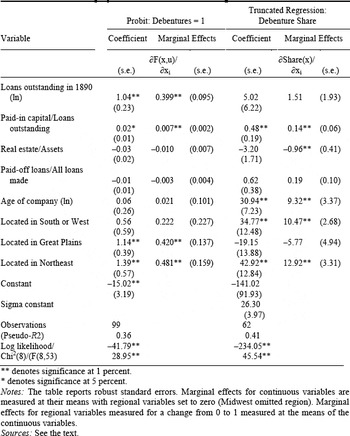
The estimates reported in Table 3 reveal why a two-part model, rather than a single tobit regression, is the preferred specification of debenture usage—measures of company size, financial strength, and reputation had different impacts on the decision to establish a debenture program than they did on the choice of how intensively to use it.Footnote 43 The important correlates of the participation decision, as shown in the left panel of Table 3, were firm size and financial strength as measured by the amount of paid-in capital per dollar of loans marketed. The impact of size was large as well as statistically significant: a one-unit increase from the mean (that is, from $.89 to $3.3 million of loans) increased the probability of establishing a debenture program by 38 percent. The significant positive association between debenture use and financial capital in the probit regression, moreover, stands in contrast to the misleading as well as counterintuitive pattern in the group averages shown in Table 2—firms that issued debentures held more, not less, financial capital per dollar of outstanding loans after controlling for firm size. Both results suggest that the debenture movement grew out of established brokerage businesses because these firms could reduce the probability of default by assembling spatially diversified loan pools and backing the promised payments from them with greater amounts of financial capital.Footnote 44
DETERMINANTS OF ISSUING DEBENTURES AND SHARE OF LOANS BEHIND DEBENTURES IN 1890 (99 western mortgage loan companies operating in Massachusetts and New York)

** denotes significance at 1 percent.
* denotes significance at 5 percent.
Notes:
The table reports robust standard errors. Marginal effects for continuous variables are measured at their means with regional variables set to zero (Midwest omitted region). Marginal effects for regional variables measured for a change from 0 to 1 measured at the means of the continuous variables.
Sources:
See the text.
The estimates of the truncated regression shown in the right panel of Table 3 indicate that a different set of factors explains how intensively companies used their new debenture programs. As expected, higher levels of capital were associated with a greater reliance on debentures after the innovation was adopted, but company size had no statistically significant impact on the share of loans marketed behind the new securities. The intensity of debenture use also increased with company age and decreased with the share of assets held in real estate, although neither measure had a statistically significant impact on the probability of issuing the securities in the first place. These last two impacts suggest that reputation and past performance were important determinants of the willingness of investors to accept a particular debenture issue once a program had been established. Older mortgage companies had by the late 1880s maintained successful loan brokerage operations for a decade or more, while companies that held low amounts of foreclosed real estate on their balance sheet had shown that they could select mortgages carefully and service them responsibly.
The mortgage company data indicate, therefore, that debenture programs tended to be established by large and financially secure mortgage companies and that the securities were then used most intensively by companies that had strong records of past performance. The debenture movement of the 1880s grew alongside, and out of, the brokerage loan system that dominated the western farm mortgage market.
WHAT TYPES OF LOANS WERE FUNDED WITH DEBENTURES?
After establishing its debenture program in 1887, the Watkins Company had to decide—like other mortgage companies that adopted the innovation—which mortgages to place behind covered bonds and which ones to broker. In this section, I examine that decision for a sample of 689 loans that Watkins made and marketed in the first year of his debenture program.Footnote 45 These mortgages were typical of loans that Watkins had brokered since opening his company in 1873 as they were all written on Kansas farmland and negotiated through the company's established loan agent system. The data for each loan, moreover, was drawn from the company's original mortgage ledger so that we observe the same information for these loans that the company's personnel recorded as 465 of these loans were being brokered and the remaining 224 were assigned to the company's debenture program.Footnote 46 I use the loan sample in this section to assess how and why this allocation was made.
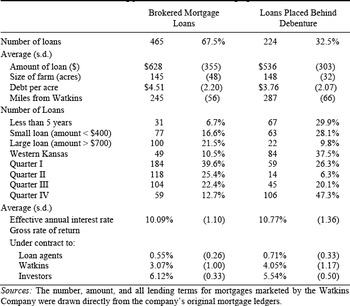
The descriptive statistics for the brokered and debenture loans are shown separately in Table 4. Both groups were written on farms that averaged just less than 150 acres in size, but debenture loans were smaller in size (an average of $536 versus $628) and so carried lower average debt-per-acre ($3.76 to $4.51). Debenture loans were also written more often for short, three-year terms, for unusually small amounts (less than $400), and on farms that were located in western Kansas, in recently settled counties of the state, or far away from Watkins's Lawrence office.Footnote 47 Watkins expanded his new program quickly in 1887 so that the proportion of loans that were brokered fell from three-quarters to one-third between the first and fourth quarters of the year.
689 MORTGAGES MADE IN KANSAS IN 1887: WATKINS’ BROKERED AND DEBENTURE MORTGAGES

Sources:
The number, amount, and all lending terms for mortgages marketed by the Watkins Company were drawn directly from the company's original mortgage ledgers.
The bottom panel in Table 4 shows the average effective interest rates borrowers were charged and the average gross rates of return to be paid under the contracts to Watkins, his loan agents, and investors for both brokered and debenture loans.Footnote 48 These data reveal two interesting patterns. First, Watkins's average contractual rate of return on debenture loans was 98 basis points higher than on brokered loans. The reverse was true for investors as their average gross rate of return on brokered loans was 58 basis points higher than the return on debentures. Second, the average mortgage rate on loans placed behind debentures was 68 basis points higher than the average rate on brokered loans. This differential indicates systematic differences in lending costs and risks across the two programs and accounting for these turns out to be an essential first step in understanding and interpreting Watkins's debenture selection rule.
Mortgage Rates and Foreclosure Within the Loan Sample
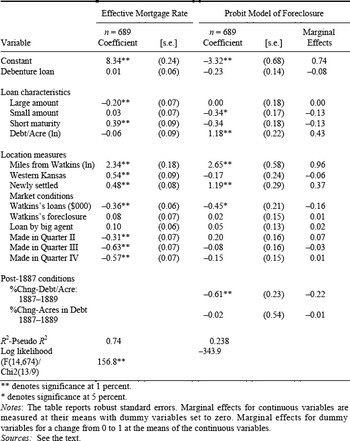
The effective interest rate that Watkins charged his borrowers can be modeled as a hedonic function of loan terms, borrower location, and local mortgage market conditionsFootnote 49

The first group of regressors controls for the impacts that loan size, term-to-maturity, and debt-per-acre had on the borrower's costs of funds. Because mortgage origination and marketing entailed fixed costs, the effective rate should have decreased with loan size and contract length; rates should have also increased with the borrower's leverage as measured here by the debt-per-acre. Three location regressors are also included in the specification to capture variations across space in agricultural risk, in lending risk, and in monitoring costs during this decade of rapid agricultural settlement in Kansas: the distance between the borrower and Watkins's Lawrence office and indicators for loans that were made in Western Kansas or in a newly settled county.Footnote 50 The remaining six variables control for temporal, local, or firm-level influences on mortgage rates—quarterly dummies to control for seasonal impacts, Watkins's share of lending and previous foreclosure experience in each county, and an indicator for the participation of one of Watkins's high-volume loan agents.Footnote 51 Finally, debenture status is included to capture the remaining unexplained difference in average rates on debenture and brokered loans.
The estimated hedonic model, reported in the first two columns of Table 5, explains nearly three-fourths of the variation in the borrower's cost of funds—and the entire 68 basis point differential between average mortgage rates on brokered and debenture loans. The latter result makes sense because borrowers in a competitive primary farm mortgage market would have refused to pay a premium based simply on how their loans were to be funded. The hedonic specification is also recommended by the reasonable signs and magnitudes of other estimated coefficients, such as the 20 basis point reduction in the rate for a large-sized loan and a 39 basis point increase in rates for a short-term loan.Footnote 52 The locational measures of production and lending risk, moreover, trace out a sensible spatial pattern of lending risk premia that ranges from 200 basis points in the more settled areas of central Kansas to nearly 400 basis points in the most western areas of the state; borrowers also paid a 48 basis point premium if they were located in a newly settled county. Rates were significantly lower in markets in which Watkins's own lending was heaviest, but were unaffected by the other company-related measures of local market conditions.Footnote 53 The coefficients on the quarterly dummies, finally, indicate that rates charged to borrowers fell by 60 basis points over the course of the year.
MORTGAGE RATES AND FORECLOSURE: 689 KANSAS LOANS

** denotes significance at 1 percent.
* denotes significance at 5 percent.
Notes:
The table reports robust standard errors. Marginal effects for continuous variables are measured at their means with dummy variables set to zero. Marginal effects for dummy variables for a change from 0 to 1 at the means of the continuous variables.
Sources:
See the text.
An unexpected result in Table 5 is that the debt per acre on loans had a small and statistically insignificant impact on mortgage rates. This variable was included because the actual loan-to-value ratio, which is the traditional measure of mortgage lending risk, was not available for the sample.Footnote 54 Debt per acre could be a poor proxy for actual leverage, of course, if the remainder of the specification does not adequately control for variation in land values across the sample. It is also likely, moreover, that lenders adjusted the term and size of a mortgage, as well as absolute debt levels, to control lending risk.
As a check on the specification of ex ante lending risk in the mortgage rate equation, the last three columns of Table 5 examine how well the same set of regressors predict the likelihood of foreclosure for the loans in the sample.Footnote 55 The probit model reported there (the dependent variable equals one if Watkins subsequently foreclosed on the loan) employs the same hedonic specification used in the mortgage rate model, but this time augmented with two county-level measures of mortgage market disruption for the three-year period after the loans were made—the percentage change between 1887 and 1889 in the number of acres mortgaged and in the debt-per-acre on new mortgage loans. Both should have decreased if general mortgage distress spread within a county.Footnote 56
The estimates of the probit model show that two of the locational measures of risk from the mortgage rate regression affected the probability of foreclosure several years later in the expected direction—the probability increased with distance from Watkins's office and was higher for loans made within a newly settled county. The results also reveal, as expected, that foreclosure was more likely for loans that were located in counties where the debt-per-acre on new loans decreased between 1887 and 1889. On the other hand, the probability of foreclosure was lower, just like mortgage rates, in counties where Watkins lent large volumes of funds. These results provide confidence that the hedonic mortgage rate specification captures fundamental lending risk as it was priced and ultimately felt in the primary mortgage market.Footnote 57
Against this backdrop the behavior of the debt-per-acre variable in the foreclosure equation is striking—it was strongly, positively and statistically significantly associated with the probability of foreclosure even though it had no impact on the effective mortgage rate when these loans were actually being written. This pattern suggests that debt per acre was an effective measure of lending risk, at least after origination, and provides evidence that Watkins may have accepted some loans that violated his own conservative standard of holding loan-to-value ratios below 50 percent.Footnote 58 Allan Bogue reports convincing evidence, in fact, that the Watkins company was under competitive pressure from other lenders to approve poorly secured loans in 1887.Footnote 59 The evidence of market-wide pressures on underwriting standards during the late 1880s makes it particularly interesting to assess how Watkins, and presumably other mortgage companies, assigned loans to their debenture programs.
Selecting Loans for Debentures
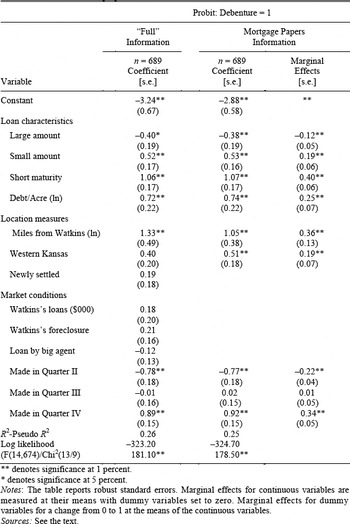
An important feature of the Watkins's sample is that it contains the information investors in the brokered loan market would have observed about each mortgage whether it was brokered or placed behind the company's debentures.Footnote 60 To take advantage of this feature of the data, two probit models of debenture status are reported in Table 6. The model in the left panel of the table uses the entire hedonic specification from the effective interest rate to explain debenture status, while the second includes only those variables within the hedonic specification that an investor would have observed had the loan been brokered. We refer to this smaller subset of variables as the “Mortgage Papers Information” set, and the estimates in Table 6 indicate that only these loan features were associated with debenture selection.Footnote 61
DEBENTURE STATUS: 689 KANSAS LOANS

** denotes significance at 1 percent.
* denotes significance at 5 percent.
Notes:
The table reports robust standard errors. Marginal effects for continuous variables are measured at their means with dummy variables set to zero. Marginal effects for dummy variables for a change from 0 to 1 at the means of the continuous variables.
Sources:
See the text.
The importance of the mortgage papers information set in debenture selection, coupled with the interpretation of the individual coefficient estimates in the probit model, represents strong evidence that Watkins used his covered mortgage bond program to fund loans that would have been difficult and costly to broker. Investors would have avoided buying small and short-term loans, for example, unless they received a higher rate of return to compensate for the substantial fixed costs they bore under brokerage. Watkins tended to place these loans behind his debentures. Large-sized loans should have been preferred in the brokered market for the same reason and, as expected, had low idiosyncratic lending risk such as those made in Western Kansas or far away from Watkins's Lawrence office—but Watkins placed these types of loans behind the company's new securities. These patterns of debenture assignment are all consistent with the hedonic mortgage rate regression in that the same loan characteristics that raised lending costs and risks in the primary mortgage market also increased the probability of a loan being placed behind debentures. Together these results provide compelling evidence that debentures were used to provided a funding channel to serve borrowers who were most poorly served by the brokered loan system.
The debt-per-acre variable follows a different pattern as Watkins avoided brokering loans with relatively high levels of debt per acre even though this proxy for the true debt-to-value ratio had no impact on expected lending costs and risks as captured in the hedonic mortgage rate model. On the other hand, we have seen earlier that loans with high levels of debt per acre had higher probabilities of foreclosure and that Watkins felt competitive pressure to approve loans with high loan-to-value ratios in 1887. Taken together, the pattern of evidence suggests that Watkins used his new debenture program not only to fund loans that had always been risky and costly to broker, but also to fund mortgages that were made under relaxed mortgage lending standards during the western farm mortgage lending boom of the late 1880s. If so, this evidence provides an important cautionary note to claims that an issuer's “skin in the game” under the covered mortgage bond contract provides strong incentives to maintain lending standards because the Watkins Company was a solvent, well-established, and reputable mortgage company in 1887.
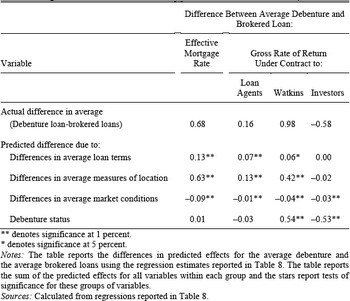
Watkins could use debentures to market relatively high-cost and high-risk mortgages because covered bonds packaged the costs and risks on mortgage loans differently than brokerage. To demonstrate this feature of the innovation, Table 7 reports the sources of the differentials in the average effective mortgage rates for debenture and brokered mortgages in the sample and in the differences in average gross rates of return that each market participant was to be paid under the contracts for the two groups of loans. In the first column of Table 7, the differential in average effective mortgage rates has been decomposed into four components by using the in-sample predictions from the earlier hedonic mortgage rate regression. That calculation reveals that higher lending costs and risks on debenture loans (as measured by loan terms, size, maturity, and location) explain 76 basis points of the differential in average mortgage rates between brokered and debenture loans while differences in market conditions (that measure the strength of local demand and supply) reduced the differential by an average of 9 basis points. After controlling for these influences, debenture status itself explains none of the average differential in mortgage rates between the two types of loans.
SOURCES OF DIFFERENCES IN MORTGAGE RATES AND GROSS RETURNS FOR DEBENTURE AND BROKERED LOANS (predicted differences based on hedonic models for 689 Kansas loans)

** denotes significance at 1 percent.
* denotes significance at 5 percent.
Notes:
The table reports the differences in predicted effects for the average debenture and the average brokered loans using the regression estimates reported in Table 8. The table reports the sum of the predicted effects for all variables within each group and the stars report tests of significance for these groups of variables.
Sources:
Calculated from regressions reported in Table 8.
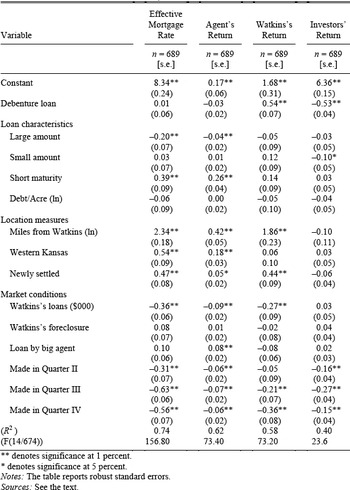
To sort out how the debenture contract allocated these differences in lending costs and risks among the parties, the same hedonic specification was used to model the gross contractual return earned by Watkins, his loan agents, and investors. These three regressions are reported in Table 8 and, as above, the in-sample predictions from them were used to decompose the differential between loan types in average gross returns for each group.Footnote 62 Three patterns stand out. First, the debenture contract directed all of the payments borrowers agreed to as compensation for higher lending costs and risks to Watkins and his loan agents.Footnote 63 This pattern made sense because investors bore none of these loan-specific costs or risks while holding debentures that were secured by these mortgages. Second, all three groups shared the relatively small decreases in gross returns on debenture loans, relative to brokered loans, that were associated with differences in the local market conditions under which they were negotiated. Finally, Watkins's gross return increased by 54 basis points, and investors’ fell by a nearly identical amount, when a mortgage loan—regardless of its lending risk, costs, or market characteristics—was placed behind a debenture. This shift in returns compensated mortgage companies for the costs associated with establishing trusts, issuing securities, and holding additional financial capital when they issued debentures. Investors in covered bonds, on the other hand, received lower gross returns than on brokered loans because they no longer had to evaluate, purchase, and hold an individual mortgage or bear the risk on it.
MORTGAGE RATES AND GROSS RETURNS UNDER CONTRACT TO AGENTS, WATKINS, AND INVESTORS

** denotes significance at 1 percent.
* denotes significance at 5 percent.
Notes:
The table reports robust standard errors.
Sources:
See the text.
CONCLUSION
The debenture movement of the 1880s involved the introduction of covered mortgage bonds as an alternative to a loan brokerage system that up until then had dominated the interregional farm mortgage market in the United States. Western mortgage companies adopted the innovation in order to provide investors with greater risk sharing and lower transactions costs than were available under brokerage, but by holding loans and issuing bonds against this security these firms increased the probability of their own financial failure. These basic insights have been used here to explain both the timing and the contribution of the debenture movement. First, mortgage companies did not issue debentures until the 1880s because before then they were not large enough or sufficiently well-capitalized to issue their own securities. Second, debentures improved the efficiency of the interregional mortgage market, and broadened access to it, by creating a funding mechanism for loans that were difficult and costly to broker because of unusual size, term to maturity, or risk characteristics. Davis conjectured more than four decades ago that mortgage companies were instrumental to the regional integration of the farm mortgage market.Footnote 64 The analysis presented here clarifies both the timing and character of their contribution.
The broader access provided by debentures helped to finance a rapid expansion of mortgage debt in western agricultural markets during the 1880s. During that expansion, we have seen that Watkins, and presumably other mortgage companies, profited by placing riskier loans behind debentures than the ones he brokered. This feature of the debenture movement proved to be a double-edged sword when weather shocks and financial panic in the early 1890s wreaked havoc in the western farm mortgage market. The crisis drove the Watkins agency into receivership along with 89 of the 98 other mortgage companies that had been licensed to operate in New York and Massachusetts in 1890 (see the third column of Table 2). It is difficult to argue, therefore, that the use of covered mortgage bonds strengthened mortgage companies or provided them with strong incentives to resist a general weakening of mortgage lending standards during the 1880s. The debenture movement, therefore, represents a cautionary tale as we once again consider introducing covered bonds to the U.S. mortgage market.