INTRODUCTION
The genus Halicarcinus includes 21 species (Ng et al., Reference Ng, Guinot and Davie2008), most of which are distributed in waters of the south-western Pacific Ocean. Halicarcinus planatus (Fabricius, 1775) is the only species of the genus occurring at the southern tip of America, in sub-Antarctic, cold-temperate waters (Boschi et al., Reference Boschi, Fischbach and Iorio1992; Vinuesa, Reference Vinuesa2005). It is a scarcely calcified crab and is mainly present in shallow marine waters. This small spider crab is usually more abundant in protected areas such as bays and inlets, but it has also been found on exposed rocky shores of Patagonia (Vinuesa et al., Reference Vinuesa, Ferrari and Momo2005).
Although aggregations of H. planatus do not dominate the community, they are often abundant and occur mainly in the lower intertidal and subtidal. In the Deseado River estuary (47°45′S 65°55′W) the population of H. planatus shows spatial segregation of the sexes, with no males being reported in the intertidal and upper subtidal throughout the year (Vinuesa et al., Reference Vinuesa, Ferrari and Momo2005). A morphological and morphometric study was performed on the females of this population, establishing at least five juvenile stages (four immature and one adolescent) prior to terminal moult. The adolescent stage may be extended in time and occurs within a wide size-range, in association with mating, gonadal maturation and moulting. As a consequence, an almost complete overlapping of sizes between adolescent and adult females was found (Vinuesa & Ferrari, Reference Vinuesa and Ferrari2008a).
In Hymenosomatidae, the reproduction, development and growth were investigated in the euryhaline crab Hymenosoma orbiculare Desmarest from South Africa (Broekhuysen, Reference Broekhuysen1955), in Halicarcinus australis (Haswell) (Lucas & Hodgkin, Reference Lucas and Hodgkin1970a, Reference Lucas and Hodgkinb) and in Halicarcinus cookii (Filhol) (McLay & van den Brink, Reference McLay and van den Brink2009; van den Brink & McLay, Reference van den Brink and McLay2010) from New Zealand. Reproductive aspects of different populations of H. planatus in sub-Antarctic waters were studied in the Kerguelen Islands (49°S 70°E) (Richer de Forges, Reference Richer de Forges1977), in the Beagle Channel (Diez & Lovrich, Reference Diez and Lovrich2009) and in the Deseado River estuary (Vinuesa & Ferrari, Reference Vinuesa and Ferrari2008b). These authors provide evidence of the occurrence of two reproductive seasons separated by a resting period. Mainly from June to August, the adolescent females, which are already impregnated, moult to adults and begin their first reproductive season. Within this period, three or four successive spawning events could occur. After the resting period (between March and May) adult females begin their second reproductive season. Consequently, during part of the year (winter, spring and early summer) females in the first reproductive season coexist with those of the second one (Vinuesa & Ferrari, Reference Vinuesa and Ferrari2008b).
Recently, Diez & Lovrich (Reference Diez and Lovrich2009) described the reproduction of H. planatus at Almirante Brown Bay, Beagle Channel (54°51′S 67°30′W). In this population, with a sex-ratio near 2:1 (females:males), two different cohorts were identified with spawns in June and September. The available information on the fecundity and embryonic development of H. planatus is limited to the populations of the Kerguelen Islands (Richer de Forges, Reference Richer de Forges1977) and Almirante Brown Bay (Diez & Lovrich, Reference Diez and Lovrich2009), both with a population structure very different from the one registered in the Deseado River estuary (Vinuesa & Ferrari, Reference Vinuesa and Ferrari2008a, Reference Vinuesa and Ferrarib).
The aims of the present work were to evaluate the length of embryonic development until hatching during successive spawnings, to determine the fecundity for the H. planatus population from the Deseado River estuary and to discuss the adaptive reproductive strategies of this particular population to the cold-temperate waters of the estuary.
MATERIALS AND METHODS
Crabs were collected at the Deseado River estuary (47°45′S 65°55′W) in Santa Cruz Province, Argentina. The study area is a typical marine environment with salinity around 33–34‰. Waters of the estuary are warmer than the Beagle Channel and Kerguelen Islands. Monthly samplings were carried out between March 2002 and May 2003. Samples were taken during spring tides from the lower intertidal and upper subtidal areas of rocky shores, near the mouth of the estuary. A total of 1849 mature females were collected. Carapace width (CW) was measured with a digital caliper at the level of the two posterior spines (measurement error ≤ 0.1 mm). Adult females were classified as ovigerous (OVI) or post-ovigerous (POV), according to the criteria of Vinuesa & Ferrari (Reference Vinuesa and Ferrari2008b). As a consequence of its successive spawnings, adult females between oviposition events are considered POV. OVI crabs were used to analyse embryonic development and fecundity. In July, October and November 2002 sub-samples of OVI females were used for laboratory rearing under controlled temperature conditions.
Embryo development
The identification of the embryonic stages of H. planatus was based on the criteria used for Hymenosoma orbiculare (Broekhuysen, Reference Broekhuysen1955), but dividing the process into the following five stages:
stage I (includes Broekhuysen's stages I and II): dark green eggs (in vivo), no signs of cell division;
stage II (includes Broekhuysen's stages II, III, IV and V): green eggs (in vivo), with small blastomeres at one pole of the embryo;
stage III (includes Broekhuysen's stages VI and VII): light yellow eggs containing semitranslucent whitish embryos. Crescent-moon shaped eyes with chromatophores and at the beginning of ocular pigmentation. The yolk is still abundant;
stage IV (equivalent to Broekhuysen's stage VIII): larva is visible within the egg, with well-developed carapace and completely pigmented eyes. Yolk is scarce; and
stage V (including Broekhuysen's stages IX and X): full-grown embryo; beginning of larval hatching, reduction of egg mass to nearly complete hatching.
Laboratory rearing
To study the embryonic development, three groups of OVI females with eggs in stage I from the samples of July, October and November 2002 were reared for 30 days in 1000-ml containers with natural seawater. The mean rearing temperature ± SD, experimental period and number of OVI females in each group were as follows: (1) 7.4 ± 0.4°C, culture from July 15 to August 14 (N = 17); (2) 8.3 ± 0.3°C culture from October 12 to November 10 (N = 12); and (3) 9.0 ± 0.3°C culture from November 5 to December 4 (N = 15)
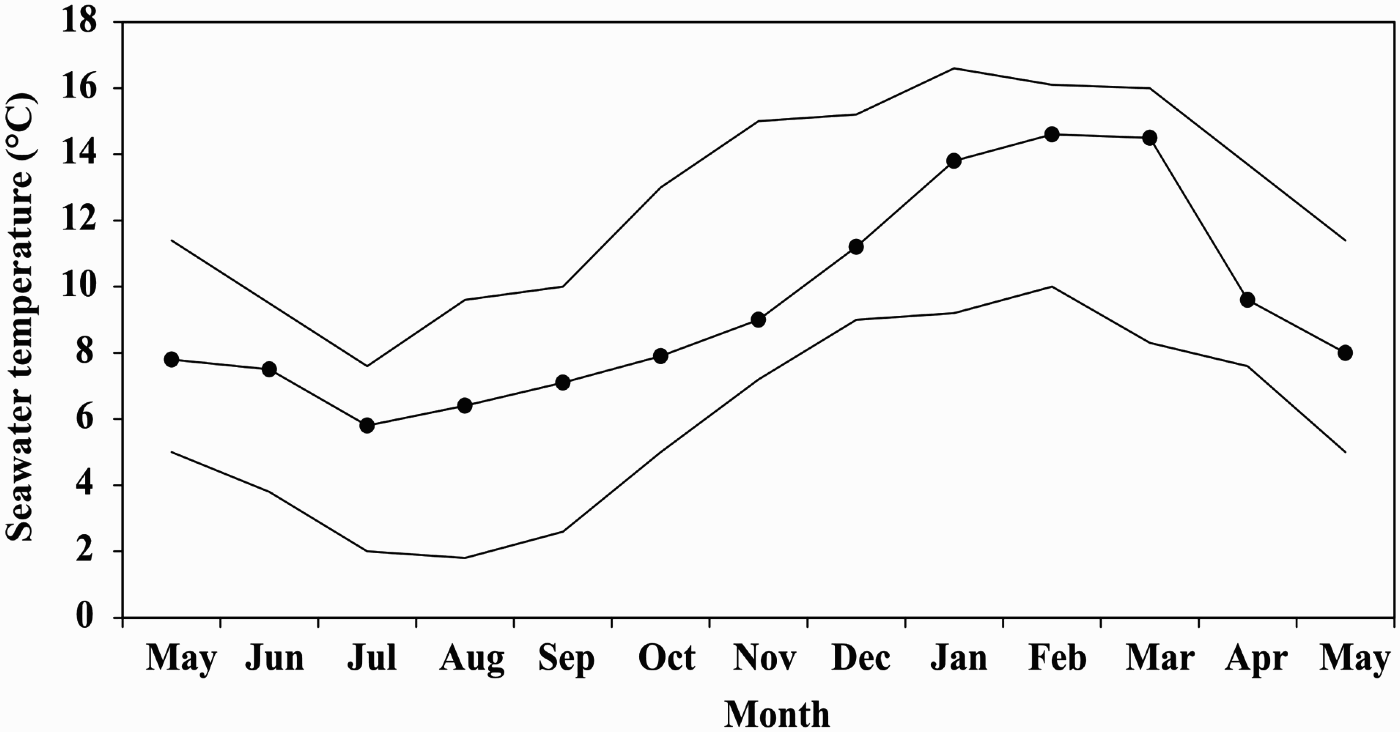
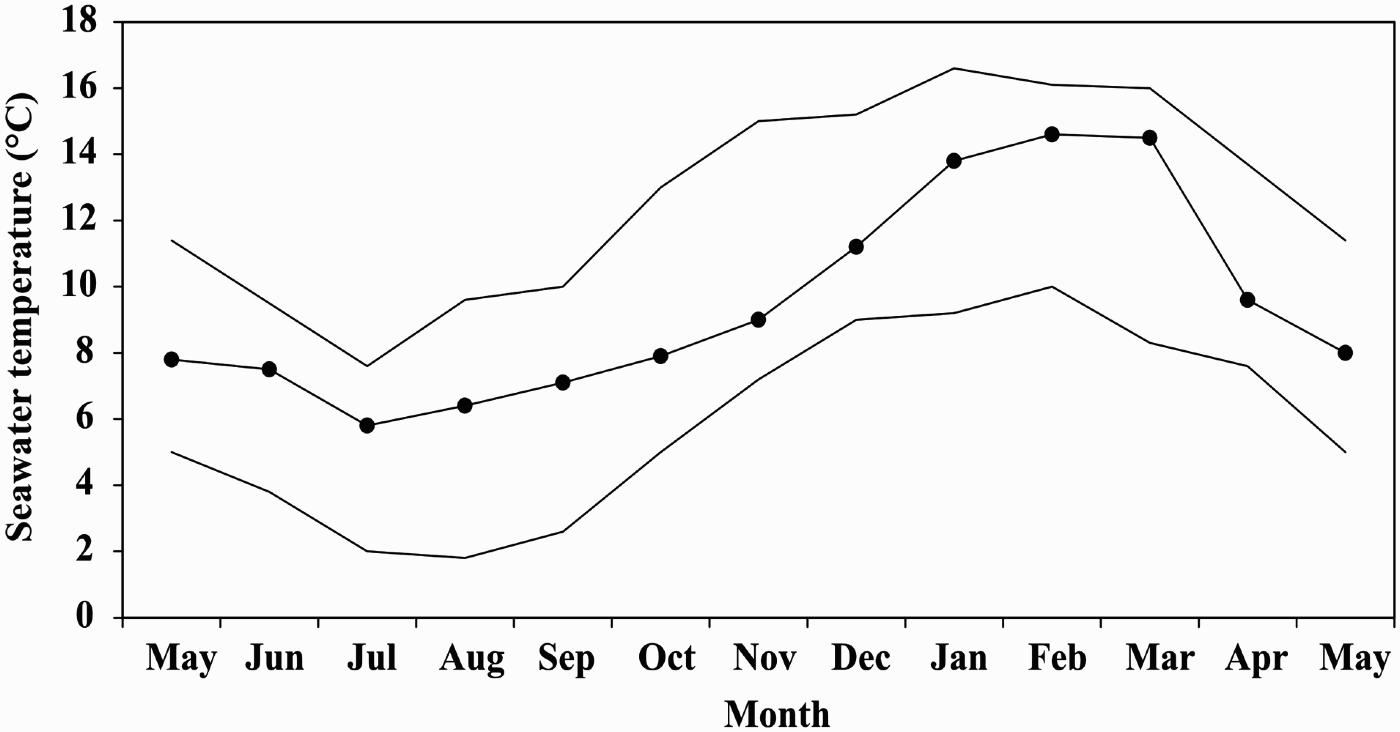
In each case, the temperature was similar to the one recorded during the corresponding sampling period, except for July, when environmental temperature was 1°C higher (Figure 1).
Sea surface temperatures in the Deseado River estuary over the study period (2002–2003). The upper and lower lines represent the historical maximum and minimum temperatures, respectively (data from the Servicio de Hidrografía Naval, Argentina).
The frequency of the embryonic stages after 30 days of laboratory rearing was compared across temperatures treatments using an R × C G-test (Sokal & Rohlf, Reference Sokal and Rohlf1995).
From the sample of July 2002, a group of 20 recently moulted to adults females were reared separately and monitored for 150 days until December (hitherto referred to as long-term rearing), with temperature increasing gradually from 7 to 10.2°C.
In all cases the water was changed weekly and the crabs were fed open mussels (Perumytilus purpuratus) and pieces of isopods (Exosphaeroma sp.).
Fecundity
The term fecundity is here considered as the number of eggs carried by a female in its pleopods during a spawning event. The analysis of fecundity was performed on a total of 136 females with eggs in stages I or II (subsamples from May, September, October and December 2002, and May 2003). In order to determine fecundity and size, eggs were separated from the ovigerous setae, counted, and a subsample was measured to the nearest 0.01 mm under a stereoscopic microscope. The relationship between fecundity and CW was examined by least-squares regression analysis with log-transformed data. Very small broods (22−75 eggs) were observed in a few females, but they were not included in the regression analyses, since females had ripe ovaries and could have been undergoing spawning.
To test the hypothesis that fecundity may be affected by successive spawnings, a one-way GLM ANCOVA, with CW as the covariate, was used to determine if regressions of the number of eggs for each individual × CW differed between spawning dates (Zar, Reference Zar1999). Crabs sampled in October and December 2002 were not included in the ANCOVA because of the possibility of simultaneous occurrence of females undergoing two different annual classes (see Vinuesa & Ferrari, Reference Vinuesa and Ferrari2008b). In the case of significant differences, post-hoc pairwise tests between spawning dates were conducted using the Sidak approach to compare estimated adjusted means (Day & Quinn, Reference Day and Quinn1989). No significant differences were detected when a slope homogeneity test was carried out for ANCOVA (P > 0.10). Assumptions of homoscedasticity of data were tested with Cochran's C test. The dependent variable (number of eggs) and covariate (CW) were log-transformed to achieve homogeneity of variances. The approximate normal distribution of the within-cell deviations from the respective cell means was tested graphically by normal probability plots. A significance level of 5% was used for all analyses.
RESULTS
The registered surface water temperature in the estuary (from 5.8 to 14.6°C) over the period of study was included between the historical maximum and minimum values (Figure 1).
Carapace width of mature females of the Deseado River estuary was between 5.5 to 13.8 mm, with a mean size of 9.25 mm ± 1.52 SD (N = 337).
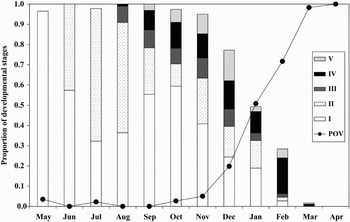
The embryo development of H. planatus follows the typical pattern of brachyurans, which have eggs with abundant yolk. Eggs (stage I) have a mean diameter of 0.44 mm (±0.03 (SD), N = 126), while stage V, at the beginning of larval hatching, have a mean diameter of 0.49 mm (± 0.02, N = 64). The embryo is located at one pole of the egg and the developmental stages can be observed on the surface. Figure 2 shows the relative proportions of the different developmental stages in the monthly samples throughout the study period. Stage I, indicating a recent spawn, was found between May and February, delimiting the beginning and the end of the spawning season, respectively. Three or four spawns were likely to occur during this period (Vinuesa & Ferrari, Reference Vinuesa and Ferrari2008b). In May, the females at the onset of the second reproductive period experienced a mass spawn. In June, about 50% of the brood were at stage II and completed their development from August onwards (Figure 2). The follow-up of these females during winter was hampered by the slow developmental rate of the egg mass and the co-occurrence of females in their first reproductive season. Embryos at stage III were present from August onwards and at stages IV and V from September onwards. Embryos at stage I dominated all samples from September to January. From October onwards, there was an increase in the proportion of POV females, which became dominant from January onwards and represented 98% of all females in March and 100% in April, when no OVI females were detected (Figure 2). These data confirm that the studied H. planatus population goes through a reproductive resting period during the warmest months. It is important to take into consideration that females died after their 2nd reproductive season, between December and February (Vinuesa & Ferrari Reference Vinuesa and Ferrari2008b); so, the POV indicated in Figure 2 in summer are entering in the resting period.
Monthly proportion of developmental stages registered in the ovigerous females. The embryonic stages (I–V) are defined in the text. Circles connected by lines indicate the proportion of post-ovigerous females (POV) recorded monthly.

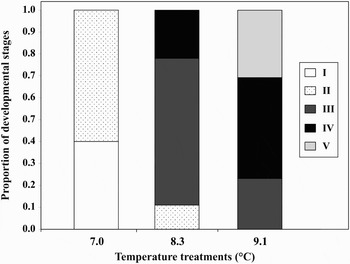
The proportions of the different embryo stages after 30 days of laboratory rearing differed significantly (R × C test, P < 0.001) between rearing temperatures (Figure 3). The embryo development was highly affected by rising temperature. The culture at 7.4 ± 0.4°C, with similar temperatures to the ones recorded in the field in winter, showed proportions of stages I and II comparable to those observed in the field during the same period (Figure 2).
Developmental stages of embryos reared in laboratory at three mean temperatures (7.4, 8.3 and 9.0°C) during 30 days after spawning.

There was a remarkable decrease in the development time at 8.3 ± 0.3°C, with 11% of the embryos at stage II, about 70% at stage III and the remaining at stage IV. The embryos at 9.0 ± 0.3°C were at stages III, IV and V, with the former representing only 23% of the total.
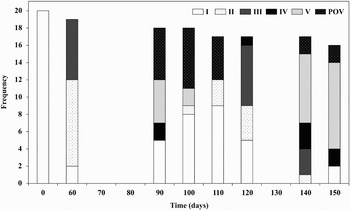
Results obtained from the long-term culture (Figure 4) reveal that females have their first spawn in July. After 60 days, eggs are mainly in stages II and III, and complete embryogenesis in approximately three months. In the following 60 days of rearing, two additional spawns were recorded. It is worth mentioning that females brooding eggs at intermediate and advanced developmental stages at the end of the rearing period, had fully mature ovaries indicating a nearly spawning event.
Developmental stages of embryos from laboratory-reared females (N = 20) monitored for 150 days, from July to December. The number of days from the beginning of the rearing period is indicated.

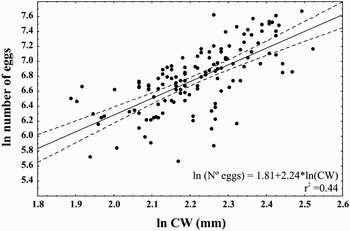
Mean number of eggs per OVI females was 948.42 (SD = 412.89, N = 136). The number of eggs carried by OVI female ranged between 210 (crab of 8 mm CW) and 2150 eggs (crab of 12.1 mm CW). There was a significant positive log-transformed linear relationship (F1,134 = 106.46, P ≤ 0.01) between CW and fecundity (Figure 5).
Linear relationship between the ln number of eggs and ln carapace width (CW) of ovigerous females (N = 136 collected during the study period). The dashed lines represent the upper and lower 95% confidence limits.

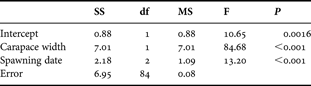
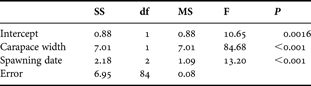
The ANCOVA indicated that fecundity was significantly different between spawning dates (F2,84 = 13.2, P < 0.001) (Table 1). Post-hoc comparison of estimated adjusted means indicated significant differences (P < 0.001) between the second brood of 2002 (September 2002) and the rest of the analysed broods. These results may indicate that there was a significant decrease of fecundity between successive broods (first and second brood in 2002). There was no significant difference in the fecundity between two different age-classes (May 2002 and May 2003).
One-way GLM ANCOVA test for differences in fecundity between spawning dates (spawning data from May 2002, September 2002 and May 2003; N = 88). The effect of carapace width was included as a covariate.
DISCUSSION
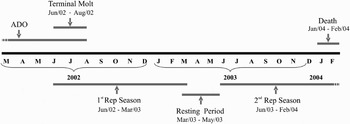
In a previous work we described the ovarian maturation and spawning seasons of H. planatus in the Deseado River estuary (Vinuesa & Ferrari, Reference Vinuesa and Ferrari2008b). The life-cycle of a female year-class, from terminal moult to death, is represented schematically in Figure 6. During her lifetime, a female may have 7 to 8 spawns following a single mating.
Life-cycle scheme of a year-class Halicarcinus planatus female from terminal moult to death.

The several successive spawns found in the studied population of H. planatus represent an adaptive strategy to increase fecundity (Vinuesa & Ferrari, Reference Vinuesa and Ferrari2008b). This spawning behaviour is similar to that reported for other hymenosomatids from tropical and warm-temperate waters (Lucas, Reference Lucas1980; van den Brink & McLay, Reference van den Brink and McLay2010). At the study site, in cold-temperate waters, oogenesis and embryogenesis become tightly synchronized, resulting in successive spawning and hatching events during the two reproductive periods. But, in contrast with other studied hymenosomatid species (Lucas, Reference Lucas1980) and the populations of the Kerguelen Islands (Richer de Forges, Reference Richer de Forges1977) and the Beagle Channel (Diez & Lovrich, Reference Diez and Lovrich2009), the studied population undergoes a short period of reproductive arrest during late summer and early autumn (Vinuesa & Ferrari, Reference Vinuesa and Ferrari2008b). This period might represent an energy storage period for the next breeding season.
Since embryogenesis is a metabolic process, its duration depends on the environmental temperature (Wear, Reference Wear1974). Annually, the temperature of surface waters in the study area varies over a wide range and the incubation period in the area may occur in water temperatures from nearly 2°C in winter to nearly 16°C in summer (see Figures 1 & 2). Richer de Forges (Reference Richer de Forges1977) reported that the incubation period in H. planatus from the Kerguelen Islands reared between 6 and 8°C lasts 60 days and speculated that in winter it might last up to 120 days. In the Beagle Channel, where temperatures are similar, embryo development takes 120−150 days in April spawning and 90−120 days in September (Diez & Lovrich, Reference Diez and Lovrich2009). In our study area, the incubation period is approximately 90−100 days for the brood in May with mean temperatures between 6 and 8°C (Figures 1 & 2). It would be reduced to approximately 30 days at mean temperatures above 9°C, as suggested by the results obtained for laboratory-reared females (see Figure 3). This is an extremely abrupt shortening of the embryo development with an average temperature increase of no more than 2°C.
The long-term rearing group of females showed three consecutive spawnings, along with a decrease of the embryonic developmental time with increasing temperature (Figure 4). These results suggest that the large number of spawnings recorded in the studied population is directly linked to the increase of water temperature by the end of the spring and during the summer. A similar event has been registered for the sub-Antarctic galatheid Munida gregaria, which shows a single spawn in the Beagle Channel (Tapella et al., Reference Tapella, Lovrich, Romero and Thatje2002), two spawns in San Jorge Gulf (Vinuesa, Reference Vinuesa2007) and multiple spawns in warmer waters of Nuevo Gulf (Dellatorre & Barón, Reference Dellatorre and Barón2008).
A mean fecundity of 1600 eggs for H. planatus has been indicated at Kerguelen Islands (Richer de Forges, Reference Richer de Forges1977), and values between 692 and 1226 eggs at the Beagle Channel (Diez & Lovrich, Reference Diez and Lovrich2009). In the studied population, we have recorded fecundities from 210 to 2150 eggs. Considering the smaller size of females of the estuary in relation to the other two populations studied and the similar egg size with those of the Beagle Channel (0.43 mm diameter; Diez & Lovrich, Reference Diez and Lovrich2009), the population of the Deseado River estuary would have higher biotic potential. This is supported by the high number of eggs they carry (mean fecundity = 948 eggs, mean CW = 9.23 mm) and the highest number of spawnings in adult life.
For invertebrates it is noted that in those females with several spawnings, the latter tend to have lower fecundity (Ramirez Llodra, Reference Ramírez Llodra2002). Diez & Lovrich (Reference Diez and Lovrich2009) hypothesize that the difference recorded in the fecundity is because the primiparous females produced fewer eggs as a result of their smaller size during the adolescent stage. The present study showed that during the second reproductive period, fecundity differed between the first and second successive spawning. Also, a positive relationship was found between the fecundity and CW of mature females. One factor to consider, as a possible cause of variation in fecundity, would be the limited energy available for growth and reproduction. Usually, the allocation of energy to reproduction will be associated with a decrease in somatic investment, but in females with determinate growth, such as H. planatus, the somatic investment is minor. Another factor to consider is the nutritional status, which is strongly related to the production of eggs (Wen et al., Reference Wen, Chen, Zhou, Ai and Glenn2002; Djunaidah et al., Reference Djunaidah, Wille, Kontara and Sorgeloos2003; Sui et al., Reference Sui, Wu, Wille, Cheng and Sorgeloos2008). Females spawning in May would have a higher fecundity because they came from a summer resting period when they could increase nutrient reserves. Females which spawn in September would present a lower fecundity, since during winter the feeding activity of the crabs could decrease due to low temperatures and scarcity of food.
The large number of successive spawnings (Vinuesa & Ferrari, Reference Vinuesa and Ferrari2008b) would represent the main selective force influencing the reproductive effort in the population. Nevertheless, it would be only a contribution of no more than 9500 eggs during the lifespan of mature females. As was pointed out previously by Lucas (Reference Lucas1980), hymenosomatids may produce more egg masses per female or unit of time, but their total egg production must be in the lower range for the Brachyura with planktotrophic larvae (Lucas, Reference Lucas1980). Some hymenosomatids with large eggs have suppressed larval development. Abbreviated larval development and restricted dispersion are adaptations to increase larval survival in the family (Lucas, Reference Lucas1980). Some species have evolved towards large eggs with few larval stages, as is the case of H. planatus, whose larvae go through three zoeal stages (Boschi et al., Reference Boschi, Scelzo and Goldstein1969; Richer de Forges, Reference Richer de Forges1977) and skip the megalopal stage, reducing the period of larvae in plankton. Larger eggs produce larger larvae, which are better able to survive in variable conditions, such as water currents, salinity, starvation, predation, among others (Steele & Steele, Reference Steele and Steele1975; Schuh & Diesel Reference Schuh and Diesel1995; Hancock et al., Reference Hancock, Hughes and Bunn1998). This peculiarity reflects a general strategy of keeping larvae in the vicinity of the adult's suitable habitats (Lucas, Reference Lucas1980). Hatching of H. planatus occurs between late winter and mid-summer. First hatching of the year occurs at cold water temperatures (7−8°C), but simultaneously with a major phytoplankton bloom and a subsequent rise of temperature; likewise, hatching during mid-summer is also synchronized with a second peak of phytoplankton availability in the area (Akselman, Reference Akselman1996). Thus, this species has adapted very well to living in more temperate water of the Patagonian Atlantic coast.
ACKNOWLEDGEMENTS
We thank Natalia Melgar for technical assistance. Our gratitude to the referees' comments, suggestions and criticisms that helped us to improve significantly the manuscript. This research was partially supported by the Consejo Nacional de Investigaciones Científicas y Técnicas (CONICET) and the Universidad Nacional de Luján, Argentina.