INTRODUCTION
The flagellated protozoan parasite Trypanosoma cruzi is the aetiological agent of Chagas' disease, representing a serious health problem in the Americas, with 18 million people infected and 100 million people at risk (Barrett et al. Reference Barrett, Burchmore, Stich, Lazzari, Frasch, Cazzulo and Krishna2003). A common feature amongst parasitic protozoan organisms is their ability to adapt their metabolism to endure a wide range of environmental conditions and selection pressures, including the availability and quality of carbon sources in the different mammalian and insect hosts (Tielens et al. Reference Tielens and Van Hellemond1998). One of the enzyme families related to cell energy management is the nucleoside diphosphate kinases (NDPKs). These are enzymes involved in energy metabolism transferring high-energy phosphates between nucleosides di- and tri-phosphates, thus maintaining the nucleoside balance in the cell (Parks and Agarwal, Reference Parks, Agarwal and Boyer1973), according to the following reaction:

NDPKs were considered house-keeping enzymes for a long time; however, a wide variety of additional functions have been described. In humans, 8 NDPK isoforms were identified; 5 of these proteins bear nuclease activity with different functions related to apoptosis and tumor suppression processes (Lacombe et al. Reference Lacombe, Milon, Munier, Mehus and Lambeth2000). This feature has also been demonstrated for NDPKs from bacteria such as Escherichia coli and Mycobacterium tuberculosis (Levit et al. Reference Levit, Abramczyk, Stock and Postel2002; Saini et al. Reference Saini, Maithal, Chand, Chowdhury, Vohra, Goyal, Dubey, Chopra, Chandra, Tyagi, Singh and Tandon2004). One of 3 plant NDPK isoforms also has this activity probably associated with programmed cell death (Hammargren et al. Reference Hammargren, Salinas, Maréchal-Drouard and Knorpp2007). Trypanosoma cruzi has 2 bona fide NDPK isoforms named TcNDPK1 and TcNDPK2 (GeneBank Accession numbers XP_820714 and XP_821632, respectively), which were cloned and biochemically characterized (Miranda et al. Reference Miranda, Canepa, Bouvier and Pereira2008). While TcNDPK1 is similar to canonical NDPKs, TcNDPK2 presents an N-terminal extension similar to a DM10 domain (InterPro number: IPR006602) which is capable of targeting proteins to flagella (Miranda et al., unpublished observations). In addition, 2 putative NDPKs were also predicted using the T. cruzi genome data (TcNDPK3 and TcNDPK4).
In this study, the first evidence of a protozoan NDPK harbouring nuclease activity is presented. We report that T. cruzi TcNDPK1 cleaves a linear and supercoiled plasmid substrate and also genomic DNA, with characteristics similar to other nucleases.
MATERIALS AND METHODS
Preparation of recombinant TcNDPK1
TcNDPK1 was expressed in E. coli as described by Miranda et al. (Reference Miranda, Canepa, Bouvier and Pereira2008). Briefly, TcNDPK1 sequence was obtained from GeneDB (http://www.genedb.org/) and TcruziDB (http://tcruzidb.org/). The fragment carrying the entire T. cruzi TcNDPK1 gene (GeneDB systematic ID Tc00.1047053508707.200) was obtained by PCR amplification and ligated to the pRSET-A expression vector (Invitrogen, Carlsbad, CA). Over-expression of the recombinant protein was performed in the E. coli strain BL21(DE3)pLysS (Invitrogen, Carlsbad, CA). The recombinant protein was purified by affinity chromatography using an Ni2+-agarose resin (Qiagen, MD, USA). The purity of the enzyme was evaluated by reverse-phase HPLC in a Beckman System Gold equipped with a C18 column of 4·6 mm×150 mm and a 20 μl loop. A gradient elution composed by acetonitrile/water, 0·05% (v/v) trifluoracetic acid was employed as follows: 10 min 0/100, 15 min to reach 40/60, 10 min to reach 60/40 and 30 min to reach 100/0. The flux was 0·15 ml/min and detection was carried out at 280 nm. A peak eluting at a retention time of 37·6 min corresponding to TcNDPK1 represents more than 90% of the total proteins in the sample. The purity of TcNDPK1 was also evaluated by SDS-PAGE as explained in the Results section.
In vitro nuclease assays
Samples of 300 ng of plasmidic linear, supercoiled or genomic DNA substrates were incubated in 50 mm Tris (pH 7·0), 10 mm MgCl2 with 500 ng of TcNDPK1 at 37°C for 3 h, unless otherwise indicated. In other assays ATP or ADP (5 mm) was added to the reaction mixtures. The reaction products were resolved in agarose gels. All assays were performed at least in triplicate and data are representative of at least 3 independent experiments.
Bioinformatics
A group of nucleoside diphosphate kinase amino acid sequences available at GenBank were selected and aligned, clustered according to their amino acid identity using the ClustalW algorithm (Higgins and Sharp, Reference Higgins and Sharp1988) and schematically represented using the Treeview program (Page, Reference Page1996).
RESULTS
TcNDPK1 degrades linear and circular supercoiled DNA in a time, protein and temperature-dependent manner
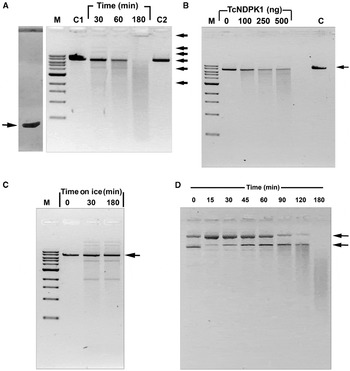
The nuclease activity of TcNDPK1 was evaluated using an in vitro cleavage assay as described in the Materials and Methods section. The capability of TcNDPK1 to cleave and degrade linear DNA was initially tested using a plasmid substrate. Different incubation times and enzyme quantities were tested. These assays showed that TcNDPK1 cleavage activity is proportional to incubation time and enzyme amounts up to 3 h and 500 ng of enzyme where DNA substrate was consumed (Fig. 1A and B). During the time-course of DNA degradation, different plasmid structures have been observed (arrows on Fig. 1A). Interestingly, some of these bands have lower gel mobility compared with the DNA substrate, suggesting the formation of an enzyme-DNA intermediary. Control assays were performed without enzyme (lane C1 in Fig. 1A), using TcNDPK2 instead of TcNDPK1 (lane C2 in Fig. 1A) or incubating nuclease reactions on ice (Fig. 1C). In all the mentioned control assays DNA substrates remained unaltered. As occured with linear DNA, the entire substrate sample was completely degraded in about 180 min (Fig. 1D).
Nuclease assays using different DNA substrates. (A) The first (left) lane showed an SDS-PAGE of the TcNDPK1 used for nuclease activity assays. A time-course of linear DNA degradation was assayed using 300 ng of 6·2 kb length plasmid and 500 ng TcNDPK1. Arrows indicate bands associated with the enzymatic degradation process. Controls without enzyme (C1) and using TcNDPK2 (C2) were included. (B) Increasing amounts of enzyme source (0–500 ng) with 300 ng of a linear DNA substrate (arrow) were tested including a control (C) without enzyme. (C) A standard nuclease activity (300 ng linear DNA and 500 ng enzyme) was performed during 180 min on ice. Arrow indicates the DNA substrate. (D) A time-course using 300 ng of circular supercoiled DNA as substrate and 500 ng of enzyme. Arrows indicate supercoiled and open-circle plasmid.

Nuclease activity is Mg2+ dependent but is not affected by ADP or ATP
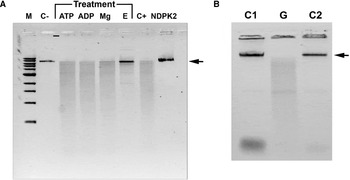
In order to test if the nuclease activity is regulated by nucleosides di- or triphosphate nuclease assays were performed using TcNDPK1 and a reaction mixture supplemented with 5 mm ATP or ADP. As Fig. 2A shows, nucleotides are not required for TcNDPK1 nuclease activity, suggesting that kinase and nuclease are independent enzyme activities unlike other NDPKs. However, similar to other nucleases, the absence of Mg2+ in the reaction mixture abolishes the enzymatic activity (Fig. 2A).
Requirements of nuclease activity and assays using T. cruzi genomic DNA. (A) Standard nuclease assays (300 ng linear DNA and 500 ng enzyme) were performed under different conditions: reaction mixture with ATP or ADP, without Mg2+ (5 mm EDTA) and the control with Mg2+. Additional controls were performed without enzyme (C−), using a standard reaction mixture (C+) or 500 ng of TcNDPK2. (B) Enzyme assays with T. cruzi genomic DNA (G) including controls performed without enzyme (C1) or 500 ng of TcNDPK2 (C2).

T. cruzi genomic DNA is also susceptible to TcNDPK1
To test if TcNDPK1 is able to degrade long DNA substrates, T. cruzi genomic DNA was used as substrate, including 2 negative controls without enzyme and using TcNDPK2. It is noteworthy that similar times were needed to completely degrade genomic or plasmidic DNA (Fig. 2B).
Nuclease and NDPK activities decrease proportionally by heat treatment
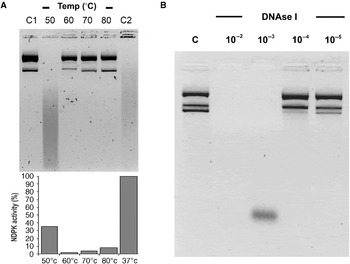
In order to test if separate protein environments are responsible for TcNDPK1 nuclease and kinase catalytic activity, a thermostability assay was performed. Purified TcNDPK1 samples were pre-incubated at different temperatures and assayed for nuclease and NDPK activities. Fig. 3A shows that both activities were completely inhibited at the same temperature, 60°C, suggesting that the same or close localized residues/structures are involved in the catalytic site. TcNDPK1 activity was also compared to a commercial nuclease, DNAse I (Invitrogen). Using different enzyme quantities between 2×10⁻² and 2×10⁻⁵ units, DNAse I-specific activity was estimated to 0·9 ng dsDNA×(min.ng enzyme)−1 (Fig. 3B) while TcNDPK1 specific activity was 0·06 ng dsDNA×(min.ng enzyme)−1. Both assays were performed under the same conditions and same DNA substrate amount.
Effects of temperature on TcNDPK1 activities and comparison with DNAse I. Correlation between nuclease and NDPK activity was evaluated at different temperatures. (A) Upper panel: TcNDPK1 (500 ng) was pre-treated at different temperatures between 50 and 80°C during 10 min and evaluated for nuclease activities using 300 ng of plasmid substrate. Controls without enzyme (C1) and standard assay at 37°C (C2) were performed. Lower panel: NDPK activity, using 10 μg of enzyme, at different temperatures was represented with a bar graphic. (B) Commercial DNAse I (Invitrogen) was used at different amounts between 2×10⁻² and 2×10⁻⁵ units in the same conditions as TcNDPK1 nuclease assay.

TcNDPK1 is conserved between different species
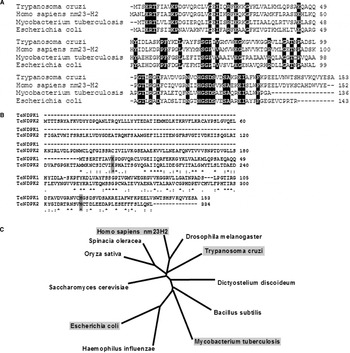
Fig. 4A shows a global alignment between some of the reported NDPKs which have nuclease activity. Different peptides are completely conserved between evolutionarily distant species, the first arrow indicates the lysine involved in the nuclease activity while the second arrow shows the histidine residue participating in the phosphoryl transfer between NDPs and NTPs (Kumar et al. Reference Kumar, Verma, Saini, Chopra, Chakraborti, Singh and Chowdhury2005). In order to identify sequence features associated with nuclease activity, a phenogram was constructed with different NDPKs, including those with demonstrated nuclease activity (Fig. 4C, grey shaded). TcNDPK1 appears to be close to the Drosophila melanogaster and human (Nm23-H2) equivalents. In addition, Fig. 4B shows a global alignment of TcNDPK1 and 2. Interestingly, despite TcNDPK2 lacking nuclease activity, the previously reported lysine involved in it (grey shaded) is completely conserved among both enzymes.
Sequence alignment and phenogram of different NDPKs. (A) A global sequence alignment was performed using NDPKs harbouring nuclease activity. Arrows indicate the previously reported residues involved in nuclease (K) or kinase activities (H). (B) Global sequence alignment between TcNDPK1 and TcNDPK2 (without nuclease activity). Shadowed residues are those reported to be involved in nuclease activity. (C) Selected NDPK seed sequences were used as references of this enzyme group. A phenogram was constructed based on the sequence identity. Shadowed sequences represent enzymes with previously reported nuclease activity.

DISCUSSION
Nucleoside diphosphate kinases belong to a very well-characterized enzyme family; however, its nuclease activity was reported only in a few organisms (Lacombe et al. Reference Lacombe, Milon, Munier, Mehus and Lambeth2000; Levit et al. Reference Levit, Abramczyk, Stock and Postel2002; Saini et al. Reference Saini, Maithal, Chand, Chowdhury, Vohra, Goyal, Dubey, Chopra, Chandra, Tyagi, Singh and Tandon2004; Hammargren et al. Reference Hammargren, Salinas, Maréchal-Drouard and Knorpp2007). In the specific case of TcNDPK1, this enzyme is capable of degrading different DNA substrates, independent of it's length and structure with a specific activity 15-fold lower than a commercial high-activity nuclease, but 6-fold higher than the pea NDPK (Hammargren et al. Reference Hammargren, Salinas, Maréchal-Drouard and Knorpp2007). T. cruzi genomic DNA is also susceptible to TcNDPK1 nuclease activity, which is indirect evidence that TcNDPK1 could be a component of programmed cell death machinery in trypanosomatid organisms (Debrabant and Nakhasi, Reference Debrabant and Nakhasi2003). It was reported that ATP activates the pea mitochondrial NDPK nuclease activity in vitro while ADP has an inhibitory effect (Hammargren et al. Reference Hammargren, Salinas, Maréchal-Drouard and Knorpp2007); however, TcNDPK1 is not affected by the presence of such nucleotides. On the other hand, the nuclease activity is completely dependent on Mg2+, as occurs with most other nucleases. In contrast with the previously identified lysine involved in nuclease activity in Mycobacterium tuberculosis and human NDPKs (Kumar et al. Reference Kumar, Verma, Saini, Chopra, Chakraborti, Singh and Chowdhury2005; Postel et al. Reference Postel, Abramczyk, Levit and Kyin2000), our sequence comparison between both T. cruzi NDPKs suggests that other amino acids or structures are critical for such activity. The human orthologue Nm23-H2, which also has nuclease properties, was associated with relevant diseases such as oncogenic processes as a human metastasis-suppressor (Backer et al. Reference Backer, Mendola, Kovesdi, Fairhurst, O'Hara, Eddy, Shows, Mathew, Murty and Chaganti1993). In addition to the nuclease function, Nm23-H2 also participates in the activation of potassium channels by histidine phosphorylation (Srivastava et al. Reference Srivastava, Li, Ko, Choudhury, Albaqumi, Johnson, Yan, Backer, Unutmaz, Coetzee and Skolnik2006); however, the physiological function of TcNDPK1 requires further investigation.
We are deeply grateful to Rosario Medici for technical assistance. This study was supported by Consejo Nacional de Investigaciones Científicas y Técnicas (CONICET, PIP 5492), University of Buenos Aires (UBACyT X073), and Agencia Nacional de Promoción Científica y Tecnológica (FONCYT-PICT REDES 2003-0300 and PICT 2005-33431). C.A.P. is a member of the career of scientific investigator of CONICET (Argentina), M.R.M. is a research fellow from Fundación YPF, G.E.C. and L.A.B. are research fellow from CONICET.