Implications
Previous studies have demonstrated that selection for lean meat yield using breeding values for post-weaning growth, eye muscle depth and back fat depth is reducing intramuscular fat percentage (IMF%) in the loin. This study has demonstrated that this impact extends beyond the loin, to muscles of the fore and hind sections of the carcass. This work provides essential information regarding the impact of carcass breeding values on IMF% and eating quality, facilitating the management of these detrimental effects.
Introduction
Consumers in both domestic and international markets have an increasing desire for lamb which produces retail cuts of meat that are well muscled and low in salvage fat, representing value for money and healthy meal options (Pethick et al., Reference Pethick, Banks, Hales and Ross2006). The Australian lamb industry has responded to these market drivers to select for larger, leaner lambs (Hall et al., Reference Hall, Kelf, Fogarty and Murray2000; Banks, Reference Banks2002; Laville et al., Reference Laville, Bouix, Sayd and Bibé2004). Health characteristics such as low levels of fat and the nutritional content will remain important (Harper and Pethick, Reference Harper and Pethick2004; Pannier et al., Reference Pannier, Pethick, Boyce, Ball, Jacob and Gardner2014b); however, eating quality has also been shown to be important to consumers (Harper and Pethick, Reference Harper and Pethick2004). Intramuscular fat percentage (IMF%) is a key determinant of eating quality in red meat and it is well accepted that IMF% has a positive impact on flavour, juiciness and tenderness (Thompson, Reference Thompson2004; Hopkins et al., Reference Hopkins, Hegarty, Walker and Pethick2006; Pannier et al., Reference Pannier, Gardner, Pearce, McDonagh, Ball, Jacob and Pethick2014c). In lamb, it has been suggested that a minimum of four to five IMF% is required for Australian consumer satisfaction with regard to palatability (Hopkins et al., Reference Hopkins, Hegarty, Walker and Pethick2006). Accordingly, the IMF% of the Muscularis longissimus lumborum (short loin) has been identified as a key factor for maintaining premium eating quality of lamb (Pannier et al., Reference Pannier, Pethick, Geesink and Ball2014a and Reference Pannier, Gardner, Pearce, McDonagh, Ball, Jacob and Pethick2014c).
Given that the loin musculature contains the most valuable cuts in the carcass, previous research has focused on the eating quality and IMF% of this muscle (McPhee et al., Reference McPhee, Hopkins and Pethick2008; Pannier et al., Reference Pannier, Pethick, Geesink and Ball2014a and Reference Pannier, Gardner, Pearce, McDonagh, Ball, Jacob and Pethick2014c). The IMF% of muscles other than the M. longissimus lumborum has not been well described in lamb. These levels are likely to vary between muscles, in part as a consequence of functional variation owing to muscle fibre type (Hocquette et al., Reference Hocquette, Gondret, Baéza, Médale, Jurie and Pethick2010). Muscles composed of more oxidative fibres contain more triglycerides and so IMF (Hocquette et al., Reference Hocquette, Gondret, Baéza, Médale, Jurie and Pethick2010). Muscles responsible for maintenance of posture tend to be more oxidative and are predominantly comprised of Type 1 fibres with a propensity for higher IMF% (Picard et al., Reference Picard, Lefaucheur, Berri and Duclos2002).
A key factor driving reduced IMF% in the M. longissimus lumborum is selection for lean growth. Pannier et al. (Reference Pannier, Pethick, Geesink and Ball2014a) demonstrated an association between various carcass indicators of fatness and IMF% in the M. longissimus lumborum, whilst Gardner et al. (Reference Gardner, Williams, Siddell, Ball, Mortimer, Jacob, Pearce, Hocking Edwards, Rowe and Pethick2010) reported a negative phenotypic (−0.24) and genetic correlation (−0.46) between IMF% and lean meat yield percentage (LMY%). Selection for improved LMY% in Australian sheep is performed indirectly through the use of Australian Sheep Breeding Values (ASBVs) to increase post-weaning weight (PWWT) and c-site eye muscle depth (PEMD), and reduced c-site fat depth (PFAT; c-site defined as a measure 45 mm from the midline over the 12th rib). Pannier et al. (Reference Pannier, Pethick, Geesink and Ball2014a) demonstrated that decreasing PFAT and increasing PEMD, both reduced IMF% in the M. longissimus lumborum. A decreased PFAT breeding value reduces total carcass fatness, which would include IMF. Moreover, sires with high PEMD and/or low PFAT breeding values had increased weight of the M. longissimus lumborum, located in the saddle section (Gardner et al., Reference Gardner, Williams, Siddell, Ball, Mortimer, Jacob, Pearce, Hocking Edwards, Rowe and Pethick2010; Anderson et al., Reference Anderson, Williams, Pannier, Pethick and Gardner2013) and had proportionately more lean weight in the saddle (loin) section than in other regions of the carcass. Therefore, it seems likely that the impact of these breeding values on IMF%, delivered through their effects on muscle hypertrophy and so dilution of IMF%, will be greater in the saddle musculature.
Lambs from sires selected for high PWWT may also have reduced IMF%. These lambs are faster growing due to their larger mature size (Huisman and Brown, Reference Huisman and Brown2008), thus when compared at the same carcass weight, they will be leaner and less mature and subsequently have reduced IMF%. However, in the study by Pannier et al. (Reference Pannier, Pethick, Geesink and Ball2014a), there was no association of PWWT with IMF% in the M. longissimus lumborum, suggesting that any maturity-linked effect may be too subtle to impact. This is likely to extend to other muscles of the carcass.
Therefore, given the negative phenotypic correlation of LMY% and IMF%, we hypothesised that as LMY% increases, measured in this study by computed tomography (CT) lean percentage (CT lean%) the IMF% will decrease. Based on the impact of ASBVs used to improve LMY% on carcass composition, we hypothesised that lambs from high PEMD sires or from low PFAT sires will have reduced IMF% in the short loin, but to a lesser extent in the hind and fore sections, and that increasing sire PWWT will have no impact on IMF% in the carcass. Finally, we hypothesised that the IMF% of muscles in postural regions of the carcass will have greater IMF% than muscles in locomotive regions.
Material and methods
Experimental design and slaughter details
The Australian Cooperative Research Centre for Sheep Industry Innovation established an Information Nucleus Flock commencing in 2007 (Fogarty et al., Reference Fogarty, Banks, van de Werf, Ball and Gibson2007). This paper examines data from 400 lambs born at Katanning, Western Australia in 2011.
The lambs (Merino, Maternal×Merino, Terminal×Merino and Terminal×Border Leicester–Merino) were the progeny of 97 industry sires, representing the major sheep breeds used in the Australian industry. The sires types included 46 Terminal sires (Hampshire Down, Poll Dorset, Suffolk, Texel, White Suffolk), 16 Maternal sires (Border Leicester, Coopworth, Corriedale, Dohne Merino, Prime South African Meat Merino) and 35 Merino sires (Merino, Poll Merino). These sires had ASBVs for PWWT, PEMD and PFAT, which were all sourced from Sheep Genetics, which is Australia’s national genetic evaluation database for sheep (Brown et al., Reference Brown, Huisman, Swan, Graser, Woolaston, Ball, Atkins and Banks2007). The sire breeding values were generated within three separate databases for Terminal, Maternal and Merino sired progeny. This was from an analysis completed in August 2013, and excluded progeny from the Information Nucleus Flock. Some of the youngest sires used in this experiment lacked industry records and therefore did not have ASBVs available. The ranges for these ASBVs varied within sire types as shown in Table 1.
Number of lamb sires and mean (minimum, maximum) of Australian Sheep Breeding Values for each sire type

PWWT=post-weaning weight; PFAT=post-weaning c-site fat depth; PEMD=post-weaning eye muscle depth.
Pregnant ewes were maintained on grass and supplementary-fed grain only if pasture was limited. Ewes were scanned for multiple pregnancies and managed in groups with stocking density appropriate for paddock size, with no difference in the pasture available between different sire groups or birthing and rearing types.
Lambs were yarded the day before slaughter and transported to a commercial abattoir in Katanning, held in lairage overnight and slaughtered the following day at a target average carcass weight of 21.4 kg. Carcasses were subjected to medium voltage electrical stimulation (Pearce et al., Reference Pearce, van de Ven, Mudford, Warner, Hocking-Edwards, Jacob, Pethick and Hopkins2010), and then sampled the day after slaughter for a wide range of carcass and meat quality traits after being chilled overnight (4°C).
Sample collection and measurements
Hot carcass weight (HCWT) was measured immediately after dressing and carcasses were transported to Murdoch University to undergo CT scanning within 72 h of slaughter. (For details of CT scanning, see Anderson et al., Reference Anderson, Williams, Pethick and Gardnersubmitted.) CT scanning of the carcasses enabled the lean% to be determined, which was used as a covariate in some of the statistical models.
Following CT scanning, the individual muscles were dissected from each carcass, weighed and samples collected for IMF% measurement from the fore section, the Muscularis supraspinatus and Muscularis infraspinatus; from the saddle section, the M. longissimus lumborum; and from the hind section, Musculus semimembranosus and Muscularis semitendinosus. Owing to carcass imperfections, all five muscle could not always be obtained from each carcass. IMF was determined on all of these muscles using the method described by Anderson et al. (Reference Anderson, Williams, Pethick and Gardnersubmitted).
Statistical analyses
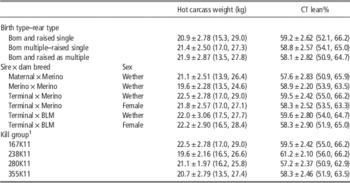
The data analysed in the base model has been summarised in Table 2. The IMF% were analysed using linear mixed effect models (SAS version 9.1; SAS Institute, Cary, NC, USA). The base model included fixed effects for muscle (M. semimembranosus, M. semitendinosus, M. longissimus lumborum, M. supraspinatus, M. infraspinatus), sex within sire type (Merino wether, Maternal wether, Terminal female and Terminal wether), birthing and rearing type (term representing if lamb was born and reared as a single, born as multiple and raised as single or born and raised as a multiple), sire type (Merino, Maternal, Terminal), kill group and dam breed within sire type (Merino×Merino, Maternal×Merino, Terminal×Merino and Terminal×Border Leicester–Merino). Sire identification, dam identification and animal identification were included as random terms. All relevant first-order interactions between fixed effects were tested and non-significant (P>0.1) terms were removed in a stepwise manner.
Number of lambs analysed in the base model according to sire type, sex, birthing and rearing type, dam breed and kill group

BLM=Border Leicester–Merino.
1 Kill group=average age of lambs at slaughter followed by location and birth year (2011); K=Katanning.
The association between IMF% and sire ASBVs for PWWT, PEMD and PFAT were tested in the base model. These ASBVs were initially included concurrently as covariates along with linear and quadratic interactions with the fixed effects. Non-significant (P>0.1) terms were removed in a stepwise manner. Correlations exist between the three ASBVs, therefore this process was repeated with ASBVs included one at a time to determine the independence of their effects.
The base and ASBV models described above were additionally tested with HCWT included in the model as a covariate to determine the effect of HCWT on IMF%, and whether the fixed and ASBV effects were associated with HCWT. Similarly, this process was repeated using CT lean% and carcass weight at the time of CT scanning to determine the impact of carcass composition on IMF%. The relevant linear and quadratic interactions with these covariates were also included. The mean and distribution of the HCWT and CT lean% data are shown in Table 3.
Lamb hot carcass weight (kg) and carcass lean percentage as measured by computed tomography displaying raw mean±s.d. (minimum, maximum)

CT lean%=percentage of lean in the carcass as measured by computed tomography; BLM=Border Leicester–Merino; K=Katanning.
1 Kill group: average age of lambs at slaughter, followed by location (K) and birth year (2011).
Results
Effect of non-genetic factors
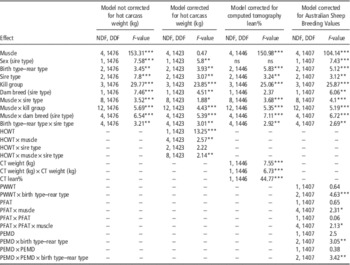
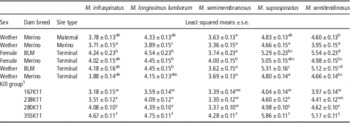
The base model used 1900 of the 1908 observations available, after excluding animals with missing data and described 52% of the total variance in IMF%. The IMF% varied between all muscles examined (P<0.01, Table 4). The mean for IMF% from highest to lowest was M. supraspinatus (4.87±0.1), M. semitendinosus (4.54±0.1), M. longissimus lumborum (4.21±0.1), M. infraspinatus (3.86±0.1) and M. semimembranosus (3.58±0.1). Within the Terminal sired lambs, females (4.59±0.08) had on average 0.2 IMF% more (P<0.01, Table 4) than wether lambs (4.38±0.08). Birth type–rear type impacted on IMF% (P<0.05, Table 4). However, this was only evident in the Merino sired lambs, with the multiple born and raised lambs (4.23±0.14) being 0.5 IMF% higher than that of the single born and raised or multiple born and single raised lambs. The IMF% increased with each successive kill group (P<0.01, Table 4), and on average there was an increase of 1.3 IMF% between the first and last kill group (Table 5). This increase varied between muscles (P<0.01, Table 4), with the greatest increase of 1.8 IMF% seen in the M. supraspinatus and the smallest increase of 0.9 IMF% seen in the M. semimembranosus (Table 5).
F values, and numerator and denominator d.f., for the effects of the base linear mixed effects model, corrected for hot carcass weight (HCWT), computed tomography lean% and Australian Sheep Breeding Values on intramuscular fat% of lamb muscles (Muscularis semimembranosus, Muscularis semitendinosus, Muscularis supraspinatus, Muscularis infraspinatus and Muscularis longissimus lumborum)

NDF, DDF=numerator and denominator d.f.; HCWT=hot carcass weight; CT=computed tomography; PWWT=post-weaning weight; PFAT=post-weaning c-site fat depth; PEMD=post-weaning c-site eye muscle depth.
*P<0.1, **P<0.05, ***P<0.01.
Lamb intramuscular fat percentage for sex, dam breed, sire type and kill groups within the Muscularis semimembranosus, Muscularis semitendinosus, Muscularis supraspinatus, Muscularis infraspinatus and Muscularis longissimus lumborum (not corrected for hot carcass weight)

BLM=Border Leicester–Merino; K=Katanning.
a,b,cValues within a column with different superscripts differ significantly at P<0.05.
w,x,y,zValues within a column with different superscripts differ significantly at P<0.05.
1 Kill group: average age of lambs at slaughter followed by location and birth year (2011).
When the model was corrected for HCWT, the impact of kill group was reduced with IMF% differing by 1% on average across the four kill groups. When both CT lean% and carcass weight at scanning were included in the model sex (sire type) was no longer significant.
Effect of sire type and dam breed
In the base model, sire was significant at P=0.08 with sire estimates varying between 3.66 and 4.81 IMF% within Maternal, 3.34 and 4.49 IMF% within Merino and 3.91 and 5.06 IMF% within Terminal sired lambs.
Comparison of IMF% between sire types was possible only in the male progeny of Merino dams. The Merino sired lambs had on average 0.15 and 0.32 less IMF% than the Maternal and Terminal sired lambs (P<0.01, Tables 4 and 5). The greatest difference in IMF% was seen in the M. semitendinosus, where the Merino sired lambs (3.95±0.15) had 0.71 and 0.65 IMF% less than both the Terminal and Maternal sired animals. In the M. longissimus lumborum, the Merino sired lambs had 0.44 IMF% less than the Maternal sired lambs, but were not different compared with Terminal sired lambs. There were no differences between sire types in the other muscles.
The impact of dam breed on IMF% was assessed in the Terminal sired lambs. Differences were evident (P<0.01, Table 4) within the M. infraspinatus, M. supraspinatus and M. semitendinosus, where the lambs from Border Leicester–Merino dams had IMF% of 4.21±0.11, 5.29±0.11 and 5.34±0.11, compared with lambs from Merino dams with IMF% of 3.96±0.11, 4.92±0.11 and 4.81±0.11 (values represent mean of male and female progeny in Table 5). A similar trend (P<0.1) was seen in the M. longissimus lumborum, where lambs from Border Leicester–Merino dams had IMF% of 4.50±0.10 compared with 4.30±0.10 for lambs from Merino dams.
Correcting the model for HCWT accounted for the difference between sire types in the M. longissimus lumborum, and partly accounted for the difference in the M. semitendinosus, with the Merino sired lambs having only 0.5 IMF% less in the M. semitendinosus than the Maternal and Terminal sired lambs. The difference between dam breeds was relatively unchanged. Including CT lean% and carcass weight at scanning accounted for the differences between dam breeds.
Effect of ASBVs
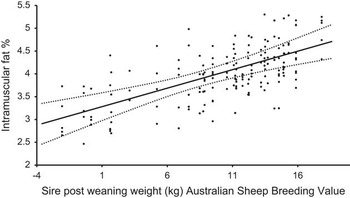
When the sire ASBVs for PWWT, PFAT and PEMD were included at the same time in the base linear mixed effects model, all three demonstrated a significant effect (P<0.1, Table 4). The impact of sire PWWT on IMF% only impacted in lambs born as multiples and raised as a singles (P<0.01, Table 4). In this group of lambs a 1 unit increase in sire PWWT was associated with a 0.08 IMF% increase (Figure 1). The PWWT effect was independent of its impact on HCWT.
The relationship between intramuscular fat percentage in lamb and sire post-weaning weight (PWWT) Australian Sheep Breeding Value, for lambs born as multiples and raised as singles. ● represents residuals for each lamb as deviations from the predicted means for intramuscular fat percentage. Line represents least square means (±s.e. as dashed lines) across the PWWT range.

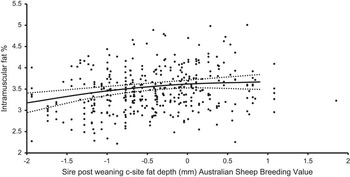
The impact of sire PFAT ASBV differed between muscles (P<0.05, Table 4). This effect was non-linear and across a 2.75 unit range (1.0 to −1.75 mm) of decreasing PFAT values, IMF% in the M. semitendinosus and M. semimembranosus decreased by 0.4 IMF% (Figure 2) and the M. longissimus lumborum decreased by 0.3 IMF%. There was only one lamb with a sire PFAT value >1.5 mm; however, when this animal was removed from the analysis, there was no change to the magnitude of the responses. The fore section muscles showed no change in IMF% in response to decreasing sire PFAT.
The relationship between intramuscular fat percentage in lamb and sire post-weaning c-site fat depth (PFAT) Australian Sheep Breeding Value, for the Muscularis semimembranosus. ● represents residuals as deviations from the predicted means for intramuscular fat percentage. Line represents least square means (±s.e. as dashed lines) across the PFAT range.

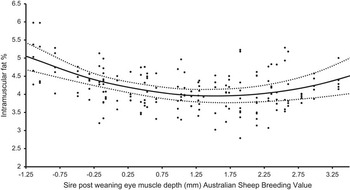
An impact of increased sire PEMD was observed only in the lambs born as multiples and raised as singles (P<0.05, Table 4). This effect was non-linear and across a 3 unit range of sire PEMD (−1.1 to 2.25 mm), IMF% decreased in single raised lambs by 0.9 IMF% (Figure 3).
The relationship between intramuscular fat percentage in lamb and sire post-weaning eye muscle depth (PEMD) Australian Sheep Breeding Value, for lambs born as multiples and raised as singles. ● represents residuals as deviations from the predicted means for intramuscular fat percentage. Line represents least square means (±s.e. as dashed lines) across the PEMD range.

The association of the ASBVs with IMF% did not alter when the ASBVs were included individually in the base model. When HCWT was included in the ASBV model, the effects did not change except for the magnitude of the PWWT effect, which was reduced by a quarter.
Including CT lean% and carcass weight in the ASBV statistical model reduced the magnitude of the PEMD and PWWT effects in the lambs born as multiples and raised as singles by 0.2 IMF%. Within the same model, the impact of PFAT was altered, with a decrease in IMF% observed only in the M. semimembranosus (0.1 IMF% across the decreasing 2.75 unit PFAT range). In this model, the M. supraspinatus and M. infraspinatus increased in IMF% by 0.4 and 0.2 as PFAT reduced from 1 to −1.75.
Effect of HCWT and LMY%
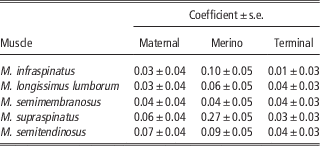
When HCWT was included in the model as a covariate, heavier carcasses had more IMF%, although this varied between the different muscles and sire types (P<0.01, Table 4). On average, IMF% increased by 0.82 units over a 13 kg HCWT range (15 to 28 kg) across all muscles and sire types, which is equivalent to 0.06 IMF%/kg of HCWT. Most muscles followed this trend, with the outlier to this being the M. supraspinatus in the Merino sired lambs where IMF went up by 0.27 IMF%/kg of HCWT (Table 6). Excluding the M. supraspinatus, the Merinos increased at 0.07 IMF%/kg HCWT compared with the Maternal and Terminal sired lambs, which increased on average by 0.04 IMF%/kg HCWT. When comparing muscles, the M. semitendinosus increased at the greatest rate per unit HCWT (0.07 IMF%/kg HCWT), followed by the M. infraspinatus (0.05 IMF%/kg HCWT), M. longissimus lumborum (0.04 IMF%/kg HCWT) and M. semimembranosus (0.04 IMF%/kg HCWT).
Coefficients±s.e. for the Muscularis semimembranosus, Muscularis semitendinosus, Muscularis supraspinatus, Muscularis infraspinatus and Muscularis longissimus lumborum in the model corrected for hot carcass weight

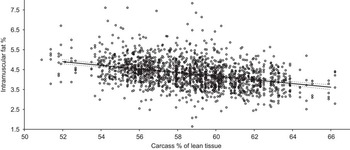
When CT lean% was included in the base model along with carcass weight at scanning, it was associated with a decrease in IMF% (P<0.01, Figure 4). On average IMF% decreased by 1.3 units as whole carcass CT lean% increased from 52% to 66% (Figure 4).
The relationship between intramuscular fat percentage in lamb and the percentage of lean in the carcass, as measured by computed tomography (CT). ° represents residuals as deviations from the predicted means for intramuscular fat percentage. Line represents least square means (±s.e. as dotted lines) across the range of CT lean percentage.

Discussion
Recent work by Pannier et al. (Reference Pannier, Pethick, Geesink and Ball2014a) shows IMF% of the M. longissimus lumborum in Australian lamb to be 4.2 IMF%, aligning well with the results in this study (4.2±0.1). Other Australian work by Warner et al. (Reference Warner, Jacob, Edwards, McDonagh, Pearce, Geesink, Kearney, Allingham, Hopkins and Pethick2010), showed a mean IMF% of the M. semitendinosus of 3.11±0.3, which is slightly lower than the IMF% in this study (3.6±0.1) but similarly to our study shows IMF% to be lower than the M. longissimus lumborum. Comparisons of IMF% in studies from other countries are difficult, as lambs are from vastly different genotypes, environments and are slaughtered at greatly varying ages, all of which have been shown to impact IMF% (Pannier et al., Reference Pannier, Pethick, Geesink and Ball2014a). The variation in the IMF% of the five muscles examined was not as large as had been observed in other species such as beef (Brackebrush et al., Reference Brackebrush, McKeith, Carr and McLaren1991), with the ranking of muscles also being vastly different. Brackebrush et al. (Reference Brackebrush, McKeith, Carr and McLaren1991) found the highest IMF% in the M. infraspinatus, followed by the M. longissimus lumborum, M. supraspinatus, M. semimembranosus and M. semitendinosus. The reasons for the differences in the Brackebrush et al. (Reference Brackebrush, McKeith, Carr and McLaren1991) study compared with ours is difficult to explain, although the comparison is imperfect, given that the animals were older in the study by Brackebrush et al. (Reference Brackebrush, McKeith, Carr and McLaren1991), and this may be influenced by variation in the maturation patterns of the individual muscles and therefore IMF%.
In contrast to our hypothesis, the variation in IMF% between muscles was not strictly related to postural v. locomotive muscle function. Variation in IMF% has been shown to relate to species, breed type, gender and muscle fibre type (Hocquette et al., Reference Hocquette, Gondret, Baéza, Médale, Jurie and Pethick2010; Pannier et al., Reference Pannier, Pethick, Geesink and Ball2014a). Fibre type is related to the function of the muscle, therefore muscle location and function is likely to impact on IMF%. Muscles responsible for maintenance of posture are more oxidative and are predominantly comprised of Type 1 fibres with a propensity for higher IMF% (Picard et al., Reference Picard, Lefaucheur, Berri and Duclos2002). Within a muscle, more oxidative fibres contain more phospholipids and triglycerides, and conversely muscles with high glycolytic activity have lower IMF% (Hocquette et al., Reference Hocquette, Gondret, Baéza, Médale, Jurie and Pethick2010). On this basis, we expected that the M. longissimus lumborum would have the highest IMF% of the five muscles examined, being a stabiliser muscle, however, this was not observed in our results. Alternatively, the M. supraspinatus could be considered a postural muscle as it helps to bear body weight and therefore would be expected to have high IMF%. It had greater IMF% than the M. infraspinatus, which can be considered a locomotive muscle as it is used for extension and flexion of the shoulder joint in sheep (Suzuki, Reference Suzuki1995).
A study examining the metabolic characteristics in sheep classified both the M. supraspinatus and M. infraspinatus muscles as being more oxidative relative to the M. semimembranosus, M. semitendinosus and M. longissimus lumborum (Briand et al., Reference Briand, Talmant, Briand, Monin and Durand1981). Based on fibre type and metabolic activity, it is unclear why the M. infraspinatus has less IMF% than the M. semitendinosus and M. longissimus lumborum. The M. semitendinosus is considered a fast glycolytic muscle (Briand et al., Reference Briand, Talmant, Briand, Monin and Durand1981; Gardner et al., Reference Gardner, Hopkins, Greenwood, Cake, Boyce and Pethick2007; Hocquette et al., Reference Hocquette, Cassar-Malek, Jurie, Bauchart, Picard and Renand2012), especially in comparison with the M. semimembranosus and M. longissimus lumborum. Therefore, it would be expected for the M. semitendinosus to have less IMF% than the latter two muscles, which was contrary to our findings. Our findings indicate that muscle function/fibre type alone cannot be used to predict IMF% of a muscle.
Genetic influence on IMF
In support of our hypothesis, decreasing sire PFAT ASBV decreased IMF%, with the magnitude of this effect varying between muscles. As expected, there was a marked impact in the M. longissimus lumborum, with a 0.3 unit decrease in IMF% over a 2.75 unit range of PFAT. However, there was a marginally greater effect in the M. semimembranosus and M. semitendinosus, and no effect in the muscles of the fore section. Assuming that this impact is associated with increased muscle hypertrophy (Hocquette et al., Reference Hocquette, Gondret, Baéza, Médale, Jurie and Pethick2010), this aligns well with the hypertrophy effects induced by PFAT, which Anderson et al. (Reference Anderson, Williams, Pannier, Pethick and Gardner2013) demonstrated were focused on the saddle section of the carcass, with least impact in the fore section. The reduced IMF% in the M. longissimus lumborum was slightly less than that observed by Pannier et al. (Reference Pannier, Pethick, Geesink and Ball2014a) where IMF% decreased by 0.17%/mm reduction in PFAT; however, the results of Pannier et al. (Reference Pannier, Pethick, Geesink and Ball2014a), in a larger data set, were only evident for the Terminal sired animals.
Contrary to our hypothesis, increasing sire PEMD ASBV had no effect on the IMF% of muscle tissue in the majority of lambs studied in this experiment. The only effect was seen in multiple born lambs raised as singles, where IMF% was reduced in all of the five muscles examined. The basis for our PEMD hypothesis was associated with muscle hypertrophy in the saddle section, with previous studies demonstrating that PEMD increased the weight of the loin muscle (Gardner et al., Reference Gardner, Williams, Siddell, Ball, Mortimer, Jacob, Pearce, Hocking Edwards, Rowe and Pethick2010) and increased the proportion of lean in the saddle section (Anderson et al., Reference Anderson, Williams, Pannier, Pethick and Gardner2013). However, a recent analysis of the composition data derived from CT scanning of the 400 animals in this study showed that PEMD did not increase lean saddle weight, so the lack of PEMD impact is not unexpected. These results contrast with work by Pannier et al. (Reference Pannier, Pethick, Geesink and Ball2014a), who demonstrated that increasing PEMD reduced IMF% in the M. longissimus lumborum. However, this effect was only evident in the Terminal sired lambs, and appeared to be driven by a small number of sires that were extremes for this ASBV. Indeed, the lack of impact of PEMD in this analysis may be due to the absence of these extreme sires, which had PEMD values between 4 and 5 mm in the study by Pannier et al. (Reference Pannier, Pethick, Geesink and Ball2014a), contrasting with a maximum of only 3.8 in this study. The marked effect of PEMD on IMF% in the multiple born and single raised lambs is difficult to explain, and has not been previously documented.
As expected, increasing sire PWWT ASBV did not impact on IMF% in the majority of lambs used in this experiment. Previous analyses of this trait have shown no PWWT maturity-linked impact on IMF% (Pannier et al., Reference Pannier, Pethick, Geesink and Ball2014a). Alternatively, there was a substantial effect of PWWT on IMF% in the multiple born and single raised lambs, increasing it across all muscles. This is the same sub-group of lambs where the PEMD effect was identified, representing only 10% (40 lambs) of the population used in this study, and like the PEMD effect has not been documented previously. Furthermore, in an analysis of a much larger data (n=5642) set, Pannier et al. (Reference Pannier, Pethick, Geesink and Ball2014a) found no such interaction of PWWT with birth or rear type, and therefore more work is required before attributing confidence to this effect.
The results of this study demonstrate the need to carefully manage the potentially negative impact that selecting for reduced sire PFAT has IMF% of the lamb carcass. Alternatively, they also highlight that some monitoring of the hind section muscles may be required, given that the impact of PFAT was greater in this region of the carcass. PEMD and PWWT largely had no effect, although the unusual result found in the multiple born and single raised lambs may require future investigation.
IMF% differences between sire types and dam breeds
In contrast to our hypothesis, the Maternal sired lambs did not have more IMF% than the Terminal sired lambs. The only differences were for the Merino sired lambs, which had less IMF% than both the Maternal and Terminal sired lambs in the M. semitendinosus, and less IMF% compared with the Terminal sired lambs in the M. longissimus lumborum. These differences in the M. semitendinosus were still present (although slightly diminished) after correcting the model for HCWT, inferring that size/maturity only partly accounts for the sire type differences. These results are in contrast to those of Pannier et al. (Reference Pannier, Pethick, Geesink and Ball2014a) who found no differences in IMF% between sire types in the M. longissimus lumborum, although when compared at the same HCWT, the Merinos had the highest IMF%.
The Border Leicester–Merino dams produced lambs with more IMF% in four muscles, although the effect was not as large as had been previously reported in the M. longissimus lumborum (Hopkins et al., Reference Hopkins, Stanley, Martin, Toohey and Gilmour2007; McPhee et al., Reference McPhee, Hopkins and Pethick2008; Pannier et al., Reference Pannier, Pethick, Geesink and Ball2014a). This affect is likely to align with greater whole body adiposity in the Border Leicester–Merino dams, an assertion supported by the inclusion of CT lean%, which accounted for the difference between dam breeds.
In conclusion, the generally lower IMF% levels of Merino sired lambs can only partly be attributed to differences in weight. More importantly, this highlights that IMF% is unlikely to account for the superior eating quality of Merino lambs as demonstrated by Pannier et al. (Reference Pannier, Gardner, Pearce, McDonagh, Ball, Jacob and Pethick2014c).
The impact of LMY% and HCWT on IMF
In support of our hypothesis, increasing CT lean% led to a decrease in IMF%, with this effect being consistent across all sire types and muscles. Increasing muscularity is thought to dilute the final fat content in muscle (Hocquette et al., Reference Hocquette, Gondret, Baéza, Médale, Jurie and Pethick2010) and therefore reduce IMF%. When CT lean% was included in the ASBV model, the impact of the breeding values on IMF% was reduced, however, still significant, which indicates that CT lean% does not account for all the variation in IMF%. As with previous studies, increasing HCWT was associated with an increase in IMF% of the M. longissimus lumborum (McPhee et al., Reference McPhee, Hopkins and Pethick2008; Pannier et al., Reference Pannier, Pethick, Geesink and Ball2014a); however, the variation in the association across muscles has not been previously reported in Australian sheep. In particular, the large increase in IMF% in the M. supraspinatus of the Merino sired lambs is a unique finding, the reason for which is not currently known. These results, particularly those in response to phenotypic increase in CT lean%, highlight the importance of maintaining IMF% as the lamb industry continues to select for lean growth. Furthermore, this demonstrates that this impact is not restricted to the loin, affecting muscles in both the fore section and hind section of the carcass.
Production and management effects on IMF
The increase in IMF% with each successive kill group is likely to be a reflection of age and weight. The average age in days of these kill groups was 167, 238, 280 and 355, therefore the linear increase in IMF% with age aligns well with the impact of maturity on adiposity as has previously been observed in the M. longissimus lumborum (McPhee et al., Reference McPhee, Hopkins and Pethick2008; Pannier et al., Reference Pannier, Pethick, Geesink and Ball2014a). Nonetheless, other factors that may also have impacted, such as changing nutrition/pasture quality across this period cannot be completely discounted. When corrected for HCWT, the magnitude of the kill group effect was reduced, though still significant, indicating that increasing animal size contributes to IMF%, but that there are likely to be effects of age or maturity that impact beyond their simple correlation with weight. The increase in IMF% present across all muscle types varied in magnitude between muscles, with the M. supraspinatus showing the greatest increase in IMF% and the M. semimembranosus showing the least. These differences are likely to reflect development towards differing IMF% at maturity (i.e. higher in the M. supraspinatus, and lower in the M. semimembranosus), although the possibility of differential maturation rates to the same IMF% at maturity cannot be ignored.
The impact of birthing and rearing types was only evident within the Merino sired lambs. The IMF% of the multiple born and raised lambs was higher than that of the multiple born–single raised and singleton born and raised lambs. This does not appear to be the result of an impact of HCWT as its inclusion in the base model did not alter the magnitude of this effect. One explanation may be associated with maternal nutritional restriction. During the early gestation period in sheep, restriction has been shown to increase the IMF% of the M. longissimus lumborum of offspring at 8 months of age (Zhu et al., Reference Zhu, Ford, Means, Hess, Nathanielsz and Du2006). If the IMF% is related to gestational nutritional restriction, it is unclear why the lambs born as multiples and then raised as singletons have low IMF%, though it is possible that the postnatal growth of musculature in the single raised lambs results in a dilution effect on IMF%. Another explanation may be associated with fibre type, as the muscle of multiple raised lambs has been shown to be metabolically more oxidative and less glycolytic than those reared as singletons (Greenwood et al., Reference Greenwood, Harden and Hopkins2007). Given that oxidative muscle types have been shown to associate positively with IMF% (Hocquette, Reference Hocquette2010), this may account for the higher IMF% in this group. It is unclear why the birth–rear type effect was only observed in the Merino sired lambs.
Female lambs had higher IMF% than the wethers, which was consistent across all muscle types. This effect aligns well with the greater whole body fatness of females (Butterfield, Reference Butterfield1988) and is further supported in this study through the correction of the model for body composition (CT lean% corrected for carcass weight), which accounted for the difference between sexes. The sex differences in IMF% between females and wethers has previously been demonstrated, however, only in the M. longissimus lumborum (Craigie et al., Reference Craigie, Lambe, Richardson, Haresign, Maltin, Rehfeldt, Roehe, Morris and Bunger2012; Pannier et al., Reference Pannier, Pethick, Geesink and Ball2014a).
Conclusion
There are no previously published comparisons of IMF% over a range of carcass regions in Australian lamb, making this study unique. The use of sires with reduced PFAT breeding values results in a decrease in IMF%; however, this effect was greater in the muscles of the hind section, indicating that additional monitoring may be required in these muscles for managing the broader impact of PFAT. The PEMD and PWWT breeding values largely had no impact on IMF%, although their effect identified in the multiple born–single raised lambs may require further investigation. Finally, the marked effect of phenotypic CT lean% across all muscles of the carcass further emphasises the need to manage the potential impact of this selection goal in Australia to maintain optimum eating quality.
Acknowledgements
The authors would like to thank the Sheep CRC, Meat and Livestock Australia and associated organisations for funding, and data collection support.