Introduction
Trichinellosis is a worldwide zoonosis caused by nematodes of the genus Trichinella. It has a very broad range of host species of animals. Most human infections are accidental, caused by the ingestion of undercooked pork meat containing infective larvae (Rainova et al., Reference Rainova, Kaftandjiev, Harizanov, Tsvetkova, Jordanova, Marinova, Kurdova, Kantardjiev and Lalkovski2016). Globally, 10 000 people are estimated to be infected with Trichinella spp. per year, among which Trichinella spiralis (T. spiralis) is the most common due to its universal distribution and high pathogenicity (Dupouy-Camet, Reference Dupouy-Camet2000; Murrell and Pozio, Reference Murrell and Pozio2011). Trichinella spiralis has a unique life cycle, which passes through all phases of development (adult, migratory and encysted stage) in a single host (Gottstein et al., Reference Gottstein, Pozio and Nöckler2009).
Treatment of trichinellosis is somewhat controversial, anthelmintic drugs such as mebendazole (MBZ); a benzimidazole derivative that is used to treat various worm infections is the drug of choice (Gottstein et al., Reference Gottstein, Pozio and Nöckler2009). However, it was reported to have a limited effect against the encapsulated larval stage (Pozio et al., Reference Pozio, Sacchini, Sacchi, Tamburrini and Alberici2001). MBZ has low water solubility that limits its absorption from the intestinal lumen resulting in reduced bioavailability (Codina et al., Reference Codina, García, Leonardi, Vasconi, Di Masso, Lamas and Hinrichsen2015). Therefore, a high dose of MBZ is used with numerous adverse effects mainly gastrointestinal in nature. Central nervous system side effects were also described. In addition, several experimental studies have shown evidence of teratogenicity of MBZ in rats and mice (De la Torre-Iglesias et al., Reference De la Torre-Iglesias, García-Rodriguez, Torrado, Torrado, Torrado-Santiago and Bolás-Fernández2014).
Current studies focus on artemether, a derivative of artemisinin which is isolated from the sweet wormwood plant, Artemisia that grows in Southeast Asia (Obistioiu et al., Reference Obistioiu, Cristina, Schmerold, Chizzola, Stolze, Nichita and Chiurciu2014). There are about 300 species in the Artemisia genus, some of which are medical species used for the treatment of many infectious and non-infectious diseases. It came to the attention of the World Health Organization in the 1970s when Quinine lost efficacy against malaria resulting in the use of ART for the treatment of malaria caused by Plasmodium falciparum. In addition, ART has potential roles in the treatment of parasitic helminthic infections. Generally, it is considered a safe drug and is well tolerated with minimal undesirable side effects in normal or high doses (Keiser and Utzinger, Reference Keiser and Utzinger2007; Cui and Su, Reference Cui and Su2009). Experimentally, its efficacy against trichinellosis was conducted by Abou Rayia et al. (Reference Abou Rayia, Saad, Ashour and Oreiby2017) in vitro on adult worms and in vivo during enteral and migratory phases. Based on these studies, the present work was designed aiming at studying the efficacy of ART compared to MBZ for the treatment of T. spiralis in mice when administered during the various phases of infection.
Materials and methods
Parasite and dose of infection
Trichinella spiralis strain was obtained from the Parasitology Department, Faculty of Medicine, Alexandria University. The standard experimental infective dose for each mouse was 300 orally inoculated larvae (Basyoni and El-Sabaa , Reference Basyoni and El-Sabaa2013). Before infection, mice were starved for 12 h, after which they were given the larvae.
Drugs
Mebendazole
MBZ (micronized product of Nasr for Chemical Pharmaceutical, Egypt) was given at a dose of 50 mg kg−1 body weight/mouse/day (it is ten times higher than the human dose) for three consecutive days (vs 10–14 days in human) (Keittivuti and Keittivuti, Reference Keittivuti and Keittivuti1989; Nair and Jacob, Reference Nair and Jacob2016; Abou Rayia et al., Reference Abou Rayia, Saad, Ashour and Oreiby2017).
Artemether
Artemisinin (Mether®, a product of Kunming Pharmaceutical Corp. Kunming, China, 100 mg tablet) was suspended in a solution of 3% ethanol, 7% Tween 80 and distilled water. It was given orally at a dose of 300 mg kg−1 body weight mouse−1 day−1 for five consecutive days which is 100 times higher than the dose used to treat malaria in humans (3 mg kg−1 day−1) (Li et al., Reference Li, Wang, Li, Qu, Xing, Tao, Wei, Dai and Liang2011; Abou Rayia et al., Reference Abou Rayia, Saad, Ashour and Oreiby2017).
Mice grouping and experimental design
The present work was carried out on 70 laboratory-bred Swiss albino mice known to be susceptible to T. spiralis larvae. Their age at the start of the experiment was between 6 and 8 weeks and their weight was in the range of 20–25 g. Animals were put on a standard pellet diet and water ad libitum. All animals were inoculated with the infective dose of T. spiralis larvae then divided into two main groups:
Group I: infected untreated control group
Ten infected untreated mice.
Group II: experimental group: infected treated mice
Sixty infected mice were treated with either MBZ or ART (30 each). They were then equally subdivided into three subgroups as follows:
-
IIa: 10 mice treated with MBZ and 10 mice treated with ART during enteral phase [2–4 days post infection (PI)]
-
IIb: 10 mice treated with MBZ and 10 mice treated with ART 10–12 days PI (invasive phase)
-
IIc: 10 mice treated with MBZ and 10 mice treated with ART 28–30 days PI (encapsulated phase)
Parasitological evaluation of drug efficacy
Mice of all groups were sacrificed after 35–42 days PI, skinned and eviscerated (Abou Rayia et al., Reference Abou Rayia, Saad, Ashour and Oreiby2017). As described below, portions of the diaphragm of each mouse were examined by the compression method to demonstrate T. spiralis larvae. The mean count of T. spiralis larvae in muscles of each group was determined by an artificial digestion method. All mice survived till the end of the study.
Compression diagnostic method
Before artificial digestion, a piece of diaphragm from each mouse was placed between two slides and pressed to obtain a thin layer which was examined under low-power objective to detect the presence of T. spiralis larvae and confirm infection (Dyab et al., Reference Dyab, Ahmed and Abdelazeem2019).
Artificial digestion method
Following evisceration, the carcasses of mice were weighed, minced then digested in acid pepsin solution (Bruschi and Murrell, Reference Bruschi and Murrell2002). Digestion was performed at 37°C for 2 h. Larvae were then isolated from the digest of each mouse by filtration through two layers of gauze onto a 200 mesh cm−2 sieve (Kapel et al., Reference Kapel, Webster and Gamble2005), which retained any undigested tissues, but allowed the passage of T. spiralis larvae. The tissues were then washed with tap water and larvae concentrated by simple sedimentation method for 30 min. The supernatant was poured off, and the sediment was washed three times with tap water by repeated sedimentation.
Counting of T. spiralis larvae
The sediment was measured, then three samples of 0.1 mL each were spread on a microscope slide for larvae count using McMaster counting chamber (10 × objective). The number of larvae was expressed per gram of tissue and was established from the mean result of three counts (Kapel et al., Reference Kapel, Webster and Gamble2005; Abou Rayia et al., Reference Abou Rayia, Saad, Ashour and Oreiby2017). The efficacy of each drug was assessed by comparing the number of larvae recovered from treated and untreated infected groups.
Histopathological study
Parts of the mice skeletal muscles were kept in 10% formalin, processed for paraffin sectioning, and stained by haematoxylin and eosin stain (H&E) according to Carleton et al. (Reference Carleton, Drury, Willington and Cammeron1967). Trichinella spiralis larvae in the tissues, the presence of encapsulated larvae, nurse cells, atrophic muscles and inflammatory reaction were elucidated.
Statistical analysis
The data collected were tabulated as mean ± s.d. and analysed using the statistical package for the Social Sciences, version 20 (SPSS-20). Larvae reduction rate (LR %) was calculated as follows:

Student's t-test was used for comparing means of two quantitative, normally distributed groups. ANOVA test (F-test) was used to relate more than two arithmetic means. Post hoc (Tukey's) test was applied to explore all possible pairwise comparisons of means comprising a factor using the equivalent of multiple t-tests. The P value was used to test the level of significance among the different groups. P value was set at 0.05 (P < 0.05, significant).
Results
Evaluation of drug efficacy
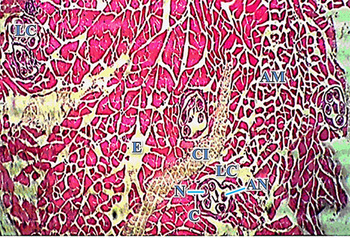
By microscopic examination of the compressed diaphragm, all mice were found infected. Trichinella spiralis larvae were obtained from the muscles of the infected mice 35–42 days PI and counted (Fig. 1).
Trichinella spiralis larvae with typical coil shape in the artificial digested muscles of the infected control mice (100 × )

Parasitological study
LR % of the treated groups compared to control
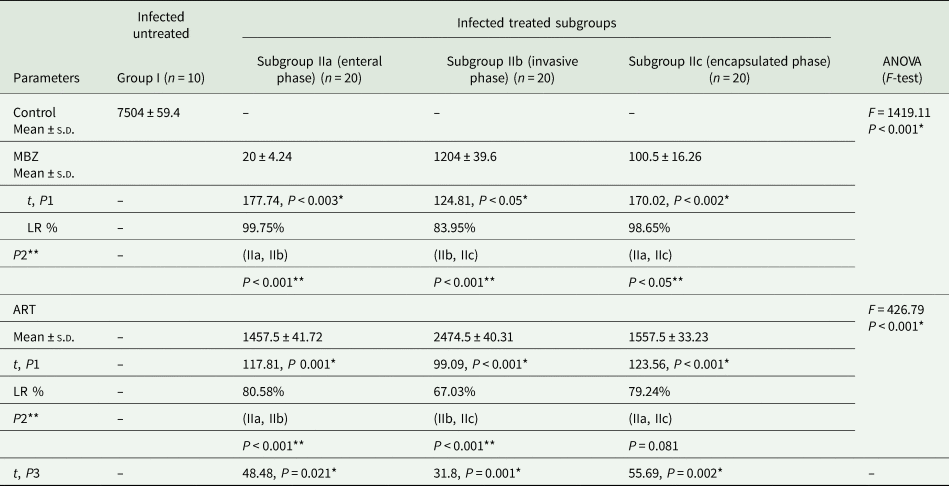
The mean larval count in the muscles of the infected untreated control mice was 7504 ± 59.4 larvae g−1. As for mice receiving MBZ and ART, a maximal LR % of 99.75 and 80.58% were detected when the drugs were administered during the enteral phase. In the encapsulated phase, the LR % was 98.65 and 79.24% for MBZ- and ART-treated mice, respectively. The lowest LR % was attained during the invasive phase (83.95 and 67.03%). A statistically significant reduction in the mean parasite counts among the three subgroups as compared to the control was observed (P1, P2 and P3 < 0.05) (Table 1).
The mean larval count and larval reduction rate (LR%) among the MBZ- and ART-treated subgroups

Infected treated subgroups (10 mice each).
P1 Comparison between treated mice and control group.
F: ANOVA test (F-test) to compare more than two arithmetic means.
P2** Comparison between pairs of groups using post hoc test (Tukey's).
P3: Comparison between MBZ and ART efficacy in each phase.
*Significantly different at P < 0.05.
Comparison between mean numbers of larval counts for each of MBZ and ART during the various phases
On receiving MBZ or ART, the lowest mean larval count was observed when the drugs were given during the enteral phase, 2–4 days PI, followed by encapsulated phase, 28–30 days PI and finally the invasive phase, 10–12 days PI. MBZ showed lower mean counts compared to ART during all phases. Few larvae were still alive after the ART administration in contrast to MBZ. In the subgroups receiving MBZ, post hoc pairwise comparison revealed a statistically significant difference between each subgroup (P2). Subgroups IIa and IIc treated with ART showed no statistically significant difference in parasite counts. By comparing the mean larvae numbers and LR% from all three subgroups, a significant difference was disclosed between MBZ and ART in each phase (P3 < 0.001) (Table 1).
Histopathological studies
Specimens from skeletal muscles of all groups obtained 35–42 days PI were stained with H&E. Figure 3 showed a higher number of larvae in the control group as compared to the treated groups (Figs 3 and 4). Stained skeletal muscle sections revealed numerous T. spiralis larvae encysted in or between the muscle fibres forming several nurse cells (LC), each containing 4–5 intersected larvae forming a nucleated feature (N) in the infected untreated control mice (group I). They were separated by definite subcapsular space, in which remnants of homogenized muscle fibres were seen. The parasitized muscles showed interstitial inflammatory reaction (myositis) that appeared as heavy cellular infiltrates (CI) around the capsule and in between the muscle fibres. The muscular tissues appeared as a cross-section with peripheral nuclei surrounding the muscular bundles and atrophic muscles (AM) surrounding the larvae capsules (Fig. 2).
Paraffin section photomicrograph of mice skeletal muscles infected with T. spiralis showed intersected muscle larvae forming a nucleated feature in cysts encapsulated by collagen sheath (C) forming nurse cells (LC) and containing parts of the larvae muscles (AN) (H&E stained 100 × ).

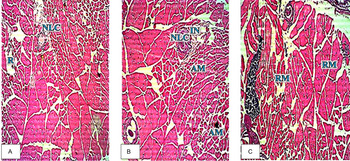
Muscles of mice from MBZ-treated group (group II a–c) showed larvae surrounded by moderate inflammatory reactions (Fig. 3). Phase IIa showed decreased number and size of larvae with empty necrotic nurse cells (NLC) and others with residual nuclei (R). Necrotic muscle bundles (NM) as well as atrophic muscles (AM) were observed. In phase IIb necrotic and atrophic larvae cysts, decreased cellular infiltrates and necrotic and atrophic muscular bundles appeared (AM). Phase IIc revealed atrophic nurse cells and regenerative muscles (RM).
H&E stained sections of T. spiralis-infected mice muscles in the subgroups administered MBZ at a dose of 50 mg kg−1 in the different phases and examined at 100 × .

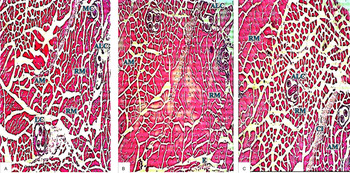
Figures 3 and 4 showed paraffin section photomicrograph of infected mice muscles treated with MBZ and ART, respectively. In phases IIa and IIIc, decreased number and size of necrotic larval nurse cells (NLC) was observed as well as decreased atrophic muscles (AM) compared to phase IIb. Moreover, group IIc showed the appearance of some regenerative muscles (RM).
H&E stained sections of T. spiralis-infected mice muscles examined at 100 × magnification. Subgroups were administered 300 mg kg−1 ART in the different phases.

Figure 4 phase IIa showed fewer nurse cells containing intersected larvae (LC) of nucleic features in nurse cells (ALC). Necrotic muscle bundles as well as increased regenerative muscles (RM) were seen. Phase IIb showed necrotic and atrophic nurse cells, others with residual nuclei (RN), and few regenerative muscles. Phase IIc showed atrophic nurse cells with elongated intersected muscle larvae and some regenerative muscles (RM).
Discussion
The treatment of trichinellosis has not yet been standardized, and the curative efficacy of antiparasitic drugs has not been convincingly demonstrated (Sun et al., Reference Sun, Li, Yuan, Wang, He and Xie2019). In the present study, the administration of MBZ and ART at doses of 50 and 300 mg kg−1 body weight, respectively, was effective in reducing T. spiralis larval counts compared to the untreated control group. Their efficacy varied according to the time lapse after infection. A significant lower mean larval count and higher LR % were observed when treatments were initiated during the enteral phase compared to that obtained in the invasive and encapsulated phases. Moreover, the invasive phase was the least sensitive to treatment compared to the other phases.
Regarding MBZ, similar results were obtained by Keittivuti and Keittivuti (Reference Keittivuti and Keittivuti1989), they reported that MBZ was effective in eliminating 99.77% of T. spiralis larvae in mice in the enteral phase compared to 76.21 and 96.70% during the invasive and encapsulated phases, respectively. Similarly, albendazole and ricobendazole derivatives were less active against migrating and encysted T. spiralis larvae as reported by Lopez-Garcia et al. (Reference Lopez-Garcia, Torrado-Duran, Torrado-Duran, Martínez-Fernández and Bolás-Fernández1997). On the other hand, McCracken and Taylor (Reference McCracken and Taylor1980) reported that MBZ showed high efficacy against experimental trichinellosis in mice which had received a 3-day course of treatment during the invasive and encapsulated phases. De la Rosa et al. (Reference De la Rosa, Alvarez and Gómez-Priego2008) reported a reduction of 72.9–89.9% in the parasite load in MBZ-treated mice with a single dose of 20 mg kg−1 given during enteral and encapsulated phases. However, Pozio et al. (Reference Pozio, Sacchini, Sacchi, Tamburrini and Alberici2001) revealed that MBZ was incapable of killing encapsulated larvae in human muscles. Therefore, the efficacy of benzimidazole and its derivatives in the treatment of T. spiralis varied according to different treatment regimens, parasite strain, the host and the used experimental model.
The action of MBZ is related to its ability to interfere with glucose metabolism and hence killing the parasite. Yet, it has many side effects when taken for prolonged periods at the recommended doses (Vadlamudi et al., Reference Vadlamudi, Reddy and Raju2015). Additionally, it was demonstrated that MBZ at a dose of 150 mg kg−1 amplifies the lipid peroxidation processes in the blood of both infected and parasite-free animals (Tolstoj et al., Reference Tolstoj, Lytvynets and Langrova2007). Accordingly, the search for alternative drugs would be extremely welcomed.
Alternatively, the current work investigated the trichinicidal action of a commercial preparation of ART. The significantly greater larvae reduction observed with ART administered 2 days PI (enteral phase) compared to that given 10 days (invasive phase) and 21 days (encapsulated phase) PI may be explained by greater susceptibility of adult worms to the drug compared to the larval forms. Another possibility is that the orally administered drug that reached the intestine had higher absorption capacity and bioavailability during inflammation attaining a higher concentration in the intestine prior to parenteral dissemination (Rodríguez et al., Reference Rodríguez, de Prada, Durán and Fernández2009).
Generally, lower efficacy of MBZ and ART was observed in the infected treated mice during the invasive phase compared to those treated in the encapsulated phase. Intestinal infection by T. spiralis is known to induce a transient acute inflammation, which is gradually abrogated after worm expulsion from the gut. This situation stimulates the recovery of absorption capacity and oral bioavailability of the drugs (Velebný et al., Reference Velebny, Tomasovicova and Stpiczynska1992). On the same line, Hong (Reference Hong2018) reported that albendazole restored its absorption and bioavailability when the inflammatory reaction ceased after worm expulsion by day 22 PI (encapsulated phase). During the encapsulated phase, T. spiralis larvae reside successfully in nurse cells owing to their ability to endorse angiogenesis for nutrition.
The presence of few fragile and distorted undigested live larvae after ART might be explained by the fact that nurse cells act as a barrier against drugs reducing their efficacy against these larvae. Moreover, Abou Rayia et al. (Reference Abou Rayia, Saad, Ashour and Oreiby2017) verified that ART may deprive the larvae of nutrition because of interference with the angiogenesis process.
Although, the present study showed that ART possesses a substantial anthelmintic activity against T. spiralis infection in mice, its efficacy was significantly lower than that of MBZ. It was confirmed that derivatization may be one possible strategy to prolong the clinical usefulness of Artemisia preparations (Sukul et al., Reference Sukul, Ghosh and Sinhababu2005; Caner et al., Reference Caner, Döşkaya, Değirmenci, Can, Baykan, Üner, Başdemir, Zeybek and Gürüz2008; Held et al., Reference Held, Soomro, Kremsner, Jansen and Mordmüller2011). Sukul et al. (Reference Sukul, Ghosh and Sinhababu2005) reported that the administration of the artemether homoeopathic drugs (Cina 30 and Santanicum 30 prepared from the flowering tops of Artemisia nilagirica) in mice starting 7 days PI and continued daily for 120 days caused LR% by 84.1 and 81.2%, respectively. The results of the present study are comparable to those reported by Caner et al. (Reference Caner, Döşkaya, Değirmenci, Can, Baykan, Üner, Başdemir, Zeybek and Gürüz2008) who examined the efficacy of Artemisia vulgaris and Artemisia absinthium against T. spiralis in rats.
Histopathological examination revealed an improvement of the histopathological changes with both treatments including decreased number of encysted larvae and their surrounding cellular infiltrates and increased regenerative muscles. The larvae were surrounded by mild inflammatory reactions when treatment was given during the enteral phase followed by the encapsulated phase. MBZ showed higher effectiveness compared to ART. These histopathological findings were supported by many previous studies, suggesting the higher effectiveness of different trichinicidal medications when given at an early stage (Soliman et al., Reference Soliman, Taher and Mahmoud2011; Basyoni and El-Sabaa, Reference Basyoni and El-Sabaa2013).
In conclusion, the highest drug efficacy was obtained during enteral and encapsulated phases. ART is highly tolerated and safe. It possesses anthelmintic activity against T. spiralis infection in mice; however, it was significantly lower than that of MBZ. ART needs further investigation to improve its trichinicidal effect solely or in combination with other therapy. Also, giving two or three divided doses over 24 h may increase drug therapeutic effect during the invasive and encapsulated phases. New treatment discovery and other anthelmintics should be investigated.
Financial support
This research received no specific grant from any funding agency, commercial or not-for-profit sectors.
Conflict of interest
None.
Ethical standards
Ethical clearance was obtained by the Ethics Committee of the Medical Research Institute, Alexandria University in accordance with the ethical guidelines of animal experiments.