Implications
Given the expensive price of red meat in general and lamb meat in particular, the fattening of cull ewes, being low productive animals, generally undernourished and slaughtered at a low price in a poor body condition and low BW, became promising. The use of rosemary (Rosmarinus officinalis L.) distillation residues (RR) as part of basal diet and concentrate containing linseed improved body condition and permit a considerable gain of BW. This improvement is without adverse effect on non-carcass components, carcass traits and meat quality.
Introduction
The human population will increase by 33% by 2050 whereas the demand for agriculture products, including those of animal origin, will increase about 70% (Food and Agriculture Organization, 2012). However, in the arid and semi-arid regions and with annual and seasonal fluctuations and climate change, the cultivated land areas are qualitatively and quantitatively degraded. Facing these nutrient shortages, sheep production systems formerly based on pasture becomes dependent on expensive feed supplements and high concentrate diet (Atti et al., Reference Atti, Salem and Priolo2003). This is why farmers mostly undernourished low productive animals such as older ewes (Bhatt et al., Reference Bhatt, Soren, Sahoo and Karim2012). At this stage, ewes reached the end of their productive life cycle and are usually sold at a low price due to poor body condition, low live weight and low carcass yield (Bhatt et al., Reference Bhatt, Soren, Sahoo and Karim2012; Fruet et al., Reference Fruet, Stefanello, Júnior, de Souza, Tonetto and Nörnberg2016). As ewes grow to be culled, their carcasses became fatter at the expense of lean proportion which reduce the income of the livestock holders (Atti et al., Reference Atti, Bocquier and Khaldi2004). In order to optimize feed conversion to BW gain and increase dressing yield a high energy diet was recommended for cull ewes finishing (Bhatt et al., Reference Bhatt, Soren, Sahoo and Karim2012 and Reference Bhatt, Sahoo, Shinde and Karim2013), whereas this leads to an excessive deposition of fat in carcass as well as a high content of fat in meat (Nourozi et al., Reference Nourozi, Abazari, Raisianzadeh, Mohammadi and ZareShahne2008; Bhatt et al., Reference Bhatt, Sahoo, Shinde and Karim2013). Whereas, in recent years consumers are becoming very conscious about healthy food and are looking for low fat meat products enriched with polyunsaturated fatty acids (PUFA). For meeting consumer requirements, carcass yield and meat quality can be improved with suitable feeding strategies (Karaca et al., Reference Karaca, Yılmaz, Kor, Bingöl, Cavidoğlu and Ser2016). The supplementation of sheep by linseed resulted in high meat’ PUFA content (Bas et al., Reference Bas, Berthelot, Pottier and Normand2007; Atti et al., Reference Atti, Methlouthi, Saidi and Mahouachi2013). This type of fat has a low oxidative stability which can degrade the meat quality during storage (Moloney et al., Reference Moloney, Kennedy, Noci, Monahan and Kerry2012). To prevent lipid oxidation and preserve meat quality, it was recommended to add natural antioxidant like RR as dried oil-free leaves in pellets form to animal diet (Yagoubi et al., Reference Yagoubi, Joy, Ripoll, Mahouachi, Bertolín and Atti2018a). In fact, many positive effects of dietary RR (as a rich source of bioactive components including polyphenols) on sheep performances were documented; it improved feed intake, weight gain and enhanced meat shelf life were achieved (Nieto et al., Reference Nieto, Díaz, Bañón and Garrido2010 and Reference Nieto, Estrada, Jordán, Garrido and Bañón2011; Yagoubi et al., Reference Yagoubi, Joy, Ripoll, Mahouachi, Bertolín and Atti2018a and Reference Yagoubi, Hajji, Smeti, Mahouachi, Kamoun and Atti2018b). Therefore, our hypothesis resides in increasing feed intake and meat production yields as well as improving carcass traits, tissues’ composition and meat quality by feeding RR and linseed to cull Barbarine ewes. In addition, the conditioning of cull ewes using a high energy diet may be an alternative to improve their body condition and increase meat production and farmer profitability.
Material and methods
Diets, animals and experimental design
Fresh leaves of R. officinalis L. were collected in June from an experimental field (Oueslatia, Centre-West of Tunisia) of the National Institute for Research in Rural Engineering, Water and Forest. The experimental site is located in a semi-arid climate region at an altitude of 480 m. The specimen of the rosemary plant was submitted to the herbarium division of the Institute and identification was performed in the Laboratory of Forest Ecology. Collected leaves were harvested and mixed before essential oils extraction by hydrodistillation (10 kg of fresh plant in 50 l of distilled water) using a Clevenger-type apparatus for 5 h. Then, the RR composed by oil-free rosemary leaves in loose form were dried in the shade at the air for 1 week to ensure complete dehydration, stored in plastic bags and then transferred to the experiment place to fed animals as a part of basal diet.
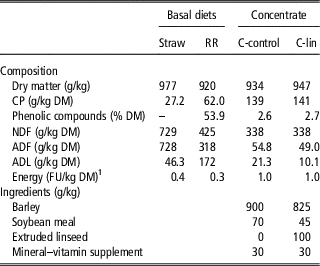
In addition to RR, the used foods were barley-straw and two types of isonitrogenic concentrate. The control concentrate (CC) contains barley and soya bean and the experimental concentrate (LC) contains barley, soya bean and extruded linseed. The chemical composition of diets was reported in Table 1.
Chemical composition of diets fed to Barbarine cull ewes

RR=rosemary residues; C-control=control concentrate; C-lin=concentrate supplemented with linseed; DM=dry matter; FU=forage unity.
1 1FU=1883 kcal net energy (INRA, 1978).
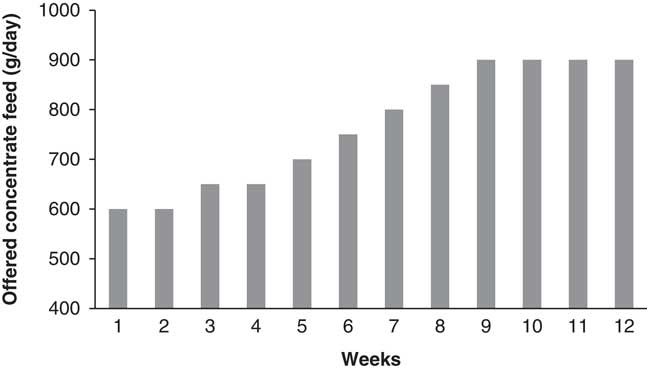
In total, 28 culled ewes of fat-tail Barbarine breed, above 6 years old and 33±0.5 kg of BW were used. Animals were randomly divided into four homogeneous groups according to age, BW and body condition score and fed in individual boxes so that all of the animals were able to see and hear other ewes. Two groups received the CC concentrate with 500 g of straw for CCC group and 300 g of straw plus 200 g of RR for RCC one. The two other groups received the LC concentrate with 500 g of straw for CLC group and 300 g of straw plus 200 g of RR for RLC one. The offered quantities of concentrate increased progressively from 600 to 900 g/day (Figure 1). Ewes of all groups had free access to fresh water. The RR used in loose form and the straw were distributed in one meal at 08.00 am but in separated feeders to facilitate the control of each feed intake. The concentrate was offered in two equal meals at 0800 and 1500 h in order to guarantee the whole consumption of each feed and to avoid digestive disorders, including ruminal acidosis. The quantities of offered and residual feeds were daily recorded. The ewes were weighed weekly from the beginning until the end of the 3 months experiment. Ewes’ body condition score were determined on a 0 to 5 scale, at the begging and at the end of the experiment.
Increasing levels of offered concentrate to all Barbarine cull ewes.

Slaughter procedure and carcass trait measurements
At the end of experiment, all animals were weighed and slaughtered, after a period of solid fasting of 14 h. The slaughter BW (SBW) was recorded. The head, skin, feet, red organs (heart, liver, lung and trachea) and omental and mesenteric fat (OMF) were removed and weighed. The gastrointestinal tract (GIT) was weighed full then empty after flushing with running water; the digestive content was obtained by difference between full and empty GIT weight. This weight was subtracted from SBW to obtain the empty BW (EBW). The weight of hot carcass was recorded at slaughter. The fat firmness was evaluated in a subjective way by touching carcasses and assessed on a 5-point scale from 1 ‘very firm’ to 5 ‘very soft’ (Crouse et al., Reference Crouse, Ferrell, Field, Busboom and Miller1982). The carcasses were stored for 24 h at 4°C and then the cold carcasses were weighed. The thickness of the subcutaneous fat was measured at a point 4 cm from the spine and 4 cm behind the last rib. The fat tails were removed and weighed then each carcass was split into two halves. The left sides were separated into four joints: shoulder, leg, neck and a thoracic region combining the rib, loin and breast. Then, joints were dissected into lean, fat and bone. For regional and tissular carcass composition, different joints and tissues were expressed (i) in proportion of whole carcass and (ii) in proportion of untailed carcass to make easier the comparison with animal of thin tail breeds.
The commercial dressing percentage (CDP) and the real dressing percentages (RDP) were calculated as the rate of hot carcass to SBW and as the rate of cold carcass weight to EBW, respectively.
Meat analysis
After 24 h of slaughter, the right longissimus dorsi (LD) was excised without its subcutaneous fat. Meat color was expressed as CIE L*a*b* values: lightness (L*), redness (a*) and yellowness (b*) (CIE abbreviation means ‘International Commission Illumination’) using a Minolta spectrophotometer (CM-2006 d; Konica Minolta Holdings, Inc., Osaka, Japan).The color parameters of subcutaneous caudal fat were also recorded.
The pH of meat was measured on LD at the 12th/13th rib site after 1 h and 24 h postmortem with penetrating electrode connected to a calibrated pH meter (Hanna Instruments, Temse, Belgium). For cooking loss determination, samples from LD muscle were weighed (initial weight, W i) and held in plastic bags and then immersed in a water-bath at 75°C and heated for 30 min until the internal temperature reached 75°C, which was monitored with a thermocouple. Then, the bags were cooled under running tap water for 30 min and blotted dry with paper towels. The cooked meat was weighed again (final weight, W f) and cooking loss (g/kg) was calculated as 1000×(W i −W f)/W i.
Samples from LD were stored at −20°C for chemical analyses. The LD samples were lyophilized on 1 mm screen to get dry matter (DM). Ash was determined by combustion at 600°C for 8 h, and fat proportion by ‘Soxhlet’ method. Nitrogen was determined using ‘Kejldahl’ method then CP was calculated as N×6.2.
Statistical analyses
Data were analyzed using the general linear models procedure of Statistical Analysis System (version 8.2; SAS Institute Inc., Cary, NC, USA) in a balanced 2×2 factorial experiment (2 basal diet’ types and 2 concentrate’ types) using the following model:
 $${\mib{Y}} _{{{\mib{ijk}} }} {\equals}{\mib{\rmu }} {\plus}{\bf{BD}} _{{\mib{i}} } {\plus}{\bf CT}_{{\mib{j}} } {\plus}{\bf BD}_{{\mib{i}} } {\times}{\bf CT}_{{\mib{j}} } {\plus}{\mib{e}} _{{{\mib{ijk}} }} $$
where Y ijk represents the responses of the ewe k receiving the basal diet i and the concentrate j; µ is the mean; BD i is the basal diet (i=straw or straw+RR); CT j is the concentrate type (j=control or linseed concentrate); BD i ×CT j are the interactions between BD and CT.
Results and discussion
The interaction between basal diet and concentrate type was not significant; hence it was not mentioned in the tables.
Diet intake, ewes’ body weight and body condition score variation
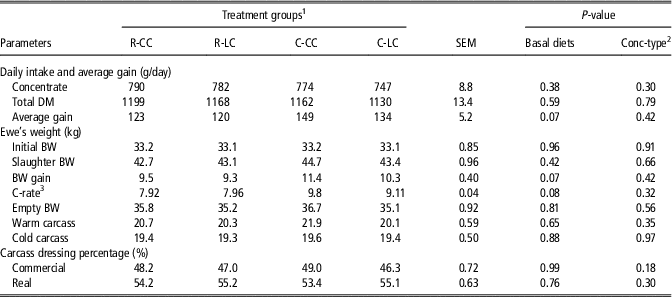
The offered straw and RR quantities were imposed by experimental protocol. So, the average daily DM straw intake was 385 g for CCC and CLC and 230 g plus 167 g RR for both RR groups (RCC and RLC). The RR intake up to 150 g/day, representing 40% of basal diet, was possible. This amount, even minor, could replace part of straw or hay; furthermore, this consumption could limit the meat oxidation. The concentrate consumption followed the similar pattern of offered quantity (Figure 1), it reached 900 g DM/day at week 9 and stabilized at this level. Hence, the concentrate intakes (Table 2) were similar for ewes from all groups. It is important to note that the RR consumption did not alter the concentrate intake, which averaged 773 g/day. This value is close to that reported for cull ewes offered concentrate ad libitum 752 g/day (Bhatt et al., Reference Bhatt, Sahoo, Shinde and Karim2013). The ewes of all groups consumed comparable amounts of roughages and concentrate in the proportion of 34% and 66%, respectively, corresponding to an energetic level of 2.5 Mcal of metabolizable energy(ME)/kg DM. Therefore, the total DM intake averaged 1165 g/day without significant differences between dietary treatments (Table 2).This value is comparable to the previously reported values for re-alimented cull ewes (Bhatt et al., Reference Bhatt, Sahoo, Shinde and Karim2013) but lower than that reported by Nourozi et al. (Reference Nourozi, Abazari, Raisianzadeh, Mohammadi and ZareShahne2008), which is 1500 g/day. For both mentioned studies, DM intake depends on diet energy level and composition. In opposition in other studies, DM intake was related to dietary fat level (Bhatt et al., Reference Bhatt, Sahoo, Shinde and Karim2013). In another hand, both concentrate were iso-energetic and iso-proteinic which explain the similarity of DM intake between ewes’ groups.
Feed intake, weight gain, carcass weights and dressing percentage for Barbarine cull ewes fed rosemary residues and linseed

1 C-CC: group receiving 500 g of straw and control concentrate (CC); R-CC: group receiving 300 g of straw, 200 g of rosemary residues (RR) and CC; C-LC: group receiving 500 g of straw and concentrate line seed (LC); R-LC: group receiving 300 g of straw, 200 g of RR and LC.
2 Conc-type: the type of concentrate feed (control or supplemented with linseed).
3 C-rate: conversion rate BW gain/feed intake (kg/kg).
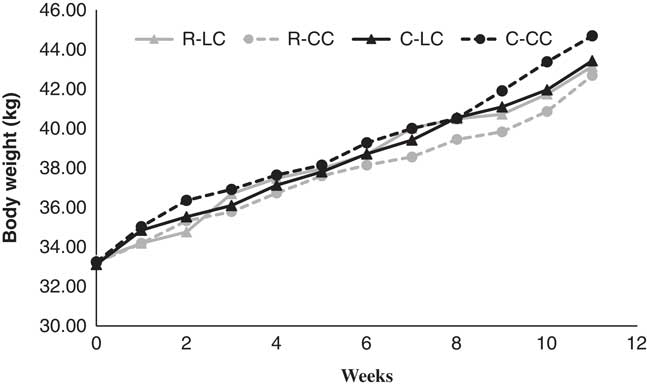
The ewes’ BW evolution was comparable between diets (Figure 2). It reached 43±1 kg at the end of the experiment. The mean BW gain was 10 kg for all groups, with a tendency to higher values (P=0.07) for both groups fed only straw than those fed straw plus RR; the highest value was observed for CCC group (11.4 kg) and the lowest for the RLC one (9.3 kg). The same tendency (P=0.07) was conserved for the average daily gain with 149 and 120 g for the mentioned groups, respectively. Compared to BW gain of culled ewes of other breeds, these values are higher than that of Moghani and Malpura ewes (4.5 to 6.1 kg) receiving the same energetic level and similar for that receiving a higher energetic level (Nourozi et al., Reference Nourozi, Abazari, Raisianzadeh, Mohammadi and ZareShahne2008; Bhatt et al., Reference Bhatt, Soren, Sahoo and Karim2012 and Reference Bhatt, Sahoo, Shinde and Karim2013) for the same fattening period (90 days).
Body weight evolution of Barbarine cull ewes’ groups: C-CC (500 g of straw and control concentrate (CC)); R-CC (300 g of straw, 200 g of rosemary residues (RR) and CC); C-LC (500 g of straw and concentrate linseed (LC)); and R-LC (300 g of straw, 200 g of RR and LC).

The mean feed efficiency (kg DM intake/kg BW gain) was 8.90 for animals in different dietary groups. However, the diet without RR tended to have better feed efficiency. The best value was 7.80 for CCC group and the worst for the RLC one (9.75). These results showed higher feeding conversion by Barbarine breed ewes than Malpura ewes, fed additional concentrate at the level of 250 g/day or ad libitum and Moghani ewes fed high energy diet with different additives levels. For Malpura, the feeding efficiency varied between 12.3 and 17.2 (Bhatt et al., Reference Bhatt, Soren, Sahoo and Karim2012), it varied for Moghani between 10.5 and 13.4 (Nourozi et al., Reference Nourozi, Abazari, Raisianzadeh, Mohammadi and ZareShahne2008). In all cases, the high rate of concentrate in the diet improved performance of cull ewes.
The RR did not affect DM intake and BW gain. It was shown that RR contained a high level of polyphenols (Yagoubi et al., Reference Yagoubi, Joy, Ripoll, Mahouachi, Bertolín and Atti2018a); these compounds were communally accused by their anti-nutrient effect affecting negatively the feed intake and the animal performance when consumed in great quantity in nonconventional roughage (Landau et al., Reference Landau, Molle, Fois, Friedman, Barkai, Decandia, Cabiddu, Dvash and Sitzia2005). In our study, the RR represent only 14% of the total intake which explain the slight decrease of animal BW weight, but this decrease generated a worse feed efficiency of these animals (9.74) compared with those receiving straw without RR (8.12).The type of concentrate did not affect the feed intake and BW gain of cull ewes, this result confirmed that reported on young lambs fed linseed (Atti et al., Reference Atti, Methlouthi, Saidi and Mahouachi2013).
Carcass weights and dressing yield
Carcass weights and dressing yield are shown in Table 2. Carcass weights were similar among groups: the EBW averaged 35.7 kg; the hot and cold carcass weights were 20.75 and 19.43 kg, respectively; the CDP and RDP were 47% and 55% respectively. These values were higher than that (41% and 51%) reported by Bhatt et al. (Reference Bhatt, Soren, Sahoo and Karim2012 and Reference Atti, Methlouthi, Saidi and Mahouachi2013) for cull ewes fed straw and concentrate. This can be related to higher energy level of the used concentrate based on barley with high fiber content leading to high dressing percentage (Fruet et al., Reference Fruet, Stefanello, Júnior, de Souza, Tonetto and Nörnberg2016).The lack of RR and linseed effect on carcass yields confirmed other results using RR at a rate of 10% to 20% or Rosemary essential oil (0.06%) on animal yield and carcass weight (Nieto et al., Reference Nieto, Estrada, Jordán, Garrido and Bañón2011; Smeti et al., Reference Smeti, Atti, Mahouachi and Munoz2013). In addition, feeding linseed at different levels to lambs had no effect on carcass weight and dressing percentage (Bas et al., Reference Bas, Berthelot, Pottier and Normand2007). Whereas, the re-alimentation of cull ruminants with high energy diet with fat incorporation had higher carcass gain and dressing percentage when compared with other without fat supplementation in ewes and cows (Field et al., Reference Field, Prasad and Riley1987; Bhatt et al., Reference Bhatt, Sahoo, Shinde and Karim2013). In another hand, the similarity in carcass weights and dressing yields was generated by the similarity between SBW of ewes among all dietary treatments; several researches had recorded this relationship (Sents et al., Reference Sents, Walters and Whiterman1982; Field et al., Reference Field, Prasad and Riley1987; Hajji et al., Reference Hajji, Smeti, Ben Hamouda and Atti2016).
Non-carcass components
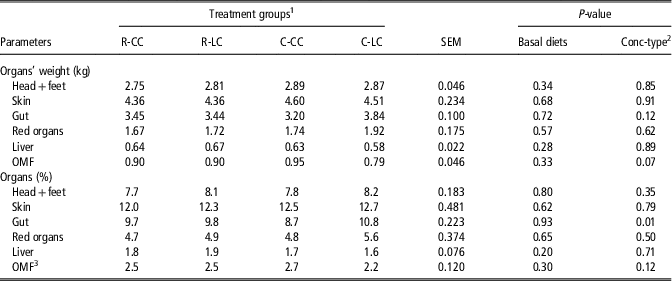
The weights of non-carcass components and their percentages were not affected by diets (Table 3). Being early developed organs with rich composition in bone and low metabolic activity, the skin, the head and the feet had comparable weights and similar proportions in EBW (%) among diets (Mahouachi and Atti, Reference Mahouachi and Atti2005; Hajji et al., Reference Hajji, Smeti, Ben Hamouda and Atti2016). The weight of all red organs and the liver was not affected by the dietary treatments; they meanly were 1.7 and 0.6 kg, respectively. It was reported that liver weight did not change under the same DM intake level (Mahouachi and Atti, Reference Mahouachi and Atti2005). The weight of GIT was similar among ewes (3.5 kg), whereas the OMF weight showed a tendency to be lower in Linseed groups; 0.84 v. 0.92 kg (P=0.07). The DM intake was similar for diets that can explain the comparable weights of GIT for different dietary treatments (Atti et al., Reference Atti, Salem and Priolo2003). Non-carcass component depends on the animal age, sex, breed and the SBW, more than the diet composition (Atti et al., Reference Atti, Salem and Priolo2003; Hajji et al., Reference Hajji, Smeti, Ben Hamouda and Atti2016). Lower values for non-carcass components were reported for young sheep (Hajji et al., Reference Hajji, Smeti, Ben Hamouda and Atti2016). However, similar values for these parameters were reported for adult ewes (above 3 years old) from Barbarine and Pelibuey breeds (Atti et al., Reference Atti, Bocquier and Khaldi2004; Ruiz-Ramos et al., Reference Ruiz-Ramos, Chay-Canul, Ku-Vera, Magaña-Monforte, Gómez-Vázquez and Cruz-Hernández2015).This confirmed the dependency of non-carcass components more on age and SBW than on diet.
Non-carcass components’ weight and proportion in empty BW for Barbarine cull ewes

OMF=omental+mesenteric fat.
1 C-CC: group receiving 500 g of straw and control concentrate (CC); R-CC: group receiving 300 g of straw, 200 g of rosemary residues (RR) and CC; C-LC: group receiving 500 g of straw and concentrate line seed (LC); R-LC: group receiving 300 g of straw, 200 g of RR and LC.
2 Conc-type: the type of concentrate feed (control or supplemented with linseed).
Carcass cuts
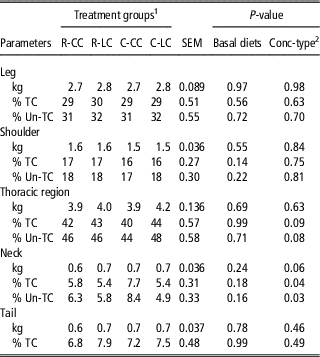
The dietary treatment had no effect on carcass joints’ weight and proportion (Table 4). This is the consequence of the lack of dietary treatment on SBW and carcass weight given the strong correlation between the carcass and joint’s weights (Hajji et al., Reference Hajji, Smeti, Ben Hamouda and Atti2016; Yagoubi et al., Reference Yagoubi, Hajji, Smeti, Mahouachi, Kamoun and Atti2018b). The proportions of joints’ weight in tailed or untailed carcasses were similar for all groups. This result on constancy of joint proportions in the carcass supported the anatomical harmony established by Boccard and Dumont (Reference Boccard and Dumont1960) and confirmed by several authors for young sheep and cull ewes (Sents et al., Reference Sents, Walters and Whiterman1982; Atti et al., Reference Atti, Salem and Priolo2003; Fruet et al., Reference Fruet, Stefanello, Júnior, de Souza, Tonetto and Nörnberg2016).
Carcass joints’ weight and proportion for Barbarine cull ewes

TC=tailed carcass; Un-TC=untailed carcass.
1 C-CC: group receiving 500 g of straw and control concentrate (CC); R-CC: group receiving 300 g of straw, 200 g of rosemary residues (RR) and CC; C-LC: group receiving 500 g of straw and concentrate line seed (LC); R-LC: group receiving 300 g of straw, 200 g of RR and LC.
2 Conc-type: the type of concentrate feed (control or supplemented with linseed).
The tail weights were comparable for the four groups (1.4 kg) representing 7.6% of carcasses without effect of both dietary treatments (RR and Linseed). This value is lower than that of young sheep of the same breed where the fat-tail weighed 2.5 k for 25 kg of carcass weight (Hajji et al., Reference Hajji, Smeti, Ben Hamouda and Atti2016) and that of cull ewes from another fat-tail breed, the Moghani, where the fat-tail weighed 4.7 k for 25 kg of carcass weight (Nourozi et al., Reference Nourozi, Abazari, Raisianzadeh, Mohammadi and ZareShahne2008). So, the re-alimented cull ewes of fat-tail Barbarine breed depose less fat-tail than fattened lambs of the same breed and so less than cull ewes from another fat-tail breed. In Tunisia, the fat tail has been commonly used in traditional dishes recipes like Kadid and Couscous. For better producers’ income, the fat tail can be used in processed meat products as the pork back fat usually used in sausages manufacturing.
Carcass tissue composition
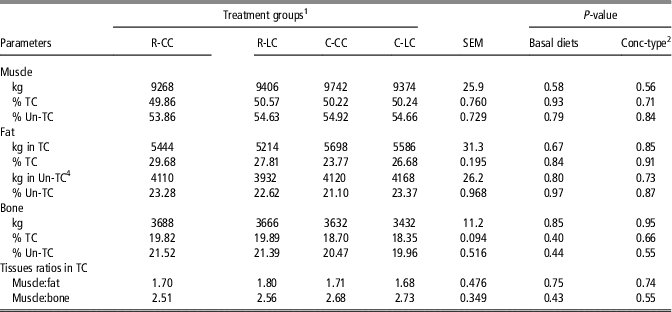
Feeding ewes with RR and/or linseed did affect neither the tissular carcass composition nor the muscle to fat and muscle to bone ratio (Table 5). Bones’ weight (3604 g) and its proportions in carcasses (19.3%) did not differ among dietary treatments. This early maturing tissue depends on animal breed and age rather than its feeding system or diet composition (Wachira et al., Reference Wachira, Sinclair, Wilkinson, Enser, Wood and Fisher2002; Hajji et al., Reference Hajji, Smeti, Ben Hamouda and Atti2016). Higher values (25%) were previously recorded for adult ewes from the same breed (Barbarine, Atti et al., Reference Atti, Bocquier and Khaldi2004) and Pelibuey one (Ruiz-Ramos et al., Reference Ruiz-Ramos, Chay-Canul, Ku-Vera, Magaña-Monforte, Gómez-Vázquez and Cruz-Hernández2015). The weights and proportions of muscle and fat in carcasses with or without fat-tail were similar for all dietary treatments. Similar values for lean proportion were found in Malpura cull ewes (Bhatt et al., Reference Bhatt, Soren, Sahoo and Karim2012). The lack of diet effect on lean proportions was the consequence of the similarity in warm carcass weight (Atti et al., Reference Atti, Salem and Priolo2003). It was shown that neither dietary fat source (animal: fish or vegetal: linseed) nor its administration form (oil or seeds) did affect fat tissue proportion for sheep and cattle (Wachira et al., Reference Wachira, Sinclair, Wilkinson, Enser, Wood and Fisher2002). Sheep carcass tissue composition depends rather on breed, sex, age, SBW (Carrasco et al., Reference Carrasco, Ripoll, Sanz, Álvarez-Rodríguez, Panea, Revilla and Joy2009; Hajji et al., Reference Hajji, Smeti, Ben Hamouda and Atti2016), growth rate for lambs and energy level for adult ewes (Field et al., Reference Field, Prasad and Riley1987; Atti et al., Reference Atti, Bocquier and Khaldi2004) than feed composition.
Tailed (TC) and untailed (Un-TC) carcass tissue composition for Barbarine cull ewes

1 C-CC: group receiving 500 g of straw and control concentrate (CC); R-CC: group receiving 300 g of straw, 200 g of rosemary residues (RR) and CC; C-LC: group receiving 500 g of straw and concentrate line seed (LC); R-LC: group receiving 300 g of straw, 200 g of RR and LC.
2 Conc-type: the type of concentrate feed (control or supplemented with linseed).
High energy diet is recommended for cull ewe’s re-alimentation (Bhatt et al., Reference Bhatt, Soren, Sahoo and Karim2012) to prevent a potential negative impact on selling incomes of lower (27%) muscle proportion and lower (41%) carcass yield (Nourozi et al., Reference Nourozi, Abazari, Raisianzadeh, Mohammadi and ZareShahne2008). Nor basal diet composition, neither concentrate type did affect carcass tissues ratios. High energy diet leads to similar meat to bone ratio (2.6) in adult ewes (Ruiz-Ramos et al., Reference Ruiz-Ramos, Chay-Canul, Ku-Vera, Magaña-Monforte, Gómez-Vázquez and Cruz-Hernández2015), whereas enriched fat diet had no effect on carcass tissue ratios in cull ewes (Bhatt et al., Reference Bhatt, Sahoo, Shinde and Karim2013).
Meat physic-chemical proprieties
Chemical composition
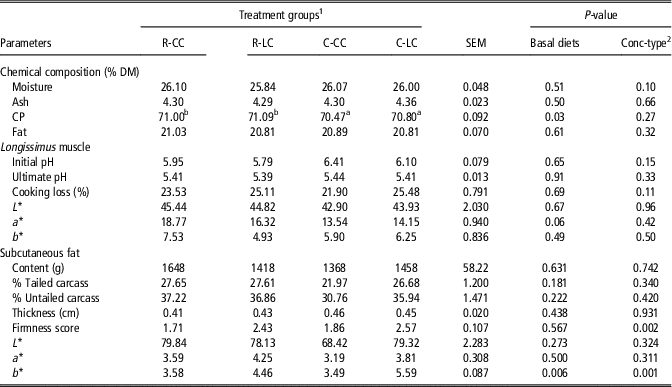
Concentrate type and basal diet did not affect fat and ash contents which average values were 20.89% and 4.31%, respectively (Table 6). These values are in range of those previously reported for cull ewes and younger sheep (Field et al., Reference Field, Prasad and Riley1987; Smeti et al., Reference Smeti, Atti, Mahouachi and Munoz2013). For protein, a slight difference (0.5%) in favor of RR group was observed (P=0.03). Similarly, Moran et al. (Reference Morán, Rodríguez-Calleja, Bodas, Prieto, Giráldez and Andrés2012) reported an increase of 0.5% in meat protein content for lambs fed rosemary co-product (an extract containing 48% of carnosic acid) at a dose of 0.6 or 1.2 (g/kg of feed concentrate) during 5 weeks without affecting ether extract, DM and ash proportions.
Meat and subcutaneous fat characteristics for Barbarine cull ewes

DM=dry matter.
Color results were expressed as CIE L*a*b* units: lightness (L*), redness (a*) and yellowness (b*).
1 C-CC: group receiving 500 g of straw and control concentrate (CC); R-CC: group receiving 300 g of straw, 200 g of rosemary residues (RR) and CC; C-LC: group receiving 500 g of straw and concentrate line seed (LC); R-LC: group receiving 300 g of straw, 200 g of RR and LC.
2 Conc-type: the type of concentrate feed (control or supplemented with linseed).
The pH and cooking loss
The RR intake tended to decrease initial pH (P=0.06); it was about 6 for all groups (Table 6). After 24 h postmortem, the rigor mortis took place and pH values decreased to attend 5.4 for all diets. This value was in range of good quality meat (5.4 to 5.7) and it can exert a bacteriostatic effect during meat storage (Khliji et al., Reference Khliji, Van de Ven, Lamb, Lanza and Hopkins2010). The linseed intake did not affect pH value; whereas RR diet tended to decrease the ultimate pH in ewes’ muscle (P=0.06).
The cooking loss of cull ewes muscle was about 24% for all dietary treatments. Neither RR intake nor concentrate type did affect the cooking loss percentage of ewes’ meat. Similarly, feeding sheep with different form of rosemary such as co-product (essential oil) or by-product (distillation residues) had no effect on the ultimate pH or cooking loss measured on LD in sheep (Nieto et al., Reference Nieto, Díaz, Bañón and Garrido2010; Smeti et al., Reference Smeti, Atti, Mahouachi and Munoz2013).
Meat color
Comparable values were recorded between diets for lightness (above 42), redness (above 13) and yellowness (about 6; Table 6). These results are in acceptability range for good quality and acceptable meat (Khliji et al., Reference Khliji, Van de Ven, Lamb, Lanza and Hopkins2010). Although the similarity in meat color parameters, RR intake tended (P=0.06) to increase meat redness from 13.8 for CC to 17.5 for RR groups. This result is in accordance with previous works performed on lamb meat concluding that the intake of rosemary by-product (RR) improved redness in chilled meat by increasing oxymyoglobin rate (Yagoubi et al., Reference Yagoubi, Joy, Ripoll, Mahouachi, Bertolín and Atti2018a). This result can be related to cull ewes’ age at slaughter (above 5 years). It was reported that the content of pigment in ruminants’ muscles has a speedy increase until the age of 1 or 2 years, then it slows down (Calnan et al., Reference Calnan, Jacob, Pethick and Gardner2014). However, others’ researches did not show any effect on meat redness when rosemary co-products (extracts) or by products (RR) were added to sheep diet (Nieto et al., Reference Nieto, Díaz, Bañón and Garrido2010; Moran et al., Reference Morán, Rodríguez-Calleja, Bodas, Prieto, Giráldez and Andrés2012; Smeti et al., Reference Smeti, Atti, Mahouachi and Munoz2013).
Subcutaneous fat characteristics
No significant differences were found between groups for subcutaneous fat amounts, proportions in total carcass fat (with or without tail) and rib fat thickness (0.4 cm) (Table 6). The average subcutaneous fat weight was 1473 g for all groups, it represented about the third (35%) of total fat tissues in tailed (35%) and untailed carcasses (26%). Being a later maturing fat depot, subcutaneous fat deposition is related to carcass weight more than to growth level or breed (Atti et al., Reference Atti, Bocquier and Khaldi2004). The lightness and redness of subcutaneous fat were similar among diets, whereas yellowness was higher for linseed groups. For all dietary treatment, fat firmness score ranged between 1.7 and 2.6, fat lightness (L*) was above 76; whereas redness (a*) and yellowness (b*) had low values, under 6. The firmness score and color parameters of subcutaneous fat are among the main aspects of carcass quality when evaluated by consumers; the lack of fat firmness and colored subcutaneous fat (dark-yellow or brown-red) are the main undesirable fat aspects responsible of carcass depreciation with financial losses (Prache and Theriez, Reference Prache and Theriez1999). Therefore, carcasses from the current study had a good quality fat grade corresponding to light cream and firm to slightly soft fat (Prache and Theriez, Reference Prache and Theriez1999; Mendizabal et al., Reference Mendizabal, Thériez, Bas, Normand, Aurousseau and Purroy2004).
Conclusion
The Barbarine cull ewes have considerable potential and aptitude to gain BW when received high concentrate diet. This study suggested a novel feeding strategy for cull ewes using rosemary by-product, straw and concentrate with and without linseed. It improved body condition and permitted a considerable BW gain and a high carcass yield without adverse effects on carcass characteristics and meat quality. Therefore, this re-alimentation strategy can be a good opportunity to increase sheep farmers’ incomes with no more need to sell cull animals at low prices. In one hand, the dietary use of RR in loose form and at dose of 200 g/day was insufficient to change carcass characteristics and tissues composition. In another hand, RR intake achieved a positive effect on meat quality with moderate increase in protein content and meat redness. However, linseed concentrate had no effect on carcass characteristics and meat quality. In perspective, more evaluations in fresh and processed meat quality are needed to confirm the benefic effects of linseed on PUFA content and its interaction with RR antioxidant capacity.
Acknowledgments
This work was financially supported by the Tunisian Ministry of High and Scientific Research through ‘Animal and Forage Production Laboratory’. The authors would like to thank the ‘Societe de Nutrition Animale’ (SNA) for their donation of linseed; Dr M. Chikhaoui is specially acknowledged; and Ms Taghouti Zina from PAF Laboratory of INRAT for help in laboratory analysis.
Declaration of interest
The authors confirm that there are no conflicts of interest.
Ethics statement
All procedures employed in this study (transport and slaughtering) meet ethical guidelines, animal welfare adhere to humanitarian practices and Tunisian legal requirements (The Livestock Law No. 2005-95 of 18 October 2005).
Software and data repository resources
Used data and models are not deposited in an official repository.