Introduction
Mussidia nigrivenella Ragonot (Lepidoptera: Pyralidae) is one of the key pests attacking maize in West Africa (Moyal, Reference Moyal1988; Bosque-Pérez and Mareck, Reference Bosque-Pérez and Mareck1990; Moyal and Tran, Reference Moyal and Tran1991a, Reference Moyal and Tranb; Shanower et al., 1991; Silvie, Reference Silvie1993; Sétamou et al., Reference Sétamou, Schulthess, Poehling and Borgemeister2000). In field-grown maize, reported yield losses vary between 5 and 25% (Moyal and Tran, Reference Moyal and Tran1991b) with additional losses of 10–15% in stores (Sétamou et al., Reference Sétamou, Schulthess, Poehling and Borgemeister2000). Moreover, M. nigrivenella damage predisposes maize to pre- and post-harvest infestation by coleopteran pests, Aspergillus flavus Lk. Fr. (Deuteromycetes: Monoliales) infections and subsequent aflatoxin contamination (Sétamou et al., Reference Sétamou, Cardwell, Schulthess and Hell1998). Hence both the quantity and quality of maize are affected (Sétamou et al., Reference Sétamou, Cardwell, Schulthess and Hell1998).
Currently available control options include sun drying of the cobs after harvesting and insecticides (Sétamou, Reference Sétamou1999), but none provides satisfactory control. Probably due to the cryptic nature of the larvae and the timing of application, M. nigrivenella is particularly difficult to control with insecticides (Moyal, Reference Moyal1988; Sétamou et al., Reference Sétamou, Schulthess, Bosque-Pérez and Thomas-Odjo1995; Ndemah and Schulthess, Reference Ndemah and Schulthess2002). Moreover, insecticides are often not affordable to African peasant farmers. Therefore, botanical pesticides such as neem products extracted from seeds of the neem tree Azadirachta indica Juss (Meliacae) which are locally available, are of special interest. They are categorized as broad-spectrum insecticides and alternatives to synthetics (Immaraju, Reference Immaraju1998; Isman, Reference Isman2006). Juan and Sans (Reference Juan and Sans2000) and Carpinella et al. (Reference Carpinella, Ferrayoli, Valladares, Defago and Palacios2002) showed that extracts of neem seeds and fruits had antifeedant activity in larvae of Sesamia nonagrioides (Lefebvre) or Spodoptera eridania (Stoll) (both Lepidoptera: Noctuidae). Crude extracts of A. indica showed growth inhibitory, antifeedant and toxic effects against two noctuids, the cabbage looper Trichoplusia ni (Hübner) and the armyworm Pseudaletia unipuncta (Haworth) (Akhtar et al., Reference Akhtar, Yeoung and Isman2008). In Africa, apart from neem products, other extracts derived from indigenous plants such as Hyptis suaveolens L. (Lamiaceae), the fish bean Tephrosia vogelii Hook F. (Leguminosae) and the physic nut Jatropha curcas L. (Euphorbiaceae) recently gained attention with regard to their insect pest control potential. According to Gaskins et al. (Reference Gaskins, White, Martin, Delfel, Rupel and Barness1972), leaves of Tephrosia species contain at least four compounds that possess insecticidal properties. Likewise, H. suaveolens has been recently shown to possess insecticidal properties (Perry, Reference Perry1980) and, among others, was effective against cowpea weevil during storage (Fatope et al., Reference Fatope, Nuhu, Mann and Takeda1995). An ovicidal effect of J. curcas oil has been demonstrated on Phthorimaea operculella Zeller (Lepidoptera: Gelechiidae) (Shelke et al., Reference Shelke, Jakhav and Salunkhe1987).
Botanicals have been successful against a number of maize pests in Africa. Mugoya and Chinsembu (Reference Mugoya and Chinsembu1995) reported that aqueous fresh-leaf extracts of T. vogelii reduced the incidence of the spotted stalk borer Chilo partellus Swinhoe (Lepidoptera: Crambidae) in maize in Zambia. Siddiqui et al. (Reference Siddiqui, Sarup and Marwaha1990) tested neem products against C. partellus, and Bruce et al. (Reference Bruce, Gounou, Chabi-Olaye, Smith and Schulthess2004) against the stemborers Sesamia calamistis (Hampson) (Lepidoptera: Noctuidae) and Eldana saccharina (Wlk.) (Lepidoptera: Pyralidae), while Bekele et al. (Reference Bekele, Obeng-Ofori and Hassanali1997) and Ogendo et al. (Reference Ogendo, Kostyukovsky, Ravid, Matasyoh, Deng, Omolo, Kariuki and Shaaya2008) used indigenous plant extracts against stored maize pests. The present work aimed at assessing the efficacy of botanicals occurring in West Africa in controlling M. nigrivenella.
Materials and methods
Extraction and formulation of A. indica and J. curcas oils
Neem oil extraction followed a protocol described by Lale and Abdulrahman (Reference Lale and Abdulrahman1999). Ripe neem fruits were sun-dried before oven drying at 50 °C for 72 h. Grains obtained after decortication, using a pestle and mortar, were ground in an electric blender. The neem seed powder obtained was then moistened and kneaded till oil started oozing. The neem oil, which was analysed by Trifolio-M GmbH (Lahnau, Germany), contained approximately 0.009% azadirachtin. Neem oil was formulated with a water and emulsifier solution (soap without any detergent) to prepare the different concentrations of neem oil emulsion.
The protocol for the extraction of J. curcas oil followed a method developed by Atchall (Reference Atchall1999). Shelled seeds of physic nut were treated like the neem seeds and then ground. Five kilograms of seed paste was soaked in 37.5 l of water. The mixture, homogenized using an agitator, was then boiled for 5 h. The volume of the mixture was maintained constant by adding water (approximately 5 l/h). After 2 h, the foaming cream formed on the surface of the mixture was collected periodically. The cream – a mixture of water, oil cake and oil – was heated for 30 min to retrieve oil floating on the solid residue. The oil thus obtained was oven dried at 105 °C for 15 min, and formulated as required for the experiments.
Preparation of aqueous extract of T. vogelii and H. suaveolens
Aqueous extracts at 15 and 20% were prepared by soaking 3.75 and 5 kg pounded fresh-plant material (leaves and fruits, respectively) in 25 l of water, leaving it for 12 h and then filtering it through muslin cloth. A solution of emulsifier was added to each preparation before field application.
Insect culture
A laboratory culture of M. nigrivenella originating from specimens collected from field-grown maize in the Southern Guinea Savannah of Benin was established at the Benin station of the International Institute of Tropical Agriculture (IITA) in Abomey-Calavi (6°24′N, 2°24′E). The insects were continuously reared for two generations on jack bean Canavalia ensiformis (L.) (Fabaceae) pods following the protocol developed by Sétamou et al. (Reference Sétamou, Schulthess, Bosque-Pérez, Poehling and Borgemeister1999). Pieces of mature jack bean pods were infested with red eye-spotted eggs (egg stage after 5 days with a visible red point) collected from the oviposition cage. The pieces were then maintained in 14 cm high and 11 cm diameter plastic containers, and incubated at 26 ± 2 °C and a 12 h light-12 h dark photoperiod. At pupation, the pupae were collected and transferred to oviposition cages.
Oviposition behaviour
For the oviposition experiment, maize plants were produced in pots. Silking plants were transferred to metallic cages of 2 m height and 2 m length, and 1 m wide cages (blocks) were used for this study and repeated five times. All cages were covered with a netting material to avoid external infestations and to prevent the experimental moths from escaping. At the dough stage, treatment (except Furadan) was assigned to a pot containing two plants. Approximately 8 h after applying the treatment, five newly emerged pairs of M. nigrivenella were released in the centre of each cage in a Petri dish supported by a cylindrical tube placed in soapy water to keep away predators such as ants. Newly emerged insects were used in the study, as M. nigrivenella has no pre-oviposition period and lays the maximum eggs during the first 2 days (Sétamou et al., Reference Sétamou, Schulthess, Bosque-Pérez, Poehling and Borgemeister1999). Five days later, cobs were sampled and examined under a binocular microscope. Eggs deposited were counted and recorded. Oviposition deterrence index (ODI) for the extracts and oils was calculated using the formula: [(C − T)/(C+T)] × 100 (Akhtar and Isman, Reference Akhtar and Isman2003), where C is the number of eggs laid on the control and T is the number of eggs laid on the treated cobs.
Toxicity to eggs and larval survival
Eggs (2–3 days old) laid on tissue papers were collected from the oviposition cage and adjusted to 50 eggs per tissue paper. These tissues were treated with different concentrations (0, 2.5, 5, 10 and 100%) of neem and physic nut oils and allowed to be air-dried for 1 h. The treated tissue papers were then transferred to C. ensiformis pods. The pods were introduced into plastic containers (20 cm long, 12 cm diameter and 10 cm high) and stored in the laboratory at 27 ± 2 °C and about 70% relative humidity (RH). After 6 days, the numbers of hatched eggs were recorded, and the numbers of larvae still alive were counted after 7 days. The treatments were replicated four times.
Topical toxicity of neem and J. curcas to second instar larvae
Sets of second instar larvae were topically treated with the different concentrations of the oil emulsions and fed Canavalia pods by applying the treatment on the anterior pronotum of the second instar larvae using a micro-litre syringe. The larvae were placed in the C. ensiformis pod for feeding. Larval mortality was recorded every week. The number of larvae that reached the pupal stage was also recorded in both experiments. The treatments were replicated four times.
Field trial
The experiment was conducted to evaluate the efficacy of plant extracts and oils in controlling M. nigrivenella under field conditions. The study was carried out at the IITA station in Benin during the first growing season of 2004. The site is located in the derived savannah characterized by a bimodal distribution of rainfall with peaks in June and September, and an annual precipitation of about 1200 mm. During our trials, monthly mean rainfall recorded was 189.2 mm and temperatures ranged from 18.5 to 32.6 °C, with a minimum in September and a maximum in October.
A 4-month maize variety quality protein maize was used in this study. The experiment was laid out in a complete randomized block design consisting of ten treatments, each replicated four times. The experimental plots measured 12.5 × 7 m. Plots were separated by 2 m and blocks by 3 m. Alleys were sown with sorghum 3 weeks before planting maize to reduce interaction between treatments. Maize was sown at three seeds in a pocket, a spacing of 0.4 m within rows and 0.75 m between rows. Two weeks after sowing, the crop was thinned down to two plants per pocket. NPKSB 14–23–14–5–1 fertilizer was applied 14 and 45 days after sowing (DAS) at a rate of 60 kg/ha for each application.
The treatments consisted of aqueous extracts of H. suaveolens and T. vogelii at concentrations of 15 and 20%, oil emulsions of A. indica and J. curcas at concentrations of 2.5 and 5% and of the synthetic insecticide Furadan 5G (5% of active ingredient). Emulsified water and an untreated check served as controls. Local farmers commonly use the concentrations of plant extracts used in the present trial against cowpea pests (PEDUNE/PRONAF, unpublished report).
The botanical treatments and the control were applied three times, i.e. at the soft dough stage, approximately 70 DAS, and two subsequent applications at two weekly intervals, according to the infestation pattern of M. nigrivenella in the field (Moyal and Tran, Reference Moyal and Tran1991a). At each application, the whole cob was sprayed, including the silks. Because of its persistence, Furadan was applied only once at the rate of 2 g per plant by placing the granules between the stem and the leaf immediately below the cob.
A week after each spray, a sample of ten cobs was randomly taken from each plot. The cobs were taken to the laboratory and checked thoroughly for eggs before being de-husked. However, as eggs were rarely obtained – they are very difficult to detect – cumulative numbers of larvae and pupae only are presented in the tables.
M. nigrivenella and other borer densities
Different stages of larvae and pupae of M. nigrivenella and other borer species found in maize cobs such as E. saccharina and S. calamistis were recorded. The density of M. nigrivenella at each sampling date was also determined.
Larval survival and parasitism
The data collected here aimed at examining whether the treatments have an effect on larvae and parasitism. All larvae collected were therefore kept in the laboratory at 27 ± 2 °C and 70% RH to record larval mortality and parasitism.
Cob weight and damage
The effects of plant extracts and oils on cob weight and damage by cob borers were determined. At harvest, a last sampling was done to assess cob weight, damage and grain losses. The damage caused by the cob borers was calculated as the percentage of grains consumed by the borer and/or contaminated by fungi. The loss (in g) was calculated as the difference between the initial weight of the cob and the weight of the cob after removing the damaged grains.
Statistical analysis
Differences in the insect counts per cob among the treatments in field trial were analysed by analysis of variance (ANOVA), using the mixed model procedure (SAS, 1997) for repeated measures over sampling dates. Treatments were considered as fixed effects, while plants within replications were considered as random. Percentages were arcsine and counts were log(x+1) transformed before analyses. Least-square means of treatments across sampling date and within sampling date and of sampling date within treatment were separated using the t-test. Means of eggs hatching and larval survival in laboratory experiments were separated by Student–Newman and Keuls test. Significance was set at P ≤ 0.05. Numbers of eggs deposited on treated and untreated plants in the oviposition experiment were analysed by a non-parametric ANOVA using the Kruskal–Wallis test.
Results
Oviposition behaviour
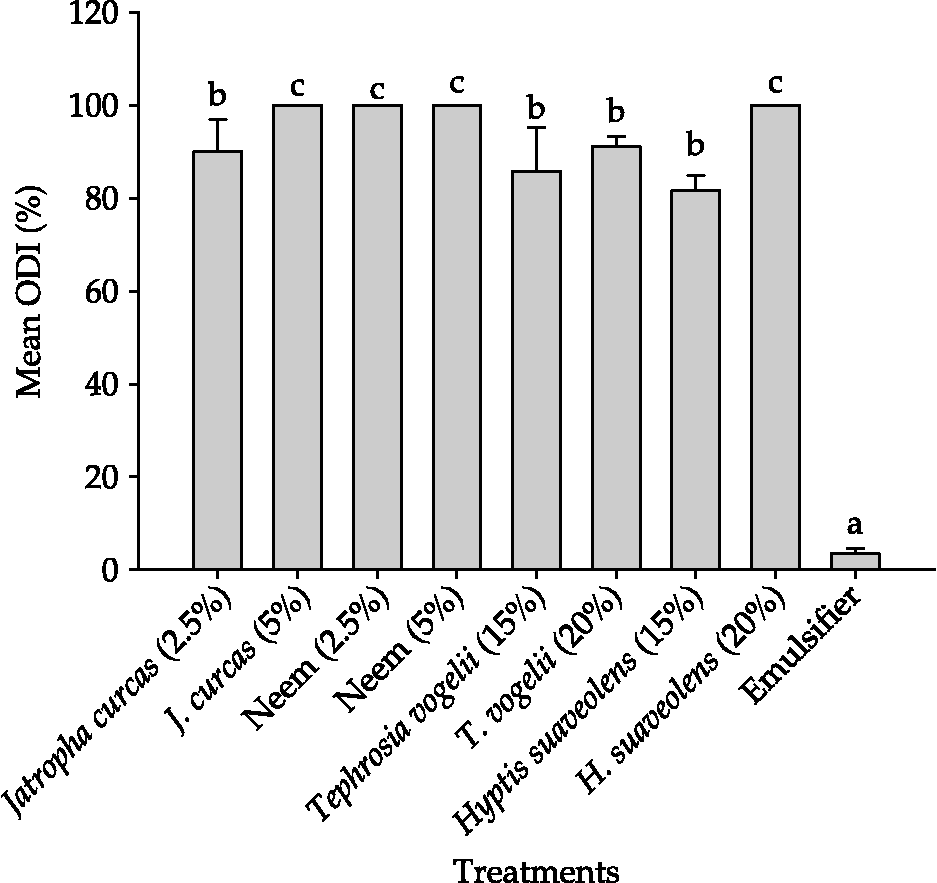
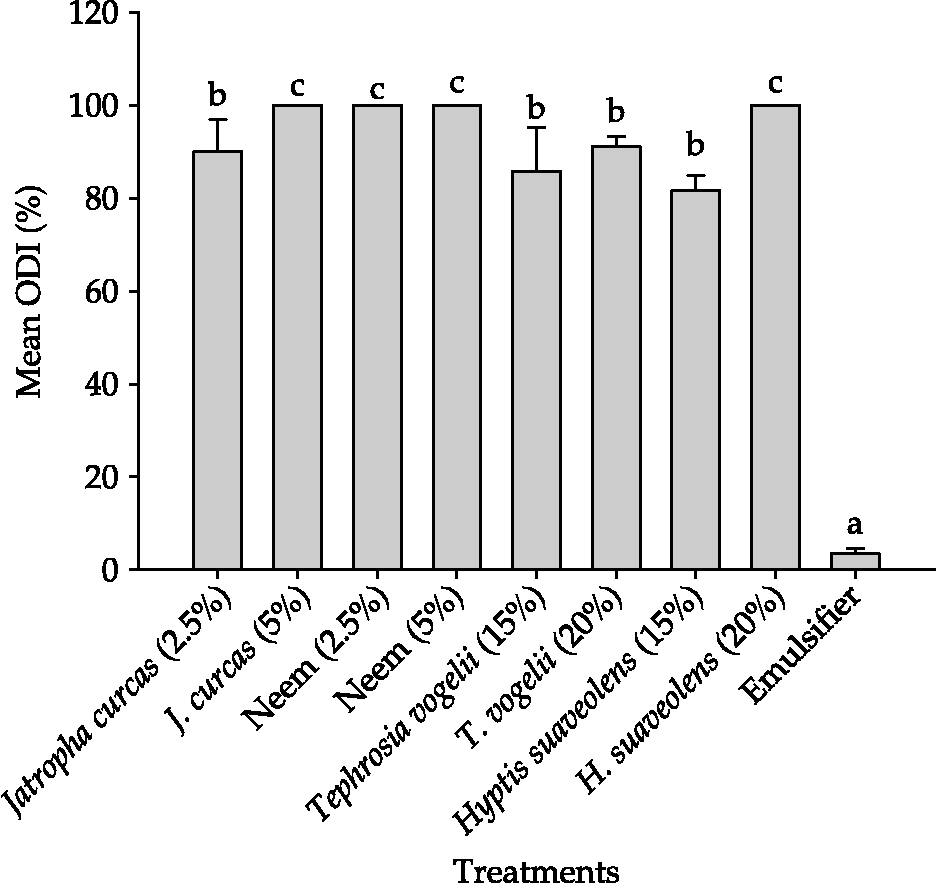
Plant extract and oil emulsion treatments significantly reduced oviposition on the plants offered. More eggs were laid by M. nigrivenella on untreated plants than treated plants (degrees of freedom (df) = 8, χ2 = 29.3, P = 0.0003; Fig. 1). The ODI was significantly higher with 5% J. curcas, both concentrations of neem oil and H. suaveolens at 20% compared with the other treatments and control (F = 12.12, P < 0.0001), indicating complete oviposition deterrent effects by neem, J. curcas oils and H. suaveolens extracts at their respective concentrations.
Oviposition deterrence index (ODI) of the extracts and oils. Different letters above bars indicate significant differences between means at P < 0.05 (Kruskal-Wallis test).
Toxicity to eggs and larval survival
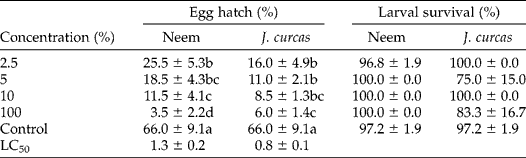
Hatching of M. nigrivenella eggs was adversely affected by neem and Jatropha oils (df = 8, F = 14.96, P < 0.0001), and it decreased with increasing concentrations of the oils applied (Table 1). Only 3–6% of eggs hatched in the 100% oil treatments with neem and Jatropha, respectively, compared with 66% in the control treatments. Lethal concentration 50 values calculated for neem and J. curcas oils were 1.3 and 0.8%, respectively. Percentages of larvae developing to the fifth instar and pupae were >75% in all treatments (Table 1).
Mean percentage (±SE) of egg hatching after being treated with neem and Jatropha curcas oils, and survival of Mussidia nigrivenella to pupae
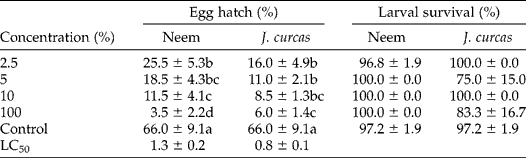
LC50, lethal concentration 50. Means in a column followed by the same lower case letter(s) are not significantly different (Student-Newman-Keuls). n = 20.
Topical toxicity of neem and J. curcas to second instar larvae
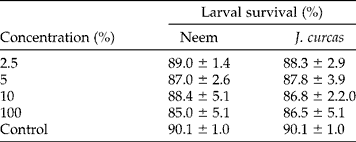
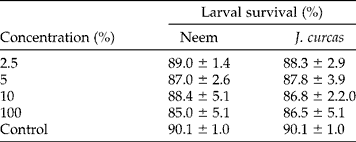
Topical application of oil emulsion on second instar larvae did not have any significant effect on their survival when compared with the control (df = 8, F = 1.27, P = 0.32), and pupae formation was >80% (Table 2).
Survival (mean±SE) of Mussidia nigrivenella second instar larvae to pupation via topical application with neem and Jatropha curcas oil emulsions (n=40)
Field experiment
M. nigrivenella and other borers' densities
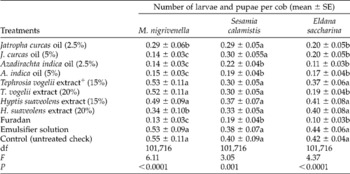
Significantly fewer M. nigrivenella larvae and pupae were recorded on plots treated with Furadan, A. indica and J. curcas than in the controls (df = 10, F = 7.27, P < 0.0001), but there were no significant differences between concentrations of oil emulsions (Table 3). Tephrosia vogelii and H. suaveolens aqueous extracts did not significantly affect M. nigrivenella densities, except for the 20% concentration of H. suaveolens.
Effects of neem and Jatropha curcas oils, Furadan, and aqueous extracts of Tephrosia vogelii and Hyptis suaveolens on Mussidia nigrivenella and infestations of other cob borers

df, degrees of freedom. Means within columns followed by the same letter(s) are not significantly different at P ≤ 0.05 (t-test).
+ Aqueous extracts. n = 160.
Neem and Jatropha oils at both concentrations, Furadan, and extracts of T. vogelii at 20% significantly reduced the numbers of E. saccharina larvae, but only neem oil and Furadan had an effect on S. calamistis (Table 3).
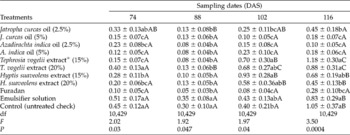
Densities of M. nigrivenella varied significantly with sampling date and tended to increase towards harvest (df = 3, F = 16.4, P < 0.0001; Table 4). They were significantly lowest at the second sampling date (P < 0.007). In addition, in the oil-treated plots, M. nigrivenella densities tended not to vary with sampling date (Table 4).
Mean number (±SE) of Mussidia nigrivenella (larvae and pupae) per maize cob following treatment with plant extracts and oils at different days after sowing

DAS, days after sowing; df, degrees of freedom. Means within column followed by the same lower case letter(s) and within row followed by upper case letter(s) are not significantly different at P ≤ 0.05 (t-test).
+ Aqueous extracts. n = 40.
Larval survival and parasitism
Survival of M. nigrivenella larvae from treated fields was not affected by the treatment (df = 10, F = 1.57, P = 0.12), and mortality varied from 0 to 3.2% only.
No natural enemies were recorded on M. nigrivenella, but Cotesia spp. (Hymenoptera: Braconidae) cocoons were obtained from one S. calamistis larva.
Cob weight and damage
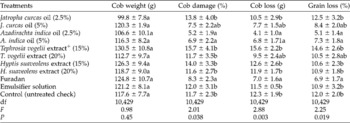
The treatments did not significantly influence cob weight (P = 0.45; Table 5), and only neem oil at both concentrations and Furadan significantly reduced cob damage (df = 10, F = 2.01, P = 0.038) and consequently grain losses (df = 10, F = 2.25, P = 0.019).
Effects of oils and extracts on cob weight, loss and damage caused by Mussidia nigrivenella and other cob borers (means±SE)

df, degrees of freedom. Means within a column followed by the same lower case letter(s) are not significantly different at P ≤ 0.05 (Student-Newman-Keuls).
+ Aqueous extracts. n = 40.
Discussion
The results of our field trials showed that larval population of M. nigrivenella can be significantly reduced through the application of oil emulsions of A. indica and J. curcas, which were as efficient as Furadan. By contrast, plant extracts of T. vogelii and H. suaveolens were not efficient. Neem oils and pure compounds of neem have been found to exhibit ovipositional deterrent effects on many crop pests including lepidopteran, homopteran and dipteran species (Schmutterer, Reference Schmutterer1990; Isman, Reference Isman1996; Singh and Singh, Reference Singh and Singh1998; Bruce et al., Reference Bruce, Gounou, Chabi-Olaye, Smith and Schulthess2004; Showler et al., Reference Showler, Greenberg and Arnason2004). According to Udayagiri and Mason (Reference Udayagiri and Mason1995), chemical cues play a major role in host selection. In the ovipositional test, M. nigrivenella tended not to oviposit on maize plants treated with the oils, indicating a repellent effect. Similar results have been observed by Bruce et al. (Reference Bruce, Gounou, Chabi-Olaye, Smith and Schulthess2004), who found that application of neem oil at 0.075 ml per plant leads to a reduction in the number of eggs laid by S. calamistis and E. saccharina of 88 and 49%, respectively, compared with the control. Oviposition deterrence was also observed in Liriomyza spp. (Diptera: Agromyzidae) (Webb et al., Reference Webb, Hinebaugh, Lindquist and Jacobson1983; Hossain and Poehling, Reference Hossain and Poehling2006; Seljåsen and Meadow, Reference Seljåsen and Meadow2006) and the beet armyworm (Greenberg et al., Reference Greenberg, Showler and Liu2005). Lowery and Isman (Reference Lowery and Isman1993) suggest that this deterrence results from a variety of compounds working in concert with another, producing different behavioural responses, which vary in magnitude between species. Deterrent and ovicidal effects have also been reported for J. curcas (Adebowale and Adedire, Reference Adebowale and Adedire2006; Boateng and Kusi, Reference Boateng and Kusi2008).
The reduction of M. nigrivenella larvae in the field could also be due to reduced egg viability as indicated by the findings of the laboratory experiment. Although eggs are supposed to be strongly protected by the impermeable chorion, which may inhibit the penetration of neem and J. curcas products, egg hatch was adversely affected by both oils. Schmutterer (Reference Schmutterer1990) stated that the ovicidal action of neem treatments is common, and the product can obstruct the egg aeropyle, thus impeding the respiratory changes during the embryonic development. Similarly, neem oil also affected the viability of S. calamistis and E. saccharina (Bruce et al., Reference Bruce, Gounou, Chabi-Olaye, Smith and Schulthess2004), and of C. partellus (Siddiqui et al., Reference Siddiqui, Sarup and Marwaha1990) eggs. Also, Schulz and Schlüter (Reference Schulz, Schlüter, Schmutterer and Ascher1983) showed that changes in the ooplasm and vitellogenesis, which is necessary for oocyte maturity, resulted in egg sterility. This ovicidal effect is advantageous, because larvae are killed before they can cause damage.
In this study, contact toxicity of the oils on larvae could not be observed as nearly all larvae treated with oils developed to pupae. This indicated that second instar larvae were not susceptible to neem and J. curcas oils used in the present experiment. At 100%, the larvae demonstrated very low susceptibility to the oils and this result is very relevant, if we consider that in most studies, neem oil has caused insect mortality at doses between 0.1 and 5% (Schmutterer, Reference Schmutterer1990). The low contact toxicity of neem oil against M. nigrivenella larvae could be due to low azadirachtin (0.009%) content of the oil. However, adults of treated larvae were not reared to determine whether the treatments affected fitness. For example, Bruce et al. (Reference Bruce, Gounou, Chabi-Olaye, Smith and Schulthess2004) showed that neem oil reduced the fecundity of S. calamistis and E. saccharina. These findings indicate again that the treatments in the fields did not kill the larvae but deterred oviposition and affected the hatching of eggs. By contrast, in other studies, neem and Jatropha deterred feeding of the larvae, when they were incorporated in the diet (Zabel et al., Reference Zabel, Kostic, Manojlovic, Stankovic and Tomasi1999). In laboratory tests conducted by Ratnadass et al. (Reference Ratnadass, Cissé, Diarra, Mengual, Taneja and Thiero1997), artificial diet supplemented with extracts of nuts of J. curcas at 0.01 and 1% crude oil concentration yielded 100% of mortality in Busseola fusca Fuller (Lepidoptera: Noctuidae) and S. calamistis larvae. However, under natural conditions – except for first instar larvae – the larvae live cryptically inside the cob and may not be affected by the treatment. Thus the treatments should be targeted towards the first larval instar, before they penetrate the cob.
Compared with untreated plots, maize treated with oil emulsions of J. curcas at 5% and neem at both concentrations were protected from M. nigrivenella attack for more than 1 week, indicating a long-lasting effect. Moreover, M. nigrivenella density in oil-treated plots tended to be constant over sampling dates, indicating that the oil treatments protect the maize cob from further infestations. In Nigeria, Olaifa and Adenuga (Reference Olaifa and Adenuga1988) demonstrated that under field conditions during the dry season, neem products prepared from the seeds appeared to lose their efficacy after 11 and 14 days. Likewise, Schmutterer (Reference Schmutterer1990) stated that under field conditions, a foliar application of most commercial neem formulations persists only for 5–7 days. The differential effects of neem and J. curcas oils observed on S. calamistis and E. saccharina might be because the two borers attack maize at different plant growth stages. Sesamia calamistis only oviposits on pre-tasselling plants (Kaufmann, Reference Kaufmann1983; Sémeglo, Reference Sémeglo1997), while E. saccharina infests the plant at or after the tasselling stage, but both species also feed on the cob (Kaufmann, Reference Kaufmann1983). In the present study, plants were treated at silking; thus S. calamistis larvae were already present in the stem and well protected against the impact of the J. curcas oil. However, they might have been affected by the neem oils, which can have systemic properties (Weintraub and Horowitz, Reference Weintraub and Horowitz1997; Thoeming et al., Reference Thoeming, Borgemeister, Sétamou and Poehling2003). By contrast, at silking, both E. saccharina oviposition behaviour and its eggs could be affected by the oils as showed by Bruce et al. (Reference Bruce, Gounou, Chabi-Olaye, Smith and Schulthess2004).
Although Tephrosia species and H. suaveolens have been reported to be sources of a number of compounds with toxic and deterrent activities toward insects (Simmonds et al., Reference Simmonds, Blaney, Delle Monache and Marini Bettolo1990; Machocho et al., Reference Machocho, Lwande, Jondico, Moreka and Hassanali1995; Morris, Reference Morris and Janick1999), their aqueous extracts did not have any significant effect on M. nigrivenella larvae compared with neem and J. curcas, even though they reduced oviposition by M. nigrivenella. This inefficacy to significantly reduce larval populations could be due to their low persistence and characteristics of their active compounds, or they were more quickly washed off by rain than the oil emulsions. Also, rotenone – one of T. vogelii bioactive compounds – is not soluble in water (Anonymous, 1999), which might explain the results obtained. It is therefore recommended to use other solvents (alcohol, acetone, etc.) rather than water, or add a good emulsifier or use their essential oils to achieve significant results.
In the present experiment, only neem oils significantly reduced cob damage and grain losses. Neem products have been shown to be systemic (Hossain and Poehling, Reference Hossain and Poehling2006), a property which has not yet been demonstrated for J. curcas products. Thus neem might also act as a feeding inhibitor of larvae present in the maize cob, although feeding deterrence appears to be more acute in sap-sucking insects like the Western flower thrips Frankliniella occidentalis (Pergande) (Thysanoptera: Thripidae) (Thoeming et al., Reference Thoeming, Borgemeister, Sétamou and Poehling2003).
In conclusion, the potential of neem and J. curcas in M. nigrivenella control has good prospects. However, oils including aqueous extracts of seeds have to be tested in environments with higher infestations as prevalent in the Southern Guinea Savannah (Sétamou, Reference Sétamou1996) before being included in integrated pest management programmes currently being developed.
Acknowledgements
This study was financed by a grant from the Dutch Ministry of Foreign Affairs. The authors thank Professor Dr Sanda Komla at the University of Lomé, Togo, for his technical assistance in oils extraction.