I. INTRODUCTION
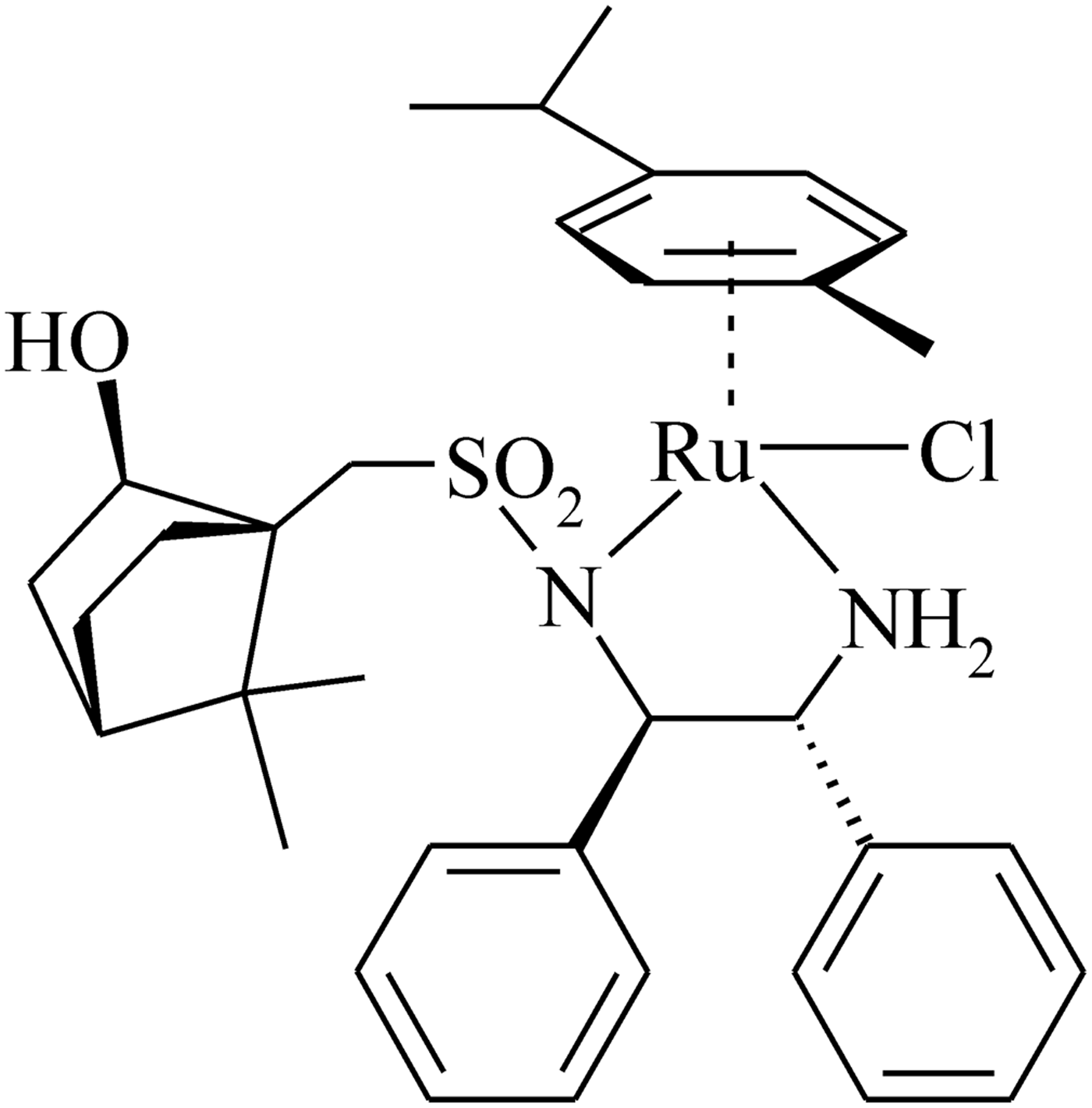
[Ru(II) Cl η-6-p-cymene (1R, 2R)-N-[((1R,2R)-7,7-dimethyl-2-hydroxy-bicyclo-[2.2.1]-heptan-1-yl)-methansulphonyl]-1,2-diphenylethylene-1,2-diamine] complex is a new catalyst for asymmetric transfer hydrogenation (ATH) of C = O and C = N double bonds (Figure 1). The structure of this complex is based on the Noyori–Ikariya concept of ATH catalyst (Noyori et al., 1996). This complex represents the first successful application of N-alkylsulphonyl substituent instead of N-arylsulphonyl on the diphenylethelynediamine ligand framework.
Structural formula of the title compound, [Ru(II) Cl η -6-p-cymene (1R,2R)-N-[((1R,2R)-7,7-dimethyl-2-hydroxy-bicyclo-[2.2.1]-heptan-1-yl)-methansulphonyl]-1,2-diphenylethylene-1,2-diamine.

Asymmetric hydrogenation represents nowadays a valuable and versatile method of production of enantio-enriched material starting from achiral precursor.
II. EXPERIMENTAL
A. Sample preparation
The title compound was prepared using a procedure similar to the work of Noyori et al. (1996). The key starting compounds were [RuCl2 (η 6-p-cymene)]2, (1R,2R)-1,2-diphenylethylene-1,2-diamine and (R)-(-)-10-camphorsulphonic acid, all of commercial origin. The asymmetric reduction of C = O double bond in the camphorsulphonic part of the molecule occurred spontaneously during the formation of the complex in propan-2-ol at 85 °C. The product crystallized from methanol/ethanol mixture 1:1.
B. Diffraction data collection and reduction
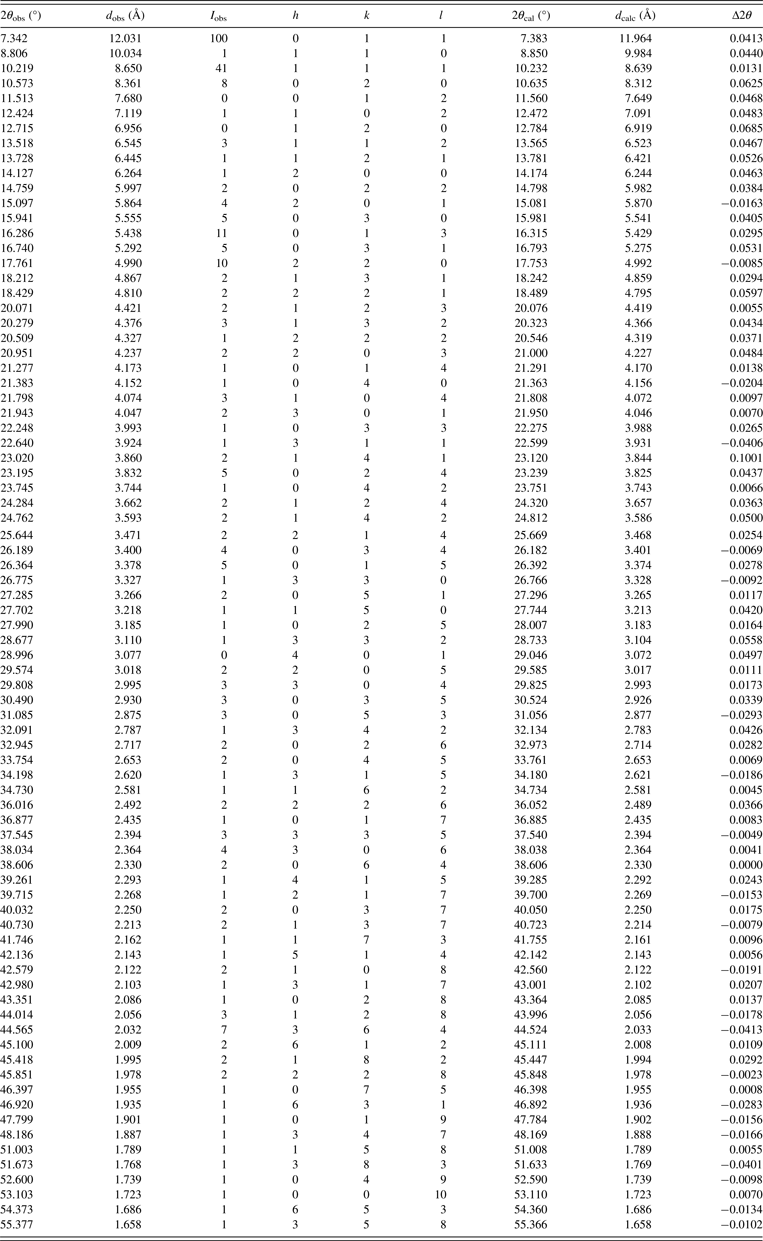
The diffraction pattern for the title compound was collected at room temperature using an X'Pert PRO θ–θ powder diffractometer with parafocusing Bragg–Brentano geometry and CuKα 1 radiation (λ = 1.5406 Å, generator setting: 40 kV, 30 mA). An ultrafast X'Celerator detector was employed to collect XRD data over the angular range from 4 to 60° 2θ with a step size of 0.017° 2θ and a counting time of 20.32 s/step. The experimental powder diffraction pattern is depicted in Figure 2. The software package HighScore Plus V 3.0d of PANalytical, Almelo, Netherlands was used to smooth the data, to fit the background, and to eliminate the Kα 2 component. The top of the smoothed peak method was used to determine the peak positions and intensities of the diffraction peaks (Table I).
X-ray powder diffraction pattern of the title compound using CuKα 1 radiation (λ = 1.5406 Å).
Indexed X-ray powder diffraction data for the title compound, C36H48N2SO3Ru Cl. Only the peaks with I rel of 1 or greater are presented [a = 12.487(4) Å, b = 16.624(5) Å, c = 17.230(3) Å, unit-cell volume V = 3576 79 Å3, Z = 4, and space group P212121]. All measured lines were indexed and are consistent with the P212121 space group. The d-values were calculated using CuKα 1 radiation (λ = 1.5406 Å).
Automatic indexing of the experimental XRD pattern was done using DICVOL04 (Boultif and Louër, Reference Boultif and Louër2004).
III. RESULTS
Automatic indexing results obtained by DICVOL04 show that the title compound is monoclinical with space group P212121 and unit-cell parameters: a = 12.487(4), b = 16.624(5) Å, c = 17.230(3) Å, unit-cell volume V = 3576 79 Å3, and Z = 4. The figures of merits are F 20 = 13.9(0.0063, 227) (Smith and Snyder, Reference Smith and Snyder1979) and M 20 = 10.6 (de Wolf, Reference De Wolff1968). All lines were indexed and are consistent with the P212121space group.
ACKNOWLEDGEMENT
This work was supported by the grants GA104/09/1497 and P106/12/1276 of the Grant Agency of the Czech Republic.