I. INTRODUCTION
Compared with a bulk material, nanoparticles exhibit many unique features in material properties (e.g., thermal, optical, electrical, magnetic and catalytic) due to their small-size effect, surface effect and quantum size effect. So, they have attracted great research interest over the past two decades.
Magnetite (Fe3O4) exhibits the strongest magnetism of any transition metal oxide and high Curie temperature (T c) of 858 K.Reference Teja and Koh1, Reference Chang, Chou, Hsieh, Chueh, Wang, Murakami and Shindo2 But Fe3O4 is a material with half metallicity (i.e., electrical resistivity of bulk magnetite crystal is ρ = 1.9 × 10⁻² Ω cm at room temperature) and weak antioxidation capability.Reference Chang, Chou, Hsieh, Chueh, Wang, Murakami and Shindo2–Reference Zheng, Cheng, Bao and Wang4 Silver (Ag) is the most conductive bulk metal (1.6 × 10⁻⁶ Ω cm electrical conductivity at room temperature) and has good chemical inertness. In addition, Ag can be facilely fabricated into nanoparticlesReference Hostetler, Wingate, Zhong, Harris, Vachet, Clark, Londono, Green, Stokes, Wignall, Glish, Porter, Evans and Murray5–Reference Jiang, Moon, Lu and Wong7 and these nanoparticles have been widely used in the fields of biomedicine, electronics, optics and optoelectronics.Reference Lee, Jun, Choi, Lee, Joung and Oh8 In order to acquire the materials that possess the properties of both Ag and Fe3O4, Ag-Fe3O4 composite materials need to be prepared.
Generally, metal–nonmetallic (or metal–half metallic and metal–semiconductor) composite materials can be prepared by many methods including coprecipitation,Reference Li, Huang and Guo9 ball milling,Reference Puclin and Kaczmarek10 electroless depositionReference Wen, Guo and Davies11 and chemical reduction.Reference Hwang, Toriyama, Sekino and Niihara12 Among these methods, electroless deposition, based on autocatalytic reduction of metallic salt complexes, has many advantages, the most notable of which is uniform dispersion of the metallic coating.Reference Shi, Yang, Wang and Jin13 For example, the electroless deposition of metals [e.g., Ag, gold (Au), copper (Cu) and nickel (Ni)] on the surface of nonmetallic (or half-metallic and semiconductor) nanosized particles [e.g., carbon (C) nanotubes, silicon carbide (SiC) nanofibers and ceramic nanopowder] has been reported in many publications.Reference Kobayashi, Salgueirino-Maceira and Liz-Marzan14–Reference Chang, Pitt and Alexander16 Thus, the prepared composites can acquire the properties of both metallic materials (e.g., ductility and electrical conductivity) and nonmetallic (or half metallic and semiconductor) materials (e.g., high melting point or magnetic property). Furthermore, their anticorrosion-, antiwear-, and wetting capability can also be significantly improved.Reference Chang, Lin, Lin and Kattamis17
Core-shell Ag-coated Fe3O4 composite nanoparticles had been synthesized by electroless deposition of Ag on Fe3O4 nanopowder.Reference Zhang, Yang, Zhang, Guan and Wang18, Reference Cao and Zhang19 Their structure, component, and thermal properties had been explored,Reference Zhang, Yang, Zhang, Guan and Wang18, Reference Cao and Zhang19 i.e., (i) high-resolution transmission electron microscopy (HRTEM) analysis showed that the nanoparticles had a core-shell structure with magnetite as the core and silver as the shell, (ii) x-ray diffraction (XRD) analysis confirmed that only two phases of Fe3O4 and metallic Ag were present in the nanoparticles, and (iii) thermal analysis by thermogravimetry analysis (TGA) pointed out that the nanoparticles had better antioxidation capability than that of the raw material Fe3O4 nanopowder.
In addition, their applications in the fields of biomedicine, thick-film inductors, anticounterfeit labels and wide-frequency electromagnetic shielding materials had been reported.Reference Tang, Yuan and Chai20, Reference Guo, Wang, Gu, He, Zhang, Tang and Lu21 It is anticipated that they can also be used as wave-absorbing materials. However, research on electrical conductivity and magnetic properties of these nanoparticles is inadequate. Therefore, in this article, their electrical conductivity and magnetic properties are explored in detail.
II. EXPERIMENTAL
A. Materials
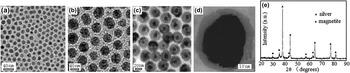
Both Fe3O4 nanopowders with particle sizes of 10–20 nm [Fig. 1(a)] and 40–60 nm were purchased from Shanghai Fritsch Instruments & Facilities Co., Ltd. (Shenzhen, China) and Ag nanopowder [Fig. 1(b)] with a particle size of 40–60 nm was from Shenzhen Zunye Nanomaterials Co., Ltd. (Shenzhen, China). Analytical reagent (AR)-grade chemicals including silver nitrate (AgNO3), 25% ammonia (NH3·H2O), 37% formaldehyde (HCHO), polyethylene glycol-400 (PEG-400), sodium hydroxide (NaOH), nitric acid (HNO3), tin dichloride (SnCl2) and hydrochloric acid (HCl) were purchased from Sinopharm Chemical Reagent Co. Limited, China and used as received without further purification.
TEM (a and b) and HRTEM (c and d) images, and XRD spectrum (e) of pristine magnetite (a) and silver (b) nanopowder, and as-synthesized nanoparticles (c-e, 40 wt% silver content).

B. Preparation of core-shell Ag-coated Fe3O4 composite nanoparticles
An electroless deposition bath composed of 5 wt% additive PEG-400, with AgNO3 (18–35 g) as the main salt, ammonia (200 mL) as a complex agent, and HCHO (9 g) as a reductant, was topped up to 1 L with deionized water. The pH value of the bath was adjusted to 10–12 using NaOH aqueous solution (7 g/L) or 10% HNO3 (the pH value was measured by a pH meter).
The as-purchased Fe3O4 nanopowder with a particle size of 10–20 nm was treated with 5–10% HNO3 for 3–5 min at room temperature (25 °C) under ultrasonic vibration (300 W power, 38 kHz frequency). They were then filtered and washed with deionized water several times until onset of neutral conditions (pH = 7).
The treated Fe3O4 nanopowder was sensitized in a SnCl2 aqueous solution (15 g/L) for 5 min, then filtered and washed with deionized water several times. Afterward, they were activated with an aqueous solution of AgNO3 (30 g/L) for 3 min. The activated Fe3O4 nanopowder was filtered and washed with deionized water several times.
The activated Fe3O4 nanopowder was added to the above-mentioned bath at 50 °C. The electroless deposition was sustained for 65 min under ultrasonic vibration. Then it was filtered, washed and dried at 60 °C under vacuum.
The above product was soaked in 30% HCl aqueous solution for 5 h. Next, it was washed and separated in a magnetic field to eliminate free Ag particles. Consequently, core-shell Ag-coated Fe3O4 composite nanoparticles with the highest Ag content of around 40 wt% were obtained [Figs. 1(c)–1(e)]. In this case, these nanoparticles had a particle size of 40–60 nm with the shell thickness ranging from 5 nm to 15 nm.
The composite nanoparticles with different Ag contents (≤40 wt%) could be prepared by changing the electroless deposition time (≤65 min).
C. Measurements and characterization
TEM and XRD were performed on a Tecnai G2 20 transmission electron microscope and an X′ Pert PRO x-ray diffractometer, respectively. The fine structure of the as-synthesized composite nanoparticles was observed by a HRTEM (Philips CM200).
The Ag content (weight fraction) in the as-synthesized nanoparticles could be calculated using Eq. (1).

Here, W2 denotes the total weight of the Fe3O4 nanopowder plus the Ag layer after purification, and W1 denotes the weight of the Fe3O4 nanopowder coated by the Ag layer.
To test direct current (DC) volume electrical resistivity of the nanoparticles or nanopowder, under different pressures and at room temperature, 1 g of the sample was pressed by a manual tablet-pressing machine (model L7690063, Shanghai Xiyu Electromechanical System Co., Ltd., Shanghai, China) to form a cylinder with about 0.3 cm diameter and 1 cm height. Then, the electrical resistance (R, Ω) between two surfaces of the cylinder was measured by DC four-probe method.
The electrical resistivity (ρ, Ω.cm) of the nanoparticles or nanopowder was calculated using Eq. (2).

Here, R denotes the above measured electrical resistance (Ω). A, H, and D denote the cross-sectional area (cm2), height (about 1 cm) and diameter (about 0.3 cm) of the cylinder, respectively.
The magnetic properties of the nanoparticles or nanopowder were measured by a Lake Shore 7410 vibrating sample magnetometer at room temperature.
III. RESULTS AND DISCUSSION
A. Electrical conductivity of core-shell Ag-coated Fe3O4 composite nanoparticles
It is found that the pressure used when preparing the sample cylinder and the Ag content in the as-synthesized composite nanoparticles are the main factors affecting the electrical resistivity of the nanoparticles.
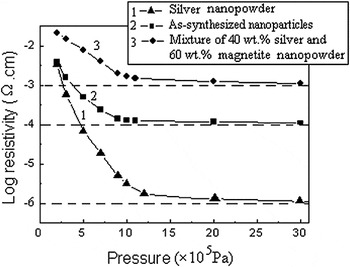
The effect of the pressure on the resistivity of the nanoparticles (40 wt% Ag content) is displayed in Fig. 2 (curve 2). It shows that, under lower pressures ((0–7) × 105 Pa), the resistivity reduces significantly with increasing pressure. However, when the pressure is larger than 1 × 10⁶ Pa, the resistivity varies only slightly and is close to the order of 10−4 Ω cm. It is known that the electrical conduction within an electrically conductive substance is mainly through two paths.Reference Jiang, Moon, Lu and Wong7 One is through the contact of adjacent conductive particles, and the other is through the carrier tunneling effect of microcosmic particles (e.g., free electrons). In this research, when the pressure increases, the distance between the nanoparticles will reduce. Thus, the contact area between the adjacent particles will be enlarged and the carrier tunneling effect will become more significant. So the electrical conductivity of the sample cylinder is enhanced and the resistivity decreases. Nevertheless, under enough pressure, the contact between the particles is sufficient, so the resistivity do not change further. The effect of pressure on the resistivity of the as-synthesized composite nanoparticles with other Ag weight fractions is similar.
Electrical resistivity (log) of particles as a function of pressure used when preparing the sample cylinder (1. silver nanopowder, 2. as-synthesized nanoparticles (40 wt% silver content), and 3. mixture of 40 wt% silver and 60 wt% magnetite nanopowder).

As a comparison, the resistivity curves of a Ag nanopowder (curve 1) and of a nanopowder mixture (curve 3, consisting of 40 wt% Ag and 60 wt% Fe3O4) are also displayed in Fig. 2. It can be seen that all the three curves have similar changing trend. However, under the same pressures, their resistivity values are different. The resistivity of the Ag nanopowder is the lowest, and that of the as-synthesized nanoparticles lies in between, whereas that of the mixture is the highest. The explanations are as follows. Because metallic Ag has excellent electrical conductivity, the higher (the Ag nanopowder is with 100% content of Ag, and the other two are with 40 wt% content) the Ag content, the lower the resistivity. When the samples (i.e., the as-synthesized nanoparticles and the mixtures) are with the same Ag content, it is easier for the as-synthesized nanoparticles to form a conductive network and enhance conductivity because of the encapsulation of Ag on the Fe3O4 nanopowder.
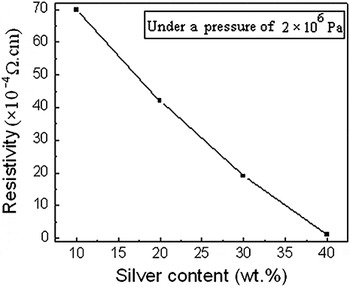
As discussed above, when the pressure is adequately large, the resistivity of the nanoparticles varies only slightly. Therefore, in the next experiments, all the sample cylinders are prepared under a pressure of 2 × 10⁶ Pa. In this case, the effect of silver content on resistivity of the as-synthesized nanoparticles is displayed in Fig. 3. It can be seen that the resistivity almost reduces linearly with increasing the silver content. When the silver weight content in the nanoparticles is 10%, the resistivity is around 7 × 10⁻³ Ω cm. The 40 wt% silver content is corresponding to the resistivity of around 1.2 × 10⁻⁴ Ω cm. The reason for this has been given above.
Electrical resistivity of as-synthesized nanoparticles as a function of silver content.

Further tests show that, under the same pressure, when increasing the weight content of Ag in the mixture consisting of Ag and Fe3O4 nanopowder, the electrical resistivity decreases. When the content approaches 90 wt%, the resistivity of the mixture is close to that of the as-synthesized nanoparticles with 40 wt% silver fraction. Thus, the as-synthesized nanoparticles are better conductors. These facts further underlie the above explanations.
According to the rule of mixtures, we calculate the electrical resistivity (ρ) of a resistor formed by bulk silver and magnetite.
In the case of a serial connection, the resistivity (ρserial) of the resistor can be expressed using Eq. (3).

Meanwhile, in the case of a parallel connection, the resistivity (ρparallel) of the resistor can be expressed using Eq. (4).

Here, x denotes the volume fraction of Ag in the resistor, and (1−x) is the volume fraction of Fe3O4. ρAg and ρmagnetite are the electrical resistivities of bulk Ag and magnetite, respectively. At room temperature, ρAg ≈ 1.6 × 10⁻⁶ Ω cm and ρmagnetite ≈ 1.9 × 10⁻² Ω cm2.
Because the densities of bulk Ag and magnetite are about 10.5 g/cm3 and 5.2 g/cm3, respectively,Reference Teja and Koh1, Reference Brandow, Chen and Wang22 in this research, if the weight content of Ag in the as-synthesized nanoparticles is 40%, its volume fraction is calculated to be 24.8% (i.e., x = 24.8%). Thus, ρserial ≈ 1.4 × 10⁻² Ω cm and ρparallel ≈ 4.0 × 10⁻⁷ Ω cm. If the weight content of Ag is 10%, its volume fraction is calculated to be 5.2%. Thus, ρserial ≈ 1.8 × 10⁻² Ω cm and ρparallel ≈ 8.3 × 10⁻⁸ Ω cm.
Obviously, the measured (under 2 × 10⁶ Pa pressure) electrical resistivity (close to 10−4 Ω cm) of the as-synthesized nanoparticles is higher than that of the bulk Ag (1.6 × 10⁻⁶ Ω cm), less than that of the bulk magnetite (1.9 × 10⁻² Ω cm), and between the above ρserial and ρparallel. So the measured resistivity of the as-synthesized nanoparticles is not in accordance with the value calculated from the serial or parallel connection model, and it is consistent with the general effective media (GEM) model,Reference Mclachlan, Blaszkiewicz and Newnham23 neither. An appropriate model to calculate the resistivity of the as-synthesized nanoparticles needs to be established in the future, which should take the contribution of such factors as voids among the nanoparticles, contact resistance between the nanoparticles, and so on.
Experiment also shows that the as-synthesized composite nanoparticles have a similar electrical conductivity at room temperature when they are prepared by the electroless deposition of Ag on Fe3O4 nanopowder with different particle sizes.
B. Magnetic properties of core-shell Ag-coated Fe3O4 composite nanoparticles
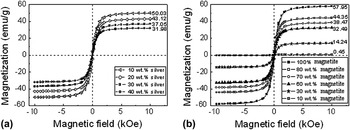
Magnetic hysteresis loops of the as-synthesized composite nanoparticles with different Ag contents are displayed in Fig. 4(a), from which it can be seen that the shape of these loops is similar to that of the loop [Fig. 4(b)] of the magnetite nanopowder. It is also found that the remanences (3.7–4.2 emu/g) and coercivities (60-70 Oe) of the as-synthesized nanoparticles are close to that of the magnetite nanopowder (i.e., 3.9 emu/g remanence and 60 Oe coercivity) after the magnetite nanopowder is coated by different content of Ag using the method of the electroless deposition. Therefore, the as-synthesized nanoparticles have typical ferrimagnetic property, which is similar to the magnetite nanopowder.Reference Teja and Koh1
Magnetic hysteresis loops (a. as-synthesized nanoparticles, and b. mixtures of magnetite and silver nanopowder).

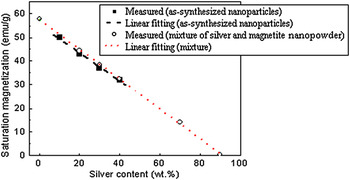
Figure 4(a) shows that the saturation magnetizations of the as-synthesized nanoparticles are 50.03, 43.12, 37.05 and 31.98 emu/g when the nanoparticles are with the Ag contents of 10, 20, 30 and 40 wt.%, respectively. It indicates that the saturation magnetization was greatly dependent on the amount of the magnetically active material, i.e., the lower the amount of the magnetite, the lower the saturation magnetization. When the figure of saturation magnetization versus silver content is plotted (Fig. 5), it is found that these data have good linear correlation and the correlation coefficient is as high as 0.9972. Therefore, it will be an effective method to adjust the magnetic properties of the as-synthesized nanoparticles by changing the relative content of Ag and Fe3O4.
Variation of saturation magnetization with silver content.

As a comparison, we prepare the mixtures consisting of Fe3O4 and Ag nanopowder of different contents and their magnetic hysteresis loops are displayed in Fig. 4(b). From this, their saturation magnetizations are obtained. Then, they are also plotted in Fig. 5. It shows that these data also have good linear correlation and the correlation coefficient is 0.9997. However, they are not equal to (a little larger than) the measured saturation magnetizations of the as-synthesized nanoparticles when the silver content is the same. This is possibly attributed to both the strong diamagnetism of the metallic silver and the thorough encapsulation of the Ag layer on the Fe3O4 nanocore.Reference Chang, Chou, Hsieh, Chueh, Wang, Murakami and Shindo2, Reference Zheng, Cheng, Bao and Wang4
Further experiment shows that the as-synthesized composite nanoparticles have similar magnetic properties when they are prepared by the electroless deposition of Ag on the Fe3O4 nanopowder with a particle size larger than about 10 nm. However, when they are prepared from the Fe3O4 nanopowder with a particle size smaller than about 10 nm, they often exhibit superparamagnetism. The reason for this is that the magnetite nanopowder smaller than about 10 nm often display superparamagnetic behavior at room temperature.Reference Teja and Koh1
IV. CONCLUSIONS
Test of DC volume electrical resistivity shows that the core-shell silver-coated magnetite composite nanoparticles prepared by electroless deposition of Ag on Fe3O4 nanopowder have an electrical conductivity affected mainly by the Ag content and the pressure used when preparing the nanoparticles sample cylinder. Keeping the Ag content constant, under lower pressures [(0-7) × 105 Pa], the resistivity reduces quickly with increasing the pressure. However, when the pressure is larger than 1 × 10⁶ Pa, the resistivity varies very slightly and is close to the order of 10−4 Ω cm. While keeping the pressure constant, the resistivity almost reduces linearly with increasing the silver content. According to the rule of mixtures, the resistivity of the nanoparticles is calculated. But it is found that the calculated values have a large deviation with the corresponding measured ones. Test of magnetic properties reveals that the nanoparticles prepared from the Fe3O4 nanopowder with a particle size larger than about 10 nm are with a typical ferrimagnetic behavior. The saturation magnetization of the nanoparticles almost reduces linearly with increasing the silver content. As a comparison, the resistivity and saturation magnetization of the mixtures consisting of Ag and Fe3O4 nanopowder were also measured. Changing the Ag content in the composite nanoparticles will be an effective method to adjust their electromagnetic performance.
ACKNOWLEDGMENTS
This project was supported by the National Natural Science Foundation of China (Grant No. 51172081). We thank the Analytical and Testing Center of Huazhong University of Science and Technology for performing TEM, HR TEM, XRD and vibrating sample magnetometry (VSM) tests.